I know little about the dance known as the Tango, apart from its participants are locked in a close embrace. Wikipedia says it originated in the 1880s in the working-class neighbourhoods of Argentina and Uruguay, along the Rio de La Plata and initially was performed by two men, due to the shortage of women in the immigrant communities. We could have gone to one of the many places where it’s performed for the tourists; next time maybe.
There’s something romantic about the word ‘pampas’ and the gaucho cowboys who worked these vast temperate areas. The Pampas plains cover some million square kilometres and stretch from Brazil’s Rio Grande do Sul state in the north, include the whole of Uruguay, and south into the Argentina provinces of Buenos Aires, La Pampa, Sante Fe, Entre Rios and Cordoba. The region known as Patagonia covers the southern half of Argentina and is a wild place with stunning, dramatic geography.
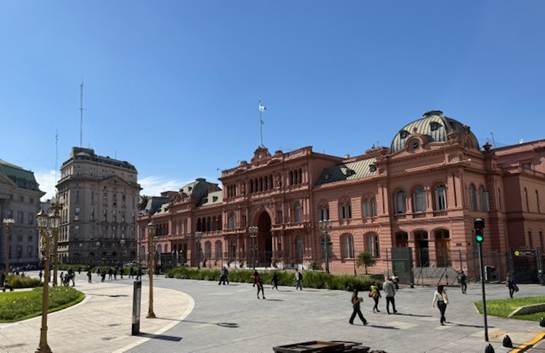
From our hotel in Buenos Aires, the Casa Lucia, we walked down to the Plaza de Mayo, the ceremonial and political centre of the Argentinian capital, with the Casa Rosada, The Pink Palace and home of the President, at its eastern side.
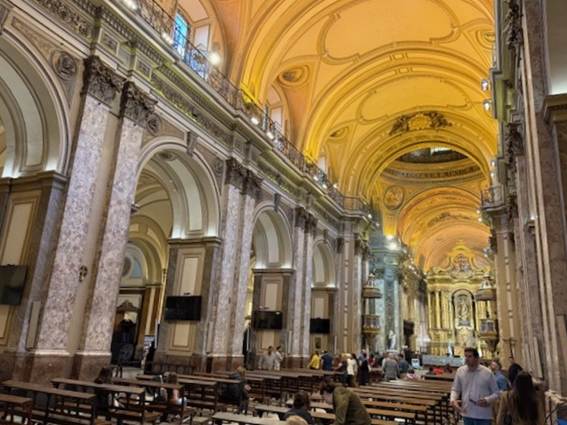
In the northwestern corner lies the Cathedral of Buenos Aires, where Jorge Bergoglio was Archbishop for 15 years. He moved to the Vatican in 2013 as Pope Francis, but his connection to this place of worship has ensured hundreds of visitors. I thought it rather odd that, of the twenty or so large oil paintings adorning the walls, the majority showed various representations of Christ carrying the wooden cross on which he would be crucified. Just an observation and I don’t have a reason! We walked down to the Casa Rosada and saw the balcony from where President Duarte Peron’s wife Eva would address the nation.
Duarte was overthrown by a military coup on 24th March 1976. Led by Jorge Rafael Videla, the junta became a brutal regime, initiating state-sponsored terrorism to eliminate political opposition and committing massive human rights violations; an estimated 30,000 people, mainly aged under 35, simply disappeared.
Fortunately, in the United Kingdom we haven’t had a period of authoritarian rule for a while, although some would argue the wartime measures introduced temporarily in 1914 and 1940 were C20th examples. (Note 1) In both Argentina and Brazil, military dictatorships governed the countries within living memory; in Brazil from 1964 to 1988 and in Argentina from 1976 to 1983. In the former, over 400 dissidents were either confirmed killed or went missing, and some 20,000 suffered torture.
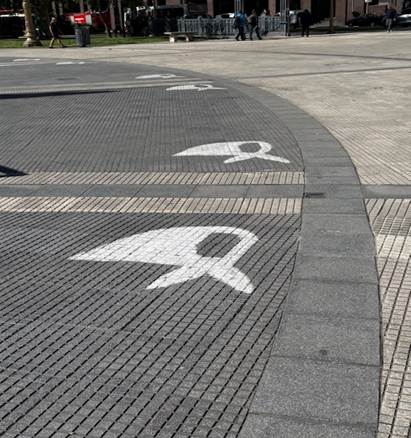
In the latter, the mothers of those who had disappeared without arrest, trial or judicial process formed a human rights association called Madres de Plaza de Mayo and began demonstrating in the square in April 1977, looking for answers. This movement continued to protest and demonstrate, their efforts culminating in the Trial of the Juntas in 1985, two years after democracy was reestablished. Towards the middle of the square are, painted onto the cobbles, representations of white headscarves, the symbol of the Madres de Plaza de Mayo.
Its founders, Azucena Villaflor, Esther Ballestrino and Maria Ponce de Bianco and French nun supporters Alice Domon and Leonie Duquet, simply disappeared themselves, killed on death flights by being thrown out of an aeroplane over the sea. The stain is indelible and reading that those responsible were only brought to justice reluctantly leaves a horrible taste in my mouth.
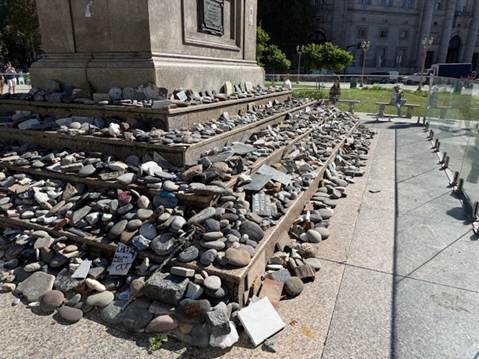
Under a statue of General Belgrano are layers of stones, each stone named after a victim of the Covid 19 Pandemic.
Since 1833 the islands we know as The Falklands, and known in Argentina as Las Malvinas, have been a British Overseas Territory. When domestic policies are failing and one’s unpopular, often governments rally the public by focusing on something external. On 2nd April 1982 the Argentine Armed Forces invaded Las Malvinas. There was much rejoicing on the mainland and the Head of the Armed Forces, General Leopold Galtieri, became the hero of the hour. Margaret Thatcher sent a taskforce from the UK to retake them, which it did successfully on 14th June. Within Argentina the public mood changed and within a year democracy was restored to the country. (Note 2)
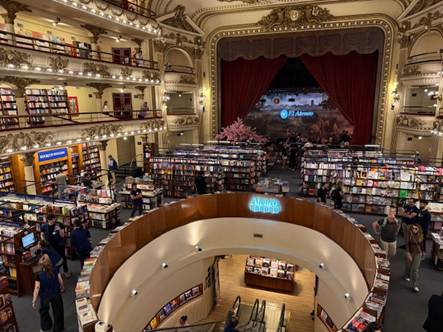
Back in Buenos Aires, further down Avenida Santa Fe, is El Ateneo Grand Splendid, a 1919 theatre transforming into a bookstore in 2000. It’s so bizarre until you realise it’s such a wonderful idea.
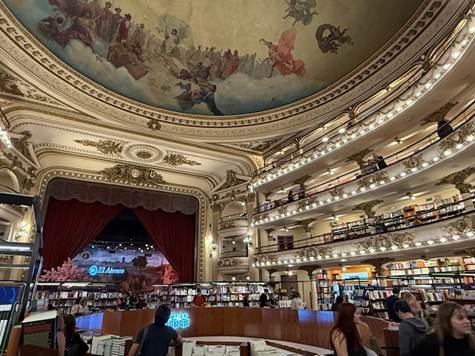
The interior preserves its theatrical heritage but everywhere there are racks of books, the floors are packed with shoppers and tourists, the private boxes with people sitting and reading. In the basement a children’s section is hugely popular, as are the shelves of LPs and CDs.
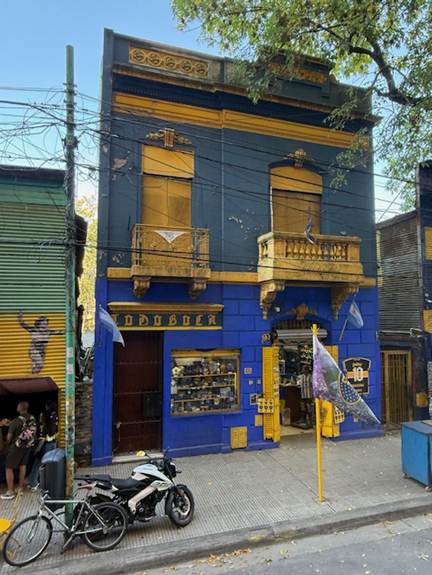
Part of the tourist Red Bus circuit of Buenos Aires took us past La Boca, originally an Italian immigrant community, mainly from Genova, and just south of Puerto Madero. Apparently, its weekend street markets are wonderful – we were there on a Thursday – but La Boca is also famous for its football team, Club Atletico Boca Juniors.
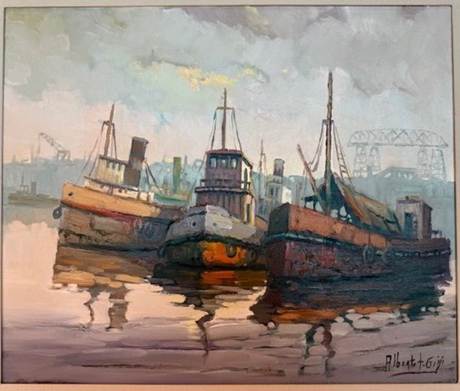
I saw this painting, and others like it, and loved them. The painter is Alberto Tomas Gini, who was born in 1942 in La Boca, where he still has his studio.
Coming from Rio de Janeiro, humid and tropical, noisy, edgy, the contrast between the haves and the have-nots very evident, I was reminded of a ripe cheese, whereas Buenos Aires is the chalk, on the surface clean, ordered, defined but clearly with a potential to be anything but.
Richard 8th May 2026
Hove
http://www.postcardscribbles.co.uk
Note 1 Oliver Cromwell’s Protectorate was certainly a military dictatorship (1653 – 1659), monarchs of the Tudor and Stuart houses exercised authoritarian powers, and William Pitt’s administrations (1783 – 1801 and 1804 – 1806) suspended, for example, Habeas Corpus, fearing the spread of the French Revolution.
Note 2 Sadly I don’t think the UK Armed Forces have the ability today to undertake such an operation. Don’t tell President Javier Milei!
 postcards