PC 484 Five Days in May (2)

Continued …..

On Saturday 23rd April 1983 (St George’s Day) I took a call at home from the Ministry of Defence Duty Officer in London, asking about using SAM systems for the defence of the British contingent to the UN’s MNFIL in Beirut. Lebanon was in the grip of a nasty civil war, with an UN-imposed multinational force trying to bring about peace. Before midnight the following day I am on a C130 Hercules flying out of RAF Lyneham to Cyprus; I share the huge aircraft hold with an aircraft engine – I am the only passenger. You can read all about it in PC 183 Beirut June 2020; I was back in Bulford two days later!

I made two trips to Belize, to visit my soldiers and to facilitate some live missile firing off one of the uninhabited offshore cayes (local name for islands).
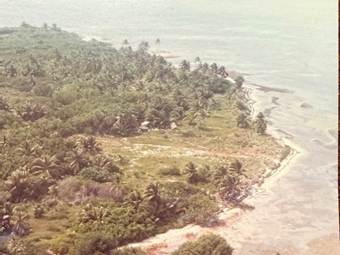
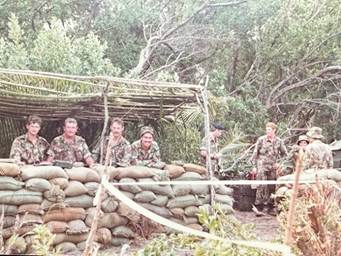
We flew out to the caye by helicopter, accompanied by a 81mm mortar section from the roulement infantry battalion, who provided the targets – a bunch of phosphorus hanging below a little parachute, normally used to illuminate the battlefield.
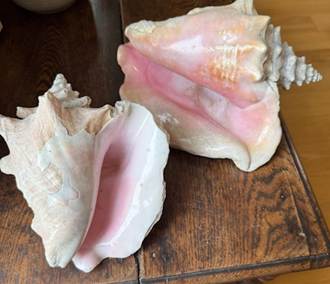
When not swotting away the mosquitoes, we took advantage of the crystal clear and warm water. The seabed was covered with large shells; I brought two home! On my first trip to Belize, I had gone down to the southern British military base in Toledo District; I think it was called Camp Riddeau. My troop sergeant had organised a night deep in the jungle, something I had never experienced. We made the A-frame supports for our hammocks, cooked some supper and listened to the insects and animals that make it their home. Night comes early in the jungle, and it was noisy, wet, extremely humid and hot. (Note 1)
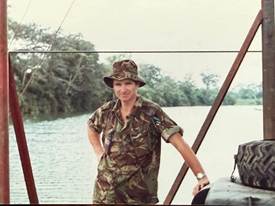
I had some down-time during my time, accommodated in the RAF Officers Mess, and remember reading John Fowles’ Daniel Martin. Today, Wikipedia says “it follows the life of the eponymous protagonist, using both first and third person voices, whilst employing a variety of literary techniques such as multiple narratives and flashback.” I wished I’d had Wikipedia back in 1983. I struggled with the first third, almost gave up, then understood it, devoured the remaining two-thirds and started at the beginning again, to reread that incomprehensible first section!! John Fowles had written The Magus and of course The French Lieutenant’s Woman and remains one of my favourite authors.
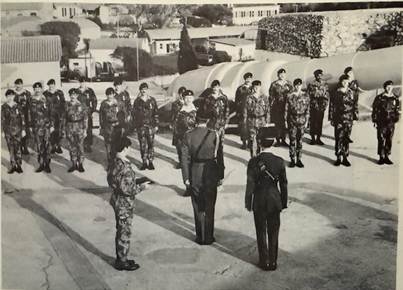
In December 1982 E Troop soldiers who had taken part in the Falkland’s War were presented with their campaign medals by the Deputy Fortress Commander of Gibraltar. (See photograph) I returned to The Rock in 1984 with the whole battery (ie less the Belize troop) for some adventurous training and to take part in the Gibraltar Half Marathon. Flying into Gibraltar is always interesting. The airport lies on the north of the massive vertical rockface and in certain weather conditions it’s a very turbulent area. In my first visit in a RAF C130 we went around twice, succeeding on the third attempt with a very hard landing.
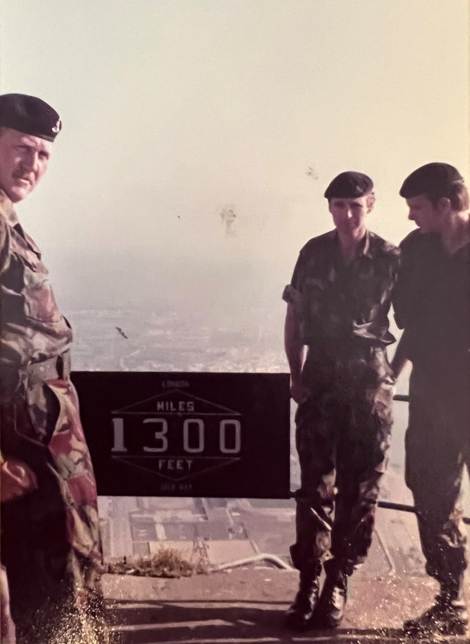
At the very top of the Rock with WO2 Black and Lt Richard Dare

After Belize, Beirut and Gibraltar, you might think that Manorbier, to the west of Tenby, the Brecon Beacons, both in South Wales, and Otterburn in the Northumberland National Park, were rather tame. But each in their own way added to one’s appreciation of the United Kingdom landscape. We had regular ‘live firing camps’ at Manorbier, staying in the Sennybridge training camp, used the wonderful Brecon Beacons for strenuous exercises and carried out some troop training up in Otterburn. It was here for five days in May 1984 that I had the largest component of Lloyds Company together during my two-and-a-half-year tour; Lieutenant Paul Goad was on a course and the Belize troop of 14 wasn’t there!
I always sought to bringing out the best of my soldiers, testing their ability where necessary, promoting them when they earned it, encouraging them to apply for external roles, even if it meant they were posted away. The commanding officer, Lieutenant Colonel Ian Forward, noted in my annual confidential report: “He never sought to hoard his assets, willing to share his carefully nurtured talent across the board.” And, of course, it was personally satisfying when soldiers grew and matured before my eyes.

But not everyone grows! When I took over my battery I rapidly sensed that one of my sergeants, let’s call him Sergeant Smith, had been promoted (Note 2) above his ability; he wasn’t happy and didn’t seem to enjoy his job. After a chat, I arranged a couple of training exercises where he had ample opportunity to show his capabilities. He failed miserably, so he was reduced back to Bombadier and was found another position in another unit, one more suited to his abilities. He wrote later saying how happy he was. We see it in civilian life, individuals ‘promoted’ into roles they’re not suited to, not able to fulfil. I much prefer round pegs in round holes!

At one of the weekly Commanding Officer’s conferences of 1983, it was suggested we should hold a Summer Ball in the Officers’ Mess. Feeling that the ball I had organised in Lippstadt in 1972 had been a success, I volunteered, formed a committee, doled out responsibilities and set about making it happen.
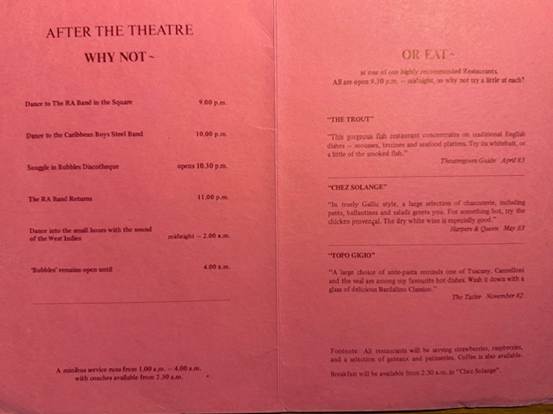
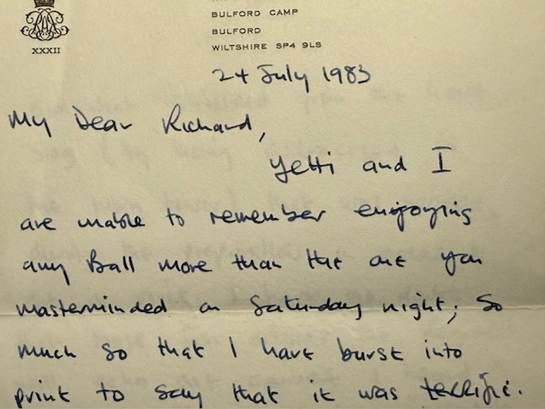
I decided that the theme should be ‘After The Theatre’, when one might have drifted around, finding different places to eat and maybe a nightclub or two to dance in. It was a great success, so much so that both the Commanding Officer and adjutant wrote letters in appreciation. The latter’s started:
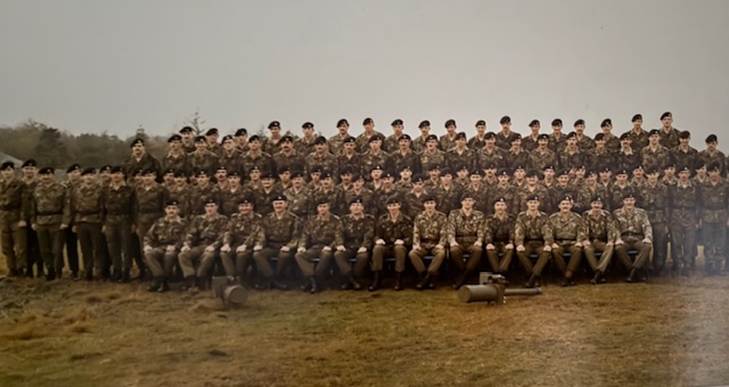
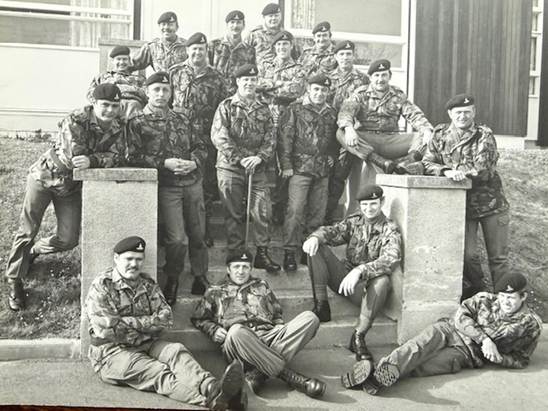
And the men who made the two and a half years I had in command of 43 Air Defence Battery (Lloyd’s Company) RA fun and rewarding are here, in this photograph, my officers, Warrant Officers and senior non-commissioned officers outside the training wing at Sennybridge Camp in South Wales.
Richard 27th March 2026

Hove

www.postcardscribbles.co.uk

Note 1 My Stepfather, Philip Thomson-Walker, as a Captain in SOE during World War 2, spent months in the Malayan jungle in Force 136 fighting the Japanese.

Note 2 Normally on probation for six months, this man had been on probation for 15 months. No one had ‘grasped the nettle’!
PC 483 The Shipping Forecast

Scanning the television guide, I noticed Channel 4 was broadcasting ‘Sailing The Shipping Forecast’ with the Reverend Richard Coles (Note 1). My interest was roused enough to watch the three episodes. The voice-over introduction by Coles went something like:

“Now it’s time for the shipping forecast; “……, Shannon SW 2 veering (Note 2) NW 3-5, occasional rain ….” For over 100 years sailors and fishermen have received daily life saving shipping forecasts. It’s now a national institution and its soothing tones have become a recognisable comfort to all. For me the shipping forecast is timeless, it’s almost like a prayer, comforting.”

It’s hard to imagine anyone who hasn’t heard of the UK ‘Shipping Forecast’, broadcast on BBC Radio 4 at 00:48, 05:34 and additionally on weekends at 17:54. But then if you live in the middle of the country, you’re more likely to be interested in the local weather than that affecting our coastal waters. Our weather is something we talk about endlessly …. but one of those aspects of life you can do nothing about. It is what it is, to use a common phrase.

I probably heard the UK’s Shipping Forecast for the first time in Cyprus in August 1968. As a Second Lieutenant, I was in charge of a small rear party, whose sole task was to ensure the Regimental training equipment was dispatched back to the UK from RAF Akrotiri, following three weeks’ regimental training on the island. One evening I happened to hear the British Forces Broadcasting Service broadcast the 00:48 Shipping Forecast.

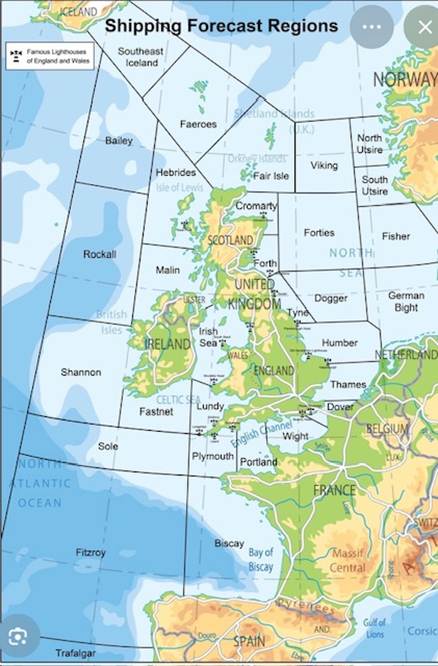
I learned later that the seas around the UK are divided into 31 areas, and the forecast follows a set format. It starts in Viking, moves through those sea areas covering The North Sea, down to the English Channel (Thames, Dover, Wight ….), out into the eastern Atlantic (Biscay, Fitzroy (Note 3), Sole,) then the seas around Ireland before finishing just short of Iceland.

Gale warnings precede the main forecast which follows a strict 350-word count. An example might be “There are warnings of gales in Dover and Wight. The general synopsis at 0400. Low 995 (barometric pressure in millibars) Biscay moving slowly NE and filling. The area forecasts for the next 24 hours: Viking, Forties, Cromarty, SW 3-4 (as in the Beaufort scale in knots) locally 5, good (a measure of visibility eg ‘good’ is greater than 5nm).” Actual weather reports from coastal stations follow. Winds circle areas of low pressure in an anticlockwise direction, around a high in a clockwise direction.

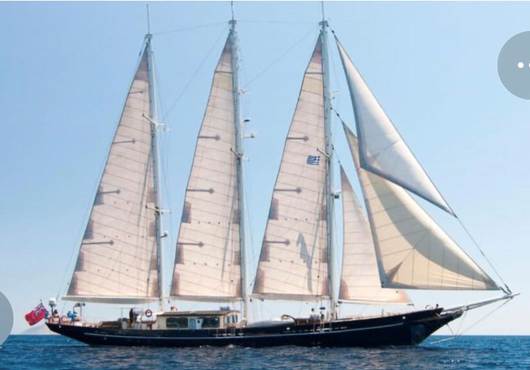
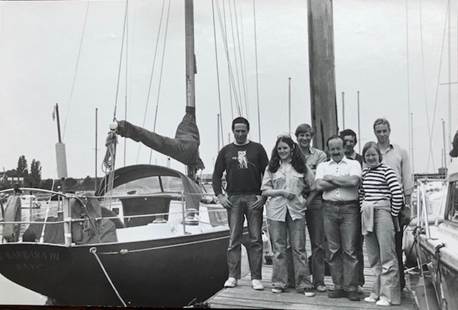
My crew on St BIII in Trouville, before our Arromanches experience!

As soon as I started sailing in 1968, it became essential to understand the weather forecast. The Shipping Forecast was written down with a chinagraph onto a wipeable talc and hung up in the skipper’s/navigator’s area of the cabin. Whether it was to warn us of gales offshore racing, see ‘PC 249 Knockdown’, or forecast when the northeasterly gale might abate and we could leave Trouville see ‘PCs 209 & 211 Off Arromanches’. (see crew photograph above)

You can get alarmed when the forecasts are for gales (Force 8) or severe gales (Force 9), and just as alarmed when the visibility is ‘less than 500m’. Sailing north from the Channel Islands and suddenly encountering a vast container ship, about 300m away and steaming across your track, gets the adrenaline flowing.    

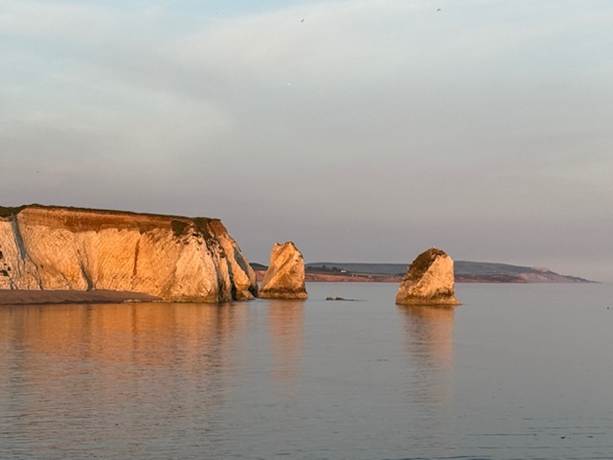
Freshwater Bay on the SW corner of the Isle of Wight

I mentioned Richard Coles’s series. He covered only four particular sea areas; firstly ‘Wight’ and visited the international sailing centre of Cowes on the Isle of Wight. The Isle of Wight is England’s largest island. (see PC 440 The Isle of Wight May 2025).

The episode about sea area ‘Lundy’ featured South Wales’ Gower Peninsula and Lundy Island. I had been lucky enough to visit Lundy when a Watch Officer on the cadet training ship Malcolm Miller.

Her sister ship the Sir Winston Churchill also anchored in the lee of the island. Coles also visited ‘Thames’ and went out to the ex-pirate station Radio Caroline, anchored outside the three-mile limit.

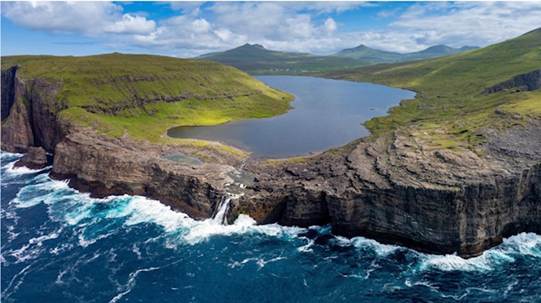
The Faeroes

Coles had started at ‘Faeroes’, a dramatic island group midway between the north of Scotland and Iceland. Thanks to Coles, I now know what it looks likes, and want to go!

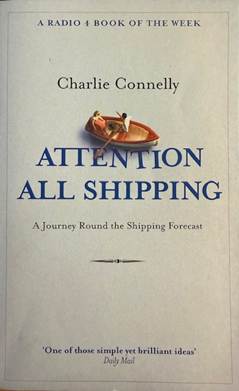
And if you’re a landlubber, then read Charlie Connelly’s book ‘Attention All Shipping’ – ‘a journey round the Shipping Forecast’. Brilliant.

For trivia, Stephanie Waring and her sister from Tyneside named their three children Shannon, Bailey and Tyne as their husbands both work at sea. And the poet AC Bevan wrote an entire collection of poetry inspired by The Shipping Forecast. He says the forecast is like a liturgy. “there’s something religious about it, the names suggest emptiness, but the way in which they are read out is very comforting. It’s something very spiritual.”

So, The Shipping Forecast, ingrained in my soul:

‘There are warnings of gales in Portland and Plymouth. The general synopsis at ……’

Richard 20th March 2026

Hove

www.postcardscribbles.co.uk

PS The full list is Viking, North Utsire, South Utsire, Forties, Cromarty, Forth, Tyne, Dogger, Fisher, Fisher, German Bight, Humber, Thames, Dover, Wight, Portland, Plymouth, Biscay, Fitzroy (Note 3), Sole, Lundy, Fastnet, Irish Sea, Shannon, Rockall, Malin, Hebrides, Bailey, Fair Isle, Faeroes and Southeast Iceland.

Note 1 Richard Coles first rose to fame in the 1980s as a multi-instrumentalist in the pop duo The Communards. He then studied theology, was ordained as a priest and serve as a vicar for over a decade. In 2022 he retired, reinventing himself as a prolific broadcaster and author.

Note 2 The term ‘veer’ means, in meteorological terminology, that the direction of the wind shifts in a clockwise direction. If it’s ‘backing’, it’s in an anticlockwise direction.  

Note 3 The UK sea area Finisterre, to the west of Biscay and the French coast, at 90,000 square miles was a much larger area than the Spanish sea area of the same name. Spain complained to the United Nations World Meteorological Organisation there could be confusion and the UK was ordered to change the name. Vice Admiral Robert Fitzroy (1805 – 1865) was considered the founding father of the UK’s Meteorological Office, so ‘Finisterre’ became ‘Fitzroy’ in February 2002. Somehow the original lilt of the repetition of the names changed without Finisterre! Fitzroy spent his personal savings on designing better ways to make weather information more widely available. In failing health and suffering from depression and financial concerns, he committed suicide by cutting his throat on 30 April 1865.

PC 482 Five Days in May (1)

As a regular Army Officer in the Royal Artillery, I always imagined the command of a battery, a sub-unit of some 120 personnel, would be one of the defining moments of my career. And having spent fifteen years of my commissioned service up to that point in the Field Branch of the artillery, that is guns and howitzers so surface-to-surface, I looked forward to commanding a field battery. Whilst in a staff job in the MOD Procurement Executive, I indicated my preference to the postings branch, known as AG6.

So, it was a little bit of a surprise to find myself posted to be Battery Commander of 43 AD (ie Air Defence) Battery (Lloyd’s Company) Royal Artillery (Note 1) which was stationed in Bulford, north of Salisbury in Wiltshire and equipped with surface-to-air missiles; “Theirs not to make reply, theirs not to reason why, theirs but to do …..!!” Incidentally, the letter ‘B’ seems to feature a lot so I will collate my experiences accordingly. (See PC 414 ‘It’s All About B’ November 2024)

The Battery was part of 32 (GW) Regiment Royal Artillery (Note 2), the Regiment’s other components being two batteries equipped with an anti-tank missile system called Swingfire, and one with the 105mm Light Gun. The gun battery joined five other international batteries that supported the Allied Command Europe Mobile Force (Land) (AMF(L)) and our regimental headquarters formed that force’s Artillery Headquarters.

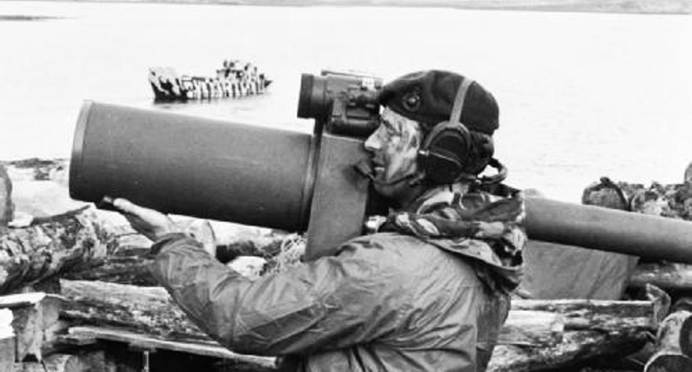
A Blowpipe operator during the Falklands conflict

The battery was equipped with a shoulder-launched surface-to-air missile system known as Blowpipe. It was a first generation and quite rudimentary. The operator had to keep his sight graticule not only on the fast-moving target but also on his missile. It was extremely difficult to use, although the manufacturers trumpeted the fact that it would not be confused by any flares that the plane might have initiated. Operators needed to be very fit as it was cumbersome and heavy.

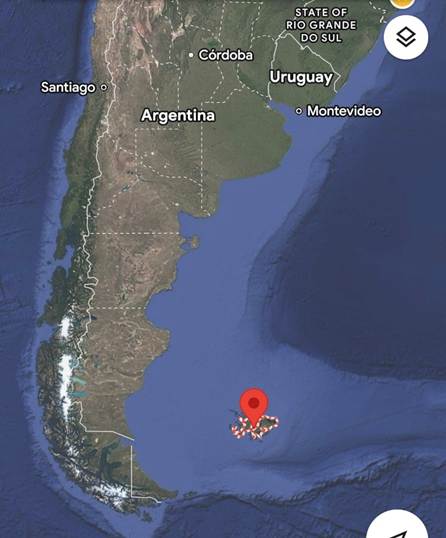
The Falkland Islands east of the coast of South America

For some, May 1982 is a date etched in their memory, as it was the middle of the conflict with Argentina after their invasion of the Falkland Islands, which had begun on 2nd April and lasted ten weeks. Two troops from the battery had been deployed with the combined forces to retake the islands. Given Blowpipe was a first-generation SAM system, it was remarkable that four possibly five Argentinian aircraft were shot down. In additional to the Falklands commitment, the battery had three detachments in Belize and one troop on leave, and it was only the sick, lame and lazy left when I arrived to assume command!

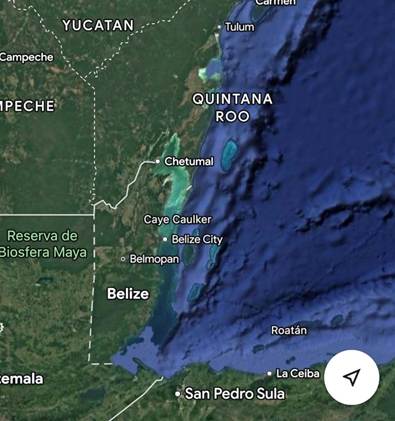
Belize in Central America

I had imagined I would see my whole battery together during my tenure as its commanding officer, but with those personnel on a six-month deployment to Belize, that was never going to happen. Situated south of the Yucatan Peninsula in Central America, Belize borders Mexico in the north and Guatemala to the west and south; its Caribbean coastline stretches for some 280kms. An independent sovereign nation since September 1981 and member of the British Commonwealth, Britain maintained a mixed Royal Air Force and Army group to counter territorial threats from neighbouring Guatemala. (Note 3)

The aftermath of the successful Falklands campaign caused ripples through government department. I suspect the old files – ‘What If …..?’ got dusted off. One ‘What if ….’ centred around continuing agitation by some sections of hard-line politicians in Spain about the status of Gibraltar. Ceded by the Spanish after the War of the Spanish Succession in 1713 as part of the Treaty of Utrecht, its British Overseas Territory status now seemed anachronistic. Right wing politicians dreamed of simply overrunning it and claiming it as Spanish.  

In October 1982, The Rock had its defences strengthened with another Royal Navy ship and three RAF fighter jets. I was tasked to recce The Rock for the possible deployment of a troop of Blowpipe, so flew out there for a couple of days.

The Rock of Gibraltar at the northern entrance to the Mediterranean Sea

I stayed in the RAF Officers’ Mess; someone endlessly played Rod Stewart’s ‘I Don’t Want to talk About it’ and my Gibraltar memories will be forever triggered by hearing it! On my return I wrote up my operational reconnaissance report, which resulted in a troop going to Gibraltar on a three-month rotation. With one troop in The Falklands, a large section in Belize and now one in Gibraltar, it was not an easy command, but six months later the Gibraltar Regiment’ Air Defence Troop was re-equipped with Blowpipe, so those gunners came home.

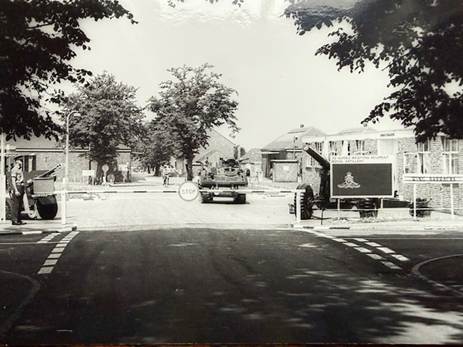
Bulford, north of Salisbury, was home to Wing Barracks, some 68 miles from my house in Fleet, Hampshire.

Wing Barracks Bulford

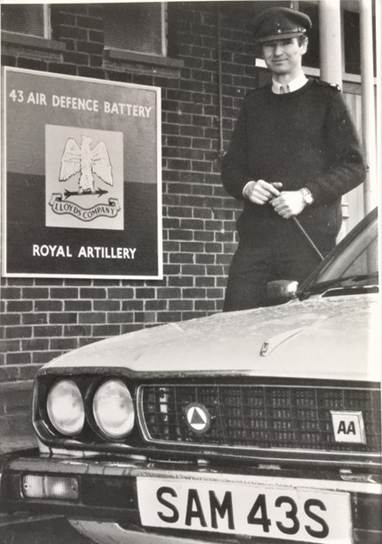
Sometimes I drove to work in my Honda Accord, a wonderful example of Japanese engineering. I had bought it in 1980, loved it, but it disintegrated before my eyes in a ball of rust after 6 years. It had a very appropriate number plate – ‘SAM 43 S’ (Surface-to-Air Missile (SAM) and 43, the number of the battery I commanded.

For my second year I bought a very old VW Beetle for £199 to trundle to and from work; rust holes in the body work provided some air conditioning, although those in the floor plan meant wet feet when it rained!

I rounded off 1983’s memorable experiences with a voyage on another ‘B’, this St Barbara III, a Nicolson 43 and then flagship of the Royal Artillery Yacht Club. As part of its 50th Anniversary, St B III was being sailed around the British Isles; as a skipper, I drew the leg from Liverpool to Oban on the west coast of Scotland. My ‘sailing log’ records we sailed 215 miles, visited the Isle of Man and cruised up through the Western Isles of Scotland before arriving in Oban.

To be continued …..

Richard 13th March 2026

Hove

www.postcardscribbles.co.uk

Note 1 Captain William Lloyd formed the company in 1808 and on 16th June 1815 took part in the Battle of Waterloo, particularly in the engagements at Quartre Bras and Hougoumont. Lloyd died of wounds ten days later. The Battery shield features the Waterloo eagle.

Note 2 GW stands for Guided Weapons; in this case, owing to the odd collection of equipment, others referred to it as ‘Guess What’.

Note 3 This was withdrawn in 1994  

PC 481 Hope in The Hope

Hadn’t said farewell to Mo for too long before Sami poked his head around the door, saw me and made his way over to my table.

“Do you want another coffee, Richard? Double espresso?”

“Hey Sami! Good to see you: yes please!”

Sami’s not one to engage in too much small talk, wanting instead to explore his opinions and ideas, as well as keeping me abreast of the latest developments of the continuing saga of the Post Office scandal, of which he was a real victim. He’s personally got over it, taken an acceptable offer of compensation, and is rebuilding his life with his new partner Lisa. (See PC 335 ‘Lisa Wallace – My story’ May 2023 (Ed: This is interesting!))

“You saw that Betty Brown, the 92-year-old former subpostmistress from County Durham, was appointed an OBE in last December’s New Year Honours list? It took her twenty-two years to secure justice for herself and her late husband; lives destroyed!

The scandal’s no longer headline news but everyone’s eagerly awaiting the outcome of the police investigation to see who will be charged.”

“You think that will ever happen? These things have a habit of festering for so long, with prevarication and obscuration, that many on both sides will have died and someone will say: ‘What’s the point?’. It’s like the Infected Blood Scandal (see PC 392 Hope Continues (June 2024) and PC 420 Contentious Issues in the UK for 2025 (January 2025).)”  

“You’re becoming cynical as you get older Richard! Incidentally not sure what’s your view but we seem to have got our knickers in a twist when it comes to a person’s background, heritage and ancestry. Being curious, I am often asking new people I meet what they do and, frankly, if they are a person of colour as I am, where they’re from.” (Note 1)

“Do you remember about three years there was a hoo-hah at some Buckingham Palace reception when Lady Susan Someone asked a delegate, Charity founder Ngozi Fulami, where she was from, and not happy with the answer “I was born in the UK”, asked: “No! Where are you really from?”

“What’s the issue? I met a lovely couple of junior doctors many years ago, both the result of mixed marriages, and asked the chap, who looked like me, Eurasian, where he was from. “Nottingham!” and I so nearly asked, for no other reason than curiosity: “No! Where were you from originally?” but never did!

“A Gunner friend is in the process of penning his autobiography, not for public consumption but for his grandchildren. He let me read a couple of drafts of some parts and I know his intended audience will be fascinated. He thought I was doing the same, sort-of, writing of my life’s experiences in my weekly postcards. That hadn’t occurred to me, that I was writing my own autobiography, albeit in instalments and interspersed with contemporary observations and thoughts. Hey Ho!”

“Your weekly postcards Richard ….. I enjoy most of them ……..”

“Someone the other day told me they don’t have time which, given that they are a mere 5-minute read, is a sad reflection of modern life. I get more ‘likes’ and comments for some than others. The one that keeps surfacing is PC 461 “Bumped into Sami!” from October 2025 ……”

“Ha! I remember, we had a coffee in Gail’s and chewed the fat upstairs, mainly about weight-loss drugs as a way of tackling obesity. Sorry for the unintended pun! I imagine you saw that BBC report that GP Surgeries in England are to be paid an average of £3000 a year in bonuses to prescribe weight loss drugs?? (Note 2) Seriously not the way to go; get a bonus for everyone who signs up to some exercise programme!! But what else to you do to keep the brain from going to mush, apart from your beloved hot yoga?”

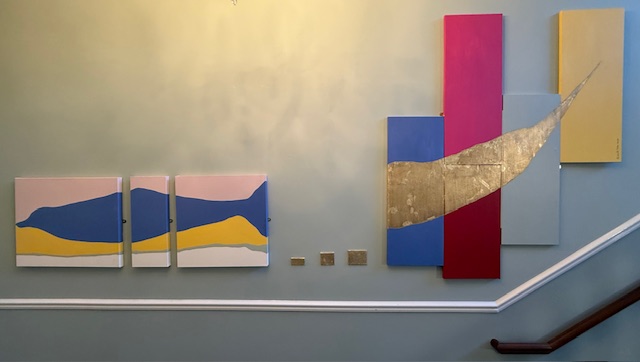
“Mmm! I do the daily Sudoku puzzles in The Times and occasionally paint something. Look (reaching for my iPad) ….. the composition on the right for Amber House’s communal hall is new, linked to another from some years ago by three little squares.

and by our internal apartment door, four little canvases …..

“I like both, a lot!”

Two other observations, Sami. Firstly, we had to go to the cremation of a dear friend the other day. She’d chosen some songs by Neil Diamond, Rod Stewart and Tina Turner, so the tone was as light-hearted as these things can be.  The service was conducted by Aileen Smart, who needed some reading glasses to read the tribute. The frames themselves were enormous, obviously quite heavy and they gradually slipped down her nose. As everyone would, she simply pushed them back up the bridge, only for gravity to impose itself once again and the whole action was repeated. Once or twice …… but I became mesmerised as her habit continued and my attention drifted from what she was saying!

The other concerned our yoga studio, where we had a new student the other week. If I can, I try to pass on a couple of bits of advice before they start: breathe through your nose, not your mouth and don’t drink water during class if you can help it. His reply to the latter was: “Ramadan started yesterday evening (17th February) and I can’t drink until sunset, so won’t be a problem.” This conversation was on the first day of Lent in the Christian calendar (18th February this year) so then I got into a discussion with myself about how it was apposite that devout Christians would be foregoing goodies for 40 days, at the same time as Muslims would be fasting for 28. My ignorance about the finer details of Islam prompted a Google search. I knew the dates of Ramadan progressed earlier each year but didn’t know by how much – it’s 11 days. Ramadan is the 9th month of the Islamic calendar, which is itself based on the cycles of the moon.

“Well! Well! Well! Richard. Thank you!”

Richard 6th March 2026

Hove

www.postcardscribbles.co.uk

Note 1 Sami’s mother was English and father Indian, so he’s classified as Eurasian.

Note 2 Of course very overweight people will eventually cost the NHS a great deal of money, so I assume this is the reason for encouraging them to take a weight-loss drug.