PC 489 Argentina and Buenos Aires

The guidebook says: “Often dubbed the ‘Paris of South America’, Buenos Aires is the world capital of Tango, the birthplace of dulce de leche and gaucho cuisine and combines European elegance in Recoleta with Latin American flair”.

Back in the 1970s I saw the stage show ‘Evita’, with its famous song ‘Don’t Cry for me Argentina’ still performed all over the world. Andrew Lloyd Webber wrote the music, Tim Rice the lyrics, and it covered the early life, rise to power and charity work of Maria Eva Duarte de Perón (1919 – 1952), the second wife of the Argentine President Juan Perón. She died of cancer aged 33 and is buried, since 1976, in Recoleta Cemetery in Buenos Aires.

Did someone mention Dulce de Leche? This incredibly sweet Latin American ‘sauce’ is made by heating sugar and milk for several hours. You can make a very simple version by simmering an unopened tin of condensed milk for 2-3 hours to caramelize the milk sugars. As its birthplace, it was inevitable we would find a shop in Buenos Aires devoted entirely to selling every conceivable variation.

My own internal guidebook says: ‘Beef, in the UK synonymous with Dewhurst the High Street butchers, Eva Peron, the Battle of the River Plate in 1939, the Tango, the Pampas and Patagonia, The Disappeared, and the Argentine invasion of the Falkland Islands, 300 miles off the east Argentinian coast, in 1982.’ I realise I know more about Argentina than any other South American country, apart from Brazil.

Let’s get ‘beef’ out of the way. Argentina today is one of the top five beef exporters in the world; the others might surprise you – Uruguay, Brazil, Mexico and Kazakhstan. The biggest producer is the Unites States but they like their meat in the USA and most is reared for domestic consumption. Britain’s link to the Argentinian meat market go back to 1915. Two brothers, William and Edmund Vestey, had started a butchery business in Liverpool in 1897, grew it exponentially through the first refrigerated shipments of beef from the USA, creating their own shipping line, the Blue Star, expanding into Australia and New Zealand and developing the Dewhurst butchers’ shops throughout the UK. To avoid tax here, the two brothers moved to Buenos Aires in 1915; by 1940 the Vestey family were estimated to be the second wealthiest family in Britain, after the King!  (Note 1)

Eva Duarte was born into poverty in 1919, moved to Buenos Aires in 1934, aged 15, to become an actress, and married an army colonel, Juan Perón, in 1945. He became President of Argentina the following year and so started six years when Eva established her legacy. She championed labour rights, ran a charitable foundation, and formed the first large-scale female political party. A few months before her death from cancer at the age of 33, the Argentine Congress bestowed on her the title of the ‘Spiritual Leader of the Nation of Argentina’. I haven’t space to describe all the twists and turns of where her body was between her death and 1976; for instance, from 1971 to 1973, the corpse was on a platform near the dining table of Juan Peron and his third wife Isabel in their Spanish home, before they returned to Argentina when he became president for the third time! Since 1976 her body and that of her husband have been interned in the Duarte family tomb in La Recoleta Cemetery.

We visited it, for it’s one of the top tourist attractions in Buenos Aires; what a weird and slightly discombobulating place. Inaugurated in 1822, it holds more than 4800 vaults and mausoleums containing the coffins of the great and the good, well, those whose families could afford the architect and sculptor’s fees. One guide says: “More than a cemetery, it’s a place where art, architecture and time intertwine, offering a deeply intimate glimpse into the soul of Buenos Aires.

Rather ominous, a ‘dead’ soul and for us, not a place to linger. And when no descendants of the great and the good exist, who pays for the upkeep?

As schoolboys we lapped up the portrayal, in our comics and in the1956 film, of the David and Goliath fight between the Royal and German Navies off the coast of Uruguay and Argentina in December 1939, in what become known as the Battle of the River Plate, the first major naval battle of World War II. Naval intelligence had reported that the pocket battleship Admiral Graf Spee, under the command of Captain Hans Langsdorff, was operating off the Rio de La Plata; the British heavy cruiser, HMS Exeter and two light cruisers, HMS Ajax and HMNZS Achilles, went to find her.

In the ensuing battle, HMS Exeter was severely damaged and limped to The Falkland Islands; the Admiral Graf Spee’s fuel system became inoperable and she put into Montevideo for repairs. The ‘rules of war’ allowed the German ship to stay in neutral Uruguay’s capital for up to 72 hours. Naval intelligence created a deception campaign, so effective that Langsdorff believed a superior Royal Navy fleet awaited his departure. With his time in Montevideo up, he sailed out into the estuary of the Rio de La Plata, ordered his sailors to lay explosives, and about 7 miles offshore scuttled his ship. After the funerals of those of his crew who’d been killed in the action, Langsdorff shot himself. Many of the 1000 strong crew of the Admiral Graf Spee were interned but after the war settled in Montevideo or across the river in Buenos Aires. Today the wreck continues to be a hazard to navigation and is under Uruguayan jurisdiction.

I almost wrote ‘Cape Horn’ on my list of Argentine knowledge, then remembered that, in the complicated geography of the southern tip of South America, this cape, revered of sailors for hundreds of years, is Chilean! It is the southern tip of Hornos Island within the archipelago of Tierra del Fuego.

(To be continued)

Richard 1st May 2026

Rio de Janeiro

www.postcardscribbles.co.uk

PS On the flight from Rio to Buenos Aires, the film choice was poor, so I watched Julia Roberts in the 2010 film ‘Eat Pray Love’ again! At some time, she reaches for her cardboard box containing ideas, things to do, places to go. The very first thing was a travel article – about Buenos Aires. Love coincidences!

Note 1 Dewhurst couldn’t survive the growth and convenience of supermarket shopping and in 2006 closed its remaining shops.

PC 487 The High Street

They’re in your face, aren’t they, the boarded-up shop fronts and the ‘for sale’ signs that litter our ‘High Street’. Doorways once a busy entry and exit point now where the sadly homeless can doss down. A sign of urban decay if ever there was one; and in the back of my mind the images of Detroit, once home to the United States’ automotive industry and now just one of many rusting and run-down areas. So, what’s the new normal?

Living in Brighton & Hove we have examples of every sort of commercial enterprise, and some are not surviving. It doesn’t require a degree in economics to understand that the financial pressures of high Business Rates, levied by the local council, and unstainable increases in rent from absent landlords are just two of the factors. Many retailers argue that the current rates systems unfairly penalise physical stores compared with online retailers. Another factor will simply be the rising costs of running a business, like those of energy, rents, and minimum wage hikes.

But the change in the way we buy goods, from going into a physical store to logging onto a website, ordering what we want and having it delivered home or to the office, is irreversible. Those who clamour for the authorities to ‘Bring back the High Street’ have to realise it will not have the same ‘pre-internet shopping’ look.

Five minutes from where I live, out of choice in a town rather than in the countryside where the whole issue is completely different, I found:

The Flower Stall’s tucked into an outside corner of a deconsecrated church, itself another change to the urban look. You can buy flowers on-line, for instance from Freddie’s Flowers, but particularly for the impulse purchase, this is great.

Our dentist’s practice is across the road; you cannot have a dental checkup online! They are around the corner from Ben, an acupuncturist we use; he charges 50% more for an online session.

Along Church Road we find a traditional butcher, Canham & Sons, which does a roaring trade, both for its meat and poultry products, and at lunchtime for its pies, pasties and sausage rolls. For vegans the all-invasive smell of meat means giving it a wide berth.

A private doctors’ practice (The Hove Practice) is popular with those finding getting a GP’s appointment difficult and wanting medical advice in a day or so.

It sits opposite the Osbon Pharmacy, so those needing a prescription can simply walked across Church Road.

Delicate discussions about the choice of a coffin, flowers and other funeral arrangements just cannot be conducted online, so Attree & Kent, part of CPJ Field, is an essential part of our High Street. This company was established in 1690 and has been run by the Field family for 10 generations. There is no shortage of customers!

Another generational story is Timpson where you talk to Adam, get another set of keys cut, impossible online: a new sole for your favourite shoes or a passport photo needed in a hurry. Online? Nah!

When the family’s been to stay, a laundry service is essential and Essame’s Bubbles provides just that, although it would benefit from a ‘u’ and a ‘r’!

But the new-look High Street is personified by pedestrianised, 200m long, George Street.

Gail’s sits at the bottom, the first of many bakery and coffee shops – a sign of what the public want, if they can afford the cost of a Mocha or Latte.

And if you don’t want something or need some cash to tide you over until payday, go to the pawnbrokers.

Yes! Yes! I know, you can read an e-book, or you can order books from many online stores, but isn’t there something very grounding, just browsing in a bookshop like Waterstones, picking up a paperback, attracted enough by its cover to read a review??

I don’t get my nails ‘done’, well, not yet, but understand the current fashion ….. and here’s another service you can’t do online. But do we need so many? In George Street alone there are eight!

Whilst you can buy non-prescription glasses online, as I did through ThinOptics for some standard, extremely lightweight, reading glasses, you need to see a real optician to have your eyes regularly checked.

My love/hate with individual tattoos continues. When I was in the Army there was a snobbery about tattoos, officers never dreaming of having one, seeing them as very working class. Often if a senior Non-commissioned Officer was elevated to some commissioned rank, they invariably tried to remove any visible tattoos they had; removing tattoos has apparently got easier. I sense some people get them when drunk or under peer pressure and years later wish they hadn’t. In 2026 Brighton & Hove the rapid increase in their popularity is evident, although some I find repulsive and not in the least attractive; the black ‘sleeve’ tattoo is one.

I used to smoke, even when I knew that there was a causal link between cigarettes and lung cancer. My last cigarette was in March 1994 and whilst I still remember the delight of that first ‘drag’, I remain repulsed by someone else’s cigarette smoke and the reek of it on clothes, curtains and carpets. Vaping seems another world, 95% less harmful than smoking tobacco;100 puffs a day is the equivalent of smoking 7-10 cigarettes a day. Even so not healthy! George Street has three vape shops, most are empty of customers; one wonders if they are simply set up to launder the proceeds of criminal activity.

In addition to the three vape stores and eight nail bars, George Street has 5 charity outlets, for example Barnardo’s and the RSCPA, 8 phone shops and 14 cafes ….. and there are only 88 shopfronts in the whole street! The new High Street? Well, there is a bank branch!

Richard 17th April 2026

Rio de Janeiro, Brazil

www.postcardscribbles.co.uk

PS Regular readers please note next week’s postcard will not be in the post-box until late Saturday afternoon – assuming there’s a collection!

PC 471 Another Tale  

Most of us are too busy to read much at this time of the year, so here’s something I wrote last year, which is just another tale. And if you don’t read it that doesn’t matter either!

“I had only the vaguest of directions, in the form of a land survey map and some handwritten notes from the solicitors, but as I neared what I thought was about my destination, I could sense my heart beginning to beat faster, the excitement palpable; I pulled into the verge. Somewhere down this deserted country road, 100 miles in from the coast north of Sydney, was a five-barred gate. Sure enough 50 metres away there was an old wooden gate, hanging at an odd angle from a large timber post, rather unkempt and unloved; across the top bar was the name, “Standby”, burned into the wood by an untrained hand. A track led through the gums and over a small hillock; clearly no one had travelled this way for a while, so thick was the red dust and the absence of tyre tracks.

So much had happened since I had received that letter from Wilcock & Brown, a firm of solicitors in Sydney, in London two months before, informing me that a long-lost relative had left me a station in New South Wales. Being rather vague about the family tree, I had rung my grandfather, to see if he could enlighten me.

Come down and see me, dear boy”, more an order than an invitation! A few days later we had had sat around the coffee table in his drawing room, doing a cursory search of some dusty albums and box files. He’d told me how James Ruse, his great great grand-father’s half-brother, had been one of the first European settlers and the first to be deeded land in Australia, thirty acres at Parramatta, west of Sydney. James had prospered and had bought tracts of land as future investments. One was far north of Sydney, which he had let to a fellow settler, who had gradually built up a sizeable holding. Over the years my grandfather had rather lost touch with his extended family relatives in Australia and had no clue as to how the station had come to be left to me.

Grandpa’s parting comment still rang in my ears: “Why don’t you go and have a look? You have nothing to lose, it could be a wonderful adventure and you can come back and tell me all about it.”

Certainly, I had to take a look, if only out of curiosity, but I had no experience of running anything bigger than my back garden, the size of postage stamp, in South London, so I would probably sell the station. After the long flight to Sydney and a few days to get over the jetlag, here I was, north of Newcastle. I remember smiling as I passed a sign on the road to Booti Booti, without knowing how it came to be so named and how I would become intimately involved with those words. Then I spied ‘Standby’ on that gate.

At the top of a rise in the track I caught a glimpse of buildings in the distance, half hidden by gums, with a water tower and fences that formed cattle pens. The nearer I got, details of the main house became clearer, classic colonial ranch style, with a large overhanging roof and wide verandas at both ground and first floor level. I had arranged to meet the man who had been looking after Standby since my relative had died, at noon. It was almost that time now, judging by the position of the sun, burning down from the cloudless sky, and yet there appeared to be no one around. 

I parked my car in the shade of a large barn, walked across to the main house and up the steps to the front door, which opened to my push. Inside, dust lay on everything, on the furniture, across the floors and the windows; my finger ran across the table in the dining room, underneath the dust the surface of a lovingly polished mahogany table, obviously brought out from England many years before. The interior was cool and pleasantly laid out, with the main rooms off the central corridor, and the kitchen at the far end.

I was just about to explore the first floor when steps sounded on the veranda. Framed in the doorway was the slender frame of a woman, a broad-brimmed hat on her head, bare arms and legs, and a flowing skirt; in her right hand was a basket. The strong sunlight made it difficult to see any detail of her face and I walked back to the front door to introduce myself.

Good afternoon”, I said, “my name’s Robert Harrison; you are?”

As I came closer, I could see she was probably in her late twenties, her skin the colour of milky coffee with large soulful eyes and a broad smile.

“G’day, I’m Clarissa; I am Winston’s daughter.”

Ah! Yes. Winston was the chap who was looking after the station. She told me he’d been delayed with some cattle about an hour’s ride away.

Would you like some lunch? I’ve got some cheese and mangoes, and a bottle of beer. Why don’t you sit on the veranda and I will get it.” Without waiting for a reply, she brushed past me and headed for the kitchen. 

I sat in the shade, tasted the most delicious goat’s cheese, slurped my way through a couple of mangoes and quenched my thirst with the beer. Winston arrived about an hour later, riding into the yard on a rather rough looking black mare, accompanied by a cloud of reddish dust. We introduced ourselves and sat on the veranda whilst Winston told me something of the ranch. A hundred thousand acres of cattle station was mine if I wanted it. He suggested that the best way to see what Standby consisted of was to ride the land. He startled me as he yelled at Clarissa to saddle up a horse, but soon we were riding out of the station yard and up the hill to the east. It was late afternoon, the heat of the sun was easier now, and the kangaroos were coming down to the water holes to take their first drink and nibble the short grass. I looked back at the house, already deciding that here was a place I could live. The comparisons with England were few, it was an exciting idea and, although I knew nothing about cattle and running a station, seemed too good to turn down.

What was the alternative?  Whilst I had no illusions about how different and physically demanding it would be, I felt a surge of excitement as I following Winston over the hill and through the gums. We crossed dried-up river beds, through gullies and around ant hills as big as my horse; the air was dry but clear and there was a wonderful smell of eucalyptus. Some three hours later we rode back into the yard in the soft light of dusk; Clarissa came running out and took the reins and led the horses back to the stables.

I gratefully accepted the offer to stay the night and later, lying in bed wide awake, I wondered what I was letting myself in for.”

(To be Continued – maybe)

Richard 26th December 2025

Hove

www.postcardscribbles.co.uk

PS Ideas always welcome!

PC 467 Hope News Continues

“Sorry Richard! That took a long time. Coming back from the loo I got side-tracked by Josh who wanted to ask about my mother. I have read your postcards about your Australia – New Zealand trip (PCs 458, 459, 460, 462, 463 & 464) ….. you obviously had a good time, jetlag notwithstanding. Anything you haven’t mentioned?”

“Now you’ve reminded me, in Perth, walking back from Kings Park, we came across a couple of young chaps standing beside their car which had a flat front tyre. They looked rather pathetic, so I asked if they had a problem.”

“No! Thanks! My brother/cousin/flat mate’s coming to give us a hand.”

“But you’ve only got a flat tyre. Can’t you change it?”

“Never had to before; no idea how to! Here’s the jack, but where does that go?”

“So …..” and I get a look from Celina as I have a mild hernia and shouldn’t force anything, “…… the first thing to do is loosen the wheel nuts whilst the wheel is on the ground. Good garages will tighten them with a torque wrench; others use an impact wrench which can easily exceed the recommended torque (Note 1) and they are almost impossible to undo.”

At that point their brother/cousin/flat mate turned up, looking reasonably confident, so I left them to it but mentioning a torque wrench reminded me of my Army Service.

In 1968, 27 Medium Regiment moved from Devizes, Wiltshire to Lippstadt, Germany, swapping our towed 5.5̋ howitzers for the self-propelled M109. The latter had seven idler wheels between the track sprockets. Each wheel was attached by a number of large nuts, which we assumed had to be tightened to the maximum. After three months in Germany, the Aluminium idler wheels were showing signs of extreme wear and many had to be replaced. Eventually the problem was identified; the tightness of the nuts needed to be to a certain torque, and that could only be achieved by using a torque wrench, not by Gunner Elrick who believed they should be as tight as physically possible.”

“Live and learn huh! Although these days some newer cars don’t seem to have a spare tyre! By the way, have you ever watched ‘Celebrity Who Dares Wins’, one of those celebrity television programmes where you don’t know any of the contestants? I’m sure you have; anyway, I was fascinated to listen to some of the individual ‘back stories ’in the last series. There was a man whose family were very committed to their church. As a six-year-old he was horrified to be told by the pastor that he had demons that needed to be exorcised. As an adult he questioned how someone could be so cruel. Another contestant’s career was going well, until her sister died suddenly and she had to step in and look after her eight children.”

“Ready-made family!”

“Exactly, but can you imagine that, your own plans and ideas for your life suddenly and completely put on hold? Anyway, then there was a black ex-footballer who recalled not being able to find a UK club so signed for Lithuania, only to be the subject of racist chants from the stands: ‘Zigger zigger, kill the nigger!’ And finally there was a singer auditioning for the show X Factor, who got wasted one evening, was raped by the hotel porter, …… and became the victim when thrown off the show. Years later these experiences are life-defining. Talking of life defining, how are your daughter’s house renovation coming on?”

“Certainly life defining, but in a pleasant way. I drove up to see her and the state of the house during Half Term week. So often these days I need to break my journey for a pee-break.

“Isn’t there some theory that one of the factors in the cause of vehicle accidents is the full bladder of the driver?”

“I have heard, yes, that but not sure whether it’s based on any statistics. Not the sort of question you ask someone who’s just been involved in an accident: “Excuse me, do you need to go to the loo?”

“No! I guess not! Anyway, you were saying …..”

“I pulled into the layby on the Hogs Back, a prominent ridge running east west between Guildford and Farnham and know as the Hogs Back since the time of Jane Austen, knowing the little café had some loos.

The lay-by and little café can be seen on the right of the dual carriageway

It was raining quite heavily and I scurried down the concrete path, following the signs to the loos, which were round the back. I get to the Men’s; it’s locked and you need a code, presumably from the café. My expectation was that the loo would be open and I am getting desperate – and wet! There is no alternative but to water the weeds growing between the cracks in the concrete.”

“I am sure that happens to a lot of men; we women don’t really have that option! Have you been watching the historian David Olusoga’s ‘Empire’ three-part series on the BBC?”

“I have, Mo, and I’m glad I have, as so often you get the ‘British Empire was bad’ bias whereas David’s tried to create balance and a modern reflection. I was fascinated by the explanation of the Indentured Labour Scheme, brought in to provide the sugar plantations with workers after the abolition of slavery in 1834.”

“It was a huge success for the plantation owners, but most workers came from the poorest parts of British India, and many were unaware of the long distance they would travel and indeed the terms of their contract. They were paid a paltry sum and had to stay for five years. The scheme was active for 80 years and its results can be seen today in the significant communities of Indian descent in South Africa, East Africa, the Caribbean and Mauritius.  Why were you fascinated by this?”

“David mentioned how Prime Minister Gladstone’s father had owned sugar plantations in Guyana and was one of the major instigators of the Indentured Labour Scheme. One of our yoga chums, Serena Wells, is from Guyana and she and her father are going to try and find out more about their family history, as ‘Wells’ was a common surname for slaves.”

“Now that will be interesting. Oh! Look, there’s Sami and Lisa …..”

Richard 28th November 2025

Hove

www.postcardscribbles.co.uk

PS Why have Christmas decorations suddenly appeared in mid-November? Now the radio stations are broadcasting carols! Humbug?!

Note 1 Wheel nuts should be torqued to between 80 and 160 Nm (Newton-meter)

PC 464 On to South Island

Fourteen years on from Christchurch’s 2011 earthquake, there are many buildings still not rebuilt. The city’s cathedral is one and, rather than leave it a ruin like Coventry’s in the UK after the Second World War, it’s half rebuilt and the money’s run out.

This was taken from a book about the earthquake

And as it is now ….

Of course, today other parts of New Zealand need State Funding, and they argue Christchurch’s had enough!

Third-cousin Debs Nation used to work for Radio New Zealand and lives in Lyttelton, over the hill from the city. Her brother Gerald also lives in Christchurch; this photograph from some years ago!

Her son Henry and daughter-in-law Lou work for the civil service in the New Zealand capital Wellington, at the bottom of North Island. Her daughter Tessa runs an emporium of New Zealand-made products situated in The Arts Centre in Christchurch.

She’s called the store Frances Nation after her maternal grandmother.

It’s a huge success and one of those places where it’s impossible, once you’ve entered, not to purchase something!

More recently she and her wife Emma have opened ‘Peaches’, a café in Linewood Village. Given that her grandmother’s maiden name was Hope I had suggested she call it The Hope Café, then the one here could claim to be international, but it was not to be. Her father’s surname is Peach so …..

I sense that white New Zealand is attached to the United Kingdom by an invisible umbilical cord. The receptionist in The George Hotel in Christchurch was from Manchester and Mark, on the concierge’s staff, has a sister who holds a senior position in the NHS on north London. A woman who ran a gift shop where I bought some soap eggs ……

has a sister in England.

We were lucky enough to have some beautiful spring weather in Christchurch

and the city has a great atmosphere. The George Hotel where we stayed was a good choice, not something I could say about the carpet in the corridor outside our room. You would not want to be confronted by this on your return from a boozy night out!

South Island is rich with stunning scenery; for instance the beautiful Milford Sound in its Fiordland in the southwest,

…. but I wanted to revisit one particular view, the one as you come up out of Burke’s Pass on the way to Lake Tekapo. We took the direct route from Christchurch to Geraldine, a classic NZ farming town, and stopped for lunch.

Twenty minutes out of the town we pulled into one of those designated ‘Scenic Viewpoints’, the Geraldine Fairlie Lookout, and gazed over a classic New Zealand rural landscape.

Up through Burke’s Pass …… and you have to stop ….. and take this view in.

A very flat expanse of countryside and then, on the horizon, the Southern Alps. It reminded me of a trip many decades ago, driving down to Rome from Germany. Passed Strasbourg, passed Colmar and suddenly, before you get to Basel, you see the European Alps filling the horizon.

New Zealand’s Southern Alps

Breathtaking in every sense; I could have stayed a long time, just sitting, just looking, in silence, in awe. 100% Pure New Zealand!

We had booked a night in the Grand Suites Lake Tekapo, essentially accommodation only but to a high standard. Dave the South African manager says it’s very popular in the summer as a base for trekking, mountain biking, exploring.

Lake Tekapo is known for the remarkable blue colour of its water, caused by rock flour, finely ground particles of rock brought down by the glaciers at the head of the lake and held in suspension in the melt water.

Then above the lake, because of the purity of the atmosphere, the University of Canterbury has an observatory on Mount John to the west of the town, from where there are glorious views of the lake and to the west, of New Zealand’s highest mountain, Mount Cook (3755m); not to mention the stars in the night sky.

Mount Cook

Lake Tekapo fills what’s known as the Mackenzie Basin

The Church of the Good Shepherd is one of the most photographed buildings in the whole of New Zealand. Built in 1935, the architect Richard Harman based his design on sketches done by a local artist, Esther Hope. And here’s a family connection: Esther neé Barker married Deb Nation’s grandfather’s brother Tom Hope. Today a manager runs the agricultural and Merino sheep side of the Grampian Hope Farm leaving the family to concentrate on the artistic activities.

It’s difficult to get a photograph of the church without capturing some of the 600,000 tourists who now visit annually. (Note 1)

A donation into a wooden box inside the church and chatting up the volunteer who was there to ensure no one takes photographs inside, and there’s no wonder why people want to come and see this, heaven and earth and all between.

I sense we met a large proportion of the tourists, either in the supermarket buying supplies for their self-catering accommodation or where we had supper, as pork seemed to be everyone’s choice! They come because they want to experience what they’ve seen in photographs; I suspect they don’t want to see too many other people. There needs to be a balance between the wish of individuals to go and see places and the need to restrict numbers to preserve the very reason people go!

We drove back to Christchurch via the scenic route

which took us over the Rakaia gorge and river just north of Methven.

Back in The George in Christchurch for one night before our return via Singapore home. We were blessed with clear flying conditions as we flew over the Southern Alps

And later over the central section of Australia, which looks like another planet!

Richard 7th November 2025

Hove

www.postcardscribbles.co.uk

PS We were lucky with the weather at Lake Tekapo. A week ago this was how the road from Geraldine looked!

Note 1 Thanks to the ‘clean’ option on my iPhone I can erase the tourists!

PC 463 More from Down Under

Other highlights from our time in Auckland were attending a hot yoga session in the Hiyoga studio on Queens Street, experiencing the local rail network when we went out to Des & Gleneth’s in Meadowbank for supper, seeing Cornwall Park where we met Michael & Angela and Des & Gleneth for lunch in The Bistro, and being lucky enough to stay in the Sofitel Viaduct Hotel, which was very central and comfortable. During our time in Auckland, England’s Women’s team The Lionesses played Canada in the Rugby World Cup final on Saturday 27th September. Cousin Michael in Victoria on Vancouver Island found a pub at 0800 local time to watch the match; in Auckland the time for the kick-off was at 0400 local on the Sunday, so I watched the highlights!

After checking out of our hotel, we picked up a hire car and drove down to Rotorua. Known for its lively geothermal activity, it’s an area of New Zealand I wanted Celina to see. Of course, there is so much of New Zealand that’s gorgeous; another two hours’ drive further south we could have seen Mount Ruapehu, one of the country’s largest volcanos and Lake Taupo.

Mount Ruapehu

Rotorua is also the home of distant cousin Peter & Gwenda Russell and their daughter Anna & husband Paul. We checked in to the On the Point hotel with its glorious view across the lake ….

… and drove out to their home. I’d first met Peter & Gwenda in London almost twenty years ago, been to stay in their then house in Tauranga and now find them co-located with their daughter Anna. How we live out our later years is a challenge for all of us; The Russells are a good example of how to do it. Gwenda developed a huge interest in our Nation family story and remains curious and enthusiastic, adding for instance a little colour where none existed.

Anna & Paul recommended we visit Te Puia – ‘a place that changes you’ – and it did just that the following morning. Patrick, our engaging Māori guide,

took us first to the New Zealand Māori Arts & Crafts Institute, where students are trained in carving and weaving, using traditional techniques.

A Master craftsman was concentrating on a little wood carving while elsewhere an apprentice was sharpening a chisel. The craftswomen weave beautiful bags, made from New Zealand flax, but they are expensive; for instance, the second left on the bottom row around £210.

I found the whole enterprise fascinating and, in another life, might have become a student!

The Kiwi, a small flightless bird, is recognised as an icon of New Zealand and the human population are often referred to as Kiwis. It’s the smallest of the ‘ratites’ family, which includes ostriches, emus and rheas. In Te Puia there are a number of these nocturnal birds in a carefully controlled habitat. Obviously, photography is forbidden in their hide but this photograph shows a stuffed bird and its eggs. Think the eggs rather large for a small bird; must be painful?

Mud pools, grey and bubbling, …….

…… form the backdrop to the Pōhutu geyser, which erupts once or twice an hour. It’s easy to become completely mesmerised by the constantly evolving geothermal landscape but eventually we had to move on.

We left, as the brochure suggests, changed, thoughtful,

.. and drove back to Auckland.

As you do when you hire a car, you look for the last possible petrol station, so you deliver the car back with a full tank of fuel. We had a very new Yaris ‘something’ and I knew the fuel cap was on the passenger side of the car. We pulled up to the pump, I walked around to the panel covering the fuel cap and pressed ….. and pressed …. and pulled ….. and pressed again …… I looked in the car for some lever ….. couldn’t find one, went back and pressed again. Just then James, or Nick or Good Samaritan appeared; filling up his own truck, he’d seen me making a fool of myself, Googled the make of my car and came around and said: “Oh! There’s a level under the dash somewhere” …. and so there was, not obvious (obviously!).  

We caught an Air New Zealand flight to Christchurch, a city a third of the way down South Island and, glancing out of the window as we crossed the coast, I could make out Farewell Spit where great grandmother Eve was shipwrecked in 1877. (See PCs 169 Shifting Sands & Feathers and 170 100% Pure New Zealand January 2020)

New Zealand lies on one of the many fault lines of the earth’s crust, this one between the Indo-Australian and Pacific Plates, part of the Pacific Basin Ring of Fire. To keep it in perspective, about 14,000 earthquakes occur in and around the country each year, of which some 175 are big enough to be felt. Within living memory, the February 1931 Hawke’s Bay earthquake, also known as the Napier earthquake, remains the country’s deadliest natural disaster. Two hundred and fifty-six people died when the quake, with a magnitude of 7.8, devasted the Hawke’s Bay region; aftershocks continued for two weeks.

The disaster prompted a review of the country’s building codes, deemed woefully inadequate. By way of illustration, today there are only four buildings in the Hawke’s Bay region taller than five storeys. In Christchurch on 22nd February 2011, a total of 185 people died, more that 7000 were injured and over 10,000 made homeless when a magnitude 6.3 earthquake struck the city. (Note 1) It caused over NZ$52.2 billion’s worth of damage.

If you live in a part of the world which is prone to earthquakes, there’s not much you can do about it, except be vigilant ….. and maybe have a ‘Go Bag’ always handy! We were planning to stay for a few days in Christchurch, so the topic wasn’t mentioned – a little like not watching an aeroplane disaster film when you’re about to fly somewhere!

Continues in PC 464 ….. next week

Richard 31st October 2025

Hove

www.postcardscribbles.co.uk

Note 1 Seventeen days before the first Nation family get together in Auckland.

PC 460 Perth and The Margaret River WA

I sent this WhatsApp to Mo, who’d asked why we were going to WA.

“Many years ago, someone recommended ‘Cloudstreet’ by Western Australian author Tim Winton. I read it and loved it enormously.

In summary: ‘The novel opens in 1943. Two poor families, the Lambs and the Pickles, flee their rural homes to share a large house called Cloudstreet in Perth, Western Australia. The two families contrast each other; the devoutly religious Lambs find meaning in hard work and God’s grace, while the Pickles hope for good luck and do not share the Lambs’ appetite for hard work.

Since then I have read most of his subsequent books, like Dirt Music and Breathe and had Western Australia on my bucket list for years. And it’s true, it’s roughly the same distance from Singapore to Perth and from Perth to Sydney; Perth is also in the same Time Zone as Singapore.”

“Now I understand. So, what have you been up to?”

“Perth in September is between seasons and we caught a rather cool wind, especially compared with Singapore! So, we didn’t take the 30-minute train ride to visit Fremantle on the coast, nor the ferry to Rottnest Island to sit on the beach or look for the Quokka marsupial, but we did walk up to Kings Park and admire its views across the city.

In the park I took a few photos of a kookaburra up in a tree, but for some strange reason they failed to materialise. Doesn’t happen very often and when it does it’s infuriating. Fortunately, we found another one in Cape Lodge’s grounds that was equally photogenic. To round off the outside activities we walked Elizabeth Quay …… which was basically closed!”

“OK! Richard. I’ll catch you when you’re back. Safe travels and enjoy WA.”

 Later we went to Perth’s Art Gallery of Western Australia and I was very taken by Mrs Bundamurra’s painting ‘Kira Kiro spirits’. The card said:

She often painted the Kira Kiro spirits that reside in and around the town of Kalumburu where she lived. There are good spirits and traditional dancers who sing about the yam and fruits that can be gathered when the wet season begins. Mrs Bundamurra had a strong connection to them which is how she was able to illustrate their animated, quirky nature.”

We all dream and sometimes our dreams are very vivid, sometimes they evaporate as soon as we wake, at other times their weirdness or strangeness lingers in our conscious. I wonder how I would paint these colourful thoughts, even the odd ethereal spirit, if indeed I could. Could you? I look at Mrs Bundamurra’s painting and marvel big time.

Normally I get very bored very quickly with museums, maybe 90 minutes max, but we spent about three hours in the WA Museum Boola Bardip, a fascinating collection of local culture and history. And somewhere in one of the galleries, one detailing skeletons of prehistoric animals found in this part of Australia ……

……. we found this little chap, the only living non-human on three floors of the museum. Felt he, or she (?), must have been lonely.

We checked out of our hotel, picked up a hire car, and headed south towards the Margaret River area which lies between Cape Naturaliste in the north and Cape Leeuwin in the south. The latter is the place where the Indian Ocean meets the Southern Ocean – the Indian Ocean current going north and the Southern Ocean current south.

Indulging ourselves, we’d booked three nights in Cape Lodge – “offering intimate accommodation and an award-winning restaurant, Cape Lodge is a hidden gem situated in a private paradise within Yallingup and the renowned Margaret River wine region. Its restaurant was recognised in Australia’s top 1% at the 2025 Good Food Guide Chef Hat Awards.”

Driving around this region, everywhere one looked were vineyards, some smaller than others; Cape Lodge has its own – ‘Sous Ciel’.

The stand-out memories of our stay are: The lovely staff, especially Josefinna, from Argentina, in reception and Lèa, from Normandy in France, who, at just 28, ran the restaurant; the restaurant’s food was beautiful, in a minimalistic way; ‘Vegetarian’ and ‘Australian’ don’t occupy the same page and one meal left Celina quite hungry; no matter how you treat a carrot, boil it, peel it, grill it, roast it, grate it, it’s still a carrot – and one needs more than one; the local kookaburra obliged with his best side…..

…… and the stars over the vineyard were exceptional (you have to look hard at this; the iPhone camera is excellent but this is stretching its abilities!

Geologically the area is mainly limestone on a lower stratum of granite. There are numerous caves; we drove south to the Mammoth Caves …..

….. and ooo’d and ah’d at the magnificent stalactites and stalagmites.

Lunch down on Prevelly Beach gave me the opportunity to paddle in the Indian Ocean for the first time in my life.

We drove up to the lighthouse on Cape Naturaliste, the cape named after the second ship in Frenchman Baudin’s mapping expedition of the coast.

The recognition of the ancient Aboriginal people and their influence is very poignant here in Western Australia. The Magaret River area is the home of the Wadandi people. By the lighthouse is this welcome: “The traditional name for this location is Kwirreejeenungup, the place with the beautiful view. Look out to the horizon, where the sun sets. That’s where the spirits of our ancestors travel to rest, until the spirit totem return back to the boodja (country). We have a close connection to the ocean, land, plants and animals and will continue to care for this land and its waters. Our six-season calendar guides us as we live in harmony with boodja. We are encouraged by nature’s changes such as the flowering of different plants and animal behavioural cycles. If you look after the boodja, the boodja will look after you.”

To be continued ……….

Richard 10th October 2025

Hove

www.postcardscribbles.co.uk

PC 455 A Nation State? Or the State of the Nation

Writing in the summer months should be light-hearted, tackling subjects like the size of the marrows in the annual Village Fete, one’s recollections of, or lack of, attendance at one of the many festivals, either musical or book-related, or even, if you’re of a certain age or persuasion, at one of the many summer Scouts Camps. The 16th World Scout Jamboree Parade was held this year in the Portuguese city of Porto. Or, of course, of one’s memories of taking part in the 2025 Fastnet Race.

Recently two pieces in The Times prompted this postcard, inevitably a little more serious than posting a selfie on Instagram of you and your friends at the Edinburgh Fringe Festival (1st – 25th August). One was the personal view of the United Kingdom by author Lionel Shriver who has moved abroad and the other The Sunday Times’ survey of 2,113 British adults (excluding Northern Ireland), carried out by More in Common between 22nd and 24th July.

It’s fashionable at the moment to be critical of Britain, not where it stands in the world, but of the mess that our society, you and me, us, are perceived to be in.

I remember reading Lionel Shriver’s 2003 book ‘We Need to Tak About Kevin’, a fictional story of a school massacre in the United States, written from the first-person perspective of the teenage killer’s mother. It was Shriver’s seventh novel, won the 2005 Orange prize and was made into a film in 2011. I have read a number of Shriver’s other novels; some I’ve liked and some I’ve found hard going.

Lionel Shriver’s piece started: “An American based in the UK for 36 years, in 2023 I absconded to Portugal (She’s aged 68). So how dismal does Britain look from a distance? I’m still emotionally and politically enmeshed in British affairs. But my personal fate is no longer joined at the hip with the increasingly distressing fate of the UK.” Nice huh! Diving straight in!

The easy target for anyone concerns the levels of immigration, legal and illegal, and the way the state meets its humanitarian obligations. The current Labour Government won last year’s General Election with a promise to ‘stop the small boats’; so far, they have failed miserably! This tide of humanity, mainly but not exclusively single men aged 18-30, has been washing up on the Kent shore for some years, increasing year-on-year; so far this year 28,000 have made the crossing. Every shade of the political spectrum claims to have an answer, but so far the stream continues unabated.

Shriver continues:

“Small boats and sky-high legal immigration will continue to wreak demographic havoc. This change is permanent. Millions of immigrants from clashing traditions will bring only more of their friends and families.”

If you look at the projected demographic changes in European countries and the shifting burden of increasing pension provision onto a smaller workforce, most show their populations in decline; apart from Britain, due to net immigration! The trick will be to assimilate these immigrants into our society and no one seems to be very creative in this respect. We haven’t insisted, for instance, on immigrants learning English within a few years, as a prerequisite of citizenship; in some towns there are enclaves of people who arrived in the latter half of the last century, still unable to speak the language. Across the North Sea, potential Danish immigrants have to have proof of a certain income level, proficiency in speaking Danish, passing a citizenship test and integrating into society. This policy, introduced last year, has slowed the flow of potential immigrants to a trickle.

From the Times survey for ‘More in Common’, when asked the main reasons people crossed the Channel in small boats to get to the UK, voters agreed the government needs to crack down on the UK’s black market for labour and welfare payments. According to the poll, 54 per cent believed the most likely reason people came was to access the UK’s welfare system. This was followed by claims it was easier to gain asylum in the UK than elsewhere (49 per cent) and because they were fleeing conflict in other countries (37 per cent).

In one focus group, Peter, a dockyard manager from Plymouth, described Britain as a “soft touch” because as “soon as [migrants] land on our shores, they’re entitled to healthcare, food and a roof over their head. There won’t be many countries in the European nation[s] that will offer them that. I think we need to harden our borders and take advice maybe from America or Australia, which I appreciate. Seems harsh, but the country is on its knees.” He speaks for the silent majority.

Shriver followed up with: “Supposedly, a leading “British value” is “fair play”. So let’s talk about fairness. Amid an ever-escalating housing shortage, itself powered by mass immigration, your government uses your money to provide a free water-taxi service to your shores and to put up low-skilled, overwhelmingly male foreign citizens in four-star hotels. No one’s putting locals in free hotels.”

This sort of popularist comment is swallowed by the unquestioning masses. It’s recognised, for instance, that successive governments have failed to ensure sufficient houses are built to meet national demand; the current immigration crisis has simply exacerbated an already bad situation. Until their asylum application is processed, it’s perceived that these immigrants might make our streets unsafe. But, as Fraser Nelson says: “It chimes with what a great many Brits now believe. Poll after poll finds the public convinced that crime is getting far worse. The reality is different; NHS hospital data shows knife assaults last year fell to a 25-year low, with the number treated for violent assault close to half what it was in 2000. Crime surveys agree. By such measures our streets have seldom, if ever, been safer.”

I am as concerned as Shriver is when she writes: “Ten million working-age inhabitants are on benefits. Almost half of universal credit recipients need neither work nor look for work, and over a million are foreign-born.” If I understand it correctly, you can apply for benefits online, with no face-to-face meeting. Self-diagnosis? Absolute nonsense. A quick way to reduce this ridiculous figure would be to have face-to-face reviews; those who genuinely need support can be identified from those who are gaming the system.

Fraser Nation gives a final perspective. ‘Perhaps the ultimate sign of national confidence is the migration figures: not so much the arrivals, but the departures. Last year, just 77,000 Brits emigrated, the lowest since records began. Among those who remain, I like to think, are some who share my deeply unpopular belief: that in spite of our problems, this is an amazing country. And that now, more than ever, there is no better place in the world to call home.’

Richard 5th September 2025

Hove

www.postcardscribbles.co.uk

PS Shriver makes the point that Portugal has an immigration backlog of over 400,000 cases.

PPS Jeremy Clackson’s column in last weekend’s Sunday Times was titled: ‘Britain is awful. But here’s why you shouldn’t leave.’  This made me smile: ‘Then there’s the problem of Europe’s unpredictability. One minute Portugal has the welcome mat out for Brits who wish to escape from the menace of Keir Starmer, but then they change their minds.’ 

PPPS The queue at Passport Control Lisbon Airport yesterday morning was enormous; 55 minutes? Almost Third World!!

PC 454 Portugal’s Estoril

Estoril? Where’s that? Well, it’s west of Lisbon, just before you get to the Atlantic coast of Portugal.

According to Wikipedia, “Estoril is ‘a town in the civil parish of ‘Cascais e Estoril’, of the Portuguese Municipality of Cascais, on the Portuguese Riviera. It is a popular tourist destination with hotels, beaches and the Casino Estoril.

Estoril’s Casino

It has been home to numerous royal families and celebrities. It’s one of the most expensive places to live in Portugal and the Iberian Peninsula; it is home to a sizeable foreign community.” (Note 1)

Estoril, enclosed by the candy-striped line

Why Estoril? I’ll explain. My connections with Brazil, itself a former Portuguese colony, go back to 1851; my great grandfather Richard Sydney Corbett was born in Recife, on its northeast coast (See PC 34 Recife Brazil February 2015). More recently, I got to know Celina in the Balham Hot Yoga studio in 2011 and made my first visit to Rio de Janeiro in April 2012. When her brother Carlos decided to uproot his family and move to Portugal in 2016, he chose to live in Estoril. Their cousin Toni did the same and their mother spends six months of the year here; Celina and I have made the most of having a home-from-home here in Portugal! I have mentioned Estoril and neighbouring Cascais before in some of my postcards.

With no convenient Hot Yoga studio, we get our daily exercise by a long before-breakfast walk to Cascais and back, the five-mile circuit including some of Estoril’s most expensive real estate. For instance, up on Rua Bélgica there’s a monster of a house, its street frontage running for some 100m:

……. from the air you can see it’s rectangular in shape. Rumour has it its worth upwards of €10 million

In this particular area of Estoril, high up on a hill overlooking the sea, the streets reflect the country’s imperial past; names such as Rua Angola, Rua Timor, Rua Cabo Verde and Rua Brasil. Towards the southern end of Rua Inglaterra (Note 2), last year there was a house that needed some TLC. You can see it on this screenshot from Google Maps.

This year the house is gone and is being replaced by four structures that look more like warehouses than dwellings, with concrete rooves. You get one view from Rua Inglaterra:

And another from Rua Dom Afonso Henriques

The men working on these building projects are generally from Portugal’s African ex-colonies and most arrive around 7 o’clock at Monte Estoril station on the train from some cheaper dormitory village near Lisbon. Other arrivals disappear into the staff entrances of the many hotels here in Estoril.

Connecting Rua India and Rua Ingleterra is Rua Mouzinho de Albuquerque.

I wondered who he was …… and found out! A general, Joaquim Augusto Mouzinho de Albuquerque (1855 – 1902) was Governor of Mozambique. Portuguese society saw him as the hope and symbol of Portuguese reaction to threats against its interests in Africa from European empires. For example, in 1890, The British required Portugal to give up all the land between its African colony of Angola in the west and Mozambique in the east and gave it an ultimatum. Portugal was no match for the British Empire and acquiesced; the land became the British colonies of Malawi and Rhodesia. (See PC 353 ‘…. Of Cabbages and Kings’ September 2023)

Following a common Portuguese tradition, he married his cousin, but they didn’t have children (Note 3). He allegedly committed suicide at the entrance to the Jardim das Laranjeiras in Lisbon on 8th January 1902 aged 46.

Walking through the streets I am pleased to see wonderful examples of craftsmanship evident in the stone walls that surround some of the mansions. I first noticed it in Iposeira in Rio de Janeiro:

Then saw a couple of examples here in Estoril. Here’s the best:

Although maybe the builders are simply trying to copy nature?

Of course doing things the traditional way is generally very expensive, the cost of labour the critical factor. But it’s very sad when, in this particular area of expensive houses, there’s a great example of naffness. The owner, who could probably afford the real thing, substitutes some hedge greenery with plastic … yes, real green plastic! Apparently they are Chinese.

Historically the water off some of Estoril’s beaches had high levels of iodine where older people bathed to heal joint pains and bone diseases; the seaweed grew on the rocky sea ledges. Currently there’s an invasion of foreign kelp and the council make huge daily efforts to remove it from the sand.

I am aware I see things that don’t register with others! One of our fellow passengers on Ms Roko in Croatia last year (See PCs 390, 391 & 393) commented:

Were we on the same boat, did we go on the same tours, did we have meals together? All I do on holiday is relax and enjoy the sun. You seem to do that and observe life going on around you, listen to life going on around you, enough to write three fascinating ‘Tales of Croatia’ PCs.”

For instance, the daytime view across Avenide General Carmona is of another house; no surprises there!

The nighttime view, taken at 0215, is very different; worthy of note?

And if you own a large mansion and only occupy it occasionally …..

you need some guard dogs to roam freely, although these two aren’t very alert!

Maybe I should finish these musings about Estoril with the refrain from ‘Nights in Estoril’ by Christine McVie (Jul 1943 – Nov 2022), of Fleetwood Mac. It featured in their album ‘Time’.  

“I remember the nights in Estoril

A kiss and, oh, the never ending thrill

And I remember the coming storm

Oh, and you my love, how you kept me warm.”

Richard 29th August 2025

Estoril Portugal

www.postcardscribbles.co.uk

Note 1 There is a large contingent of Brazilians here, drawn by the common language.

Note 2 Maybe a nod to our 600-year-old alliance.

Note 3 Statistically 25% of children born from a marriage of first cousins have some defect, mainly mental.

PC 453 Travelling in August

It’s Sod’s Law (Note 1) that it’s only after you leave for the airport for your flight, the airline texts you to say there’s a delay. Fortunately for us going to Lisbon last week, it was only an hour. My mother-in-law and Toni, returning to Portugal after a retreat in France in July, were told of a nine-hour delay in their TAP flight as they were in the taxi from their Parisian hotel to Orly Airport. Nothing one can do ….. just shrug ….. and resign oneself to a little more time to browse the airside shops ….. have another coffee ….. or debate whether paying for the use of an airport lounge is worth it …. if indeed there is space!

Having checked in, we accept the offer of a printed Boarding Pass, despite having downloaded it earlier; sometimes it’s just easier than searching for it in one’s smartphone – did I add it to my Wallet, takes a screenshot or is it still in my email? I am aware there’s been an international standardisation of the size of a passport, so why isn’t the boarding pass the same size?

A tall chap in Baggage Security asked whether I had any fruit in my backpack; given that his shift had started at 0300, he was remarkably alert! He’d smiled when he’d seen Francisquinha, who always travels with her front paws, ears and head out of my yellow backpack, but needed to delve down into all the stuff you pop in at the last minute. Actually in this case the chemical sensors had noticed the four Conference pears I was taking out to Portugal, to make an Upside-down Pear Cake for the family birthday. Establishing they were genuine, we repacked and went to get something to eat on the plane for lunch.

Regular readers may remember that, in my last visit to the Hope Café, Sami had quoted something from one of Mick Herron’s Slow Horses series: “But Catherine’s journey had been more moving staircase than slippery slope; a slow downwards progression. Looking across at the people heading upwards and wondering if that was a better idea. But somehow knowing she’d have to reach the bottom before she could change direction.” At London Gatwick’s South Terminal, there seemed plenty of people on the Up escalator who looked as they weren’t sure where they wanted to be …. and vica versa! And mid-morning in August, it’s constant, this stream of potential airline passengers, going up, coming down, mingling, stopping, gapping, talking, confused and occasionally running in the direction of a departure gate as if they’ve remembered why they were there in the first place.

With more time to kill than usual, we explored some of the shops, wondering whether the prices were better than on the High Street or just hiked for those in urgent need to find something they realised they had forgotten to pack. The salesgirl in Superdry said they sold lots of the latter!

I got another espresso and we found a spare place to sit. On the bench next to us was a young man selling some App over his laptop. It’s hard not to lend half an ear ….. and when he’d finished I asked him about it. It was an app that allowed you to view the layout of a restaurant in 3D, so you could select a table – not too close to the kitchens, or loos, or main entrance perhaps. It cost you 10% of your bill – the restaurant kept 50%, the app developers 50%. Sounded interesting – if you eat out a lot in swanky expensive places!

But in some ways I was more interested in him, just buzzing with energy and life. He, a Spaniard living in Dubai, and his friend had just finished ‘A’ Levels at Wellington College (Note 2); they were flying to Sweden. Good to chat to young people with an obvious zest for life ….. when you know that, sadly, a huge proportion of young adults in the UK are on some form of benefits.

Despite the fact I’ve written over four hundred and fifty postcards, I still occasionally struggle with being grammatically correct, often ignoring a Microsoft prompt if I feel it sounds better! A great believer in grammar reflecting society’s trends! I have got better with spelling but not immune to an incorrect word getting through my editor’s reread ….. and reread! I love the comments my scribbles engender, even if they’re critical of my writing; never too late to learn so, please, keep them coming, even if they’re a little pedantic.

One of the joys of an August holiday is you get more time to read, if that’s your bailiwick; it’s certainly mine. I enjoy the novels of American Michael Connelly, such as his Lincoln Lawyer series or the thrillers featuring detective Harry Bosch. At the weekend I finished his latest, ‘Nightshade’. Being a bit of a pedant (!) I wrote to his website:

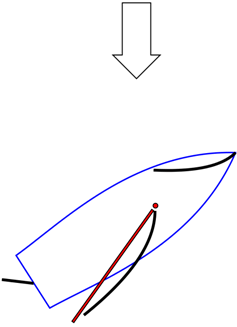
“There are some interesting differences in English and American English. For instance, we ‘go for a ride’ whereas you would say we are going for a ‘horseback ride’! And I don’t think we use the term ‘sailboat’, preferring dinghy, yacht and motorboat. As far as yachts are concerned, in ‘Nightshade’ there was reference to a ketch. Not sure whether the main character was deliberately unaware of nautical nomenclature (?) but by definition a ketch is a two-masted yacht, the smaller mast, called a Mizzen, stepped forward of the rudder. The other two-masted yacht is a yawl, where the smaller mast is stepped aft of the rudder, with its boom often overhanging the stern of the yacht. A single masted yacht can be referred to as a sloop. I read that Michael doesn’t read emails …… so do with this information what you want!”

His PA Jane replied saying she would pass on my email to Michael. I obviously hope the great man will reply personally!

Richard 22nd August 2025

Estoril Portugal

www.postcardscribbles.co.uk

Note 1 Another term for Murphy’s Law, which states that if something can go wrong, it will.

Note 2 ‘A’ Levels and Alaska are this week’s common words