PC 193 Stuck in The Lift!

Next month Celina and I will celebrate nine years together, although last week we celebrated our fourth wedding anniversary. Marking important events gives us a framework on which to build our lives, to be corny, putting flesh on the skeletal outline of the predictable sequence of ‘birth ….. marriage(s)…. death’.

Living in the half-life of Covid, we decided to have a night in a hotel, having been assured that it was safe! And it was! There were hand sanitisers everywhere and masks were obligatory in the public areas, except at the Terrace restaurant’s socially distanced tables when eating; at least they recognised that difficulty.
PC 193 1

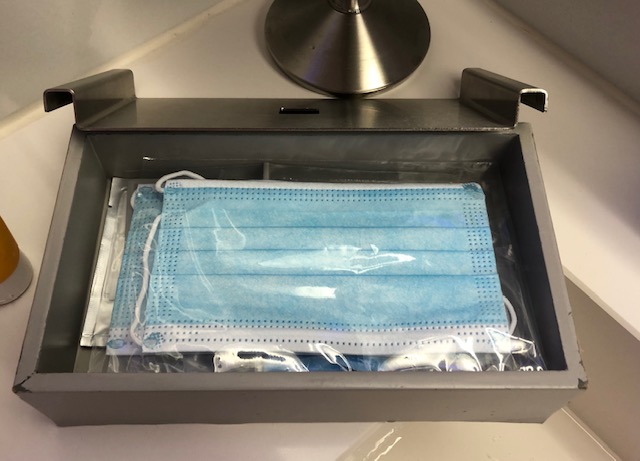
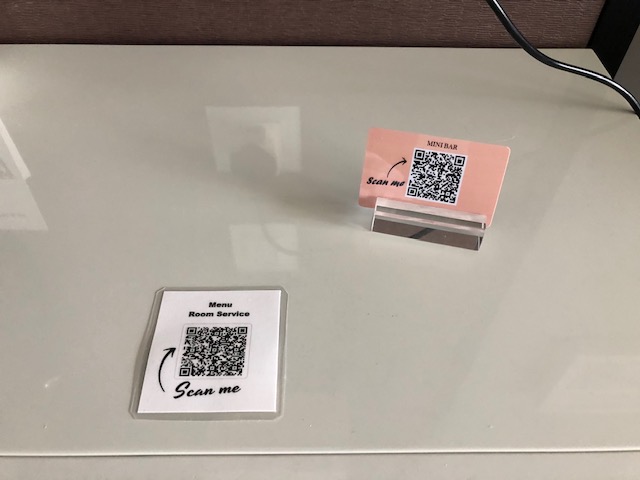
In our room where one might expect a box of tissues there was a box of masks; the mini-bar and coffee machine were wrapped in a paper that indicated they had been sanitised. The mini bar price list, hotel facilities and even the menu for supper were accessible through your smart phone camera.

PC 193 2

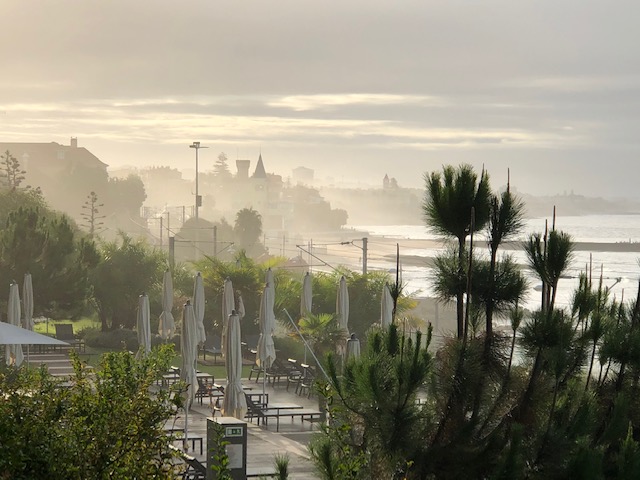
Back on the Terrace again for breakfast. I imagine we may have seen the death of the ubiquitous ‘Breakfast Buffet’, those tables groaning with every conceivable need for the famished guest. I remember a Norwegian one in Voss where fish was predominant or Far Eastern ones focused on fresh exotic fruit. Today one guest’s cough and the whole table would need to be consigned to the incinerator! It was a misty morning and Estoril and its Forte da Cruz looked rather enchanting.
PC 193 3

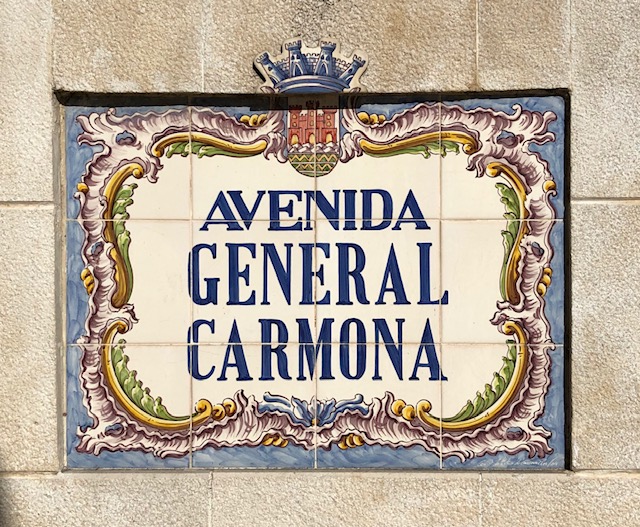
Later Celina and I returned to the apartment on Avenida General Carmona (Note 1)

PC 193 4

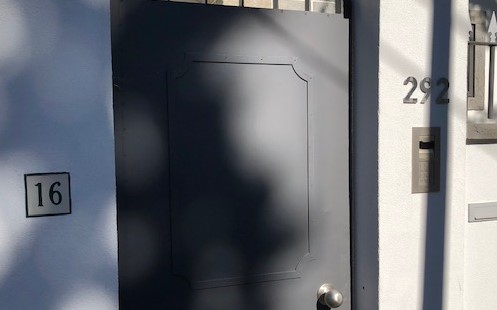
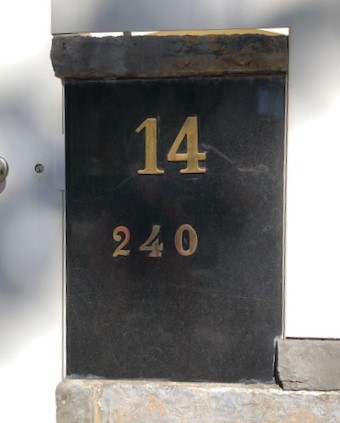
As an aside, for some reason known only to the Portuguese authorities, the house numbers on this four hundred metre street are being renumbered. Previously they had run from No 1, obviously, at the bottom with even numbers on one side and odd on the other, to the top, No 26. Now, No 16 for instance has been made 292, two hundred and ninety two, No 14 two hundred and forty (240!) And why would you leave the old numbers up? Go figure!

PC 193 5


PC 193 6

At the bottom of the street stands one of the largest casinos in Europe, not some embryonic housing complex …… that I might understand.

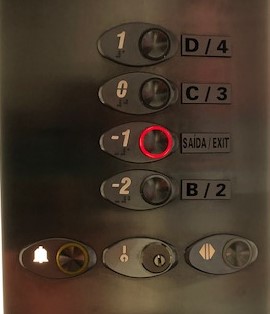
Having dropped off our overnight bag we headed for the pool as the sun, which had been reluctant to make an appearance when we had been at the hotel, had changed its mind! An hour and a half later we made our way inside and entered the lift. The pool is at -2 (Note 2); we needed No 1 …… and we both needed the loo! We pressed the button, the doors closed, and the lift ascended ……. a few feet …… and shuddered to a stop ….. briefly ….. before going back down with a bump. We pressed the floor button again; nothing happened! We pressed other floor buttons in that vain hope that that would make a difference …… but all we got was a row of red circles but no moving jackpot. The lift was made by the reputable company, Otis, and designed to hold 8 people or 630kgs; surely I hadn’t put on that much weight since lockdown on 23rd March?

Celina is Latin by temperament and by looks so tends to get excited very quickly, although we had both realised we were stuck in a lift, neither going up nor down. She pressed the button with a ‘bell’ symbol a number of times and eventually the emergency control room answered.

PC 193 7

A team was dispatched. We also banged on the doors to attract the attention of others in the building. (Note 3) It was getting warm inside and we both began to sweat. Internally I was trying to remember which films had people stuck in a lift and what the outcome was. Were we going to see Bruce Willis or Jason Stathan pull the doors open with their bare hands, the aluminium crumpling under their efforts …… or would we have to wait until Jorge or Costa arrive, puffing on their cigarettes and pulling up their blue, stained work trousers?

We both wanted the loo ….. and as the minutes ticked by there was little else that took our focus away. We did an inventory; a small empty tonic water bottle and two rather damp pool towels. If push came to shove, towel or bottle, or …….

Celina got a bit emotional, imagining we were going to be stuck for hours, but by now her loud banging on the doors had finally attracted her family’s attention (note2). Camila and Cecilia arrived outside; sort of comforting to know but it did nothing to relieve our bladder pressure!! By now I was dripping with sweat as if I was in our hot yoga studio, not a metal box stuck somewhere between floors. True to their promise, Jorge and Costa eventually arrived, 5 o’clock stubble and blue trousers in evidence, used a key to allow them to open the doors manually (no need for Willis or Stathan), and we were out in the daylight; the relief, both emotional and physical, was palpable. Not a pleasant experience although this is not a tall building; imagine being stuck in a lift in, for example, The Shard in London, with its 95 floors. Not daring to take the lift, we raced up three flights of the stairs to find a loo – always a difficult manoeuvre when your bladder is full!

Life on the edge!

Richard 26th August 2020

Note 1 General Antonio Carmona was President of Portugal from 1926 until his death in 1951. He appointed Antonio Salazar as prime minister and allowed him to run Portugal as an authoritarian dictatorship whilst his own powers became largely ceremonial. Just over twenty years after his death, in 1974, the Carnation Revolution saw the establishment of a modern democracy. Compare with Spain’s dictator General Franco who ruled his country from 1939 to his death in 1975.

Note 2 For other example of odd decisions by architects, the entrance level to the building is -1, the first floor is 0 and the top 1!!

Note 2 You could imagine someone in one of the apartments hearing a muffled banging noise and them thinking it was builders down the street …… and carrying on doing whatever they were doing!


PC 192 Why You Should Try Something Different – Ceroc?

In the coming months I suspect we are all going to have to be more open to different ideas, be more creative to achieve what we want to do, more accepting of restrictions and understand their necessity. When the future is uncertain and confused, it is natural to be cautious but it’s important not to let caution become a suffocating habit. Let me illustrate this from my own experience.

It was a busy late afternoon in early October, you know, when one begins to sense the evenings drawing in and feel the hint of autumn in the air; must have been about 1993. The Morgan & Banks office was in Brettenham House, opposite Somerset House on the north side of Waterloo Bridge in London. My desk telephone rang. (Note 1) It was Sophie, a bubbly friend who had established herself as the Office’s caterer for Boardroom lunches. Those of you who regularly read my PCs may remember a visit Celina and I made last year to The Anchor in Walberswick, run by Sophie (PC 153  Courgette Neutral June 2019).

“Why don’t you come Cerocing?” she screamed – she always screams, does Sophie.

“What the hell’s that?” I asked defensively, my alarm bells ringing, immediately thinking of reasons why I couldn’t/wouldn’t/shouldn’t!

“French Rock & Roll (See Note 2) – it’s great fun and I’m getting a party together – Thursday in Fulham; see you there about 7.30.” ……. And with that she ended the call ….. probably without hearing my “Not sure it’s my thing but thanks anyway.” Much relieved, I put the phone down and got back to work, resigning myself to the fact that Sophie rarely took “no” for an answer. Sure enough, two days later, another call to seek my participation!

“Come on! It’ll be fun.”

“But I’ve never done it/I can’t do it!”

“Doesn’t matter; everyone’s got to start at some time.”

“Thanks but no thanks!”

PC 192 Ceroc 1

All shapes and sizes have fun

Then on the Thursday morning a final “COME ON” – I had nothing on that evening but still my inclination was to say “no”. Yet the request and my response to it had me niggled; why had I been so dismissive, why did the negative response come first, particularly as I really had no idea what Cerocing was. Oh! Of course I could imagine …., I could visualise the evening … a disaster …. uncomfortable …everyone pointing to the chap who couldn’t do it.

Eventually, on my way home from the office on the Northern Tube Line, I began to take a more rational approach to my thoughts. OK, so I didn’t know what Cerocing was, so why shouldn’t I find out? I had never danced Rock & Roll effectively in the ‘60s, never did master Chubby Checker’s The Twist, but that should be no barrier to trying it now. “Oh! I see, you think everyone else will be able to do it quite well, and you won’t and you’ll feel stupid, inept, embarrassed by being completely uncoordinated. And anyway, what sort of people go Cerocing anyway, would I have anything in common with them?” the thoughts rumbled. Rational brain said I had no answers to these questions as I had never experienced it … so why didn’t I try it? Whoa! Get out of my comfort zone and try something different? No way! But why NOT?

My mind in turmoil, I eventually decided to call Sophie and tell I was coming. She was predictably delighted and I took down the directions to the ‘Dance Hall’, trying all the time to push the seeds of doubt further and further away.

I arrived in Fulham Broadway and found the alleyway – as I passed the flashing arrow pointing to the venue I almost, almost turned back! Then the sign-in, the table lit by red lights and the sound of music beginning to lift my spirits – “in for a penny, in for a pound” I thought. I made my way into the hall, looking for Sophie, but am met by an amazing sight: on the stage a couple with throat mics are explaining the next step whilst on the main floor six lines of dancers, alternating between all male and all female, filled the space, practising as instructed. At the end of the sequence, newcomers were asked to join a line.

Suddenly I find myself in front of a girl I’ve never met – “I’ve never done this before” I mumble by way of excuse. “Don’t worry, not many people have, let’s just enjoy it.” And so we did! Every so often the lines moved so that you danced with someone different and gradually, so so gradually, it all began to make sense. And the evening is now a lovely memory of music and dancing and fun – but more that that.

PC 192 Ceroc 2

Maybe this Ceroc move requires some practice?

It’s an important reflection of why you shouldn’t let your perceptions put you off from trying something new.

Richard 20th August 2020

Note 1 An office was somewhere you went to work BC, to engage with your work colleagues, to exchange gossip over the water cooler. We each had our own desk and could book a small meeting room where, in my case, I could meet clients. My ‘desk telephone’ was a landline with push-button controls; ‘the mobile’ was a bit of a misnomer as they were the size of a house brick and you needed to work-out in the gym to lift them. One person in the office had a ‘dial-up’ internet connection; that dialing sound remains with me as an example of technological change!

Note 2 The name ‘Ceroc’ is said to derive from the French “C’est le roc” (it’s roc), used to describe rock n’ roll dancing in France. Ceroc is an international dance club which has with over 200 venues across the UK as well as national and regional competitions and weekend events throughout the year. It also has franchises in many other countries in Europe, Asia and in The Antipodes.


PC 191 Not Normal Behaviour? Well, maybe now!

I started PC 189 with: “You remember back BC (Note 1) when we couldn’t envisage the future and we made plans …..” and I was thinking how to start this little scribble ……. and rather liked that ‘You remember back BC …’ because it’s possible that we will contrast much of our behaviour today and in the coming weeks and months with what we did BC.

BC we read people’s faces in an unconscious manner, looking for tell-tale signs of emotions, the whole gamut from happy to sad, from delight to disgust, from friendliness to suspicion, from openness to ‘keep your distance’, from love to hate. The list and pairings are endless. From two metres with reasonable eyesight you could pretty much gauge the messages, up close and personal definitely. Now ‘up close and personal’ is seen as an invasion of one’s space, as a mark of disrespect. For those whose natural inclination is to hug and French kiss at any opportunity, these new-found rules are hard to abide by. For those who are very internally focused and emotionally cold-blooded it’s a godsend; they see everyone behaving just like them!

Then comes the wearing of the mask, which the majority of us believe is a sensible way to shield oneself and others from airborne germs. There are those who want to kick against the perceived threat to their personal freedom and liberties and talk of court action – poor souls. The mouth, that wonderful feature that tells tales, conscious and unconscious, is hidden. My comments in PC 189 about unconscious communication and its difficulty wearing a mask prompted many comments. One highlighted the difficulty of the paramedic, communicating within the team and with the individual, the focus of their emergency call-out. Reading personal accounts of hospital staff coping with patients in the intense days of the pandemic reinforces how we have to consciously change our facial features to ensure the messages are received.

The other evening my brother-in-law celebrated his birthday and a few friends were invited to share some Thai food and the cake. Should I wear a mask? Well, these people hadn’t been out of Portugal since lockdown so we assumed (?) they were Covid-free …. but we didn’t know! Later in the evening I realised how hypocritical I had been, chastising those in the UK who had attended parties with scant regard for spreading the virus and yet here I was, surrounded by strangers with hardly a social distance in evidence. But of course in a nod to the new behaviour, we did ‘elbow kiss’ or ‘bum bump’ as they arrived!

Today I overheard a scene that would not have happened BC. Firstly let me put my hand up and confess my knowledge of the Portuguese language is only marginally better than it was eight years ago which, given that then I had ‘da nada’, is not much to crow about! I had gone to the local upmarket grocers (read PC 141 Saloio from December 2018) to buy some supplies. They had a visibly stated policy of only allowing a certain number of people into the store at any one time, so there was a small queue on the narrow cobbled pavement of Avenida de Nice, although its masked participants were not socially distancing (so 50% OK!). I watched a woman and two children lift their purchases onto the checkout desk; as always when shopping with small children there were things in the basket that she hadn’t chosen but with some discussion with the animated children one or two items made it through the checkout. At the head of the queue outside, whether ‘at the head’ by taking her turn or by barging in with the air of entitlement, was an older woman, let’s call her Renata, clearly frustrated by having to wait:

“Children aren’t allowed in the shop. Come on! Hurry up!” Renata muttered in a voice clearly loud enough to be heard inside. The woman at the check-out looked up, acknowledged the other one, finished packing her purchases and paid the friendly staff. As she left she said to Renata who was already pushing her way in, completely oblivious of two little children and shopping bags:

“Now you can go in!”

Well, you could sense that this was a trigger, this well-mannered and quietly-spoken comment, to Renata whose fuse was set at danger.

I’ll paraphrase with my own personal observations.

“You stupid woman! Don’t you know that children are not allowed in the shop? I can’t afford to wait, as I have a very busy and important day.” (Note 2)

Raising her voice into a scream, twisting her face into a grimace, sure of the righteousness of her opinion, she wasn’t expecting anyone to dare a retort!

(We were all, shoppers and staff, who I later found out considered Renata always rude, were transfixed, frozen in the moment, awaiting the next interaction!)

It was clear that such selfishness deserved a response from the woman who, by now, was already on the pavement.

“Actually, you rude cow, children are allowed in and if you have such a busy life, why don’t you f**king shop when it’s less crowded?” she shouted at Renata.

Renata strode back towards the entrance, puce in the face, basket in hand and flustered: “How dare you talk to me like that; you don’t even know who I am! Bitch!”

The woman on the pavement screamed something like “Go f**k yourself!” and walked away, red-faced and probably inwardly regretting her own inability to control her temper.

Anyway this was only my reading of the situation, as the words were ‘lost in translation’! I couldn’t imagine this happening BC …… but maybe it did occasionally?


Richard 13th August 2020

Note 1. BC short for Before Coronavirus

Note 2. Somewhere in PC 141 I wrote: “…… a member of staff coming up the stairs clutching a single item asked for with an imperious tone and raised eyebrow in answer to the ‘they are downstairs madam’ response. The old-moneyed Europeans mingle with the nouveau riche, both stretching past one for a packet of smoked salmon, without any consideration or acknowledgement of your existence. There’s a certain haughtiness, a sense of birth right, that gives them the confidence to act in this rude way, whether the disdain is obvious or not.”

PC 190 Up My Nose!

For those of you who follow my Face Book postings, you may have seen something about my nose? I have a nose for a good story and used to have a nose for a good Shiraz but this was about my physical nose.

Let’s cut to the chase; my mother-in-law was due in Portugal this week from Brazil and is in a ‘high risk’ category for Covid 19 (She arrived safely on Wednesday thank goodness.) Common sense said it would be sensible for Celina and I to have the virus test; after all we have come from a country where the pandemic has caused widespread suffering. As we didn’t have any symptoms, to be able to access a test a doctor’s prescription was needed. We had to book and pay for individual appointments, although in the end we were seen together! I might have imagined this gave the very overweight but charming doctor the opportunity to go outside for a cigarette break. Then on Monday we went to the Convention Centre (aka Covid 19 Centre) here in Estoril.

PC 190 1Covid 1

Forming filling, passport checking, another 200 euros across the counter and we wait on social-distanced spaced-out chairs in the cavernous building.

PC 190 2

We are called forward individually. I go to Room 4 and am directed to a chair. The swab is shoved up the left nostril of my nose ….. I am reminded of cleaning a rifle’s barrel with a ‘pull through’ ….. it feels as though the swab is going to pierce my forehead ….. instinctively I push back on the small plastic chair. I had been instructed not to close my eyes …… but as the discomfort seems to reach a climax I realise I have done exactly that! I do not apologise!

It’s over and I leave; the results were emailed to us within 24 hours and we are negative. When I read of the search for better means of testing for Covid 19, such as using saliva, to avoid the invasiveness of the swab test, I now know what they mean.

If you Google ‘nose’, apart from the obvious links to descriptions about the proboscis (Note 1) that sits between your eyes, you get ‘The Nose’, a short story by the Russian author Nikolai Gogol, ‘The Nose’, an opera by Dmitri Shostakovich and ‘The Nose’ aka El Capitan, a particular difficult climb in the Yosemite National Park in California.

‘The Nose’ is satirical short story by Nikolai Gogol, written in 1835 during his time in St. Petersburg. It tells the story of a City official whose nose leaves his face and develops a life of its own. The use of iconic city landmarks by way of illustration, as well as the sheer absurdity of the story, has made this an important part of St. Petersburg’s literary tradition.

Over 90 years later Dmitri Shostakovich picked up the story and scripted an opera called ‘The Nose’. I am not a Shostakovich fan but the little snippet on You Tube of the Royal Opera House performance (24 November 2016) of the ‘noses’ tap-dancing is both intriguing and delightful.

PC 190 3 The Nose Shostakovich

I have done some hill walking in the Brecon Beacons and in the Lake District, been targeted by swarms of the Scottish midges strolling up Ben Lomond and abseiled down cliffs, but I have never been that interested in actually climbing mountains. That said, I do have ‘Climbing Wall Centres’ on my ‘To Do’ list for a bit of fun; maybe a bit contrary huh!

PC 190 4 El Capitan

The Nose, El Cap, otherwise known as El Capitan, is a vertical rock formation in Yosemite National Park, located on the north side of Yosemite Valley, near its western end. The granite monolith is about 3,000 feet (914 m) from base to summit along its tallest face, and is a popular objective for rock climbers. The top of El Capitan can be reached by hiking out of Yosemite Valley on the trail next to Yosemite Falls, then proceeding west. For climbers, the challenge is to climb up the sheer granite face and that has now been climbed by ‘free climbers’ ie those not using ropes or pitons etc. BASE jumping from it is currently illegal.

PC 190 5 Nose diagramme

The nose is a particularly delicate part of my anatomy. On a positive note I use it to filter the air I breathe, to smell my surroundings and food; on a negative note it drips when I have a cold and blood flows from it when I bang it – or someone else bangs it! It’s the most prominent structure between my eyes, contains the olfactory organ and is the entrance to the respiratory tract. The air I breathe in is cleaned, moistened and warmed and the nose cleans itself of any foreign debris that I have inadvertently inhaled. Good eh!

When I was a teenager I suffered for years with poor quality sinuses. If you have never heard of the sinuses, they are a connected system of hollow cavities in the skull. The largest are behind your cheekbones, the smallest low in your forehead. They produce mucus that moisturises the inside of your nose.  Sinusitis gives you the most horrendous headache, probably on a par with a migraine, although fortunately I have never suffered from one of those. There was a progression in the treatment; I had all three. First they were washed out, with a pressure pump stuck up your nose; I remember today why it was a pressure pump! That didn’t work, so I had them cauterized with a wire stuck up my nose and into the sinus cavity; then the doctor turned on the electrical current …….. I could smell my flesh burning! Yuk. That didn’t work, so I went under a general anaesthetic and had them enlarged, the drill going up my nose! It’s a useful access, the nose!

PC 190 6

When I think of noses, some cartoon characters immediately come to mind.  Pinocchio, for example, the wooden puppet of an 1883 Italian children’s novel whose nose had a tendency to elongate when he lied, which he did frequently. Or each of the Seven Dwarfs (apparently the politically correct word; not midget!) who all had big noses. I also think of the actor who played Cyrano De Bergerac, Gerald Depardieu, as he has a very large nose!

Richard 7th August 2020

PS My family name on my maternal grandfather’s side is Nation. Looking back over old photos it’s easy to see the resemblance past and present – the ‘Nation nose’ is quite prominent.

Note 1: The word Proboscis refers to a mammal’s nose, although strictly one which is long and mobile, like that of an elephant or Tapir.

PC 189 With Some Trepidation!


You remember back BC when we couldn’t envisage the future and we made plans ….….. that this year included seeing Celina’s family in Estoril over Easter. As we booked the TAP Portugal flights we thought even further ahead and also booked flights to cover the month of August in the sun. Little did we know the whole world was about to be turned on its head, or arse depending on your view.

Our Easter flights were cancelled and we have a voucher for future use with TAP Portugal. As we lived further into the lockdown period, we prayed we would still be able to go to Portugal on 28th July. At some point Celina was checking the airline’s flights from Brazil and in a ‘while I am on the website’ sort of moment, checked our July flights were still there. Nothing showed! We rang the airline in Portugal; I won’t bore you will the length of the call and the number of times we were put on hold etc etc as that, sadly, is an all too familiar experience, but eventually we talked to Gustavo.

We are not flying out of Gatwick in July so had to cancel your flight.”

(Unspoken, as we wanted to keep Gustavo sweet and didn’t want him to hang up , …… “But why didn’t you tell us and explore some of our options?”)

He rebooked us on a flight from London Heathrow for the same day. And so it transpired that on Tuesday we were due to fly to Lisbon. Two days before, the Prime Minister surprised the whole country and those 600, 000 tourists already there by adding Spain to the list of countries from which returnees would have to isolate for 14 days. Difficult if you are only allowed to take 14 days holiday at one go.

We had packed; we had a chum coming to stay in our apartment; we had the taxi booked to take us to Terminal 2. Still ….. Monday night was spent tossing and turning ….. should we or shouldn’t we. ……. imagining this and that …. and some of the other? A little bell was reminding me that my travel insurance probably would be invalid as the UK’s Foreign Office had advised against non-essential travel to Portugal. Maybe that health agreement whereby UK NHS registered individuals could access Portugal’s health care system would be honoured? Was it worth the risk? I should add that it was our intention to simply spend five weeks in Celina’s mother and cousin’s apartment, which has its own pool, not join a group of fifty somethings wanting to relive their youth in the local Cascais nightclubs or boogieing the night away at a BBQ on some distant beach. And anyway Portugal had been remarkably successful in dealing with Covid 19, far far better than the UK, so it wasn’t exactly jumping out of the frying pan into the fire or indeed vica versa. The doubts rumbled around over breakfast!

Sam picked us up and drove us to Heathrow. We hadn’t spent so long with someone in a car for a while and as we talked, I realised something was different. When you meet someone of the first time we automatically look at their eyes; if we find the eyes friendly our own eyes drop down to the mouth – more information gathering at a sub-conscious level. Our Covid 19 facial masks hide a real contributor to the conversation, the visual inputs now limited to the other’s eyes and eyebrows. You have to work harder at a conscious level to convey the intended message. Some people naturally have smiley eyes; for most of us it’s something we are going to have to work on if the wearing of masks becomes a way of life and not just for those attending a Venetian Ball.

PC 189 1

Apparently there is a shop in Brighton only selling facial masks!

At Terminal 2 there are one or two shops open for the few passengers in evidence; everyone is socially-distancing, wearing their personal choice of mask, and looking anxious. We board and taxi to our take-off position. No aircraft are landing and there is no queue of planes on the tarmac, neither in front nor behind us. Normally I am always like a child, fascinated by the long line of landing lights fading up into the sky as the aircraft make their decent towards the apron. Not today! We take off slightly early and fly out over the Isle of Wight, arriving over France on the western side of the Cherbourg Peninsula, and on over the Channel Islands of Sark and Jersey. We’re over Ushant, situated on that North West corner of France and I am reminded of our ferry trip from Portsmouth to Santander on the northern coast of Spain in 2018, when their course takes them through this rocky stretch of water.

My reveries are interrupted by a paper form that’s stuck rather unceremoniously under my nose. We borrow a Biro from the stewardess, for the form wants the details of where we are staying, our mobile numbers, full names, sex, shoe size (no! not really!) and our home address. I have read that some Covid-vaccine deniers think a microchip might be slipped under your skin as you have the little prick of the vaccine needle. This will give Big Brother the ability to access details of your life. (Some people actually believe this rubbish!) This form was enough ….. and I was filling it out very readily!

PC 189 2

The mask is hot to wear for a long time and I reach up to angle the ‘fresh’ air nozzle onto my face. The distance between the rows of seats is adjustable depending on the carrier, the position of the nozzles not. The best I can achieve is for the jet of cool air to hit – just behind my shoulder.

PC 189 4

Flying over Lisbon before doing a 360° turn to line up the approach

We land safely at Lisbon. There’s always one individual who has to be the first to stand as soon as the aircraft comes to a stop, as if they will gain a few seconds and lemming-like the rest of the passengers follow, only to stand bunched in the aisle until row 3 has cleared. Social distancing? Nah? At least they restrict passenger numbers on the coach that took us to the terminal building.

PC 189 7

The Sintra hills in the distance, the Monument to the Discoveries in the foreground on the shore.

On the way up the escalator to ‘Passport Control’ I realise this is my first European flight since the UK left the Union at the end of last year; we are currently in a ‘transition period’. So ‘EU Passports’ or ‘Non-EU Passports’? My burgundy-coloured EU passport is still valid so we try that line. We are through without a hitch. Bags collected and on our way towards Estoril within 40 minutes of landing – without any trepidation!

Richard 30th July 2020

PC 188 Did I Plan my Life? – A Sequel to PC 181

The current pandemic has laid bare a number of myths about the way we live. For instance we have always imagined that the government had stockpiles of ‘kit’ to cope with whatever contingency it faced, be it providing aid to a hurricane-devastated country, coping with heavy snowfalls or managing a health pandemic for instance. In the same vein I used to imagine, in my youth, that my National Insurance contributions were going into an account with my name on it, the government would match them and it was this money, with compound interest added of course, that would pay my state pension when I got to 65 or whenever. Sadly these are just myths!

I have a somewhat jaundiced view that politicians and civil servants often put off making decisions …… until Friday. That afternoon they look at their desk, thinking they should clear some of the stuff before the new week starts and by 1600 they have done so – having no thought to the on-going consequences of those decisions. When I worked in an Army headquarters in Salisbury back at the beginning of the 1980s, we reinforced the British contingent in Belize once and upped the troop numbers in Northern Ireland twice – the decision in each case coming on a Friday afternoon. As we laboured all weekend on the logistics needed to action the plan, the cynic might believe that the decision-maker was enjoying a glass of Pimms in his or her deckchair!

There is obviously a lot of planning within the Army, at all sorts of levels, but it’s widely recognised that at the very basic level, all planning goes out of the window when the first shot is fired. Fortunately individual and unit training kicks in as soon as the battle starts.

I planned to stay in the British Army for ever, but by the time I was 39 I felt I had had the most fun I was going to have; then I was offered a sales role with Short Brothers. Flattered by being asked without any attempt to solicit an offer, I made no effort to check what the alternatives were; no plan! Short Brothers was an interesting company. Founded in circa 1898 by three brothers who in addition to having the surname Short were all vertically challenged, they claimed the first global contract to build six aeroplanes for the Wright Brothers in 1906. Mr Rolls and Mr Royce were chums! During the interwar years Shorts built flying boats, for the government wanted to open up the empire and saw air travel as the way to do it. During the Second World War Shackleton and Stirling bombers came off the production line from their Belfast-based manufacturing facility. By the time I joined they were making short-haul aircraft for the commuter market, huge aircraft composite wing and tail assemblies and SAM missiles. I always thought it ironic that they made things that could fly and things that could destroy things that flew!

Working on the sales side out of a suitcase and the London Office, I took over the ‘India and the Far East’ patch. I planned to stay until I retired! What I hadn’t planned for was the 1991 recession, which was vicious and deep. Turning down the option to work at head office in Belfast, I took redundancy. Emotionally it’s like being punched in the face; in an open-plan office the ‘return to your desk and clear your things’ was accompanied by the awkward glances of those remaining. Even the rational me couldn’t uncouple the fact that it was the role that had been reorganised and I took it personally. How we handle change defines us and like all situations, there are pluses and minuses.

This recession was the first time companies here in the UK wanted to support their departing employees by giving them ‘Outplacement’. (Note 1) So I joined Morgan & Banks that, inter alia, provided this service, helping people repackage themselves, giving them the tools and techniques necessary to find new employment. I have Varina who ran the London office to thank for this opportunity, one I grasped wholeheartedly! I sense I grew from a rather dried wrinkled chrysalis into a butterfly; not an exotic one like a Red Admiral, more a Cabbage White – I felt I had found my ‘Element’ (Note 2)! Of the many successes, two will illustrate what made me smile. Carol had left a senior role in an animal healthcare company. After working with her for a few sessions, I asked her who she would like to work for, be it a company or an individual. There was no hesitation; “John Manners” (not his real name!) – and she went on to tell me why. So we hatched a plan for her to meet him …… and her enthusiasm got her a role that hadn’t been advertised.

Andrew came out of the financial services sector, one of thousands ‘let go’ in early 1993. “More of the same please” was his response, but given the lack of roles available, I suggested he explore alternatives. He had a passion for wine, for its production, for the whole viticulture world.

“So do you see yourself working in the industry?”

“If I could, of course! I’d work for Tony Laithwaite (note 2) like a shot!”

“Do you know him?”

“No!”

So we talked around how he might get to meet him; he rang me a few days later to say that he was going to a wine tasting evening and he’d been told Tony Laithwaite would be there. We met to rehearse that initial chat – this we planned! The long and the short of this tale is that he got invited to their Head Office for an interview.

So working one-on-one with individuals in a business coaching capacity became my next career …… one that lasted over twenty years ……. and one  certainly not planned!


Richard 24th July 2020

Note 1: It was such a hideous term but it stuck; I preferred Career Transition.

Note 2: Ken Robinson’s excellent book ‘The Element: How Finding Your Passion Changes Everything’ is a ‘must read’, particularly for those who haven’t found their element.

Note 3: Tony Laithwaite had become extremely successful at selling wine in the UK.


PC 187 Numbers (3)

My first two postcards about numbers (PCs 176 and 177) were written in April this year and I still have more thoughts about numbers running around inside my skull. For the past two weeks I have been engaged in a little creative constructive DIY. The result has been very pleasing even if I say so myself, but my mind has been full of numbers, for instance the measurements of bits of wood, both lengths and of cross-sectional size and of numbers and sizes of screws.

When engaged in some form of carpentry, there is a saying that you need to keep at the forefront of your mind: “Measure three times and cut once” and I was reminded of something that happened way back last century; a classic example of miscommunication if ever there was. My first wife and I had bought a marble-topped table in a second-hand shop and we both recognised it was too tall for where we wanted to put it. We ‘agreed’ to cut something off the legs, except she meant the finished height should be 70 cms from the top, whereas I thought it would be a low coffee table and took 70 cms off the bottom!!

PC 187 1

Map reading skills are a delight to acquire and we are lucky here in the UK that the Ordnance Survey produces maps with amazing detail; a glance as some other countries’ maps will make the difference obvious. Reading a map well gives you confidence moving across the country, although I appreciate that electronic maps and Global Positioning Systems can give you good accuracy without the romance of an old-fashioned map. Navigating using a map over land or a chart at sea requires taking a bearing and converting it to ‘magnetic’ for use with a compass, whose needle is affected by the earth’s magnetic field. When I was doing my military service or sailing offshore, the mnemonic ‘grid to mag add, mag to grid get rid’ served us well as the variation was some 4 degrees ……. and mistakes happened!

The tour of the French beaches and hinterland of Normandy was a highlight of my Staff College course, as those who had fought on D-Day on both sides recounted their stories at the very spot where the action had happened. For some of us it was an opportunity to sail the 60 miles from Gosport to Trouville on the north coast of France. I skippered a Nicholson 43 and we had an easy and safe passage. An hour after our arrival one of the other skippers, who I knew well, took me aside up on the harbour wall and quietly questioned whether you added the magnetic variation or not, as they had missed the channel entrance!! (Note 1)

But I now read that in September 2019 ‘magnetic’ north and ‘true’ north aligned, in Greenwich, London at least, for the first time in 360 years and will remain so for some years to come. A relief for some no doubt!

Some years ago I was sufficiently anal to record all the sunrise and sunset times over one year in London. I was keen to find out why and when it was noticeable that the days were getting longer/shorter. Then I plotted the results (times are GMT) thus:

PC 187 2

At this time of year in the Northern Hemisphere we are currently enjoying longer evenings as the sun had reached its northerly point on 21st June, the ‘summer solstice’, and that gives us here in Hove 16 ½ hours of daylight. At the top of the curve it appears as though the sun just hangs there before it starts its long descent towards the shorter days of winter. Actually the numbers support this. For a week after the longest day the sunset time doesn’t change (BST 21:18) and the sunrise time only by a mere 3 minutes (from 04:46 to 04:49). Now almost three weeks into the second half of the year we have lost 15 minutes of daylight.

I am sure you’re bored about my fascination and addiction to the 26 postures and 2 breathing exercise sequence, practised at 40°C (before Covid!), put together by Bikram Choudhury that was known as Bikram Hot Yoga. Now, because of Choudhury’s behaviour, the sequence has taken on the term 26-2 Hot Yoga. It’s coincidental that the distance of a modern marathon run is 26.2 miles.

When I was at school numbers were I, 2, 3, up to 9, essentially the decimal or Base 10 system. Other systems are the Binary, Octal and Hexadecimal. We have become familiar with the binary system, Base 2, as the basis for computer language, where 0 represents ‘off’ and 1 represents ‘on’. For example 348 becomes 101011100 – if you divide 348 successively by 2 you get a zero if it’s even and if odd you get a 1. Not sure why the bottle of scent by eccentric is called 01100101 but looks very modern – and smells wonderful!! And equates to 101 in the decimal system

PC 187 3

Of course the visible sign of the binary system is the barcode attached to every manufactured item – and actually even on non-manufactured items, like the weight-ticket from my online-bought bananas.

PC 187 4

Many years ago I read Aldous Huxley’s Brave New World, written in 1932 about life on earth in 2540. I don’t remember whether he imagined we would all have barcodes on our skin or a simple chip embedded in our shoulder but I can sense some benefits!

Some numbers are easy to understand, to assimilate, others just so mind-boggling they simply become ‘a number’. We are all vaguely aware that the earth revolves around the sun, along with a host of other planets, but do you have any concept of the scale of these rocks? Because I think this is a fascinating set of photos, I thought I should share them (Note 2) They don’t need any numbers, or indeed any commentary; the comparison of scale is just extraordinary.

PC 187 5

PC 187 6

PC 187 7

PC 187 8

And to bring you back to earth (!), remember that it’s only thirty seconds that stands between a soft or a hard-boiled egg or is the difference between catching one’s train or standing puffing at the barrier!

Richard 10th July 2020

Note 1 Each degree of variation over a distance of 60 miles will result in one nautical mile off course. A 4 degree variation would give you 4 nautical miles off course …… and the entrance to Trouville was a narrow dredged channel you approached on a transit and accessible only for a two hours either side of high water.

Note 2 Quoted by Ken Robinson in his excellent book ‘The Element: How Finding Your Passion Changes Everything.’ ….. a MUST READ for those who don’t enjoy the work they do, for they haven’t found their element.

PC 186 RUBBISH

You might think that rubbish with an exclamation mark is simply the shout of the drunk at an onstage comedian trying to earn their crust, or maybe a cry of derision at an attempted goal in some crucial football match. In either case the owner of the exclamation probably wouldn’t have the guts to be the individual on the receiving end. Hey! Ho!

But rubbish, without that exclamation mark, has become one of the most important issues of our time, how to change our habits, how to deal with the detritus of our throw-away society and how to improve the environment. This PC is prompted by what happened in the last full week of June, here in Brighton & Hove. The weather that week was actually quite warm, about 30°C, and the pandemic lockdown was easing. It also coincided with the end of the virtual term exams for our 16 year olds. Hundreds of teenagers descended on the seafront, intent on ‘having a good time’. The mess they left should have shamed everyone who created it, but ownership and responsibility are sadly lacking. Plastic containers, beer bottles, coke cans, Nitrous Oxide gas canisters (note 1), cardboard pizza boxes smeared with tomato paste and grease, portable BBQs, soiled nappies etc.

PC 186 1

At the moment the Co-Op, an average UK supermarket, is offering two pizzas and four Budweiser beers for £5 – with no thought to how the pizza boxes and bottles will be disposed of. I know this because the distinctive blue bags that were part of the rubbish on the promenade!

PC 186 2

The local seafront rubbish bins are frequent but far too small for the summer season; designed to look good but they are not fit-for-purpose. On an average June day the council refuse staff remove 3 tonnes of rubbish from the seafront; on Thursday 25th June 2020 they picked up a staggering 11 tonnes. Social Media went into overdrive, everyone moaning about the appalling lack of this and disgusting lack of that, ‘what’s our society coming to?’ sort of thoughts. The advent of the ‘take out’ and ‘take-away’ has created habits which need changing: if you use a ‘take-away’, take away your rubbish to a bin large enough to receive it or take it home!

I was as horrified as the rest of us but I was certainly not blameless in the past!! Back in the 1970s, when I went sailing we always dumped our rubbish overboard – sans plastic bag (the boiled egg empty shells were, tradition had it, for Davey Jones’ locker!). Empty bottles of gin were thrown high into the air and used tonic bottles were aimed to intersect; the broken glass ended in the sea, without a thought to any harm it might have done.

A house I brought in Battersea in 2000 had a World War Two air-raid shelter with walls two feet thick and a reinforced concrete roof. One weekend, with the aid of a jackhammer and a chum, it was demolished.

PC 186 3

Before, with Tony sizing up the task


PC 186 4

Didn’t take that long – but there was a lot of rubbish!

Most of the rubble ended up in a skip; the balance was put into sacks, fifteen in all, and stacked in the very small front garden to be disposed of later in the week. That night the doorbell rang. “Ev’ning Guv” said Paddy, his broad Irish brogue betraying his traveller roots, “Would yer like me to remove yer rubbish? £65?” I was shamed the next day to find the bags tucked away in other people’s skips only a street or two away!

In the first decade of this century, in company with scores of other dog owners, I walked my Labrador Tom on Wandsworth Common, London, a wide-open patch of grass, copses, lakes, paths etc, bisected with the London-to-Brighton railway line. The common was large enough for the local football league to lay out three pitches and these were well used during the weekends. Traditionally oranges have always been provided at half-time to provide some nourishment and moisture for parched mouths. There was no precedent for leaving the used orange peel, empty plastic water bottles and other player paraphernalia. I asked the referee whether they could take their rubbish home; one of the teams’ Captains came across and told me the Common had council workers who would clear it up! We had a few more words and I continued my walk, shaking my head in sheer disbelief.

Because of Covid 19, the five-day music event called the Glastonbury Festival that started at Worthy Farm in September 1970 is not happening. Last year over 200,000 people attended; the amount of rubbish, brand new tents, wellingtons, sleeping mats, cool boxes, old food etc covering the fields of the site took an army of volunteers a whole week to clear. How could you throw away a perfectly good tent????????

Jetsam and flotsam come to mind when thinking about rubbish: the former items jettisoned overboard to lighten a vessel in distress that have subsequently washed ashore, often to the benefit of the local communities! The latter is simply debris in the water that was not deliberately thrown overboard; an example would be a shipping container half-afloat and a real danger to yachts. I was scribbling some notes for this PC, flotsam included, and that very morning the word ‘flotsam’ came up in one of the word puzzles I complete. You may recall that a number of code words used in the planning for the invasion of northern France in June 1944 appeared in crossword clues in the week before D-Day. Just one of these strange coincidences.

There is often a circular motion to our lives and it simply takes a little observation to notice it. In Wandsworth in London the council ‘tip’ where you could take your old mattress, kitchen carcases, garden rubbish, old broken ironing boards, bottles and other recyclable and non-recyclable stuff was located in Smugglers Way. It was a busy place, particularly at the weekend and queues would form. Immediately opposite was the huge car park of B&Q (originally Block & Quayle) a British multinational DIY and home improvement retailing company. You could watch as drivers left the tip, having disposed of their rubbish, and went straight into the car park to shop for more ‘stuff’ which in a few years would no doubt end up in the tip and ……

I have no space to scribble about oceans of plastic, of fly-tipping, of the buying and selling of rubbish …… but it’s ironic that the generation who protest so much about the need for a cleaner, more environmentally friendly existence don’t care that much on an individual level. Responsibility begins with oneself!


Richard 3rd July 2020

Note 1 Nitrous Oxide, commonly known as laughing gas, is often used to fill balloons which are then exhausted causing those near to feel euphoric and relaxed. Currently it is illegal in the UK for ‘human consumption’ – although you can buy them on eBay! If Nitrous oxide is inhaled through the mouth from a pressurised gas canister or in a confined space it can cause sudden death through a lack of oxygen!

PC 185 Virtual Stuff – Funerals

One of the aspects of living through a global pandemic is that you experience a few ‘firsts’, such as city streets clear of traffic, skies empty of aeroplanes and their vapour trails, the air we breathe noticeably cleaner, and queuing for even the simplest of items. The hairdresser at the top of our road, Gentlemen Prefer Blondes, has been occupied cuckoo-like by a greengrocer; the chairs, mirrors and other paraphernalia remain. We hadn’t done ‘hot yoga’ online before and the little fan heater hasn’t really produced the 40°C heat we are used to. And as all of us, we have had to get used to strangers seeing what’s behind us as we practise – for us, as the laptop is perched on the dining room table, the fridge freezer with its attendant magnets form the backdrop!!

PC 185 1

I queued at our local Post Office Depot yesterday to collect a parcel. The sun was out and it was warm. When you queue with ‘social distancing’ you invariably look on the others in the queue with suspicion, imagining they’re Covid 19 carriers. In pre-pandemic days I would probably have passed the time in idle conversation with those in front or behind; not now!

PC 185 2

At lunchtime on Tuesday we were, and I struggle to find the right verb here, part of a funeral service at Mortlake Crematorium, except of course numbers were limited to immediate family and we were attending virtually. I have to say it was very strange, being rather like a spy on the wall, the camera showing us the scene an owl might have seen from the rafters, and there was no acknowledgement from the funeral celebrant of our out-of-crematorium online existence!!

Normally of course going to a funeral service requires a degree of thought as to what to wear, getting the right balance between being too Victorian and all in black or too colourful and offending other attendees. Given that no one else was going to see us, you might have thought we could have stayed in our PJs ….. but it was taking place after our 90 minutes strenuous yoga and shower, so a proper shirt and blazer seemed to be a brief nod to the solemnity of the occasion; the light green shorts were not in view!

The other thing that was odd was a lack of input into the other senses, the ones you take for granted when you walk into a chapel – a slight coolness maybe, smells of age and of dust and of sorrow and of sadness, and the sounds of silence, of noises outside the building intruding into the inner space. You could see the family mourners and the celebrant and the bier where the coffin would rest on its arrival ….. but the sound was turned off right up until the start-time so you couldn’t hear anything! Very weird!

David’s wicker casket arrived, the celebrant took us through the service, we listened to a poem read jointly by his sons, to the eulogy from his Godson and then sang Jerusalem. You might think I would know the words, and I can get 70% of them, but I needed to Google the lyrics to get really stuck in, for no one had thought to provide an online service sheet. Good to have an iPad handy!

The ‘Virtual Wake’ was more difficult, so we simply imagined that those who had been at the crematorium were having a lovely boozy lunch somewhere, social distancing notwithstanding, and raised a glass in David’s memory later in the evening.

Watching the proceedings got me thinking about other funerals I have been to or participated in – Monkey Mind invariably gets in the way here, despite trying to concentrate on the events from our pitch up on the rafters!

I think my first funeral was actually the worst to handle. During my Army days in Germany, one summer we were at the Bergan-Hohne NATO training grounds north of Hannover. Work hard, play hard was our motto and when we weren’t out on the ranges practising our art, we were propping up a bar somewhere. Two officers went off to a party at the local Officers’ Mess’ and, on the way back, their car left the road and impacted a large concrete culvert. Major Dick Jones, married to Hazel with three children, was in the passenger seat and died instantly; the driver climbed out unharmed. It was decided the funeral service would be in the nearest Garrison Church. As the senior Lieutenant I was added to the pallbearers’ list of his fellow Majors. I remember we practised with a filing cabinet full of sandbags and that dug into our shoulders. Fortunately the coffin was easier.

My nephew Hugh’s brother died of cancer aged 18 and his death came four days after my Mother’s. Attending two close family funerals within a fortnight freezes that period in a dark part of my memory. But my mother had lived her ‘four score years’ and some, as had both my father and my step-father, so their departures were more easily assimilated. Celina’s father Carlos also made those years (See PC 60) so the sadness is coloured by the celebration of a life well lived. All were cremated. For William the dice had rolled badly.

I have only attended four burial services. One was of my chum Alwin’s sister-in-law (see PC 22 October 2014). It fittingly rained, was a cool cloudy morning and the little village churchyard a very sombre place, made more so when I remember Victoria was only 60. The other concerned one of my daughter Jade’s uncles, Justin. With his wife Sue they suffered the heartache of the death of their first child Claire after six weeks. The only thing I remember about the funeral service was the sight of the baby’s coffin, and thinking about it now brings an ache to my heart that is as deep today as it was some forty years ago.


Richard 26th June 2020

PC 184 News? No news – no common sense.

There are a great deal of items in the newspapers here in the UK and on the television news that makes me shout: “Really? Wow! What a surprise!”

For instance, last week some government organisation announced that the UK economy had shrunk in April by 20%. This surely is not news? When you lockdown a population and close all the shops, no one indulges in their favourite activity so there is no exchange of goods for cash and the economy suffers. Pre-school mathematics I reckon – all that QED stuff! And as if to reinforce this, when on Monday the ‘non-essential shops reopened here in the UK, there were long queues outside Primark, a cheap outlet, from 0300!!

Another issue here seems to be the completely unsubstantiated link between Covid19 and the currently installation of our 5G mobile telephone network. One is believed to cause great harm to individuals but I am not sure which way around it is. To add to the mystery, our 5G network is being built in part by Huawei a Chinese company that is rumoured to be part State owned and often accused of being a front for the CCP ……. for the conspiracy theorists this is manna from heaven …… ergo Covid19 is a state-sponsored global pandemic. For other conspiracy theorists Covid19 doesn’t even exist and all the news reports from around the world are false, or as the Brazilian President Jair Bolsonaro claims: “it’s simply a bad ‘flu”. (Some Brazilians wish he would catch it!)

PC 184 1

Just love this representation of being in tune – heart and head!

A twenty year old footballer Marcus Rashford, who plays for Manchester United and for England, has shamed our government into continuing to provide free meals to disadvantaged children during the coming school holidays – a bit of a misnomer this year as most children have not been in school since March. He added weight to his singled-minded campaign that children would be going hungry in poor households by recalling his own childhood when he remembers a lack of food. Some of us might argue that if you have more children that you can afford to clothe and feed this is a result; in this case his mother had five and was a ‘single mother’ – whatever you can make of this statement.

The Black Lives Matter campaign has gained a great deal of traction here and in other countries. Britain was of course a maritime nation whose ships transported black slaves from the west African coast to the Americas. This is a fact, however you look at it; we recoil in horror at the very thought of it, this trade in humans, but it took a huge effort by William Wilberforce before the British Government banned it in 1833, such were the vested interests that supported it. You could, if you wanted to, blame the slave traders for making Britain in the C21st the fattest nation in Europe, as their ships brought sugar back to Georgian England …… and so started our addiction to sweet things. Good to blame someone distant from one’s own love of sugar ie the slave traders. Of course it’s convenient to forget who brought the slaves from the African interior to the ports and sold them to the European traders and it’s convenient to believe this is a single issue between Europe and North America. Ten times as many slaves, over five million, were transported to Brazil by the Portuguese. In PC 117 I wrote about ancient and modern slavery; as sure as eggs are eggs it still exists in certain countries, in differing forms.

Even before this country got a good grip on Covid 19, the Government was being blamed for the fact that more BAME (Black, Asian and Mixed Ethnicity) people are dying of Covid19 than their statistical representation would forecast; the latter is 14% of the British population and the former 36%.   No doubt statisticians will pore over the numbers to provide some ideas where healthcare policy might lead. We already know that 50% of those who have died were obese and a similar number were diabetic; the majority are men. If there are proportionally more BAME deaths due to Coivd19 then they must be more obese ….. and this comes down to life style, traditional food choices and a whole raft of other issues you can’t legislate against. Another statistic doing the rounds is that British people of South Asian origin are more likely to die of Covid19 due to a higher-than-normal incidence of diabetes And to add to the complexity, those with A positive blood group are more likely to die than those of us who are O positive! Oh! And BAME lack vitamin D ……. so they should now all take Vitamin D supplements. In summary, if you are a man of South Asian heritage over 65, have blood group A positive, have diabetes and a BMI over 30 ….. self-isolate until the end of next year (2021)

I read that those who suspect that Covid19 is not a real pandemic are also not supporters of vaccinations and of wearing facemasks. Funny world!

Every evening on the BBC news I listen as the newscaster highlights how many people have died from Covid19 and gives us the cumulative total. What needs checking is how these figures are compiled and how accurate are they. For sure, more people have had some form of the virus than the figures reflect: my daughter and son-in-law both got it …. but not badly enough to need calling any healthcare organisation, so not being counted. And there seems to be some variation about whether the death was caused by Covid19 or whether the fact they were 94 had some bearing on it?

And this week we are told that if we for instance break an arm or a leg, before you arrive at your local hospital you need to book an X Ray!

A few weeks ago the news was drenched by the fact that our Prime Minister’s adviser Dominic Cummings had broken the lockdown rules. This was a classic case of ‘Do as I say, no it as I do’. The sadness is he would have got more credit from the chattering classes if he had simply said: “I am sorry. I will resign.” But he didn’t …… and the whole episode left us with a nasty taste in our mouths. Of course those that expressed outrage the most were not necessarily behaving as saints!!

PC 184 2

Enough! Just some scribbles ….

Richard. The day after the Longest Day (Northern Hemisphere). 2020