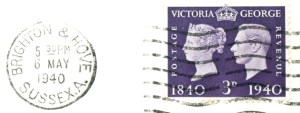
My parents moved from Bath to Sussex in the mid-1950s and eventually settled in the village of Balcombe, twenty miles north of Brighton. Given the paucity of excitement in the nearest town, Haywards Heath, apart from the Perrymount Cinema which showed up-to-date films (Note 1), it was inevitable that Brighton provided more interest. There were regular trips to the Theatre Royal on New Road (Note 2) …..
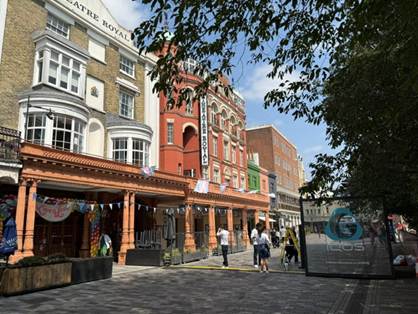
…… to watch pre-London plays. Today, seventy years later, it presents comedy, musicals, cabaret and children’s entertainment. We also went to the annual Christmas ‘Ice Spectactual’ at the rink at the bottom of West Street. The steam train from Balcombe took 20 minutes … in the summer holidays a day on the beach involved the train from Balcombe then a walk down to the beaches of Hove, always less crowded that those immediately south of the railway station.
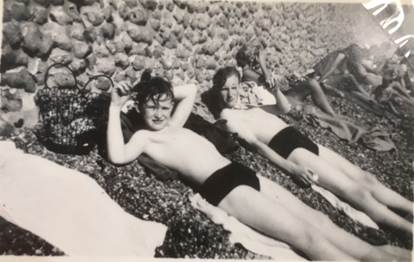
My brother and me, circa 1958
It’s the same today; day trippers heading straight down to the sea, hugger mugger on the beach with others, while a little walk West would give them more space!
I think the most interesting parts of the city, apart from the Royal Pavilion, built between 1815 and 1822, are the North Laine, at one time Brighton’s worst slum – a laine was an open plain divided into sections for farming – and The Lanes. The latter are essentially located in what was the village of Brighthelmstone, bounded by West Street, North Street, East Street and the sea on its southern edge.
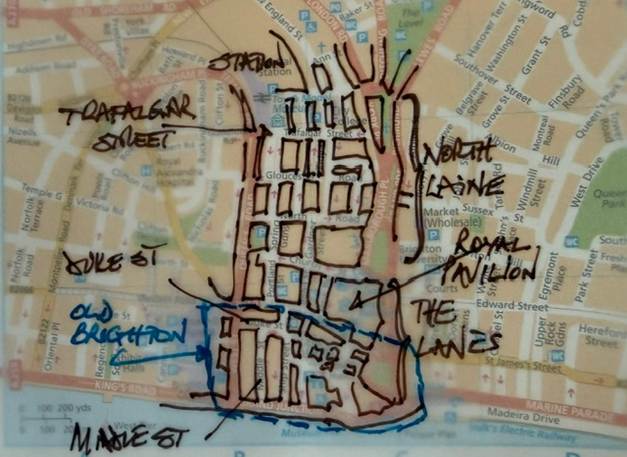
We have to thank King George IV who, as the Prince of Wales, first came to Brighton in 1783 and put the town on the map, establishing its first ‘Season’. He later commissioned the Royal Pavilion and his annual visits encouraged a building spree that defines Brighton’s architectural character today. Georgian buildings such as the Old Ship Hotel (circa 1794) rub shoulders with whitewashed Regency and early Victorian townhouses.
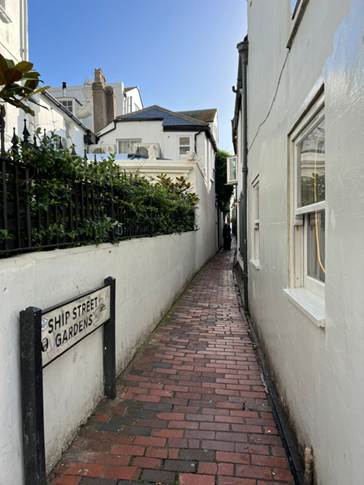
The Lanes are a delightful collection of little streets and pedestrianised squares, often linked by twittens. A twitten is an old Sussex-dialect word for a narrow path or alleyway, which serve as short cuts. From North Street running south into The Lanes is Meeting House Lane, a twitten said to be haunted by the ghost of a nun who was walled up alive after eloping with a soldier. There’s another good example of a twitten just up from our yoga studio, which is situated in the old Rabbi’s house behind the synagogue on Middle Street.
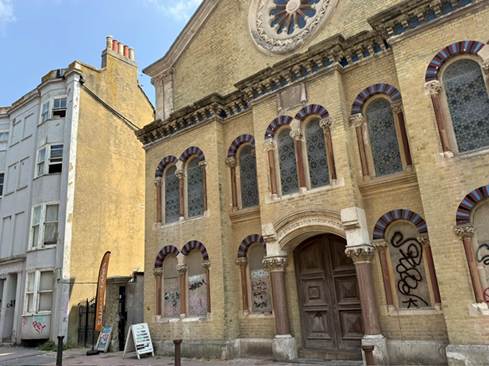
Yoga In The Lanes’ entrance to the left of the Synagogue
Ship Street Gardens features C19th cottages and a famous fig tree and links Middle Street with Ship Street.
Whilst both The Lanes and the North Laine have many independent shops, The Lanes has a greater preponderance of chain outlets, such as Penhaligon’s, Molton Brown, Lush, Russell & Bromley, Loake, and Flying Tiger.

It is also well known for its jewellers and antique shops, fashion boutiques, cafés and restaurants, including The Ivy and its Asian sister.

English’s of Brighton, the city’s famous seafood restaurant on East Street, is located in three former fishermen’s cottages. Reviewers highlight the fresh rock oysters as a ‘must try’. The city’s Town Hall is located on Bartholomew Road and is where Celina and I got married on 20th August 2016. The building also houses the Old Police Cells museum.

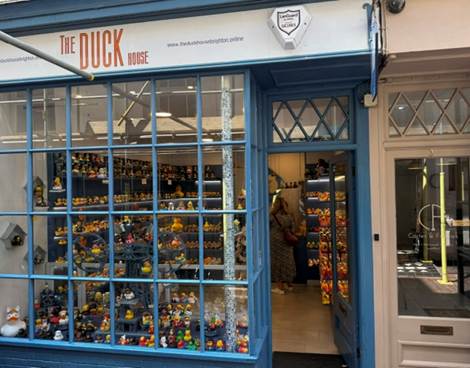
You could easily while away an afternoon, drifting from a coffee house such as Café Coho, exploring Meeting House Lane, Brighton Place, Market Square, winding down its narrow lanes, ….. stopping and being surprised at, for example, The Duck House!
To access the North Laines you cross busy North Street, up New Street with the theatre opposite Pavillion Gardens and a glimpse of the Royal Pavillion, on past The Brighton Museum & Art Gallery and the Brighton Dome, once the Prince Regent’s stables and now a venue for concerts, dance shows, and plays and the headquarters of the Brighton Festival. Here you find a patchwork of small streets lined with quirky shops, drawing crowds of locals and tourists alike.
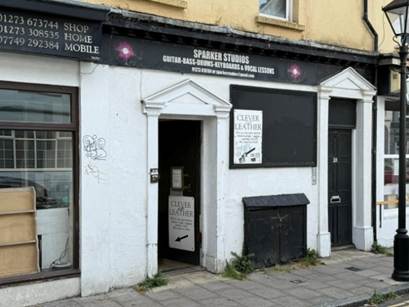
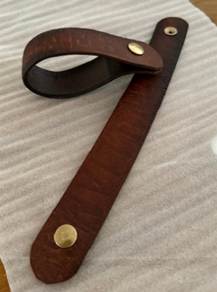
When I wanted someone to fashion two little loops of leather, I went to Clever with Leather in a basement workshop on Tidy Street.
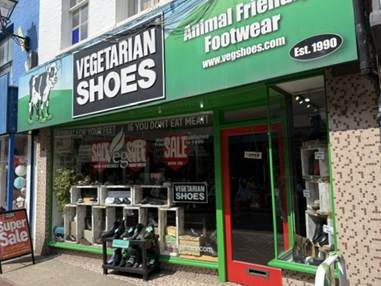
Writing of leather, if you are fastidious about not using animal products, you could buy some shoes or boots from The Vegetarian Shoe shop on Gardner Street.
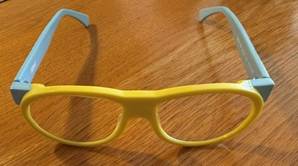
After wearing contact lenses for decades, the removal of my cataracts meant I could indulge in some funky reading glasses. Bromptons Opticians, further up on Gardner Street, has just such frames, but I needed a second mortgage to buy these:
Having a sweet tooth, I get drawn to Caramella on Kensington Gardens where you can buy old-fashioned confectionary. Fancy a humbug or Sherbert Lemons or do you prefer liquorice; the latter in many shapes and lengths and, if you ask nicely, you can pick and choose your favourite ‘Liquorice All Sorts’ – for me the little pink and blue buttons!

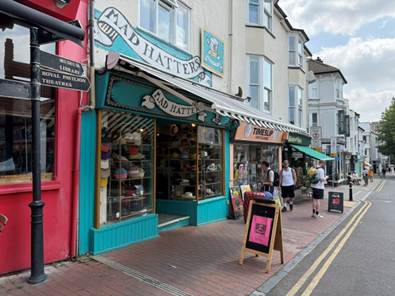
On Trafalgar Street you can find just the right hat for you, assisted by knowledgeable staff who know about face shapes, and can advise accordingly.
Every city suffers from Grafitti and Brighton is no different, but this mural on Bond Street is surely in a class of its own.

Brighton has just celebrated Pride and I am reminded yet again how inclusive this city is, quite extraordinary! There is a tangible acceptance of people being who they want to be, and no one bats an eyelid, apart from visitors unused to such genuine displays of confidence. I saw these women walking up Gardner Street and thought ‘why not?’

The Lanes and North Laines are so worth a visit!
Richard 7th August 2026
Hove
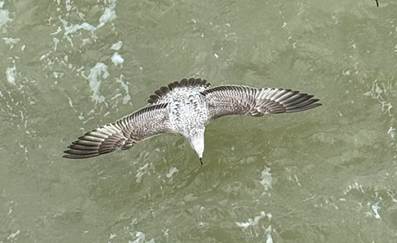
PS If you come to Brighton don’t forget to say hello to the European Herring Gull, otherwise known as: “Oi!” as it swoops down on your fish ‘n chips.
PPS Brighton is 9,219kms (5,729 miles) from Rio de Janeiro, Brazil
Note 1 Opened in 1936, it had a little dance hall and a café, as well as the auditorium for screening films. You could smoke in the rear rows! It closed in 1972 and the building demolished in 1984.
Note 2 It had opened in 1807.

