PC 510 And so we go on!

At some point earlier this week I looked at my ‘notes for future PCs’ and thought there was so much to comment on I wasn’t quite sure where to start. So I thought I’d go to The Hope Café in the off chance I would bump into Sami and Lisa, or one of them, and conversation might help. Sure enough on Tuesday afternoon I found them both, sitting quietly at their favourite table and, armed with a double espresso, went over and interrupted them.

“Hey! Richard, how are you?” asked Lisa; “haven’t seen you since your fortnight in Portugal”

“God, that seems ages ago now; actually, over three weeks but it was a good time and now back into our Hove routines, the weather still lovely and warm. Hope it’s not a harbinger of a hard winter as some doomsayers are suggesting!”

“I hope not too; El Niño, this autumn and into next year, has a history of extremes. Incidentally, I follow Camilla Long’s column in The Sunday Times and couldn’t believe last Sunday’s. It covered the fact that an Iman, Hafiz Ashrafi, had been given an ‘interfaith’ award by the Archbishop of Canterbury, Sarah Mullally, on the 25th anniversary of the 9/11 attacks in the USA. Clearly no one did much research about his views as the award was withdrawn days later when it was discovered that he had, inter alia, praised Bin Laden!

“Actually, that’s awful, Lisa. Seems rather symptomatic of everyone turning a blind eye to unsavoury issues, just for the sake of the PR.”

“But what incensed Camilla Long, and me when I read her article, was that Sarah Mullally had welcomed him, together with his wife, who was wearing a full niqab and his daughter, wearing a facemask. Mullally was an outspoken feminist and had said she would speak out against misogyny, although ‘when misogyny physically turned up at Lambeth Palace, she said nothing.’ The accompanying Times’ photograph was extraordinary.”

“Not sure where I stand”, interjects Sami. “A complex issue for sure but seeing someone wearing the burqa on the streets of Britain is very odd. We pussyfoot around the issue, most of my friends hate the fact that women are made to wear such a medieval form of dress when they are outside.”

“I hadn’t read the article, Lisa, but I’ll find it online. I must admit whenever I see someone wearing a burqa, I feel extremely sad for the individual underneath, and feel it has no place in British society. I do know that several European countries have banned its wearing, France for instance, since 2011, and Portugal last month brought in its own ‘burqa regulations’. I think Italy’s Prime Minister, Giorgia Meloni, summed it up quite well: “In our view, anyone who comes to Italy to build a future here must learn our language, understand our culture and respect our rules.” Same for us; this hideous form of dress, and everything that is physically and mentally attached to it, must be banned here too. As a nation we believe in the equality of both the sexes and opportunity and mustn’t use our tolerant nature to justify acceptance of this form of clothing.”

“I think I got it” says Sami, ruefully. Lisa smiles; maybe she’s already thinking of writing an article about it for The Argus. Sami continues: “You know my parents were Anglo-Indians and when you British partitioned British India into India and Pakistan we had nowhere to go and ended up here?”

“Sorry Sami! Bit before my time!”

“Exactly. A little like the present-day situation with Israel and Palestine, which you helped create with the Balfour Declaration of 1947. We can’t rewrite history in the light of what has transpired since then; we have to make the most of it, for both the Jewish population and the Palestinian nation. Genuinely I think here in Britain we support the idea of a two-state solution but get incensed when Israel ignores the illegality of building settlements in areas of the Palestinian West Bank. I was pleased when the current Foreign Secretary, Ed Miliband and himself a British Jew, announced in the House of Commons that the UK would officially recognise that illegality and impose targeted sanctions and trade bans on those Israeli settlements.”

“And then there were howls of protests from Jewish groups here in the UK, sort of ‘How could you?’. They can’t have it both ways! I imagine you’ve watched the Netflix series Fauda?” (Note 1)

“We have loved the first four series”, says Lisa “and read about the problems the producers had in trying to create a fifth series which covered the 7th October 2023 attacks on Southern Israel by Hamas. Wasn’t one of the show’s previous series’ producers, Matan Meir, blown up in a booby-trapped tunnel and killed?”

“Yes, I think so. I certainly read that the sister of Lior Raz, one of the show’s creators and the actor who plays the main lead ‘Doron’, and her children managed to stay protected in their house’s bomb shelter while Hamas fighters roamed around outside. It all gets a bit personal in a nation of 10 million! We have watched this latest series and it’s very good but, having read the warnings about upsetting scenes in the middle episodes, didn’t watch it after 9 o’clock; too emotional to guarantee a dreamless sleep!”

“We must watch it, although I am aware that Palestinians see it as anti-Arab and a racist tool of Israeli propaganda. Think I read that ‘it reduces a political conflict over land and rights into a simple narrative of counterterrorism versus blood-thirsty terrorists!’”

“I love talking to you two but now I need to run; thanks for your thoughts and enjoy Fauda!”

Richard 25th September 2026

Hove

www.postcardscribbles.co.uk

PS Two days ago, Wednesday (23rd) marked the northern hemisphere’s autumnal equinox ie the sun at midday was directly over the equator and the length of our day and night are roughly equal.

Note 1 Fauda translates to mean ‘chaos’ or ‘disorder’. It’s an Israeli show following a unit of Mizrahi Jews who go undercover among their Palestinian neighbours to root out terrorist plots. Mizrahi Jews are indistinguishable from Arabs and speak both Hebrew and Arabic.
PC 509 Communication

Our friend Sandi, who currently lives near London Bridge, has been frustrated by the sudden closure of the local Hot Yoga studio. Frustrated by its closure over a month ago, but now more and more angry, yes, I know it’s a yoga studio and yoga and anger shouldn’t be on the same page, by the total lack of communication. No one responds to emails, no one suggests monthly membership will be refunded and much more importantly there’s no indication as to when it might reopen. Members drift, find somewhere else that ticks most of the boxes, and by the time it announces it’s reopening, there won’t be any students. Why don’t individuals and companies really understand how important it is to keep people informed?

I have always believed in the power of communication, good and bad; communication is key – even if you know nothing. When I worked for Shorts, the Aerospace manufacturer in Belfast, a huge percentage of the company was owned by the Northern Ireland Development Board. Suddenly HMG announced it was up for sale but as the weeks went by, no one said anything. On one of my frequent visits from our London office, I noticed how depressed people were, worrying whether they would have a job, who was going to buy the company etcetera; there had been no news. Meeting my Divisional Director, I asked him why he couldn’t tell the workforce anything about the proposed sale, who might be in the running to buy it and he said: “I don’t know anything”. I said: “But you’re the MD and your workforce expect you to know, think you do know, so why can’t you simply say you currently don’t know but you’ll keep them up to date?” Why are people so afraid of saying they don’t know? Communication …..

On our TAP flight to Lisbon on 16th August the plane was fully emplaned, the doors closed and we waited and waited and ……there was no announcement saying they expected to take off in five or ten minutes/waiting for our slot …… or similar, and I thought: ‘Why not?’ Twenty minutes before we ‘pushed back’. Good or bad communication helps us understand what’s going on and helps us prepare.

Last week the UK’s National Air Traffic System (NATS) failed; the IT breakdown led to the cancellation of more than 2000 flights and calls for the resignation of Martin Rolfe, its CEO, as this was NATS’s second major failure in three years. What will happen to him and to NATS is one thing, but for Jane & Joe Public it was the lack of communication – for instance no one knew what was/wasn’t happening; the lack of any contingency planning – for instance there was no extra drink delivered to planes sitting on the tarmac full of passengers for 6 hours; obviously no one within the airport’s management asking the real ‘What if …. ?’ questions. Didn’t we learn anything the last time this happened? Don’t Jane & Joe Public deserve better?   

And while I am ranting about communication, I could mention the sad news that a local hardware store on Portland Road, Nuts & Bolts, is closing tomorrow after 45 years. “Ever since the (COVID) lockdown, there’s been a massive shift from high street to online shopping, which is proving to be the death-knoll for many.” Libby Purves, writing in The Times early this week, wrote: ‘Veteran locals see it bit by bit: the big, confident ironmongery and household store shuts, sabotaged by Amazon; the little boutique, deli and shoe shop give up, independents going first; three more charity shops appear with their 80% business rate exemption.’

Sometimes needing to buy something to solve a problem requires looking around at a range of items or talking to someone more knowledgeable than oneself. Nuts & Bolts was an emporium for bolts, nuts, brackets, fixtures, screws, almost anything metal you could imagine. If I couldn’t find what I wanted when I wandered the aisles or was unsure whether ‘A’ was better than ‘B’, I went up to the counter and spoke to a human. Communicating with a chatbot isn’t the same, is it?

Celina’s nephew Tiago is 14 and goes to school in Estoril in Portugal. Every parent knew the school was building an extension to house his year group, due to open in the first week of September. During the Summer holidays there was no indication that there were problems, no warning, no time for considered thought ….. but the school administrators must have known the building wouldn’t be ready for the first day of term nor apparently any time soon. Parents have been scrambling around to find an alternative school for their child. With some warning, some communication, the school’s reputation might have survived; now it’s in tatters.

The subject of the Duke & Duchess of Sussex’s return to the UK had come up in conversation with Sami in the Hope Café last week. Irrespective as to whether one should care or not, as I am writing about communication there was a mixed reaction to the public notice sent out on behalf of King Charles by the Lord Chamberlain to government officials and the media, seeking to clarify their status. Was it really necessary to remind us they are private individuals rather than ‘active representatives of the monarchy’, non-working royals? Was it to spike their guns as they begin to find their feet and determine how to pay for their privileged lives? Whatever the Royal family does there is interest in this couple from certain sections of society …… and they’re just going to have to live with that!  

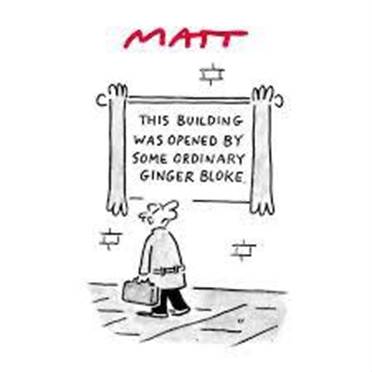
My brother spotted this cartoon by Matt …… which delightfully sums up the issue!

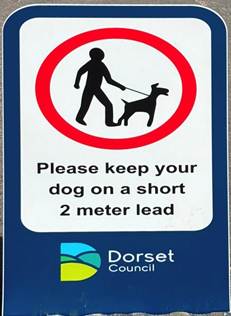
And, finally, correct spelling of words is essential for good communication. Seen in Dorset:

We have gas, water and electricity meters, and two metres, short or not.

Richard 18th September 2026

Hove

www.postcardscribbles.co.uk

PS I accept that American English spells metre meter, but this is Dorset not Delaware.

PC 508 Back in The Hope (Continued from PC 507)

………

“Didn’t large sections of Middle-Class America dodge the draft, studying at college and university, leaving the poorer section of society’s 18–24-year-olds, who weren’t so fortunate, to fill the ranks? Isn’t it one of the many things the current president is accused of?”

“A bone of contention that still smells rotten today. When I finished Caputo’s book, I looked up the casualty numbers. Just over fifty-eight thousand American servicemen died, 10,000 of these from accidents, illness or wounds. Another 300,000 were wounded. The North Vietnamese and Viet Cong lost over 1.1 million fighters, while the South Vietnamese some 225,000 soldiers died.

Do read it Richard; it’s very good. What was your major Summer read?”

“Apart from some glorious fiction from David McCloskey, Chris Hammer and Michael Connelly, it has to be Rory Carroll’s ‘A Rebel and a Traitor’, the story of Roger Casement, knighted by the Crown for his work as a British consul, but who turned into a spy and traitor for the cause of Irish Unity and, after a summary trial, was hanged in HMP Pentonville in August 1916. Reviews called it ‘a rich, stylish and immersive epic’, ‘deeply researched and fascinating’ and Max Hastings thought it ‘a gripping read’. I loved it!

I can’t remember where I read it, but someone reflected that in general terms the British and the Americans see the world as it is today and determine their politics, especially their foreign policy, on that uncluttered view. Others are continually thinking about their historical journey, in some cases letting this shape, dictate even, their modern politics. Reading the obituary of Ratko Mladic (1943-2026), the Serb who earned the moniker ‘The Butcher of Bosnia’, made my skin crawl. In amongst the horrific details of bloodshed and murder was this: ‘The day after his troops had taken Srebrenica, Mladic declared he was presenting the city to the Serbian nation as a gift, in revenge for the events of 1804 when forces of the Ottoman Sultan retook the town from Serbian rebels.’

Mladic is not alone. Putin’s invasion of Ukraine was predicated on his warped view of Russian history. I also consider, as a westerner, the governments of Iran, Israel and Afghanistan beholden to historical influences.”

“Hey! Hang on Richard! Getting a bit heavy! What’s that quote from Buddhism: “You can’t change the past, but you can ruin the present by living in the past and worrying about the future.” You may not have heard but Mo told Lisa the other day that she’s going to spend more time north of London, now her mother’s no longer with us.

Listen ….. you remember the decision you made when buying a video player – VHS or PAL? PAL (Phase Alternating Line – 50Hz) was used primarily in Europe, Africa, Australia and parts of Asia for analogue TVs and VCRs; VHS (NTSC – 60Hz) was the public’s choice in the USA and Japan. Despite being technically inferior, VHS from JVC offered 2 hours video play so the public preferred it. And now you probably have old video tapes gathering dust in the attic, treasured memories and nothing to play them on. Technology has moved on.”

“We’ll miss Mo. Actually, I did convert some Super8 Cine film to video, then the technology moved on ….. so I converted them to CDs …… and now I don’t have a CD player!!”

“What about your mobile phone? Most of us starting using either Apple or Samsung because you knew someone who said theirs was the better option. And we get adept at using the one we chose; Lisa and I use Apple. Lisa’s mother, who has a Samsung, was given a Kindle for her birthday last month; to buy a book she needed an Amazon account. (Note 1) You download the App, and it tells you it will send a code to your email. It does, although by the time you close the app and find the email, the time for the code’s validation is over – 10 seconds? Lisa was trying to help, although unfamiliar with the Samsung!”

“Reminds me of a procedure that older Brazilians have to do every year to guarantee continued receipt of their pension – ‘proof of life’. In essence, you take a ‘selfie’, upload it to the government website, and expect a code sent to your email; hoping that your photograph was acceptable! You have to come out of the website, open your email, find the code, make a note of it, go back to the government website and enter the code ….. all within 20 seconds, or you get timed-out. Whoever designed the system forgot that the only people using it are likely to be slight slower than others, so I don’t understand why that ’20 seconds’ can’t be, say, one minute?”

“From a book I am reading, I learned a new word, Richard: ‘susurrus’ which means a humming, whispering or muttering sound, as in ‘the enthusiastic susurrus of conversation ……’. So, susurrus is an onomatopoeic word, it sounds like its meaning. But I guess you knew that?”

“No! But I do like it. The word just sounds like intermingled conversations; add the occasional clink of glasses and you have a cocktail party! By the way, I was forwarded a faux photograph of Harry and Meghan, in the sort of inflatable rubber dinghy used by people smugglers to get illegal immigrants into the UK; the attached message read: ‘Love it. I am so bored with them. Maybe the media’s fault in part but …’.

I responded: ‘Seriously couldn’t care a monkey. Both play the victim card and this gives me the idea they have NO concept of how others live. Various commentators have gone to print about their vacuous lives.’ The fake photograph showed them with the white cliffs of Dover behind them ….. maybe they were paddling to France? You saw the photo of a double rainbow over Cascais in my last postcard?”

“Think so!”

It was about the same time as the moon’s eclipse on 28th August – and I managed to get a passable photograph with my iPhone at 0521.

Listen, we both need to get going; well, I certainly do. Stay in touch and love to Lisa.”

Richard 11th September 2026

Hove

www.postcardscribbles.co.uk

Note 1 There are other ways to buy e-books but this seems the simplest.

PC 507 In The Hope Café Again

We came back from a fortnight in Estoril in Portugal on Wednesday. I have written before about Estoril (PC 454 in August 2025) and am reminded on my morning walk through Estoril and Monte Estoril that ‘it has been home to numerous royal families and celebrities, is one of the most expensive places to live in Portugal and the Iberian Peninsula and is home to a sizeable foreign community.’  It’s sad to sense that so many of these enormous houses are empty, have that unlived-in feel about them, maybe a second or even third home, at a time when ordinary folk struggle to afford somewhere, anywhere to live.

As always, it’s good to come home, providing of course ‘home’ meets your needs and your wants. For Celina and me, our large apartment in Hove ticks many boxes; spacious, high ceilings, dual aspect, modern insulation and the sea is two minutes away. We thank our lucky stars that in the unusually warm weather we have had this summer, our bedrooms are downstairs, in what might be described as ‘lower ground’. They are about 3C cooler than our living room! William and Stefano are renting the apartment above us in Amber House. One day in desperation they asked whether we had a fan! A neighbour kindly lent them her two.

After the delivery of our Waitrose shopping, I popped into The Hope Café mid-afternoon yesterday to catch up with Sami, who I hadn’t seen since mid-June. Amazing where the time goes huh! I joined Sami at a table, having got a double espresso from Josh, who’d asked whether I knew anyone who they could hire, as Libby is finally going to retire.

“Do you?” asked Sami.

“No one springs to mind and this is a difficult time of the year, what with the new Academic Year, a new school for some, others to university or Sixth Form College. Lots of people already committed.”

“I liked your last postcard, Richard, (PC 506 Be the Person you want to be) and that final paragraph when you said ……. let me look at my WhatsApp ….. here we are: ‘We are social animals; we want to fit in, not brave it out, not branch out, be the odd one out. But understanding ourselves better, our extraversion or introversion, the degree we engage/need to engage with others, with our families and with friends, or preferring our own company ….’

We all find ourselves not being who we want to be, presenting an untrue image, hiding behind a façade, and I found this from some psychologist:

‘Some people call it a division between the ‘original self’ and a ‘pseudo self’. A person exhibiting a ‘false self’ occurs when other people’s expectations override the spontaneous expression of the ‘true self’. The ‘false self’ is a kind of masquerade, a self that is presented to the world, a ‘social self’. Not the true, private self, the one ‘inside’.’”

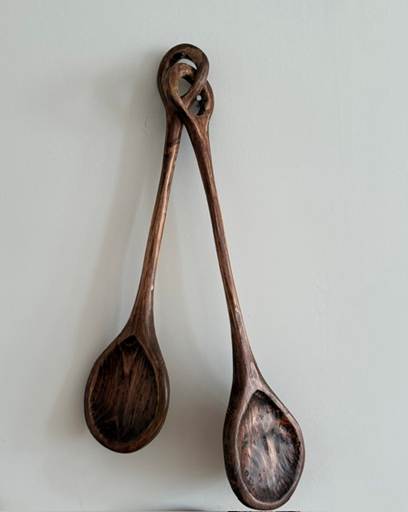
“I am pleased …… and I assume I am talking to the true self, Sami, not some cardboard cutout?! Haven’t seen you since I completed my two linked wooden spoons, have I?”

“You showed me the enormous one you made for your daughter from a discarded scaffolding plank, but this is something else?”

“I had the idea I could fashion two spoons from one plank, the loop at the end of each linked. Once the idea got embedded, I thought long and hard about how I would carve that; this is how they look:

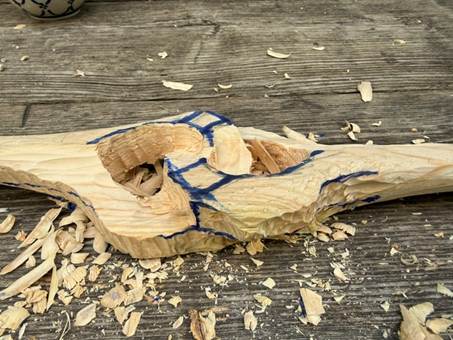
To get there I made a model out of some plasticine; hadn’t bought that for decades although you can still find it! Eventually I got to this point ….

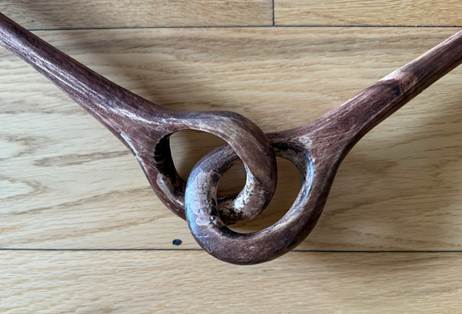
 Then spent some time thinking about how to untie the knot, as it were; slowly but surely managed to separate them. Some wood filler, stain and wax and we’ve ended up with exactly what I imagined!

“Wow! They’re amazing Richard. Well done you! By the way, I know you read a lot when you’re in Estoril ….. and before you tell me about your stand-out book, I need to tell you about mine. I’ve caught your habit of glancing through the newspapers’ obituary column and found that a chap called Philip Caputo had died.

“Who? What was his claim to fame?

“He was an American author and journalist, best known for his best-selling memoir of his experiences during the Vietnam War, ‘A Rumour of War’. In 1973 he was part of a writing team that won the Pulitzer Prize for reporting on election fraud in Chicago. You had written a couple of postcards (PCs 493 and 494) about your stepfather’s deployment to Malaya in 1945 as part of Force 136 and I was curious as to Caputo’s time in Vietnam; I ordered his book and finished it a couple of weeks ago.”

“Wasn’t that the first modern war that the USA lost?”

“Yup! And they left with their tail between their legs, their departure from Saigon (renamed Ho Chi Minh City) in 1975 reduced to a rout.

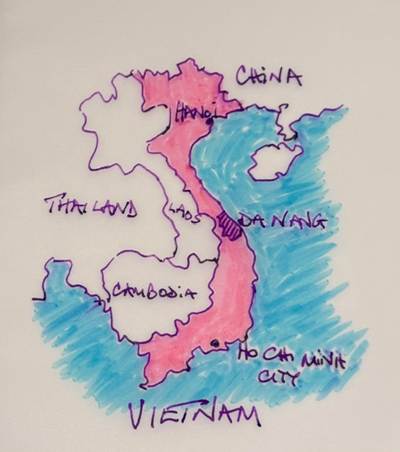
Caputo had been a Marine Second Lieutenant in Da Nang Province in 1965 for just over a year and his memoir is widely regarded as a classic in the literature of war, being compared to ‘All Quiet on the Western Front’ (Note 1) What I found fascinating was his ability to describe the rigours of jungle warfare in every gruesome and human detail. For instance, the Marines were provided with three sheets of loo paper ….

“The British Army had the same, part of a one’s field ration pack, except ours was made of that hard, unabsorbent, paper. The common saying was: ‘One up, one down and one polish’! Sorry, I interrupted you, Sami.”

“That’s OK. Caputo described how you could never get your arse clean, most soldiers suffered from permanent Diarrhoea, and how you lived and fought in the rain, covered in leaches and being bitten by mosquitoes. He also observed what fighting, kill or be killed, does to the human soul.”

(To be continued ….)

Richard 4th September 2026

Hove

www.postcardscribbles.co.uk

Note 1 A semi-autobiographical novel by Erich Maria Remarque, a German veteran of World War!1, billed by some as ‘the greatest war novel of all time’.