PC 502 Heading to The Hope Café

After lunch on Tuesday, before a dental appointment towards the end of the afternoon, I headed to The Hope Café for a coffee and a catch-up. In a little bag I had some toothpaste and a toothbrush, as I needed to clean my teeth before being subjected to an oral examination. Nothing worse than one’s dentist berating one for poor dental hygiene. This reminds me that we make sure our apartment is clean and tidy ….. before our fortnightly cleaner’s visit; funny what we do, huh? ‘There are standards, Caruthers.

In my mind I was collecting thoughts for this week’s scribbles and suddenly thought: ‘I have enough …… I don’t need to have a conversation with anyone!’ ….. so popped into Café Nero on Church Road, got a double espresso, plugged in my laptop and looked at my notes.

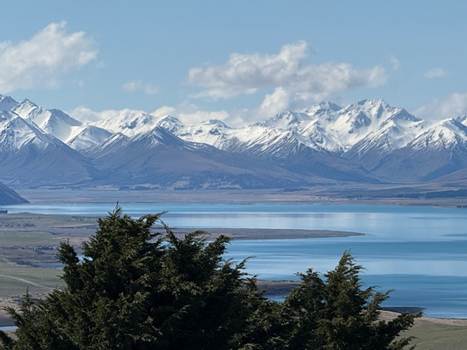
My regular readers will know Celina and I visited both the North and South Islands of New Zealand last autumn, and on the latter drove from Christchurch to Lake Tekapo. The weather was glorious:

The little stone Church of The Good Sheppard, built in 1935 to honour the first English settler families in the area, is one of the most photographed buildings in the country. On Facebook a couple of weeks ago it looked completely different; I read that Lake Tekapo had recorded minus12.5C!

In my normal perusal of the obituary column in The Times, I found that the former Emir of Qatar, Sheikh Hamad bin Khalifa al-Thani, has died aged 74. He had deposed his father and was credited with bringing Qatar into the C21st. What I found amazing was his ability to procreate! He had married three times; his first wife Mariam, a cousin, gave him 2 sons and 6 daughters, his second, Moza, 5 sons and 2 daughters and his last, Noora and another cousin, 4 sons and 5 daughters, a total of 11 sons and 13 daughters. Quite a brood. The practice of marrying a first cousin, and the obituary didn’t say whether two of his wives were first cousins, is debateable. For example, it’s legal in the UK and in about 50% of the States in America, while banned in many other places. Statistics show that children of first-cousin marriages have a 5% risk of ‘autosomal recessive genetic disorders’ compared to the 3% of the children of unrelated parents. It’s certainly a common practice in the Pakistan community in Leeds where, according to a television documentary, the percentage of abnormal births is very high.

Back from a week in Estoril in Portugal earlier this month, I read another obituary, that of a judge, André Cerdini. What caught my eye was the subtitle: ‘Provincial magistrate praised for his calm restraint during the prosecution of ‘The Butcher of Lyon’ (Klaus Barbie), four decades after the US helped him to escape justice.’ Barbie had been ‘notorious as a sadistic figure, relentlessly pursuing both the city’s Jewish population and its French Resistance members. He was responsible for hundreds of murders and deportations to concentration camps.’ He was one of the monsters in human form, the subject of my PC 324 ‘Monsters’ from March 2023.

You might think that our yoga studio has some background music before class and that it’s all yoga-stuff, spiritual, chanting, Indian etc. Most of the time the music that’s playing as students check-in is the choice of the individual teaching. Last month Eve was playing music that I instantly recognised, from a 1960’s British folk-rock band called ‘Pentangle’. Their single ‘Light Flight’ became popular when it was used as the theme music for a BBC drama series ‘Take Three Girls’ – incidentally the first drama series to be televised in colour.

My postcards reach a wide variety of individuals, maybe the readership expanded by people sharing them with others. Back in March, a photograph from September 1965 of Burma Company Intake 39 at the Royal Military Academy, Sandhurst (RMAS) caught the eye of Nick Whittle, who was researching an uncle’s career and thought he might have been an Officer Cadet at RMAS in my time. Eventually, through a very helpful individual at The Sandhurst Collection, a Dr Sebastian Puncher, we established that Stephen Hall-Jones had been in Normandy Company in Intake 37 (September 1964 – July 1966) and was commissioned into The Inniskilling Fusiliers. Sebastian sent Nick a cache of information that enabled him to fill out the details of his uncle’s life.

At about the same time, a Nick MacAndrews got in touch about a fellow Officer Cadet in Burma 39, Martin Ward-Harrison. I will write about him in a subsequent postcard.

My parents’ house in Balcombe had an enormous garden and at one time the gardener was a chap called Buswell, who cycled about 4 miles from his home. He was a red-cheeked chap, full of enthusiasm for life, although his actual knowledge of plants was minimal! He needed careful supervision. I remember him for all sorts of reasons but particularly for the way he said ‘binoculars’. Why this particular useful piece of equipment came up in the conversation I don’t know but he pronounced it ‘binockerknickers’. And why it came to my mind this week is a mystery!

          I mentioned we’d been to Portugal (See PC 499 Évora 10 July). The new entry arrangements – fingerprinting etc – took no time at all, although we had to have our passport checked by a human being. When we flew back, I presented my passport to check-in my suitcase, got through an electronic gate using my passport, but then had to go to a border force official in a kiosk, showing my passport again ….. then to get into the boarding gate waiting area had to show it again ….. and then again when we started boarding! Absolute nonsense! Then to cap it all, my suitcase took the long route, eventually delivered home by personal courier 36 hours later at 0200.

Last week’s postcard PC 501 ‘Living and loving more, or victim’, the follow-on from PC 485 ‘Live more, live less’, was well-received: ‘Beautiful PC this morning’; ‘This PC really spoke to me’; ‘With 485, this time you’re getting deeper and closer …’, while Eddie commented he only had 7 months left to confound the statistics! If it’s still in your ‘will catch up later’ folder (?) I suggest you spend 5 minutes and read it (well, 10 if you didn’t read the first!)

Richard 31st July 2026

Hove
www.postcardscribbles.co.uk

PC 501 Living and loving more, or victim?

In PC 485 ‘Live more? Live less?’ I hoped I got across the idea that we should be striving to do more than just existing. The more I thought about it, the more I recognised that there is a dreadful condition, that of ‘being a victim’; this might stop someone from fulfilling their capabilities and expectations, living more, loving more.

Without doubt, in our lives we will all experience some form of hardship, disappointment, loss, often due to external circumstances or the actions of others. While the initial event may not be your fault, you may feel the victim, and start complaining, shifting accountability to others. Don’t let this ‘victim mentality’ linger. Understanding the psychology behind this mindset is the first step toward regaining control. It often develops as an unconscious defence mechanism, to protect oneself after experiencing adversity.

Various ideas to get out of this mentality include acknowledging the areas of your life where you do have control and focusing on problem-solving rather than complaining. Whatever happened in the past, is in the past. Uncoupling those events from your current sense of unhappiness and self-worth can allow you to live and love more, today!

On the Sunday before we flew to South America in mid-April, I was walking to Rahmi’s 7-11, to exchange my Sunday Times coupon for an actual paper, and passed Hixon Green, a ‘café with food’, on Church Road. Sitting at one of the outside tables, enjoying the weak Spring sunshine, was a chap who’d recently bought one of the twelve apartments in Amber House. Tom waved and I went to say ‘hello’; he introduced me to his friend Ricky, who was enjoying a glass of Coke. Tom started telling Ricky I practised hot yoga a lot – ‘Six days a week, Tom’, I interjected – and Ricky said: ‘I should start doing something like that, shouldn’t I?’ (Was this a question to me or to himself?)

“Absolutely” I said. “Let me know and you can come as my guest for your first session. How old are you?”

Forty-three. But listen, I really don’t have time for that.”

Always difficult, to allocate one’s time to all those things you think important, be it work, one’s family, staying in touch with friends, indulging in a passion like singing, playing golf, or going to the gym for example. Many years ago, a CEO client said he didn’t have time to learn a language he wanted to be proficient at. He then admitted he didn’t get up until 0730! I suggested he could fit in an hour of study if he got up earlier; he later called that precious extra time ‘Yates’s Hour’.

I am a lark, preferring to be, as Private Godfrey from Dad’s Army often exclaimed, ‘Up and at ‘em’, early, although he was suggesting tackling the enemy head-on! Maybe the analogy works for taking on the day’s challenges?

“There is a time in the affairs of men which, taken at the flood, leads on to fortune.  Omitted, all the voyage of one’s life is bound in shallows and in miseries. On such a full sea am I now afloat, and I must take the current when it serves or lose my venture”. Brutus in Shakespeare’s ‘Julius Caesar’ obviously believed in living and loving more.

At around the same time as I learned that the nephew of our masseuse had died aged 39 from a heart attack, I read that here in the United Kingdom the span of our lives when we might expect to be healthy has declined over ten years to just 60 years. The headline is disturbing, but how the Health Foundation came to the conclusion suggests we should take the result with … a pinch of salt? Firstly, their population sample went from 170,000 households to 80,000 and covered a three-year period (2022-2024) so, as well as being smaller, may well have been affected by the tail-end of the pandemic. Secondly, there was a marked deterioration among young adults, from 91% to 84% reporting good health, the recent focus on ‘mental health’ being a major factor, whereas older women reported being much healthier.

As Mark Twain wrote in his autobiography, mistakenly attributing it to Benjamin Disraeli’: ‘There are three kinds of lies; lies, damned lies and statistics’!! More likely we’ll have some 68 years of healthy life, and not something forecast by a small tick box survey.

I have mentioned the victim mentality as I have personal knowledge of one such person. Through the generosity of others, they’ve been looked after, fed, watered and housed, whilst making no discernible effort to get off their butt and start taking responsibility for themselves. Love can be complicated, but sometimes a dose of ‘tough love’ is needed.

My fellow yogi Ian calls a spade a spade and not a shovel: “We all need to dare to …. but we accept we get knocked back …. and then you need to pick yourself up, and start again! The accusation this is ‘bad for my mental health’ is bollocks; it’s exactly the opposite.”

Shakespeare, the great observer, wrote these opening lines for Macbeth:

“Tomorrow, and tomorrow, and tomorrow,
Creeps in this petty pace from day to day
To the last syllable of recorded time;
And all our yesterdays have lighted fools
The way to dusty death. Out, out, brief candle!
Life’s but a walking shadow, a poor player
That struts and frets his hour upon the stage
And then is heard no more: it is a tale
Told by an idiot, full of sound and fury,
Signifying nothing.”

The co-owner of our hot yoga studio teaches a lot and adds her own take on life to the traditional dialogue. The other day she said the practice of hot yoga ‘prepares one for one’s future’. My own thoughts are that you need to live, truly live, now and not wait for ‘your future’ to arrive. And that at my age I truly believe my ‘future’ has arrived, like NOW. Make sure your life is full of love and fun and don’t ever be a victim; well, not for too long!

Richard 24th July 2026

Hove

http://www.postcardscribbles.co.uk

PC 500 Half a Century!

Back in 2014 I never ever dreamt that, twelve years later, I would write ‘PC 500 Half a Century!’ Yet here we are, having scribbled about this and that, finding the weekly 1000-word challenge part of the routine of my life. Where did twelve years go and what happened during that time? (I have added some of my photographs from our travels; their position is not connected to the script!)

Eagle on the Yukon River, Alaska 2015

          There are global events that I have no control over, but their significance often affects the decisions of our government and therefore eventually my life. Living in western Europe gives me a view on world events that I wouldn’t necessarily have if I lived, for instance, in Brazil or in New Zealand. I am not saying there’s a bias, but a European war is more concerning for this continent than for South America.

          These twelve years started with Russia’s modern annexation of The Crimea. In England we remember The Crimea as the land fought over between 1853-1856, one of Victoria’s Wars. Then it was Russia against an alliance of The Ottoman Empire, France, the United Kingdom and the Kingdom of Sardinia (!); it ended with Russia’s defeat. Who hasn’t heard Alfred Tennyson’s poem ‘The Charge of The Light Brigade’, describing 670 cavalry men’s charge against some Russian guns? Only 195 men remained mounted and survived unharmed.

          In 2014 Russia annexed The Crimea, siting all sorts of historic reasons why its people wanted to be part of Russia; Europe took no action. Eight years later an emboldened Russia invaded Ukraine and that war continues. Whatever its outcome, its use of drone technology is changing the way conflicts are conducted.

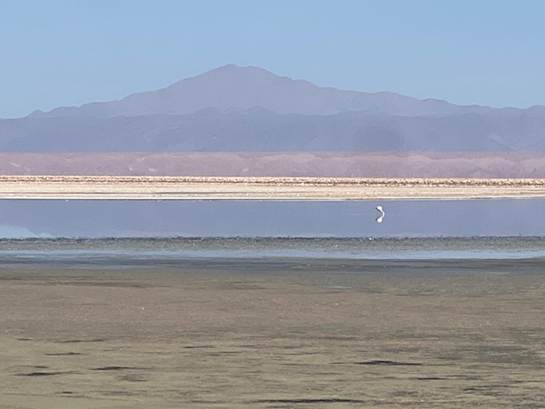
The Salt Lake, the Atacama Desert, Chile 2023

           In 2021, after twenty years in Afghanistan trying to bring peace and stability, the United States and its Nato Allies withdrew, having failed. The departure was quite chaotic, reminiscent of the American pull out of its unsuccessful war in Vietnam. So much blood spilt, only to see Afghanistan regress to the C7th ideas of the Taliban. Not having learned its lesson, America embarked on yet another war, this one with Iran, in February this year; most commentators suggest this was ill-thought through and the likely outcome of any peace settlement disappointing. The European focus on the Ukrainian and Iranian conflicts masks news of the other disastrous conflict in Africa, that of the civil war in Sudan.

For two years after the start of my PCs, Africa suffered its first Ebola Epidemic. The second is happening now! And who can forget the global pandemic of Covid 19 that lasted from 2020 for three years. In the UK there were over 25 million cases which resulted in 232,000 deaths. The worst day was on 19th January 2021 when 1490 individuals died. Globally it’s estimated that some 18-35 million people died. No rhyme or reason why someone who caught the virus died – age and health no determinator, but there was a suggestion that some ethnic groups were more susceptible than others.

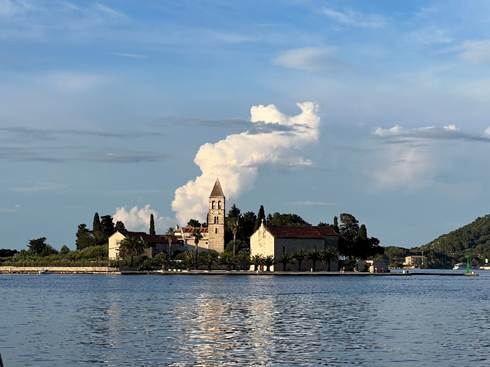
The island of Vis, Croatia 2024

Two other global changes mark these twelve years. Firstly since 2023 there has been an exponential rise in the integration of Artificial Information technologies in virtually every aspect of life, transforming global industries, labour markets and technology policy. This is comparable with the introduction of the mobile telephone or the shift to digital technology or the introduction of television.

Secondly, the election of Donald Trump to President of the USA in 2024 has been marked by geopolitical shifts in diplomacy, in alliances, in international trade and in the political landscape. Whether you like him or not, his erratic policies and mood swings have created greater uncertainty and instability.

Here in the United Kingdom the 2016 referendum on our European Union membership resulted in 52% of the population voting to leave. The consequences of that fateful decision reverberate in every aspect of our lives today. The Prime Minister David Cameron resigned, and five other politicians have since tried to lead the country, Theresa May, Boris Johnson, Liz Truss, Rishi Sunak and Keir Starmer, the latter replaced as I write by Andy Burnham. Eight in 12 years! Another referendum in Scotland, in 2014, put the case for independence on hold! But in the same year same-sex marriage became legal in England and Wales; Brighton celebrated!

Lake Tekapo, South Island, New Zealand 2025

The circle of life continues. In 2016 ‘births’, my third grandson Theo was born in December, ‘marriages’, ours in August and ‘deaths’, that of Celina’s father Carlos in the January. In the following year my nephew Hugh’s first child Dougie was born, on 17th February, the same day as Celina’s brother’s second son Joaquim. I miss Bill Pender and Ray Morrell, both good friends for decades, who are no longer here. And as a nation we said goodbye to Queen Elizabeth II.

As we age it’s inevitable our bodies react to internal and external factors but trying to live an active life and eating well helps. For instance, last year I completed 4000 hot yoga classes since I started in 2009, despite having to have a prolapsed disc operated on in 2017!

Rio de Janeiro, Brazil 2012 – to date

Celina and I have travelled, and not only to Brazil on our annual visits to her home city Rio de Janeiro! In 2015 we went west, up into Alaska, following in the footsteps of great grandfather George Nation. At the end of 2019 we were on the north coast of South Island, New Zealand, on Farewell Spit, the sandbar on which the Queen Bee, a barque from England, sank. Amongst the passengers was Eve Fosbery, aged 17, who would become my great grandmother. We then went out into the Marlborough Sounds, to Frenchman’s Pass, where the survivors came ashore two days later. We’ve had two other trips to New Zealand and Australia, loved Singapore, and spent a few days in the Atacama Desert in northern Chile. Celina’s brother and family moved to Estoril in Portugal in 2016, giving us opportunities to visit on an annual basis.

But in twelve years I have failed miserably to get to grips with the Portuguese language.

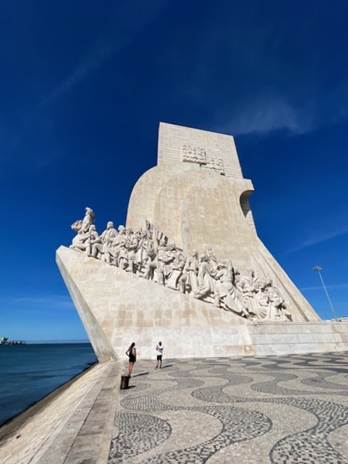
The Monument to the Discoveries, Lisbon, Portugal. 2016 to date

My postcards continue …….. PC 501 in draft!

Richard 17th July 2026

Hove

http://www.postcardscribbles.co.uk

PC 499 Évora, Portugal

Évora in the centre, Lisbon to its west.

A snippet cut from The Times’ Travel Section over a year ago says that ‘Portugal’s south-central Alentejo (note 1) region is an underrated spot for fine red wine and ‘porco preto’, that’s pork from acorn-fed black pigs. The walled city of Évora is a charming base from which to explore. Between outings to hilltop Monsaraz and along the Alentejo Wine Route, queue to try that pork inside Botequim de Mouraria or to scoff typically simple local dishes such as dogfish soup at rustic Fialho. Évora also has temples and a skull-filled Chapel of Bones to explore, while its markets offer ewe’s milk cheese.’

The DK Guide adds: “The town rose to prominence under the Romans and flourished throughout the Middle Ages as a centre of learning and the arts. It was a popular residence of Portugues kings but fell out of favour after Spain’s annexation of Portugal in 1580. Its influence waned further when the Jesuit university closed in the 18th century.”  Today in the C21st, students once again throng the streets, joined by visitors to this UNESCO World Heritage Site.

So, we went! Évora is about an hour’s drive east of Lisbon; by noon the temperature had reached 39C and it was baking! We had rooms in the Pousada dos Lóios, a hotel converted from the old Monastery of St John the Evangelist, which had been founded in 1485. Today the hotel’s bedrooms are the old ‘cells’ of ‘Cónegas Regrantes’ – although my little suite suggested there was a little luxury permitted!

Our first lunch was in a small restaurant, Luar de Janeiro, somewhere in the maze of tiny streets below the hotel.

I am not a fan of Alentejo food, or most Portuguese food for that matter, but I had to try the little ham, but not its accompaniment of goat, cheese and garlic rice.

Near our hotel stood the Roman Temple, thought to have been built in the 2nd or 3rd century AD.

In daylight it’s a glorious reminder of the deep history evident on the European continent. By night it’s altogether different; more ethereal.

The nearby square has some marble sculpture. I thought this was interesting:

I didn’t find out its creator and wasn’t sure whether the crack splitting it in two was intentional or not!

Some of the shops nestling down Évora’s little narrow streets sell cork products, for the Alentejo region in Portugal is the world’s largest producer of cork; for example, 30 million corks for the wine industry, per day. Hats, bags, purses, waterproofs, those cork mats for the kitchen and even a cork postcard!

Cork trees cover some 7000 sq kms of Portugal. Harvesting cork is a skilled business; mature trees have their bark stripped off every ten years or so, leaving the exposed wood raw and red. 

Most shops shut during the heat of the afternoon but the guide had highlighted a C16th church, the Igreja da Graça, on the top of which are ‘four muscular figures supporting globes. They are quaintly nicknamed Os Meninos’ (The Children). Despite the temperature, (Note 2) I had to go and have a look. The church is undergoing a major restoration and is covered in plastic sheeting. Fortunately, the authorities had stuck a photograph of what it looks like on the outside and I was able to identify Os Meninos; sort of ‘boys will be boys’?

You can make out the four old men, two left and two on the right

Later, back in the wonderfully cool hotel, we had dinner. I chose the ‘stewed peas and Alentejo tomatoes’ as a starter …. more out of curiosity than anything else, although when Nuno the waiter asked whether I wanted the poached egg with it, I was slightly nonplussed; I declined. However, I was completely gobsmacked to be served a bowl of lukewarm soup, complete with bits of pork!

‘Lost in Translation’

I am seriously not one to take photographs of what I am eating although this … took the biscuit! Their ‘orange pie’ for dessert was not a pie!

Beside the C15th church of São Francisco sits the Capela dos Ossos.

The largest and oldest ‘Chapel of Bones’ in Portugal, built in the first half of the C17th, is a space ‘that can only be understood within the context of the Catholic spirituality that originated it.’  The chapel holds the skeletal remains of some 5000 monks and others associated with the church … and has a rather strange invitation at its entrance: ‘Nos ossos que aqui estamos pelos vossos esperamos’ (‘we bones that are here await yours’)

I found it very, very odd, strangely mesmeric, these skulls and bones artistically laid out. I can imagine the chat between those who created it: ‘José, have you got a small skull, just need one to fill a hole?’ or ‘Carlos, do I place the leg bones in a fan shape, or shortest to longest?’ – just seeing them as pieces in some macabre display.

European walled cities have always held a fascination for me, be it St Malo in the northwestern corner of France, Dubrovnik in Croatia or Kotor in Montenegro. Carcassonne in southern France remains on my bucket list.

In Évora fragments remain of the inner Roman walls, whilst the C14th outer wall is very much in evidence, made in the 1640s into a major fortification. 

Water was carried into the town by the aqueduct, built between 1531 and 1537.

Today it’s used by the local water company to pipe water into the town; some 9kms of the old aqueduct still survive. Finally, you remember that marble sculpture near the hotel? With the sunset behind it ….

…. it reminded me of the lines from the song ‘As Time Goes By’ by Louis Armstrong ……. ‘a kiss is just a kiss, a sigh is just a sigh, the fundamental things apply, as time goes by.’  

Évora? Enchanting!

Richard 10th July 2026

Hove
www.postcardscribbles.co.uk

Note 1 The Romans valued this land ‘beyond the Tagus’ – além Tejo – for its wheatfields; grain was exported all over their empire.

Note 2 Only ‘Mad dogs and Englishmen go out in the midday sun’ wrote Sir Noel Coward (1899 – 1973)

PC 498 Our Hands

My annual visit to the Hove Skin Clinic to check for skin cancers resulted in Dr Bav Shergill freezing three little spots on the back of my hands. They took just three weeks to heal and during the first two, I was careful in some yoga postures in the floor series, as the backs of my hands should have been in contact with the floor.

It’s not until we sprain a thumb, split a nail, break a finger, or have an open sore that we realise how much we rely on our hands. The ‘prehensile multi-fingered appendage at the end of the forearm in primates such as humans, chimpanzees, monkeys and lemurs’ is crucial for fine motor skills, tactile sensations and the manipulation of the surroundings. The fingers contain some of the densest areas of nerve endings in the body, giving us enormous tactile feedback. Each hand is controlled by opposing brain hemispheres so that our preferred choice for single-handed activities such as writing reflects individual brain functioning.

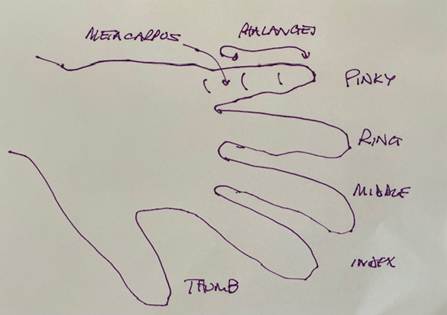
This is an outline of my left hand.

The whole hand is made up of 27 bones. The top two bones in each finger are the well-known phalanges and the metacarpus bone completes the finger; four fingers (Note 1), the index, middle, ring and little (or pinkie), and one thumb make up the hand. The importance of our hands and their component parts is reflected in our language, in our sayings and phrases. Instantaneously I recall people saying ‘I’m all fingers and thumbs’, meaning they are, particularly when flustered or nervous, extremely clumsy or awkward.

The distance between the tip of the thumb and the tip of the index finger is typically around 6 to 7 inches (15cms); maybe a more useful measurement is the distance between the tip of your thumb and the tip of your little finger, about 9 inches (23cms). The tip of the thumb to its first joint is about an inch (2.54cms), and from the nose to the tip of the outstretched arm is about a yard (92cms). A finger is approximately ¾ inch wide – so if you’re asked how much whisky you want and you answer: ‘two fingers’ – you’ll get about 1 ½ inches. (Note 2)

Sailing in coastal waters and checking for navigational aids, it’s good to know that at arm’s length the little finger covers about one degree, three middle fingers together about 5 degrees, a clenched fist about 10 degrees, the spread of index and pinky about 15 degrees, and there’s 25 degrees between the thumb and pinky. There’s more! If you spread your hand out so the pinky is horizontal, the ring finger is at about 30˚, the middle 45˚, the index about 60˚ and the thumb 90˚.

We talk of using the ‘rule of thumb’, working with a method or procedure based on experience and not on theory.

‘Many hands make light work’ is a saying that’s been around since the 1540s, meaning with teamwork tasks are more easily achieved. In this case the word ‘hand’ refers to a ‘person who does something’, most common as a sailing term for the ship’s crew – ‘all hands on deck!’. Those of you who remember The Goon Show with Harry Seacombe, Spike Milligan, Michael Bentine and Peter Sellers may recall a skit when they gathered around an unlit light bulb; ‘Ah! Many hands make light work’ quips Spike …. and the lightbulb lit up; a wonderful example of the zany, timeless humour of that show.

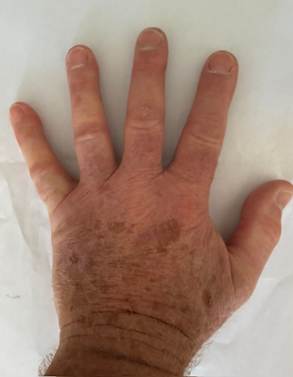
This is my left hand (Note 3). Pseudo psychology would have me believe that if the ring finger is longer than the middle finger, I am poor, that if the middle finger is longer than the index finger I am rich, and if the ring and index finger are the same length you’re a genius. As I said: ‘pseudo psych’!

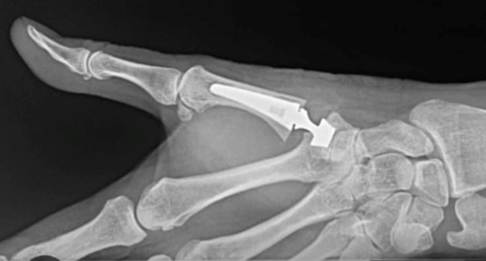
I wrote at the start of this postcard that we rely on our hands for so much. Spare a thought for Armi, a yoga friend from Naples, who works for the hairband Schwarzkopf. Over the years he developed repetitive strain injury in his left thumb, which eventually required the insertion of a metal rod.

He had his operation some weeks ago and the normal functionality is returning. There was debate about who owns the copyright to his X-ray …. so I am chancing he does!

You could add ‘hand’ to ‘writing’, ‘shake’, ‘cuff’, ‘ball’, ‘bell’, ‘to mouth’, ‘over fist’; or after ‘in’, ‘off’, ‘to’, ‘take in’. You could keep your hand in, lay your hand on, change hands, or even ‘win hands down’.

One of the greatest hits of the French singer Françoise Hardy’ was ‘Tous Les Garcons et Les Filles’, from 1962. It’s second verse started: ‘Et les yeux, dans les yeux, et la main, dans la main’  (And the eyes, in the eyes, and the hand, in the hand …). Like every song or lyric one adores, it’s on instant recall.

There is no space here to delve into the interesting mysteries and reading of the various lines on the palm of one’s hand. Palmistry has been around for centuries; who knows what a professional reading of mine would reveal, Oh! I don’t know, how any years I have left …… or whether I should just reflect that according to those beliefs about the lengths of my fingers …. I am a poor genius or a rich nincompoop!

…… if I could put my finger on it!

Richard 3rd July 2026

Evora Portugal

www.postcardscribbles.co.uk

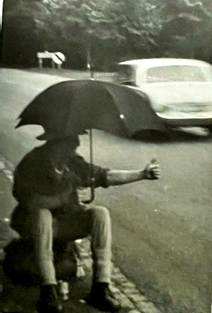
PS Back in 1964 I hitched through the Low Countries. Here’s me trying my luck ….. to ‘thumb a ride’.

Note 1 I asked one of our fellow yogis, Daren, whether he remembered the ‘Four Candles’ sketch with Ronnie Barker and Ronnie Corbett and he admitted to never having seen it. I told him a scruffy Barker walks into a hardware store and asks Corbett who, complete with brown coat, is behind the counter, for ‘fork handles’ (ie new wooden handles for large gardening forks.) Corbett hears ‘four c …. andles’, as Barker has dropped the aitch, and puts those on the counter. It continues ……..

Note 2 Imperial units of measurement work better here.

Note 3 Actually it’s my right hand but when you insert a photograph into a word document sometimes the software turns it through 180˚!