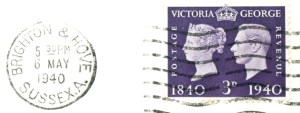
In case your history is a little rusty, the conflict of World War II ended in Europe on 8th May 1945 with the unconditional surrender of Nazi Germany. Four months later in the Far East, as a result of the two atomic bombs dropped on Hiroshima and Nagasaki, Japan surrendered. The formal signature took place on 2nd September on board USS Missouri in Tokyo Bay, although most fighting finished on 15th August.
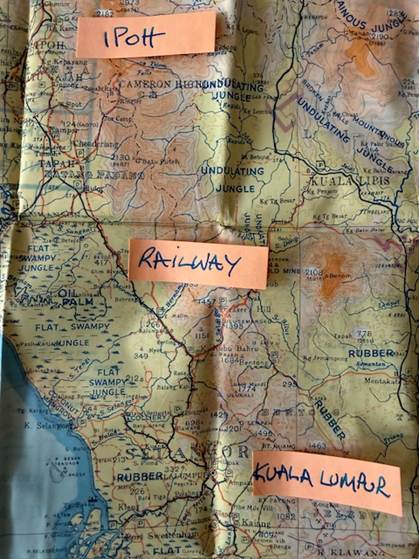
You may remember from PC 493 that Philip’s company was tasked with gathering intelligence along the 200km railway line that ran between Kuala Lumpur and Ipoh, in preparation for an Allied invasion.
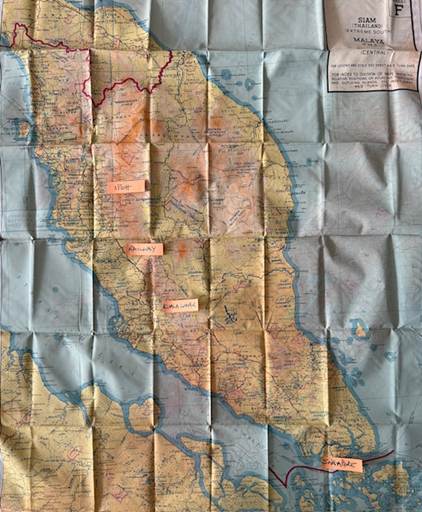
A much-folded silk map of Siam (Now Thailand) and Malaya (now Malaysia), with Singapore in the bottom right-hand corner.
Today you can travel between Kuala Lumpur and Ipoh in about two and a half hours, by either car or train. Google Maps says you could walk it in two days – but not through the dense Malayan jungle where you could only make about two kilometres in 24 hours.
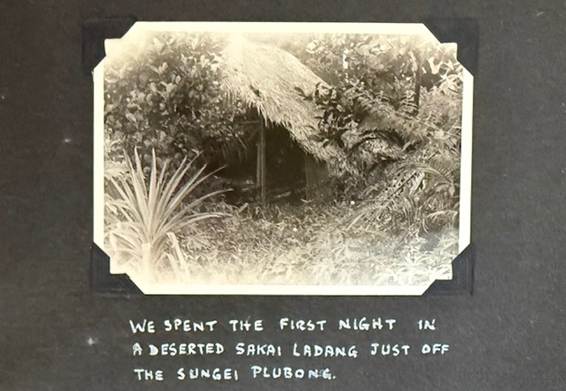
It must have been surreal to leave Europe and arrive, via Ceylon (now Sri Lanka), by parachute, into the jungle terrain of Selangor. Philip’s first night was spent in this shelter.
Later he met the troops who would provide the intelligence he was tasked with collecting.
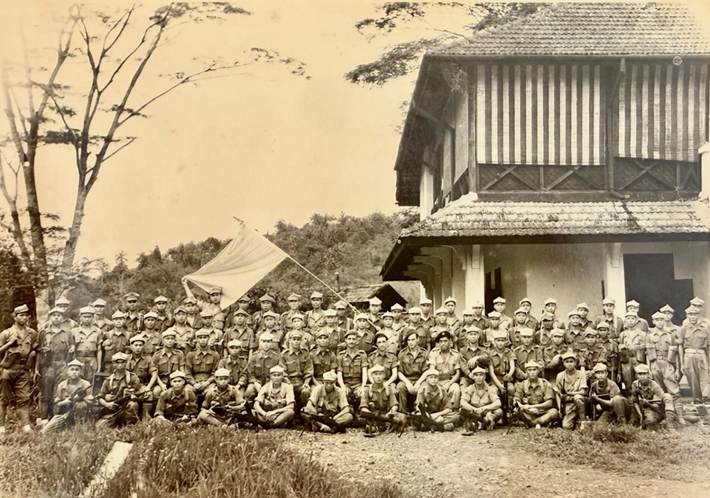
Major Philip Thomson-Walker, Squadron Leader Jimmy Robertson RAAF, Bob Elvidge and Sergeant Ted Wong (Canadian Corps of Infantry) and their soldiers. Probably taken after Japan had surrendered.
Some obviously were very pleased to pose for their photograph …..

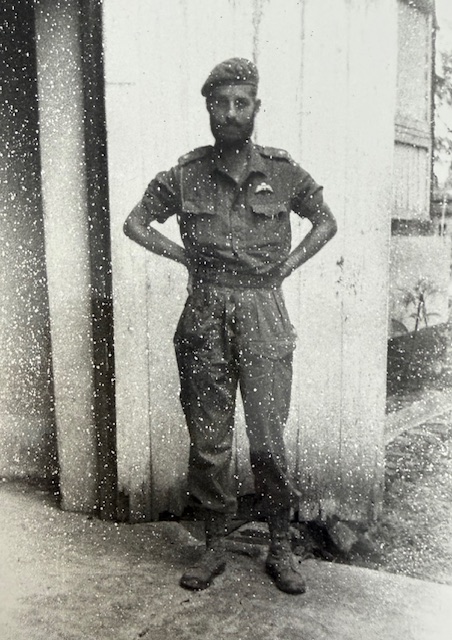
Growing a beard gave him just the look ……
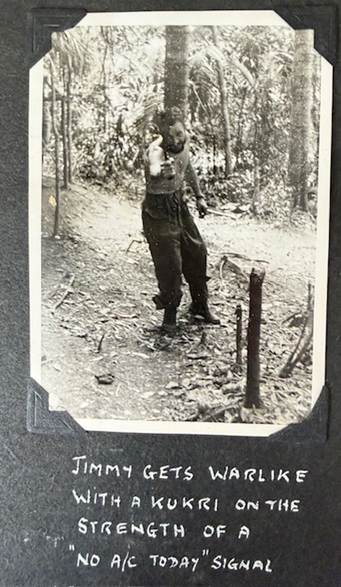
I wonder whether the kukri Squadron Leader Jimmy Robertson RAAF was brandishing in this photograph …….
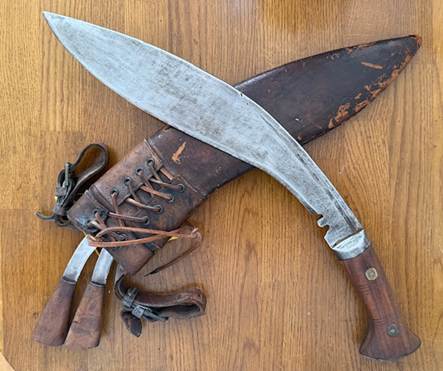
….. is the same one as I have here in Hove, made by Pioneer in Calcutta in 1942 …….??
Part of Philip’s cache of treasures are silk sheets covered in numbers for coding. The one on the left is annotated ‘outbound’ and the one on the right ‘base’.
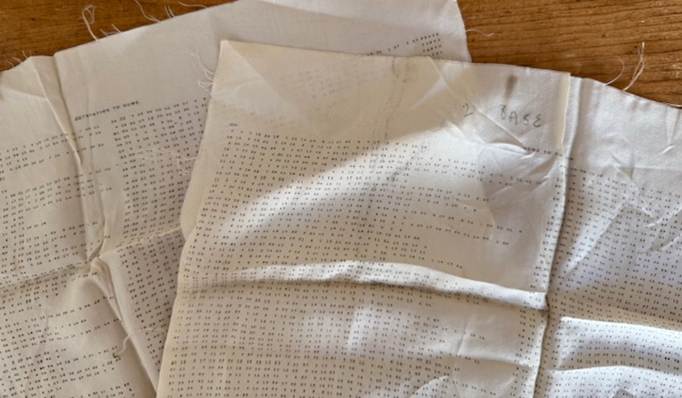
Seah Tin Toon (Tony) might have used these when trying to organise a supply drop
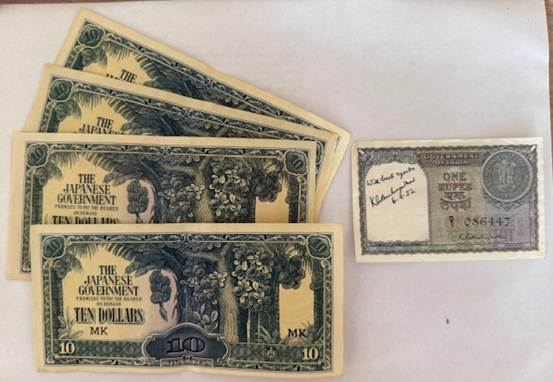
Not sure whether these Japanese Government ten-dollar bills have much value in 2026…..
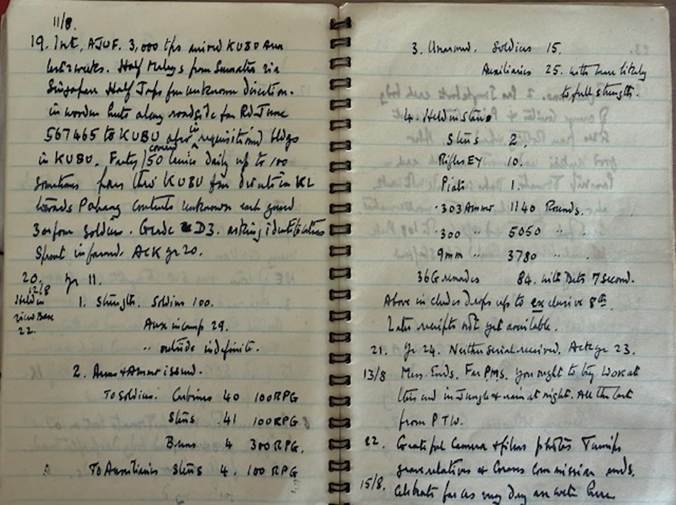
But I do know that Philip’s writing was not the easiest to read; these are pages from a notebook, detailing ammunition supplies and useage. It looks as though the notes were written in ink? If so, I wonder how he got supplied?
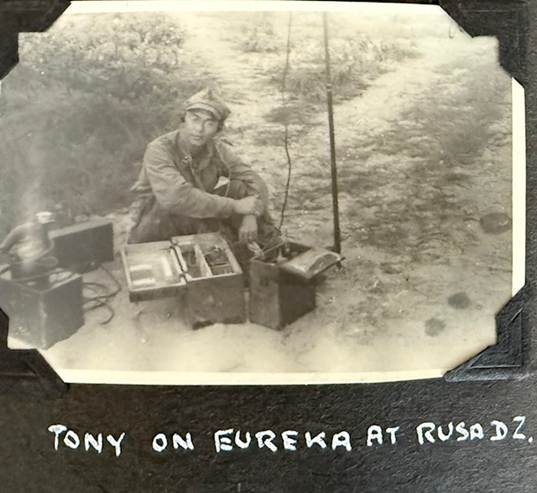
I have relied heavily of Philip’s photograph album …. but how did he get the film and when did he get it processed? In KL at the end of the war, waiting to be repatriated?
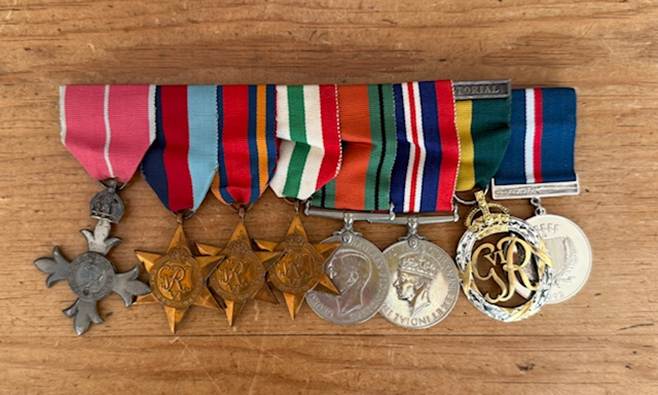
Philip’s medals included his MBE, The 1939-1945 Star, The Burma Star, The Italy Star, The Defence Medal 1939-1945, The War Medal 1939-1945, The Territorial Army Medal and The Malta George Cross medal. The Malta George Cross Fiftieth Anniversary Medal 1942 – 1992, which was ‘commissioned by the Maltese Government to honour veterans of the George Cross Island siege’. In April 1942 King George VI had awarded the people of Malta the George Cross ‘in recognition of their continuing and heroic struggle against repeated and continuous attacks by the Axis powers during World War 2.’ Malta was the first British Commonwealth country to receive the bravery award, which ranks second only to the Victoria Cross and is normally given to individuals. I can only assume that Philip’s role in the SOE Inter-Services Research Bureau in June 1942 involved Malta.
The success of the Chinese Communist guerillas in the war against Japan encouraged a belief that Malaya could become a Chinese Communist State. Tensions rose and eventually war broke out in 1948. Called The Malayan Emergency (Note 1), the conflict lasted for 12 years, the communist pro-independence fighters of the Malayan National Liberation Army fighting the combined forces of the Federation of Malaya and the British Commonwealth. Taking twice as long as the Second World War, victory was eventually achieved through a comprehensive counter-insurgency strategy that systematically cut off the insurgents from their popular base. This is another story!
Malaya became independent from Britain in 1957. (Note 2) During my time with Short Brothers (1986 – 1991) I visited Malaysia a number of times and got to know the modern federation, where Malays, Chinese Malays and Indians live in relative racial harmony.
An ex-Army friend read the first part of my Force 136 postcard and wrote: “….. what a matter-of-fact summary of ostensibly unexceptional people doing extraordinary things over what must have seemed a limitless period – no end of tour or roulement or r & r (R&R? Rest and Recuperation) for any of them; and, as you note, seldom even a passing mention of it afterwards. One of the defining characteristics of that generation seemed to be understatement- even conditions in the jungle were at worst described as inhospitable or challenging.”
I hope I have been able to illustrate actions that happened many decades ago but contributed in their small way to the defeat of Japan. I have reflected on Philip’s relatively short time as part of Force 136 but believe it had a disproportionate effect on his life compared with his other experiences during his time anyone in SOE during World War Two. His hatred of the Japanese and the way they treated anyone but their own led him to boycott anything they made; he would never have considered buying a Sony television or Nissan car for instance.
Richard 5th June 2026
Hove
Note 1 It was to all intense and purposes an all-out war. It was called an emergency so that insurance companies couldn’t say they were not liable for claims, ‘war’ being an exemption!!
Note 2 I have always been saddened by the economic comparison of two countries who both gained independence in 1957, Ghana and Malaya. Income per capita in 1957 was $190 in Ghana and $230 in Malaya. By last year Ghana’s had only grown to $2,500, whereas Malaysia’s had increased to $13,000.

