PC 505 Did you see …….

Those who decide who should be included in the day’s obituaries must have an interesting time discussing the merits of one person’s life over another. And they obviously hope that, having made their selection, the last-minute demise of someone mega well-known will not have them scrabbling for their page layout tools. As an example of their craft, a week ago yesterday The Times’s included Monty Roberts, ‘horse whisperer and friend of Queen Elizabeth II’; Eve Wilkinson, ‘message coder for Winston Churchill’; Justin Hardy, ‘film maker’; Plas Johnson, ‘saxophonist whose solo defined ‘The Pink Panther’ theme (Ed. It immediately started playing in my memory); The Rev Edward Hovsepian-Mehr, ‘Iranian pastor who led an underground church’ and Kath Pettingill, ‘one-eyed matriarch of a Melbourne crime family’.

The rules of copyright forbid me from copying and pasting Kath’s photograph here but believe me she was not blessed with a natural beauty. The Times’ obituary started:

“A diminutive, one-eyed grandmother known as Granny Evil, Kath Pettingill was the matriarch of Melbourne’s most notorious crime family. She oversaw an empire built on drugs, armed robberies and prostitution that reached its heyday in the 1980s, often protected by corrupt police officers. Pettingill bore the scars of a lifetime on the wrong side of the tracks. Her front teeth were smashed after leaping over a wall to retrieve a ball but remained untreated. Her right eye was shot out in 1978 during an argument with a prostitute over a $300 debt. That brought the benefit, she joked, of not seeing double after excess drinking. The police joined the humour, naming a surveillance exercise against her family Operation Cyclops. Several of her ten children followed in her criminal footsteps.” Etcetera! Etcetera. A fascinating story.

I really don’t think I am alone, such is the natural curiosity running through us all, that when I read something interesting, or unusual, or something that highlights my lack of knowledge, it sometimes leads me to find out more about it. And it’s so easy these days, with the internet and its trillions of data available at the stroke of a computer key.

I have read many of the fictional novels of Australian author Chris Hammer and have just finished his latest, ‘Legacy’. A previous one, ‘The Broken River’, had these lines:

“He drew deep on the reefer before breathing out. ‘The ancient Greeks worshipped a sun god, Helios, who had a son and seven daughters. When the son died, his sisters wept tears of golden sunlight that were hardened by their grief to become amber.’

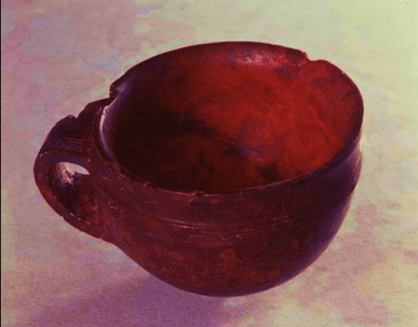
Celina and I live in an apartment in a 2010 conversion of a large 1890s house in Hove. The developers named it Amber House, after the Amber Cup which was unearthed during landscaping in 1856 to create nearby Palmeira Square. An ancient 6-metre-high burial mound was excavated and found to contain a coffin hewn from a tree-trunk. Dated from 1200 BC, it yielded many treasures including this cup, made of translucent red Baltic Amber and about the size of a regular teacup. The find suggests trade links between Britain and the Baltic States over 3200 years ago??? Wow!

I have no knowledge of even the basics of Greek Mythology, so I went online and found this, ‘Thank you, AI’, which filled some of the spaces in Chris Hammer’s story.  ‘Phaethon, son of Helios, begs his father to let him drive the golden sun chariot for a day. A hot-headed youth, he loses control of the horses, and the fiery chariot scorches the earth, nearly destroying it. To save the earth, Zeus strikes Phaethon with a thunderbolt, causing him to fall into a river called Eridanus and he’s drowned. His grieving sisters, known as the Heliades, stood on the riverbank and wept for him so long that the gods turned them into Poplar trees and their hardened tears into golden Amber.’ So now I understand that the little cup was made from Greek tears.

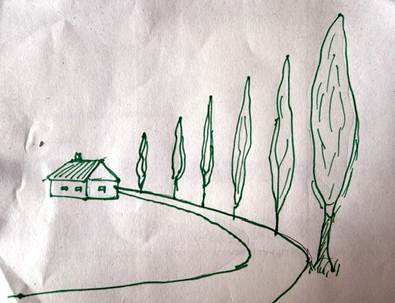
Reading the ladies became Poplar trees reminded me of a framed print in the dining room of Glencot, a ‘prep’ school near Wookey Hole in Somerset. I don’t recognise any images that the internet offers when I search for ‘poplar trees’, so it may not have been by a famous artist, but it’s stayed with me. It looked something like this:

A possible entry into the RA’s Summer Exhibition 20027? Think it would need some work!

Talking of reading, James Marriott’s weekend essay in last Saturday’s Times was jaw-dropping. He writes: ‘Where people once used smartphones to read news articles, they now use them to spend hours scrolling through a dazzling stream of videos, many of them only a few seconds long. More than 40 per cent of young adults regularly get their news from TikTok.’ He highlighted the fact that the publishing industry is ever more reliant for its survival on a committed hard core of “super-readers”; ‘80 per cent of books are read by 20 per cent of adults.’ (Note 1) and claims, more worrying for those who care, that the decline of reading is about more than the fading of a pleasant hobby. ‘It is one of the most important trends of our time. We are moving from a literate culture based on the written word to a visual one dominated by moving images.’

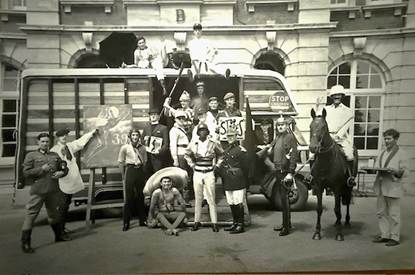
My postcards have helped close an ‘open’ memory. Martin Ward-Harrison was in my intake at Sandhurst (RMAS) and we became very good friends.

Our ‘end of Officer Training’ photograph July 1967; Intake 39 Burma Company. Martin’s on his horse, with his groom holding the drinks tray. I suspect it was his horsebox too.

On commissioning our paths parted; in the days before email and mobile phones, keeping in touch required writing letters and we were both very busy. I had no inkling what had happened when I heard he had died in Oman in 1976. A childhood friend of Martin’s, Nick MacAndrews, got in touch through my postcards about my time at RMAS, asking what I knew. We did some digging and, thanks to Keith Ryde of Oman.org, found he’d been in a Landover that crashed near the Dhofar border with Yemen. Badly injured, he was airlifted back to the UK but died a few days later. On 24 October 2023 his name was added to the Roll of Honour at RMAS, suggesting he’d been seconded to the Sultan of Oman’s Armed Forces, to assist in their border conflict with Yemeni rebels. Feel good about this closure!

Richard 21st August 2026

Estoril, Portugal

www.postcardscribbles.co.uk

Note 1 I no longer get paid to work, so in theory have more time to read than others. In 2025 I read 35 books, so I suspect clearly in Marriott’s 20%.

PC 504 Houses – Buying and Selling

Last Wednesday I found myself, mid-afternoon, in The Hope Café, taking time-out to recall and reflect. You may remember that postcard ‘Wait ….’ (PC 465 November 2025), but you’d be wrong to think I was waiting for something ……. just ‘being’.

Towards the end of last year, it must have been November, an ex-Army chum Jim informed me he was moving from his house in Suffolk to somewhere near Cambridge to be closer to grandchildren. He moved in June this year – over six months between agreeing to buy the house and moving in. The wise say that this experience is one of the most stressful transactions we do and in the course of our lifetime we may do it many times. Mention moving house and immediately memories of your own experiences will flood your brain!

Hurst Cottage in Fleet; my first house – much extended!

Just as I was finding out from Google that Stamp Duty, payable to HMG in England when you buy a house, is 5% if its value is between £250k and £925k, I see Sami walk in with Lisa, so I put my thoughts on hold.

“Hey! You two! Haven’t seen you together for weeks. You been away?”

“Had a very lovely week in Salcombe at the end of July. I remember you writing about being there when it was wet and cool; this year it was glorious. So lucky! Enjoyed your postcards about Brighton’s Lanes and North Laines (PC 503 August 2026) – you should get a job working for the tourist section of the council.”

“God forbid! I’m thinking about writing a postcard about buying and selling a house.”

“Well, how long have you got Richard …?”

I interrupt. “Actually, my first experience, buying Hurst Cottage on Victoria Road in Fleet, Hampshire for £29,500 in 1978, was fine.

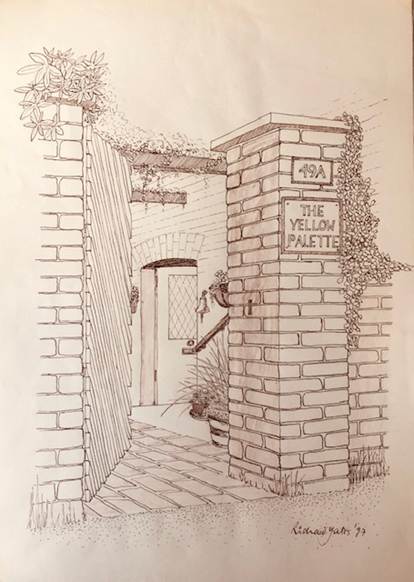
49a, Cavendish Road, Clapham

My ‘lower ground’ flat on Clapham Common South Side went ahead without memorable angst but the next, a Victorian terraced house on the southern end of Battersea, taught me something.”

“What was that?”

“It’s a personable business and we response accordingly. I had written to the owner, to say how much we were looking forward to completing the purchase, recognised that she had made it a charming property and knowing we would be happy there. About three weeks before we thought we would complete, the estate agent said someone was offering another £10,000 and they had an obligation to forward it to the owner. Eeek! We learned later that she didn’t entertain this new offer as our letter had touched her and she wanted us to have it. So, we were not ‘gazumped’ (note 1)”

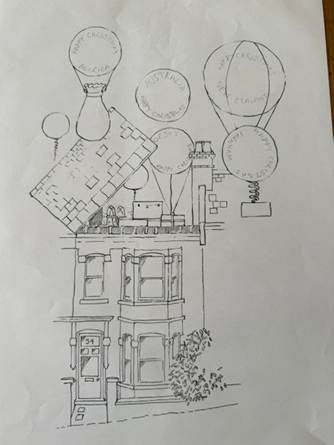
A sketch for a Christmas card, prior to a loft conversion! A terraced house is a terraced house; 54 Bramfield Road.

Just as Lisa is about to comment, maybe offer some of her own insights, a stranger comes over:

“Sorry to interrupt” she said, “but couldn’t help but hear you talking about house purchases and thought you might like to know that my husband was a reverse-gazumper. Do you want to hear the story?” and she said it in that way, suggesting we were going to hear it, like it or not!

I am Sally, by the way. We were getting divorced, thank God, and he was really reluctant to find somewhere for himself to live, so I left and rented to encourage him; not sure it did. But we had a buyer, at our asking price. He explained he hadn’t found somewhere and they should be patient. The weeks rolled into months ….” I could tell this was a painful period for her, recalling how her life was really on hold until he found somewhere. “Then he realised property prices had risen over the period, and asked the prospective buyers, with whom we had already exchanged, ie agree the price, for another 10%!”

“Could he do that?”

“The option for the others was to pull out and after all this time they decided they had no option. I was absolutely disgusted. I complained to the estate agent that I hadn’t agreed this but the estate agent said they didn’t need the agreement of both parties and that they had to forward the instruction.”

“Wow! Sally! That’s really greedy. So sorry for you ….. but thanks for telling us. You a local?”

“No. I live up in Essex …. and must go; love The Hope Café!” and she got up and left.

Sami: “This is England right. This would be very rare in Scotland, where the agreement to buy becomes legally binding much earlier in the process through formal letters between solicitors called ‘concluded missives’. Additionally, sellers must legally provide a single survey and energy report, so that prospective buyers can’t argue that their survey found ‘x’ and ‘y’ and therefore would ask for a reduction in their offer.”

“I had that problem as the executor of my maiden aunt’s estate, selling her house on the north side of Clapham Common. Someone had come along, very quickly offered the asking price, and just when the sale was due to be completed, claimed his survey had highlighted major problems and wanted a huge reduction, some 20% if I remember correctly, imagining he had me by the ‘short and curlies’ and I would agree. I found out this individual had a reputation for doing this …… so didn’t agree and put the house back on the market. But this was a probate sale so I was slightly personally detached!

Statistically, once an offer is accepted it takes an average of four months to complete; Jim’s took six. One in three house sales fall through before exchange. The Ministry for Housing, Communities and Local Government has said: ‘We’re stopping gazundering by introducing legally binding agreements that prevent buyers from walking away at the last minute without a valid reason, with fines for those who do.’ But not until 2029!

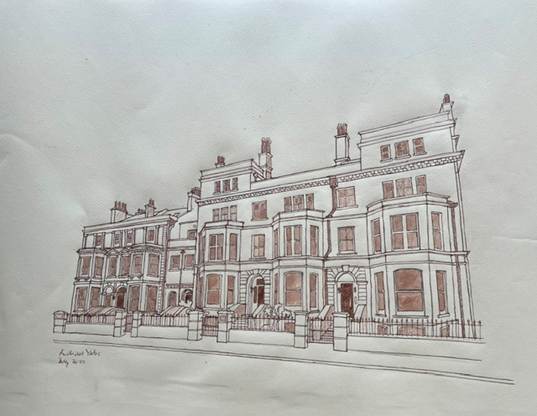
Our Hove apartment is in this magnificent 1890s building

I could tell that Lisa wanted to add some of her own experiences, but I had to dash, as I had to fashion a pinhole viewing device for the evening’s solar eclipse!”

Richard 14th August 2026

Hove

www.postcardscribles.co.uk

PS The only other house I owned was in the village of Rowledge, for 15 months.

Note 1 A gazumper is a person who steps in with a higher offer on a property after the seller has already accepted an offer from someone else, but before the contracts are legally signed.

PC 503 The Lanes and North Laine, Brighton

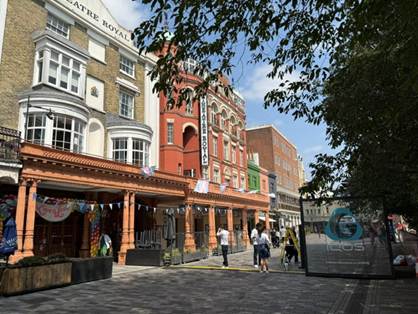
My parents moved from Bath to Sussex in the mid-1950s and eventually settled in the village of Balcombe, twenty miles north of Brighton. Given the paucity of excitement in the nearest town, Haywards Heath, apart from the Perrymount Cinema which showed up-to-date films (Note 1), it was inevitable that Brighton provided more interest. There were regular trips to the Theatre Royal on New Road (Note 2) …..

…… to watch pre-London plays. Today, seventy years later, it presents comedy, musicals, cabaret and children’s entertainment. We also went to the annual Christmas ‘Ice Spectactual’ at the rink at the bottom of West Street. The steam train from Balcombe took 20 minutes … in the summer holidays a day on the beach involved the train from Balcombe then a walk down to the beaches of Hove, always less crowded that those immediately south of the railway station.

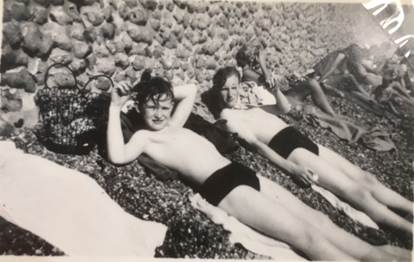
My brother and me, circa 1958

It’s the same today; day trippers heading straight down to the sea, hugger mugger on the beach with others, while a little walk West would give them more space!

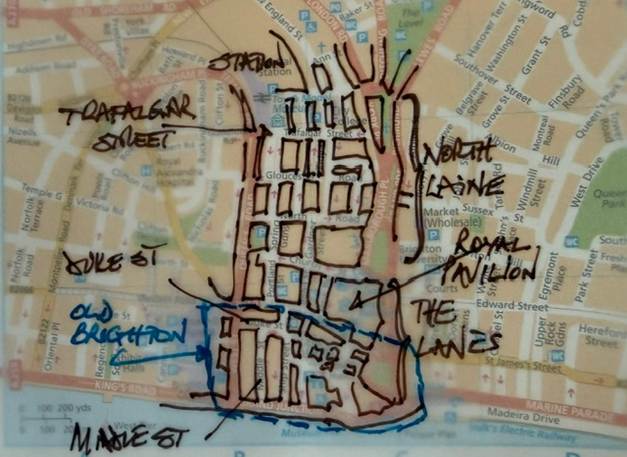
I think the most interesting parts of the city, apart from the Royal Pavilion, built between 1815 and 1822, are the North Laine, at one time Brighton’s worst slum – a laine was an open plain divided into sections for farming – and The Lanes. The latter are essentially located in what was the village of Brighthelmstone, bounded by West Street, North Street, East Street and the sea on its southern edge.

We have to thank King George IV who, as the Prince of Wales, first came to Brighton in 1783 and put the town on the map, establishing its first ‘Season’. He later commissioned the Royal Pavilion and his annual visits encouraged a building spree that defines Brighton’s architectural character today. Georgian buildings such as the Old Ship Hotel (circa 1794) rub shoulders with whitewashed Regency and early Victorian townhouses.

The Lanes are a delightful collection of little streets and pedestrianised squares, often linked by twittens. A twitten is an old Sussex-dialect word for a narrow path or alleyway, which serve as short cuts. From North Street running south into The Lanes is Meeting House Lane, a twitten said to be haunted by the ghost of a nun who was walled up alive after eloping with a soldier. There’s another good example of a twitten just up from our yoga studio, which is situated in the old Rabbi’s house behind the synagogue on Middle Street.

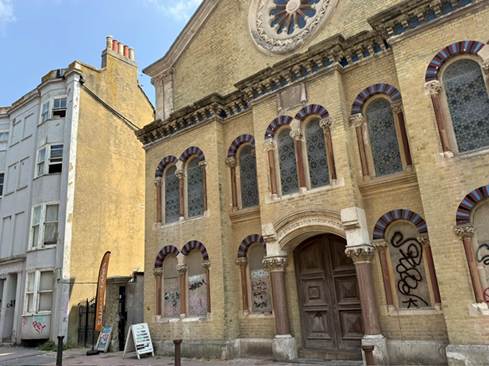
Yoga In The Lanes’ entrance to the left of the Synagogue

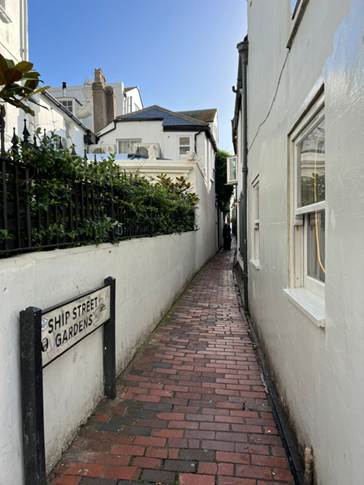
Ship Street Gardens features C19th cottages and a famous fig tree and links Middle Street with Ship Street.

Whilst both The Lanes and the North Laine have many independent shops, The Lanes has a greater preponderance of chain outlets, such as Penhaligon’s, Molton Brown, Lush, Russell & Bromley, Loake, and Flying Tiger.

It is also well known for its jewellers and antique shops, fashion boutiques, cafés and restaurants, including The Ivy and its Asian sister.

English’s of Brighton, the city’s famous seafood restaurant on East Street, is located in three former fishermen’s cottages. Reviewers highlight the fresh rock oysters as a ‘must try’. The city’s Town Hall is located on Bartholomew Road and is where Celina and I got married on 20th August 2016. The building also houses the Old Police Cells museum.

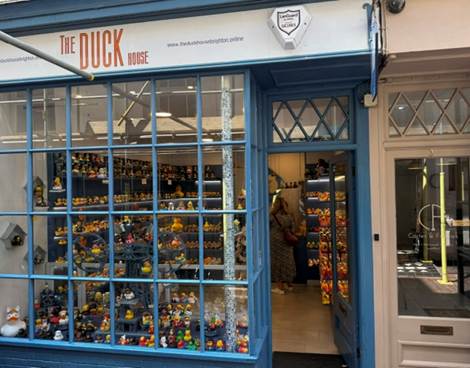
You could easily while away an afternoon, drifting from a coffee house such as Café Coho, exploring Meeting House Lane, Brighton Place, Market Square, winding down its narrow lanes, ….. stopping and being surprised at, for example, The Duck House!

To access the North Laines you cross busy North Street, up New Street with the theatre opposite Pavillion Gardens and a glimpse of the Royal Pavillion, on past The Brighton Museum & Art Gallery and the Brighton Dome, once the Prince Regent’s stables and now a venue for concerts, dance shows, and plays and the headquarters of the Brighton Festival. Here you find a patchwork of small streets lined with quirky shops, drawing crowds of locals and tourists alike.

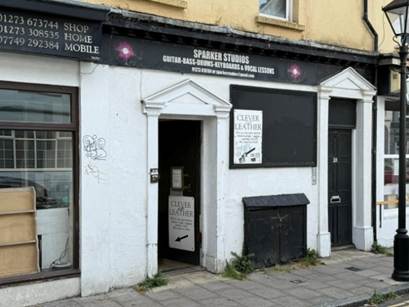
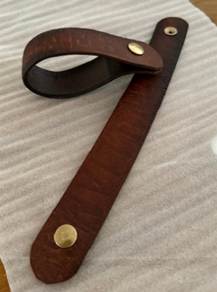
When I wanted someone to fashion two little loops of leather, I went to Clever with Leather in a basement workshop on Tidy Street.

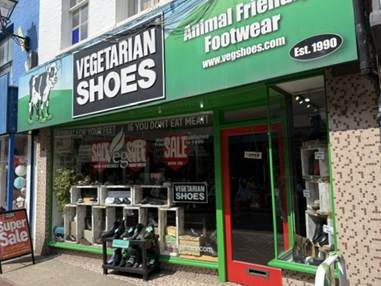
Writing of leather, if you are fastidious about not using animal products, you could buy some shoes or boots from The Vegetarian Shoe shop on Gardner Street.

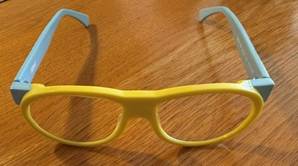
After wearing contact lenses for decades, the removal of my cataracts meant I could indulge in some funky reading glasses. Bromptons Opticians, further up on Gardner Street, has just such frames, but I needed a second mortgage to buy these:

Having a sweet tooth, I get drawn to Caramella on Kensington Gardens where you can buy old-fashioned confectionary. Fancy a humbug or Sherbert Lemons or do you prefer liquorice; the latter in many shapes and lengths and, if you ask nicely, you can pick and choose your favourite ‘Liquorice All Sorts’ – for me the little pink and blue buttons!

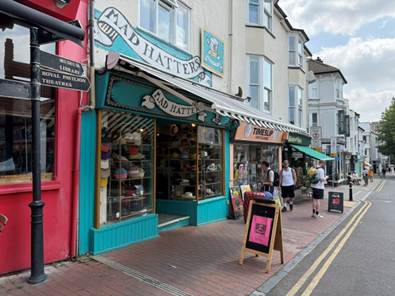
On Trafalgar Street you can find just the right hat for you, assisted by knowledgeable staff who know about face shapes, and can advise accordingly.

Every city suffers from Grafitti and Brighton is no different, but this mural on Bond Street is surely in a class of its own.

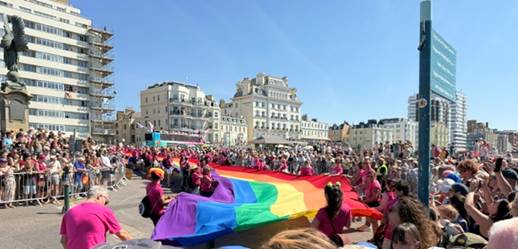
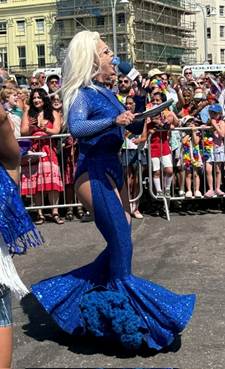
Brighton has just celebrated Pride and I am reminded yet again how inclusive this city is, quite extraordinary! There is a tangible acceptance of people being who they want to be, and no one bats an eyelid, apart from visitors unused to such genuine displays of confidence. I saw these women walking up Gardner Street and thought ‘why not?’

The Lanes and North Laines are so worth a visit!

Richard 7th August 2026

Hove

www.postcardscribbles.co.uk

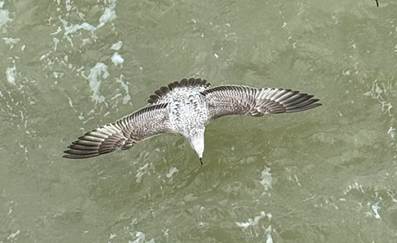
PS If you come to Brighton don’t forget to say hello to the European Herring Gull, otherwise known as: “Oi!” as it swoops down on your fish ‘n chips.

PPS Brighton is 9,219kms (5,729 miles) from Rio de Janeiro, Brazil

Note 1 Opened in 1936, it had a little dance hall and a café, as well as the auditorium for screening films. You could smoke in the rear rows! It closed in 1972 and the building demolished in 1984.

Note 2 It had opened in 1807.