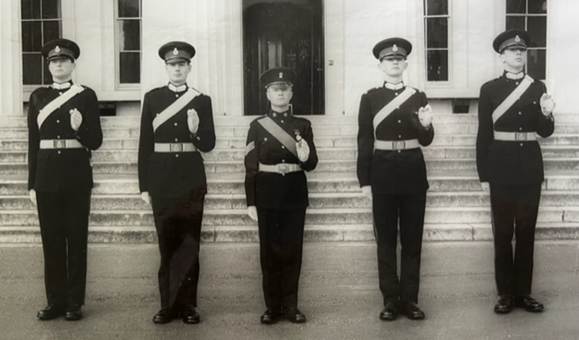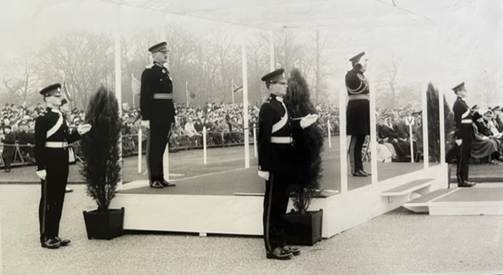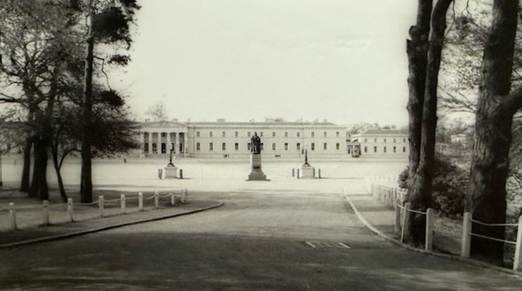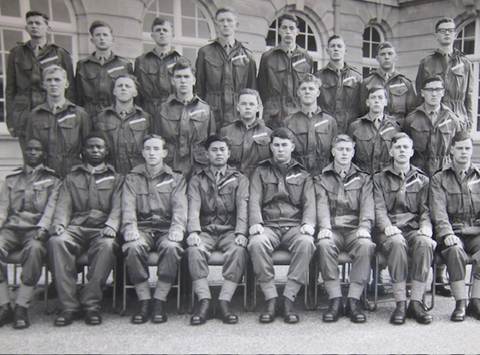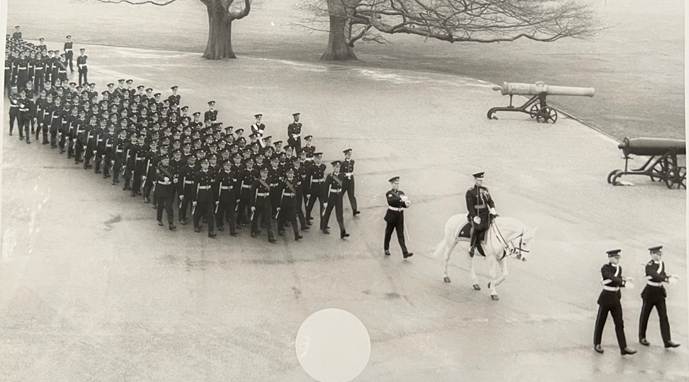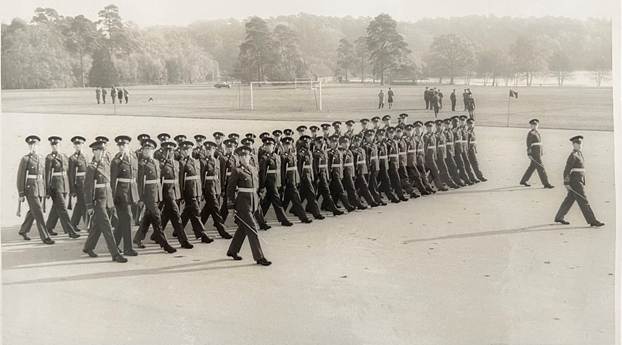
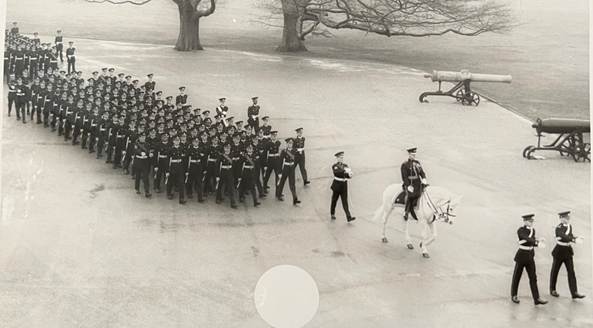
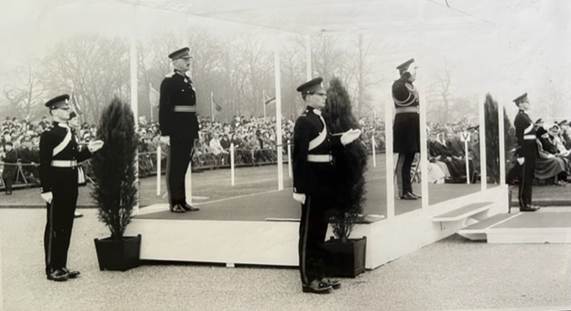
Traditionally two stick orderlies led the 1000 officer cadets onto Old College Square at the Royal Military Academy Sandhurst for the end-of-term parade. That’s me on the extreme right!
I don’t think I have personally contributed to the rich fabric of our traditions, rather pompous to think I might have done, but the late Queen’s funeral and more recently the new King’s coronation have reminded me just how deep tradition is imbedded into the way we do things in the United Kingdom. Seems a long time ago now when Charlie Wilson and I were ‘Stick Orderlies’ and formed the guard for the Inspecting Officer for the Commandant’s Parade; in fact December 1966! Tradition at Sandhurst dictated everything.
In a constitutional monarchy the coronation of a new sovereign (Note 1) is a hugely important event, a time when tradition dictates so much of what happens and we the public marvel and gawp in equal measure.
Unless you’re involved …… like the current Leader of the House of Commons, Penny Mordaunt, who had to carry the Sword of State, weighing 3.6kgs, for nearly an hour – keeping it upright of course! (Note 2)
Unless you’re involved ….. like Charles who, as King, placed his hands on a bible from the C6th: the Augustine Gospels are regarded as the most precious and important medieval manuscript to survive in England. Then tradition had it he had to be dressed in the colobium sindonis, supertunia and girdle, a sort of solid gold overcoat before being given some spurs, representing bravery and knighthood, the bracelets of sincerity and wisdom, the Sovereign’s orb, the Ring of Kingly Dignity and the rod of Equity and Mercy.
Caitlin Morran of The Times wrote it reminded her of the end of a TV game show called Crackerjack, when kids had to hold an increasing load of prizes and cabbages. I think the ‘Glove of God’, looking remarkably like your average oven glove, was the last straw! No wonder Charles looked rather overwhelmed by the whole occasion.
Unless you are involved ….. like the Archbishop of Canterbury who played an important role, having earlier put his foot in it saying he thought the public should swear ‘allegiance to the new king’ – sort of ‘touch the forelock’? In 2023, I don’t think so!
And each to their own, but I personally find it difficult to believe that the chrism or holy oil used to anoint the king came from God. I would prefer to understand that our upmarket Waitrose had a special offer, or maybe they bought it at the King’s grocer Fortnum & Mason, but I do know it was vegan.
Other snippets of information that intrigued me? The Roman Catholic prelate Vincent Nichols became the first of his office to play a part in a coronation since the Reformation (1517-1555). The Chief Rabbi, Ephraim Mirvis, reminded the congregation that in 1189, when Jewish leaders came bearing gifts to the coronation of Richard Coeur de Lion (Note 3) they were stripped, flogged and thrown out of the abbey. Fortunately we have a different view in 2023. And you have heard of King’s Troop, Royal Horse Artillery? The ‘king’ in this case was George VI and the troop provides gun carriages for state funerals and uses its 13 pounder guns to fire salutes on State occasions. Apparently, at the moment, all the riders are female, as is the Officer Commanding.
As I dutifully watched the King’s Coronation Concert in the back garden of Windsor Castle, on the Sunday evening of that weekend, I was reminded of the overheard conversation between two American tourists. As a Boeing 747 (so that dates it!) roared overhead on its way to landing at London’s Heathrow airport, one turned to the other and yelled:
“Why did they build the castle so close to the airport?” (Note 4)
And never one to miss an opportunity to have fun, our rabbit Francisquinha (see PCs 172, 217 & 331) managed to appear above the castle holding on to dozens of drones!
It goes on! Next week, on July 5th the new King & Queen will be presented with the ‘Honours of Scotland’. The oldest crown jewels in Great Britain, they were first used in the coronation of Mary Queen of Scots in 1543, then in 1707 put away in a chest when Scotland was joined to England in The Union.
The newspaper says they were ‘rediscovered by Sir Walter Scott (and others?) in 1818’. Brief descriptions such as this create incredulous thoughts! What? Stuffed in the attic, in a cellar, in someone’s bothy, these priceless items wrapped in some cloak or blanket. And who told Scott where to look? Ah! History huh!
But at the end of the coronation, seven thousand of the troops who had taken part marched into the grounds of Buckingham Palace and formed up in long ranks on the grass; not easy marching in time on grass. Rifles were laid on the ground, headgear was removed and as the new King and Queen arrived at the rear of the building, the Sergeant Major in charge of the parade gave the order:
“Three cheers for His Majesty. Hip! Hip!”
……… and the sound of thousands of voices shouting ‘Hurray’, three times, reverberated around the grounds, over the roofs of the palace and down The Mall to Trafalgar Square.
Watching it on television produced a lump in my throat, the slight wetness in the eyes and the thought: “Yes! Wonderful! We do this sort of thing really well. That’s tradition.”
Yes! That’s tradition.
Richard 30th June 2023
Hove
PS At a rehearsal for the King’s Official Birthday Trooping the Colour Parade, one of the bandsman succumbed to the heat. The accompanying photograph pictured him horizontal on the parade ground; it looked as though he was still trying to play – probably a flat note!
Note 1 For instance, Victoria in 1838, Edward VII in 1902 (delayed a month because of acute appendicitis), George V (1911); Edward VIII’s was cancelled due to his abdication and his brother George VI was crowned instead in 1936; then Elizabeth II in 1953.
Note 2 The weight of the sword was eased by placing its hilt in a small pocket at the bottom of a sash around her shoulders.
Note 3 Richard 1 (1157 – 1199) also ruled as Duke of Normandy, Aquitaine and Gascony. His statue is outside the Houses of Parliament.
Note 4 The building of Windsor Castle was started by William the Conqueror in 1070 on some high ground overlooking the River Thames. It was completed 16 years later.