
In June 2023 I wrote a postcard entitled Serendipity (PC 340), initially prompted by the obituary of Astrud Gilberto, the young woman who serendipitously was asked to sing the English version of ‘Da Garota de Ipanema’ (The Girl from Ipanema). The wonderful opening lines will be familiar to many: “Tall and tanned and young and lovely/the girl from Ipanema goes walking/and when she passes, each one she passes goes, ‘ahhh’.” (Note 1)

Heloisa Pinheiro Born 7th July 1943
In 2025, over 60 years later, is the modern-day equivalent of Heloisa Pinheiro still visible, walking along the promenade of one of Rio de Janeiro’s iconic beaches? I sense the 1960s were a more tranquil, more relaxed era, no more so than along Ipanema’s beach.
Today there’s a constant effort to get fit, be seen, wear the right gear and hundreds of people are in constant motion on Ipanema’s beach; not many seem to have the time to sit and stare at others. We were lucky enough to stay two nights in the Fasano Hotel, situated just before the little promontories of Pedra do Arpoador and Forte de Copacabana that separate Ipanema and Copacabana beaches.
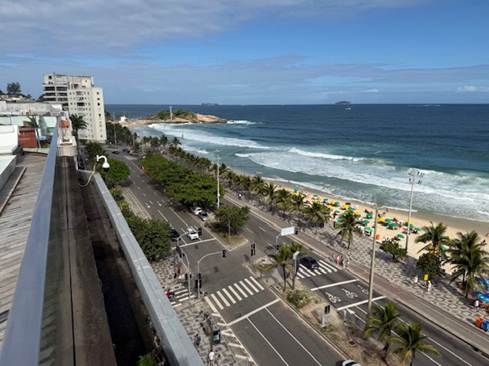
Pedra do Arpoador
From the rooftop swimming pool there’s a good view west down the road ……
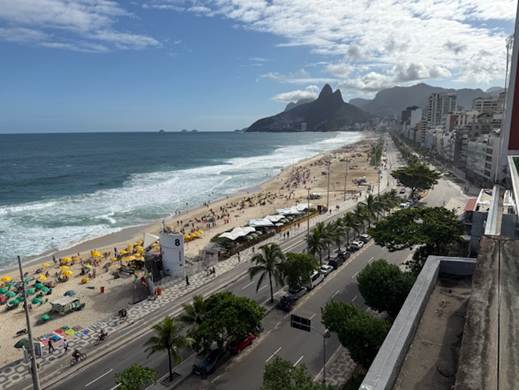
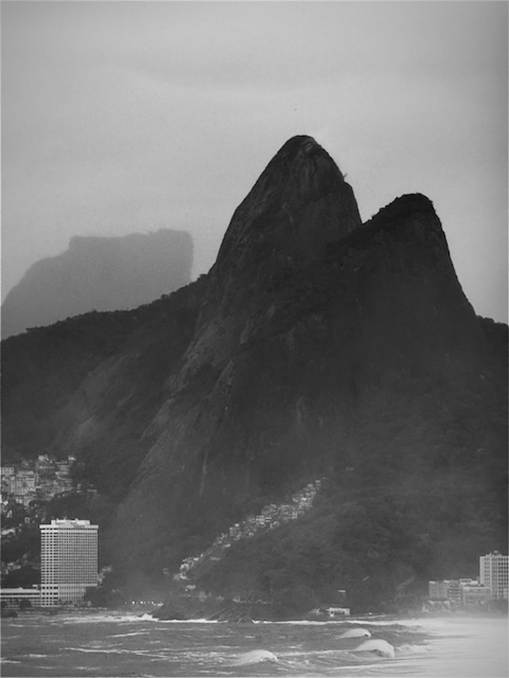
and, at the far end, the favela of Vidigal cheek-by-jowl with the Sheraton Grand Rio Hotel & Resort and both overshadowed by the two peaks known as Dois Irmãos. We arrived in the rain on a Sunday afternoon and those two mountains seemed extremely mysterious.
On our second morning rather than walk along the sand as we had the first day, we walked on the promenade the length of both Ipanema and Leblon beaches, about 5kms. Maybe I could identify a modern ‘girl from Ipanema’? No one seems as carefree as Heloisa Pinheiro must have seemed; a little too much filler in the lips, eyelashes so long they could be used as a paintbrush, small or large tattoos in abundance, the smallest bikini bottoms requiring Brazilian waxing, and possibly stopping every few moments to take a Selfie! (Note 2) Towards the end of the pavement, with its characteristic black & white swirling patterns, suddenly someone yells: ‘Celina!’; I turn around and there’s a friend we hadn’t seen since 2019, Alessandra, getting fit on the beach. She doesn’t speak English so I left her to catch up with Celina and walked to the end, reengaging with Celina on the way back. Six years – in the same time, in the same place – a lovely coincidence!
There was a wonderful observation from Letitia, one of the delightful managers in the Fasano Hotel. The hotel was hosting a book launch on our second night. Assouline Publishing, founded in 1994 in New York, has published over 1700 titles on subjects including architecture, art, design, fashion, gastronomy, photography and travel. In amongst these coffee table book titles are, for instance, ‘Napoli Amore’, ‘Bangkok Spirit’ and ‘Paris Paris’. The book for the launch was obviously about Rio de Janeiro (Note 3), by Bruno Astuto.
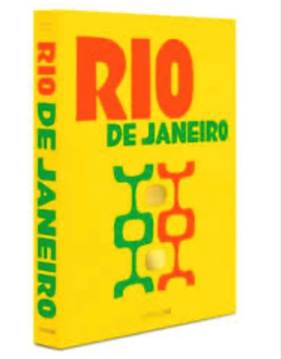
Letitia told us the book costs about R$ 1300 per copy (£170) and ‘that is about the same as Brazil’s minimum wage’! Maybe small change for those who can afford to stay at the Fasano and who might say: ‘Cost of living crisis? What crisis?’ but a good example of the gulf between rich and poor.
Since my first visit to Brazil in April 2012, the Brazilian Real has gone from R$3.2 to the pound to R$7.5. This is great for tourists from Europe like me, but not for instance for Celina’s cousin Bel Gasparian, whose recent week in Florence cost her an arm, a leg, and the bag off her back!
On the subject of finance, here in Brazil, forget ‘contactless’, forget cash; everyone is using a system called Pix (Instant Payment Ecosystem). Created and managed by the Banco Central do Brazil, its aim is to reduce cash transactions and offers an alternative to existing payment instructions. It was fully operational in 2020; all you need is to have a Brazilian bank account. Here credit card transaction fees can reach up to 2.2%, whereas Pix charges retailers about 0.2% and is free to individuals. Naturally everyone is using it, the hotels and restaurants, supermarkets and our taxi drivers, even the street artist making a meagre living selling souvenirs or the chap on the beach offering chairs and a sun umbrella to rent. It aims to achieve the transaction in under 10 seconds, although there is an individual payment limit of R$1000 between 2000 and 0600. (Note 4)
I suspect that most decent human beings are sadden by the way in which the new president of the United States goes about dealing with people. The bullying, the threatening manner; “Do as I say or else …. I’ll throw your toys out of my pram.” But we encountered a couple of instances where international hotel guests completely disregarded anyone but themselves, with no ‘Thank you’, no ‘excuse me!’, certainly no ‘please’. I imagine they hadn’t read ‘manners maketh man.’
To be continued …….
Richard 18 April 2025
Hove
Note 1 The rhythm of Brazil is of course Samba. Sadly today you’re more likely to hear some repetitive techno stuff.
Note 2 These days filler in one’s buttocks (The Brazilian Lift) is popular globally among some, but I don’t think it’s something the Brazilians want to be associated with.
Note 3 R is pronounced H in Brazilian Portuguese. On one visit there was an advertisement for a rock concert called ‘Rock in Rio’ …. Pronounced ‘Hockinghio’!
Note 4 In England the use of contactless cards is widespread, but the retailer pays a percentage for every transaction. On my way back from hot yoga I often buy a drink from Hanan who runs a 7/11. The bottle cost £1.85; I pay cash. Recently it went up to £2 as he makes a loss if the customer pays by contactless; I pay cash and he charges me £1.85.
 postcards
A bargain at £170. £203 on Amazon with this about the book “Arms outstretched, gaze slightly downward, covered in millions of soapstone tiles, and placed atop a pedestal, Christ the Redeemer stands watch over Rio de Janeiro from its perch on Corcovado. With Brazil’s Guanabara Bay in the distance, the statue keeps an eye on the fabled beaches of Ipanema and Copacabana. Passionate, dynamic, colorful, Rio is a city that is bursting with a zest for life. This energy is palpable during the numerous celebrations and events that have taken place in the city, including the Summer Olympics, two World Cups, Carnival, and more. Rio de Janeiro is home to the expressive dance of the samba, which perfectly embodies the high-tempo rhythms of the city. Whether it is the sound of a record by bossa nova pioneer João Gilberto or the reverberations of a massive Madonna concert on Copacabana Beach, Rio does not cater to those looking for peace and quiet. Beyond the musical output, the city is also a major influence in the world of design, inspiring the likes of Oscar Niemeyer and Roberto Burle Marx. Then there is Copacabana Palace, a true icon of the Rio landscape and the hotel of choice for members of the jet set for the past century. This and more pop off the pages of Assouline’s Rio de Janeiro, with local insights from Bruno Astuto.” I’ve never seen a modern book at £170… Eddie
LikeLike