PC 429 Behind The Glass

I don’t know about you, but I am often intrigued to know what goes on behind shop fronts that have frosted windows. They are the complete opposite of those using the shop window to entice potential customers, displaying something to make you want to go inside, maybe a poster showing a sale percentage reduction. Sometimes restaurants have an opaque window to give their customers some privacy and it’s the same for The Hove Practice, a private GPs’ surgery, which recently moved onto Church Road. Along the street is a massage clinic, with the obligatory hazy windows! We are lucky enough to have Kay Delphine, a very experienced masseuse, who comes to our apartment, otherwise we might have used one of these places. Some had a seedy reputation, offering more than a simple massage, but I sense those days have long gone.
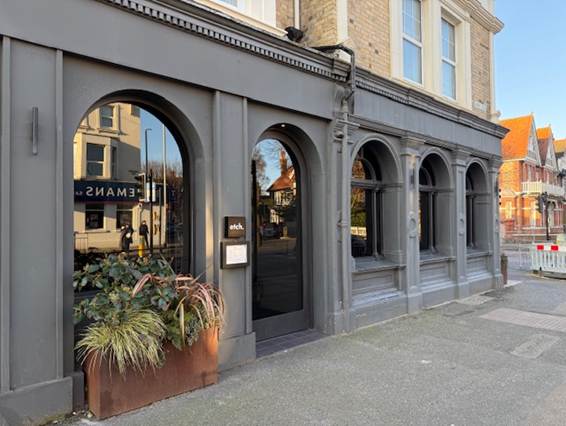
Opposite etch (note 1), a restaurant on the corner of Church Road and Hove Street run by Steven Edwards, a winner of MasterChef The Professionals, is one such place. A non-descript opaque window with its shop signage, ‘CryoBright’, offering no real clue to what goes on inside.
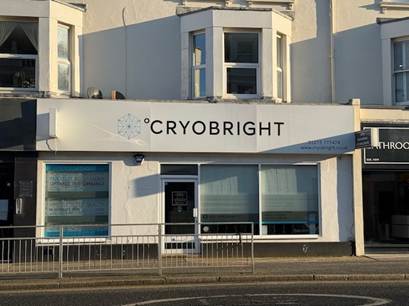
A voucher at Christmas gave us a couple of ‘experiences’ at CryoBright and in late January we pushed open the door. CryoBright provides ‘convenient, affordable access to the most advanced wellness and recovery techniques.’ These include an infrared sauna, red light therapy, fat freezing, leg compression therapy, physiotherapy, whole body cryotherapy and massage, mainly aimed at those recovering from some form of sports injury, which I am not! I was interested in the leg compression trousers, to improve blood circulation to my feet, and in the cold chamber – out of curiosity!

The ‘Compression’ trousers slide over your legs then go through a 20-second sequence of inflate/deflate, inflate/deflate for 20 minutes. It seems very gentle, too gentle almost and so I decide to concentrate on the cold chamber.

The idea is that extreme cold acts as a stimulus to your nervous system, particularly to the hypothalamus, responsible for reacting to dangerous situations; the ‘fight or flight’ trigger. It initiates several physiological reactions in the body, the main one being to restrict blood flow to the periphery, concentrating it around one’s vital organs.

I said I am curious. Most of my experience of ‘cold’ is from winter weather, either skiing or on military exercises many years ago, when the wind chill can drop temperatures alarmingly. I am a pussy when it comes to swimming in a cold sea, such as in Estoril in Portugal, but the benefits of cold-water immersion are becoming more mainstream. Here in Hove many people swim in the sea all the year around, part of their daily routine, and swear by the invigorating afterglow. (Note 2) I guess we’ve all heard of Dutchman Wim Hof, aka the Iceman. In addition to plunging himself, and other paying customers, into freezing cold water, he markets a particular technique of breathing. Proper breathing is an essential part of practising yoga; in the hot yoga series you only breathe through your nose for the first hour.
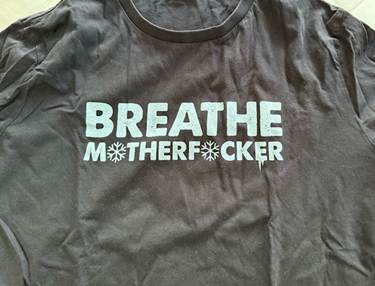
My Wim Hof T Shirt

Hof’s technique involves inhaling through your nose or mouth, filling both belly and chest, and exhaling through your mouth. Each breath should be short and powerful; do 30 to 40 then stop. We all take our lungs for granted, never bothering to exercise them – it’s estimated we only use some 60% of our lung capacity. And I certainly hadn’t heard of COPD (Chronic Obstructive Pulmonary Disease) until those first COVID months. In summary, I breathe well but wouldn’t want to plunge myself into a bath full of ice. (Note 3)

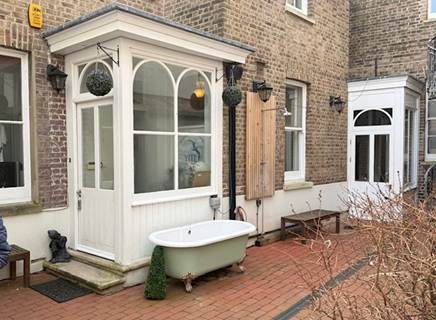
But when we returned from Portugal in September last year, a new cold-water shower, installed in the outer courtyard as part of the yoga studio’s new sauna offering, offered an opportunity to cool down quickly. Now, at the end of my 90 minutes 40°C hot yoga class, I go straight out and have a cold shower. Strangely, I have begun to look forward to it; odd huh! It’s wonderful!
At CryoBright, Rob explains that the cold chamber is designed to give your body a thermal shock so, wearing shorts, a facemask, gloves, socks and slippers and with a set of headphones clamped around my ears, I open the door and enter. Oh! I should have said, it’s minus 85C. I have opted for 4 minutes but after 5 seconds my brain is already saying ‘fly!’. Fortunately, I decide to stay, moving around, glancing at the large clock on an iPad outside that’s counting down the four minutes, listening to music. I wonder how my body is reacting, why my nipples are feeling particularly cold, and resist the temptation to focus on the time. Just enjoy the experience. Outside, I put my clothes back on; my back is tingling in a delicious way and I feel fantastic. We sign up for a package of sessions; this Monday was my eighth and now I look forward to freezing my b******* off!
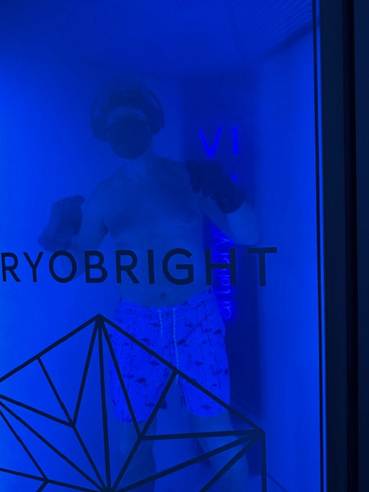
Our curiosity has encouraged chums to try it. Spread the word!

Richard 7th March 2025

Hove

www.postcardscribbles.co.uk

PS Celina also enjoys the cold chamber!

Note 1 Note the small ‘e’. Generally the first word of a sentence uses a capitalised first letter. There’s a distinction between ‘Etch’ and ‘etch’, although it’s personal! As a verb, to etch means to eat away the surface of something; I can only guess this is the tenuous connection for the title of the restaurant.

Note 2 In the summer of 1966, as an Officer Cadet at Sandhurst, I was attached to a Germany-based Artillery Battery for its two weeks Adventure Training near Oberammergau. I went with Staff Sergeant Curtis to recce a lake for some canoeing. The water looked inviting; he suggested I jump in. It was absolutely freezing, almost heart-stopping (!) and I got out as quickly as I had got in! Curtis laughed.

Note 3 The outdoor swimming pool water at Dauntsey’s School was fed directly from a cold spring. Maybe our lap times were quick as we wanted to get out as soon as possible.
PC 54 The Loo

Some subjects are so dry it’s difficult to get worked up about them, but my PC about loo paper brought back many memories for my readers, some good and some hilarious. So popular was this PC that it’s inspired me to go the next step and scribble about the actual loo.

Some of you will have visited ancient castles or manor houses in England where the ‘loo’ was a little seat in a turreted corner of the bedroom; an improvement from the portable box! From the outside, the turret overhung enough for the ‘drop’ to clear the stone façade. Some years ago there was a TV documentary series in the UK, trying to take a new look at old designs: one was about the loo. The design of the loo doesn’t seem to have changed much in more than 150 years.

There are many words for this receptacle for our daily waste. Whilst this list if not definitive …….loo, toilet, lavatory, ‘long drop’, khazi, WC (short for water closet), the crapper, the Dunny, the ‘restroom’, bog, the ‘ladies’ or ‘gents’ in a public environment, the facilities, the white phone, latrine, the John, little room and privy.

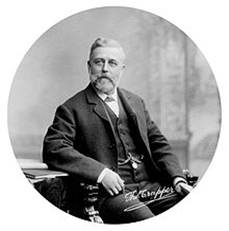
Funny how words become part of our language. Take ‘crap; possibly a verb and certainly a noun! It’s been around since the C17th referring to waste, but not used for bodily waste until 1846. But the word only became well known thanks to a Victorian plumber, Thomas Crapper. He was extremely successful in manufacturing bathroom fixtures and had a Royal Warrant. So ubiquitous were Mr Crapper’s toilet bowls, with his name written on the rim, that American servicemen stationed in Britain during WWII coined the phrase “going to the crapper”!

Thomas Crapper (1837 – 1910)

I do remember potties under the bed, but was shocked by this story, told to me in 1975 by a female newspaper reporter who had covered the kidnap by the IRA of a Dutch industrialist in County Kildare. Traced to a small village called Monasterevin, the siege attracted the world’s press, who had trouble finding somewhere to stay. My chum eventually found a house that offered the share of a bed (!) …… but was horrified to find that under the bed were emptied beer bottles ….. full of urine!

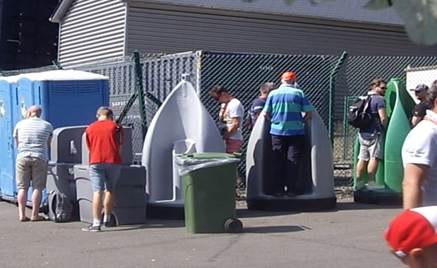
I am indebted to Paul for sending me this photograph, the latest design of ‘pissoire’ used by men at the Spa motor racing circuit in Belgium. He couldn’t find the female equivalent although you can buy a female ‘P EZ’ funnel on Amazon!

I wonder at what point the rocket-nose-shaped ‘pissoires’ take off?

Back in 1968 I chartered a small 19ft yacht for a week’s sailing in The Solent on the south coast of England. On board was fellow Gunner Gerry and two girl friends (note that this is girl …. friends and not girlfriends!) joined for the weekend. Braganza was a very basic sailing boat, with two small bunks and a little gas stove – but no loo! This doesn’t present a problem if you’re a bloke, but for members of the fairer sex a bucket placed below on the cabin sole of a moving/shifting/lurching sailing boat does not encourage the natural flow of things! On the Saturday evening we moored in Wootton Creek on the Isle of Wight …. and I have a very vivid memory of these two girls rowing the little pram dinghy ashore to find a proper loo. The speed at which they were rowing was possibly indicative of the urgency of their quest.

I remember painful experiences at boarding school. If you wanted to go to the loo before breakfast, you had to go before the breakfast bell sounded. After that, you were simply not allowed to go, irrespective of how desperate you might have been. I really to this day do not know what aspect of social behaviour I was meant to learn? If you need to go to the loo, you need to go to the loo – simple!

If you were camping in the 1960s and 1970s you simply took a shovel and walked off to somewhere where no one could see you. Cousin Susan writes: “…. Then there was the loo paper in Egypt and one small town in particular…..a hole in the middle of the floor, no loo paper and no doors so we had to get our friends to stand in the doorway so passers-by could not see us performing our acrobatic ablutions. My thighs were mighty strong in those days!”  Benedicte has similar memories of loos in China today – but would rather forget them! In the Army the camping arrangements were more formal; the Royal Engineers dug bore holes (should that be bored bore holes I wonder?). If it was cold it was OK, in this hessian-encircled latrine; if hot, the flies ensured it was not somewhere you lingered.

My stepfather loved smoking his pipe, particularly when mowing his wonderful lawn … but also, and sadly for the rest of us, when occupying the small downstairs loo. Part of his morning weekend routine, I guess, attempting the daily crossword in the paper, sucking on his tobacco-filled pipe and attending to nature … all at the same time. The little room needed a quarantine notice on the door for at least an hour afterwards.

Mind you, it isn’t necessarily your own loo experiences that are worth writing about. Jeremy Clarkson, a man made famous as much by his Top Gear TV Motoring programme as his ability to call a spade a spade, has a column in the UK Sunday Times. After someone complained of their hotel in Turkey, his weekly column was full of his own experiences, including this: “Certainly I cannot forget the converted old sheep station in the uplands of Bolivia. During my stay, I was woken one morning by a cleaner who entered my room without knocking, shuffled past my bed with a mumbled ‘Buenos dias’, went into my bathroom and took a noisy dump (slang for ‘going to the loo’!!) before shuffling out of the room with a frankly insufficient ‘gracias’”

I have always remembered a story that did the rounds one term at school; written on a grubby piece of paper it told the story of the confusion that arose between the use of WC for either ‘Wesleyan Chapel’ (Named after John Wesley, the founder of the Methodist Church in the C18th) or ‘Water Closet’. This being the C21st, I ‘googled’ it (That must be a verb by now – ‘to google’?) to get the story correct. It hasn’t lost its amusement after 50 something years and is reproduced in full below.

Celina’s father would sympathise with Paul who, recalling Bronco loo paper, wrote:  “Bronco was absolutely useless of course but then I have always detested loo paper of any sort, as it is just not up to the job (so to speak)! Every house I have ever owned has had a bidet and I would find it uncomfortable now to live without one.” Maybe he should try the combined loo/bidet; choose your music/scent/temperature/softness/air …… and away you go!

This PC seemed to go on and on; sorry! I normally try and constrain myself but seem to have suffered a bout of verbal diarrhoea with this one! Enjoy the scribbles!

Richard 8th November 2015                                               richardyates24@gmail.com

PS. “There was a little old English lady who was looking for a place to live in Switzerland.  She asked the local village schoolmaster to help her and together they found a place that suited her.  She returned to London to get her things, but on the way home she remembered that she had not noticed a bathroom in the new place, or as she called it, a water closet.  So when she arrived in London she wrote to the schoolmaster to inquire about a water closet in her place.  Being somewhat embarrassed to ask about this, she decided to just use the abbreviation W.C. rather than spell out the words.  When the schoolmaster received her letter he was puzzled by the initials W.C., never dreaming that she was referring to a bathroom.  So he went to the local minister to see if he knew what a W.C. was.  Of course, the minister thought it stood for the Wesleyan Church.  So the schoolmaster wrote this reply to the English lady.

Dear Madam,

The W.C. is situated nine miles from the house in the center of a beautiful grove of trees.  It is capable of holding 350 people at a time and is open on Tuesday, Thursday, and Sunday of each week.  A large number of folks attend during the summer months, so it is suggested you go early, although there is plenty of standing room.  Some folks like to take their lunch and make a day of it, especially on Thursday when there is organ accompaniment.  The acoustics are very good and everyone can hear the slightest sound.

It may be of interest to you to know that my daughter was married in our W.C. and it was there she met her husband.

We hope you will be here in time for our bazaar to be held very soon.  The proceeds will go toward the purchase of plush seats for our W.C., which the folks agree are a long-felt need, as the present seats all have holes in them.

My wife is rather delicate; therefore, she cannot attend regularly.  It has been six months since the last time she went.  Naturally, it pains her very much not to be able to go more often. I shall close now with the desire to accommodate you in every way possible, and I will be happy to save you a seat down front or near the door, whichever you prefer.

Sincerely,

          Alfred Schmidt

Schoolmaster”

PC 47 Loo Paper

It was Mark Twain who observed that travel broadens the mind; you don’t have to go far, however, even the local streets are full of rich pickings, if you care to look! I thought my own mind fairly broad, but it’s been stretched further by our recent North America travels, experiencing other places and other cultures. So when I encountered the thinnest, no, I really mean thinnest, loo paper in my life in Seattle, I thought this could be the subject of another PC ….. although it might need a little delicate handling ….. know what I mean? And if you had a rather prudish upbringing, maybe it’s best not to read any further!!

When I refer to ‘loo’ paper I encompass all the various descriptions of the genre; ‘toilet’ paper, ‘lavatory’ paper (very old fashioned maybe) …. and now the word ‘tissue’ is common-place. In France they refer to loo paper as PQ (a contraction of ‘papier cul’- ‘cul’ meaning ‘bum’ or ‘arse’); in German it’s ‘klopapier’ and in Portuguese ‘papel higiênico’. A couple of hundred years ago you might only have had the option of using some torn grass or old newspaper, but now the options are endless. The manufacturers of the ubiquitous ‘Wipes’, available for every cleaning job, have even developed the ‘toilet wipe’, which is ‘flushable’. Oh! Joy!

Back in the days of a less sensitive nation, in Britain there was ‘Jeyes Toilet Tissue’. Jeyes is now synonymous with cleaning products that get around the U-Bend but back then …. here was a cardboard pack of folded sheets of hard paper. The paper was a light brown in colour. It was neither absorbent nor comfortable; fortunately we have moved on. All loo paper used to be white, then coloured bathroom suites came into vogue and the manufacturers made a fortune in making loo paper that matched the various colours on offer – Avocardo, Peach etc. And we all know Andrex’s playful little puppy …… to advertise loo paper! I’m sorry, I simply do not see the connection here; what is the association between a sweet, soft, cuddly, youngster, having fun …. and wiping your bum?

If you worked for Her Majesty, as I did during my time in the British Army, we had ‘Government Issue’ loo paper; like the Jeyes stuff, but on every sheet it said ‘Government Issue’! If you were not a fan of a particular Government, the joke was obvious! And the ration that came in the ‘field pack’ had three small sheets per day; the common thought was ‘one up, one down, one polish’!

In Waitrose, an upmarket British supermarket, you can buy ‘Bathroom Tissue’ scented/coated in Aloe Vera, Jojoba or Cashmere. Do you sniff it before you use it, or do you really appreciate the difference in texture ……. by touching it? The mind boggles! In Yukon Territories, Canada, in a small place called Carmacks, a tourist emporium had a stack of loo paper wrapped as ‘Up North Toilet Paper’!?

The large, round container with a commercial-sized roll means less checking for cleaning staff , but have you ever found that the ‘free’ end is somewhere inside, almost stuck to the whole roll, and getting the free end usable takes forever? The ‘Seattle’ loo paper I think was designed for two (or more?) uses. The first is obvious, but the second? Well, it could easily have been used for tracing paper, it was so thin. And actually very difficult to take off the roll if the end was not obvious; a little like cling film/kitchen wrap when the effing end is completely invisible/undiscoverable!

One of the loos I use regularly (no pun intended!) is in our Bikram Studio complex. The overhead light is motion-activated (I’m sorry, this is just the way it comes to mind) which is fine unless you sit for longer than the timer allows – and the light goes off ….. and stays off until your flailing arms get noticed. In the Riverside Cottages we stayed in in Fairbanks, Alaska, they went one better, or worse! The shower/loo room had a timer for both light and extractor fan, and was customer-operated before you went in and locked the door. Well, here’s a conundrum. How long do you set it for before you enter? Get it wrong and you might end up in the dark, with your knickers around your ankles and …….

Bikram Yoga is practised in a studio where at least two walls have floor to ceiling mirrors. That’s fine, as part of the practice is to observed one’s half-hearted attempts to get into a certain posture; ‘must do better’, the voice in my head is often shouting! But in Brazil I encountered a mirrored wall …. in the loo! Aaaggghhhhh! The first time I used it, I was only wearing my Bikram shorts, ready for the session that would started shortly. After a minute or so sitting down, I suddenly looked to the right and ……. saw ……. well, Rodin’s Thinker is good to contemplate …… this sight was not! It sure hurried up my visit.

Recently I went into a loo, a rather narrow little room, sat down, did what I wanted to do, and then looked for the loo paper. After about 30 seconds, I located the roll, behind my shoulder. I almost dislocated said shoulder in trying to release a few sheets of paper; should I put my arm under my shoulder or above? Eventually the only way was to physically swivel on the loo seat through about 160°.

I don’t think we British have really got into using a Bidet, but I can understand its raison d’être! In an imagined nightmare scenario, you use the bidet ….. and look for a towel. There isn’t one! OK! There are probably some paper towels somewhere ….. but then you realise that in the C21st paper towels have been replaced by a Dyson Hot Air drier, fixed up on the wall. Success in the subsequent physical gymnastics required might guarantee you a place in the 2016 Olympics!!

Very mundane musings for a summer afternoon!

Richard 14 August 2015                                          richardyates24@gmail.com

PC 509 Communication

Our friend Sandi, who currently lives near London Bridge, has been frustrated by the sudden closure of the local Hot Yoga studio. Frustrated by its closure over a month ago, but now more and more angry, yes, I know it’s a yoga studio and yoga and anger shouldn’t be on the same page, by the total lack of communication. No one responds to emails, no one suggests monthly membership will be refunded and much more importantly there’s no indication as to when it might reopen. Members drift, find somewhere else that ticks most of the boxes, and by the time it announces it’s reopening, there won’t be any students. Why don’t individuals and companies really understand how important it is to keep people informed?

I have always believed in the power of communication, good and bad; communication is key – even if you know nothing. When I worked for Shorts, the Aerospace manufacturer in Belfast, a huge percentage of the company was owned by the Northern Ireland Development Board. Suddenly HMG announced it was up for sale but as the weeks went by, no one said anything. On one of my frequent visits from our London office, I noticed how depressed people were, worrying whether they would have a job, who was going to buy the company etcetera; there had been no news. Meeting my Divisional Director, I asked him why he couldn’t tell the workforce anything about the proposed sale, who might be in the running to buy it and he said: “I don’t know anything”. I said: “But you’re the MD and your workforce expect you to know, think you do know, so why can’t you simply say you currently don’t know but you’ll keep them up to date?” Why are people so afraid of saying they don’t know? Communication …..

On our TAP flight to Lisbon on 16th August the plane was fully emplaned, the doors closed and we waited and waited and ……there was no announcement saying they expected to take off in five or ten minutes/waiting for our slot …… or similar, and I thought: ‘Why not?’ Twenty minutes before we ‘pushed back’. Good or bad communication helps us understand what’s going on and helps us prepare.

Last week the UK’s National Air Traffic System (NATS) failed; the IT breakdown led to the cancellation of more than 2000 flights and calls for the resignation of Martin Rolfe, its CEO, as this was NATS’s second major failure in three years. What will happen to him and to NATS is one thing, but for Jane & Joe Public it was the lack of communication – for instance no one knew what was/wasn’t happening; the lack of any contingency planning – for instance there was no extra drink delivered to planes sitting on the tarmac full of passengers for 6 hours; obviously no one within the airport’s management asking the real ‘What if …. ?’ questions. Didn’t we learn anything the last time this happened? Don’t Jane & Joe Public deserve better?   

And while I am ranting about communication, I could mention the sad news that a local hardware store on Portland Road, Nuts & Bolts, is closing tomorrow after 45 years. “Ever since the (COVID) lockdown, there’s been a massive shift from high street to online shopping, which is proving to be the death-knoll for many.” Libby Purves, writing in The Times early this week, wrote: ‘Veteran locals see it bit by bit: the big, confident ironmongery and household store shuts, sabotaged by Amazon; the little boutique, deli and shoe shop give up, independents going first; three more charity shops appear with their 80% business rate exemption.’

Sometimes needing to buy something to solve a problem requires looking around at a range of items or talking to someone more knowledgeable than oneself. Nuts & Bolts was an emporium for bolts, nuts, brackets, fixtures, screws, almost anything metal you could imagine. If I couldn’t find what I wanted when I wandered the aisles or was unsure whether ‘A’ was better than ‘B’, I went up to the counter and spoke to a human. Communicating with a chatbot isn’t the same, is it?

Celina’s nephew Tiago is 14 and goes to school in Estoril in Portugal. Every parent knew the school was building an extension to house his year group, due to open in the first week of September. During the Summer holidays there was no indication that there were problems, no warning, no time for considered thought ….. but the school administrators must have known the building wouldn’t be ready for the first day of term nor apparently any time soon. Parents have been scrambling around to find an alternative school for their child. With some warning, some communication, the school’s reputation might have survived; now it’s in tatters.

The subject of the Duke & Duchess of Sussex’s return to the UK had come up in conversation with Sami in the Hope Café last week. Irrespective as to whether one should care or not, as I am writing about communication there was a mixed reaction to the public notice sent out on behalf of King Charles by the Lord Chamberlain to government officials and the media, seeking to clarify their status. Was it really necessary to remind us they are private individuals rather than ‘active representatives of the monarchy’, non-working royals? Was it to spike their guns as they begin to find their feet and determine how to pay for their privileged lives? Whatever the Royal family does there is interest in this couple from certain sections of society …… and they’re just going to have to live with that!  

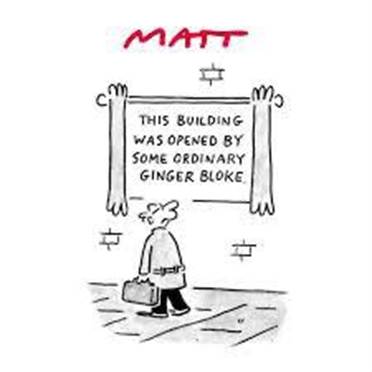
My brother spotted this cartoon by Matt …… which delightfully sums up the issue!

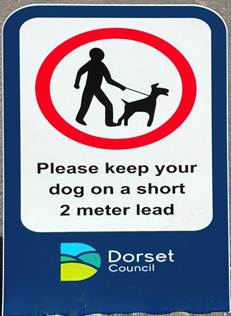
And, finally, correct spelling of words is essential for good communication. Seen in Dorset:

We have gas, water and electricity meters, and two metres, short or not.

Richard 18th September 2026

Hove

www.postcardscribbles.co.uk

PS I accept that American English spells metre meter, but this is Dorset not Delaware.

PC 508 Back in The Hope (Continued from PC 507)

………

“Didn’t large sections of Middle-Class America dodge the draft, studying at college and university, leaving the poorer section of society’s 18–24-year-olds, who weren’t so fortunate, to fill the ranks? Isn’t it one of the many things the current president is accused of?”

“A bone of contention that still smells rotten today. When I finished Caputo’s book, I looked up the casualty numbers. Just over fifty-eight thousand American servicemen died, 10,000 of these from accidents, illness or wounds. Another 300,000 were wounded. The North Vietnamese and Viet Cong lost over 1.1 million fighters, while the South Vietnamese some 225,000 soldiers died.

Do read it Richard; it’s very good. What was your major Summer read?”

“Apart from some glorious fiction from David McCloskey, Chris Hammer and Michael Connelly, it has to be Rory Carroll’s ‘A Rebel and a Traitor’, the story of Roger Casement, knighted by the Crown for his work as a British consul, but who turned into a spy and traitor for the cause of Irish Unity and, after a summary trial, was hanged in HMP Pentonville in August 1916. Reviews called it ‘a rich, stylish and immersive epic’, ‘deeply researched and fascinating’ and Max Hastings thought it ‘a gripping read’. I loved it!

I can’t remember where I read it, but someone reflected that in general terms the British and the Americans see the world as it is today and determine their politics, especially their foreign policy, on that uncluttered view. Others are continually thinking about their historical journey, in some cases letting this shape, dictate even, their modern politics. Reading the obituary of Ratko Mladic (1943-2026), the Serb who earned the moniker ‘The Butcher of Bosnia’, made my skin crawl. In amongst the horrific details of bloodshed and murder was this: ‘The day after his troops had taken Srebrenica, Mladic declared he was presenting the city to the Serbian nation as a gift, in revenge for the events of 1804 when forces of the Ottoman Sultan retook the town from Serbian rebels.’

Mladic is not alone. Putin’s invasion of Ukraine was predicated on his warped view of Russian history. I also consider, as a westerner, the governments of Iran, Israel and Afghanistan beholden to historical influences.”

“Hey! Hang on Richard! Getting a bit heavy! What’s that quote from Buddhism: “You can’t change the past, but you can ruin the present by living in the past and worrying about the future.” You may not have heard but Mo told Lisa the other day that she’s going to spend more time north of London, now her mother’s no longer with us.

Listen ….. you remember the decision you made when buying a video player – VHS or PAL? PAL (Phase Alternating Line – 50Hz) was used primarily in Europe, Africa, Australia and parts of Asia for analogue TVs and VCRs; VHS (NTSC – 60Hz) was the public’s choice in the USA and Japan. Despite being technically inferior, VHS from JVC offered 2 hours video play so the public preferred it. And now you probably have old video tapes gathering dust in the attic, treasured memories and nothing to play them on. Technology has moved on.”

“We’ll miss Mo. Actually, I did convert some Super8 Cine film to video, then the technology moved on ….. so I converted them to CDs …… and now I don’t have a CD player!!”

“What about your mobile phone? Most of us starting using either Apple or Samsung because you knew someone who said theirs was the better option. And we get adept at using the one we chose; Lisa and I use Apple. Lisa’s mother, who has a Samsung, was given a Kindle for her birthday last month; to buy a book she needed an Amazon account. (Note 1) You download the App, and it tells you it will send a code to your email. It does, although by the time you close the app and find the email, the time for the code’s validation is over – 10 seconds? Lisa was trying to help, although unfamiliar with the Samsung!”

“Reminds me of a procedure that older Brazilians have to do every year to guarantee continued receipt of their pension – ‘proof of life’. In essence, you take a ‘selfie’, upload it to the government website, and expect a code sent to your email; hoping that your photograph was acceptable! You have to come out of the website, open your email, find the code, make a note of it, go back to the government website and enter the code ….. all within 20 seconds, or you get timed-out. Whoever designed the system forgot that the only people using it are likely to be slight slower than others, so I don’t understand why that ’20 seconds’ can’t be, say, one minute?”

“From a book I am reading, I learned a new word, Richard: ‘susurrus’ which means a humming, whispering or muttering sound, as in ‘the enthusiastic susurrus of conversation ……’. So, susurrus is an onomatopoeic word, it sounds like its meaning. But I guess you knew that?”

“No! But I do like it. The word just sounds like intermingled conversations; add the occasional clink of glasses and you have a cocktail party! By the way, I was forwarded a faux photograph of Harry and Meghan, in the sort of inflatable rubber dinghy used by people smugglers to get illegal immigrants into the UK; the attached message read: ‘Love it. I am so bored with them. Maybe the media’s fault in part but …’.

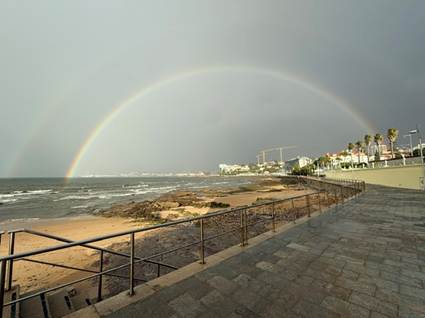
I responded: ‘Seriously couldn’t care a monkey. Both play the victim card and this gives me the idea they have NO concept of how others live. Various commentators have gone to print about their vacuous lives.’ The fake photograph showed them with the white cliffs of Dover behind them ….. maybe they were paddling to France? You saw the photo of a double rainbow over Cascais in my last postcard?”

“Think so!”

It was about the same time as the moon’s eclipse on 28th August – and I managed to get a passable photograph with my iPhone at 0521.

Listen, we both need to get going; well, I certainly do. Stay in touch and love to Lisa.”

Richard 11th September 2026

Hove

www.postcardscribbles.co.uk

Note 1 There are other ways to buy e-books but this seems the simplest.

PC 507 In The Hope Café Again

We came back from a fortnight in Estoril in Portugal on Wednesday. I have written before about Estoril (PC 454 in August 2025) and am reminded on my morning walk through Estoril and Monte Estoril that ‘it has been home to numerous royal families and celebrities, is one of the most expensive places to live in Portugal and the Iberian Peninsula and is home to a sizeable foreign community.’  It’s sad to sense that so many of these enormous houses are empty, have that unlived-in feel about them, maybe a second or even third home, at a time when ordinary folk struggle to afford somewhere, anywhere to live.

As always, it’s good to come home, providing of course ‘home’ meets your needs and your wants. For Celina and me, our large apartment in Hove ticks many boxes; spacious, high ceilings, dual aspect, modern insulation and the sea is two minutes away. We thank our lucky stars that in the unusually warm weather we have had this summer, our bedrooms are downstairs, in what might be described as ‘lower ground’. They are about 3C cooler than our living room! William and Stefano are renting the apartment above us in Amber House. One day in desperation they asked whether we had a fan! A neighbour kindly lent them her two.

After the delivery of our Waitrose shopping, I popped into The Hope Café mid-afternoon yesterday to catch up with Sami, who I hadn’t seen since mid-June. Amazing where the time goes huh! I joined Sami at a table, having got a double espresso from Josh, who’d asked whether I knew anyone who they could hire, as Libby is finally going to retire.

“Do you?” asked Sami.

“No one springs to mind and this is a difficult time of the year, what with the new Academic Year, a new school for some, others to university or Sixth Form College. Lots of people already committed.”

“I liked your last postcard, Richard, (PC 506 Be the Person you want to be) and that final paragraph when you said ……. let me look at my WhatsApp ….. here we are: ‘We are social animals; we want to fit in, not brave it out, not branch out, be the odd one out. But understanding ourselves better, our extraversion or introversion, the degree we engage/need to engage with others, with our families and with friends, or preferring our own company ….’

We all find ourselves not being who we want to be, presenting an untrue image, hiding behind a façade, and I found this from some psychologist:

‘Some people call it a division between the ‘original self’ and a ‘pseudo self’. A person exhibiting a ‘false self’ occurs when other people’s expectations override the spontaneous expression of the ‘true self’. The ‘false self’ is a kind of masquerade, a self that is presented to the world, a ‘social self’. Not the true, private self, the one ‘inside’.’”

“I am pleased …… and I assume I am talking to the true self, Sami, not some cardboard cutout?! Haven’t seen you since I completed my two linked wooden spoons, have I?”

“You showed me the enormous one you made for your daughter from a discarded scaffolding plank, but this is something else?”

“I had the idea I could fashion two spoons from one plank, the loop at the end of each linked. Once the idea got embedded, I thought long and hard about how I would carve that; this is how they look:

To get there I made a model out of some plasticine; hadn’t bought that for decades although you can still find it! Eventually I got to this point ….

 Then spent some time thinking about how to untie the knot, as it were; slowly but surely managed to separate them. Some wood filler, stain and wax and we’ve ended up with exactly what I imagined!

“Wow! They’re amazing Richard. Well done you! By the way, I know you read a lot when you’re in Estoril ….. and before you tell me about your stand-out book, I need to tell you about mine. I’ve caught your habit of glancing through the newspapers’ obituary column and found that a chap called Philip Caputo had died.

“Who? What was his claim to fame?

“He was an American author and journalist, best known for his best-selling memoir of his experiences during the Vietnam War, ‘A Rumour of War’. In 1973 he was part of a writing team that won the Pulitzer Prize for reporting on election fraud in Chicago. You had written a couple of postcards (PCs 493 and 494) about your stepfather’s deployment to Malaya in 1945 as part of Force 136 and I was curious as to Caputo’s time in Vietnam; I ordered his book and finished it a couple of weeks ago.”

“Wasn’t that the first modern war that the USA lost?”

“Yup! And they left with their tail between their legs, their departure from Saigon (renamed Ho Chi Minh City) in 1975 reduced to a rout.

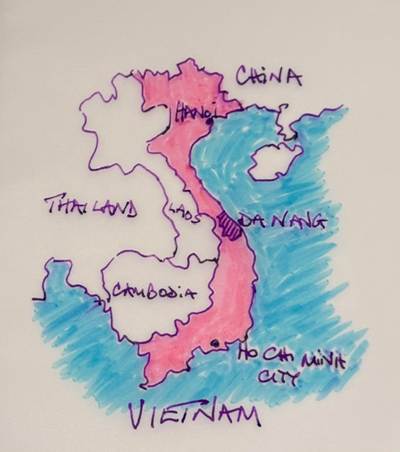
Caputo had been a Marine Second Lieutenant in Da Nang Province in 1965 for just over a year and his memoir is widely regarded as a classic in the literature of war, being compared to ‘All Quiet on the Western Front’ (Note 1) What I found fascinating was his ability to describe the rigours of jungle warfare in every gruesome and human detail. For instance, the Marines were provided with three sheets of loo paper ….

“The British Army had the same, part of a one’s field ration pack, except ours was made of that hard, unabsorbent, paper. The common saying was: ‘One up, one down and one polish’! Sorry, I interrupted you, Sami.”

“That’s OK. Caputo described how you could never get your arse clean, most soldiers suffered from permanent Diarrhoea, and how you lived and fought in the rain, covered in leaches and being bitten by mosquitoes. He also observed what fighting, kill or be killed, does to the human soul.”

(To be continued ….)

Richard 4th September 2026

Hove

www.postcardscribbles.co.uk

Note 1 A semi-autobiographical novel by Erich Maria Remarque, a German veteran of World War!1, billed by some as ‘the greatest war novel of all time’.

PC 506 Be the Person you want to be

These scribbles are aimed at those who are not doing what they really, really want to do ….. yet!

Do you have the opportunity, the luxury, the personal understanding to be the person you want to be? Do you even know how to describe what that person might feel like, might act like? It may not be easy, being the person you want to be …… as personal needs and practical issues often get in the way! But if you aspire to something, to do something, to be someone and can remain focused ….. you’ll get there. Remember, we only get one life.

One life ….. one full rainbow; yesterday morning, before the heavens opened!

Many years ago, someone recommended to Patrick that he spend some hard-earned cash and have a session with me, as he was unsure what he should do after serving in the Army for ten years, and that I might be able to help him with that exercise. I think I became quite good at helping individuals unlock their inner thoughts and validating their ideas and dreams. For some it’s difficult but maybe easier doing so with a stranger than a work colleague or relative.

Patrick reminded me that we are often initially guided by our well-meaning parents, but their advice can be skewed by their own experiences, the trends and opinions of the society when they were growing up; they were them and not you. Patrick had gone into the Army at his father’s insistence. Now he was free to choose, although his chums swamped him with standard ideas that didn’t appeal. After a couple of hours, I remember very distinctly him leaning forward and, in a very quiet voice, said: ‘Do you know what I really want to do?’ ‘No! Tell me!’ Ten minutes later he asked what I thought. “Why don’t you give it a try?” And off he went, having had ‘permission’?

Ring any bells? Are you doing what you want to do?

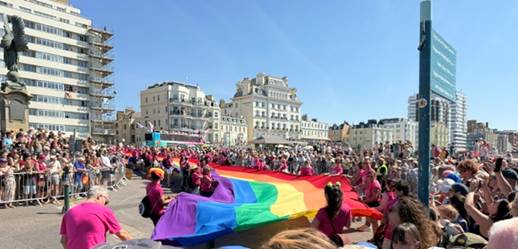
It seemed appropriate that on the August weekend that the City of Brighton & Hove celebrated ‘Pride’, there was an article in the Saturday Times’ magazine about the crisis in men’s health, featuring an interview with psychologist Dr Peter Meades. For those who don’t live here, the Pride Festival attracts ‘a diverse demographic audience from across the globe and is singularly the city’s most popular visitor attraction. Pride is as famous, vibrant, popular and utterly unique as the city itself. (My italics) Its sole ethos is to promote diversity, inclusion and education within our communities.’

I have broken down a couple of paragraphs from the Times interview with Meades that encapsulate this issue, being the person you want to be, accepting the individual you are. Meades has worked with men for some 25 years, and recently written a book ‘for the silent majority, who need help but don’t know how to ask for it.’,

“I was born in Caerphilly (Wales) and grew up gay in a mining village in the 1980s.” The traditional way of life and beliefs in the Welsh valleys would have made it extremely difficult to be accepted, to be who he was.

“My family were born-again, fundamentalist, evangelical Christians. My three older brothers played rugby. It was challenging.” Homosexuality was a crime and for those with Christian beliefs, a sin that condemned one to hell and damnation. More charitable souls suggested it was a mental affliction, perhaps a disease.

Understanding who you are is the very first step to being the person you want to be. My very first question to a new client when I started my executive coaching session was, for some, extremely difficult: ‘Tell Me About Yourself’. Peter Meades recommends keeping a diary, as this simple exercise often gets ideas out into the open. If you have never written for pleasure, why don’t you open a blank Word document, or an inexpensive real-paper notebook, and write: ‘I remember ……’ and let the thoughts flow without interrupting. As soon as you stop to think about what to write next, write: ‘I remember …..’ and off you go again. Write at your own pace, even for an audience of one! It’s a great way to really understand yourself and maybe it will open up ideas for your life. Many years ago, I thought I should start writing my novel; to get some time to do it, I got up at 0530, an hour earlier than usual.

There’s this very appropriate anonymous quotation: “Five percent of the people think; ten percent of the people think they think; and the other eighty-five percent would rather die than think.” So start thinking?

One of our yoga chums is adding singing to his portfolio of skills, just because he wants to. You may remember the delightful story of the actor Michael Crawford who decided he wanted to learn to sing. Many a Saturday morning would find Michael practising at his singing teacher’s flat. One week the teacher’s doorbell rang. Instructing Michael to carry on with his scales, he went to answer it; it was Andrew Lloyd-Webber. “Who’s that upstairs, Mark?” “Michael Crawford; he’s got a good voice.” “I think I have found my Phantom!” (The lead role in his new musical Phantom of the Opera)

Yoga’s physical and mental discipline attracts many gay men; they tend to be more in tune with their inner selves and their emotions than heterosexual men. Our studio is no exception and naturally we now have many good, gay friends

I titled this postcard ‘Be the Person you want to be’ ……. because I think fundamentally this can be quite difficult. We are social animals; we want to fit in, not brave it out, not branch out, be the odd one out. But understanding ourselves better, our extraversion or introversion, the degree we engage/need to engage with others, with our families and with friends, or preferring our own company, where and when we feel 100% engaged with what we are doing ….. and accepting that that’s who we are, should enable you to be the person you want to be.

Richard 28th August 2026

Estoril, Portugal

www.postcardscribbles.co.uk

PS If you still haven’t found your ‘element’, read Ken Robinson’s book of the same name, with its subtitle: ‘How finding your passion changes everything’.

PC 505 Did you see …….

Those who decide who should be included in the day’s obituaries must have an interesting time discussing the merits of one person’s life over another. And they obviously hope that, having made their selection, the last-minute demise of someone mega well-known will not have them scrabbling for their page layout tools. As an example of their craft, a week ago yesterday The Times’s included Monty Roberts, ‘horse whisperer and friend of Queen Elizabeth II’; Eve Wilkinson, ‘message coder for Winston Churchill’; Justin Hardy, ‘film maker’; Plas Johnson, ‘saxophonist whose solo defined ‘The Pink Panther’ theme (Ed. It immediately started playing in my memory); The Rev Edward Hovsepian-Mehr, ‘Iranian pastor who led an underground church’ and Kath Pettingill, ‘one-eyed matriarch of a Melbourne crime family’.

The rules of copyright forbid me from copying and pasting Kath’s photograph here but believe me she was not blessed with a natural beauty. The Times’ obituary started:

“A diminutive, one-eyed grandmother known as Granny Evil, Kath Pettingill was the matriarch of Melbourne’s most notorious crime family. She oversaw an empire built on drugs, armed robberies and prostitution that reached its heyday in the 1980s, often protected by corrupt police officers. Pettingill bore the scars of a lifetime on the wrong side of the tracks. Her front teeth were smashed after leaping over a wall to retrieve a ball but remained untreated. Her right eye was shot out in 1978 during an argument with a prostitute over a $300 debt. That brought the benefit, she joked, of not seeing double after excess drinking. The police joined the humour, naming a surveillance exercise against her family Operation Cyclops. Several of her ten children followed in her criminal footsteps.” Etcetera! Etcetera. A fascinating story.

I really don’t think I am alone, such is the natural curiosity running through us all, that when I read something interesting, or unusual, or something that highlights my lack of knowledge, it sometimes leads me to find out more about it. And it’s so easy these days, with the internet and its trillions of data available at the stroke of a computer key.

I have read many of the fictional novels of Australian author Chris Hammer and have just finished his latest, ‘Legacy’. A previous one, ‘The Broken River’, had these lines:

“He drew deep on the reefer before breathing out. ‘The ancient Greeks worshipped a sun god, Helios, who had a son and seven daughters. When the son died, his sisters wept tears of golden sunlight that were hardened by their grief to become amber.’“

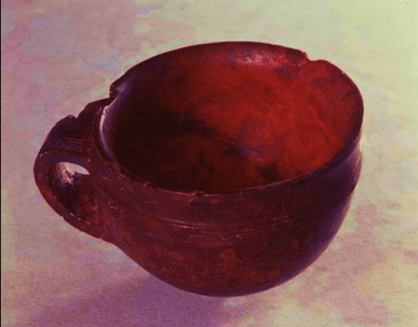
Celina and I live in an apartment in a 2010 conversion of a large 1890s house in Hove. The developers named it Amber House, after the Amber Cup which was unearthed during landscaping in 1856 to create nearby Palmeira Square. An ancient 6-metre-high burial mound was excavated and found to contain a coffin hewn from a tree-trunk. Dated from 1200 BC, it yielded many treasures including this cup, made of translucent red Baltic Amber and about the size of a regular teacup. The find suggests trade links between Britain and the Baltic States over 3200 years ago??? Wow!

I have no knowledge of even the basics of Greek Mythology, so I went online and found this, ‘Thank you, AI’, which filled some of the spaces in Chris Hammer’s story.  ‘Phaethon, son of Helios, begs his father to let him drive the golden sun chariot for a day. A hot-headed youth, he loses control of the horses, and the fiery chariot scorches the earth, nearly destroying it. To save the earth, Zeus strikes Phaethon with a thunderbolt, causing him to fall into a river called Eridanus and he’s drowned. His grieving sisters, known as the Heliades, stood on the riverbank and wept for him so long that the gods turned them into Poplar trees and their hardened tears into golden Amber.’ So now I understand that the little cup was made from Greek tears.

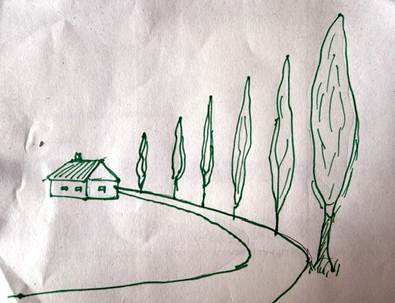
Reading the ladies became Poplar trees reminded me of a framed print in the dining room of Glencot, a ‘prep’ school near Wookey Hole in Somerset. I don’t recognise any images that the internet offers when I search for ‘poplar trees’, so it may not have been by a famous artist, but it’s stayed with me. It looked something like this:

A possible entry into the RA’s Summer Exhibition 20027? Think it would need some work!

Talking of reading, James Marriott’s weekend essay in last Saturday’s Times was jaw-dropping. He writes: ‘Where people once used smartphones to read news articles, they now use them to spend hours scrolling through a dazzling stream of videos, many of them only a few seconds long. More than 40 per cent of young adults regularly get their news from TikTok.’ He highlighted the fact that the publishing industry is ever more reliant for its survival on a committed hard core of “super-readers”; ‘80 per cent of books are read by 20 per cent of adults.’ (Note 1) and claims, more worrying for those who care, that the decline of reading is about more than the fading of a pleasant hobby. ‘It is one of the most important trends of our time. We are moving from a literate culture based on the written word to a visual one dominated by moving images.’

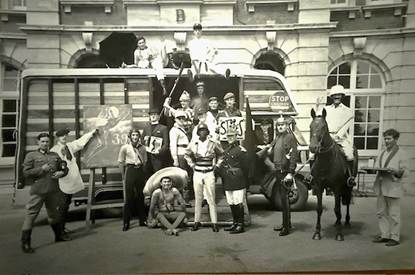
My postcards have helped close an ‘open’ memory. Martin Ward-Harrison was in my intake at Sandhurst (RMAS) and we became very good friends.

Our ‘end of Officer Training’ photograph July 1967; Intake 39 Burma Company. Martin’s on his horse, with his groom holding the drinks tray. I suspect it was his horsebox too.

On commissioning our paths parted; in the days before email and mobile phones, keeping in touch required writing letters and we were both very busy. I had no inkling what had happened when I heard he had died in Oman in 1976. A childhood friend of Martin’s, Nick MacAndrews, got in touch through my postcards about my time at RMAS, asking what I knew. We did some digging and, thanks to Keith Ryde of Oman.org, found he’d been in a Landover that crashed near the Dhofar border with Yemen. Badly injured, he was airlifted back to the UK but died a few days later. On 24 October 2023 his name was added to the Roll of Honour at RMAS, suggesting he’d been seconded to the Sultan of Oman’s Armed Forces, to assist in their border conflict with Yemeni rebels. Feel good about this closure!

Richard 21st August 2026

Estoril, Portugal

www.postcardscribbles.co.uk

Note 1 I no longer get paid to work, so in theory have more time to read than others. In 2025 I read 35 books, so I suspect clearly in Marriott’s 20%.

PC 504 Houses – Buying and Selling

Last Wednesday I found myself, mid-afternoon, in The Hope Café, taking time-out to recall and reflect. You may remember that postcard ‘Wait ….’ (PC 465 November 2025), but you’d be wrong to think I was waiting for something ……. just ‘being’.

Towards the end of last year, it must have been November, an ex-Army chum Jim informed me he was moving from his house in Suffolk to somewhere near Cambridge to be closer to grandchildren. He moved in June this year – over six months between agreeing to buy the house and moving in. The wise say that this experience is one of the most stressful transactions we do and in the course of our lifetime we may do it many times. Mention moving house and immediately memories of your own experiences will flood your brain!

Hurst Cottage in Fleet; my first house – much extended!

Just as I was finding out from Google that Stamp Duty, payable to HMG in England when you buy a house, is 5% if its value is between £250k and £925k, I see Sami walk in with Lisa, so I put my thoughts on hold.

“Hey! You two! Haven’t seen you together for weeks. You been away?”

“Had a very lovely week in Salcombe at the end of July. I remember you writing about being there when it was wet and cool; this year it was glorious. So lucky! Enjoyed your postcards about Brighton’s Lanes and North Laines (PC 503 August 2026) – you should get a job working for the tourist section of the council.”

“God forbid! I’m thinking about writing a postcard about buying and selling a house.”

“Well, how long have you got Richard …?”

I interrupt. “Actually, my first experience, buying Hurst Cottage on Victoria Road in Fleet, Hampshire for £29,500 in 1978, was fine.

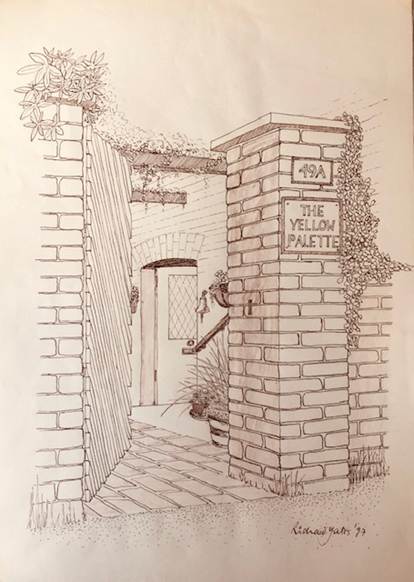
49a, Cavendish Road, Clapham

My ‘lower ground’ flat on Clapham Common South Side went ahead without memorable angst but the next, a Victorian terraced house on the southern end of Battersea, taught me something.”

“What was that?”

“It’s a personable business and we response accordingly. I had written to the owner, to say how much we were looking forward to completing the purchase, recognised that she had made it a charming property and knowing we would be happy there. About three weeks before we thought we would complete, the estate agent said someone was offering another £10,000 and they had an obligation to forward it to the owner. Eeek! We learned later that she didn’t entertain this new offer as our letter had touched her and she wanted us to have it. So, we were not ‘gazumped’ (note 1)”

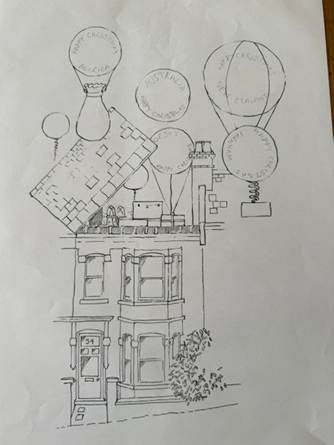
A sketch for a Christmas card, prior to a loft conversion! A terraced house is a terraced house; 54 Bramfield Road.

Just as Lisa is about to comment, maybe offer some of her own insights, a stranger comes over:

“Sorry to interrupt” she said, “but couldn’t help but hear you talking about house purchases and thought you might like to know that my husband was a reverse-gazumper. Do you want to hear the story?” and she said it in that way, suggesting we were going to hear it, like it or not!

“I am Sally, by the way. We were getting divorced, thank God, and he was really reluctant to find somewhere for himself to live, so I left and rented to encourage him; not sure it did. But we had a buyer, at our asking price. He explained he hadn’t found somewhere and they should be patient. The weeks rolled into months ….” I could tell this was a painful period for her, recalling how her life was really on hold until he found somewhere. “Then he realised property prices had risen over the period, and asked the prospective buyers, with whom we had already exchanged, ie agree the price, for another 10%!”

“Could he do that?”

“The option for the others was to pull out and after all this time they decided they had no option. I was absolutely disgusted. I complained to the estate agent that I hadn’t agreed this but the estate agent said they didn’t need the agreement of both parties and that they had to forward the instruction.”

“Wow! Sally! That’s really greedy. So sorry for you ….. but thanks for telling us. You a local?”

“No. I live up in Essex …. and must go; love The Hope Café!” and she got up and left.

Sami: “This is England right. This would be very rare in Scotland, where the agreement to buy becomes legally binding much earlier in the process through formal letters between solicitors called ‘concluded missives’. Additionally, sellers must legally provide a single survey and energy report, so that prospective buyers can’t argue that their survey found ‘x’ and ‘y’ and therefore would ask for a reduction in their offer.”

“I had that problem as the executor of my maiden aunt’s estate, selling her house on the north side of Clapham Common. Someone had come along, very quickly offered the asking price, and just when the sale was due to be completed, claimed his survey had highlighted major problems and wanted a huge reduction, some 20% if I remember correctly, imagining he had me by the ‘short and curlies’ and I would agree. I found out this individual had a reputation for doing this …… so didn’t agree and put the house back on the market. But this was a probate sale so I was slightly personally detached!

Statistically, once an offer is accepted it takes an average of four months to complete; Jim’s took six. One in three house sales fall through before exchange. The Ministry for Housing, Communities and Local Government has said: ‘We’re stopping gazundering by introducing legally binding agreements that prevent buyers from walking away at the last minute without a valid reason, with fines for those who do.’ But not until 2029!

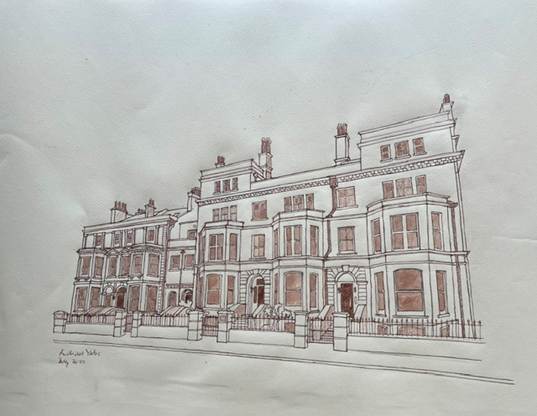
Our Hove apartment is in this magnificent 1890s building

I could tell that Lisa wanted to add some of her own experiences, but I had to dash, as I had to fashion a pinhole viewing device for the evening’s solar eclipse!”

Richard 14th August 2026

Hove

www.postcardscribles.co.uk

PS The only other house I owned was in the village of Rowledge, for 15 months.

Note 1 A gazumper is a person who steps in with a higher offer on a property after the seller has already accepted an offer from someone else, but before the contracts are legally signed.

PC 502 Heading to The Hope Café

After lunch on Tuesday, before a dental appointment towards the end of the afternoon, I headed to The Hope Café for a coffee and a catch-up. In a little bag I had some toothpaste and a toothbrush, as I needed to clean my teeth before being subjected to an oral examination. Nothing worse than one’s dentist berating one for poor dental hygiene. This reminds me that we make sure our apartment is clean and tidy ….. before our fortnightly cleaner’s visit; funny what we do, huh? ‘There are standards, Caruthers.’

In my mind I was collecting thoughts for this week’s scribbles and suddenly thought: ‘I have enough …… I don’t need to have a conversation with anyone!’ ….. so popped into Café Nero on Church Road, got a double espresso, plugged in my laptop and looked at my notes.

My regular readers will know Celina and I visited both the North and South Islands of New Zealand last autumn, and on the latter drove from Christchurch to Lake Tekapo. The weather was glorious:

The little stone Church of The Good Sheppard, built in 1935 to honour the first English settler families in the area, is one of the most photographed buildings in the country. On Facebook a couple of weeks ago it looked completely different; I read that Lake Tekapo had recorded minus12.5C!

In my normal perusal of the obituary column in The Times, I found that the former Emir of Qatar, Sheikh Hamad bin Khalifa al-Thani, has died aged 74. He had deposed his father and was credited with bringing Qatar into the C21st. What I found amazing was his ability to procreate! He had married three times; his first wife Mariam, a cousin, gave him 2 sons and 6 daughters, his second, Moza, 5 sons and 2 daughters and his last, Noora and another cousin, 4 sons and 5 daughters, a total of 11 sons and 13 daughters. Quite a brood. The practice of marrying a first cousin, and the obituary didn’t say whether two of his wives were first cousins, is debateable. For example, it’s legal in the UK and in about 50% of the States in America, while banned in many other places. Statistics show that children of first-cousin marriages have a 5% risk of ‘autosomal recessive genetic disorders’ compared to the 3% of the children of unrelated parents. It’s certainly a common practice in the Pakistan community in Leeds where, according to a television documentary, the percentage of abnormal births is very high.

Back from a week in Estoril in Portugal earlier this month, I read another obituary, that of a judge, André Cerdini. What caught my eye was the subtitle: ‘Provincial magistrate praised for his calm restraint during the prosecution of ‘The Butcher of Lyon’ (Klaus Barbie), four decades after the US helped him to escape justice.’ Barbie had been ‘notorious as a sadistic figure, relentlessly pursuing both the city’s Jewish population and its French Resistance members. He was responsible for hundreds of murders and deportations to concentration camps.’ He was one of the monsters in human form, the subject of my PC 324 ‘Monsters’ from March 2023.

You might think that our yoga studio has some background music before class and that it’s all yoga-stuff, spiritual, chanting, Indian etc. Most of the time the music that’s playing as students check-in is the choice of the individual teaching. Last month Eve was playing music that I instantly recognised, from a 1960’s British folk-rock band called ‘Pentangle’. Their single ‘Light Flight’ became popular when it was used as the theme music for a BBC drama series ‘Take Three Girls’ – incidentally the first drama series to be televised in colour.

My postcards reach a wide variety of individuals, maybe the readership expanded by people sharing them with others. Back in March, a photograph from September 1965 of Burma Company Intake 39 at the Royal Military Academy, Sandhurst (RMAS) caught the eye of Nick Whittle, who was researching an uncle’s career and thought he might have been an Officer Cadet at RMAS in my time. Eventually, through a very helpful individual at The Sandhurst Collection, a Dr Sebastian Puncher, we established that Stephen Hall-Jones had been in Normandy Company in Intake 37 (September 1964 – July 1966) and was commissioned into The Inniskilling Fusiliers. Sebastian sent Nick a cache of information that enabled him to fill out the details of his uncle’s life.

At about the same time, a Nick MacAndrews got in touch about a fellow Officer Cadet in Burma 39, Martin Ward-Harrison. I will write about him in a subsequent postcard.

My parents’ house in Balcombe had an enormous garden and at one time the gardener was a chap called Buswell, who cycled about 4 miles from his home. He was a red-cheeked chap, full of enthusiasm for life, although his actual knowledge of plants was minimal! He needed careful supervision. I remember him for all sorts of reasons but particularly for the way he said ‘binoculars’. Why this particular useful piece of equipment came up in the conversation I don’t know but he pronounced it ‘binockerknickers’. And why it came to my mind this week is a mystery!

          I mentioned we’d been to Portugal (See PC 499 Évora 10 July). The new entry arrangements – fingerprinting etc – took no time at all, although we had to have our passport checked by a human being. When we flew back, I presented my passport to check-in my suitcase, got through an electronic gate using my passport, but then had to go to a border force official in a kiosk, showing my passport again ….. then to get into the boarding gate waiting area had to show it again ….. and then again when we started boarding! Absolute nonsense! Then to cap it all, my suitcase took the long route, eventually delivered home by personal courier 36 hours later at 0200.

Last week’s postcard PC 501 ‘Living and loving more, or victim’, the follow-on from PC 485 ‘Live more, live less’, was well-received: ‘Beautiful PC this morning’; ‘This PC really spoke to me’; ‘With 485, this time you’re getting deeper and closer …’, while Eddie commented he only had 7 months left to confound the statistics! If it’s still in your ‘will catch up later’ folder (?) I suggest you spend 5 minutes and read it (well, 10 if you didn’t read the first!)

Richard 31st July 2026

Hove

www.postcardscribbles.co.uk