PC 441 Osborne and Obesity

PC 441 Osborne and Obesity
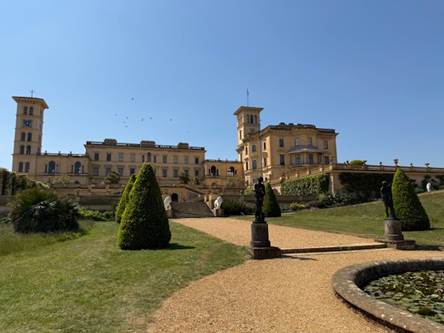
I have been to Osborne House, the summer palace of Queen Victoria and Prince Albert on the Isle of Wight, once, a decade before I moved out of London with Celina and settled in Hove. Strangely here we are surrounded by echoes of its period, the architecture copied by two houses on Albany Villas   
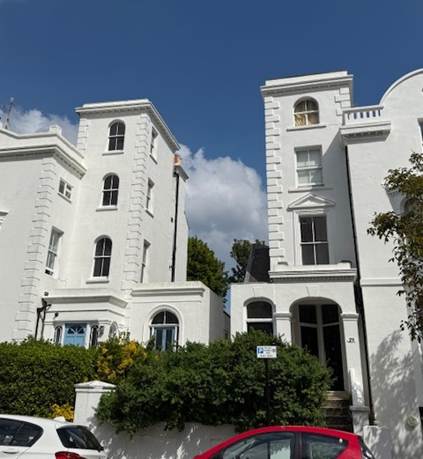
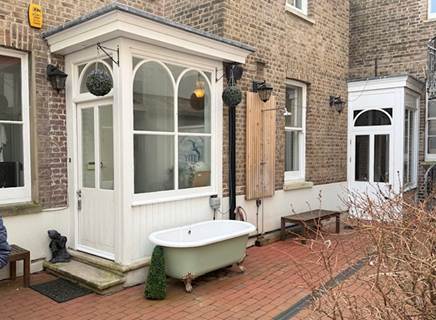
and local streets named Osborne Villas and Medina Villas, the latter named after the river that flows north to the sea at Cowes. On that first visit I had admired the floor-to-ceiling mirrors in one of the state rooms and that idea came to fruition when we moved into our apartment in Amber House. Dean from The House of Shutters was startled to be asked to mirror the inside of six of the eight shutters we had ordered, but agreed they looked wonderful; and still do!
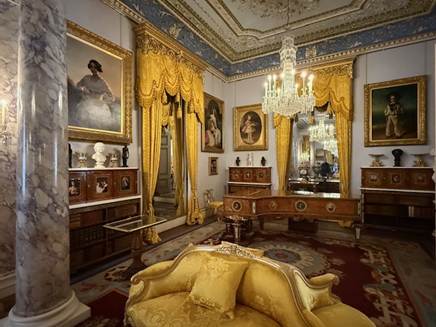
The Yellow Drawing Room at Osborne House

Osborne House (note 1) was built for Queen Victoria and Prince Albert between 1845 and 1851. In the twenty-four years between her accession to the throne in 1937 and the death of Prince Albert in 1861, The British Empire almost quintupled in size. A fascinating book that covers this period is Saul David’s ‘Victoria’s Wars – The Rise of Empire’. The importance of Osborne House to Queen Victoria following Albert’s untimely death is obvious.
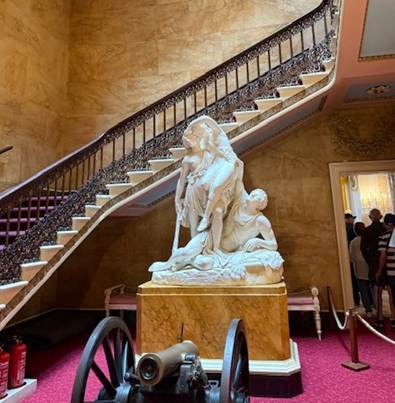
On her own death on 22 January 1901 (Note 2) the royal apartments, including Queen Victoria’s bedroom, were turned into a private museum accessible only to the royal family. A wrought iron gate was fixed across the corridor, barring anyone else! On his coronation Edward VII gave the estate to the nation. Queen Elizabeth II never visited, preferring to use Sandringham as her summer retreat, but gave permission in 1954 for the first-floor private apartments in the royal pavilion to be open to the public.

The carved dining room ceiling with a minstrels’ gallery at the end

Always interesting to see inside these magnificent buildings, glimpsing how a very minute section of our nation lived. Most of the rooms are very ornate, the decoration befitting the Ruler of the British Empire. Wearing her Empress of India hat, Victoria created The Durbar Room and corridor, with its paintings from India. Victoria had a great sense of humour and she commissioned a huge painting of bare-breasted women to hang on the wall above Albert’s and her working desks.

Their desks side by side, facing the somewhat raunchy oil painting!

Walking around Osborne, I was wondering what happened to their nine children; Victoria (1840), Albert Edward (1841), Alice (1843), Alfred (1844), Helena (1846), Louise (1848), Arthur (1851), Leopold (1853) and Beatrice (1857).
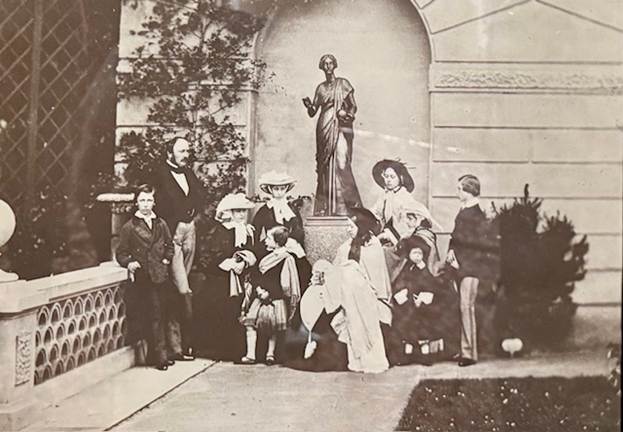
Albert, Victoria and eight of their children

 I am reminded of my great great grandmother Sarah Fosbery who, having married at 17, gave birth to nine daughters between 1839 and 1861 – and then died aged 39; hardly surprising?

Regular readers will remember that, in the aftermath of food poisoning from a TAP meal on my flight back from Brazil, I rediscovered sweet jelly. In the extensive grounds of Osborne House is Swiss Cottage, a chalet-style house that Albert built, well I don’t imagine he built it himself (!), for his children, somewhere where they could be themselves, away from the suffocating atmosphere of the main house. Each child had their own vegetable patch
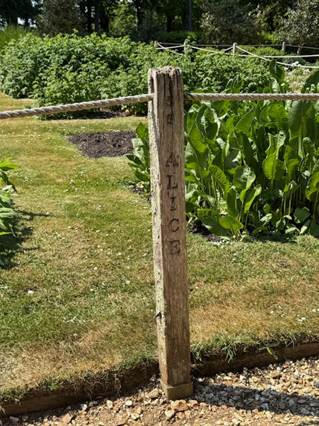
Princess Alice’s vegetable plot

and in the cottage, rooms were dedicated to cooking, playing games, sewing etc. I spied one of those lovely copper jelly, or blancmange (?) moulds and asked the volunteer overseeing the visitors whether I could borrow it. Fat chance huh! In Swiss Cottage there was an interactive explanation of what happened to their children; naturally most married into other European royal families.

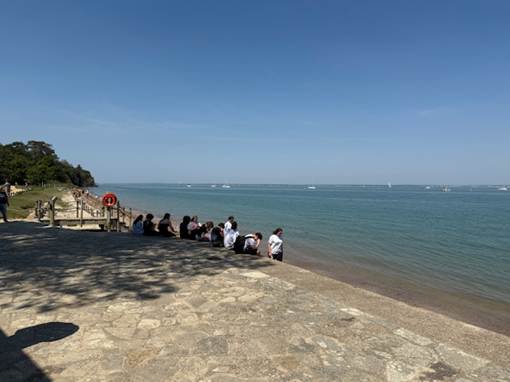
Albert’s love of horticulture has ensured that the 300 acres of gardens, pastures and woods are well worth exploring, including his walled garden with cold frames and conservatories. From Osborne House, a long tree-lined avenue leads down to a beach on The Solent
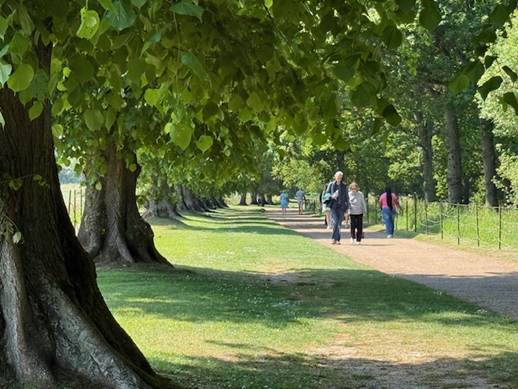
and it was here that the queen would swim.
Memories of Osborne are numerous but sadly the abiding one from this visit will be my observations on the health of the other visitors. Granted we visited on a Wednesday, so not a day to go if you were still working, but I was reminded what Sami had said on my last visit to the Hope Café (See PC 438 May 2025), that ‘only 9.3% of older people, defined as ‘surviving to the age of 70 year without the presence of any of 11 major chronic diseases’, could be classed as properly health.’ (Note 3) In the United Kingdom 45% of those of pensionable age have some form of long-term illness, impairment or disability. It’s not something you can shout about, confront, but I despaired at the general apparent lack of health of the public who visited on Wednesday, with their walking sticks, Zimmer frames, hunched postures, spare tyres and ‘bingo wings’. Maybe they will all apply to take Ozempic, ignoring the possibility that with sensible eating and general exercise, none of these things is necessary. I read on Wednesday that KFC has announced plans to create 7000 jobs across the UK and Ireland. Great! More fried chicken will be consumed ….. that’ll increase the bottom line for both KFC and the Nation!

Everyone has a story about their health; for some a genetic condition or accident will have created a disability through no fault of their own. But as I said to someone the other day, everyone is responsible for what they put in their mouth.

Richard 30th May 2025

Hove

http://www.postcardscribbles.co.uk

Note 1 The worst time to visit the house is on a Wednesday morning. If that’s your only day, visit the gardens in the morning and the house in the afternoon.

Note 2 In PCs 44 and 45 (July 2015) I scribbled about our trip to Eagle in Alaska. Great grandfather George was there when Queen Victoria died and remembers the palpable grief.

Note 3 I am not in this 9%, having had a triple heart bypass in 2013!
PC 440 The Isle of Wight

The visit of Celina’s mother and partner Toni has become an annual occurrence, and we have always tried to organise a few days away during their time in the UK. We have been to my home city of Bath (see PC 337 An American in Bath – June 2023), visited Arundel Castle, the home of the Duke of Norfolk, and spent two nights in Lymington in the New Forrest (see PCs 388 & 389 May 2024). This year, prompted by Toni mentioning his mother had much enjoyed Osborne House on the Isle of Wight, we organised a two-night stay there. Being an island itself, Great Britain has a long coastline stretching some 1800 kms with numerous offshore islands. Apart from the largest groups such as the Inner and Outer Hebrides, the Orkneys and Shetland Isles, the larger ones include Mull (875 sq kms), the Isle of Man in the Irish Sea (572 sq kms), Arran in the Firth of Clyde, and then the Isle of Wight on the south coast. This triangular shaped island covers some 381 sq kms – I read that for comparative purposes it’s about half the size of Singapore ……. if that’s useful? (Better than comparing it with Wales!)

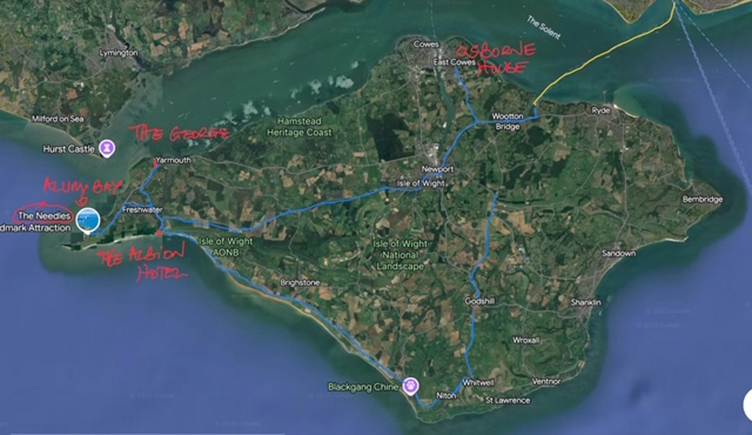
Ferry in yellow, journeys in blue, places in red

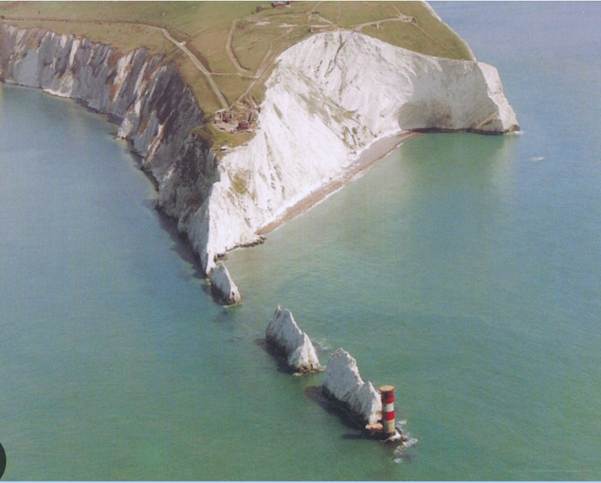
On its western tip are the famous Needles, three huge, white chalk rocks marked by a C19th lighthouse.

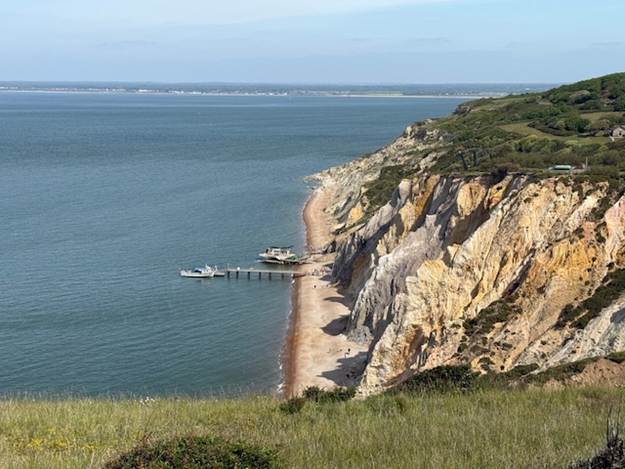
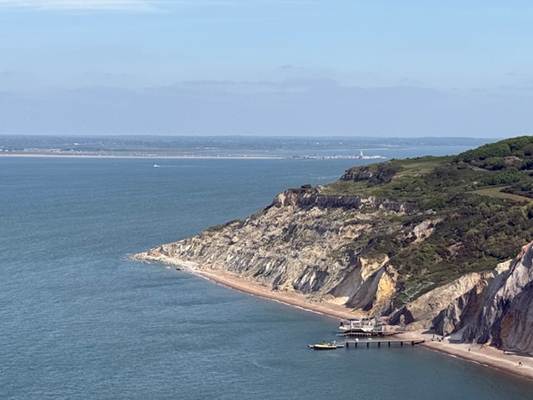
And nestling into that western coast is Alum Bay, famous for its strata of coloured sands

The western entrance to The Solent narrows by Hurst Castle on the mainland.

Hurst Castle is at the right hand end of the line of pebbles in the distance

Actually, you can see the Isle of Wight when visibility is good from the high ground on the north side of Brighton & Hove, some 55 miles away.

Most of my experiences of the Isle of Wight come from my love of sailing. I have taken part in Mermaid dinghy regattas off Seaview; I have swum in Cowes harbour way past midnight and possible having had too much to drink (!); moored up in Yarmouth harbour numerous times, once having to go over the side of the yacht to unwrap a rope from the propeller; anchored outside as the harbour was full, and had to cope with a dragging anchor in strong winds and spring tides; on returning from the Channel Islands one year, we hit the sand off Ryde, between Cowes and Bembridge, and had to wait for the tide to change; and once, as the tide was favourable, we nosed our way into Newton Creek, a wild nature reserve between Cowes and Yarmouth. For a few years I took part in Cowes Week, the August international yachting regatta that attracts thousands of entrants. In 1969 I took part in a Sail Training Association race from Cowes to Skagen in the northern tip of Denmark, and then on to Malmö in Sweden. I feel at home in this part of the United Kingdom.

The island is served by two ferry companies, Red Funnel from Southampton and Wightlink from Lymington, Portsmouth Harbour and Portsmouth. During my career as an executive coach I worked for Sea Containers, who at the time owned Wightlink and Hoverspeed, the latter running ferries to Calais and Boulogne-Sur-Mer.

I guess the most famous town on the Isle of Wight is Cowes, although its capital is a town called Newport, right in the centre of the island and where the Medina River starts being deep enough to be navigable. Most of the east-west island traffic flows through its congested streets, as north at Cowes the only way to cross the river is on a ‘floating bridge’ which can only take 20 cars on each trip. On the south coast are the Victorian holiday resorts of Ventnor and Shanklin.

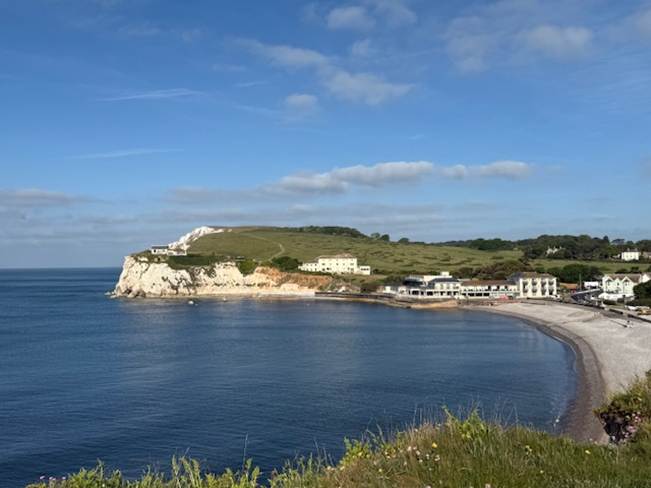
The Albion Hotel overlooking Freshwater Bay

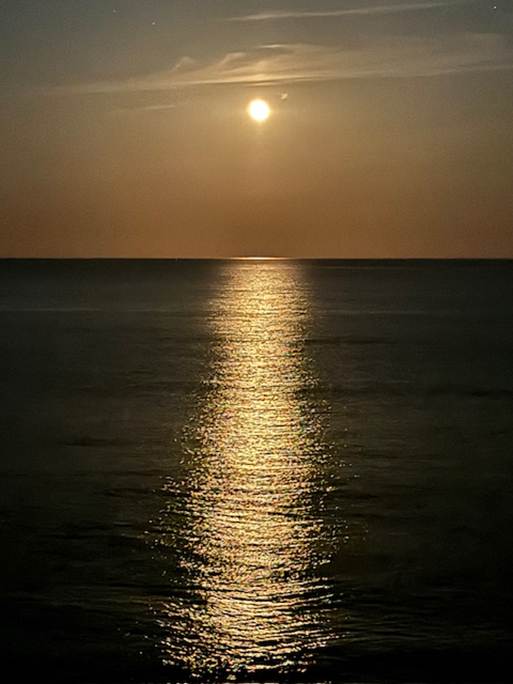
You will see from the map that we stayed a couple of nights in the renovated Albion Hotel in Freshwater on the southwest corner. A C18th hostel overlooking Freshwater Bay was destroyed in a big storm in 1824 and the Royal Albion Hotel dates from 1860. The building of Osborne House drew tourists and courtiers alike to the island and the hotel prospered. Today its 40 rooms offer a tranquil setting to unwind after cycling or walking around the island or, as we did, visiting Osborne House. And if you’re lucky, you wake up at just the right time, in this case 26 minutes past midnight, to take a photograph of the full moon over a calm sea.

Nothing is very far on the Isle of Wight and on our second evening we drove north to Yarmouth – yes, the mouth of the river Yar! Our friends from Lymington, whom we had seen last year, came across on the Wightlink ferry for supper at The George Hotel. The tourist and yachting season hadn’t really got underway and it wasn’t at all crowded; in the summer months it becomes very busy and to guarantee a mooring in the harbour you need to be there by 1600, which is too early!   

On the last morning we took a quick trip out to the coast above The Needles; in stunning warm sunshine we looked down at the iconic lighthouse, which I have sailed passed many, many times.

From there we drove east along the south coast before heading north to the ferry terminal at Fishbourne. One’s unlikely to go to the IoW with a car for a day trip, as the ferries are expensive; if you live on the island you get a discount but it does tend to isolate the island community – maybe they like it that way? We caught the 1300 ferry back to Portsmouth and were home in Hove by 1510.


We were lucky with our weather; wall-to-wall sunshine with 20°C and little wind. Next week’s scribbles will cover our visit to Osborne House.

Richard 23rd May 2025

Hove

www.postcardscribbles.co.uk

PS Flights to Portugal from Gatwick pass over the IoW. Often the view is amazing


Looking south over the Isle of Wight. Cowes is in the centre of the photograph.

PC 437 Pulled back to the Hope Café

Mo had sent me a WhatsApp asking if I was back. I am reminded of the difficulties of those who spend a long time in different parts of the world; no one is ever sure where you are, if you’re back. My mother-in-law tries to spend the European winters in Rio de Janeiro, her home city, and vica versa; her friends need to be briefed as to when she’s coming, or indeed when she’s going. I replied I could meet Mo in The Hope Café on Tuesday …. so we catch up over a coffee and a little pastry from Teresa’s Brazilian counter.

“How was Brazil? Read your postcards. (PCs 435 & 436) Sounds as though you had a great time.”

“Actually, very relaxed. Didn’t try to go to hot yoga in Copacabana; just walked along the beach before the sun got too hot, then caught up with friends and family. Two people particularly. Carl von Studnitz, in addition to his surfing and cinematography businesses, runs a charity that provided essential food and clothing to poor families in the municipality of Queimados, to the north of Barra. He lives in the suburb of Jardim Botânico.

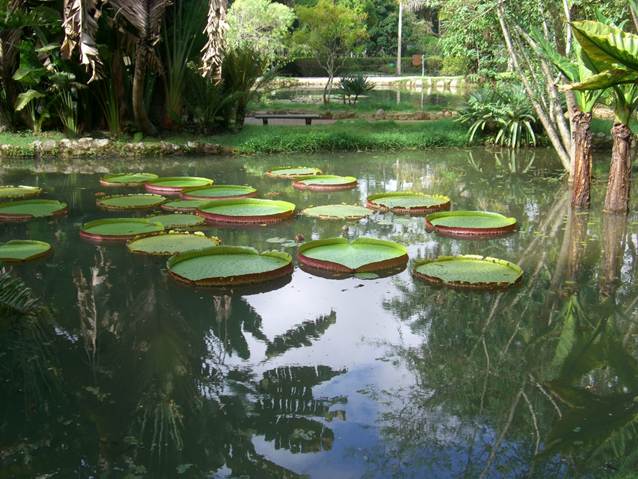
A Lily pond within the botanical gardens

The other was Pricilla Goslin, the author of ‘How to be a Carioca’.”

“Sounds like you enjoyed yourself. Wasn’t the main reason of your visit to assist your mother-in-law on her return to Lisbon?”

“Yes. Then she and her partner Toni will come and visit in May. You may recall a couple of PCs I wrote last year after a similar visit. (PCs 388 and 389 Lymington)”

“But you are looking well – always good to have a little tan, makes one look healthy!”

“You should have seen me when I got back – ‘walking death’!”

“What do you mean? What happened?”

                “We had a late afternoon flight out of Rio, with an arrival time in Lisbon of 0500 on Monday 14th.

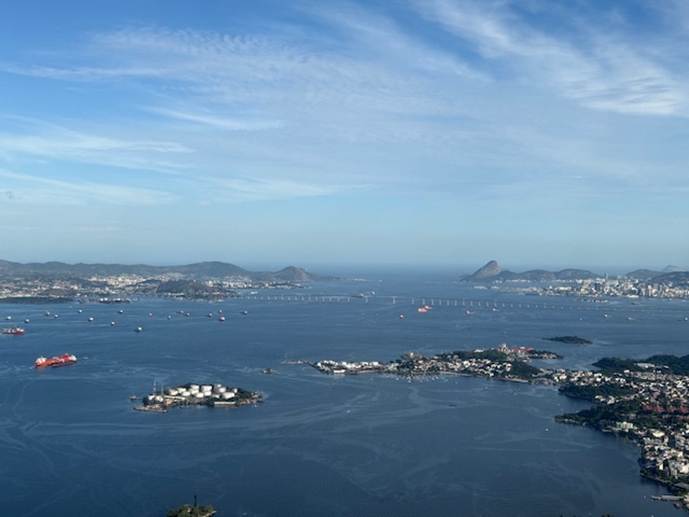
Looking south over Guanabara Bay with Pão de Açucar at its western entrance

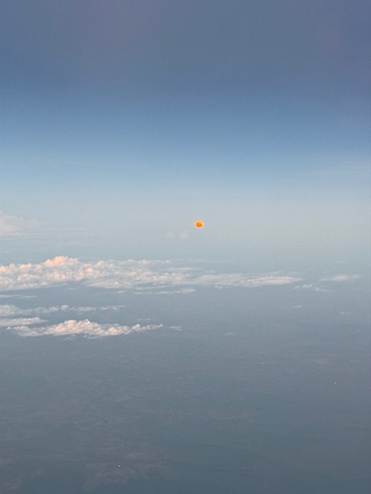
I always love looking out of aeroplane windows, in the hope I’ll see something interesting. Look at the moon rising:

This was taken late on; we’d left Brazil and were heading to the West African coast.”

Richard, I am in suspense. Why did you feel awful?”

“Chose the little ‘fish & rice’ starter and chicken ‘main’ for the inflight meal and settled down to watch Ridley Scott’s Napoleon. About two hours out of Lisbon was feeling decidedly funny. Managed to get off the plane and make my way to our connecting flight. I could still taste the meal! Slept on the Gatwick bound flight, although had a sick bag ready (they seemed ridiculously small!), got home by midday … had a couple of hours sleep …… got up and made myself vomit …… had a couple of hours sleep … got up and made myself vomit ….. repeated twice more. The Tuesday and Wednesday are a blur. Had a banana on the Wednesday and another on the Thursday. Haven’t had jelly for years but that was another option, that and dry toast ….. and Lucozade! What I hadn’t experienced before was the ache in my abdomen; sometimes it really was quite severe. Still, by Saturday of the Easter weekend was beginning to feel better, sort of 70%! The only good thing was I had no diarrhoea!”

“You know, Richard, everyone has their personal horror stories of food poisoning; dodgy curries, fish very definitely ‘off’, chicken contaminated with salmonella, funny mushrooms (Note 1). And as soon as someone tells you they have/have had food poisoning, they will tell you about their own experiences, in graphic detail, as if your own weren’t enough, but maybe theirs were worse!”

“Haven’t had any chocolate for ten days!! On the subject of food, I am often late to hear new labels and so it is with ‘Food Noise’; apparently it’s the nagging voice of craving which affects almost 60 % of the population, like ‘chocolate’ which I absolutely identify with. ‘Food Noise’ (Note 2) is the title of a new book by the son of the late Michael Mosley, author of The Fast Diet, whose engaging personality encouraged us to watch many of his television programmes about food and our bodies. Jack is following in his footsteps.

We have a friend who’s 7 months into a year-long trial using Ozempic to lose weight, so there’s a personal interest. Jack sounds several notes of warning about its use, the first about the type of weight that users tend to lose. According to its Danish manufacturer, users lost about 17% of their weight over a 70-week period, but 40% of this was lean body mass ie muscle. And that muscle loss is not regained; most put on fat when they come off the drug.”

“Wow! That’s very disturbing. Like you I have a couple of friends who are on it, but by the sound of it no one really knows its long-term effects on our organs. Incidentally had you left before Heathrow shut down on 20th March?”

“No, and fortunately we weren’t flying until the 26th, so we were unaffected.”

“Seems amazing that one failed component at an electricity sub-station near the airport could cause a fire that shut down the sub-station …… and Heathrow ….. completely. I imagine everyone is asking searching questions, about how can Heathrow, the second busiest airport in the world and important national infrastructure, be brought to a complete stop by the failure of one supply outlet. I suspect a great many organisations and companies are dusting off their Contingency Manuals, the ones which have Plan B and Plan C in the event of a failure of Plan A!” 

“Mo. Before I go, do you know when the bookshop is going to open?”

“Yes! By the beginning of June; a little later than Duncan planned. I will help out three days a week ….. and I need to get going too. Always good to chat, See you.”

Richard 2nd May 2025

Hove

www.postcardscribbles.co.uk

Note 1 Poisonous mushrooms are at the centre of a murder investigation in a court case in Australia.

Note 2 ‘Food Noise: How Weight Loss Medications and Smart Nutrition can silence your cravings’ by Dr Jack Mosley.

PC 436 Where’s the Girl from Ipanema? (Continued)

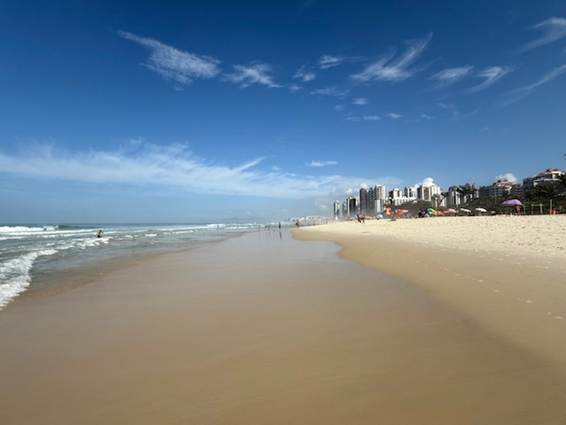
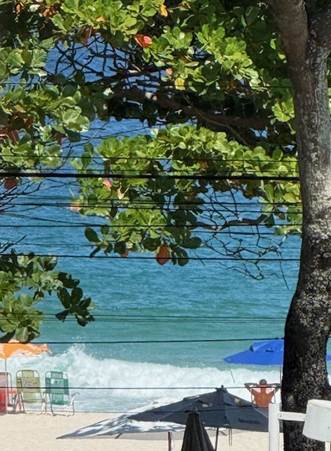
On this visit we rented an AirBnB in the Lanai Condominio, around the corner from an apartment owned by Celina’s bother, in Barra da Tijuca. The suburb lies to the west of Ipanema and Barra’s beach, just across the road, is even better than Ipanema’s; the girls probably are the same. 

I’ve written about this long stretch of sand before, collecting thoughts in PC 08 ‘Beach Life in Brazil’, which has a short postscript concerning dental floss. (See PS) On another visit in September 2014, almost eleven years ago, I wrote PC 21, questioning happenings in the world; I think the first two paragraphs are worth repeating:

“We walked along the line of the surf of the crowded beach on a Sunday in September in Barra da Tijuca; the sun was warm on our backs. I looked at the carefree groups of families and friends, at children playing either in the surf or with a football, this is Brazil after all (!), and at other adults, just splashing in the shallows. It was totally divorced from the obscene photograph of a black figure brandishing a knife in front of a kneeling, orange-suited human that had appeared on the front page of my digital Times that morning.

I had looked at the photo of the latest British hostage, a 44-year-old man with a family, with friends, with loved ones. It was so surreal. I knew from the news report that, moments after the photo had been, he would be murdered, in cold blood, in the most barbaric and inhuman way.”

‘Plus ça change, plus c’est la même chose.’ Then it was ISIS, trying to bring about a C7th Caliphate in the Middle East; today for example it’s the slaughter in Ukraine. A poem by Robert Burns in 1786 included the line – ‘man’s inhumanity to man’; we don’t learn, and some of those who profess to lead don’t care.

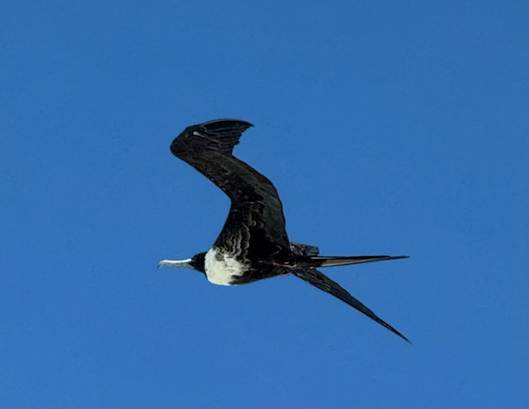
I am no ornithologist but am mesmerised by one particular bird that populates the Brazilian coast; it looks almost prehistoric, like a pterodactyl perhaps.

With the aid of Google I learned it’s called a Frigate bird. They are apparently found across all the tropical and subtropical oceans. Characterised by black plumage, deeply forked tails and long hooked bills, there are five extant species. Wonderful!

Currently the temperature of the sea at Barra is fine but, surprisingly as the littoral current moves in a southerly direction from the equator, it can be very cold. Additionally, the underwater profiles of the seabed mean it’s not a particularly safe beach. Undercurrents, fierce draw-backs and constant breaking waves mean those wanting a dip do just that, have a dip. The only swimming going on is by those on surf or bodyboards, making their way beyond the breakers. Every 400m or so is a manned lifeguard station and if someone thinks it’s safe further out, the warning whistles start and they are encouraged to come back to the shore.

It’s always interesting going to other countries and engaging with those people who live there on a permanent basis. The moans I hear today in Rio are an echo of those I hear in Hove; distrust in politicians, the cost of living, the energy/climate crisis, streets unsafe at night and more frequently in some areas during the day, the pervasiveness of social media, the lack of acceptance of opposing views, the lack of common sense etc etc. The locals complain of the traffic, especially at rush hour along the coast road that leads from Barra da Tijuca, past São Conrado and into Lebon and Ipanema. I remind them that in the UK the normal commute is at least 90 minutes.

The southeast corner of the UK is fairly prosperous; relative poverty rarer here that further north. In Brazil poverty is never far from the surface, that and the insidious drugs, their peddling and their use. Surprisingly the city administration clears the streets of those with nowhere to live, ensuring they get shelter and food. (Note 1) The rich here would hope that Rio de Janeiro remains globally famous for its Christ the Redeemer statue, Sugar Loaf Mountain, carnival and its beaches, and maybe for the girl walking along Ipanema beach. But in the last thirty years its favelas have been making the news; some are more famous than others, some more dangerous than others, and the nearest one to Celina’s mother’s house is Rocinha.

Rochinha houses cling to the mountainside in all directions

Times change and its residents have benefitted from the provision of a new tube line and station in 2016, part of the Olympic infrastructure, and lately by a Tourist Office opening within the favela. This is creating more money for the inhabitants, which can only be a good thing.

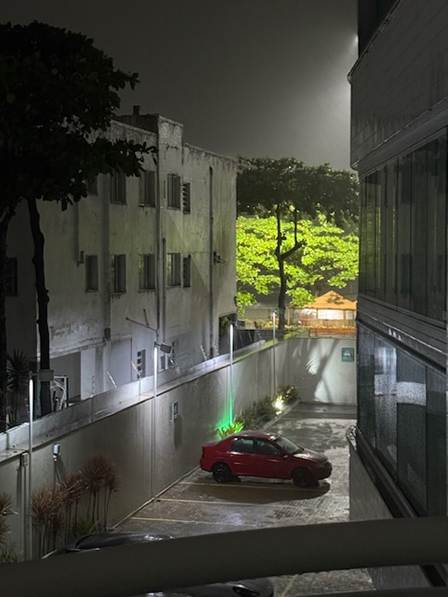
We had little rain during our visit and what we had was tropical.

Downpour at 0300!

Our AirBnB had air conditioning, essential if you want a good night’s sleep, but the pouring of water onto the external metal box made such an horrendous noise that sleep was impossible. Being a practical sort of chap, I wondered why no one had glued a thick piece of insulation material or rubber matting to its top. Think it would have worked! Of course, electricity failures are common here and then there is no air conditioning! And if you didn’t, read ‘PC 145 Extreme Weather’ from February 2019 about the floods in Rio de Janeiro.

So that girl, that ‘tall and tanned and young and lovely’ woman from the 1960s, is no longer visible. There seemed something innocent about her and I don’t think that’s true of the woman on Ipanema beach today!

Back in Hove, we miss the warmth, we miss the constant noise, we miss the friendly carefree Brazilian people; I don’t miss the mosquitoes!

Richard 25th April 2025

Hove

www.postcardscribbles.co.uk

PS For those of you who might like to read more of my Brazilian scribbles, look at: PC 01 Bahia, PCs 3&4 Rio de Janeiro, PC 5 São Paulo & Cananeia, PC 6 Petropolis, PC 8 Brazilian beach life and PS PC 09, PC 10 Paraty, PC 11 Reflections on São Conrado, PCs 17 & 20 The Pantanal, PC 34 Recife, PC 37 A Small Town in Brazil, PC 51 Foz, PC 63 Santa Catarina and PC 91 Japanese São Paulo.

Note 1 Pricilla Goslin, author of ‘How to be a Carioca’, told me that some streets in Seattle, near her Portland, Oregon home, are a permanent ‘tent city. Echoes of San Francisco perhaps?

PC 435 Where’s the Girl from Ipanema?

In June 2023 I wrote a postcard entitled Serendipity (PC 340), initially prompted by the obituary of Astrud Gilberto, the young woman who serendipitously was asked to sing the English version of ‘Da Garota de Ipanema’ (The Girl from Ipanema). The wonderful opening lines will be familiar to many: “Tall and tanned and young and lovely/the girl from Ipanema goes walking/and when she passes, each one she passes goes, ‘ahhh’.” (Note 1)

Heloisa Pinheiro Born 7th July 1943

In 2025, over 60 years later, is the modern-day equivalent of Heloisa Pinheiro still visible, walking along the promenade of one of Rio de Janeiro’s iconic beaches? I sense the 1960s were a more tranquil, more relaxed era, no more so than along Ipanema’s beach.

Today there’s a constant effort to get fit, be seen, wear the right gear and hundreds of people are in constant motion on Ipanema’s beach; not many seem to have the time to sit and stare at others. We were lucky enough to stay two nights in the Fasano Hotel, situated just before the little promontories of Pedra do Arpoador and Forte de Copacabana that separate Ipanema and Copacabana beaches.

Pedra do Arpoador

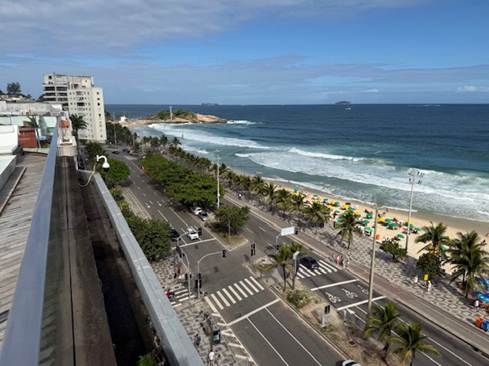
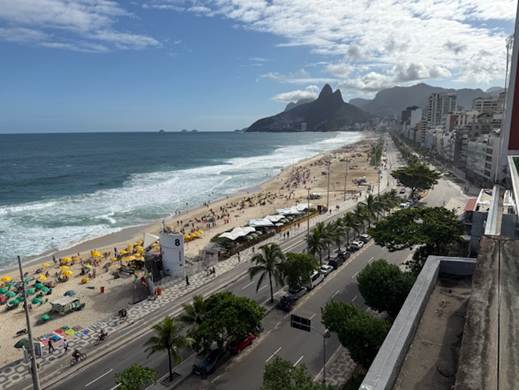
From the rooftop swimming pool there’s a good view west down the road ……

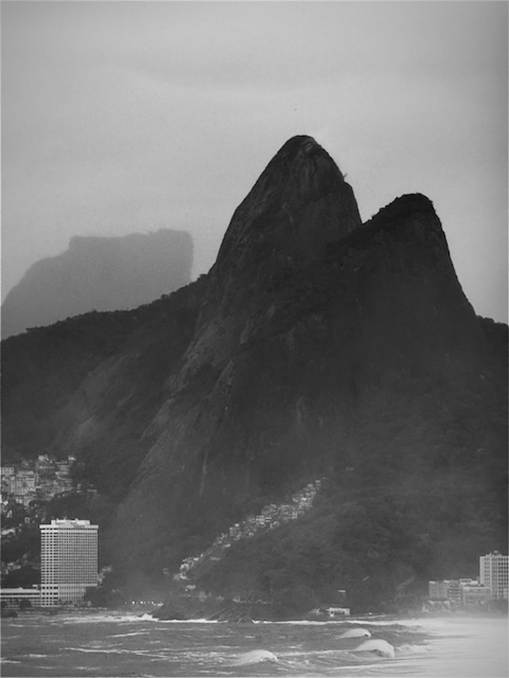
and, at the far end, the favela of Vidigal cheek-by-jowl with the Sheraton Grand Rio Hotel & Resort and both overshadowed by the two peaks known as Dois Irmãos. We arrived in the rain on a Sunday afternoon and those two mountains seemed extremely mysterious.

On our second morning rather than walk along the sand as we had the first day, we walked on the promenade the length of both Ipanema and Leblon beaches, about 5kms. Maybe I could identify a modern ‘girl from Ipanema’? No one seems as carefree as Heloisa Pinheiro must have seemed; a little too much filler in the lips, eyelashes so long they could be used as a paintbrush, small or large tattoos in abundance, the smallest bikini bottoms requiring Brazilian waxing, and possibly stopping every few moments to take a Selfie! (Note 2) Towards the end of the pavement, with its characteristic black & white swirling patterns, suddenly someone yells: ‘Celina!’; I turn around and there’s a friend we hadn’t seen since 2019, Alessandra, getting fit on the beach. She doesn’t speak English so I left her to catch up with Celina and walked to the end, reengaging with Celina on the way back. Six years – in the same time, in the same place – a lovely coincidence!

There was a wonderful observation from Letitia, one of the delightful managers in the Fasano Hotel. The hotel was hosting a book launch on our second night. Assouline Publishing, founded in 1994 in New York, has published over 1700 titles on subjects including architecture, art, design, fashion, gastronomy, photography and travel. In amongst these coffee table book titles are, for instance, ‘Napoli Amore’, ‘Bangkok Spirit’ and ‘Paris Paris’. The book for the launch was obviously about Rio de Janeiro (Note 3), by Bruno Astuto. 

Letitia told us the book costs about R$ 1300 per copy (£170) and ‘that is about the same as Brazil’s minimum wage’! Maybe small change for those who can afford to stay at the Fasano and who might say: ‘Cost of living crisis? What crisis?’ but a good example of the gulf between rich and poor.

Since my first visit to Brazil in April 2012, the Brazilian Real has gone from R$3.2 to the pound to R$7.5. This is great for tourists from Europe like me, but not for instance for Celina’s cousin Bel Gasparian, whose recent week in Florence cost her an arm, a leg, and the bag off her back!

On the subject of finance, here in Brazil, forget ‘contactless’, forget cash; everyone is using a system called Pix (Instant Payment Ecosystem). Created and managed by the Banco Central do Brazil, its aim is to reduce cash transactions and offers an alternative to existing payment instructions. It was fully operational in 2020; all you need is to have a Brazilian bank account. Here credit card transaction fees can reach up to 2.2%, whereas Pix charges retailers about 0.2% and is free to individuals. Naturally everyone is using it, the hotels and restaurants, supermarkets and our taxi drivers, even the street artist making a meagre living selling souvenirs or the chap on the beach offering chairs and a sun umbrella to rent. It aims to achieve the transaction in under 10 seconds, although there is an individual payment limit of R$1000 between 2000 and 0600. (Note 4)

I suspect that most decent human beings are sadden by the way in which the new president of the United States goes about dealing with people. The bullying, the threatening manner; “Do as I say or else …. I’ll throw your toys out of my pram.” But we encountered a couple of instances where international hotel guests completely disregarded anyone but themselves, with no ‘Thank you’, no ‘excuse me!’, certainly no ‘please’. I imagine they hadn’t read ‘manners maketh man.’

To be continued …….

Richard 18 April 2025

Hove

www.postcardscribbles.co.uk

Note 1 The rhythm of Brazil is of course Samba. Sadly today you’re more likely to hear some repetitive techno stuff.

Note 2 These days filler in one’s buttocks (The Brazilian Lift) is popular globally among some, but I don’t think it’s something the Brazilians want to be associated with.

Note 3 R is pronounced H in Brazilian Portuguese. On one visit there was an advertisement for a rock concert called ‘Rock in Rio’ …. Pronounced ‘Hockinghio’!

Note 4 In England the use of contactless cards is widespread, but the retailer pays a percentage for every transaction. On my way back from hot yoga I often buy a drink from Hanan who runs a 7/11. The bottle cost £1.85; I pay cash. Recently it went up to £2 as he makes a loss if the customer pays by contactless; I pay cash and he charges me £1.85.

PC 433 Odds and Sods

It’s appropriate to start off this postcard with something about language, as I sit at a table in an AirBnB in Barra da Tijuca, to the west of Rio de Janeiro’s famous beaches of Ipanema and Copacabana. My ability to speak Portuguese, and in particular Brazilian Portuguese, has not got any better over the years since Celina and I got together, despite periodic attempts to get to grips with it. I started with no knowledge and sometimes I sense I have come back to that point!

Consequently, I need to be careful when I write about Celina’s way of pronouncing certain words. The name of the Russian president comes up occasionally, often accompanied by some criticism or other of his cruel actions and disregard for what we in the west consider sacrosanct, like the borders of sovereign states. I commented that I loved the way she says his name, sounds like ‘putain’, a hard nasal sound. Then she explained that ‘putain’ is French for whore/bitch/shit/hooker/tart and I think this is perfect.

These days, if you are bored by your record or CD collection, you can just dial up something like Spotify and ask it to play exactly what you want to listen to. Or you can tune into one of the hundreds of radio stations, via Alexa, and podcasts, to listen to chat or music. Of course the sound of silence can, in itself, be wonderful. Over the years I have become accustomed to have Classic FM on in the background. Often I recognise the work being played, reinforcing my own prejudices about composers; ‘I love Sibelius, not so keen on Bach’ for example. The station’s output seems to cover anything from traditional ‘classical music’ to music used in film or television scores. Snobs in the world of classical music might deride Classic FM for its populist approach to what it broadcasts, but I guess that’s what the programme makers deem their audience want and tune in for. However, as a regular listener, I sometimes detect that every presenter has been encouraged to play one particular piece. A recent example is the title track from the 2004 film ‘Ladies in Lavender’, a 2004 film starring Judi Dench and Maggie Smith. It was composed by Nigel Hess, but I do not want to hear it today, tomorrow and the next! Another piece now played so frequently it’s become hackneyed is ‘Ashokan Farewell’. I grant you it’s lovely but once a month will do!

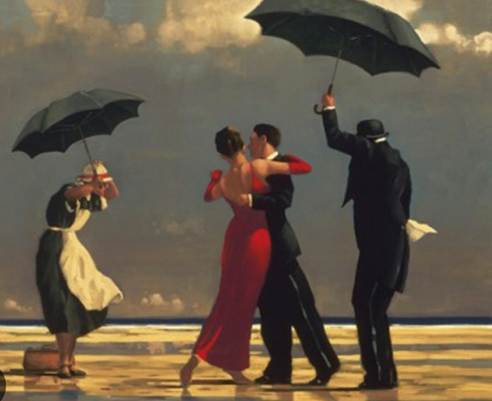
Writing about snobbery in the world of classical music brings me neatly on to the Scottish painter Jack Vettriano who died at the beginning of March aged 73. His name might not be on the tip of everyone’s tongue, but his painting entitled ‘The Singing Butler’ will, I hope, be instantly recognisable.

He was one of Britain’s most successful painters, earning a reported £500,000 in annual royalties from reproductions of his work on postcards, posters, calendars and jigsaw puzzles. Self-taught, Jack’s breakthrough came in 1993 when he was taken up by London’s Portland Gallery; “There’s a narrative (in his paintings) which invites you to continue the story. They’re a moment caught in time and you continue the story in your head.” Sir Terence Conran was slightly harsher: “I would never suggest Jack is a great artist in the manner of Francis Bacon and I don’t think he would claim to be. But he is an extremely competent artist in the Edward Hopper mould.” Most critics derided his art as ‘kitsch and derivative.’ (Note 1)

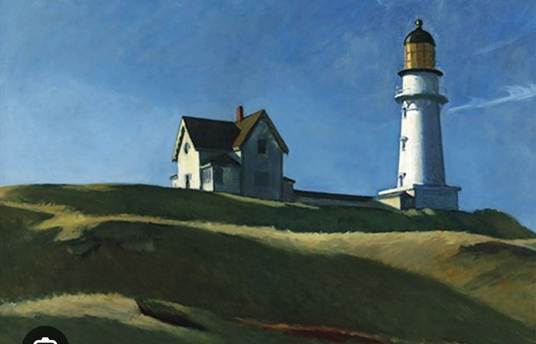
I hadn’t intended this part of the postcard to develop into a dissertation on what makes one artist greater than another, for in my mind only you can make these judgements. Personally, I love Edward Hopper’s paintings for their simplicity ….

Edward Hopper’s The Lighthouse

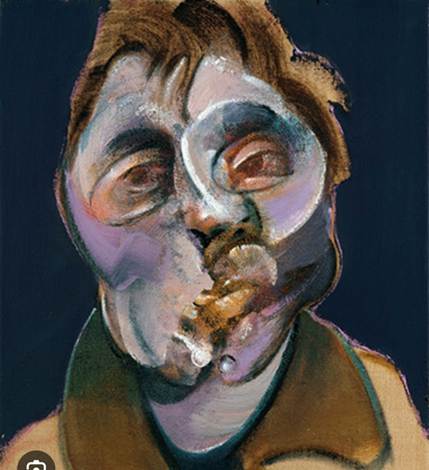
and can’t think of any reason to go to an exhibition of Francis Bacon’s work …..

Bacon – a self portrait

But then I am me and not you, or Terence Conran!

In my postcard about Gen Z (PC 425 Generation Z February 2025), I wrote how good it was to find people who recognised you could have fun without alcohol and that their attitude towards drinking and drinking to excess was refreshing. One of our major supermarket chains, Sainsbury’s, is now offering a non-alcoholic beer with one of its lunch ‘meal deals’. For some reason best known to themselves Debretts, the national guide to etiquette, were provoked to comment. Liz Wyse, one of their editors, wrote: “I don’t think it really appropriate. I know it’s alcohol free but people drinking alcohol-free generally would rather drink a normal beer.” (My italics) Now that is a statement based on a sample of, er, one? Herself?

Diane Cherryman from Melton Mowbray was so moved to write to The Times. “Sir, (Note 2) Debrett’s should set aside its prejudices and read the small print on labels before condemning a lunchtime drink of alcohol-free beer.” And went on to say it’s a far healthier choice than fizzy drinks.

And finally, something to cogitate on. I took out a life insurance policy with Standard Life a day before my 21st birthday; seemed a grown-up and sensible thing to do. It would pay out some £2314 if I accidentally died; for comparative purposes I was being paid circa £1750 per year (Note 3) and the annual premium was £24. As the years rolled by, I recognise that these £2 per month Direct Debits were not a lot, and it would help my beneficiaries a little. The annual statement arrived last month – I could cash in my Life Insurance and have £1714 in my sticky little hand today and not leave it for others. I have paid Standard Life £1392 over the years – so a gain of £322! My brother did a simple ‘£24 at 3% compound interest over 57 years’ calculation and found it amounted to almost £4000. If I had known then what I know now ……..

Richard 4th April 2025

Rio de Janeiro

http://www.postcardscribbles.co.uk

Note 1 Make sense of this: “His art is frightening …. his work shows the extent to which even art has been compromised by the argument that the market is the most powerful thing.” Duncan MacMillan

Note 2 I wonder whether this salutation has had its day. Today it could easily be Editor which could apply to someone of any gender.

Note 3 Rule of thumb suggests 150% of salary. Wishful thinking!

PC 432 Hope as Always (Continued)

There’s never enough time to catch up with everyone in the Hope Café so I make an effort to see Sami and Mo particularly. Anyone else is a bonus! Sami and his partner Lisa get a coffee, decline some pancakes that Libby is trying to get rid of, and join me at one of the bigger tables.

“You’re looking well, Richard! Must be all that ‘freezing-your-b*****ks-off’ in that CryoBright place; that and the hot yoga you’re addicted to!”

“Hello you two! Good to see you both and yes, Sami, not a crime to be addicted to something, surely! And I have lengthened my time in the cold chamber to the maximum they recommend, 5 minutes. Got carried away last Wednesday, singing along with the music in my headphones. Came out and found I had an audience! Sounds travel!!”

“You’ve sailed thousands of miles, Richard, so you’d have been shocked when those two ships collided in the North Sea. (Ed. On 10th March) How is it possible these days?”

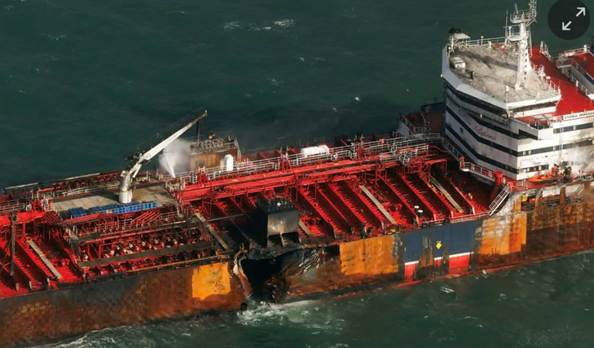
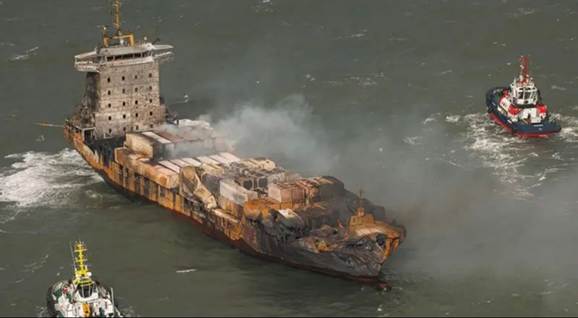
“Ah! Sami, you, like all the news releases, talk of how the two ships ‘collided’ or that they ‘crashed into each other’, inferring both were to blame. I really don’t think it could be the fault of the oil tanker MV Stena Immaculate, sadly no longer immaculate, peacefully at anchor, displaying all the appropriate signage and one of eight other large tankers and container ships at anchor off the Humber Estuary. At anchor you hoist a large black ball in the fore part of the ship; at night you additionally need an all-round white light.”

The MV Stena Immaculate with a large hole on her port side

“Do you need to have a human being on ‘anchor watch’? I read that the Portuguese-registered container ship, MV Solong (Note 1), was steaming south off the East Yorkshire coast at its full speed of 16kts when it rammed the MV Stena Immaculate. The impact caused the Stena Immaculate to be displaced some 200 metres. The Solong’s gross tonnage was 7852 and momentum, if I remember my mathematics, is mass multiplied by speed. What’s that expression? ‘What happens when an unstoppable force meets an immovable object?’

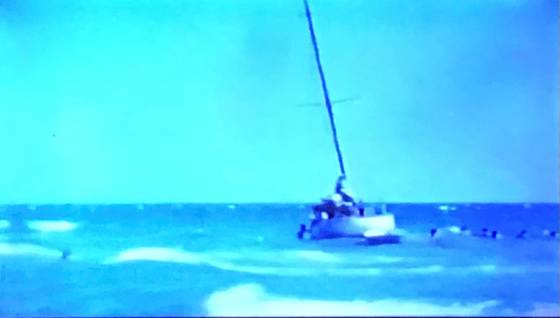
“It’s brought to mind that time in Cyprus, described in PC 231 ‘Ropes, Warps and Sheets’ from May 2021, when I was part of the crew sailing from Akrotiri to Dhekelia, and we anchored off the beach. The skipper didn’t leave anyone on board as he judged it safe. But there was a local wind that blew in the late morning. Someone alerted the skipper as he was having his eggs & bacon …. read the postcard.

A still from some Super 8 cinefilm of Highlight on the beach

In the same postcard I wrote about skippering St Barbara IV, a Nicholson 43, from Liverpool to Oban on the west coast of Scotland, years later. A day or so after visiting the Isle of Man, we anchored off the little village of Lamlash on the eastern side of the Isle of Arran. It wasn’t exactly sheltered from the northeast and when the wind shifted in the middle of the night, the chap on watch woke me, so I could assess the situation; it was 0310. We started the engine, raised the anchor and motored across to shelter in the lee of Holy Isle.

To those of us who sail, Sami, it’s unbelievable that this could happen, given radar and watch-keeper systems. Clearly a human error, ultimately by the captain of the Solong, who has now been charged with Gross Negligence Manslaughter, as one crewman sadly died. I read that the Solong had travelled through this area of the North Sea three times in the last month. However, the description of the collision reminded me of one of those regular reasons people say when they have a car accident and fill out the claim form: “The lamppost just jumped into the road.” (See PS)

“On to more local issues, I am glad I accepted the compensation offered by the Post Office last year, as some of my colleagues are still waiting. Beggars’ belief how bureaucrats can be so obstructionist! (See PC 420 Contentious Issues in the UK for 2025)”

“You’ve come a long way in 4 years, Sami, and it’s been a delight to see you and Lisa happy and excited about life. You know my daughter bought her late maternal grandmother’s wreck of a house and has spent the last 7 months working on it? Well, it’s now habitable enough and they move in tomorrow; still a great deal of work to do but the financial pot is empty and needs to be refilled.”

“You’re going to tell me a story of some blunder or other?

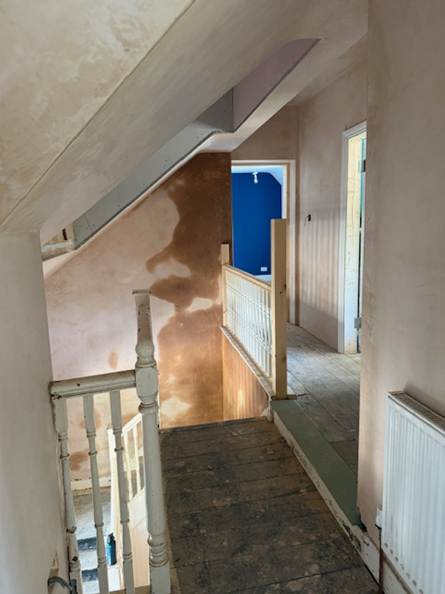
“I am, Sami, as it reinforces the wonderful adage if you’re a DIY enthusiast, ‘measure twice, cut once.’ The builder who’s been responsible for most of the work is a lovely chap and a carpenter by trade, so he of all people should follow the traditional advice. I was at the house a couple of weeks ago and thought that a new balustrade looked too low for safety. I mentioned it to my son-in-law Sam, took a photograph and reinforced my thought by WhatsApp when I got home.

Sam mentioned it to the builder who protested that it was absolutely fine. Then a day later he quietly admitted he’d measure the height from one floor level and not the other, a difference of 10cms. He’s going to have to remake it from scratch!”

“That extra 10cms could make the difference between a boisterous boy going over the top or not! Listen, we know you’re off to Rio but when you come back, can we find a date for you to come and have some supper with us? After Easter maybe?”

“That will be delightful (See PCs 329 & 330 ‘Supper with Sami’ April 2023 when they came to us). Why don’t you send us some options and we can pencil something in. And now I need to get going ….. lovely to see you both …..”

This conversation was over a week ago as we are now in Barra da Tijuca, a western suburb of Rio de Janeiro!!

View from our AirBnB apartment

Richard 28th March 2025

Rio de Janeiro

www.postcardscribbles.co.uk

PS The still smouldering MV Solong has been towed to the Scottish port of Aberdeen, arriving yesterday.

Note 1There’s a joke here somewhere: ‘so long, farewell …..’ ???? (The Sound of Music?)

PC 431 Hope as Always

Haven’t had a chance to see Mo in the last few weeks so, by text, we agreed to meet for a coffee in The Hope Café on Monday afternoon, as next week we fly to Rio de Janeiro. I’d arrived early and managed to chat to Libby for a couple of minutes. She’s recovering from her embarrassment of being the victim of a Romance Scam (See PC 427 Hope Conversations February 2025) and tells me talking about it really helped. (Note 1) She also added that the café still has a special offer of pancakes, a sort-of left over from Shrove Tuesday, as they were a big hit that day.

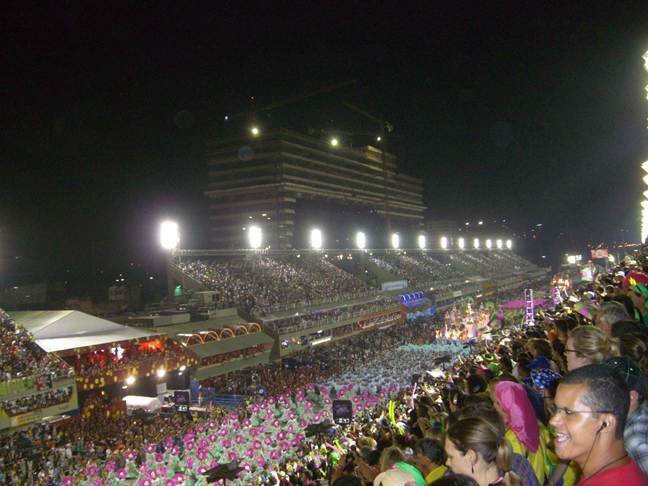
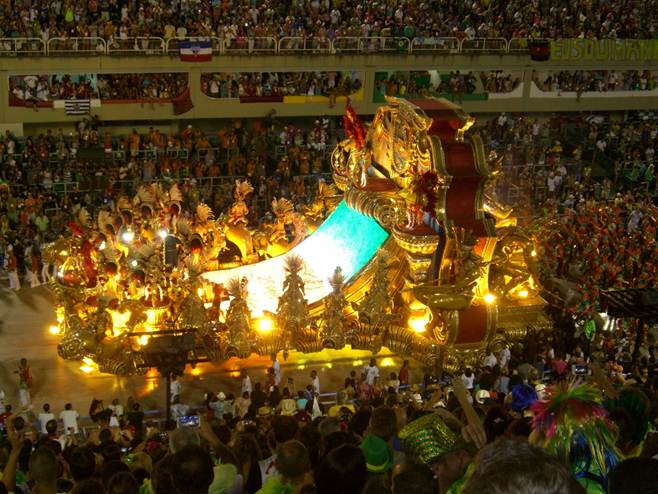
The tradition of having pancakes on the day before Lent in the Christian calendar is embedded in my DNA, as is the celebration of Carnival if you are like my wife, Celina, Brazilian. It seems the whole country stops for days to celebrate, and the parade of the Samba Schools is something to experience.

The parade on part of the 700m Sambodromo

We went to the Sambodromo to witness Rio de Janeiro’s carnival in February 2014; read PC 07 ‘Carnival’ to feel the beat!

The word carnival comes from the Latin for ‘farewell to meat’, ‘carne vale’. European countries celebrate carnival without the beat of Samba and the largest one in Northern Europe is in the Danish city of Aalborg on Jutland. The Nice carnival claims to be the oldest in the world, with its roots dating back to 1294 and it’s a well-celebrated event in many Germanic cities. Don’t forget that the words Mardi Gras, celebrated particularly in New Orleans in the United States, means Fat Tuesday in French! (Note 2)

I like the idea that the need to clear out all the eggs, before one’s 40 days and 40 nights of restricted eating, brought a plate stacked with pancakes, over which lemon juice would be sprinkled to give them a sharpness and granulated sugar sieved or Maple syrup dribbled to give them sweetness, to the dining table. I was getting stuck into such a pile when Mo arrived. Mumbling a sort-of ‘hello’, I finished my mouthful and said hello properly. Mo is already in catch-up mode:

“I wanted to get the train back to north London the weekend before last and I came up against our antiquated rail system.”

“Not sure I understand. Antiquated in what way?”

“We are lucky to have a reasonable network of railway lines and when the trains run on time it’s a very easy way to travel from A to B. But I find it amazing that, in 2025, our train services are affected by archaic employment contracts for the train drivers. Did you know that none of their contracts stipulates Sunday working – it’s voluntary and the operating companies rely on the drivers agreeing to ‘rest-day working arrangements’, for which they get paid some £600 a shift. So I had to do part of my journey on a frigging bus!”

“Ah! Yes! I think this is a clear case of the government shooting itself in the foot.”

“What do you mean?”

“Well, you’re right that the Train Operating Companies have always relied on drivers opting for overtime to cover the Sunday need. In comes the new government, more sympathetic to the ‘working man’, whatever that means (Note 3), and fed up with two years of industrial action on the railways, awards them the asked-for pay rise, without any changes to working practices. So come Christmas last year, drivers who would have traditionally needed the overtime but now flush with cash, just said: ‘No thanks I’m off to Lanzarote with the Mrs’.”

“This is ridiculous. It’s 2025 and we need both a modern transport system and modern working conditions. Reminds me that it wasn’t long ago that the German railway system got rid of a regulation that required every train to have a red flag to be waved in front of the engine! By the way, I read your PC about going into the cold chamber at CryoBright (PC 429 Beyond the Glass). Not something I want to try but I understand its potential benefits.”

“The owner of Cryobright, Rob, commented: “I’ve never really thought about our windows, but I quite like the idea they create a bit of intrigue. A better marketeer would probably blah blah blah about lost ‘awareness opportunity’ etc but we have had a lot of people saying we are a hidden gem – which is nice.”

“Not sure whether you are a cook Richard so ….”

“Oh! I love cooking although don’t do as much as I used to …”

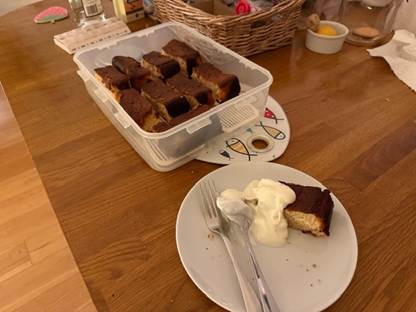
“I found this recipe for a lemon cake which was so weird I had to try it!”

“What was weird about it?”

“Well, first up it uses mayonnaise …..”

“Excuse me! Sorry! Mayo in a cake?”

“Well, as the writers of ‘Bake It Easy’, Tom Oxford and Oliver Coysh, say, mayonnaise is made from emulsified fat and eggs, and that’s half the ingredients of a cake!”

“What was it like?”

“Lovely …. and who doesn’t like lemon cake! Oh! I must tell you, Richard, of a conversation I had the other day after my weekly Pilates class. I was talking to a new student, who said that she’d come back after having her second child, now six months old. And I asked her if she had a nanny. ‘No! Man.’ I obviously looked expectant, wanting a little more information, so she said ‘partner’. Thinking about it later, I thought of these labels we use nowadays.”

At that moment Sami and Lisa came into the Hope Café and I wanted to talk to them, so said goodbye to Mo and …..

(To be continued)

Richard 21st March 2025

Hove

http://www.postcardscribbles.co.uk

Note 1 I cannot emphasise enough how beneficial it can be to talk, talk about your problems, share your thoughts, listen to your own voice.

Note 2 Love ‘Fat Tuesday’! In England the Notting Hill Carnival, first held in London in 1966, takes place in August, and is a celebration of all things Caribbean.

Note 3 The ‘working man’ is, I understand, the product of the ‘working class’ ……. but we try not to mention ‘class’ anymore ….. as most individuals who work could claim to be working. Falling over themselves to be ‘correct’, our new Labour Government suggests that the ‘working man’ is someone who will rely on the State Pension and no other income when they retire, stop working.

PC 429 Behind the Glass

I don’t know about you, but I am often intrigued to know what goes on behind shop fronts that have frosted windows. They are the complete opposite of those using the shop window to entice potential customers, displaying something to make you want to go inside, maybe a poster showing a sale percentage reduction. Sometimes restaurants have an opaque window to give their customers some privacy and it’s the same for The Hove Practice, a private GPs’ surgery, which recently moved onto Church Road. Along the street is a massage clinic, with the obligatory hazy windows! We are lucky enough to have Kay Delphine, a very experienced masseuse, who comes to our apartment, otherwise we might have used one of these places. Some had a seedy reputation, offering more than a simple massage, but I sense those days have long gone.

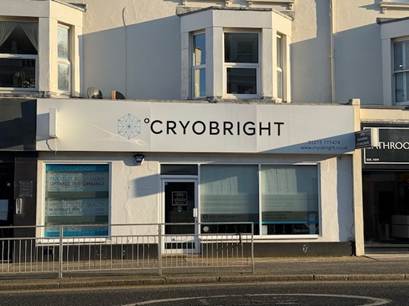
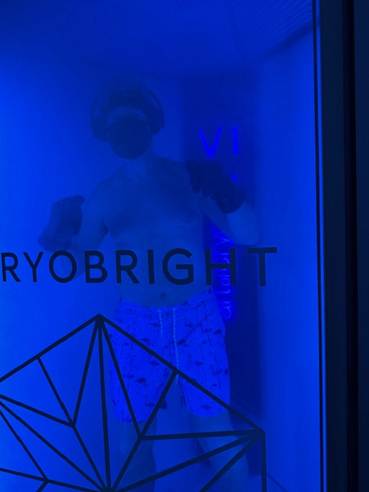
Opposite etch (note 1), a restaurant on the corner of Church Road and Hove Street run by Steven Edwards, a winner of MasterChef The Professionals, is one such place. A non-descript opaque window with its shop signage, ‘CryoBright’, offering no real clue to what goes on inside.

A voucher at Christmas gave us a couple of ‘experiences’ at CryoBright and in late January we pushed open the door. CryoBright provides ‘convenient, affordable access to the most advanced wellness and recovery techniques.’ These include an infrared sauna, red light therapy, fat freezing, leg compression therapy, physiotherapy, whole body cryotherapy and massage, mainly aimed at those recovering from some form of sports injury, which I am not! I was interested in the leg compression trousers, to improve blood circulation to my feet, and in the cold chamber – out of curiosity!

The ‘Compression’ trousers slide over your legs then go through a 20-second sequence of inflate/deflate, inflate/deflate for 20 minutes. It seems very gentle, too gentle almost and so I decide to concentrate on the cold chamber.

The idea is that extreme cold acts as a stimulus to your nervous system, particularly to the hypothalamus, responsible for reacting to dangerous situations; the ‘fight or flight’ trigger. It initiates several physiological reactions in the body, the main one being to restrict blood flow to the periphery, concentrating it around one’s vital organs.  

I said I am curious. Most of my experience of ‘cold’ is from winter weather, either skiing or on military exercises many years ago, when the wind chill can drop temperatures alarmingly. I am a pussy when it comes to swimming in a cold sea, such as in Estoril in Portugal, but the benefits of cold-water immersion are becoming more mainstream. Here in Hove many people swim in the sea all the year around, part of their daily routine, and swear by the invigorating afterglow. (Note 2) I guess we’ve all heard of Dutchman Wim Hof, aka the Iceman. In addition to plunging himself, and other paying customers, into freezing cold water, he markets a particular technique of breathing. Proper breathing is an essential part of practising yoga; in the hot yoga series you only breathe through your nose for the first hour.

My Wim Hof T Shirt

Hof’s technique involves inhaling through your nose or mouth, filling both belly and chest, and exhaling through your mouth. Each breath should be short and powerful; do 30 to 40 then stop. We all take our lungs for granted, never bothering to exercise them – it’s estimated we only use some 60% of our lung capacity. And I certainly hadn’t heard of COPD (Chronic Obstructive Pulmonary Disease) until those first COVID months. In summary, I breathe well but wouldn’t want to plunge myself into a bath full of ice. (Note 3)

But when we returned from Portugal in September last year, a new cold-water shower, installed in the outer courtyard as part of the yoga studio’s new sauna offering, offered an opportunity to cool down quickly. Now, at the end of my 90 minutes 40°C hot yoga class, I go straight out and have a cold shower. Strangely, I have begun to look forward to it; odd huh! It’s wonderful!

At CryoBright, Rob explains that the cold chamber is designed to give your body a thermal shock so, wearing shorts, a facemask, gloves, socks and slippers and with a set of headphones clamped around my ears, I open the door and enter. Oh! I should have said, it’s minus 85C. I have opted for 4 minutes but after 5 seconds my brain is already saying ‘fly!’. Fortunately, I decide to stay, moving around, glancing at the large clock on an iPad outside that’s counting down the four minutes, listening to music. I wonder how my body is reacting, why my nipples are feeling particularly cold, and resist the temptation to focus on the time. Just enjoy the experience. Outside, I put my clothes back on; my back is tingling in a delicious way and I feel fantastic. We sign up for a package of sessions; this Monday was my eighth and now I look forward to freezing my b******* off!

Our curiosity has encouraged chums to try it. Spread the word!

Richard 7th March 2025

Hove

www.postcardscribbles.co.uk

PS Celina also enjoys the cold chamber!

Note 1 Note the small ‘e’. Generally the first word of a sentence uses a capitalised first letter. There’s a distinction between ‘Etch’ and ‘etch’, although it’s personal! As a verb, to etch means to eat away the surface of something; I can only guess this is the tenuous connection for the title of the restaurant.

Note 2 In the summer of 1966, as an Officer Cadet at Sandhurst, I was attached to a Germany-based Artillery Battery for its two weeks Adventure Training near Oberammergau. I went with Staff Sergeant Curtis to recce a lake for some canoeing. The water looked inviting; he suggested I jump in. It was absolutely freezing, almost heart-stopping (!) and I got out as quickly as I had got in! Curtis laughed.

Note 3 The outdoor swimming pool water at Dauntsey’s School was fed directly from a cold spring. Maybe our lap times were quick as we wanted to get out as soon as possible.

PC 428 More of Life’s Observations

In PC 424 ‘We are Nothing Without Hope’ (31 Jan 2025) I scribbled about the lasting memories some have of the Holocaust, such as Eddie Jaku who wrote ‘The Happiest Man on Earth’. Those who survived have been encouraged to record their experiences of their time in the Nazi Concentration Camps, such as Buchenwald, Belsen Bergen Hohne and Auschwitz. Doing so has awakened long-buried memories of horror, so there has been a great reluctance; but without their courage, these stories will be lost and they cannot be.

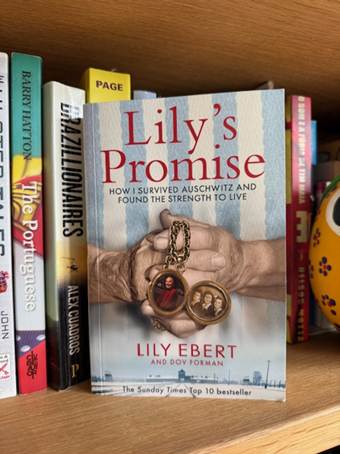
I recently finished ‘Lily’s Promise’ (Note 1), the autobiographical account of Hungarian Jew Lily Ebert’s time in Auschwitz-Birkenau from July 1944. In October 1944 she was moved to the Altenburg slave labour camp that provided the workforce for the HASAG munitions factory. In the first week of April the factory was closed and more than 2000 human skeletons of women and children were marched off – to somewhere. Three days later, on 12th April 1945, they realised their guards had gone. An American Army unit found them in a village called Pfaffroda, in Saxony, 5kms from the Czech border. The second half of Lily’s book is equally fascinating, hugely engaging, and I encourage you to read it.

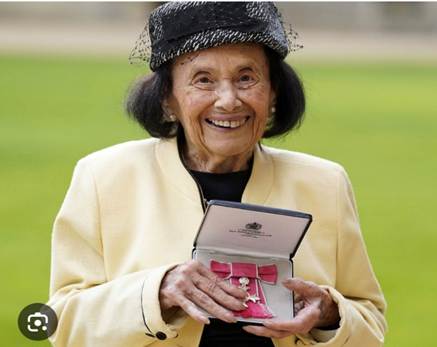
Lily receiving her MBE

You know when you’re reading a book there’s sometimes a temptation to turn a corner of the page so you can reread a piece again? The rounding up of Hungarian Jews began at the end of June 1944. By 5th July, Lily and her two sisters find themselves herded like cattle onto a train for a journey of four days; with no food, no water, nowhere to defecate. It’s possible that cattle have more space. The train took them to Auschwitz. I had to read the following paragraph twice, so awestruck and horrified by its words:

“And now I must pause and think. Words can barely describe what happened next, but words are all I have. Even while I was living through this time, I could not comprehend it, so how could I convey the experience to someone who was not there? I try to go back in my head, to understand how our hearts kept beating, how our lungs kept breathing, how we did this, how we did that, the mechanics of our movements, how could this have possibly happened. I know it did, because I can’t forget it. I realise that at this point we simply went numb. I felt yet could not feel. I thought yet could not think. In the face of such brutality, nothing about me worked as it should. The idea that one human being could do this to another overwhelms me.”

Lily Ebert died on 9th October last year aged 100; her legacy, her promise, will hopefully be remembered for decades.

Needing to come back to today, to ‘now’, I head to the Hope Café and find Sami.

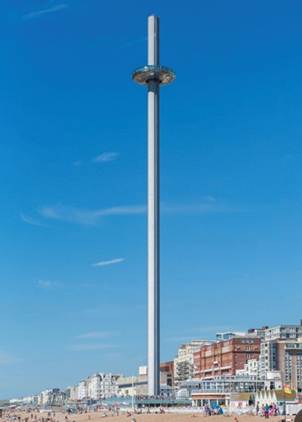
“Oh! Hi Richard” he said, looking up from his iPad. “Just trying to understand the debacle about the i360 (Note 2), how the council have written off the attraction’s debt of £53m and sold it to Nightcap for an undisclosed sum, rumoured to be between half and one-and-a-half million pounds. What do you think?”

“God! I had a very jaundiced view of the whole thing from its conception. Firstly 50% of the view from the top is the sea; no islands, no estuary mudflats, just the English Channel, so I thought it should have been called the i180! If you’ve been up The Spinnaker Tower in Portsmouth ……”

The Spinnaker Tower in Portsmouth

“Lisa and I have ……”

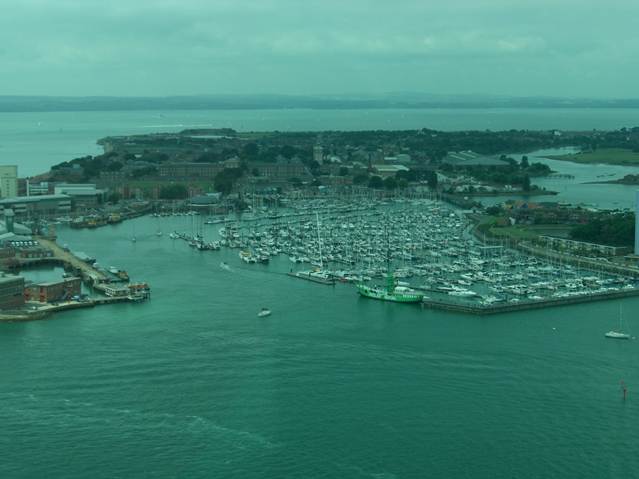
“….. you’ll remember there is something to see at every point of the compass. South and the whole of the Isle of Wight stretches in front of you, vertically down to HMS Victory and the dockyards, East towards Hayling Island and Chichester. Ferries, cargo ships, liners and yachts criss-cross The Solent.

The view across Gosport Marina to the Isle of Wight

Here in Brighton the offshore wind farm is the only thing that breaks the monotony of the view across The Channel.

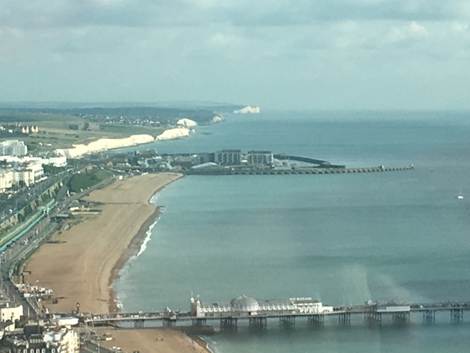
The view east over the pier and marina towards the Seven Sisters

Secondly The Green Party was running the council when it was conceived, but the glass came from Italy and the metal tubes from The Netherlands; hardly ‘supporting the local economy’ …… and actually a sad reflection on the UK’s manufacturing capabilities.

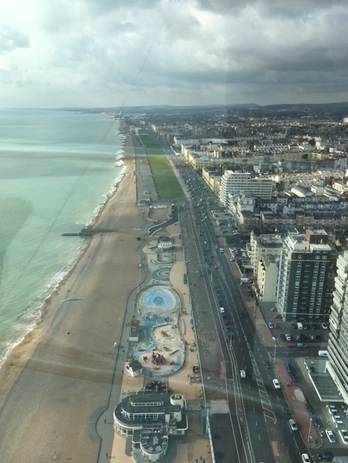
The view west. We live just inland from the top of the green strip (Hove Lawns)

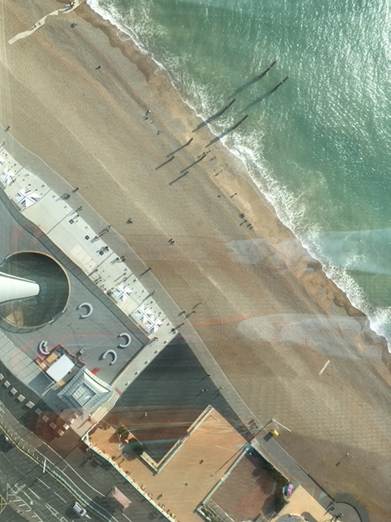
Thirdly, everyone wants to take photographs when they get to the top, so the glass should have been non-reflective. Didn’t anyone realise this was a major requirement? Too expensive? Then don’t build it!

Reflections of legs etc spoil the photograph

And lastly, it was never going to make enough money to pay off its debt; the council borrowed, inter alia, £36 million from the Government Public Works Loan Board. Currently it stands at £53 million!”

“It’s been bought by Nightcap, a company founded by Sarah Willingham-Toxvaerd in 2020, that runs some 46 hospitality sites across the UK. They take over the 115-year lease of the site. Do you know how many people have actually been up it Richard?”

“Well, Celina and I have, and my son-in-law Sam has climbed right to the top, but the wildly optimistic prediction was 739,000 per year. The reality is that the total number of visitors from when it opened in August 2016 and January 2023 was only 1,879,000; that’s only 268,000 per year, with some allowance for the pandemic lockdown. That tells you why it went into administration.”

“So often common sense is drowned out, this time by back-of-the-fag-packet predictions; the debt’s been written off to facilitate the sale and now the council take that on! Great!”

Richard 28th February 2025

Hove

http://www.postcardscribbles.co.uk

Note 1 In the depths of Auschwitz, Lily made a promise to herself that, if she survived, she would dedicate the rest of her life to ensuring the world knew what happened during The Holocaust.

Note 2 The so-called i360 is a 162m tower erected on Brighton’s seafront in 2016. It’s opposite the skeletal remains of the City’s West Pier, which burnt down in suspicious circumstances in 2003. A 200-person capacity observation capsule rises to 138m so visitors can take in the view.