PC 98 Europe in, er, 15 days?

Cousin Teresa was being serious when we saw her in Sao Paulo back in February (see PC 91). She wanted to take her son to Europe, to ‘show him Europe’, and she had 15 days holiday. We had a similar conversation a couple of weeks later with a great friend in Rio de Janeiro who had the same idea! Same idea and same time-frame. I was reminded of that joke about American tourists ‘doing Europe’. As they got off the coach in a large city, one turned to the other and asked: “Where are we?” His companion consulted her itinerary and responds: “It’s Tuesday so it must be Brussels.”

We are so, so lucky, living in an age when travel is comparatively easy, reasonably affordable and moving from A to B quick. Did you realise, for instance, the cost of air travel has halved in the last thirty years? Those of you who read PC 44 will understand that to get to Alaska in 1900 George had to train to Liverpool, get a boat to New York, train to Winnipeg and then across Canada to Seattle, before taking the ferry to Skagway and his onwards journey overland to Dawson City. His total A – B was 6 weeks, which included 3 weeks to Seattle; we flew there in just under 10 hours!!

Certainly in the 19th and maybe first half of the 20th centuries tourism was only available to the rich; before then it was probably a strange concept!! The Grand Tour was an essential part of one’s education if you were wealthy, visiting the cultural hotspots of Europe’s capital cities before going to university. Now of course anybody who has some time and some money can do it. And if you live here in the UK, you can drive, fly, train, cycle across The Channel so easily and go often – lunch in Paris anyone?? But if you don’t ……

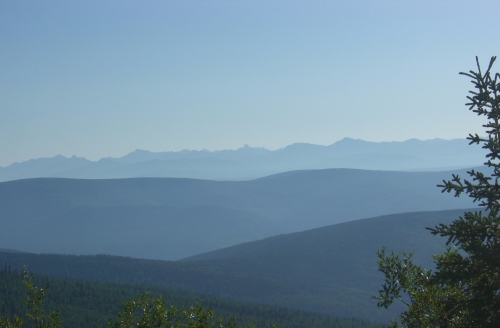
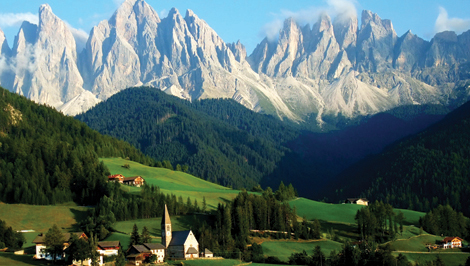
The Swiss Alps

The Swiss Alps

When someone says ‘Europe’ I wonder what that means to them. Is it the buildings, the physical shape of history so visible in every country? Incidentally did you know that Warsaw was completely rebuilt after the Germans flattened it in 1944? Is it the smell of the place, like when get off an airplane in say Singapore and are greeted by the ‘smell’ of South East Asia? Is it the history of the place, so influential in the development of the world as we know it? Oh! I know the Chinese invented gunpowder and silk and chop sticks etc etc and having a European centric view is passé but if it hadn’t been for Columbus, Marco Polo, Vasco da Gama, Cook   …… and the Europeans who went out to conquer, settle, invade, subjugate …… what sort of world would we have today? Is it the culture, oozing out of every European pore? Or the geography …. from the Nordic fjords to the Mediterranean coasts, from the wild Atlantic through the Alps to the Black Sea and the border with Asia?

Nowadays if you want to ‘see’ Europe you could just as well go online and virtually visit anywhere. Open up Goggle Maps and have a virtual drive through the Brenner Pass. Rijks Museum? Not a problem …. http://www.rijksmuseum.nl would you do it ….. and off you go, exploring the works of Rembrandt and Van Dyke ……. from the comfort of your chair ….. and not costing a penny. But that’s cheating? Is it? Instant gratification without any cost – sounds like the C21st to me.

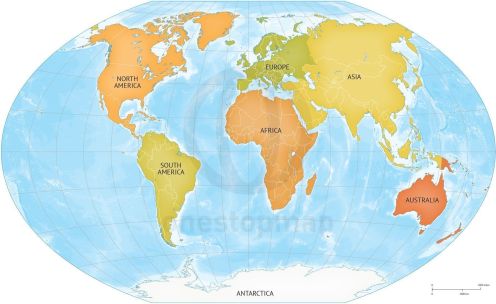
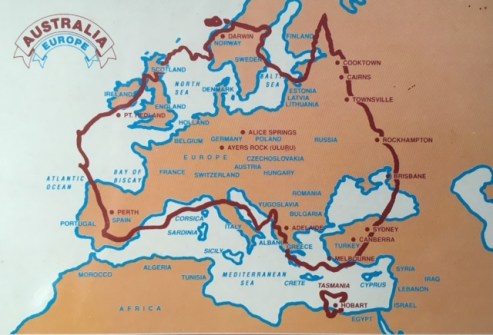
So the question is, where would you plan to go and what would you hope to see with a limited time budget – 15 days? Europe is small and extremely crowded, about the same size as, say, Australia …….

FullSizeRender (1)

….. but the distances are more doable and transport easy.

Many years ago when family were visiting from New Zealand, having collected them from Heathrow Airport we drove into central London before going home. It was nighttime and suddenly there was Buckingham Palace, down The Mall into Trafalgar Square with a floodlit Nelson on top of his column, and at the end of Whitehall Big Ben, physically there, reaching up into the dark sky. You could see the excitement on the faces of both children and adults as they looked out of the car windows. Personally I remember the first time I went to the Louvre museum in Paris …… and stood before the Mona Lisa …… or in Sienna Cathedral staring at the wonderful sculpture by Michelangelo La Pietà ……. and went all goose-pimply because here it was, in front of me, not just some photograph from a glossy magazine.

Fifteen days huh. First time ever? Seven cities/countries – two days each? The must visit list could include London, Paris, Rome & Firenze, Berlin (I’ve never been as it was behind the Iron Curtain when I did my travels in Europe), Vienna (small and compact) and maybe Amsterdam (Rijksmuseum!). But what about the cradle of civilization, Greece, or the Scandinavian countries, or Britain’s oldest ally, Portugal? And if we are talking about the whole of Europe, the capital cities of the old Warsaw Pact countries, the beauty of Bucharest or Bratislava or Budapest must feature, surely? And what about the Baltic States? Or more ‘modern’ destinations like Prague and Barcelona, although they have become victims of their own success at drawing the tourists? If we’re still talking about Europe, then Istanbul must feature? And of course the trouble with a rushed crowded schedule is half the time is spent on a train, in a car, on an airplane, or just waiting at the airport for the latter, to get from A to B; packing, unpacking, packing!

So you get a flavour, a sense of the greatness of this area of the world, for that’s all you can do in fifteen days. Promises are no doubt also made, for it simply whets the appetite for a return trip, when time and money are more flexible.  But come you surely must, if only for fifteen days!

Richard 4th June 2017

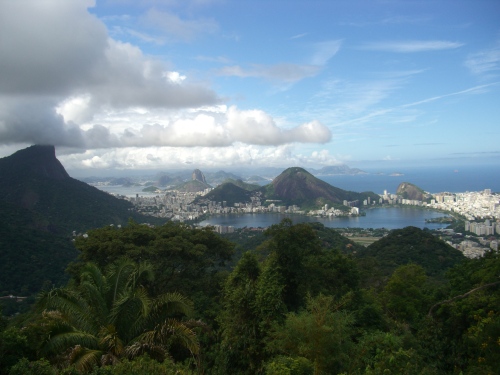
PS I remember the first time I went to Rio de Janeiro and, on the night-time drive in from the airport, saw the floodlit statue of Christ the Redeemer on top of Corcovado! Wow! No more photographs, there it was.


PC 97 Southern Technology


I am not a techie in any sense but am certainly not one of those 65-74 year olds who, according to a survey in today’s paper, have never used the internet; that much is obvious. However, when it comes to a technological problem, I only have a few responses in my kit bag.

The first is a general one, of which most of my readers will be familiar. It goes something like: “Aaggggggghhhhhhhh!” and maybe coloured a little by the addition of ‘f**k’. And when reading this you need to be reminded that this is effortlessly produced far back in the throat and announced into the open void at full volume. Not that technology normally responds to this; after a few minutes you try and rationalise it ……… and find a solution.

The other morning my iPad refused to stay ‘on’. That is, I switched it on and waited for the ‘screen saver’ to appear. As soon as it does, you can normally simply swipe the screen and enter your passcode. Nothing; wouldn’t swipe, simply went out. Blank! No problem, the old ‘soft reset’! Nothing! Maybe shaking it would help? Leave it 3 minutes ….. try again! Nothing! Throw it through the window?

“Why not try and Google it?”

The sage says do the soft reset for 45 seconds. Sure enough, back to normal. Why? No idea? Technology huh!

I am collating all my PCs on my Toshiba laptop, prior to possible publication of the first one hundred. I had about 30 minutes spare on Friday morning so I thought I could add to my collation. Turn on my laptop. Up comes the reassuring stuff then the “Don’t Turn off your computer, Windows Updating ….. 0%” You know these updates are necessary and didn’t need last weekend’s cyber hack to remind you, although they do have a very irritating habit of starting just when you want to do something for 5 minutes, now! So you watch the little figure progress …. 5% … 10% … 15% … 20% …21% …22% … 23% ….. the wretched worm endlessly circling like some demented hampster on its wheel. I went off for a pee, came back and it was still at 23%, the ‘don’t turn off, updating’ continuing to taunt me. And it stuck at 23%. So I unplugged it, knowing I could not turn it off any other way; let the battery run down. Sure enough, after a while, the 23% faded and the screen went blank. Leave for 5 minutes (Not sure why? Cool down? Seemed the right think to do but not being a techie ……! Oh! And I prayed as well. Even smiled at it, as in ‘I love you really!’) Switched back on ……. and after a few flashes of stuff, we got back to the ‘Windows updating …..’ ‘Aaaaggghhhhh’.

 I had used a local computer company before when I had a problem and phoned them.

“Bring it in.” I had some ridiculous notion that if I took it around then and there, they would drop everything else they were working on and fix it before the evening was over. It was raining, a somewhat rare event in the South East this year, so I put my laptop and charging cables into a bag and off I went. Southern Technology is up on Blatchington Road which runs at right angles to George Street; a mere 10 minute walk.

When someone has a first name which don’t translate well across cultures, you tend to remember it, especially as it  makes you laugh; that that is clearly understood and made the most of by its owner is a bonus! “Hi! Fattey” I called as I opened the shop door. Fattey is a lovely 30s something Iranian with a good sense of humour; he would need it I hear you think! He manages the business with Hassan, bearded and more hipster by appearance. The shop has a counter, situated as near to the door as possible so that there is maximum room for the computer peripherals (This generic word covers the chargers, storage devices, cables, bags, add-ons, plugs, boosters, dongles, software patches etc etc) that are for sale. Behind the counter are steps leading up to a sort of mezzanine floor where the repair work is carried out. You see piles of laptops, desk tops, data storage devices, soldering irons, cables and electrical sockets everywhere; in amongst these, reminders of human need, the odd coffee cup and discarded sandwich wrapper, its contents consumed long ago.

Hassan fills out the little work docket, Fattey shouts from the workshop it’s probably a software or hard disc problem, and I hand over my laptop. Hassan says they hope to be able to recover all the data and get it working well. “Is there anything really really important?” “Well. I don’t ‘game’ (Is that a way of saying I don’t play Auto Theft 6 or some such?) and I don’t use it for music or watching videos (I get a funny look from both of them, almost a ‘Well, what do you use it for?’ sort-of look) but all my digital photos are on it, and my Word files are very precious.”

I depart in the rain, praying that it is fixable and soon.

My little brain manages to produce some scribbles about once a fortnight and I was due to post my next postcard this weekend. It’s 90% written ……… but it’s stored on my laptop …… which remains in the workshop of Southern Technology. Unless I get a telephone call in the next hour, they will close for the weekend and I will be unable to post PC 97 as I had planned. So this little tale could well become PC 97 and the other one renumbered. I hope it doesn’t disappoint?

Richard 20th May 2017

PS So there you have it; no telephone call, no laptop! Fortunately I have a little Notebook.


PC 96 A Short Conversation with my Step Father

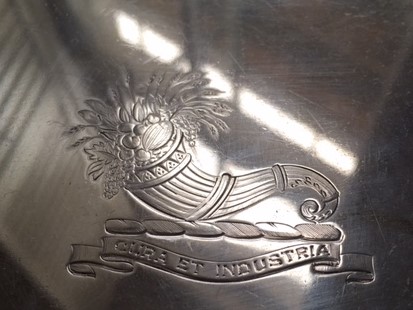
My step father, known by me throughout our thirty eight year relationship as Uncle Philip, died in November 1993. He came from a traditional Scottish family and his values were very much shaped by a strict upbringing, typical of the age, and coloured by wartime experience. Indeed the family motto was ‘Cura et Industria’ (Care and industry) and their crest showed a cornucopia of goodies – suggesting that through hard work comes abundance. He was careful with money and generous of spirit. Above all he was a skilled engineer, a mechanical one at that. He loved technology and things mechanical, always wanting to understand how something worked.

Cura et

The other evening I imagined having a conversation with him, about life in May 2017! The thought came to my head as I used some grease from a green Duckham’s tin to ease the hinge of a metal gate to stop it squeaking. Uncle Philip had had this very tin ….. using the contents to fill a grease gun for the nipples on his car. I am not a mechanical engineer so I can’t tell you where exactly these said nipples were but ……! He had only two cars in the time I knew him, an old black Riley Pathfinder and then a Rover 3500. Both he cherished and serviced himself.


Duckhams 2

“You wouldn’t know how to service a car today, Uncle Philip” I said rather confrontationally.

Oh! Why’s that?” he said, immediately bristling with indignation!

“You raise the bonnet and there’s a large cover – and very little else. All computer-controlled and very efficient. Not sure there is even a distributor or carburettor!! Do you remember how you used to check the spark gaps with a feeler gauge …… pick all the gravel out of the tread of the ‘Crossply’ tyres, to ensure they lasted longer?”

So you’re saying I would not recognise how cars have developed in the last 30 years or so? What else would I be surprised at?”

(Ed: What follows are some of the things that pop in to my head. It’s only a start!)

“First and foremost, the development of the ‘internet’ – the world wide web (www)”

“And what, pray, is the Internet?”

“The Internet was originally a military back-up plan linking super computers across the United States in the 1960s. In the early 1990s CERN proposed a global web concept and by the middle of that decade the public began to grasp its potential. Today its tentacles reach into every aspect of human activity.”

“Such as?”

Communications! There has been such an exponential growth in their development that it’s hard to keep up, unless you’re under 25 and working for a technology company.”

“A what? A ‘technology’ company?”

“They are the new Masters of the Universe! In the latter years of your life you remember the development of the mobile telephone? Looked like a brick which you charged with a bigger brick.”

“Yes! You had a ‘Rabbit’ that only worked if you were within 100m of a rebroadcast mast.”

“Yep. Well remembered! That didn’t last long (20 months). But look at this, my ‘smart’ phone through which I can make telephone calls, either through a local mast or through the internet, and that’s free (!), ……. take photographs as it has a camera…

“Hang on! You have a camera in your phone? That sounds amazing? But how do you see the photographs. It was always so expensive to print them.”

“It’s all in the digital revolution. You can define anything with a series of ones and zeros as in ‘100110111100001001’ – and this has simply turned life upside down. So I can see them on my personal computer, which incidentally is smaller but more powerful than ever. If I want to I can load them onto a web-based site and print them off in an album, individually, however I want them.”

“A ‘web-based’ site? One of those thingamajigs on the internet?”

“Absolutely! I can use my smart phone as a clock/alarm/stopwatch …. I can use it to text people.”

“This phraseology is all so alien to me. Text?” he said, peering over his half-moon glasses.

“Instead of talking to people, I can write to them electronically, either in the form of ‘electronic mail’, shortened to email, which started becoming popular about 2 years after you left us, or, if it’s a short message, by typing it out on my ‘phone’ in the form of a text. The wide availability of hand-held devices, be they a telephone or small lightweight ‘Lap Top’ computer, has ensured the success of this new medium. This is all part of Social Media, a completely new industry with odd names like Face Book, Instagram, Snapchat, WhatsApp, that ensures no one talks face-to-face and encourages the rise of self-obsession. I joke!”


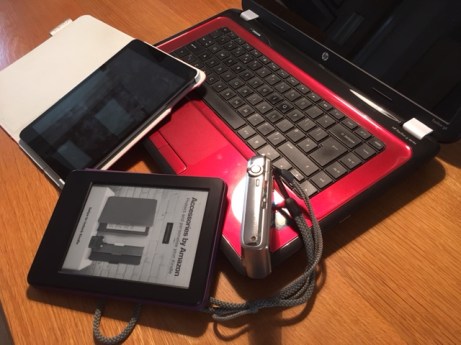
Digital Devices 2

Digital Devices

“You’d also be surprised at the development of the devices for seeing video. You will remember how TV size was defined by the Cathode Ray Tube; they got so big the set was almost as deep as it was wide. Now an extremely slim TV monitor can be made with solid- state electronics and the development of pixel technology. A pixel is the smallest element of an image that can be individually processed in a digital display – be it a photograph or video system.” (see below for greater information!)

“You remember that drawer in the hall table where you kept your Ordinance Survey Maps? Actually these days you can get any map on your phone and the Global Positioning System GPS will even tell you exactly where you are, to an accuracy of 5 metres or so.”

“My brain is being overloaded. Quickly, before I fry. What else?”

“Cursive writing (see PCs 56 & 57) is slightly passé. Reading anything, be it a book or a newspaper, can be via an electronic device although, unless you’re travelling, most people seem to prefer the old-fashioned paper book. Learning is similarly available through the internet. And the internet has freed those chained to their office desk; they can work anywhere, provided they can get an internet connection. Your electronic ‘library’ for research purposes is, in the main, provided by a company called ‘Google’; so it’s part of our language ‘to google it’, meaning to go online to find the answer through the Google search engine.”

“Search Engine? Oh! Don’t bother!”

“And the most exciting developments are going to be, I think, in the area of nanotechnology and the use of Graphene. Meanwhile everyone still moans about the weather and politicians of every persuasion, no one has solved the 69 year-old Israel-Palestine problem, and extreme Islam is the butt of blame for most of the world’s woes.”

The world’s a very different place it seems, but it was ever thus! My father would have said the same; different developments, different times. Thanks for bringing me up to date! Now I must go and tell St Peter all about it, although he probably knows as he seems to have eyes and ears everywhere!”

Richard 7th May 2017

Pixels: A pixel can be turned on (ie illuminated) and off (darkened) on a computer monitor. Resolution depends on the number of pixels a monitor can show. They have developed from 640 x 480 pixels per inch (PPI), through 1073 x 768 PPI until today’s 1000 x 1000 PPI. Colour depends on how much memory has been assigned to each pixel. For instance, two-bit memory pixels can show 8 colours, whereas eight-bit pixels can show 256 colours.

PC 95 Booking an appointment

When I was aged 8 we moved from the great Georgian city of Bath to a small village 15 miles north of here, in deepest Sussex. It was in an age when certain professions had defined status, an acknowledgment of the contribution they made to the community’s well-being. Teachers and doctors headed this list and their position in the village was well established and respected. Our local doctor, Doctor Hare, was an affable, middle aged chap with florid cheeks and a large laugh. If we wanted to see him professionally, we could make an appointment at his surgery or he would do a house call, complete with his black leather ‘Doctor’s bag’. My parents saw him socially at dinner parties and the like, and I held my 18th birthday in the large garage attached to his house. His daughter Belinda was the first girl I kissed!!

Sorry, I digress!

Back then, getting an appointment with the lowest level in the medical service, in the UK called General Practitioners (GPs), was relatively straight forward. Today I reflect on how backwards we seem to have travelled. I have had a crippling leg/back muscle pain for weeks, relieved occasionally by physiotherapy and massage, by visits to heated rooms, by some attempts at ‘hand on’ healing and with the application of oils – and with the constant use of a painkiller. I needed to check in with my doctor; so yesterday I called the surgery after the 9 o’clock watershed – for people like me, not an emergency, or so I believed with my amateurish knowledge.

You should be aware that before the Easter weekend my GP’s surgery was located in a large, rambling, rather decrepit Victorian house, once the home to a well-to-do family I imagine. Doctors had the old dining room, the square front room, or upstairs one of the old bedrooms as their consultation rooms, whilst the peripheral support staff like nurses and therapists had to make do in smaller rooms or spilled out into hallways and cupboards. Glimpses of the paper filling system did not engender any confidence and it is a wonder they managed to make it work. No! Really! It looked a real mess but this is how a lot of GPs currently interface with their patients.

So I was enormously pleased to read last year that the idea was to move into a deconsecrated church about half a mile away. A developer had had the vision to draw up plans to enable two GP Surgeries and a pharmacy to move into what was Holy Trinity Church. With new consulting rooms, a conference room, treatment rooms and the like it’s a huge step in the right direction. Needless to say Hove Preservation Society objected – to putting a building originally erected to heal the Christian soul and now no longer used, with maintenance and vandalism issues, to the use of healing the physical body, maybe as well as the soul? Fortunately the plans went ahead and it’s opened a couple of days after Easter.

Trinity Medical Centre

Tuesday – the day of the opening.

We are experiencing some technological problems with our systems and unless it’s urgent please try tomorrow.”

Yesterday

This is Trinity Medical Centre. We are experiencing high volume of call rates currently and you are held in a queue; if it is an emergency pleased dial 999 otherwise please hold (I put the telephone handset on ‘speaker’ so I can carry on doing other things) ……… We are experiencing high volume of call rates currently and you are held in a queue ……. We are experiencing high volume of call rates currently and you are held in a queue.”

For 10 minutes this went on until, eventually, I got as far as the options menu.

This is Trinity Medical Centre. If you want to change an appointment please press 2, otherwise please continue to hold.”

Holding…..

Hello. This is the Trinity Medical Centre, how can I help you.”

“I’d like to make an appointment with Doctor Mackinnon. I have been onto your website and I can’t book one.”

“If you ring tomorrow morning, I can book you an appointment with her in two weeks’ time.”

“Why can’t you book me that appointment now, rather than having me call tomorrow morning?

“Because that is not how it works”!

(and there is no point in getting frustrated because the person you are talking to didn’t decide these things, no matter how much you believe she (in this case and it could have been a male voice!) did)

Does she have any free appointments tomorrow?”

“Yes she does, about 5, but you would have to come in tomorrow morning at 0830 to book one.”

“I can’t do it over the telephone?” (Like …. Open the appointments page in the computer, put my name in one of the free slots, and tell me when)

No! You have to come in!”

“OK! So I will call tomorrow.”

Today

A repeat of the first section with which I will not bore you.

“Hello. Trinity Medical Centre. How can I help?”

“Can I book an appointment with Dr Mackinnon today?”

“I can book you an appointment in two weeks’ time.”

“But I was told she has 5 free appointment slots today.”

“I could offer you a telephone appointment.”

“What happened to those free appointment slots?”

“I could offer you a telephone consultation or an appointment in two weeks’ time.” (spoken in a tone which suggests this is ‘take it or leave it and don’t ask any more irritating questions’.)

OK! I will take the one in two weeks.” (I need to see her for her to refer me for, Oh! I don’t know, an MRI scan, Ultra Sound, physiotherapy and I am sure she wouldn’t make that referral without seeing me.

So there you have it. A little snapshot on the difficulties today of making an appointment to see your doctor. I hadn’t thought about Dr Hare, or Belinda for that matter, for decades, but it seems that we haven’t made any progress from those halcyon days of 1950’s Britain.

Richard 20th April 2017

PS I was even approached by a complete stranger in local George Street this morning. “Excuse me! But you clearly have some pain in your leg” – my hobbling along is obviously very pronounced (!) – “Can I help you though the power of prayer?” I was on my way to stock up with fresh eggs from Dean at his market stall and didn’t want to be distracted, so I mumbled a quick “No! Thank You” and shuffled on my way. Funny life innit!


PC 94 Sight and Eyes

Do you recall the first time you wore glasses? OK! If you are long-sighted it may be a treat in store, depending on your age; but if you are short sighted …… I must have been about 8 or 9 and I remember walking up the street from the opticians in the great Roman and Georgian city of Bath, where I was born. Clearly I must have needed some sight correction for a while, as it was like seeing buildings, people, traffic as if for the first time!!

FullSizeRender

This was how it was!

In the Army of the 1970s the threat from the Soviet Union was very real and we imagined any attack across the inner-German border would include nasty chemical agents. Consequently we spent part of the time on training wearing a respirator and chemical-resistant suits (not Pierre Cardin I assure you!). Having a gasmask on your face is quite incapacitating simply on its own, with vision restricted, breathing more difficult, so we all had to suffer a yearly test, in a way to remind us how wearing it kept us alive. We all trooped into a gas chamber and put on our respirators. Some CS Gas Pellets (see note) were dropped onto the floor and, after sufficient time for the gas to build up, one by one we took off our gasmask, shouted out our service number (in my case 24067711 – amazing how some numbers are instantly recalled), rank and name ….. before heading rapidly for the door ……. and most likely to vomit on the grass outside!! The frames of my normal glasses didn’t fit inside the respirator so I was issued with a pair of the type much loved by John Lennon.

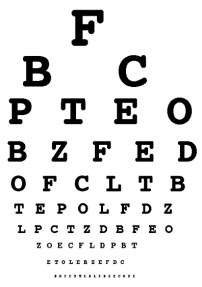
in focusand this is how it became!

Not sure why one keeps old spectacles but I seem to have a collection, of ones with small frames, a pair with large smoked glass lenses, some with ‘no frame’ (!), memories of sunglasses which had a coating making the world look rather blue, and those yellow ones now at the bottom of Sydney Harbour as the strong wind took them off on some ferry trip! Since 1970 have also used contact lenses. My regular readers will know that I spent a lot of my ‘Army’ life sailing. (See second note!) Mostly in keel boats but occasionally I was encouraged to jump into a dinghy ……. and if you wore glasses you soon couldn’t see once they had got covered in salt water. The problem is salt water and glass. It’s almost impossible to keep your specs clean ……. and when there is a lot of spray around, the handkerchief that is tucked into your pocket and which could be suitable soon becomes damp with salty water and simply smears the glass. In 1970, after a number of long offshore races and cruises to the Chanel islands, for example, I ventured into the fairly new technology of contact lenses.

I went to get fitted and came away with a pair that I cleaned and soaked overnight; they were to last one month. They are made of hard plastic. In additional to the little storage container, I was given what I can only describe as a miniature sink plunger, for that’s what it looked like; a little rubber tube about 2 cms long with an open cup at one end. The idea was you could place it over the lens in your eye and suction would help its removal. Needless to say I only used it once.

These new contact lenses were an absolute boon. Seeing and sailing became so much easier. The only trick was to make sure when you removed the lens it didn’t fly out …….. somewhere. Grubbing around on the wet and dirty floor of a yacht looking for a piece of clear plastic barely a centimetre in diameter was never easy. On one offshore race from Cowes on the Isle of Wight to Skagen on the northern tip of Denmark in 1972, we had some fairly inclement weather ie it was raining heavily and blowing a severe gale. I didn’t dare take my lenses out below decks and they stayed in for three days; my eyes felt that they had been rubbed by sandpaper when eventually oxygen got at them!

And once, in a hotel in Zurich, I was putting them in, leaning over the sink  …….. with the tap running. The left lens didn’t go it first time and dropped into the sink ……. and my attempt to turn the tap off before it disappeared down the drain was not successful. I didn’t have a spare so I had to unscrew the U Bend beneath the sink ……. and rinse it through in the bath, with the plug in I should hasten to add. You can imagine that no one had cleared out this particular U Bend in this particular hotel room since …… well, probably since the hotel was built. But in amongst the human detritus of decades that washed out was my left lens!!

Jade 0166 (2)An early pair!

Gradually technology improved contact lenses and along came ‘gas permeable’, both daily and weekly and monthly wear. I am short-sighted so as I get older my uncorrected eyes can read books, papers etc without glasses, although wearing contact lenses I additionally needed to have a pair of those half-moon ‘granny’ glasses. About twenty years ago I stumbled on another option. I think I was extremely hungover from some entertainment the night before and was on semi-automatic pilot in the morning when I attempted to put my contact lenses in. I put one into the wrong eye; I could still see, but not quite as well as normal. However I realized I could get this to work. In my left eye I correct to about 9 ft, so that that eye dominates; and my right eye I correct from 9 ft to infinity. Amazing how the brain can adapt and I have got so used to it it’s only when an object is at the cross-over distance I notice it.

So there you have it, see what I mean, illuminating scribbles about eyesight!!

Richard 10th April 2017

PS This old joke fits well in a PC about eyes. “The science teacher asks: “Which human body part increases to ten times its size when stimulated?” A girl complained this was a very inappropriate question and said she was going to tell her parents. The teacher repeated the question and Billy answered by saying it was the pupil of the eye. After congratulating Billy, the teacher turned to the girl and commented:

“As for you, young lady, I have a couple of things to say: firstly, you have a dirty mind and secondly one day you are going to be very, very disappointed.””

Notes:

CS or tear gas is a riot control, de-capacitating agent, the defining component being 2-chlorobenzalononitrile. (The ‘CS’ simply refers to the surnames of the two scientists who first synthesized it in 1928!)

There was a trio of car bumper stickers:  ‘Fly Navy’ and ‘Sail Army’ and for the Royal Air Force ‘Crab Air’ as they had a reputation for going sideways!


PC 93 Hot Yoga Thoughts – To the end!

I had imagined scribbling the other half of ‘Hot Yoga Thoughts’, to cover the floor series, very shortly after PC 84. In fact I got distracted by other adventures and thoughts, in fact eight PCs in all, so now I should finish this!

The Floor series ……..

Of course Bikram Choudhury, the man who put this Hot Yoga series together, has not exactly covered himself in glory. Having created a specific sequence of Hatha yoga positions to be practised in a hot room, it was rumoured he took advantage of one or two of the female students training to be its teachers. And he didn’t see the conflict between preaching a way of being a good human based on a spiritual tradition going back thousands of years, and using his position to abuse others ….. as well as raking in money for his aggrandizement. Bit like those TV evangelistic preachers on American television you might think? Nothing was proven until the beginning of 2016 when his lawyer won $600,000 for sexual harassment. At that moment ‘Bikram’ studios all over the world made a rapid exit, rebadging and reinventing themselves and whilst I acknowledge that Mr Choudhury’s sequence is extremely beneficial, I don’t have to like the man who created it, do I? Such a scumbag! And if you thought yoga is not for you, try the ‘yoga for beginners’ asana.

yoga-for-beginners

So …… onto your mat, quick sip of water, ‘savasana’, dead body or corpse pose. One teacher suggested you should feel like being in a coffin ……. then she said closed coffin and I didn’t like the sound of that! You’re meant to let go of all the thoughts in your mind, forget all the efforts of the last 60 minutes, just relax …. at last ….. peace. But my mind exclaims! What? I busted a gut to make a passable attempt at such-and-such pose and now I’m told to forget the recollection? “Just be in the moment”…. that sort of yoga thing ….. yes ….but what am I having for lunch, monkey mind asks?  …. I want to think of anything but lying like a dead body. But when I really really try, I visualize my prone body floating on warm water – and then I make the water extremely shallow and imagine that underneath me is golden sand – about 5 cms away. I relax – my body drops further …. completely!

For those of you aghast that I should be so flippant about this ancient art, I really must apologise; this is just the way it is ….. for me …. and I hope I don’t disappoint you?  And I am not some imitation of an Indian ascetic, spending their days at the top of some pole trying not to fart. An ascetic is characterized by ‘severe self-discipline and an abstention from all sorts of indulgence’ – what? No chocolate or sex huh? (note the order of these two indulgences!)

Of course Celina and I moved to Hove because there were two studios offering hot yoga locally. On the south coast the only other one was in Bournemouth – too far from London. And by the way, I hope you don’t think anyone who does yoga is a bit of a woof? In the western world I suspect more women do yoga than men – in fact our class ratio must be about 80:20 – but I challenge any man to do 90 minutes of hot yoga without ‘feeling it’!!

Now we’re off again. Knee to chest, other knee to chest, both knees to chest – back of the head on the floor – what? Not possible! This is known as wind removing pose ….. the right knee ‘massages’ the ascending colon, the left knee the descending colon, then when both knees are raised ……. the potential to fart is enormous.

wind-removing-pose

Onto tummies, arms like the Sphinx, lift up into ‘Cobra pose’ ….. never felt less like a snake, legs together to suggest the one snake tail, thorax off the floor. Can’t breathe …. collapse . We then do one of many situps, firstly trying to touch one’s toes and then try and get the head to knee ….. in sync with the breath  ……  of course!

Savasana

We’ve all imagined ‘yogis’ in Lotus pose, sitting serenely with not a care in the world, but Bikram’s Locust pose is something else. Hands underneath your prone body, like playing beach volleyball, …… then raise your legs. Er? OK!

Another posture … the dialogue continues …… ‘arms out to the side, legs together blah blah blah …..  ‘lift off like a 747’ (sort of dates the dialogue doesn’t it?) ……. but it’s a bit like trying to levitate! And I am not very successful at either! Eventually we move on from the ‘back strengthening’ series of postures to ‘Fixed Firm pose’ – Oh! Go on then …..Supta-Vajrasana. You kneel on the floor and with your knees quite close together, put you bum on the ground and fold over backwards, until your shoulders are on the floor. Yum! Never thought I could do and it took a while – it’s all about relaxing. Most men find this difficult initially, especially those with knee injuries from playing football.

Savasana

Some of Bikram Choudhury’s claims are a little far-fetched. In the next posture, one where you kneel with arms up together, and bend forward until your hands touch the ground, he reckons it’s as relaxing as 8 hours sleep –  but it’s over in 60 seconds – yes! OK! Bikram claims lots of benefits for his postures but if this one was true the world would sort of do it once a day and no one would go to sleep!

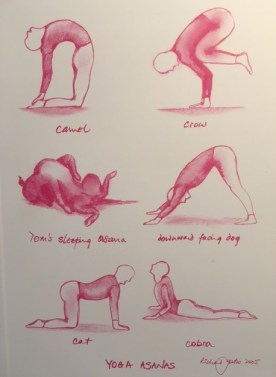
Camel, a master posture, comes next (see my little drawing below), then Rabbit, where you tuck your head to your knees and raise your bum. The penultimate posture requires your legs out in front and stretching forward. I twisted my ankle badly in battle PT in the army so a little bone sticks out making this uncomfortable.

nov-07

This little cartoon was drawn by me as Tom, my gorgeous black Labrador, had this relaxed way of sleeping, showing his bits, not a care in the world. The connection with some of the yoga poses named after animals was obvious!

‘Final spinal’, a posture where you sit on your buttocks and twist your spine, always reminds me of a good teacher, Krystina Sedlakova, as her Czech-accented English made the pronouncing of ‘final spinal’ a delight!

One teacher used to rattle off the ‘Bikram’ dialogue as though he was a commentator on some horserace, as in ‘and they’re coming to the first fence and it’s Blue Sky in the lead from Hang Back and the favourite, Golden Boy, in third …… and they’re all safely over and …..’ His went something like (and you have to invent the appropriate voice in your head): “And bend to the right, reaching up and over, straighten your left arm, and change, and bend over to the left, straightening your left arm and now, reaching back drop your head relax    Not very ‘Yogic’ you might think …. although occasionally in a class of yoga we do have a ‘faller’!!

The final breathing exercise ……. and we’re done. Hot, exhausted, stretched ‘inside and out’ …… as Bikram Choudhury says ….. ‘bones to skin’. Try it! It’s addictive! You could always start with the beginners’ pose I offered earlier on!


Richard 26th March 2017


PC 92 If You’re Over 50, Read On


If you like writing, and I have to accept that for some people it’s not their bag of tricks, don’t you just love it when you dump all those relevant thoughts that have been running around inside your head, effortlessly and with delight, onto some medium or other – and for me this has become my iPad in preference to using pen and ink? And you sit back and scan what you’ve written, somewhat pleased with yourself (see note below), thinking you’ll add to it over a few days or weeks, maybe rephrase a little here or there. And then don’t you just hate it when you inadvertently delete it? And you don’t realise you’ve done so for a day or two, when you want to add that little bit …… but you can’t find it! And you tear your hair out wondering what happened, how could I be so stupid, how could I retrieve it, ……. and then you conclude you have to start again?

So here I am starting again …. but in the meantime Robert Crampton, writing in The Times, shared thoughts similar to those in my head with his readers, so maybe it’s good to pause occasionally! Crampton wrote: “At 52, I’ve passed the stage of thinking I’m immortal, but am yet to concern myself with the details of my dotage. Yes, the issue is lurking, not too far over the horizon, but not so close that I can take current advice remotely seriously. I’m far more bothered about not going bald (all tickety-boo so far, touch wood) and sustaining an erection (or securing swift, cheap, legal access to Viagra).” And this has occurred to him at 52? Good grief …… this is hardly middle-aged in my book. Of course the chance of my becoming bald is as likely as our discovering the moon really is made of Gorgonzola; and any comment on the latter would be too much information!

Life is endless, limitless, horizons go on forever …….. until you understand it isn’t and they don’t. Not sure exactly when this particular thought started bubbling to the surface of my brain, but maybe in the last few weeks of 2016, when I guess I was subconsciously reviewing the year …… and in my case a period of real highs and lows …… I found myself thinking about the finality of life and taking it rather personally! I have always taken a very positive view on my existence and tried, in every thing I’ve done, to inject that positivity into those within my compass, infect even! Well, I hope so! What triggered this rather morbid thought? Maybe a news item of an enormous future transport infrastructure project whose completion I might not witness or maybe a simple run-list of those of my friends whose lives have come to an end, often a little earlier than they or those they cared for had imagined.

But if I’m really honest with myself, it was probably the start of a new personal decade that had something to do with it …… that and the little spots on the back of your hand, age spots, liver spots, sun spots ….. they just appear gradually without much of a by-your-leave…. and then you realise you’ve got quite a few, and you remember them on your mother’s hands, those and the increasingly noticeable veins, darker in colour. Signs of ageing huh? No, not me, I’m indestructible, I’m going on for ever and …….. er! no you’re not, you might buck the bell shaped standard distribution and come out the far side of the actuarial life expectancy mid point …. but sooner or later…… Me? I’ve got too much still to do, still to enjoy, still to experience …… I want to travel on the HS2 (Britain’s High Speed rail link that may open around 2026 for phase one and phase two 2032). I want to keep up with developments that the increasingly rapid pace of change through the application of digital technology can produce, I want to ………

When I was younger I just got up and completed the three ‘s’s (s ………., shaved and shampoo’d (you can guess the first!) …… and went off to work. Now additionally I have to take some pills ……… pills for this and pills for that, ‘but at your age you should certainly take Q10, multivitamins galore and, if you can afford it, extract of Amazonian Frog and ……..” “Afford it?” The irony is you stop earning money and suddenly your bills go up because you’re advised to take supplements! I used to watch Michael Douglas films; now I tend to be drawn to Michael Mosely documentaries about statins or heathy eating or the history of pain relief.

Not a great ‘user’ of Facebook (probably a little passé already? OK! I get it) I do occasionally post a photo or three, and skim the postings of others of my ‘friends’. “Good grief! Haven’t seen him/her for twenty years; they look old.” But it’s just the process of ageing. I remember a film where an old lady told her granddaughter: “I have always thought of myself as 17, but the other day I looked in the bathroom mirror and this wrinkled old face looked back at me. Where did my life go? Make the most of it …… seize the day!” Surprisingly, a few weeks ago it was announced that life expectancy in Scotland had actually fallen, which is quite a shock after decades of increasing: “live to 100?” – maybe not! And of course there is virtually nothing that you or I can do about it. I say ‘virtually’ because we all believe if we eat healthily, exercise moderately, drink alcohol occasionally, and don’t smoke we’ll all live cancer-free and heart-attack free; and that is definitely not the case! Some of course never exercise, never eat healthily, smoke and drink to excess ….. and live to 100! Or George Michael who died of ‘natural causes’ according to the coroner at 53; a little liver damage, a little disease here and there, maybe, but 53! Eek!. Who said life was fair?

I wrote in PC 55 (Nov 2015) about male waistlines and the advance of ‘middle aged spread’. Well I think I can do the ‘spread’ quite well although I do not accept that the ‘middle age’ moniker is appropriate. Then there’s that delightful quote from Groucho Marx, his take on the adage ‘you’re only as old as you feel’: “You’re only as old as the woman you feel.” So in my case I’m ……..

Then you go away …… in our case off to SE Asia and beyond …… and all the personal introspection is erased by the visible  onslaught and audio excitement of somewhere different …….. change of scene, change of pace being that very invigorating drug that enlivens our lives. That, and love.


Now, why was I writing this? I forget ….

Richard 14th March 2017

PS Robert Crampton finished his article by saying, “in terms of happiness, 60-plus, I’ll settle for being above ground.” Nice turn of phrase huh. Except of course if you are Jewish, when you would hope to remain above ground in this life and the next.

Note: Being a real optimist, I scribble that I’m ‘pleased’ with what I’ve written. If I had simply said that I wasn’t pleased there would be no point in saying it, as it’s a negative …… and emotionally uplifting as a wet brown paper bag. Know what I mean?

PC 91 Japanese São Paulo

Back in February 2014 I scribbled about my experiences of a first visit to São Paulo, the largest city in Brazil (PC 5). That trip included a visit to Cananéia, a sleepy town on the coast some 300 kms south west of SP. Three years later that 30km stretch of road works I mentioned is still not complete and on this trip we decided to avoid the traffic snarl-ups and simply take time to enjoy São Paulo itself.

image

To an Englishman it’s a well-known fact that London has so many French inhabitants, some 300,000 according to the French consulate, that it classifies itself as the sixth biggest French city. They have come for a myriad of reasons and they obviously not only enjoy living in London but add much to the multicultural atmosphere so prevalent in the city. There are, of course, a number of major cities in the world where you will find a ‘China Town’, such has been the spread of this Asian race across the globe but here in Brazil there’s another story. Following the abolition of slavery in 1888 the coffee plantation owners needed workers and those based around São Paulo, wanting ‘white skin’, advertised for semi-skilled workers in Japan, which at the time was suffering high unemployment. The first 790 labourers arrived in 1908 on the ship The Kasato Maru and over the years, particularly 1917-1940, many thousands followed. Today São Paulo may be South America’s biggest city but it is also has the largest Japanese community outside of Japan and it’s estimated that there are some 1.6 million Brazilians of Japanese descent.

Like the German and Italian immigrants who colour the culture of the southern Brazilian states …… you might think when you arrive in the Liberdade district of São Paulo that you are actually in Japan!! Drop into the Marukai supermarket on Rua Galvao Bueno and one is confronted by all the sushi and sashimi in the fresh food cabinet you could possibly want. Japanese tableware? Not a problem. Finding somewhere for lunch is also not a problem, providing you like Japanese food!

image

To get to Liberdade we had walked up from Jardin Paulista, past some of the enormous houses where the rich shelter behind tall walls and obvious security, to the business district known as Paulista. Here in the throbbing heart of Brazil’s economic powerhouse, office blocks rise up into an already-crowded sky, each wanting to outdo each other.

image

Occasionally you see a building abandoned during its construction as the last economic cycle slowed; graffiti artists decorating one with unflattering sentiment about Dilma, the last President being investigated for corruption. (Donald Trump isn’t the only one who gets a bashing!) On a Sunday the Avenida Paulista is closed to traffic and it becomes a riot of inhabitants doing whatever they want to do, oblivious of anyone else. They cycle down the coned-off street, they walk in every direction, they sing, they act, they mime, they practise for the forth-coming Carnival, they chat, they beg, they exercise, on their own or by joining a group encouraged by a throat-miked, Lycra-clad fitness instructor, they pose, they shop, and they eat everywhere. Some are obviously completely oblivious to the world around them, ‘far away’ in some drug or alcohol induced world of their own.

Where do you look when you see ‘interesting’ people on the tube/metro/underground? Do you chance a quick glance, stare or look nonchalantly in their direction? On the way back from our lunch, having changed at Paraiso for the line to Paulista, we got in a carriage where a chap exhibited the most strange hair cut. Maybe he was high at the time of his cut, or just wanting to push the boundaries …. jet black hair cropped in the short back and sides style of modern Hipsters, but the top was like a thatch of yellow straw. The division between the two colours was a horizontal line which looked rather red but maybe one of the pigments in the yellow was too strong? Sunglasses, ear studs and the constant chewing of ‘gum’ completed the look. His male companion sported the same fashion, less for the yellow straw bonnet. Around us the normal eclectic mix you get in any public transport system, but my eyes kept coming back to this chap’s hair.

Some 40 minutes by car, to the west of São Paulo lies Embu des Artes, a town much loved by those seeking to furnish their apartment or house, searching amongst the bric-a-brac for the ‘very thing’. It also gives the rural economy a showcase for traditional ‘arts & crafts’ although in that PC 5 you may recall me finding ‘craft’ in the local Cananéia fish shop that had ‘Made in China’ stamped on the bottom and was as far from an example of native carvings as you could imagine.

We dropped into one shop after another, looking for something interesting and not tourist tat, trying to imagine how something would look back home, in an English environment and not in the hot sticky heat of a tropical Saturday. The plastic bags gradually filled up! After a couple of hours of desultory strolling, we had lunch in a restaurant that announced prominently everything, presumably even the table we ate off, was for sale. Fortunately we finished lunch before someone made an acceptable offer!!


image

Like all good times away the memories linger long than the flight back but I’ll always be excited to see the approach to the inner-city Santos Dumont airport of Rio de Janeiro.

Richard 3rd March 2017

PC 90 Mosquitos


There is one aspect of life that I would guess most of us are in agreement with ….. personal hatred of the little mosquito? Generally in the UK the weather conditions ensure that we don’t get too many but living in the tropics they become a constant nuisance at the very least, at best they encourage an absolute loathing. Anti-mosquito netting covers the windows and doors, nets hang from bedroom ceilings, not only for romantic reasons, and in food-preparation areas you often find a blue light that buzzes every time a mosquito is electrocuted on its wire covering. Hah!

If they don’t bite you in the daytime, you can bet your bottom dollar that they will at night time, any piece of exposed skin a tantalising place into which to sink their teeth, to suck up your blood. Very vampirish ….. and my mind runs off into vampire bats, our constant obsession with cinematic and literary blood-sucking humans ….. and Peter Cushing!! (Dracula, The Curse of Frankenstein, The Hound of the Baskervilles, and even The Brides of Dracula). I digress!

img_10451468

It’s always in the early hours you first hear it, that horrible sound, a sort of buzzzzzing ……. whining ……. you think it’s by your right ear, you lift your arm to swat it away ….. slap the side of your face …… and then you hear it again …. buzzzzzz …… now over the left ear …….. buzzzzz. How can they be so irritating, so persistent?

I remember very well, before a visit to Belize in 1983 to see some of my soldiers, I bought some Citronella to keep the buggers away. This despite the fact that Price Barracks, just near the international airfield (in this case ‘airfield’ is a better description than ‘airport’), was ‘fogged’ every evening with some revolting anti-mozzie concoction. (A synthetic pyrethroid insecticide with water vapour blasted out of the fogging machine). You got used to it and you knew it was good to have it done! On the way out on some jungle patrol the little citronella bottle broke …….. and Guatemalan infiltrators would have smelt me a mile away!

Whenever I go abroad to a country that has more mosquitos than in Britain, I get bitten. And when I get bitten it becomes irresistible to scratch it, itch it. In the night I  grab any ointment I can find, irrespective of what it was originally for, such is the intense need to soothe the itch. Then of course it weeps some liquid. Weeks after I have returned to the UK the marks on my legs remain.

You will remember that in 2015 Brazil became the first country outside of Africa to have the mosquito affected with the Zika virus. Dengue fever is normal in such a tropical country but Zika was something new. Nothing to worry about you might think but then a link was suggested to the increase in the number of babies being born with a smaller head than normal (Microcephaly). The authorities were initially like the proverbial rabbits in car headlights but eventually a public campaign to educate the population as to how to reduce areas where the mosquito breeds was initiated ….  simple preventative measure …. such as getting rid of stagnant water …… removing the Bromeliads, a plant which holds water in its central trunk, from the garden in the Sao Conrado house has meant that there is a noticeable drop in the number of mozzies.

Such was the international interest, not to say concern, that a UK laboratory Oxitec genetically modified a male mosquito, which do not bite humans, so that they were infertile. Mating with a female would render that mosquito unable to reproduce. The Public Health Authority in Brazil said they would form a committee to look at how the GM mosquitos could be imported to the country, as they currently had no such category; I suspect we’re still waiting! Meanwhile pregnant tourist abandoned plans to travel to Brazil

When you travel often, it’s rare you take the trouble to look at the guidance the foreign office in the UK post about various countries – eg advice on diseases, drinking water quality etc ……. and anyway it is often a little out of date. So it was with some surprise that we learned, arriving in Rio de Janeiro in January, that Yellow Fever was present in Minais Gerais, a Brazilian state next to Rio State. The driver recommended vaccination …….. immediately ……. well, once we had unpacked! After further investigation it was apparent there was a sta te-funded vaccination programme we could access. So one Wednesday morning not long after our arrival we arrive at a public health centre. I was going to write NHS centre but it’s not called that here. For British readers, incidentally, I acknowledge there are some issues we have with our own NHS, although I could not fault my own personal interaction/experience – exemplary! Here in Brazil generally the population feel the health facilities provided by the state are awful, hence the massive private health sector …….  so I wasn’t expecting a Rolls Royce service.

img_48331237


Just beneath a huge curving block of apartments and next to the entrance to the tunnel that takes the west-going traffic under Os Dois Irmaos mountain, the single story blue & white Gavea medical centre looked rather scruffy ……. but functional. We joined the seated queue in an outside corridor, established we were in the correct place ….. and waited. The water from the nearby air-conditioning unit dripped onto the concrete and ran in a thin stream  across the path into the garden. Eventually it was our turn and we entered an office where a white-coated woman was  ready to enter our details into the system…… as clearly we needed to give our details. Nothing happens in Brazil without giving your CPF (Cadastro Pessoa Fisica) number. You can’t buy an airline ticket or a mobile phone, or even a toaster without your CPF. One might imagine that this level of bureaucracy allows the state to evaluate trends in the habits of its population, although I can’t imagine why anyone would record the purchase of a toaster? You may recall from PC 35 that a Gap-year friend, whose mobile was stolen during a trip to Rio’s Carnival, asked Celina whether she could use her CPF. And when a cousin of Celina worked for an American lighting company providing gantry lighting for the 2016 Rio Olympics, they had to use her CPF when they wanted to purchase stuff.

Without a CPF it, ie me or I (?), was clearly a problem …. but eventually my passport number was accepted. We move across an outside passageway to another set of chairs; sounds familiar? Some people in the queue are ushered into a different office to the one we’re waiting for …. we shuffle up the chairs, anxious to keep our place. The door opens, someone comes out and we go in. Without much ceremony, the injection is administered to Celina; all very quick! But I have a problem – they have registered that I am over 65 – and I need a doctor to sign that my mental health is robust enough to have the injection! Half of me says: “Oh! Sh*t”; the other half says this makes sense, the state doesn’t want to get sued …… and that disclaimer I signed probably wouldn’t stand up in court! Drink tonic water for its Quine content, stay away from the mosquitos and find a doctor; sounds like a plan.

Fortunately good doctors thrive for the worried well of Brazil’s middle class; apart from the ordinary doctor, there are oncologists, podiatrists, paediatricians, chiropractors, osteopaths, physiologists, psychologists, cardiologists, rheumatologists, gastroenterologists, endocrinologists and more ‘…..ists’ too many to mention. A hurried telephone call, and we have the answer. The vaccine has not been tested enough and reportedly has had unfortunate side effects on the elderly! We ditch the idea …… and hope that no Yellow Fever-infected mosquito bites me in the bum!!


Richard 16th February 2017


PS There was even a fighter bomber in the Second World War called a Mosquito, the de Havilland DH 98. Built between 1941 and 1945 it was fast, highly manoeuvrable, built of wood ……. capable of delivering a … er? ……. Sting?

PPS And while we are on the subject, the Mosquito or Miskito coast was traditionally an area on the eastern shores of what are now Honduras and Nicaragua.


PC 89 Franco’s Santiago


PC 89 Franco’s Santiago

Tuesday

Hello! My name’s Franco and I work as a tour guide in Santiago, the city of my birth. Tuesday I agree with Alberto that he would take the Spanish-speaking tourists and I would do the tour in English. By the time I get to the meeting point in front of the cathedral in the Plaza des Armes, a German couple are already there; five minutes before the tour starts, an English-speaking couple arrive in a bit of a lather, having been dropped off by the taxi driver three blocks away at 0950. Five minutes after the tour is due to start three Brazilians saunter up, chatting on their phones, not realising they are late; well, what’s late to a Brazilian? Anyway, enough of moaning, I welcome them, explain it’s a ‘free’ tour but ask they show their appreciation at the end. Oh! And they can’t miss me in my red T shirt with ‘Free Tour’ emblazoned across the front.

For the next four hours I take this motley multinational group, some 30 people, around the central part of Santiago. I hope I’ve learned enough about the history of my city and country to make it interesting. I am no expert although I know if one says anything with enough conviction people will believe you! We move off across the Plaza to a statue in one corner and I start: “General  Pedro da Valdiva, regarded as the founder of the city of Santiago, sits here on his horse, immortalised in bronze; you may notice that strangely the horse has no saddle or tackle! The year is 1541, the year the city was established by the Spanish. Valdiva took a fifteen year old Mapuche slave as his personal aide and over a few months taught him to ride. So good was the indigenous native he was put in charge of the general’s stables. But the smart chap escaped, with all the horses, returned to his tribe, taught them about Spanish tactics in warfare and successfully engaged the invader in numerous battles. As a result, Spanish rule didn’t extend south of Santiago for more than two hundred years.” Satisfied they all seem to understand, my English not being 100%, we  set off to the opposite corner of the plaza for here is a lovely sculpture of a Mapuches native, although to add authenticity it’s cracked and off centre, as if damaged in an earthquake.


5857afb8-b939-476e-afce-6bb934518a40


Back to the script: “These Indians remained a real headache for the Chilean government for over two hundred years until eventually the order went out to exterminate them. A severed head had a bounty on it; women were enslaved.” (Ed.

The European empire builders have a sorry record of treating the indigenous people cf The Aboriginals in Tasmania) “Chile eventually stretched south right down through Patagonia to the tip of South America and was granted independence from Spain in 1810.”

A rather plump lady asks why is it called Chile. “Well, actually in the Inca language the word for cold is ‘chile’!” Some laughter ripples around the group.

The tour takes in the obvious buildings a state capital must have, eg the Opera House, the Stock Exchange but I sense they are rather underwhelmed by these Baroque buildings. The centre of the city is, I know, a little uninspiring, block after block of close streets, of choking endless traffic ….. and waiting at pedestrian lights to see the little running green man! So much of the shopping takes place in little arcades hidden away from the hot sun. And it is hot today; 36C! After a while I notice the group is slightly smaller (either the hot sun taking its toll or the fact that my ‘free’ tour was coming to an end and it had been made clear a ‘donation’ was expected!!)

Of course I had to cover the political stories of the C20th as, although the names of Allende and Pinochet were probably well known, I needed to be sure they really grasped what happened. “On 1st September 1971 Salvador Allende, a left leaning politician, became president, elected on a platform of social reform, not through the use of violence but through social gatherings and discussion – ‘with wine not guns’. At this time the geopolitical world was often split into either extreme right wing or extreme left wing governments Eg Castro’s Cuba, Franco’s Spain, Soares’ Portugal, Mao’s China, Nixon’s USA. For two years the right wing, both in Chile and abroad, plotted to undermine Allende’s economic plans to create a more equal society. The USA were particularly concerned as they had invested heavily in Chile and were worried that the socialist government would nationalise foreign-owned companies. There was huge American CIA involvement and copies of letters from Richard Nixon, urging the right wing to act, lie in the State archives.

Two years after coming to power, in 1973, Allende’s economic strategy was in ruins and the people disgruntled. General Pinochet, as Head of the Army, gave Allende an ultimatum: “You have two hours to get out of the palace.” Tanks and snipers appeared around the building.

02f45b7b-34db-4c7a-90ee-9dab138c122e

At this particular moment on my tour, we are standing in front of this presidential palace, Palacio La Moneda. I look at the group and they clearly are imagining the armoured vehicles and soldiers and feeling the sense of drama. “Allende gave one last TV address from his office and was either killed when the airforce bombed the building or committed suicide. “Placed in an historic transition,” he said, “I will pay for loyalty to the people with my life.” He was 63! Another pivotal ’11th of September’ as the coup d’ état ushered in a military dictatorship under General Pinochet.

Pinochet’s rule ran for almost twenty years. According to Thor Halvorssen, President of the Human Rights Foundation:

“He shut down parliament, suffocated political life, banned trade unions, and made Chile his sultanate. His government disappeared 3,200 opponents, arrested 30,000 (torturing thousands of them) … Pinochet’s name will forever be linked to the Desaparecidos, the Caravan of Death, and the institutionalised torture that took place in the Villa Grimaldi complex.”    

In addition he changed the Constitution in 1980 so that he could remain influential if he stepped down. And step down he did, after enormous pressure from the international community, in 1990. The  new Constitution allowed him to take up his old position of Commander-in-chief of the Army and he later become a state senator, eventually dying aged 92. (See note)”

“Why is there an Avenue de Bernado O’Higgins?” asks a tall gaunt chap with an umbrella to shield him from the sun.  “Well, it’s named after a very successful ruler in the early decades of Chile.” “Not Irish then?” “No! Spanish.”

I get quite animated telling the story of coffee in Chile. “It may surprise you to know that coffee was not drunk in Chile until the 1970s when instant coffee first appeared. Then an enterprising woman opened a coffee shop but it was short lived because the coffee was not sweet enough. A different coffee shop developed, one run by woman and staffed by women, where you could have a coffee – but the attraction was not really the coffee, it was the fact that it was served by scantily clad girls, who would come and chat to you while you drank your coffee. These establishments have darkened windows so outsiders could not see what was going on inside.” We were walking through a shopping arcade at the time and I point out just such a coffee shop; some of the group sneak a peep when the door opened, sure enough ……! I assume they think sexism is rife throughout Chilean culture today, but then I tell them that Starbucks has recently opened outlets in the capital which is challenging this somewhat outdated enterprise.

I take them out into Parque Forestal, firstly to the German fountain and then the French one, both given to mark the centenary of the nation in 1910. Many statesmen came to Santiago but sadly the president, Pedro Montt, died on 16 August, four days before the celebrations …… so they went to his funeral ….. and that of his Vice President Fernandez Albano who died four days later! Subsequent gatherings were somewhat muted! (Ed Compare this with what happened in England. Queen Victoria died in 1901. The coronation of Edward VII was due to take place in London on 26 June 1901and the kings and queens, emperors and empresses, presidents and prime ministers from around the world converged on the capital city. Edward suddenly had to have an emergency appendix operation on 24th June and the whole thing was postponed for a month. Imagine the chaos!)

The Canadian couple from a cruise ship docked at Valparaiso (ed. some 120 kms away on the coast) ask how often I do the tour. “Every day apart from Sunday.”

Just to the east of Parque Forestal there’s a rather strange looking office building, the home of Movistar, a communications company. It dates from 1993, and was designed to look like a …. mobile telephone …….. and clearly is now very dated!!


img_1043


We pass numerous street dogs and there is obvious concern; more for these unfortunate animals than for the street-living humans, of which there are many. Proudly I tell them that a neighbourhood would adopt the local dogs, raise money for vet’s bills, and build a shelter in the nearest park so they had somewhere to sleep when it was cold or wet. Lovely idea huh!

“What’s the mainstay of the Chilean economy?” asks the Englishman.  “Copper” I say, “it’s mined out in the northern deserts.”

During the wander through the crowded streets I’ve pointed out the street stalls selling watermelon drinks, the stalls selling sweet pancakes …. and at about 1230 we stop by a restaurant in Barrio Lastarria for a 30 minute break (Well, I know the owner and he gives me a percentage; helps my bank balance!) I tell them we Chileans love sweet stuff. Ordinary beer is too bitter so we add Fanta! A real favourite dish is beef, French fries, fried eggs, fried onions, topped with corn purée with sugar on top and then placed under the grill. You have heard of Piscosour; here we take  Peruvian Pisco, lemon sugar and ice and then, as that’s too sour, add Coca Cola.

Santiago does have a river, the Mapocho, but it is very fast flowing and muddy ……. a little like an open sewer and not attractive at all. We cross over it on our way to Barrio Bellavista. (Ed. Most capital cities of the world stand on a major river or on the coast of their countries. I say most, as I can immediately think of Canberra and Brazilia which don’t but they were artificially created, if I can use that expression)

892d67af-5fdf-44cb-8ddf-ed0873b60756

Four hot and dusty hours later, we finish the tour at the home of the mistress of famous Chilean poet Pablo Neruda. (Ed. Famous to those who love  poetry, I guess) La Chascona ( meaning a woman with unruly red hair) was actually Matilde Umutia ….. but then you probably knew that as well? I thank them for their attention; well thank those who have lasted to the end, stress the ‘donations keep this business going’ aspect of the ‘Free Tour’ and hope I’ll see them again. Another group tomorrow!


Franco/Richard 3rd February 2017

Ed. Note: Those of my readers who live in the UK may remember when Pinochet was in London for some medical procedure in 1998 …… and was arrested on the orders of a Spanish judge on charges under international Human Rights laws ……. He was placed under ‘house arrest’ until the then Home Secretary, a chap called Jack Straw, under huge pressure to either release him or send him to Spain, after 16 months ordered him free to return to Chile on compassionate grounds. In 2004, four years after his return to Chile, he was arrested to stand trial for some 300 criminal charges; he died two years later.