PC 118 Where are we going?

In the duty free area of London Heathrow Airport’s Terminal 5 in January, I spied a ‘buy one get one half price’ offer in a bookstore. In addition to a gritty novel about policing in Glasgow in 1973 by Alan Parks, I bought Dan Brown’s ‘Origin’. I guess like most people, well, most people who don’t consider themselves above such wild speculation, I had read his Da Vinci Code many years ago. I admit to being one of the most gullible people in the world and was drawn, hook, line and bloody sinker into his wonderful tale of codes, conspiracies and religion. I remember even making notes somewhere on my laptop for future reference! I never knew how much was from his creative mind, how much was simply regurgitating well-worn conspiracy theories or just ‘fake news’. Did it matter? Not in the slightest, such is the power of a good book, a story well told.

I ploughed my way through ‘Bloody January’, marvelling at the ability of the main character, a policeman, to continue to operate despite drinking copious quantities of alcohol and taking recreational drugs, read Paula Hawkins’ latest on my Kindle and started ‘Origin’. In my view the mark of a good writer is to engage you from the first page; you don’t want to be wondering, having read three chapters of a book, if you are going to enjoy it. ‘Origin’ is essentially a tale about a futurist announcing a breakthrough in establishing not only where we have come from but, maybe more importantly, where we are going. Sounds the basis for a typical Dan Brown novel, doesn’t it? Absolutely! Great, pacey, well-researched read with a little pinch of drama and a huge dose of make-believe.

And why have I mentioned this? Well, a day after finishing it I visited a new museum here in Rio de Janeiro, the Museum of Tomorrow (Museu do Amanhã) which opened a year ago down on the waterfront. On the little leaflet showing the layout of the museum, it headlines “Where do we come from? Who are we? Where are we? Where are we going?” Spooky huh!

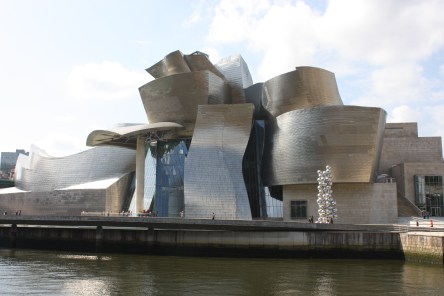
My generation have seen a step-change in museums and galleries around the world, not only in how they display their treasures but also in their architecture. Take for example Bilbao, a dusty run-down port in Northern Spain!

Guggenheim Bilbao

The Guggenheim in Bilbao was built in 1997 and is a striking, modern museum by Canadian architect Frank Gehry. Next to the museum is a large Scotty-type dog; when I say large I’m talking 40 metres tall. I went in 2004 and frankly, apart from an exhibit of large steel plates at odd angles, I remember nothing ……. apart from the amazing building itself ….. and the dog! Dan Brown’s novel starts here.

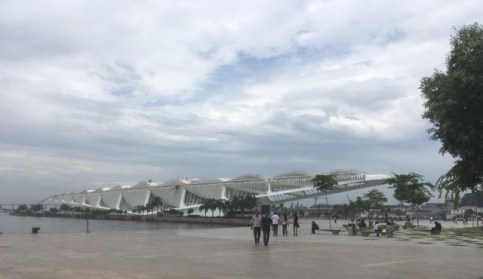
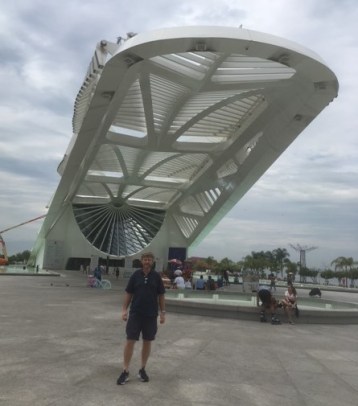
So now we have buildings meant to house artifacts and exhibits which in themselves become the reason to visit. I remember the MOMA in New York, only for the spiralling ramp that takes you up to the different levels; maybe modern art is not my thing? Here in Rio the actual building that houses this Museu do Amanhã is in itself a striking piece of architecture.

Rio 1

From a distance, from up close, and from inside it continually surprises one with its space, its details, its light.

Rio 8

Inside I’m immediately brought back to Brown’s novel when we are given a smart card with which one can interact with IRIS, a computer-generated information system ……. just as guests to his futurist’s presentation in Bilbao were given.

Most people believe the scientific consensus that we evolved slowly from primates over millions of years. Except maybe the Americans surveyed in a Gallop poll, 42% of whom believe that God created humans in their present form 10,000 years ago. Maybe they are the ones who voted for the current president? Or the Ultra-Orthodox Jews in north London who want to teach children that the world is only 6000 years old, despite evidence to the fact that the Aboriginal people populated Australia 60,000 years ago.

Even Pope Francis tries to bring Catholic thinking into the C21st: “When we read about creation in Genesis, we run the risk of imagining God was a magician, with some magic wand. But that is not so. He created human beings and let them develop according to the internal laws that he gave to each one so they could reach their fulfillment. Evolution in nature is not inconsistent with the idea of creation, because evolution requires the creation of beings to evolve.

One of the rooms in the museum, walled by mirrors, was full of 25cm square columns, covered with photographs of people, of cities, of nature, of agriculture, of religion, of riots, of warfare, of …… well, it went on and one, these closely packed columns about us …….. so much so that it became claustrophobic to be in this room …. and maybe that was the message ….. that the world will become too crowded, is over populated?

rio69

Looking ‘up’ the down-ramp

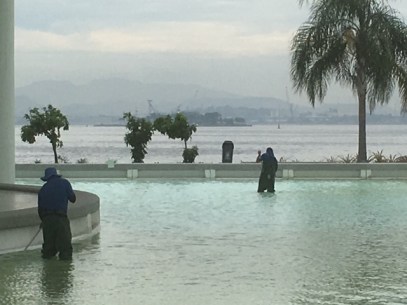
From the first floor level there is a beautiful downwards ramp, with lights, hidden in the underside of the handrail, reflected in the polished surface. Outside, the building’s soaring wings are reflected in shallow pools of water. I am sure they looked wonderful in the architect’s model but in reality, to look wonderful the pools need to be kept clean. An army of chaps spends all day scrubbing their bottoms!

Rio 16

And you know how in every museum, every gallery, every mansion or palace you visit, there’s always a shop you have to go through to get to the exit? Well, it wasn’t until we had left we realised we hadn’t been through the merchandising bit. It was back at the entrance!

I never really think about where I am going, in a futuristic sense. Who knows what’s in store ……. and I have certainly come to accept that having a fulfilling and interesting life relies more on your ability to be flexible to change than your ability to lay down great grandiose plans! And I have no better idea having read Dan Brown’s novel or having visited the Museum of Tomorrow!! Maybe I’ll know …… tomorrow? Providing of course I can get through today!

Of course as you reach middle age and beyond, there is an unspoken desire to believe in something other than nothing! More scribbles for the new year to come.

Richard 24th February 2018 (Written in Rio, posted in the UK)

PS Mind you, if you’re Elon Musk, you might think a trip to Mars in your Telsa Roadster is the way to go?

rio85

 Musk’s Telstar leaving earth’s orbit in mid-February, on its way to Mars ….. or somewhere, complete with dummy driver!

PC 117 Ancient and Modern Slavery

Sometimes the drip, drip, drip of information, often in the background and not vitally important in itself, turns into a stream that deserves some attention and thought. Or you step into a puddle you hadn’t realised was there. So it is with slavery, across the centuries.

 One tribe fought another and won …. and enslaved those captured.

My own knowledge of slavery is very much informed from English history. In the Domesday Book, the Norman census of 1086 stated that 10% of the population were slaves. But 800 hundred year later, public pressure, particularly from the Clapham Sect, and through the skills and persistence of William Wilberforce, brought about The Abolition of Slavery Act in 1807; further acts ensured the British Empire free by 1834.

 ‘In Common Law no man can have property (own) in another.’ 1706

And I knew that many individuals had made a fortune in this trade of people, as the profits were huge. British merchant ships sailed with goods to West Africa, exchanged the goods for enslaved Africans from the interior, sailed to North America where the slaves were sold, and the ships returned laden with coffee, sugar and other commodities from the West Indies. The British ports of Bristol and Liverpool were the focus for such trade.

Can you imagine being a slave? Being owned as a human being by someone else? Can you feel the shackles, real or imaginary,  around your neck and ankles? The mere idea sends shivers down my spine.

So for me ‘slavery’ was identified in those poor unfortunates taken from Africa to North America; over the years about 500,000 individuals. And I should also include those ‘transported’ to the British Colonies, firstly to the Americas and then to Australia after the American Revolution in 1776, as ‘slave labour’, for their conditions of work were hardly any different. Europeans I sense always think of this Atlantic triangle of trade as the only one, as its long-lasting legacy on the development of the United States has been fundamental.

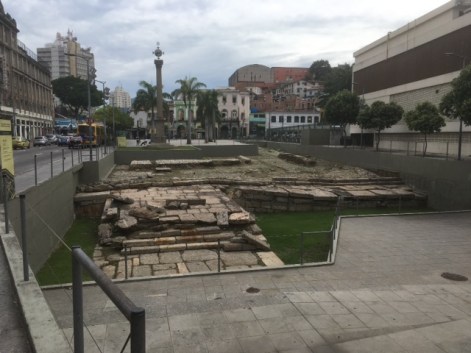
But I write this from Brazil where it is estimated that 40% of the population is descended from slaves from Africa. Starting in the 1500s, the trade reached its peak in the early 1800s as the answer to labour shortages for the sugar and coffee plantations. Most of these people came from the Portuguese colony of Angola and from The Congo. If they didn’t die in the inhuman conditions in which they were shipped, they arrived at the Valongo Wharf in the centre of Rio. Standing at this site today creates enormous emotions; none pleasant.

Rio 34

O Cais doValongo, the stones marked by slave shackles.

Here they were sold indirectly to the Slave Traders or directly to the plantation owners. It is estimated that between 1500 and 1870 some 5 million Africans arrived in Brazil and were sold. (That is ten times those shipped to the Americas.)

With the abolition of slavery complete in Britain in 1834, she put pressure on other countries to do the same, using her Royal Navy to intercept trading vessels and release the slaves. But the internal market in Brazil continued for another 54 years until the monarchy finally signed the law abolishing slavery. You may recall in PC 37 the fact that the bankrupt Baron San Clemente had to sell his large house in Friburgo to the Guinle Family in 1913 as, after the abolition of slavery, his plantations were unworkable, and unprofitable.

‘It is not something to be triumphant about, this ownership of another human being.’

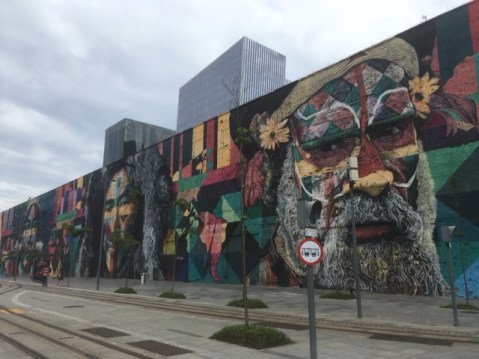
Close by where Caio Valongo has been excavated, there is a large column bearing a statue of Visconde De Mauá, a hugely wealthy businessman, entrepreneur and politician who was a driving force for the abolition movement here. Further down the street, there’s an enormous mural by Eduardo Kobra celebrating the human race, with a representative from each of the five continents. Whilst it was painted for the Rio 2016 Olympics, its juxtaposition near Valongo can’t be ignored and I sense its powerful message reaches beyond this continent.

Rio 31

 The last face, that of an Aborigine. The colours have faded but the symbolism is clear.

 And did you really think that increasing civilisation over the centuries would have made the practice of slavery extinct? Sadly not!

In Britain in the last few years there have been a number of cases where a group of people have been subjugated and badly treated. These poor unfortunates are often badly educated, maybe immigrants who are not officially registered, falling prey to unscrupulous individuals, working at their beck and call for the roof over their head and some meagre food to keep them alive. Forced into labour, prostitution and domestic servitude, this is the face of modern slavery.

Slavery is a weed that grows on every soil.” Edmund Burke

The ‘Modern Slavery Act 2015’ estimated that there were some 13,000 individuals living in ‘modern slavery’ in the UK. Section 71 of the Coroners and Justice Act 2009, which had come into force in 2010, created a new offence of holding another person in slavery or servitude or requiring them to perform forced or compulsory labour. In the first case brought under this act, former hospital director Saeeda Khan was convicted of trafficking a Tanzanian woman into the country to work as her domestic slave.

The Connors family made headlines in two county courts. In Luton two members were jailed for holding some 24 people against their will in filthy and cramped conditions. Some of the men, from Poland, Latvia and Lithuania had been held for up to 15 years, and others for just a few weeks. Some were British citizens. All were deemed “vulnerable” and had been recruited at soup kitchens and off the street with the promise of paid work, food and lodgings. A further five Connors were convicted of conspiracy to require a person to perform forced or compulsory labour between April 2010 and March 2011 following a three-month trial at Bristol Crown Court.

Also in October 2016, a couple who trafficked a 10-year-old girl to the UK, then repeatedly raped and kept her as a servant for nearly a decade, were jailed. Ilyas and Tallat Ashar brought the girl, who is deaf, from Pakistan and kept her at their home in Eccles, Salford, where she slept in the cellar. Judge Peter Lakin, sentencing, said the couple were “deeply unpleasant, highly manipulative and dishonest people”.

And I imagine this is simply the tip of the iceberg. The stream runs, the puddle gets deeper. When will we learn the difference between right and wrong?


Richard 10th February 2018

Rio 27

Eduardo Kobra’s face of Africa

PC 116 A Health Spa Break

A part of me always wanted to know what happens inside a health spa – in the summer months you get glimpses of guests in white towelling robes drifting about inside or out, in some imagined state of euphoria ….. or that’s how it seems. Give it a go, huh!

So we looked at the website of a well-known UK brand, booked an overnight stay, essentially 26 hours …… and went earlier this month. As we neared our destination, the glare from the low, late afternoon sun meant that trying to find the right road at the crossroads in the nearest village, through the dirt smeared windscreen, was a bit of pot luck. We eventually got there, to find Car Park A full, as was B and C but eventually we found a space in D; a good thing, otherwise we would have had to park under the rhododendron bushes! “Must be popular” we thought as we made our way to reception.

There were so many staff of obvious Eastern European background we wondered whether the whole venture was really some guise for money laundering. You do think like this, particularly after reading Misha Glenny’s McMafia about international criminals in the C21st!

Having checked in, been given our ‘towelling robes and flipflops’, the former a loan, the latter a gift, and dumped our bags in our room, we got the Guided Tour. Subsequently we realized it hadn’t included the restaurant, maybe as it was fully booked, and the ice room, where you can stand and shiver – probably good for closing the skin’s pores.

We go to the activities station; it’s 4 o’clock.

Can we book for the ‘Wake Up Workout’ tomorrow morning at 0830?’

“Oh! No! Sir that’s already full as are most of the sessions.”

“Well! How about the Da Vinci BodyBoard class?”

“You can have the last two places; I’ll put your names down.”

“So is there anything else on offer today?”

“There’s a talk this evening by Ms Cynthia Welbeloved on Emptiheadedness and the Spirit of Greed.”

I almost said ‘Perfect’ but thought better of it; we could probably turn up if so moved.

Around the large pool with its glass roof were special little places for people to relax and sleep/read/chat. There was a hydro pool that was so special you had to pay extra to use it! There were saunas for men, saunas for women, saunas for both sexes ….. if you have ever been to a mixed sauna, in Germany for instance, and found nudity the norm maybe you will reflect on the reserved nature of the Anglo Saxon?

Champneys Pool

There were hot Jacuzzi-type tubs inside and out. In fact everything you needed to relax and unwind; fortunately there was no background mood music from overhead speakers, just the low murmur of people talking quietly, reverentially, respecting the whole reason why people come. We tried the pool where the water was cool and the sauna which was crowded …… and then we thought about dinner.

Despite the fact that the dining area looked like a British Rail Cafeteria, with bright lights and hard furnishings, what was on offer was good. I often judge a restaurant by how many of the options I could eat. Here I could have easily have eaten the whole menu …… although at a health spa this might have been against the whole raison d’être, irrespective of how healthy each option was!

ch2

And what of the treatments on offer?  …..  ‘Elemis pro-collagen age defy’ facials …… ‘lava shell’ massages ……. ‘Dry Body’ flotation (?)  …… etc etc. Doing hot yoga daily ensures our skin is in great shape so the only thing that tempts us is a massage. But it’s £50 for 25 minutes! Twenty five minutes? You would hardly get relaxed before it would be over …… our local people charge £40 for an hour so we thought ‘no! no! no!’. Other treatments seemed equally pricey. Just wonder whether, if they reduced the prices, they would make more money. I came away questioning  how much they are used. Maybe if we were stressed out, lived chaotically busy lives, had serious health issues, then maybe ……

At breakfast we find a good range of healthy options laid out on the buffet table and, if you wanted to pay extra, you could have Eggs Benedict, Full English etc. I tried the kedgeree with some extra mackerel; the mackerel was warm but the kedgeree cold; disgusting! The delightful waiter from Hungary asked whether we wanted coffee or tea ….. coffee please! I was suspicious as soon as I saw that the coffee came in an old-fashioned Kona glass container that had probably been sitting on the ‘keep warm’ plate for ages. You could see through the brown liquid and it tasted of nothing. Fortunately we were able to get a decent Cappuccino and double Espresso from a different machine.

After breakfast it’s apparent that Day Guests and members arrive. I overheard a BA Stewardess loudly talking into her phone to Jermima; “’course, dahlin, anytime. Oh! And I’ve booked you the ‘Decléor Ultimate Wrinkle Eraser Facial’ as I think you need it. Must dash, I am seeing Matt for a personal session at 1000.” Some presumably come every week and why not if you live close enough and you have the money? Ah! Yes! If you have the money!

We vacate our room by 1030 but can stay until 1600. After a brief discussion about where to put our stuff, we eventually decided it was best in the car boot, decanting some ‘essentials’ into a changing room locker. We do one 55 minute exercise class on a ‘Da Vinci Board’. You can recall Da Vinci’s figure with spread arms and feet? Well, here you stand on a long board, with bungees running its length, and two at each end. Lifting one set exercises one bit and another another; lots of repetitions and encouragement from Vicki from Vladivostok – ‘very gooood, very gooood; that’s it’ repeated regularly throughout the whole class. Actually quite challenging and enjoyable!

Afterwards we shower and return to the sauna. By the time we think about lunch we could both be rung out. Having had a leisurely meal we decide that we should leave, after all, how many times do I want to swim in 24 hours, how many saunas do I want to endure?

Maybe this is just the place to come and write a postcard about those health spas  ………. but actually an expensive option; think my local café would be better, as would the coffee!

Richard 27th January 2018


PC 115 Modern Times

Around this time of year here in the northern hemisphere’s winter, most of us will suffer some of the normal round of colds and flu. Specifically, in the UK one reads that the hospital Accident & Emergency departments are overstretched and the wards often full of elderly patients who could go home but can’t because ‘home’ does not provide a good enough environment in which to recover. They have even developed a name – bed blockers; modern times, life in the C21st!

The health conscious (aka The Worried Well) accept the government advice and have a ‘flu jab’, an injection that should prevent the recipient from getting 99% of the viruses around; they are free to the oldies! I overheard someone the other day saying it seems this year that those who have had the flu jab have all got the irritating dry cough that lingers and lingers. Maybe this is just one of the 1% viruses? (See note below)

Some weeks ago I started coughing (predictable huh!!)…… and it just developed into a dry hacking cough that resisted all removal attempts ….. and in case you’re thinking I should have tried that remedy that your grandmother always swore by, I tried gargling with cider vinegar & water (and swallowing … a bit yuk!), I tried Vicks chest rub, I tried Strepsils, I tried using an inhaler – I remember as a young boy bending forward over a steaming bowl of Friar’s Balsam, my step-grandmother’s potion, my head wrapped in a tea towel – I tried ‘Chesty Cough’ syrup …… but nothing worked.

At some point I thought I should just check in with the Doctors’ Practice nurse; not wanting to trouble a doctor, not wanting the general antibiotics, simply to make sure nothing sinister was developing. In PC 95 I wrote about the difficulties of getting an appointment with a doctor in Britain …… but I just wanted to see a nurse!! Even she was booked up …… but then the receptionist said I could have an appointment with a doctor in another practice that evening. OK, I thought, why not!

So one Monday three weeks before Christmas I arrived at The Charter Practice 15 minutes before my 8:15 pm appointment, a little early as I hadn’t been there before and I anticipated some form filling. Implanted in the DNA of us ex-military types is a need to be somewhere in plenty of time. It probably stems from the ‘5 minutes before 5 minutes before 5 minutes before’ regime we observed during our training. For example, if the College had a parade of the Officer Cadets at 10.00, the College Sergeant Major wanted everyone there in perfect order at 0945; so the individual Company Sergeant Majors wanted their own company there in perfect order at 0930; so the individual Platoon Sergeants wanted everyone there in perfect order at 0915 …… you get the drift …….it became important ….. and remains so. (15 minutes got contracted to 5!)

Having settled into the empty waiting room, with its antiseptic coloured plastic chairs and posters advertising everything from ‘Have you booked your Flu Vaccination?’ to ‘Need to talk in confidence about domestic abuse? Call 01273 590276’, I checked my messages/emails on my iPhone. The alternative was to look at either an April 2009 copy of National Geographic or a more up-to-date Readers’ Digest circa 2015.

iPhone 1

At 8:10 pm I switched my phone to ‘silent ring’, in anticipation of the doctor’s call; sure enough:

Mr Yates?”

I walked into the doctor’s consulting room to find him standing expectantly in the centre of his room; we shook hands.

Now, tell me about this cough.”

Two minutes into a little ‘question and answer’ session, he suddenly stopped talking and stared at me. I seriously didn’t know how to react (!) so did nothing, simply looked back.

Aren’t you going to answer it?” he asked, a sense of irritation noticeable in his voice.

Answer what?” I asked, hearing various background noises but none I recognised.

Your phone. It’s ringing!”

No it’s not!” I replied, trying not to cough, but knowing full well the ring tone of my own phone; I had assumed it must have been his.

“Yes it is!” he snorted; by this time steam was beginning to appear from his ears.

Sure enough, in my jean’s pocket my phone was ‘ringing’ but with a strange ring tone!! I switched it off and apologised:

Not sure what happened here: sorry!”

By then he must have thought I was showing early signs of dementia rather than exhibiting a cough, wished me luck and ushered me out. I muttered my thanks. Back in the Waiting Room, before driving home, I pulled my iPhone out of my pocket and switched it on.

iPhone 2

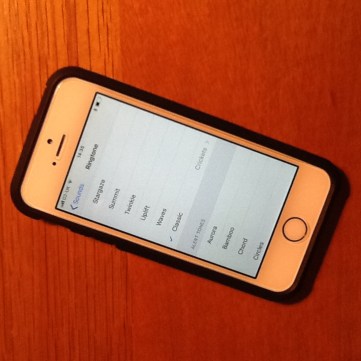
Then I realised what had happened ……. whilst I had switched it to ‘silent’, I hadn’t locked the screen and random pressure in my pocket had somehow, unbelievably, initiated a sequence of ‘settings’ …. ‘sounds’…… ‘ringtone’ …….. and was offering me ‘ripples’ as opposed to my normal ‘crickets’ ringing tone. No wonder I didn’t recognise it!!

We live in funny times huh!

Richard 13th January 2018

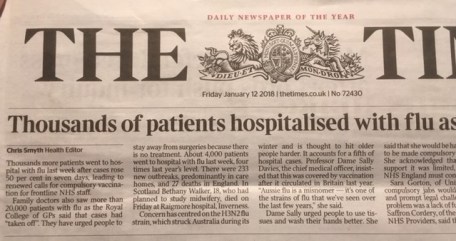
PS Just in case you’re wondering, the doctor reckoned the cough would clear itself in another 3 weeks, irrespective of what I did. And you know what? It’s gone. And to concur with the GP’s thoughts, yesterday’s Times agreed ….. “ ….. there is no treatment.”!!

Friday 12th

PPS   Two types of vaccines are available to doctors this winter, Quadrivalent vaccines offer protection against two types of influenza A and two types of B. Trivalent vaccines, cheaper and more often used by GP surgeries, offer protection against only one type of A and two types of B. Of 25 cases of influenza in the south west, Public Health England say 21 are of the B/Yamagata type not covered by the Trivalent vaccines. Bit of a bummer!

PC 114 The Box

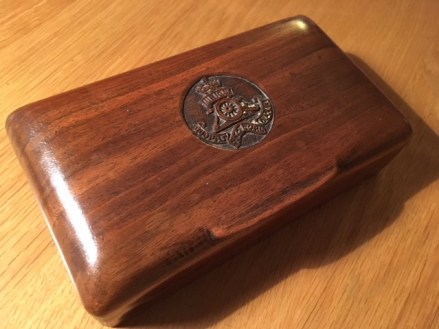
The little wooden cigarette box is in front of me, seemingly begging for its history to be read. And that’s one of the real irritations of life, isn’t it? If only inanimate objects could talk, could tell you who made them, who touched them, who used them. This one is seven inches long and 4 wide (18cms by 10cms); inside there are two compartments each capable of taking 20 normal sized cigarettes. I say ‘normal’ because ‘King’ size only became fashionable in the 1980s. On the polished lid the crest of the Royal Artillery has been carefully carved by some skilled craftsman. You can even read the motto – “Ubique quo fas et gloria ducunt.” (‘Everywhere where faith and glory lead’); there is another extremely risqué interpretation which is only available on request!

The Box (2)

Peggy gave me this box with The Gunner’s crest on the top when I became a Gunner officer. She’s long since departed after a full and rewarding life and only recently did I wonder who gave it to her. But then you imagine …..

It’s easy to forget, as time causes memories to fade, the heartaches that lives lost create. For this box probably belonged an officer killed in the Second World War, the boyfriend of Peggy. She never married and one can only assume that there was nowhere in her heart for anyone but her first love. I write ‘probably’ as I really don’t know for certain. It belonged to Peggy for sure, and it’s quite likely that any self-respecting officer at that time would have had a cigarette box. If it wasn’t silver, a beautifully carved wooden one would suffice and quite usual to have your Regimental crest carved into the lid. On his death I imagine his family gave her the box as a memento. But who was Peggy you might well ask?

Peggy was the P in C&P, Cynthia my aunt and Peggy, but she was equally the P in P&C to her family; it simply depended on your perspective!! They were Cambridge graduates but women were not officially admitted as members of the graduate body when they studied for their degree; this was rectified in 1998 when 900 of them assembled at Cambridge. They had met for the first time in 1939 and a year later they shared a flat in Walthamstow Hall School. That summer a bomb demolished most of the staff accommodation; no one had made it to the shelter and Peggy recalls seeing the tall Music mistress, the very short English mistress and Cynthia, blood pouring down her head, crawling towards safety through the dust – and thought they looked like three bears.

Having enlisted in the Women’s Royal Naval Service, both spent part of the Second World War at Bletchley Park, the secret establishment tasked with breaking enemies’ codes. Like many, they didn’t talk about their time there and it’s only by chance I found out that that was where they had worked. When the war ended Cynthia and Peggy embarked on highly successful educational careers (see note below) and lived together in Clapham, London. These days one might wonder whether there was anything other than companionship to their relationship but back then it was not something one could’ve raised.

Jade 0073

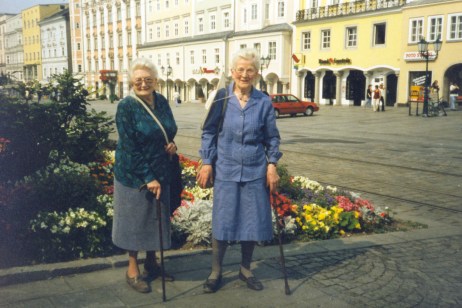
Peggy and Cynthia on one of their European travels

Peggy and Cynthia ensured that their nieces, nephews and God children were introduced to London when old enough, with visits to the major sights, historic buildings, museums and pageantry; the Thames, the theatre and the zoo, the Monument (up to the top of course), St Paul’s (and again up to the Whispering Gallery – with Cynthia leading the way), travelling by double decker, escalator and tube. Then it was back to their flat to meet whichever cat was in residence, for supper and to play cards, playing pelmanism, a quiet intellectual game or more interestingly frenetic Racing Demon, when the sight of ‘Aunt’ Cynthia’s knees on the floor was quite a revelation to a young boy used to seeing the bun and rather long skirt.

I imagine this box sitting on Peggy’s dressing table in her single-bedded room, surrounded by hundreds of postcards that reflected the active travels that she and Cynthia had embarked on during their retirement. I don’t ever recall her smoking so it was probably full of ticket stubs from plays witnessed, for rail journeys made together, the menu from a favourite restaurant, little nick-nacks that mean so much to the owner but virtually nothing to anyone else; simply the flotsam of their short time together. Indeed currently it normally sits on my desk, full of odd keys from long lost padlocks, flints for old cigarette lighters, an odd shoe lace, three rubber bands and a piece of sealing wax – my flotsam you might decide!

Lives come and go …… but the little box on my desk continues to jog the memory.

Richard 31st December 2017

PS     Happy New Year. May it bring you all you need and some of what you want.

PPS   Peggy was the author of the definitive work ‘The London Experience of Secondary Education’ – Margaret Bryant 1979. Cynthia was Head of Modern Languages at James Allen’s Girls’ School in London.

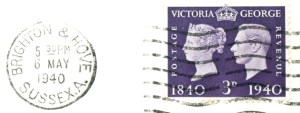
PPPS   Peggy died on 5th May 2006 aged 90 ….. and 4 days. Cynthia had died on 27th December 2004 aged 89.


PC 113 “Extra! Extra! Read All About It!”


I once went off to southern Turkey and round the corner from Fethiye was the birthplace and possibly burial site of St Nicholas of Myra, who was known for his generosity, particularly towards children. He morphed into Santa Claus through Dutch migrants to the United States calling him Sinterklaas …… and so Santa Claus. It’s quite a stretch to today’s Santa Claus and his sleigh covered with presents for the world’s children. Forget the fact that you’ve already seen Santa in his grotto in the shopping centre, ignore the fact you could have seen him, at the same time, appearing by an outside stall selling stuff for the local charity and offering selfies for children (and adults of course!). And you know he’s popular because all over the world people have dressed up to look like him and gone running in some local 10k race. But in this time of imagination and magic ….. let the mind run …..

Christmas Bow

Our Apartment Front Door Bow

Mrs Santa hears a crash and looks out across the sleigh park. Rudolph, a retired reindeer with an alcoholic red nose and used only once, in 1939, because it was foggy, stirs in his adapted St Bernard’s dog bed. “Wattts ttthhh ffuni” – sort of Reindeer speak for ‘What the fuck?’ Sure enough Mrs Santa’s husband has returned, the reindeer hooves and sleigh’s skids screeching on the ice and eventually the empty sleigh has skidded to a stop. The reindeers’ flanks are steaming from the exertion of galloping across the world and both they and Santa seem somewhat worse for wear.

Christ! What the hell’s happened?” she calls across the frozen ‘sleigh park in the sky’.

The lead reindeer Dancer’s stomach and bladder are very extended and swollen as are the other reindeers’. He belches loudly and then, unable to contain himself any longer, urinates over the ground. This gives the other reindeers freedom to empty their bladders too, as they had all helped Santa drink his way through a million gallons of sherry as they dashed from one house to another across Europe. As the sky lightens in the early dawn, the hot liquid splashes onto the frozen park and a toxic smelly mist develops, encasing Santa and his sleigh in an ethereal glow. Sadly this year is the reindeers’ last flight as a team, for next year the sleigh will be pulled/powered by a hybrid, part reindeer and part electric. They don’t know it yet, but they will be asked to apply for one of only four places.

And what’s that smile on your face for, Santa?” Mrs Santa yells.

Sure enough Santa is sitting rather quietly on the back of the sleigh, smiling as he thinks about No 26 Acacia Avenue in Berkhampstead. Traditionally Santa has been expected to climb down a chimney, deliver presents as per the wish list written by John or Jill and sent to Santa in Lapland, eat a mince pie, drink a glass of sherry and grab a carrot or two for the reindeer stacking overhead like some commercial jet over an airport. On arriving at the bottom of this particular chimney he had indeed been confronted by a glass of sherry and a couple of mince pies …… but also Sheila, dressed in a very revealing negligee, asking whether he wanted some extra cream with the mince pie. Hopefully Mrs Santa wouldn’t guess or she’d rake her claws across his back.

Mind you her voice barely registers in his befuddled brain, as he feels completely pissed from so much Amontillado Cream. Then he thinks about the letter from Sam in Vienna, who hadn’t been sure whether to ask for a train set or My Little Pony ……. and how he reckons he’d got it right by giving them an ambidextrous superperson outfit.

He muses that he spends 364 days a year sitting on his bum, putting up with Mrs Santa’s nagging, then in one 24 hour period visits 1000 million homes, each visit taking one trillionth of a second, when he tries to eat a mince pie and drink a glass of sherry, before flying off to the next house. And why does he do it? Well! It’s to celebrate of the birth of a boy whose father was so disorganised he couldn’t even book a room in a hotel for his pregnant wife, on the busiest weekend of the year.

Jesus!” Cries Mrs Santa.

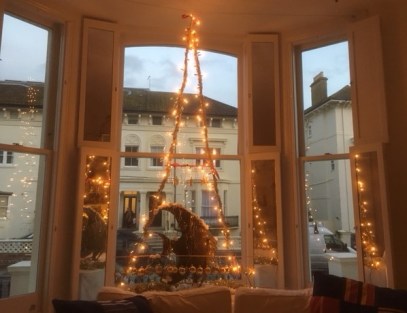
Amber House Christmas Tree (2)

Amber House Christmas Tree Thingy

Have a great Christmas if this is a festival for you.

Richard 24th December 2017


PS The title of this PC comes from the cry of the traditional newspaper sellers on the street corner, when an extra edition of a paper had been produced to cover some momentous event that had just happened.

PC 112 Another Lisbon postcard

On a visit to Estoril last month there was a need to travel into Lisbon by car. It’s not far along the toll motorway; you just have to be careful to get off at the right exit. Our destination was a lawyers’ office in the Chiado district, which lies to the west of central Baixa, home to all the cafes, shops and restaurants along Rua Augusta that make the city a tourist hotspot all year around.

Lisbon 1

The streets are narrow and where traffic is permitted congested. Some, thankfully, have become pedestrianized, for you take your life into your hands when walking in areas where lorries, cars, taxis and people jostle for space. The Portuguese are not renown for their driving skills so you just need to think that every driver is a manic …… and then you might survive. On Madeira, the Portuguese Atlantic island 1000 kms to the south west of Lisbon, they think that the ‘pedestrian crossing’ was designed to focus the drivers on how many people they could maim! And if you have ever tried to cross on a Madeiran pedestrian crossing, you’ll know what I mean.

I wandered off with Maria, my sister-in-law’s temporary carer, for a coffee. Up on Rua Garrett is a locally famous café, A Brasileira do Chiado, a busy place mid-morning. Opened in 1905 it maintains its Art Deco interior with mirrors, paintings and wooden panels. All the outside tables were taken by the well-heeled tourists from Germany and Italy – you can tell by their chic dress sense with its abundant fur and leather – basking in the quite strong autumnal sun and by those Portuguese who want to smoke, for smoking here is quite normal and acceptable. To keep them company on a permanent basis is a bronze statue of Fernando Pessoa, a famous turn-of-the-century poet who for some reason wrote under four different names and in four distinct styles. Its shoulders gleam from the cleaning effect of thousands of brushing hands from passers-by, presumably believing that a simple touch will imbue them with some artistic ability! We all do it, don’t we? “The Conversation between Franklin D Roosevelt and Winston Churchill” piece on Bond Street London is another example. The space in the middle is a completely different colour, shined by thousands of people’s bodies sitting down …. to join in the conversation?”

Fernando Pessoa

Inside the cafe with its long bar, it’s dark and rather airless but the coffee, when it eventually arrives, is strong and the obligatory Pastel de Nata quite good, although they’re better if they are slightly warm. The sugar sachet has a quotation by Fernando Pessoa: “A renúncia é a libertação, não querer é poder.” My rough translation would be “The act of giving up one’s claim (to something) is liberating, not wanting (something) is powerful.” After our fix, we welcome the fresh air as we wander 50 metres west into the next square.

At the time, I didn’t have my guide book with me and was initially unable to identify the man whose bronze statue dominates the square. From its base I read it’s of the poet Luis de Camoes, erected in 1867 and surrounded by eight smaller statues of other personalities from Portuguese literature. Mermaids and ships have been recreated in the surrounding cobblestones, reflecting Camoes epic poem The Lusiads. Further research reveals that Camoes is considered by the Portuguese to be on a par with our very own William Shakespeare. The Lusiads charts the voyage of Vasco da Gama to India and subsequent events and legends in Portuguese history. His poem was published in 1572 but only later was recognised as the work of a master. Camoes died at 54 unnoticed and unloved.

Luiz de Camoes

You walk on the sunny side of the cobbled pavements at this time of year, grateful for the warmth on your back, just as in the summer you walk in the shade, grateful for some respite from the burning sun. Further up a side street was another square, another church, another statue, this one of Padre António Vieira – a ‘Jesuit, preacher, priest, politician and diplomat’. Apparently he clashed with those Catholic zealots pursuing the aims of the Inquisition ie burning heretics in Lisbon’s Terreiro do Paco to ensure religious conformity, over his support for Christianised Jews. He fled to Brazil and died in San Salvador da Bahia in 1697

Lisbon 2

On the way back to meet up for lunch we drift into A Vida Portuguesa, a chain of shops promoting the porcelain, tiles, fabrics for which the country is rightly famous. This one is in Rua Ivens. There is a particular yellow, a sort of light Dijon Mustard quite popular at the moment and I spy a whole stack of plates, mugs and dishes. Five minutes later, a salad bowl safely inside some bubble-wrap, we make our way back to join the others.

We have lunch in what might have been described as a pop-up restaurant, rather scruffy and ‘making do’, although with reasonable food. Actually I think this one popped up twenty years ago! We wander back to the car for our return journey but our way is blocked – down the street someone has parked ‘for a few moments’ convenient for them but no one else. A traffic policewoman is awaiting the driver’s return. So we reverse and try our luck down a narrow alley. Fortunately the SatNav is as confused as we are so we are spared the ‘recalculating’ comment in that saccharine tone that makes you want to scream! Gradually we find our way back to the motorway and to Estoril.

Just a nice few hours warranting a scribble.

Richard 17th December 2017                                 richardyates24@gmail.com

PC 111 Driving Around

The other evening I was driving back from a day with my daughter – actually a rather rare occurrence, not because I don’t love her to bits but because it’s over 70 miles away. The idea of dropping in for a cuppa isn’t a practical one – that’s not to say I don’t want to and wouldn’t if we lived closer just that we don’t! I have a choice of many different routes, as you would expect in a part of the country as crowded as the south east of England. The motorways M23/M25/A3 all have good dual (or more) carriageways and if the traffic flows it’s a doddle – if it doesn’t it’s just boring, and the M25 has a rather unfortunate reputation as the world’s largest car park!

Another option is going in a more direct way, along country roads. I used to drive on some of these roads when I was at university, as home was 18 miles north of here and university north of Swindon. In those days the traffic was lighter than today and being young and carefree I wanted to get from A to B as quickly as possible, wanting to be in ‘the right gear at the right time’, overtaking and sneaking into small spaces! But because I was a sort-of responsible adult, as responsible as I have ever been, it gradually became important to me that I drove well. I had passed the fairly rudimentary mandatory Driving Test in a Morris Minor 1000.

morris-minor-1000

But that was 1964 and I wanted to check I could drive well!! So in 1970 I took the Institute of Advanced Motorists (IAM) test in Swindon – a 90 minute exacting assessment of one’s driving – in my old Sunbeam Alpine; its registration number was SMO 420H if you are interested! Swindon, a Wiltshire city, had a mixture of residential streets, 1960’s brutal city centre architecture and the most roundabouts of any UK city at the time. At some point during the test, the assessor said: “Can you pull over here!” And when I had parked along the curb….” We have just past an alleyway. Would you reverse into it ….. centrally?” Well, the Sunbeam was 5 feet (1.52m) wide and the alleyway …… probably no more than 7ft (2.14m). Exacting huh!

Sunbeam Alpine convertible

I liked the freedom of owning a car, of being able to go somewhere whenever I wanted and still do. Driving was fun and exhilarating. Turn the clock forward to today and those same roads are more congested, and now there’s a local speed limit which varies between 40 and 50 miles per hour. Frankly, with the additional traffic it’s nay impossible to go faster than that and you can forget any idea of overtaking a slow moving car. If you actually succeed, all you do is end up behind the next slow moving car. Takes a great deal of will power to just relax and ‘go with the flow’.

In my Army days, I had always believed that I had to be able to do what I asked my soldiers to do. So in Germany I often jumped into the driving seat of the M109, a self-propelled medium artillery howitzer, at the end of some training and drove back to barracks.

M109

A M109

My ability to drive a vehicle steered by its tracks is still recognised on my UK Driving Licence – Group H. And although I occasionally I drove a lorry for fun, I was lazy and didn’t get my HGV licence, otherwise you might have seen me at the wheel of an articulated lorry on the M25!!

After university I was posted back to my regiment in Germany and was able to take advantage of the tax free allowances. I ordered a new MGB GT through the local garage that serviced my car. They were agents for Mercedes and Lancia …..  and I fell in love with a little red Lancia Fulvia with cream upholstery which was displayed in their showroom!! So I cancelled the MGB GT, which was going to cost £1258 and ordered a red Lancia for an extra £53. Months later I took the train from Paderborn in Germany to Turin in Italy to collect it from the factory.

Lancia Fulvia

This was my second Lancia, in blue. Note the Institute of Advanced Motorist badge!

You will know I love coincidences! Well, in 1982 I took over command of an air defence battery just north of Salisbury in Wiltshire. The Royal Artillery history is preserved by the ‘battle honours’ of its batteries – a Battery being a sub-unit of some 120 soldiers. For instance I had served in 132 Medium Battery (The Bengal Rocket Troop) the latter reflecting the development of rudimentary rockets in India in the C19th. My Air Defence battery was known as Lloyd’s Company – after William Lloyd who had put together some guns to support Wellington in the Battle of Waterloo (1815). Its number, an arcane designation no one really understood as they were not sequential in terms of seniority, was 43. So its title was 43 Air Defence Battery (Lloyd’s Company) Royal Artillery and it was equipped with surface-to-air missiles (SAMs). My Honda Accord was bought in Swindon and its number plate, completely coincidentally, was SAM43S!


SAM 43 S

And come to think of it, I still smile when I remember Sergeant Cooke, my MT (Motor Transport) Sergeant and his driving test. The battery was down on Dartmoor for a fortnight’s training. Part of the training was all about driving, for instance testing the soldier’s ability to reverse a Landrover and trailer. He also wanted them to line up 50m away and drive the nearside wheels between two 4m long parallel planks, which he placed about 5cms more than a tyre width apart; a little light amusement! “Come on Sir! Have a go!” Well, never one to resist a challenge …… the result took the smile off his face!!

Coincidentally a neighbour five houses down here in Albany Villas Hove owns a Sunbeam Alpine (Tiger variant) and a Lancia Fulvia (Integrale) – now that’s weird.

A little nostalgia never hurt anyone and I hope you may reminisce on cars you’ve owned as a result of this PC.

Richard 3rd December 2017

PS Cars I have owned:

Volkswagen Variant (Left hand drive)

Sunbeam Alpine Convertible (SMO 420H)

Lancia Fulvia (Red)

Lancia Fulvia (Blue)

Honda Accord (SAM 43S)

Volkswagen Beetle (KBA 51K)

Vauxhall Astra

Volkswagen Golf GTI

Volkswagen Golf Cabriolet

Saab Vecta 93 Convertible

PC 110 That reminds me (2)

My introduction to classical music was gradual and subtle – staying with my grandmother in Bath and having to listen as she practised that ‘Arrival of the Queen of Sheba’ over and over again for instance! You might have thought I would have developed an aversion to it, such is the repetitive nature of someone practising, but I didn’t and came to love the sound. And it’s the sound I love; I read erudite critiques of pieces of music and wonder where the writer’s imagination has been. Not where mine has been.

And then along came Cliff Richard.

The first record I bought was his single called ‘Living Doll’ in 1959 and that was closely followed by Adam Faith’s ‘What do you want?’ I didn’t have a record player so had to borrow a school chum’s; and that wasn’t big enough to play a 12 inch ‘long playing’ record – ah! The impecunity of youth!

And then along came Elvis (Do I need to write ‘Presley’?).

My grandmother didn’t like this ‘crooner’ but boy did we. He shook the teenage world with his songs and brash antics and our memories are unsullied by subsequent binges ……. and drug abuse ……. and an early death. At boarding school we opened the windows in the winter months after evening ‘prep’ and played ‘O So Mio’ or ‘Love me tender’ at full volume ……. and wondered about life and love.

And then along came The Beatles ….. and the Rolling Stones.

In the holidays I went home, went to the odd party and heard The Beatles for the first time. I can still picture the cover of one of their first LPs ‘With The Beatles’.

The Beatles

In 1968 my UK-based regiment went to Cyprus for a month of ‘adventurous training’, a mixture of training in the mountains of this Mediterranean island and canoeing, hiking, sailing, shooting and rock climbing. Towards the end of our time, the Commanding Officer asked me, the most junior officer, to be in charge of the Rear Party. My only task, hardly onerous, was to manage the ‘Rear Party’ consisting of four soldiers and ensure the Regimental freight was dispatched by the RAF on time. Sadly it meant I had to spend an extra 14 days waiting for that flight; ‘ah!’ I hear you sigh. Why am I telling you this? Because ‘Hey Jude’ by The Beatles will be forever associated with Gail, the daughter of an officer permanently based in Dhekelia, the Sovereign Base Area on the island, whom I met at the Officers’ Club.  (Tea & toast?)

Then there was an American duo that created some lovely ballads – Don & Phil Everly. One of their famous hits was ‘Ebony Eyes’. Today I went on to YouTube ……. and there it was ……. and I put the cursor over ‘play’ ……. and I found myself singing along …… about Flight 1203 ……. my Ebony Eyes ……the words just came tumbling out of me as if it was yesterday. Ingrained somehow!

Another influence of my generation was another American called Buddy Holly – all clean cut and glasses. He sang about Peggy Sue, True Love Ways, Everyday and Crying, Waiting, Hoping …… and then he was killed in an aeroplane crash in 1959 at the age of 22 …… and became a legend in the process! Ritchie Valens was another rising music star on that plane, causing Don McLean to refer to it as ‘The Day the Music Died’ (American Pie).

The Day The Music Died

Here in Britain black & white television was becoming more common and a ‘Top of the Pops’ programme, with live acts performing their songs on television, established itself in the rhythm of our lives – it was mandatory viewing at The Royal Military Academy Sandhurst. In our Company ante-room we all crowded around a small TV, waiting with baited breath for Pans’ People, a dance group of 6 lithe women whose costumes were obviously deliberately designed to set our imaginations running.

The first musical I really loved was Evita, the story of Eva Peron and that song ‘Don’t cry for me Argentina’ still  runs around my head on occasions. As does ‘The Music of the Night’ from Phantom of the Opera, the Andrew Lloyd Webber musical. Michael Crawford, its first leading actor, recalled how some months before he was taking singing lessons on a Saturday morning when the tutor’s front doorbell rang. Telling Michael to practise his scales, he left him upstairs and went down to open the front door. It was Andrew Lloyd-Webber, who was working on bringing ‘Phantom of the Opera’ to the stage. He immediately asked whose voice he was hearing. On being told it was Michael Crawford he exclaimed ‘I think I have found my leading man for ‘Phantom’!

In Germany in the mid ‘70s I went to my first Rock concerto in Dortmund, in Germany, a group called Santana. I was just ‘going with the flow’ with chums and don’t remember finding the ground moved, but I did get completely hung up on the slow guitar introduction of Samba Pa Ti. Years later on my way to see my soon-to-be in-laws, driving down a laurel-banked road, the radio played it, taking my mentally back to Dortmund.

I developed no real passion for one particular type of singing or music over another, just loved some, and conversely didn’t get on with others. Singers whose voices and the songs they have sung I have loved, in no particular order, range from Francoise Hardy and her glorious “Tous les garçons et les filles de mon âge”, Carly Simon’s ‘I’m So Vane’, Jennifer Rush’s version of ‘The Power of Love’ and anything by Neil Diamond. I had all of his LPs up until the demise of my record player (!) and loved his ‘Jonathan Livingstone Seagull’ and ‘Stones’ LPs. I even saw him at the Wembley Arena one evening. And then, sadly, his voice was past its best and no one told him. I bought a recent CD and played it once; enough!

Another collection

Sometimes you need a good belter to lift your mood. In the immediate aftermath of my first divorce, in my lower ground flat on Cavendish Road in Clapham, London, nothing better to lift your spirits than ‘You’re the Best’ by Tina Turner.

All the LPs eventually went – cassettes didn’t really do it apart from in a cassette player travelling on business. Gradually my taste has evolved and the music of Ottmar Liebert (Thank you Jonathan H for the introduction!) and voices of individuals like Enya, Celine Dion, Adele and Enigma fill my rooms. Even more recently Angus & Julia Stone’s songs have tugged at the heart strings.

Occasionally I think “Why don’t I have any recordings of ……?” (Barry White and Demis Roussos for example) and it’s soon rectified by a cheap purchase through Amazon. Or you watch a drama on television and love the accompanying music and wait until the end of the credits to catch the artist …… and go on to Amazon …… for instance the Israeli singer Asad Avidan ….. but don’t ask me what the drama was!!

Mere scribbles, mere memories

Richard 18th November 2017


PC 109 That reminds me (1)


I hear the notes of the start of some music or song and almost immediately seem to be able to recall what it is called or remember when it meant something to me, such is the power of association. I doubt whether you are different and between us there will be hundreds and hundreds of pieces of music that we hold dear to our hearts, tunes that stir our soul. What follows are some of mine. Naturally some of you will identify with them and others will ask: “Really?”; such is life!

In my early teenage years I thought that the only ‘opera’ I liked was the accompanying overtures and none of the singing. This dislike was probably initiated at school as the teacher responsible for putting on the classical concerts and operas, Mr Oboussier, always seemed to choose Mozart. One year ‘Don Giovanni’ and the next ‘The Marriage of Figaro’; “One foot …. two feet ….. and that makes three….” sang Figaro and the squeaky strings of the school orchestra violins started these painful memories. However the school Tuck Shop was run by Mr Pickford, a delightful man with a clipped white moustache, short of stature but big in generosity; for some reason he always wore a white coat rather like a laboratory assistant. It was here we played cribbage, bought snacks and had our daily ⅓ pint of milk, invariably to the strains of Wager’s Tannhäuser Overture, obviously Mr Pickford’s favourite. I got to love it too and I get goose pimples whenever I hear those first stirring notes.

Years later my brother and I were making an infrequent visit to our father in Newcastle, driving north up the M1 in his Morris 1000 Traveller. At one point north of the Watford Gap Service Station the car radio played Rossini’s ‘Thieving Magpie’ overture …… and the link between this and travelling together on that wet grey day was cemented. I would search for record collections of ‘Overtures from the Operas’ whenever I could.

Then it all changed. You may recall my parents lived in the little village of Balcombe here in Sussex, and during my time at university (1969-1972) I would often drive down from north of Swindon for a weekend. On the Sunday evening, on the way back to a week of studying ‘Materials of Construction’ (good!) or ‘Mechanics of Fluids’ (not so good!), I would be passing through Camberley around 2100. At that time Alan Keith presented a BBC Radio 2 programme called ‘Your Hundred Best Tunes’; astonishingly he did so for 44 years – yes forty four years!! Quite often he would play the famous duet from Bizet’s opera The Pearl Fishers “Au fond du temple saint” (In The depths of the temple) – and in his wonderfully warm and cultured voice announce it would be the 1950 recording by Robert Merrill and Jussi Björling. I knew nothing about the opera but boy oh boy did this duet fill the car with a cacophony of passion, love and sheer magic. I was hooked. No more only orchestral pieces; duets and grand choruses became my love although I still dislike men or women ‘warbling’.

CDs 3

That dislike probably started in my teenage years if I think about it. My grandmother, a very accomplished pianist, would organise concerts to raise money for Bath charities. Occasionally some man or woman would get up and ‘warble’……. .not for me. But Granny practised …… and practised …… and practised Handel’s The Arrival of the Queen of Sheba, and then played it as a duet with a Rose Tobin in the concert. Hear this piece today and I am instantly transported back to the 1960s and Bath! Lovely huh!

On my journey of discovery of classical music I stopped learning the piano and took up the trumpet. The former had been taught at school in a small room by a teacher who, unbelievably, chain smoked! Clearly my strenuous but largely unsuccessful attempts to follow in my grandmother’s footsteps irritated him a great deal. I remember him trying to position my hands over the appropriate keys, leaning over me, all the time puffing on a cigarette that dangled precariously from the corner of his mouth. He gave up on me; it was mutual and everyone was happy.

A Mr Weeks taught brass instruments so I asked him to teach me how to play the trumpet. Being virtually tone deaf this presented a problem for me, well for him too I guess, but if I heard the music first, I sort of was OK. Mr Philip Oboussier decided one year that the school orchestra should perform Sibelius’s Symphony Number 2. Initially I didn’t like what I heard, as we all sat around his Grundig Gramophone and listened to a recording. Then we dissected the piece and rehearsed each bit. We brought it all together, performed in in the School concert and now it’s possibly my favourite orchestral piece. Sibelius scored his compositions with a heavy accent on the brass section, so maybe I was slightly biased!

CDs 2

Music can often be associated with the untimely departure of a friend or loved one. During our unforgettable first term at The Royal Military Academy Sandhurst, one of our fellow Officer Cadets developed a particularly vicious form of Leukaemia. He went from being an energetic, charming chap to his death bed in about four weeks, or so my memory informs me. The Company Sergeant Major, a mature figure to us 18 year olds, loved Max Bruch’s Violin Concerto. Up until that point squeaky violins didn’t do it for me; maybe this was the right time to be educated. We cried our way together through this emotional music, laying the basis for a love of weeping violin and viola concertos that continues to this day.

CDs 1

In my second term at Sandhurst our intake were accommodated in some Nissen huts (see note) some distance from the main buildings. They were rudimentary, poorly insulated at best. I had been given an old record player, for which I was grateful, but there was something wrong with its ability to rotate the turntable at a constant speed – a fairly basic requirement you might think. Further investigation revealed that the drive was transferred from the central spindle to the turntable by a rubber belt attached to a plastic disc. This disc was not a true circle and despite endless attempts to shave it ‘round’ eventually I gave up ……. and put up with its idiosyncratic variable speeds! So why am I thinking of this now? Well, one of the records I had was a recording of Beethoven’s Piano Concerto No 5 – The Emperor ……. and I have always thought that the opening of the slow movement, the Adagio ‘un posso mosso’ was a dead ringer for the beginning of the song from West Side Story ‘There’s a Place.’ (aka Somewhere) written by Leonard Bernstein. Maybe he was a Beethoven fan? Let me know if you agree.

You might think that I only love classical music but that’s not true. As someone who spent some formative years during the Summers of Love in the 1960s, how could I have not been influenced by ‘pop’? More anon …….


Richard 4th November 2017

Note: Designed as cheap accommodation in the First World War by Major Peter Nissen, these prefabricated structures had a half cylindrical corrugated steel skin, with brick ends.