PC 486 Hope Revisited

I got a WhatsApp from Mo to say her mother had had a rather nasty lung infection which developed into pneumonia and that she had died peacefully in her sleep. I offered the normal platitudes about how good to go without some awful illness, either physical like cancer or mental like dementia, how without her, her own life wouldn’t have existed but understood how much Mo would miss her. We agreed to meet in The Hope Café last Wednesday afternoon.

Josh is acting as the barista and we exchange inconsequential chat while he prepares my double espresso. I see Mo sitting at her favourite table and go and join her. We chat about the loss of one’s last parent, how now there’s no one in the family older than her and how she thought her mother had lived a good life, not merely existed. One of the facts of our existence is the older we get we recognise the thinning out of our friends and family. My brother had recently said goodbye to a very close ex-RN colleague, who had been in his term at Her Majesty’s Royal Naval College Dartmouth. I wrote: “As we age, our friends will gradually slip away – just hope we’re here to say: ‘thanks for your friendship’.”

Mo’s about to say something when her mobile rings. She looks down at the number, recognises it, says: “I need to take this, sorry; it’s the undertaker.” I quickly say, “I’ll let you have some privacy” and, without letting her protest, pick up my cup and move to another table, just as Sami enters.  

Hi! Richard. Let me get an Americano and I’ll come and join you.”

Armed with his coffee, and a small plate of his favourite biscuits, he comes and sits down.

“Enjoyed your postcard about The Shipping Forecast (PC 483) Richard; for someone who’s never sailed, really interesting!”

“Richard Coles annoyed me a little, the ‘pedantic’ me I mean! When he was messing about in yachts off Cowes in his ‘Wight’ episode, he kept referring to the left and right of the boat, when I felt he could have made a little effort and used the well-known port and starboard.”

“He didn’t use ‘pointy bit’ for the ‘bow’ did he?”

“No! But he didn’t use ‘bow’ either, preferring ‘the front end’! Agh! Having not listened to the actual broadcast of the Shipping Forecast for a long time, I had a nostalgic listen the other day. You remember that Finisterre, an area of some 90,000 sq miles northwest of Cape Finisterre in Spain, was renamed Fitzroy? Well, in the forecast I heard, they split it into North and South Fitzroy. Maybe because it’s so large.”

“Did you get more comments than usual? I sense it was quite educational for some; certainly for me.”

“No, not really! Explorer 82 said: ‘A nice one’ but my brother, who lives on the coast in Weymouth, so sea area ‘Portland’, and who’s been suffering from a lingering chest infection sent this: “….. I have Connelly’s book and others including Meg Clothier’s The Shipping Forecast. Meanwhile – “General synopsis: deep low 360 (Note 1) Portland 6 filling slowly. Area forecasts …… Dover, Wight, Portland: gales of laughter in abeyance, fair I suppose, RSV brain fog lifting.”

Mo seems to have finished her call, comes over to tell us she needs to go and see him, the undertaker that is, and waves goodbye.

“Now, where were we? Oh! Yes, I was going to scream at the lack of common sense these days.

“Tell me more …..”

“The ‘i360 report’ by the Brighton & Hove City council explored what went wrong with the i360, the observation tower project that left the city writing off over £52million …… with no one held responsible. Last week’s report laid bare a basic problem; no ‘common sense’ checks. To sell the project, visitor numbers were estimated to be 700,000 per year. A child could do the maths: open 365 days a year, for an 8-hour day the attraction would need 239 per hour for every hour of the working day, seven days a week, even if it was raining or foggy. The capsule has a maximum capacity of 200 with about one trip per hour so it wasn’t realistically possible. No one dared to challenge the promoters; no one applied common sense.”

“That’s crazy, isn’t it. Can’t believe that figure of 700,000 wasn’t challenged. How many went up and down?”

“In the first year some 500,000 but it then averaged out around 270,000 per year. No one’s been held responsible and the city ratepayers are paying £2million a year in debt repayment.”

“I don’t think there’s a mechanism for holding leaders of public organisations financially accountable for the occasional cock-up. It would be a little like asking turkeys to vote for Christmas! On a different topic, you know how it is, when you see people away from where you normally see them and you think: “I sort of recognise them?” but can’t place them.”

“Oh! Yes! Context is everything.”

“On Wandsworth Common many years ago, I was walking my Labrador Tom and someone said: “Hi! Richard”. I seriously thought ‘who’s he?’, just couldn’t place him, then I realised it was Brian from Dove’s the local butcher, who always prepared my weekly pork chop wearing his blue-and-white striped apron!!! I was reminded of this the other day when we were rushing for the bus to get to yoga and passed a small group chatting and enjoying some coffee in the Spring sunshine. They shouted: ‘morning Celina’ and waved. Just couldn’t place them and it wasn’t until we got onto the bus that Celina said: “Didn’t you recognise Dr Simon, Martha the receptionist and the other doctors from The Hove Practice?”

“Ha! Ha! Hey, need to get going Richard. See you soon?”

“Off to Brazil next week so when we get back. Bye!”

Richard 10th April 2026

Hove

www.postcardscribbles.co.uk

Note 1 The number here refers to the barometric pressure. A ‘low’ pressure system is normally below 1000mb. The lowest ever recorded was 870mb measured in the eye of Super Typhoon Tip in the Pacific Ocean on 12th October 1979 ………….. I mentioned in my piece that in low pressure systems the wind spins counterclockwise. I could have added it’s the reverse in the southern hemisphere, due to the Coriolis effect.
PC 485 Live more? Live less?

There is something rather dictatorial about the title of this week’s postcard, but it was prompted by one of the doctors at The Hove Practice on Church Road, Dr Ellie Deane-Bowers. We were chatting about the after-effects of major surgery, and I recounted my conversation with Professor Hugh Perry, Emeritus Professor of Experimental Neuropathology at the University of Southampton, who had worked with Celina’s father in Rio de Janeiro. We had lunch with him and his wife Jess in May 2024 (See PC 388 Lymington) and, having never met me before, he asked for my ‘potted history’; where I was born, what I had done etc.

I was born in Bath (blah blah) ……. In 2013 I had a triple heart bypass …..”. Hugh took a step backwards and looked at me anew. It seems that most people, 85% (?), become rather risk-averse, withdrawn from full-on activities, after major surgery. I had met a few of them in the Moulsecomb Leisure Centre on the east side of Brighton, where I went for a series of rehabilitation sessions after my bypass. “Hey! Take it easy; you’re sweating” said one of my fellow participants! He clearly was in that 85% category. There was no reason from a physical point of view to take it easy; as Jonathan Hyde my heart surgeon said: ‘good for 30 years’. So, it’s purely mental, the development of habits that restrict, that close one down, that make you live less than you’re physically capable of.

I asked a fellow yogi, Ian, his take on why we stop attempting something. “Fear!” was his immediate response and he promised to expand this idea when I asked: “Fear of what?”

Rather reflected what Marianne Williamson had written (See PC 205 First Steps): “Our deepest fear is not that we are inadequate. Our deepest fear is that we are powerful beyond measure. ….. And as we let our own light shine, we unconsciously give other people permission to do the same. As we are liberated from our own fear, our presence automatically liberates others.”

Marianne suggests we fear our own power, our own innate ability to do something if we wish to. Certainly, the fear of failure is a possibility. We all know the apocryphal story of Thomas Edison who tried 99 times to make a light bulb filament burn brightly, before the 100th attempt that worked. Another American, George Washington, claimed ‘Ninety-nine percent of all failures come from people who have a habit of making excuses,’ so the failure is self-inflicted through lack of accountability rather than lack of ability.

How do you know you can’t do something unless you try it? Four years ago, I wrote a postcard titled ‘Why You Should Try Something Different …. Ceroc?’ (PC 192 from August 2020). Maybe we don’t try things, in this case Ceroc, aka Modern Jive, because we’re worried what others will think?

The late Ken Robinson’s life’s work (PC 195) was to encourage individuals to find the one element that makes them tick, makes them want to get up and grab life, to live more. Please, if you haven’t already, read his book ‘The Element’. Isn’t everyone capable of being a writer, a musician, businessperson, sportsperson, or doing any of the myriad of things humans do? Some will be more successful at something than others – so we need to find our own personal element or elements.  

Of course, someone might have been so traumatised by some experience that they carry that burden, that trauma with them every day, every week; the trauma acts as an anchor and prevents present and future action. The suggestion in Timeline Therapy is that we attach emotions of fear, sadness, anger and guilt to past events and that we wear these emotions in the present. There was a good line in some TV drama: “Whatever darkness you’re hiding, it’s written all over your face.” So, to ‘live more’ we need, through therapy, to detach these unwanted emotions from our past. Makes sense, I think; no one really wants to ‘live less’, surely?

I was talking to a clinical psychologist the other day; at some point in the conversation, I told him of the sudden death of a friend’s sister at the age of 59. Incidentally this tragedy had reminded me of Victoria, the sister of a good friend, who had died aged just 60 (See PC 22 Life is Uncertain).  It’s always interesting to hear people’s reactions, but I was shocked by his: “Illness and death stalk us always”. Maybe it’s true but it’s so morbid, would not be my immediate response to someone’s personal tragedy.

A recent Times article about lust and libido by Jean-Claude Chalmet, a psychotherapist, raised many interesting issues, but one particularly relevant for this postcard. Under a sub-title ‘….. but do look after yourself and your body’, he writes: “I notice among my clients, and particularly in men, that if they let themselves go physically, they also let go of their needs and desires. It’s often because there’s been a realisation in midlife that they haven’t lived, they’ve merely existed. They’ve had an unfulfilling career, a marriage that has become operational (sic). Now, learning to live looks arduous and disinterest becomes their armour because they think it’s too late. This bitterness and ‘beer belly’ combination kills libido in a couple.” The message is clear; stop existing, start living.

Ian again: “Is fear the biggest inhibitor or the biggest motivator? If something scares the living daylights out of you, if you’re brave enough to pursue it, it can give you the biggest reward and often the biggest opportunity to develop as a person.” There will always be uncertainty in life, whether it’s moving up to a new school, finding your feet in university, earning money and growing as a person, developing relationships, parenting, coping with the loss of loved ones, whatever, that’s a given.

And Ian reminded me that we are born with only two innate hard-wired fears designed for survival, the fear of falling and the fear of loud noise. These instinctive responses instantly trigger the fight-or-flight mechanism!

I will continue these themes in a future postcard.

Richard 3rd April 2026

Hove

http://www.postcardscribbles.co.uk

PC 484 Five Days in May (2)

Continued …..

On Saturday 23rd April 1983 (St George’s Day) I took a call at home from the Ministry of Defence Duty Officer in London, asking about using SAM systems for the defence of the British contingent to the UN’s MNFIL in Beirut. Lebanon was in the grip of a nasty civil war, with an UN-imposed multinational force trying to bring about peace. Before midnight the following day I am on a C130 Hercules flying out of RAF Lyneham to Cyprus; I share the huge aircraft hold with an aircraft engine – I am the only passenger. You can read all about it in PC 183 Beirut June 2020; I was back in Bulford two days later!

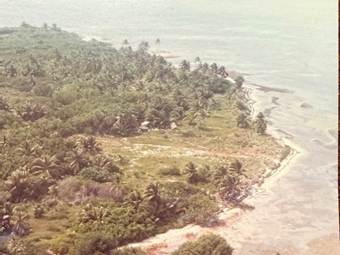
I made two trips to Belize, to visit my soldiers and to facilitate some live missile firing off one of the uninhabited offshore cayes (local name for islands).

We flew out to the caye by helicopter, accompanied by a 81mm mortar section from the roulement infantry battalion, who provided the targets – a bunch of phosphorus hanging below a little parachute, normally used to illuminate the battlefield.

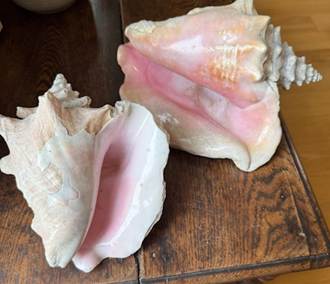
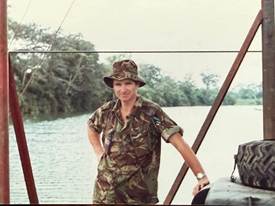
When not swotting away the mosquitoes, we took advantage of the crystal clear and warm water. The seabed was covered with large shells; I brought two home! On my first trip to Belize, I had gone down to the southern British military base in Toledo District; I think it was called Camp Riddeau. My troop sergeant had organised a night deep in the jungle, something I had never experienced. We made the A-frame supports for our hammocks, cooked some supper and listened to the insects and animals that make it their home. Night comes early in the jungle, and it was noisy, wet, extremely humid and hot. (Note 1)

I had some down-time during my time, accommodated in the RAF Officers Mess, and remember reading John Fowles’ Daniel Martin. Today, Wikipedia says “it follows the life of the eponymous protagonist, using both first and third person voices, whilst employing a variety of literary techniques such as multiple narratives and flashback.” I wished I’d had Wikipedia back in 1983. I struggled with the first third, almost gave up, then understood it, devoured the remaining two-thirds and started at the beginning again, to reread that incomprehensible first section!! John Fowles had written The Magus and of course The French Lieutenant’s Woman and remains one of my favourite authors.

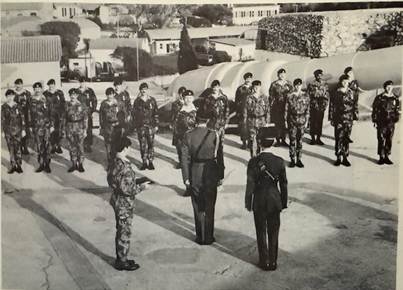
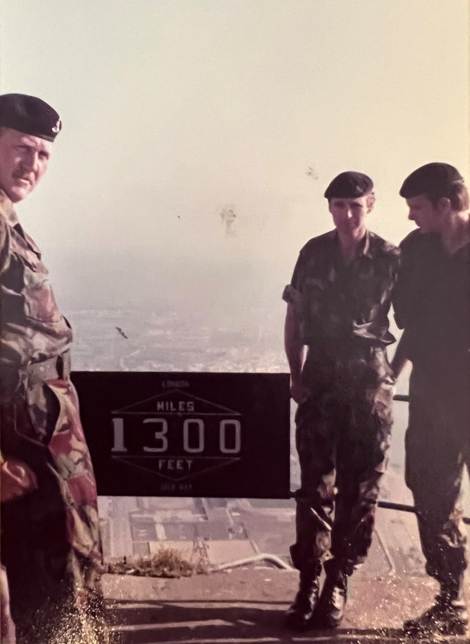
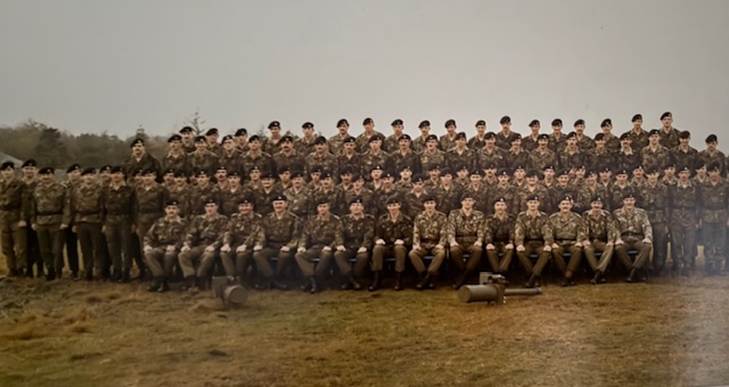
In December 1982 E Troop soldiers who had taken part in the Falkland’s War were presented with their campaign medals by the Deputy Fortress Commander of Gibraltar. (See photograph) I returned to The Rock in 1984 with the whole battery (ie less the Belize troop) for some adventurous training and to take part in the Gibraltar Half Marathon. Flying into Gibraltar is always interesting. The airport lies on the north of the massive vertical rockface and in certain weather conditions it’s a very turbulent area. In my first visit in a RAF C130 we went around twice, succeeding on the third attempt with a very hard landing.

At the very top of the Rock with WO2 Black and Lt Richard Dare

After Belize, Beirut and Gibraltar, you might think that Manorbier, to the west of Tenby, the Brecon Beacons, both in South Wales, and Otterburn in the Northumberland National Park, were rather tame. But each in their own way added to one’s appreciation of the United Kingdom landscape. We had regular ‘live firing camps’ at Manorbier, staying in the Sennybridge training camp, used the wonderful Brecon Beacons for strenuous exercises and carried out some troop training up in Otterburn. It was here for five days in May 1984 that I had the largest component of Lloyds Company together during my two-and-a-half-year tour; Lieutenant Paul Goad was on a course and the Belize troop of 14 wasn’t there!

I always sought to bringing out the best of my soldiers, testing their ability where necessary, promoting them when they earned it, encouraging them to apply for external roles, even if it meant they were posted away. The commanding officer, Lieutenant Colonel Ian Forward, noted in my annual confidential report: “He never sought to hoard his assets, willing to share his carefully nurtured talent across the board.” And, of course, it was personally satisfying when soldiers grew and matured before my eyes.

But not everyone grows! When I took over my battery I rapidly sensed that one of my sergeants, let’s call him Sergeant Smith, had been promoted (Note 2) above his ability; he wasn’t happy and didn’t seem to enjoy his job. After a chat, I arranged a couple of training exercises where he had ample opportunity to show his capabilities. He failed miserably, so he was reduced back to Bombadier and was found another position in another unit, one more suited to his abilities. He wrote later saying how happy he was. We see it in civilian life, individuals ‘promoted’ into roles they’re not suited to, not able to fulfil. I much prefer round pegs in round holes!

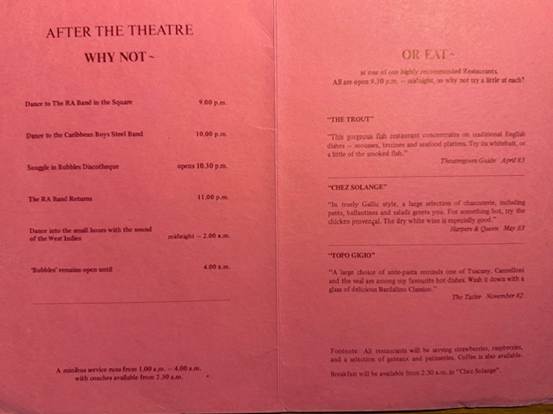
At one of the weekly Commanding Officer’s conferences of 1983, it was suggested we should hold a Summer Ball in the Officers’ Mess. Feeling that the ball I had organised in Lippstadt in 1972 had been a success, I volunteered, formed a committee, doled out responsibilities and set about making it happen.

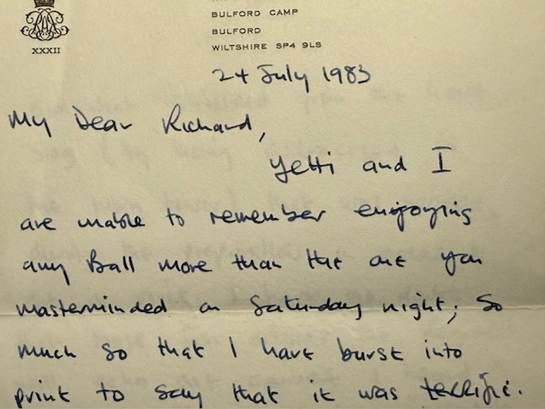
I decided that the theme should be ‘After The Theatre’, when one might have drifted around, finding different places to eat and maybe a nightclub or two to dance in. It was a great success, so much so that both the Commanding Officer and adjutant wrote letters in appreciation. The latter’s started:

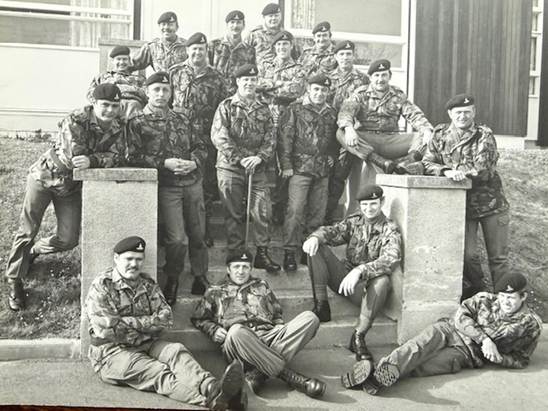
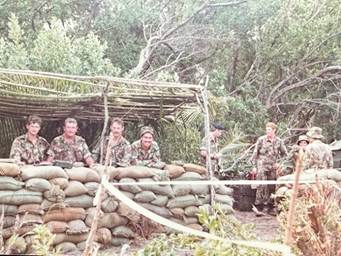
And the men who made the two and a half years I had in command of 43 Air Defence Battery (Lloyd’s Company) RA fun and rewarding are here, in this photograph, my officers, Warrant Officers and senior non-commissioned officers outside the training wing at Sennybridge Camp in South Wales.

Richard 27th March 2026

Hove

www.postcardscribbles.co.uk

Note 1 My Stepfather, Philip Thomson-Walker, as a Captain in SOE during World War 2, spent months in the Malayan jungle in Force 136 fighting the Japanese.

Note 2 Normally on probation for six months, this man had been on probation for 15 months. No one had ‘grasped the nettle’!

PC 481 Hope in The Hope

Hadn’t said farewell to Mo for too long before Sami poked his head around the door, saw me and made his way over to my table.

“Do you want another coffee, Richard? Double espresso?”

“Hey Sami! Good to see you: yes please!”

Sami’s not one to engage in too much small talk, wanting instead to explore his opinions and ideas, as well as keeping me abreast of the latest developments of the continuing saga of the Post Office scandal, of which he was a real victim. He’s personally got over it, taken an acceptable offer of compensation, and is rebuilding his life with his new partner Lisa. (See PC 335 ‘Lisa Wallace – My story’ May 2023 (Ed: This is interesting!))

“You saw that Betty Brown, the 92-year-old former subpostmistress from County Durham, was appointed an OBE in last December’s New Year Honours list? It took her twenty-two years to secure justice for herself and her late husband; lives destroyed!

The scandal’s no longer headline news but everyone’s eagerly awaiting the outcome of the police investigation to see who will be charged.”

“You think that will ever happen? These things have a habit of festering for so long, with prevarication and obscuration, that many on both sides will have died and someone will say: ‘What’s the point?’. It’s like the Infected Blood Scandal (see PC 392 Hope Continues (June 2024) and PC 420 Contentious Issues in the UK for 2025 (January 2025).)”  

“You’re becoming cynical as you get older Richard! Incidentally not sure what’s your view but we seem to have got our knickers in a twist when it comes to a person’s background, heritage and ancestry. Being curious, I am often asking new people I meet what they do and, frankly, if they are a person of colour as I am, where they’re from.” (Note 1)

“Do you remember about three years there was a hoo-hah at some Buckingham Palace reception when Lady Susan Someone asked a delegate, Charity founder Ngozi Fulami, where she was from, and not happy with the answer “I was born in the UK”, asked: “No! Where are you really from?”

“What’s the issue? I met a lovely couple of junior doctors many years ago, both the result of mixed marriages, and asked the chap, who looked like me, Eurasian, where he was from. “Nottingham!” and I so nearly asked, for no other reason than curiosity: “No! Where were you from originally?” but never did!

“A Gunner friend is in the process of penning his autobiography, not for public consumption but for his grandchildren. He let me read a couple of drafts of some parts and I know his intended audience will be fascinated. He thought I was doing the same, sort-of, writing of my life’s experiences in my weekly postcards. That hadn’t occurred to me, that I was writing my own autobiography, albeit in instalments and interspersed with contemporary observations and thoughts. Hey Ho!”

“Your weekly postcards Richard ….. I enjoy most of them ……..”

“Someone the other day told me they don’t have time which, given that they are a mere 5-minute read, is a sad reflection of modern life. I get more ‘likes’ and comments for some than others. The one that keeps surfacing is PC 461 “Bumped into Sami!” from October 2025 ……”

“Ha! I remember, we had a coffee in Gail’s and chewed the fat upstairs, mainly about weight-loss drugs as a way of tackling obesity. Sorry for the unintended pun! I imagine you saw that BBC report that GP Surgeries in England are to be paid an average of £3000 a year in bonuses to prescribe weight loss drugs?? (Note 2) Seriously not the way to go; get a bonus for everyone who signs up to some exercise programme!! But what else to you do to keep the brain from going to mush, apart from your beloved hot yoga?”

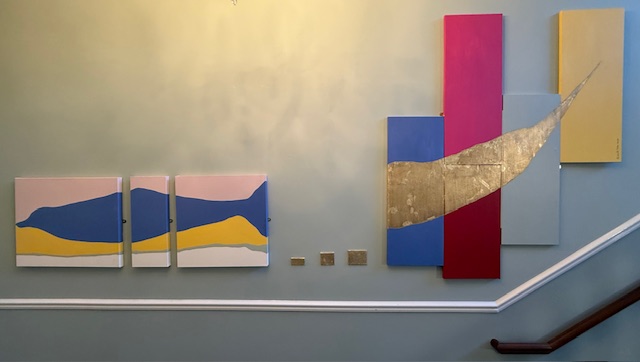
“Mmm! I do the daily Sudoku puzzles in The Times and occasionally paint something. Look (reaching for my iPad) ….. the composition on the right for Amber House’s communal hall is new, linked to another from some years ago by three little squares.

and by our internal apartment door, four little canvases …..

“I like both, a lot!”

Two other observations, Sami. Firstly, we had to go to the cremation of a dear friend the other day. She’d chosen some songs by Neil Diamond, Rod Stewart and Tina Turner, so the tone was as light-hearted as these things can be.  The service was conducted by Aileen Smart, who needed some reading glasses to read the tribute. The frames themselves were enormous, obviously quite heavy and they gradually slipped down her nose. As everyone would, she simply pushed them back up the bridge, only for gravity to impose itself once again and the whole action was repeated. Once or twice …… but I became mesmerised as her habit continued and my attention drifted from what she was saying!

The other concerned our yoga studio, where we had a new student the other week. If I can, I try to pass on a couple of bits of advice before they start: breathe through your nose, not your mouth and don’t drink water during class if you can help it. His reply to the latter was: “Ramadan started yesterday evening (17th February) and I can’t drink until sunset, so won’t be a problem.” This conversation was on the first day of Lent in the Christian calendar (18th February this year) so then I got into a discussion with myself about how it was apposite that devout Christians would be foregoing goodies for 40 days, at the same time as Muslims would be fasting for 28. My ignorance about the finer details of Islam prompted a Google search. I knew the dates of Ramadan progressed earlier each year but didn’t know by how much – it’s 11 days. Ramadan is the 9th month of the Islamic calendar, which is itself based on the cycles of the moon.

“Well! Well! Well! Richard. Thank you!”

Richard 6th March 2026

Hove

www.postcardscribbles.co.uk

Note 1 Sami’s mother was English and father Indian, so he’s classified as Eurasian.

Note 2 Of course very overweight people will eventually cost the NHS a great deal of money, so I assume this is the reason for encouraging them to take a weight-loss drug.

PC 480 More Hope News

Mo and I sit down with our individual coffees for a catch up; it’s been a while and I feel sure there’s much to chat about.

“You know my mother’s in Southwick, Richard, in one of those retirement places which offers everything those of a certain age need, without taking away anyone’s individuality?

“Yes; She’s got her own flat, hasn’t she? Am I right, she has become obsessed with the Assisted Dying Bill?”

“I suppose it’s bound to be on everyone’s lips, with the worriers wondering whether their offspring will use it to hasten their departure and those more sanguine thinking it’s needed for those with life-limiting conditions. The ‘Terminally Ill Adults (End of Life) Bill’, as it’s officially called, is currently at the Committee stage in the House of Lords. (See PS) But we had a bit of a scare last month; her doctor found she’d developed an infection that had created more fluid than normal around her heart. It’s called Pericardial Effusion and the fluid squeezes the heart muscle, so it needs to be drained, slowly.”

“All good now?”

“Yes. Just needs to take some antibiotics for a couple of weeks to clear the infection.”

“Hearts seem to be on everyone’s lips. You’ll remember before Christmas, a yoga chum’s sister, aged 59, had gone to bed early and her husband had found her dead before midnight? Well, our masseuse had a very good friend who had a fatal heart attack last month at 62, then last week her nephew had a heart attack, went into a coma and was allowed to die; he was 39! Now news of your mother, although pleased her heart issue was easily dealt with.”

“God, that sounds awful. I guess the message is, if in doubt about any ache or pain around your heart, go and get it checked – NOW! And how’s your daughter, Richard?”

“Half term last week and I suspect that was a real relief; a hard first half. In addition to her full-on teaching role and head of year, personally she’d become somewhat deficient in iron, a vital chemical for our bodies to function at 100%. She had to have two iron infusions, a fortnight apart ….. and suffered a rather swollen tongue for a few hours afterwards. A little investigation says this is a common reaction.”

“If it had been me, I would have panicked!!”

“For me, it brought back a memory from a different era when, during the long summer holidays, my brother and I found ourselves playing cricket near home in Balcombe. My own cricket experience was from a preparatory school when, despite being hopeless at either batting, bowling or fielding, so every aspect of the game (!) I realised the team needed someone to keep score. And there was the added attraction of the after-match cream teas!

Two scratch teams came together using the pitch of a local school. Apart from the fact it was a glorious summer’s day, I remember little of the cricket. But during the tea, I hadn’t realised a bee had landed on the cream éclair I was about to stuff into my mouth. The last action of its short life was to sting my tongue. One’s body reacts to certain chemicals quickly and my tongue rapidly grew in size! Someone recognised this as a Medical Emergency and called an ambulance. I obviously survived …… but the memory of that jab of its barbed stinger into my tongue remains to this day.” 

“You wrote in your last postcard about The Hope Café (PC 475 New Year in The Hope 23 January) that you were curious the Waitrose produce-picker had chosen Pomegranate seeds as a substitute for an order of Red Currents. I read that the recent storms in Southern Europe and North Africa have created a potential dearth in the UK of soft fruit like raspberries (Note 1), strawberries, blackberries, and blue berries. We have got used to being able to buy them all the year around, haven’t we – even if we accept that the blueberries in winter come from Peru!”

“Whenever I hear about berries I remember the delightful story about the colour of the mulberry.”

“The colour of the mulberry?”

“I wrote about it in PC 242 ‘What is This Thing Called Love? (1)’ (August 2021). In summary Thisbe has found her lover Pyramus’ body next to a white Mulberry bush, covered in his blood. Her heart broken, Thisbe kills herself with the same sword that Pyramus had used. The gods are so moved that the colour of the Mulberry fruit is forever changed to blood red!”

“Ah! That’s such a nice story! I think, like you Richard, I generally have the radio station Classic FM murmuring on in the background at home. A commercial station, its revenue comes from advertising. Having read PC 478 Eating Habits (13 February 2026) I have become a little more aware of what I am eating! Recently Classic FM was broadcasting an advertisement for Nestle’s Shredded Wheat.

 The voiceover says: “I’ve been asked to read out the ingredients.” Of course, these days we are led to expect lots of ‘E’ numbers, flavourings and colourings, so it is a pleasant surprise when she continues: “Whole grain wheat.” Then there’s a pause and she comes on again: “That’s it, whole grain wheat. Nothing else.”

And that’s what the box shows ……. plus the disclaimer about nuts (!), although it this case Peanuts seem to be in a category of their own (?)”

“You mentioning Classic FM reminds me! A couple of weeks ago I was scanning The Times at breakfast. Having learned to play the trumpet at school I was attracted to the obituary of John Wallace CBE, whose career as a trumpeter took him all over the world with his renowned brass group The Wallace Collection, which he’d formed in 1986. In a lovely twist, as I was reading of his career, Classic FM was broadcasting Haydn’s famous Trumpet Concerto in E flat, the Andante movement of which I played for my audition for the National Youth Orchestra. (See PPS)”

“Need to rush, Richard. Lovely to chat ….. see yer!”

Richard 27th February 2026

Hove

www.postcardscribbles.co.uk

PS Yesterday the Government of Jersey passed its own ‘Assisted Dying Bill’ and that will need Royal Assent; probable within 18 months. The Isle of Man’s bill is still awaiting Royal Assent. It’s likely that England & Wales’s own Assisted Dying Bill will fail due to lack of time. It is a Private Member’s Bill so does not have the Government’s support.

PPS Wasn’t successful! I could play something I had practised but the sight-reading test was a nightmare.

Note 1 To make the point, in this morning’s Waitrose online order, Raspberries have been substituted by …… Strawberries!!

PC 472 Shorts

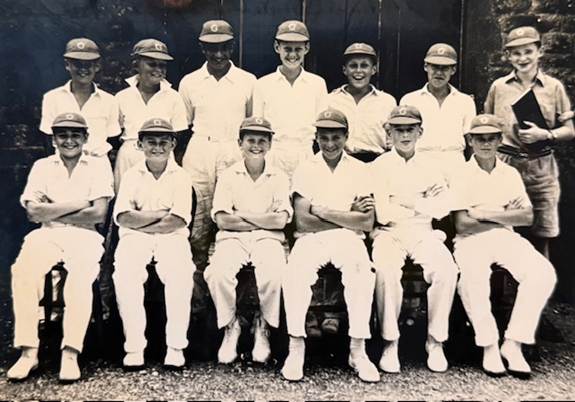
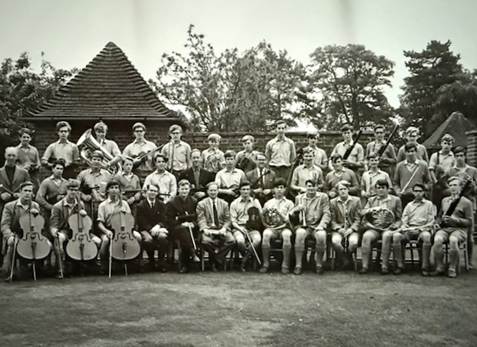
The title might have given the impression I was going to scribble about shorts, ie short trousers ….. maybe I should, given that I wore shorts at school until I was 18 …….

Dauntsey’s School First Orchestra circa 1964

…. but I’m not! Those who practise hot yoga in the Middle Street studio are an interesting group, from diverse backgrounds and professions, the young and those slightly older. Some of the regulars have become good friends, others prefer to drop in, practise, and leave, without any interaction; each to their own!

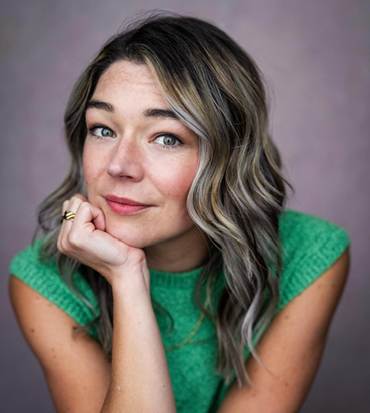
Sophie is an ‘award-winning actor, writer and film producer who works professionally under the name Cerys Knighton’. (See PC 342 Relationships IRL July 2023). She’s a graduate of the National Film and Television School and recently her short film ‘I’m Not Brilliant’ was shown as part of Brighton’s Film Festival in The Trinity Chapel on Duke Street in the centre of the city.

The chapel was built in 1817 by Thomas Kemp for his Nonconformist congregation, underwent several alterations during the C19th, and closed in 1984 due to declining numbers. In keeping with a lot of non-conformist places of worship, around three sides it has a large gallery on its first floor. The Fabrica Art Gallery made the chapel its home in 1996 and it was Fabrica which laid on the ‘Short Film Festival’.

I wouldn’t regard myself as a ‘Film Buff’, enjoy mainstream films as much as anyone, but sense our attendance at the local Odeon cinema has declined over the years. Supporting friends in their professional careers is important to me, so we went along to the early-evening screening of Sophie’s and other ‘short’ films; anything under 40 minutes is considered ‘short’. Hers was sixth on the list. The first was more like a dirge; atmospheric cliff-top images of Guernsey for 17 minutes, interspersed with a red-bearded individual who wandered around with a tattered old book. I have a habit of falling asleep in dark, warm places, so maybe I missed the whole point!

The next film was about a surprise birthday party, the subject entering a doorway and confronted by ‘friends and family’, whom you heard but didn’t see. She kept protesting that she didn’t do birthday parties and then seemed to get sprayed with blood ……! Again, the point was completely lost on me; the audience gave it desultory applause for some 4 seconds, so maybe I wasn’t alone. There was a short film, almost a documentary, about individuals who volunteered on a hospital radio. It had ‘real’ people not actors but again its point was lost – on me! One interesting film showed a series of cartoons about a boy going to Boarding School, the voice-over suggesting he felt abandoned and unloved. The choice of dull colours, browns and greys, added to the sense of despair. A clever way of portraying a difficult and possibly traumatic subject.

At the beginning of my commissioned Army service, I won a prize for being the best/worst/punctual/late/immaculate/scruffy – interested/ disinterested/capable/incapable young officer – it was a long time ago!! The award came with a cheque for £50 (about a month’s pay!) – to be spent on ‘sports equipment’.  Did I need another Squash racket? I didn’t play cricket so no need for a new bat, I played Rugby but didn’t need to buy a ball: I was at a loss! Eventually I persuaded the committee that I would seriously benefit from buying a Super 8 Cine Camera and projector; it was a stretch but ultimately successful. I used it for almost ten years before buying a Ftb Canon 50mm still camera.

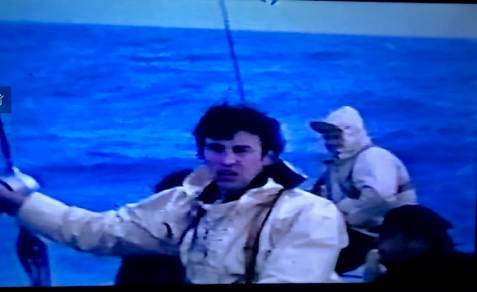
A still from one of the many hours of ‘sailing trips’ Super 8 Cine film; the late James Hodges skippering a yacht returning from the Channel Islands.

Given that two aspects of my life then, offshore sailing and my Royal Artillery service, were full of photogenic opportunities, it was inevitable I ended up with hours of 8mm cine film, spliced together when necessary. Life moved on; I transferred the films I wanted to keep to VHS video tape …… then onto CDs. Now I don’t have a dedicated CD player …….

I was reminded of my library of Super 8 film by the fifth ‘short’ showing, a mishmash of family cine film reels spliced together in some incoherent way. I am sure the more critical members of the audience would have gained something by watching all 9 minutes, but I didn’t include myself in that group.

And then we got to our ‘Main Event’, Sophie’s film ‘I’m Not Brilliant’, written by her and directed by Julian Kerridge.

Sophie plays Donna, an overly keen carer of Elsie, an elderly woman wanting to end her life. Little flashes of very dark humour, like Elsie going up the stairs with an electrical toaster saying: ‘Think I’ll go and have a bath’ made me smile, as did the confusion about the location of Dignitas as one of the options – Sweden? Elsie is determined to spend any extra cash she has and not let her ungrateful daughter get her hands on it, so they depart for the local pub. There they bump into a Hen Night, to which Donna thought she should have been invited. And there was a delightful twist at the end to make you smile with relief. This short film got the loudest round of applause of the evening, not because Sophie had packed the audience with friends and supporters but because it was a rounded, sensible and watchable film.

After an interval, another collection of ‘shorts’ and another audience. We drifted out of the old chapel, into the cool evening air and made our way home. These viewings are the bedrock of the cinematic industry and the development of its creatives, without whom we couldn’t sit back in Screen 4 with the tub of popcorn and escape into a different world. No doubt we will read about some of the makers of and participants in these short films in the years to come, as they grow, experience and are recognised for their art.

Richard 2nd January 2026

Hove

http://www.postcardscribbles.co.uk

PC 471 Another Tale  

Most of us are too busy to read much at this time of the year, so here’s something I wrote last year, which is just another tale. And if you don’t read it that doesn’t matter either!

“I had only the vaguest of directions, in the form of a land survey map and some handwritten notes from the solicitors, but as I neared what I thought was about my destination, I could sense my heart beginning to beat faster, the excitement palpable; I pulled into the verge. Somewhere down this deserted country road, 100 miles in from the coast north of Sydney, was a five-barred gate. Sure enough 50 metres away there was an old wooden gate, hanging at an odd angle from a large timber post, rather unkempt and unloved; across the top bar was the name, “Standby”, burned into the wood by an untrained hand. A track led through the gums and over a small hillock; clearly no one had travelled this way for a while, so thick was the red dust and the absence of tyre tracks.

So much had happened since I had received that letter from Wilcock & Brown, a firm of solicitors in Sydney, in London two months before, informing me that a long-lost relative had left me a station in New South Wales. Being rather vague about the family tree, I had rung my grandfather, to see if he could enlighten me.

Come down and see me, dear boy”, more an order than an invitation! A few days later we had had sat around the coffee table in his drawing room, doing a cursory search of some dusty albums and box files. He’d told me how James Ruse, his great great grand-father’s half-brother, had been one of the first European settlers and the first to be deeded land in Australia, thirty acres at Parramatta, west of Sydney. James had prospered and had bought tracts of land as future investments. One was far north of Sydney, which he had let to a fellow settler, who had gradually built up a sizeable holding. Over the years my grandfather had rather lost touch with his extended family relatives in Australia and had no clue as to how the station had come to be left to me.

Grandpa’s parting comment still rang in my ears: “Why don’t you go and have a look? You have nothing to lose, it could be a wonderful adventure and you can come back and tell me all about it.”

Certainly, I had to take a look, if only out of curiosity, but I had no experience of running anything bigger than my back garden, the size of postage stamp, in South London, so I would probably sell the station. After the long flight to Sydney and a few days to get over the jetlag, here I was, north of Newcastle. I remember smiling as I passed a sign on the road to Booti Booti, without knowing how it came to be so named and how I would become intimately involved with those words. Then I spied ‘Standby’ on that gate.

At the top of a rise in the track I caught a glimpse of buildings in the distance, half hidden by gums, with a water tower and fences that formed cattle pens. The nearer I got, details of the main house became clearer, classic colonial ranch style, with a large overhanging roof and wide verandas at both ground and first floor level. I had arranged to meet the man who had been looking after Standby since my relative had died, at noon. It was almost that time now, judging by the position of the sun, burning down from the cloudless sky, and yet there appeared to be no one around. 

I parked my car in the shade of a large barn, walked across to the main house and up the steps to the front door, which opened to my push. Inside, dust lay on everything, on the furniture, across the floors and the windows; my finger ran across the table in the dining room, underneath the dust the surface of a lovingly polished mahogany table, obviously brought out from England many years before. The interior was cool and pleasantly laid out, with the main rooms off the central corridor, and the kitchen at the far end.

I was just about to explore the first floor when steps sounded on the veranda. Framed in the doorway was the slender frame of a woman, a broad-brimmed hat on her head, bare arms and legs, and a flowing skirt; in her right hand was a basket. The strong sunlight made it difficult to see any detail of her face and I walked back to the front door to introduce myself.

Good afternoon”, I said, “my name’s Robert Harrison; you are?”

As I came closer, I could see she was probably in her late twenties, her skin the colour of milky coffee with large soulful eyes and a broad smile.

“G’day, I’m Clarissa; I am Winston’s daughter.”

Ah! Yes. Winston was the chap who was looking after the station. She told me he’d been delayed with some cattle about an hour’s ride away.

Would you like some lunch? I’ve got some cheese and mangoes, and a bottle of beer. Why don’t you sit on the veranda and I will get it.” Without waiting for a reply, she brushed past me and headed for the kitchen. 

I sat in the shade, tasted the most delicious goat’s cheese, slurped my way through a couple of mangoes and quenched my thirst with the beer. Winston arrived about an hour later, riding into the yard on a rather rough looking black mare, accompanied by a cloud of reddish dust. We introduced ourselves and sat on the veranda whilst Winston told me something of the ranch. A hundred thousand acres of cattle station was mine if I wanted it. He suggested that the best way to see what Standby consisted of was to ride the land. He startled me as he yelled at Clarissa to saddle up a horse, but soon we were riding out of the station yard and up the hill to the east. It was late afternoon, the heat of the sun was easier now, and the kangaroos were coming down to the water holes to take their first drink and nibble the short grass. I looked back at the house, already deciding that here was a place I could live. The comparisons with England were few, it was an exciting idea and, although I knew nothing about cattle and running a station, seemed too good to turn down.

What was the alternative?  Whilst I had no illusions about how different and physically demanding it would be, I felt a surge of excitement as I following Winston over the hill and through the gums. We crossed dried-up river beds, through gullies and around ant hills as big as my horse; the air was dry but clear and there was a wonderful smell of eucalyptus. Some three hours later we rode back into the yard in the soft light of dusk; Clarissa came running out and took the reins and led the horses back to the stables.

I gratefully accepted the offer to stay the night and later, lying in bed wide awake, I wondered what I was letting myself in for.”

(To be Continued – maybe)

Richard 26th December 2025

Hove

www.postcardscribbles.co.uk

PS Ideas always welcome!

PC 469 More from The Hope

Sami and Lisa come in through the doors and, spying Mo and me, come over; it’s been too long since I had seen them both. I decide to treat them to some coffee and ordered an Americano for Sami and a Mocha for Lisa from Libby. Regular readers will know that Lisa was writing an article for Brighton & Hove’s Argus newspaper about low level health care and had asked my opinion. (See PC 457 Low Level Health Care September 2025)

“Hey you two! Lisa, I saw that your article was published in The Argus in mid-October. Will there be a follow-up?”

“Hope so; nothing certain but they liked my style.”

“And, Sami, I read that not only has Sir Alan Bates finally agreed a settlement in his claim against the Post Office but that a 92-year-old ex-postmistress has also finalised hers. Not before time you might think!” 

“Time passes, doesn’t it. I hadn’t realised Alan had started his campaign for justice for victims of the Horizon scandal more than twenty years ago. So pleased to understand part of his settlement includes compensation for those efforts”.

“Betty Brown fought for 22 years for justice after The Post Office accused her of false accounting after discrepancies in their County Durham branch books. She and her husband made up the £50k shortfall, which had been caused by erroneous Horizon software. Her husband died a year later. Then the Sunday Times, towards the end of November, had a poignant article about Michael Mann, accused of stealing £15,000 from his Post Office in 2013. In October that year Mike committed suicide, so depressed at being sacked from the job he loved. The public enquiry is now analysing the evidence it’s collected and is handing over files to the Metropolitan Police for possible criminal charges. Operation Olympos has so far identified seven suspects, with a formal prosecution expected to begin in 2028; nothing seems guaranteed and meanwhile those wrongly convicted wither.”

“You probably missed the obituary of Lam Leung-tim ……”

“Who he?”

“A Chinese businessman who created ‘a kingdom from nothing’ after the Japanese occupation of China during the Second World War. His name sadly will not be familiar but one of his plastic toys, the little yellow duck, will be.

Who hasn’t had one in their bath, if you have a bath in which to float it nowadays(?), or indeed watched one of the many ‘Yellow Duck Races’.”

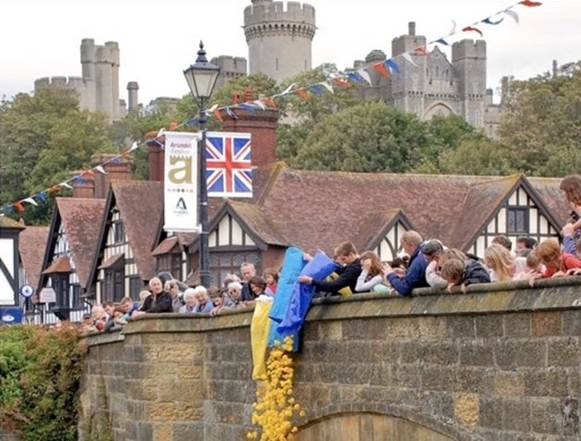
“Ah!” Says Mo, “There’s one held every year on the River Arun during the Arundel Festival of The Arts, here in Sussex. Two thousand yellow ducks, each with a number corresponding to a £1 ticket, are poured from a bag from a bridge.

The winning duck earns its owner £100, second and third £50 and £25 respectively and the remaining money goes to local charities. All the ducks are cleared from the river by the Arun Divers Club.”

“Did you know,” Sami interrupts, “that Lam says he made a ‘pleasant mistake’; there’s an old Chinese saying ‘yellow goose and green duck’ ….. but Lam made his duck yellow! He lived to 101.”

“Wow! That’s a lovely anecdote to our love of the yellow ducks.”

“How was your birthday, Richard?” asked Lisa “Not sure Sami told me”, she said, looking at her partner quizzically.

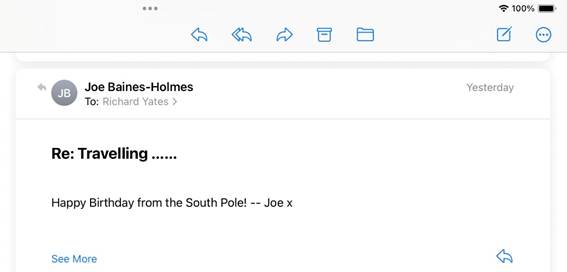
“Great. Dinner in a new restaurant in Church Road, Maré, and all the normal birthday stuff, including birthday wishes from Joe at the Amundsen-Scott South Pole Base. (see PC 403 Idle Thoughts about This and That September 2024)

You’ll have to take my word for it, as you could argue that the email could have come from anywhere! Joe owns one of the apartments in Gilmour House, the other half of Amber House. His contract finished at the end of October and he’s on his way back to Hove, via Thailand and SE Asia.”

Mo butts in: “You’ll have a view, Richard, about the budget last month; what did you think of the removal of the Child Benefit Cap?”

“I had to check the facts. Previously you could claim the benefit for every child; you’d qualify if you’re responsible for a child under 16 and live here, providing neither parent earns more than £80,000. New rules were introduced in 2017, limiting it to two children. The aim was to end the iniquity of workless households getting paid by the state for having larger families than those with jobs could afford. Today families on Universal Credit, which is typically means-tested, get £3500 per child. In removing the cap by April 2026, the government aims to lift hundreds of thousands of children out of poverty. Critics of the lifting of the ban argue there’s no real measure of ‘poverty’, it should be down to parental responsibility to decide how many children to have and whether they are affordable, and that it’s not for The State to say: ‘we’ll pay more and more’.

“You know my view Richard.” says Mo. “If you want to have children, you have to understand that there is a cost involved and there’s a responsibility for both parents, the mother and the father. There’s been an increase of about 10% in the number of families headed up by a single parent since 2019. Mothers make up 85% of the 3 million single parent families here in the UK. Not sure how you can change this, educating society about basic responsibilities, be more draconian about financial support from the absent parent? The more the state helps financially the less incentive there is to change. Don’t think Joe and Joanna Public are in favour of lifting the ban.”

“I do feel a bit concerned that the ‘Ship of State’ is captained by someone who’s just qualified, that most of his crew try hard to please him but have little professional experience, and there’s an ongoing dispute as to the destination, let alone how to navigate there.”

Richard 12th December 2025

Hove

www.postcardscribbles.co.uk

PS The knife was successful!

PC 467 Hope News Continues

“Sorry Richard! That took a long time. Coming back from the loo I got side-tracked by Josh who wanted to ask about my mother. I have read your postcards about your Australia – New Zealand trip (PCs 458, 459, 460, 462, 463 & 464) ….. you obviously had a good time, jetlag notwithstanding. Anything you haven’t mentioned?”

“Now you’ve reminded me, in Perth, walking back from Kings Park, we came across a couple of young chaps standing beside their car which had a flat front tyre. They looked rather pathetic, so I asked if they had a problem.”

“No! Thanks! My brother/cousin/flat mate’s coming to give us a hand.”

“But you’ve only got a flat tyre. Can’t you change it?”

“Never had to before; no idea how to! Here’s the jack, but where does that go?”

“So …..” and I get a look from Celina as I have a mild hernia and shouldn’t force anything, “…… the first thing to do is loosen the wheel nuts whilst the wheel is on the ground. Good garages will tighten them with a torque wrench; others use an impact wrench which can easily exceed the recommended torque (Note 1) and they are almost impossible to undo.”

At that point their brother/cousin/flat mate turned up, looking reasonably confident, so I left them to it but mentioning a torque wrench reminded me of my Army Service.

In 1968, 27 Medium Regiment moved from Devizes, Wiltshire to Lippstadt, Germany, swapping our towed 5.5̋ howitzers for the self-propelled M109. The latter had seven idler wheels between the track sprockets. Each wheel was attached by a number of large nuts, which we assumed had to be tightened to the maximum. After three months in Germany, the Aluminium idler wheels were showing signs of extreme wear and many had to be replaced. Eventually the problem was identified; the tightness of the nuts needed to be to a certain torque, and that could only be achieved by using a torque wrench, not by Gunner Elrick who believed they should be as tight as physically possible.”

“Live and learn huh! Although these days some newer cars don’t seem to have a spare tyre! By the way, have you ever watched ‘Celebrity Who Dares Wins’, one of those celebrity television programmes where you don’t know any of the contestants? I’m sure you have; anyway, I was fascinated to listen to some of the individual ‘back stories ’in the last series. There was a man whose family were very committed to their church. As a six-year-old he was horrified to be told by the pastor that he had demons that needed to be exorcised. As an adult he questioned how someone could be so cruel. Another contestant’s career was going well, until her sister died suddenly and she had to step in and look after her eight children.”

“Ready-made family!”

“Exactly, but can you imagine that, your own plans and ideas for your life suddenly and completely put on hold? Anyway, then there was a black ex-footballer who recalled not being able to find a UK club so signed for Lithuania, only to be the subject of racist chants from the stands: ‘Zigger zigger, kill the nigger!’ And finally there was a singer auditioning for the show X Factor, who got wasted one evening, was raped by the hotel porter, …… and became the victim when thrown off the show. Years later these experiences are life-defining. Talking of life defining, how are your daughter’s house renovation coming on?”

“Certainly life defining, but in a pleasant way. I drove up to see her and the state of the house during Half Term week. So often these days I need to break my journey for a pee-break.

“Isn’t there some theory that one of the factors in the cause of vehicle accidents is the full bladder of the driver?”

“I have heard, yes, that but not sure whether it’s based on any statistics. Not the sort of question you ask someone who’s just been involved in an accident: “Excuse me, do you need to go to the loo?”

“No! I guess not! Anyway, you were saying …..”

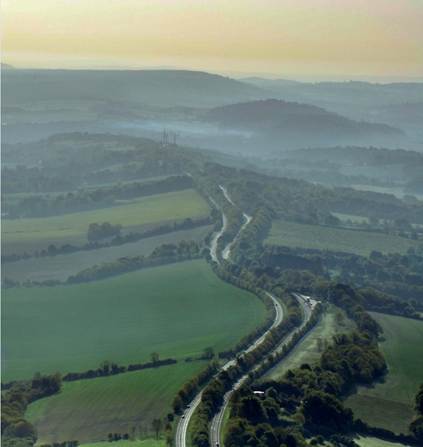
“I pulled into the layby on the Hogs Back, a prominent ridge running east west between Guildford and Farnham and know as the Hogs Back since the time of Jane Austen, knowing the little café had some loos.

The lay-by and little café can be seen on the right of the dual carriageway

It was raining quite heavily and I scurried down the concrete path, following the signs to the loos, which were round the back. I get to the Men’s; it’s locked and you need a code, presumably from the café. My expectation was that the loo would be open and I am getting desperate – and wet! There is no alternative but to water the weeds growing between the cracks in the concrete.”

“I am sure that happens to a lot of men; we women don’t really have that option! Have you been watching the historian David Olusoga’s ‘Empire’ three-part series on the BBC?”

“I have, Mo, and I’m glad I have, as so often you get the ‘British Empire was bad’ bias whereas David’s tried to create balance and a modern reflection. I was fascinated by the explanation of the Indentured Labour Scheme, brought in to provide the sugar plantations with workers after the abolition of slavery in 1834.”

“It was a huge success for the plantation owners, but most workers came from the poorest parts of British India, and many were unaware of the long distance they would travel and indeed the terms of their contract. They were paid a paltry sum and had to stay for five years. The scheme was active for 80 years and its results can be seen today in the significant communities of Indian descent in South Africa, East Africa, the Caribbean and Mauritius.  Why were you fascinated by this?”

“David mentioned how Prime Minister Gladstone’s father had owned sugar plantations in Guyana and was one of the major instigators of the Indentured Labour Scheme. One of our yoga chums, Serena Wells, is from Guyana and she and her father are going to try and find out more about their family history, as ‘Wells’ was a common surname for slaves.”

“Now that will be interesting. Oh! Look, there’s Sami and Lisa …..”

Richard 28th November 2025

Hove

www.postcardscribbles.co.uk

PS Why have Christmas decorations suddenly appeared in mid-November? Now the radio stations are broadcasting carols! Humbug?!

Note 1 Wheel nuts should be torqued to between 80 and 160 Nm (Newton-meter)

PC 466 Hope News

Hadn’t been into The Hope Café since our return from New Zealand, although I had caught up with Sami in Gail’s one afternoon (See PC 461 ‘Bumped into Sami’ 17 October 2025). On Wednesday it was cold and raining so perfect for a coffee in convivial surroundings. I find Mo sitting at one of the tables, with a couple of books she’d obviously bought from Duncan’s bookshop next door.

“Oh! Hi! Richard. Come and join me and tell me what you’ve been up to.”

I ignored the question! “New books? What have you bought Mo?”

“’The CEO; The Rise and Fall of Britain’s Captains of Industry’ and Saul David’s latest book, Tunisgrad, about the battle for Tunis and subsequent victory in May 1943 in Africa during the Second World War. As you know I love history and this looks fascinating.

“Not sure about the CEO book but, if you find it good, let me know. I read Saul David’s book ‘Victoria’s Wars’ and then met him.”

“Not name dropping?”

“No! No! No! In 2007 I went on a tour of the ‘Sites of the Indian Mutiny’ (Note 1) and he was our historical guide, giving colour and meaning to what we saw and heard. Afterwards I bought his book ‘Victoria’s Wars’ which explained just how the Empire expanded in the queen’s reign, thanks to adventurers and successful military opportunists. At its height the empire covered about 24% of the earth’s land mass and some 450 million people. Anyway, I thought you would have bought the latest local author Peter James’ book – it’s about the Royal Family, isn’t it?

“No idea – used to love his books but like anyone continuing a series, they become a little samey and he’s got it into his head that he has to include little ‘bon mots’ or modern sayings to give his writing more gravitas!! Of course, at this time of the year all my regular writers like John Grisham and Lee Child bring out their annual offering. Now, how are you?”

“Well, a regular blood and stool test worried my GP and she thought I should have a colonoscopy.”

“Why?”

“William my late nephew died aged 18 in 2002 of Bowel Cancer, so this was not the first time I have had to suffer the indignity of someone I had never met inserting firstly their finger then a tube up my arse. But if one’s GP suggests it, you should have one; just in case. You’ve probably never had one of these procedures; in preparation for it you have to clear your intestines, and this is achieved by drinking two litres of something called Moviprep. It’s a chemical concoction designed to flush out one’s colon; the ingredients, Sodium Sulphate, Sodium Chloride, Potassium, Ascorbic acid and something called Macrogol, which probably doesn’t appear on the periodic table, are enough to frighten anyone.

One of the often-quoted reasons for Britain leaving the European Union was the desire take control of our borders. Not only have the number of ‘small boats’ crossing the English Channel with illegal immigrants increased but our Health Service now seems to rely on individuals born overseas. My snapshot of the Endoscopy Department in The Royal Sussex County Hospital bears this out. There were two Endoscopists, Mrs Jane Machinjike, from Zimbabwe, and Dr Nabeel Akhtar and two nurses, Mr Ashik from Kerala in Southern India and Ms Shrishti Maharjan from The Philippines. Worse still there’s not only an audience, in this case two nurses and two endoscopists, but the only programme on the two screens was of someone’s insides – odd when you realise it’s one’s own. What else’s happening Mo?”

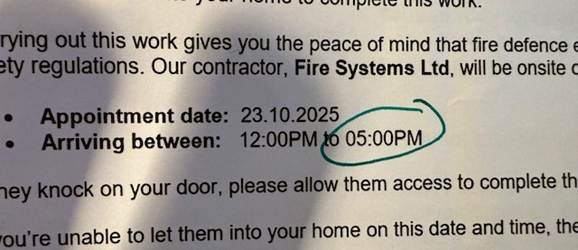
“My mother’s residential home in Shoreham recently had a Fire Equipment Inspection and the company carrying it out wrote to tell her when they would be ‘on site’. I read the important piece, when and at what time …..

 ….. and thought we’ve got our knickers in a twist! It’s either 1700 or 5:00 pm. I was nerdy enough to drop them an email and ‘William’ said he would look into it and thanked me! The same happened when I booked a haircut – the App said ‘03:00pm’ – and clearly it should be either 1500 or 3:00pm, or even 3 o’clock! This is a little like a rash. I had a hire car the other day; when I collected it the time on the dashboard said 0920. Later the same day, in the afternoon, the clock said 0335. What’s going on?    

“What indeed Mo! You know we went to London to have a pre-birthday lunch with chums last month?”

“Where did you go?”

“Colbert in Sloane Square; used to be Oriels and has a simple menu. And it’s easy to get to – into Victoria railway station and then one stop on the District or Circle Underground lines.”

“Ah! Yes! I’ve also been there. How was your journey?”

“Actually, our direct Southern train from Hove was delayed by engineering works which meant a diversion. As we arrived in Victoria the driver announced we were 23 minutes late and we could claim some refund?”

“Really? That’s remarkable. And did you?

“I did. Southern will give you 25% of a single journey fare if the delay is between 15 minutes and 29 minutes and 50% refund if it’s between 30 and 59 minutes. Not sure what happens if it’s over that!! I went online, filled out the details including our ticket number, and got a refund of £4.10 per ticket.”

“You’re well brought up Richard so I suspect you would have been as horrified as I was. Watched the reality TV programme Celebrity Traitors; at some point the contestants were filmed eating. Like pigs at the trough; knives as weapons, stuck in the air, to balance the fork sticking in the air, holding them like some dagger, or even like drum sticks, talking with their mouth open …. I was surprised someone wasn’t using their fingers. Horrified and disgusted in equal measure, like watching cavemen.”

“As a Gunner Captain, I was being run to be ADC to the C-in-C BAOR, General Harry Tuzo and had to have the ‘Knife & Fork’ test, that is have lunch with him and his wife, Lady Tuzo. I passed!”

          “Hey, I need to have a pee; back in five.”

Richard 21st November 2025

Hove

http://www.postcardscribbles.co.uk

Note 1 The Indian Mutiny took place in 1857; it resulted in much bloodshed on both sides and changed the way India was governed.