Scanning the television guide, I noticed Channel 4 was broadcasting ‘Sailing The Shipping Forecast’ with the Reverend Richard Coles (Note 1). My interest was roused enough to watch the three episodes. The voice-over introduction by Coles went something like:
“Now it’s time for the shipping forecast; “……, Shannon SW 2 veering (Note 2) NW 3-5, occasional rain ….” For over 100 years sailors and fishermen have received daily life saving shipping forecasts. It’s now a national institution and its soothing tones have become a recognisable comfort to all. For me the shipping forecast is timeless, it’s almost like a prayer, comforting.”
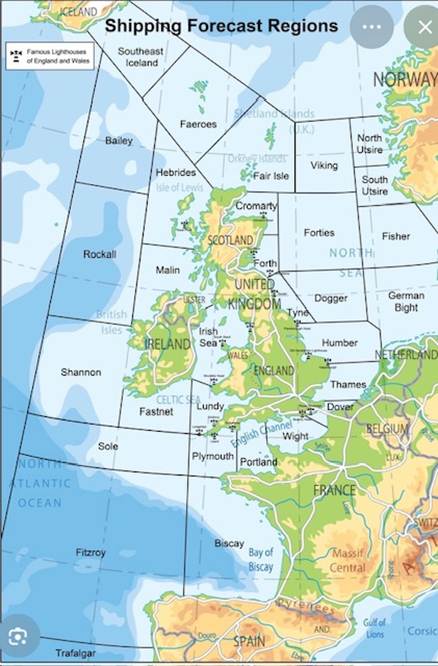
It’s hard to imagine anyone who hasn’t heard of the UK ‘Shipping Forecast’, broadcast on BBC Radio 4 at 00:48, 05:34 and additionally on weekends at 17:54. But then if you live in the middle of the country, you’re more likely to be interested in the local weather than that affecting our coastal waters. Our weather is something we talk about endlessly …. but one of those aspects of life you can do nothing about. It is what it is, to use a common phrase.
I probably heard the UK’s Shipping Forecast for the first time in Cyprus in August 1968. As a Second Lieutenant, I was in charge of a small rear party, whose sole task was to ensure the Regimental training equipment was dispatched back to the UK from RAF Akrotiri, following three weeks’ regimental training on the island. One evening I happened to hear the British Forces Broadcasting Service broadcast the 00:48 Shipping Forecast.
I learned later that the seas around the UK are divided into 31 areas, and the forecast follows a set format. It starts in Viking, moves through those sea areas covering The North Sea, down to the English Channel (Thames, Dover, Wight ….), out into the eastern Atlantic (Biscay, Fitzroy (Note 3), Sole,) then the seas around Ireland before finishing just short of Iceland.
Gale warnings precede the main forecast which follows a strict 350-word count. An example might be “There are warnings of gales in Dover and Wight. The general synopsis at 0400. Low 995 (barometric pressure in millibars) Biscay moving slowly NE and filling. The area forecasts for the next 24 hours: Viking, Forties, Cromarty, SW 3-4 (as in the Beaufort scale in knots) locally 5, good (a measure of visibility eg ‘good’ is greater than 5nm).” Actual weather reports from coastal stations follow. Winds circle areas of low pressure in an anticlockwise direction, around a high in a clockwise direction.
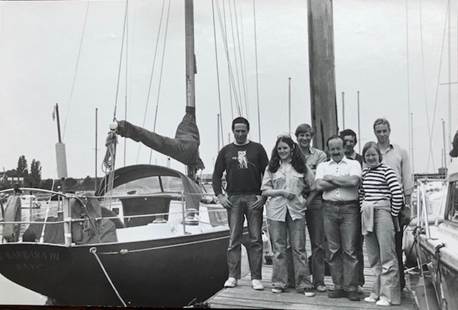
My crew on St BIII in Trouville, before our Arromanches experience!
As soon as I started sailing in 1968, it became essential to understand the weather forecast. The Shipping Forecast was written down with a chinagraph onto a wipeable talc and hung up in the skipper’s/navigator’s area of the cabin. Whether it was to warn us of gales offshore racing, see ‘PC 249 Knockdown’, or forecast when the northeasterly gale might abate and we could leave Trouville see ‘PCs 209 & 211 Off Arromanches’. (see crew photograph above)
You can get alarmed when the forecasts are for gales (Force 8) or severe gales (Force 9), and just as alarmed when the visibility is ‘less than 500m’. Sailing north from the Channel Islands and suddenly encountering a vast container ship, about 300m away and steaming across your track, gets the adrenaline flowing.
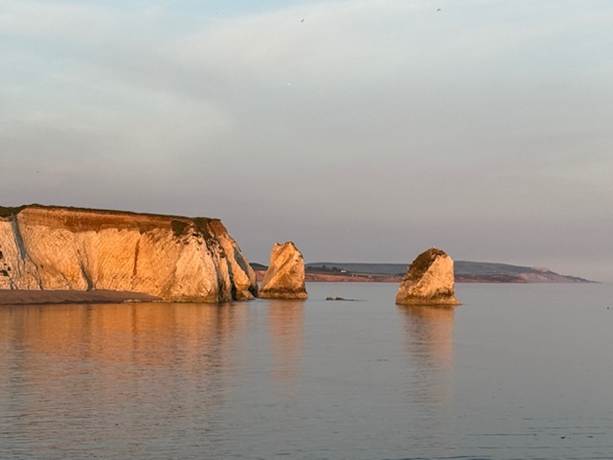
Freshwater Bay on the SW corner of the Isle of Wight
I mentioned Richard Coles’s series. He covered only four particular sea areas; firstly ‘Wight’ and visited the international sailing centre of Cowes on the Isle of Wight. The Isle of Wight is England’s largest island. (see PC 440 The Isle of Wight May 2025).
The episode about sea area ‘Lundy’ featured South Wales’ Gower Peninsula and Lundy Island. I had been lucky enough to visit Lundy when a Watch Officer on the cadet training ship Malcolm Miller.
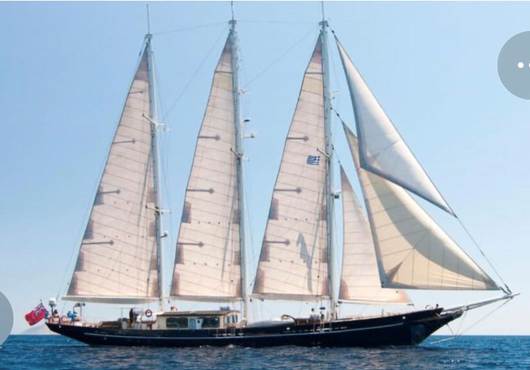
Her sister ship the Sir Winston Churchill also anchored in the lee of the island. Coles also visited ‘Thames’ and went out to the ex-pirate station Radio Caroline, anchored outside the three-mile limit.
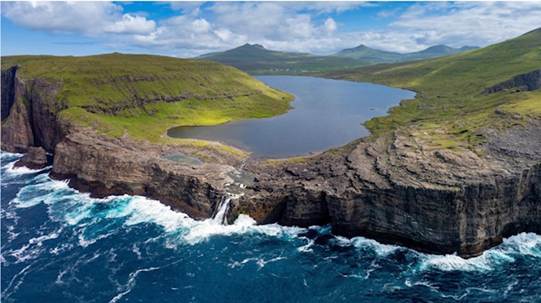
The Faeroes
Coles had started at ‘Faeroes’, a dramatic island group midway between the north of Scotland and Iceland. Thanks to Coles, I now know what it looks likes, and want to go!
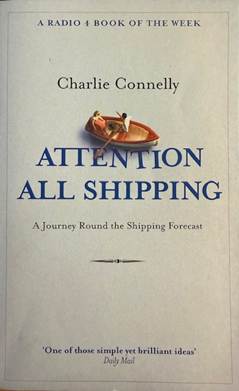
And if you’re a landlubber, then read Charlie Connelly’s book ‘Attention All Shipping’ – ‘a journey round the Shipping Forecast’. Brilliant.
For trivia, Stephanie Waring and her sister from Tyneside named their three children Shannon, Bailey and Tyne as their husbands both work at sea. And the poet AC Bevan wrote an entire collection of poetry inspired by The Shipping Forecast. He says the forecast is like a liturgy. “there’s something religious about it, the names suggest emptiness, but the way in which they are read out is very comforting. It’s something very spiritual.”
So, The Shipping Forecast, ingrained in my soul:
‘There are warnings of gales in Portland and Plymouth. The general synopsis at ……’
Richard 20th March 2026
Hove
PS The full list is Viking, North Utsire, South Utsire, Forties, Cromarty, Forth, Tyne, Dogger, Fisher, Fisher, German Bight, Humber, Thames, Dover, Wight, Portland, Plymouth, Biscay, Fitzroy (Note 3), Sole, Lundy, Fastnet, Irish Sea, Shannon, Rockall, Malin, Hebrides, Bailey, Fair Isle, Faeroes and Southeast Iceland.
Note 1 Richard Coles first rose to fame in the 1980s as a multi-instrumentalist in the pop duo The Communards. He then studied theology, was ordained as a priest and serve as a vicar for over a decade. In 2022 he retired, reinventing himself as a prolific broadcaster and author.
Note 2 The term ‘veer’ means, in meteorological terminology, that the direction of the wind shifts in a clockwise direction. If it’s ‘backing’, it’s in an anticlockwise direction.
Note 3 The UK sea area Finisterre, to the west of Biscay and the French coast, at 90,000 square miles was a much larger area than the Spanish sea area of the same name. Spain complained to the United Nations World Meteorological Organisation there could be confusion and the UK was ordered to change the name. Vice Admiral Robert Fitzroy (1805 – 1865) was considered the founding father of the UK’s Meteorological Office, so ‘Finisterre’ became ‘Fitzroy’ in February 2002. Somehow the original lilt of the repetition of the names changed without Finisterre! Fitzroy spent his personal savings on designing better ways to make weather information more widely available. In failing health and suffering from depression and financial concerns, he committed suicide by cutting his throat on 30 April 1865.
 postcards