PC 211 Off Arromanches (continued …. see PC 209)

Asking Kevin, both mate and the yacht’s mate and the most competent of my crew, to take the wheel I headed below. Sure enough there was about two inches of sea water washing around; lifting a board confirmed the bilges were full and it wasn’t simply water off crew oilskins. (Note 1). My heart started to beat faster as the crew expected me to sort it out!

I turned on the electric bilge pump; nothing happened. I shouted to John in the cockpit to find the manual pump, to make sure the tube was out of the locker and to start pumping. My mind began to fill with a thousand things I should do …… and they were all ‘NOW’! Where’s the pump? Saucepans please! Put a position on the chart, note in the log. Where are the flares? Is the life raft easily ready? What about life jackets? I had never felt the necessity of always wearing a life jacket on a yacht – but sense these days with smaller less-bulky ones available that might be an out-dated practice. But I knew down over the lee rail was the coast of Arromanches, with its rocky shallow foreshore extending far from the beach and we were on a falling tide. (Note 2) “Oh! Shit! The club’s flagship might go aground! Explain that to the Committee!” Then at last the first and only important question: “Why was there water inside?”

The crew formed a saucepan chain (you know what I mean!) and bailing began. Waves were breaking over the bow and it was unpleasant below and on deck. I needed to get the yacht in a more stable state so took the helm, brought the bow through the wind without changing the jib sheets and hove to. Wonderful! Suddenly the movements lessened and there was less noise.
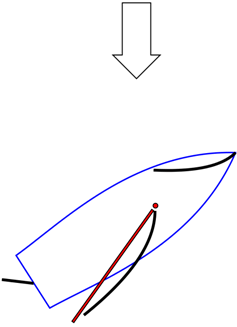
Rudder tries to turn the yacht towards the wind; wind on the foresail resists

I hope none of you have had to heave to in an emergency; I certainly hadn’t before but had demonstrated the technique to those learning to sail. I had likened the sails to two hands around a bar of soap. Squeeze – tighten the sails and the wind has to accelerate through the narrower slot – the soap and it shoots out – and the boat moves forward. When you take the bow through the direction of the wind, and leave the foresail untouched, the mainsail and rudder try to move the boat forward and the headsail resists. The yacht simply sits, slightly head to wind, and if the sail areas are well balanced, hardly moves.

I have sailed on many wooden yachts that let water in, as the planking opened a millimetre or two beating hard to wind. The 30 sqm and 50 sqm yachts at the British Kiel Yacht Club (see PC 106) were particularly wet below and it was essential to have all your spare clothes and sleeping bag wrapped in black rubbish bags to keep them dry! But St Barbara III’s hull was made of GRP (Glass Reinforced Plastic) – God help us if we had somehow cracked the hull on some high bounce as we left the harbour!

Dismissing this nasty idea, my thoughts then turned to the anchor stowage. A more stable yacht meant less water was breaking over the bow ….. and finding its way below! I knew from experience that if the Kedge Anchor was not exactly positioned in its locker, with even a centimetre proud, the hatch cover would not fit and lock properly and water would seep in, and in rough conditions flood in. Turning on the foredeck lights, I took Hew with me and, clipping on at each stage, we made our way up to the bow.
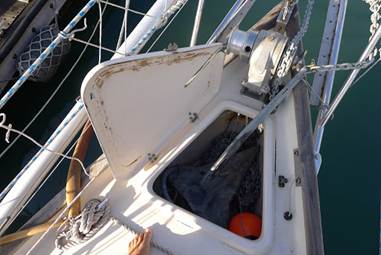
Generic ‘anchor stowage’

Sure enough, we could make out the anchor locker lid was not flush with the deck. In their haste and in the pouring rain, coping with a pitching deck as we motored out through the harbour entrance, the foredeck crew hadn’t got the anchor properly stowed. It took Hew and I about 5 minutes to get it fitted properly and, as we made our way back to the cockpit, we hoped that the level of water on board would begin to reduce. After ten minutes that was noticeable and there was much relief all around.

I was a bit of a stickler for writing up both the daily log and the journal so, as we set a revised course for The Solent and Gosport, wrote up both whilst the emotion was running! Somewhere in the archives of the Royal Artillery Yacht Club are that log and the journal entries.
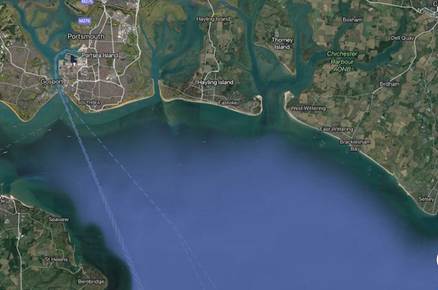
Google Earth showing The Solent, with the Isle of Wight on the bottom left and the entrance to Portsmouth top left

As is often the case when sailing, conditions can change quite rapidly. From our rough start from Trouville in a Force 7, the wind had gradually decreased as we crossed The Channel. We shook the rolls out of the mainsail and changed up to the No 1 Jib.  Abeam of the Nab Tower, the wind dropped completely, the sea strangely calm and the last few miles were made under engine. 
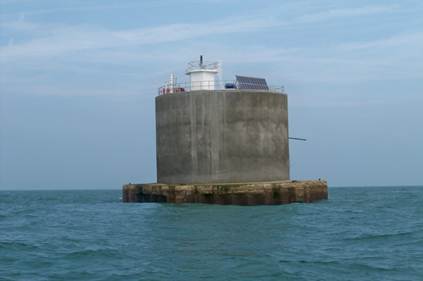
The Nab Tower at the entrance to The Solent

It was quite a relief to tie up alongside the pontoon in the Gosport Marina mid-afternoon and switch off – in every sense!

Richard New Year’s Day 2021

PS A Very Happy New Year to all my readers

Note 1 Gallows Humour is often part of a crisis and this was no exception!  I was reminded of part of Tales of Old Dartmoor, a radio sketch from The Goon Show (February 1956). To cut to the chase (It’s all on You Tube so if you have never listened to it, do so!) Dartmoor prison had somehow become HMS Dartmoor, a floating prison ship (!), and the crew were looking for the ‘treasure of the Count of Monte Cristo’. Rumour had it it lay under the floor of Cell 626. They lifted a flagstone.

“Ah! Look! Water.”

 “Salt Water!”

 “Look! There’s more of it! It’s coming in.”

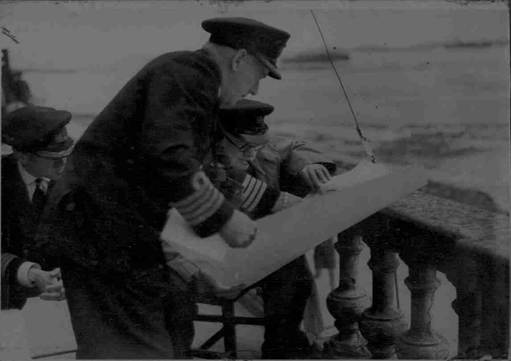
Note 2. After reading PC 209 Jonathan sent me this photograph of his great uncle Harold Hickling briefing Churchill at the Mulbery Harbours off Arromanches. June 1944
PC 206 Off Arromanches; at night, in a gale!

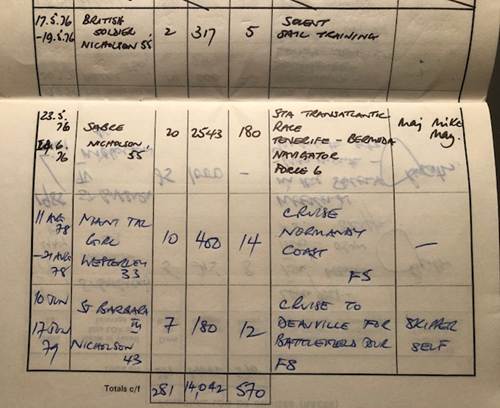
This is a page from my Royal Yachting Association Log Book. Note the entry for 10th – 17th June 1979:

…… doesn’t say more than the very basic headlines but the memories from those few days, in fact one particular two hour period, linger on over forty years later. I attended the two-year Army Staff Course at the end of the seventies: Division 1 at RMCS in 1978 and then a year at The Staff College Camberley 1979. In the summer of that second year we were fortunate enough to tour the Normandy beaches and hinterland used in D Day 1944. The Battlefield Tour was a welcome relief to classroom discussions and it lived up to its colloquial name, The Bottlefield Tour!

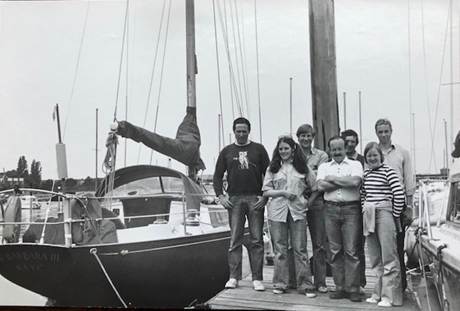
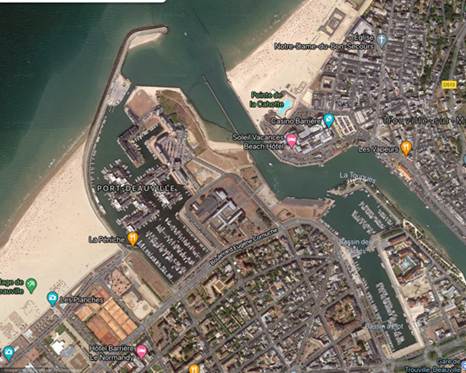
The battlefield tour was unique in that soldiers who had attacked and defended this part of northern France came and talked about their experiences and memories. I think it was the last, given the increasing age of our guest speakers; we were blessed. The administrative part of the tour was centred around Deauville but by tradition a number of us sailed across on service yachts to Trouville, the next-door harbour. I was lucky enough to skipper the RAYC flagship St Barbara III, a Nicholson 43.

The crew with St B on the left

After all the normal pre-voyage activity we assembled at Gosport opposite Portsmouth on 9th June. The weather forecast for the week was mixed, a bit like the weather of early June 1944, but for our outward trip was set fair. From memory a north-easterly F4 allowed us to clear the Solent forts and set a course for Trouville. Trouville, in keeping with a number of ports on the northern coast of France, could only be entered some two hours either side of high water.

We found the harbour entrance on the bow after some 65 miles of uneventful sailing and tied up stern-to on the harbour wall, bow to anchor, not a method I was well practised in but fortunately there weren’t too many rubberneckers!

When I was doing my military service or sailing offshore, the mnemonic ‘grid to mag add, mag to grid get rid’ served us well as the variation was some 4 degrees ……. and mistakes happened! An hour after our arrival one of the other skippers, who I knew well, took me aside up on the quay and quietly questioned whether you added the magnetic variation or not, as they had missed the channel entrance!! (Note 1)

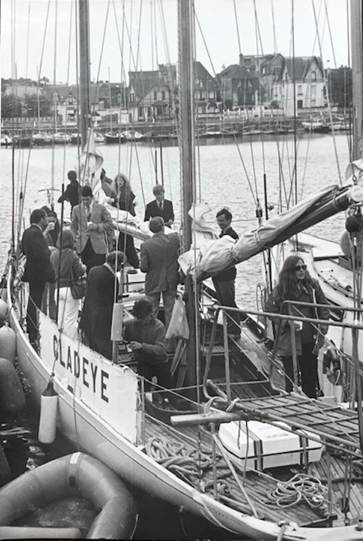
Some left for the on-shore accommodation, others were staying on board. We did have a chance to have a party on Gladeye, skippered by Robin Duchesne.   

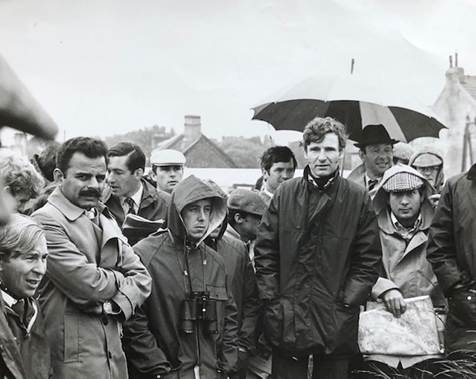
Of the tour itself, out of all the stands where a veteran, of whatever nationality or rank, told us of their experience, one particular talk stays in my memory. A grey-haired rather rotund Yeoman Officer told us he had been in command of a troop of three tanks and that they had come under fire from some Germany artillery on top of a ridge to his front. His leading tank was hit and he had watched in horror as his troop sergeant had emerged from the hatch in a ball of flame. We stood exactly where his tank had been 41 years before; on the horizon we could see the escarpment.

This lovely chap told us how it was. “I hadn’t really listened to much of the training about radio procedures and artillery cooperation and stuff, I just knew I wanted to get hold of some artillery fire to neutralise the enemy, and bloody quickly. I picked up my radio mic and yelled: “Hello Gunners, this is Tony! I need your help.” (Note 2) “Hello Tony, Gunners here!” a voice crackled in his headset “Where do you need us?” Tony admitted he wasn’t very good at map reading but after some discussion eventually the gunners put a round on the ground somewhere towards the ridge. From there Tony was able to say “Further on” “Right a bit” until he was satisfied that three rounds fire-for-effect would sort out Jerry. And it did!

The tour eventually ended and some of the participants left for the ferries whilst us sailors returned to the harbour basin in preparation for our trip back across the Channel. In an ideal world we would have time to wait for favourable weather but so often work commitments squeeze that window. The forecast was a squally Force 8 gusting 9 out of the North East …… so prudence suggested waiting a while. Just after midnight on 17th June, with the gale forecast to blow itself out, we hoisted the mainsail with its four rolls, tacked on the No2 Jib,

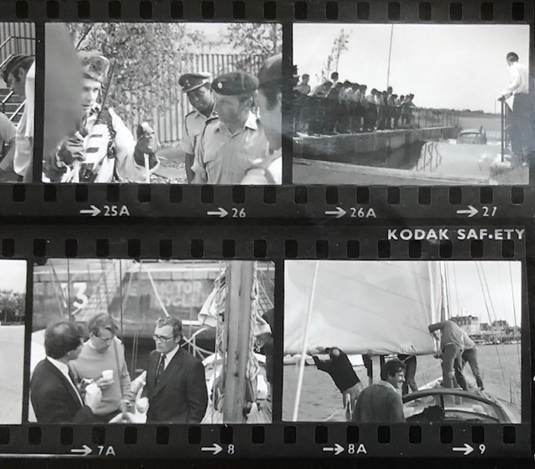
Bottom right shows the crew putting the reefs in. Bottom left happens to have the late Robin Duchesne.

…….. slipped our moorings and headed down the sheltered harbour entrance towards the sea. I sensed it was going to be a bit bumpy and ensured the fenders and warps were safely stored in their lockers and all the crew had well-fitted safety harnesses; I reminded myself the crew were not particularly experienced. Two of them worked on the foredeck, under the lights and in the torrential rain, to stow the anchor in its bow locker. Their stance was made difficult by the sea rolling in, and St Barbara rose and pitched as we motored out; every now and again there was a loud bang as she smashed into a large wave. By the time we cleared the entrance pilings they had returned to the safety of the cockpit. We could just about make our bearing to the Solent and, having hoisted the Jib, after about 30 minutes I switched off the engine; Tony went below to put the kettle on.

“Hey! Skipper! There’s lots of water on the cabin floor” (‘cabin sole’ for whom this sort of thing is important!)

To be continued …..

Richard 18th December 2020

Note 1 Each degree of variation over a distance of 60 miles will result in one nautical mile off course. A 4 degree variation would give you 4 nautical miles off course …… and the entrance to Trouville was a narrow dredged channel you approached on a transit!

Note 2 I was a Gunner so knew it should have been something like ‘Hello G31 this is Tango 23A over’