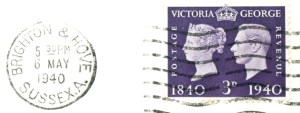
It’s appropriate to start off this postcard with something about language, as I sit at a table in an AirBnB in Barra da Tijuca, to the west of Rio de Janeiro’s famous beaches of Ipanema and Copacabana. My ability to speak Portuguese, and in particular Brazilian Portuguese, has not got any better over the years since Celina and I got together, despite periodic attempts to get to grips with it. I started with no knowledge and sometimes I sense I have come back to that point!
Consequently, I need to be careful when I write about Celina’s way of pronouncing certain words. The name of the Russian president comes up occasionally, often accompanied by some criticism or other of his cruel actions and disregard for what we in the west consider sacrosanct, like the borders of sovereign states. I commented that I loved the way she says his name, sounds like ‘putain’, a hard nasal sound. Then she explained that ‘putain’ is French for whore/bitch/shit/hooker/tart and I think this is perfect.
These days, if you are bored by your record or CD collection, you can just dial up something like Spotify and ask it to play exactly what you want to listen to. Or you can tune into one of the hundreds of radio stations, via Alexa, and podcasts, to listen to chat or music. Of course the sound of silence can, in itself, be wonderful. Over the years I have become accustomed to have Classic FM on in the background. Often I recognise the work being played, reinforcing my own prejudices about composers; ‘I love Sibelius, not so keen on Bach’ for example. The station’s output seems to cover anything from traditional ‘classical music’ to music used in film or television scores. Snobs in the world of classical music might deride Classic FM for its populist approach to what it broadcasts, but I guess that’s what the programme makers deem their audience want and tune in for. However, as a regular listener, I sometimes detect that every presenter has been encouraged to play one particular piece. A recent example is the title track from the 2004 film ‘Ladies in Lavender’, a 2004 film starring Judi Dench and Maggie Smith. It was composed by Nigel Hess, but I do not want to hear it today, tomorrow and the next! Another piece now played so frequently it’s become hackneyed is ‘Ashokan Farewell’. I grant you it’s lovely but once a month will do!
Writing about snobbery in the world of classical music brings me neatly on to the Scottish painter Jack Vettriano who died at the beginning of March aged 73. His name might not be on the tip of everyone’s tongue, but his painting entitled ‘The Singing Butler’ will, I hope, be instantly recognisable.
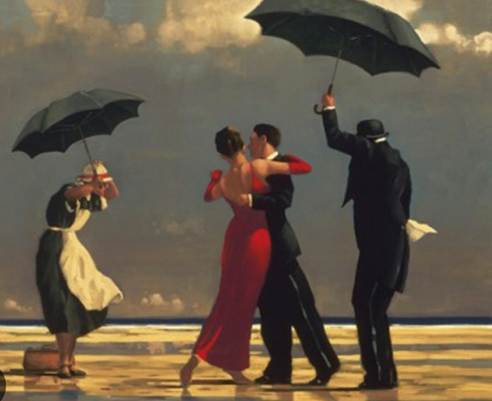
He was one of Britain’s most successful painters, earning a reported £500,000 in annual royalties from reproductions of his work on postcards, posters, calendars and jigsaw puzzles. Self-taught, Jack’s breakthrough came in 1993 when he was taken up by London’s Portland Gallery; “There’s a narrative (in his paintings) which invites you to continue the story. They’re a moment caught in time and you continue the story in your head.” Sir Terence Conran was slightly harsher: “I would never suggest Jack is a great artist in the manner of Francis Bacon and I don’t think he would claim to be. But he is an extremely competent artist in the Edward Hopper mould.” Most critics derided his art as ‘kitsch and derivative.’ (Note 1)
I hadn’t intended this part of the postcard to develop into a dissertation on what makes one artist greater than another, for in my mind only you can make these judgements. Personally, I love Edward Hopper’s paintings for their simplicity ….
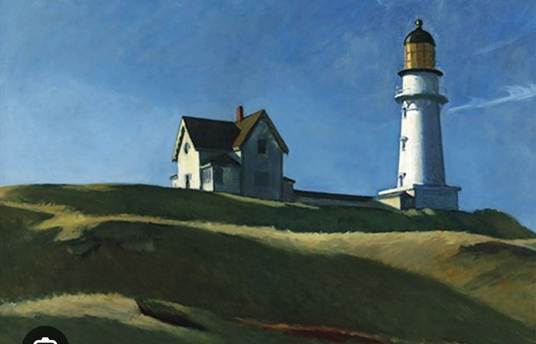
Edward Hopper’s The Lighthouse
and can’t think of any reason to go to an exhibition of Francis Bacon’s work …..
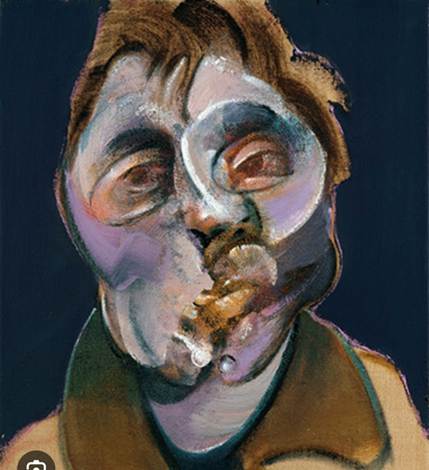
Bacon – a self portrait
But then I am me and not you, or Terence Conran!
In my postcard about Gen Z (PC 425 Generation Z February 2025), I wrote how good it was to find people who recognised you could have fun without alcohol and that their attitude towards drinking and drinking to excess was refreshing. One of our major supermarket chains, Sainsbury’s, is now offering a non-alcoholic beer with one of its lunch ‘meal deals’. For some reason best known to themselves Debretts, the national guide to etiquette, were provoked to comment. Liz Wyse, one of their editors, wrote: “I don’t think it really appropriate. I know it’s alcohol free but people drinking alcohol-free generally would rather drink a normal beer.” (My italics) Now that is a statement based on a sample of, er, one? Herself?
Diane Cherryman from Melton Mowbray was so moved to write to The Times. “Sir, (Note 2) Debrett’s should set aside its prejudices and read the small print on labels before condemning a lunchtime drink of alcohol-free beer.” And went on to say it’s a far healthier choice than fizzy drinks.
And finally, something to cogitate on. I took out a life insurance policy with Standard Life a day before my 21st birthday; seemed a grown-up and sensible thing to do. It would pay out some £2314 if I accidentally died; for comparative purposes I was being paid circa £1750 per year (Note 3) and the annual premium was £24. As the years rolled by, I recognise that these £2 per month Direct Debits were not a lot, and it would help my beneficiaries a little. The annual statement arrived last month – I could cash in my Life Insurance and have £1714 in my sticky little hand today and not leave it for others. I have paid Standard Life £1392 over the years – so a gain of £322! My brother did a simple ‘£24 at 3% compound interest over 57 years’ calculation and found it amounted to almost £4000. If I had known then what I know now ……..
Richard 4th April 2025
Rio de Janeiro
http://www.postcardscribbles.co.uk
Note 1 Make sense of this: “His art is frightening …. his work shows the extent to which even art has been compromised by the argument that the market is the most powerful thing.” Duncan MacMillan
Note 2 I wonder whether this salutation has had its day. Today it could easily be Editor which could apply to someone of any gender.
Note 3 Rule of thumb suggests 150% of salary. Wishful thinking!



 postcards