
Knowing my days would be busy with the visit of my mother-in-law around Celina’s birthday, I popped into The Hope to catch up with Sami on Monday afternoon. When I first met him some years ago, he was reading the latest John Grisham novel and sure enough, this afternoon his head is also into a book. He looks up and slips his bookmark between the pages:
“Hi! Richard. How are you? I read that you had food poisoning on your flight back from Rio. You OK now?”
“Yes! Thank God! Very nasty! Got into jelly! Haven’t had sweet jelly for decades and it was perfect. Even bought a block of blackberry flavour and poured boiling water over it ……. ! What are you reading?”
“Well, given the death of Pope Francis, it seems an appropriate time to read Robert Harris’ book Conclave; it was published almost ten years ago but it feels very current! Very good, but then I would expect nothing less from Harris; such a great and inventive author.”
“You’ve watched the film Conclave, right, the one with Ralph Fiennes and Stanley Tucci? I read the book a few years ago and found the film on our flight out to Rio de Janeiro towards the end of March. Sometimes the director of a film diverges from important elements of a book for whatever reason; for a film is only their take, their understanding, and may or may not compare with one’s own imaginative thoughts derived from its reading. Personally, I think the film’s great and whilst it may not be a completely accurate description of the real conclave, it’s going to be in the back of my mind when the 133 cardinal electors gather in the Sistine chapel on Wednesday to choose Pope Francis’ successor. (Note 1)
Hopefully there is a big dollop of truth in terms of the way the next pontiff is chosen; it sort-of lifted the lid on something regarded as very mysterious. Wasn’t his funeral wonderful? But a demonstration of a male-dominated organisation, hundreds of men in skirts and brocade and silk, centuries of tradition; I wonder whether it’s fit for the C21st? And now we’ll see the fight between traditionalist and liberals, the former tending to be a strong cohort in catholic churches of Africa.”
“Ha! I heard that, in a twist worthy of Harris’ book and the subsequent film, Pope Francis, in a death-bed letter, forbade Cardinal Angelo Becciu, the most senior Catholic Church official ever to stand trial before a Vatican criminal court, found guilty but free pending an appeal, from voting in this month’s conclave.”
“For some reason a rerun of a Dave Allen skit (Note 2) was broadcast on Instagram the other day. You remember Dave Allen, Sami?”
“Oh! Come on! I was born in 1958 so too young for what I gather was compulsory Saturday Night television viewing! Of course I have seen some of the compilation programmes. What was the topic of the skit?”
“With the current focus on the Vatican and the choosing of the next Pope to lead the world’s 1.4 billion Catholics, it’s very apposite:
‘Jeremy died and made his way to heaven, where he was welcomed by St Peter, who offered to show him around. ‘Over there, that group are Hindus, and down there by the lake are Muslims; Anglicans and Jews tend to congregate around here.’ There was a very tall wall behind St Peter and curious, Jeremy asked him what was on the other side. ‘Ah! On the other side of the wall are the Catholics; they think they are the only inhabitants of heaven.’
Then we had Morten Morland’s wonderful cartoon that summed up the late Pope (Note 3):
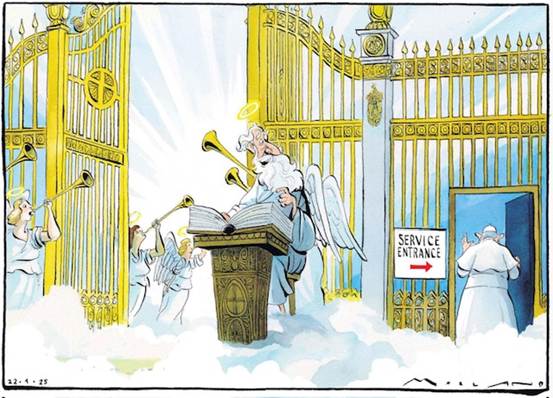
“Don’t you love cartoons like that? Perfect! Different topic. Not sure you were here or in Brazil but there was an interesting news item about health a couple of weeks ago that caught my eye.”
“Health? In Brazil it’s a national fixation but here in the United Kingdom less so!”
“You’re right! Researchers studied more than 100,000 people living in the United States over 30 years and found that only 9.3% of the older people could be classed as properly health, defined as ‘surviving to the age of 70 years without the presence of any of 11 major chronic diseases and with no impairment in cognitive or physical functions or mental health.’ Those eleven, in case you’re interested, cover cancer, diabetes, myocardial infarction (a heart attack), coronary artery disease, congestive heart failure, stroke, kidney failure, chronic obstructive pulmonary disease (COPD), Parkinson’s disease, multiple sclerosis and amyotrophic lateral sclerosis (a fatal type of motor neuron disease). Not surprisingly, it concluded that ‘greater long-term adherence to a healthy diet during mid-life was associated with greater odds of healthy ageing.’”
“Not rocket science huh but I guess everyone will be asking themselves – ‘Have I had any?’ More yoga I say! By the way, you remember I scribbled about Gen Z a while ago?” (PC 425 February 2025)
“Yes ……”
“Well, Robert Crampton, writing in The Times about Generation Z and their idea of work, laid it on the line:
‘Generation Z don’t seem to understand the basic social contract!’ and went on to say your family care for you, from being a baby to acquiring educational qualifications, then you go and earn your own living. You pay taxes to keep the country safe, educated, moving and healthy. He stressed that the ‘going to work’ business, reliably, regularly, cannot be construed as emotional abuse! ‘It’s normal to feel anxious; it’s also normal to have days when you don’t fancy it.’ Then you retire and get looked after again. ‘That’s the deal. It’s really not negotiable.’
“Actually, think that’s spot on! Not only Generation Z; too many people think The State should support them.”
“Sami! Must get on. Lovely to talk to you and I’ll let you get back into ‘Conclave’.”
Richard 9th May 2025
Hove
PS White smoke appeared yesterday as the cardinals elected Robert Prevost to be the next pontiff. He’s decided to call himself Pope Leo XIV
Note 1 135 were eligible but two are too infirm to travel.
Note 2 Dave Allen (July 1936 – March 2005) was a brilliant Irish comedian, satirist and actor.
Note 3 Morland is a Norwegian political cartoonist who regularly features in The Times.




 postcards