PC 433 Odds and Sods

It’s appropriate to start off this postcard with something about language, as I sit at a table in an AirBnB in Barra da Tijuca, to the west of Rio de Janeiro’s famous beaches of Ipanema and Copacabana. My ability to speak Portuguese, and in particular Brazilian Portuguese, has not got any better over the years since Celina and I got together, despite periodic attempts to get to grips with it. I started with no knowledge and sometimes I sense I have come back to that point!

Consequently, I need to be careful when I write about Celina’s way of pronouncing certain words. The name of the Russian president comes up occasionally, often accompanied by some criticism or other of his cruel actions and disregard for what we in the west consider sacrosanct, like the borders of sovereign states. I commented that I loved the way she says his name, sounds like ‘putain’, a hard nasal sound. Then she explained that ‘putain’ is French for whore/bitch/shit/hooker/tart and I think this is perfect.

These days, if you are bored by your record or CD collection, you can just dial up something like Spotify and ask it to play exactly what you want to listen to. Or you can tune into one of the hundreds of radio stations, via Alexa, and podcasts, to listen to chat or music. Of course the sound of silence can, in itself, be wonderful. Over the years I have become accustomed to have Classic FM on in the background. Often I recognise the work being played, reinforcing my own prejudices about composers; ‘I love Sibelius, not so keen on Bach’ for example. The station’s output seems to cover anything from traditional ‘classical music’ to music used in film or television scores. Snobs in the world of classical music might deride Classic FM for its populist approach to what it broadcasts, but I guess that’s what the programme makers deem their audience want and tune in for. However, as a regular listener, I sometimes detect that every presenter has been encouraged to play one particular piece. A recent example is the title track from the 2004 film ‘Ladies in Lavender’, a 2004 film starring Judi Dench and Maggie Smith. It was composed by Nigel Hess, but I do not want to hear it today, tomorrow and the next! Another piece now played so frequently it’s become hackneyed is ‘Ashokan Farewell’. I grant you it’s lovely but once a month will do!

Writing about snobbery in the world of classical music brings me neatly on to the Scottish painter Jack Vettriano who died at the beginning of March aged 73. His name might not be on the tip of everyone’s tongue, but his painting entitled ‘The Singing Butler’ will, I hope, be instantly recognisable.
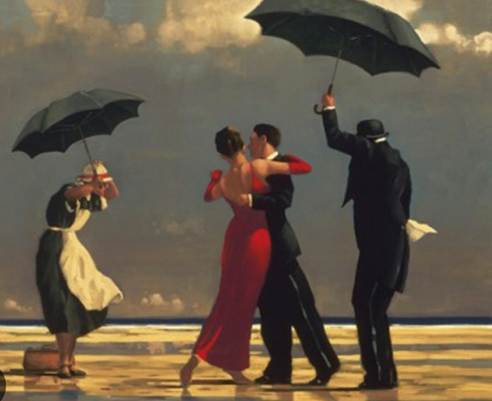
He was one of Britain’s most successful painters, earning a reported £500,000 in annual royalties from reproductions of his work on postcards, posters, calendars and jigsaw puzzles. Self-taught, Jack’s breakthrough came in 1993 when he was taken up by London’s Portland Gallery; “There’s a narrative (in his paintings) which invites you to continue the story. They’re a moment caught in time and you continue the story in your head.” Sir Terence Conran was slightly harsher: “I would never suggest Jack is a great artist in the manner of Francis Bacon and I don’t think he would claim to be. But he is an extremely competent artist in the Edward Hopper mould.” Most critics derided his art as ‘kitsch and derivative.’ (Note 1)

I hadn’t intended this part of the postcard to develop into a dissertation on what makes one artist greater than another, for in my mind only you can make these judgements. Personally, I love Edward Hopper’s paintings for their simplicity ….

Edward Hopper’s The Lighthouse

and can’t think of any reason to go to an exhibition of Francis Bacon’s work …..
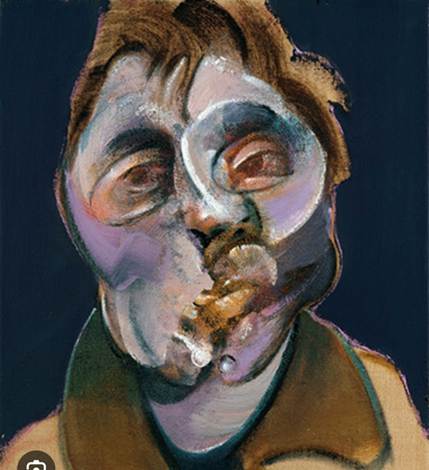
Bacon – a self portrait

But then I am me and not you, or Terence Conran!

In my postcard about Gen Z (PC 425 Generation Z February 2025), I wrote how good it was to find people who recognised you could have fun without alcohol and that their attitude towards drinking and drinking to excess was refreshing. One of our major supermarket chains, Sainsbury’s, is now offering a non-alcoholic beer with one of its lunch ‘meal deals’. For some reason best known to themselves Debretts, the national guide to etiquette, were provoked to comment. Liz Wyse, one of their editors, wrote: “I don’t think it really appropriate. I know it’s alcohol free but people drinking alcohol-free generally would rather drink a normal beer.” (My italics) Now that is a statement based on a sample of, er, one? Herself?

Diane Cherryman from Melton Mowbray was so moved to write to The Times. “Sir, (Note 2) Debrett’s should set aside its prejudices and read the small print on labels before condemning a lunchtime drink of alcohol-free beer.” And went on to say it’s a far healthier choice than fizzy drinks.

And finally, something to cogitate on. I took out a life insurance policy with Standard Life a day before my 21st birthday; seemed a grown-up and sensible thing to do. It would pay out some £2314 if I accidentally died; for comparative purposes I was being paid circa £1750 per year (Note 3) and the annual premium was £24. As the years rolled by, I recognise that these £2 per month Direct Debits were not a lot, and it would help my beneficiaries a little. The annual statement arrived last month – I could cash in my Life Insurance and have £1714 in my sticky little hand today and not leave it for others. I have paid Standard Life £1392 over the years – so a gain of £322! My brother did a simple ‘£24 at 3% compound interest over 57 years’ calculation and found it amounted to almost £4000. If I had known then what I know now ……..

Richard 4th April 2025

Rio de Janeiro

http://www.postcardscribbles.co.uk

Note 1 Make sense of this: “His art is frightening …. his work shows the extent to which even art has been compromised by the argument that the market is the most powerful thing.” Duncan MacMillan

Note 2 I wonder whether this salutation has had its day. Today it could easily be Editor which could apply to someone of any gender.

Note 3 Rule of thumb suggests 150% of salary. Wishful thinking!

PC 432 Hope as Always (Continued)

There’s never enough time to catch up with everyone in the Hope Café so I make an effort to see Sami and Mo particularly. Anyone else is a bonus! Sami and his partner Lisa get a coffee, decline some pancakes that Libby is trying to get rid of, and join me at one of the bigger tables.

“You’re looking well, Richard! Must be all that ‘freezing-your-b*****ks-off’ in that CryoBright place; that and the hot yoga you’re addicted to!”

“Hello you two! Good to see you both and yes, Sami, not a crime to be addicted to something, surely! And I have lengthened my time in the cold chamber to the maximum they recommend, 5 minutes. Got carried away last Wednesday, singing along with the music in my headphones. Came out and found I had an audience! Sounds travel!!”

“You’ve sailed thousands of miles, Richard, so you’d have been shocked when those two ships collided in the North Sea. (Ed. On 10th March) How is it possible these days?”

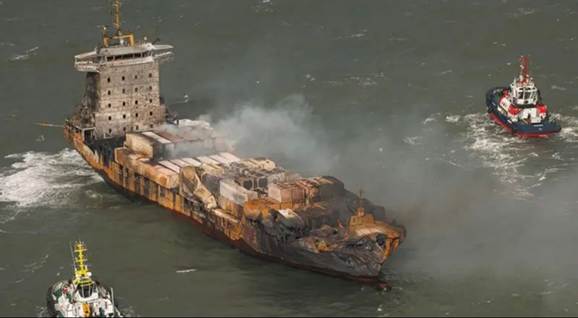
“Ah! Sami, you, like all the news releases, talk of how the two ships ‘collided’ or that they ‘crashed into each other’, inferring both were to blame. I really don’t think it could be the fault of the oil tanker MV Stena Immaculate, sadly no longer immaculate, peacefully at anchor, displaying all the appropriate signage and one of eight other large tankers and container ships at anchor off the Humber Estuary. At anchor you hoist a large black ball in the fore part of the ship; at night you additionally need an all-round white light.”

The MV Stena Immaculate with a large hole on her port side

“Do you need to have a human being on ‘anchor watch’? I read that the Portuguese-registered container ship, MV Solong (Note 1), was steaming south off the East Yorkshire coast at its full speed of 16kts when it rammed the MV Stena Immaculate. The impact caused the Stena Immaculate to be displaced some 200 metres. The Solong’s gross tonnage was 7852 and momentum, if I remember my mathematics, is mass multiplied by speed. What’s that expression? ‘What happens when an unstoppable force meets an immovable object?’

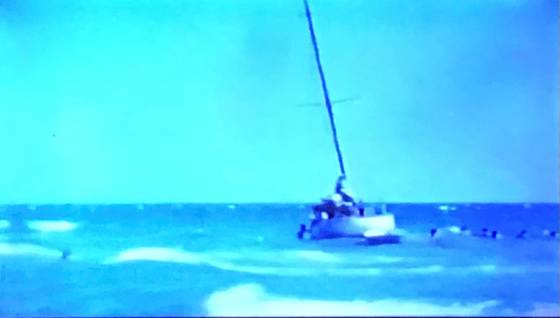
“It’s brought to mind that time in Cyprus, described in PC 231 ‘Ropes, Warps and Sheets’ from May 2021, when I was part of the crew sailing from Akrotiri to Dhekelia, and we anchored off the beach. The skipper didn’t leave anyone on board as he judged it safe. But there was a local wind that blew in the late morning. Someone alerted the skipper as he was having his eggs & bacon …. read the postcard.

A still from some Super 8 cinefilm of Highlight on the beach

In the same postcard I wrote about skippering St Barbara IV, a Nicholson 43, from Liverpool to Oban on the west coast of Scotland, years later. A day or so after visiting the Isle of Man, we anchored off the little village of Lamlash on the eastern side of the Isle of Arran. It wasn’t exactly sheltered from the northeast and when the wind shifted in the middle of the night, the chap on watch woke me, so I could assess the situation; it was 0310. We started the engine, raised the anchor and motored across to shelter in the lee of Holy Isle.

To those of us who sail, Sami, it’s unbelievable that this could happen, given radar and watch-keeper systems. Clearly a human error, ultimately by the captain of the Solong, who has now been charged with Gross Negligence Manslaughter, as one crewman sadly died. I read that the Solong had travelled through this area of the North Sea three times in the last month. However, the description of the collision reminded me of one of those regular reasons people say when they have a car accident and fill out the claim form: “The lamppost just jumped into the road.” (See PS)

“On to more local issues, I am glad I accepted the compensation offered by the Post Office last year, as some of my colleagues are still waiting. Beggars’ belief how bureaucrats can be so obstructionist! (See PC 420 Contentious Issues in the UK for 2025)”

“You’ve come a long way in 4 years, Sami, and it’s been a delight to see you and Lisa happy and excited about life. You know my daughter bought her late maternal grandmother’s wreck of a house and has spent the last 7 months working on it? Well, it’s now habitable enough and they move in tomorrow; still a great deal of work to do but the financial pot is empty and needs to be refilled.”

“You’re going to tell me a story of some blunder or other?

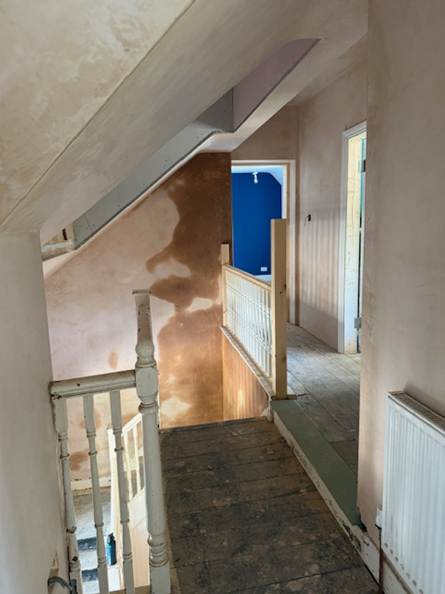
“I am, Sami, as it reinforces the wonderful adage if you’re a DIY enthusiast, ‘measure twice, cut once.’ The builder who’s been responsible for most of the work is a lovely chap and a carpenter by trade, so he of all people should follow the traditional advice. I was at the house a couple of weeks ago and thought that a new balustrade looked too low for safety. I mentioned it to my son-in-law Sam, took a photograph and reinforced my thought by WhatsApp when I got home.

Sam mentioned it to the builder who protested that it was absolutely fine. Then a day later he quietly admitted he’d measure the height from one floor level and not the other, a difference of 10cms. He’s going to have to remake it from scratch!”

“That extra 10cms could make the difference between a boisterous boy going over the top or not! Listen, we know you’re off to Rio but when you come back, can we find a date for you to come and have some supper with us? After Easter maybe?”

“That will be delightful (See PCs 329 & 330 ‘Supper with Sami’ April 2023 when they came to us). Why don’t you send us some options and we can pencil something in. And now I need to get going ….. lovely to see you both …..”

This conversation was over a week ago as we are now in Barra da Tijuca, a western suburb of Rio de Janeiro!!

View from our AirBnB apartment

Richard 28th March 2025

Rio de Janeiro

www.postcardscribbles.co.uk

PS The still smouldering MV Solong has been towed to the Scottish port of Aberdeen, arriving yesterday.

Note 1There’s a joke here somewhere: ‘so long, farewell …..’ ???? (The Sound of Music?)

PC 431 Hope as Always

Haven’t had a chance to see Mo in the last few weeks so, by text, we agreed to meet for a coffee in The Hope Café on Monday afternoon, as next week we fly to Rio de Janeiro. I’d arrived early and managed to chat to Libby for a couple of minutes. She’s recovering from her embarrassment of being the victim of a Romance Scam (See PC 427 Hope Conversations February 2025) and tells me talking about it really helped. (Note 1) She also added that the café still has a special offer of pancakes, a sort-of left over from Shrove Tuesday, as they were a big hit that day.

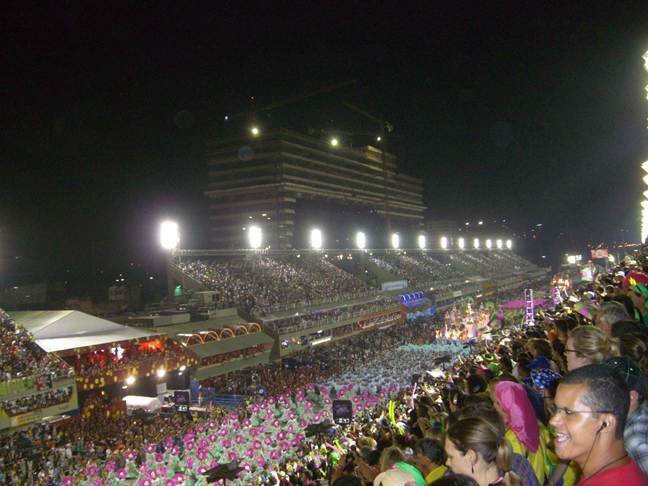
The tradition of having pancakes on the day before Lent in the Christian calendar is embedded in my DNA, as is the celebration of Carnival if you are like my wife, Celina, Brazilian. It seems the whole country stops for days to celebrate, and the parade of the Samba Schools is something to experience.

The parade on part of the 700m Sambodromo

We went to the Sambodromo to witness Rio de Janeiro’s carnival in February 2014; read PC 07 ‘Carnival’ to feel the beat!

The word carnival comes from the Latin for ‘farewell to meat’, ‘carne vale’. European countries celebrate carnival without the beat of Samba and the largest one in Northern Europe is in the Danish city of Aalborg on Jutland. The Nice carnival claims to be the oldest in the world, with its roots dating back to 1294 and it’s a well-celebrated event in many Germanic cities. Don’t forget that the words Mardi Gras, celebrated particularly in New Orleans in the United States, means Fat Tuesday in French! (Note 2)

I like the idea that the need to clear out all the eggs, before one’s 40 days and 40 nights of restricted eating, brought a plate stacked with pancakes, over which lemon juice would be sprinkled to give them a sharpness and granulated sugar sieved or Maple syrup dribbled to give them sweetness, to the dining table. I was getting stuck into such a pile when Mo arrived. Mumbling a sort-of ‘hello’, I finished my mouthful and said hello properly. Mo is already in catch-up mode:

“I wanted to get the train back to north London the weekend before last and I came up against our antiquated rail system.”

“Not sure I understand. Antiquated in what way?”

“We are lucky to have a reasonable network of railway lines and when the trains run on time it’s a very easy way to travel from A to B. But I find it amazing that, in 2025, our train services are affected by archaic employment contracts for the train drivers. Did you know that none of their contracts stipulates Sunday working – it’s voluntary and the operating companies rely on the drivers agreeing to ‘rest-day working arrangements’, for which they get paid some £600 a shift. So I had to do part of my journey on a frigging bus!”

“Ah! Yes! I think this is a clear case of the government shooting itself in the foot.”

“What do you mean?”

“Well, you’re right that the Train Operating Companies have always relied on drivers opting for overtime to cover the Sunday need. In comes the new government, more sympathetic to the ‘working man’, whatever that means (Note 3), and fed up with two years of industrial action on the railways, awards them the asked-for pay rise, without any changes to working practices. So come Christmas last year, drivers who would have traditionally needed the overtime but now flush with cash, just said: ‘No thanks I’m off to Lanzarote with the Mrs’.”

“This is ridiculous. It’s 2025 and we need both a modern transport system and modern working conditions. Reminds me that it wasn’t long ago that the German railway system got rid of a regulation that required every train to have a red flag to be waved in front of the engine! By the way, I read your PC about going into the cold chamber at CryoBright (PC 429 Beyond the Glass). Not something I want to try but I understand its potential benefits.”

“The owner of Cryobright, Rob, commented: “I’ve never really thought about our windows, but I quite like the idea they create a bit of intrigue. A better marketeer would probably blah blah blah about lost ‘awareness opportunity’ etc but we have had a lot of people saying we are a hidden gem – which is nice.”

“Not sure whether you are a cook Richard so ….”

“Oh! I love cooking although don’t do as much as I used to …”

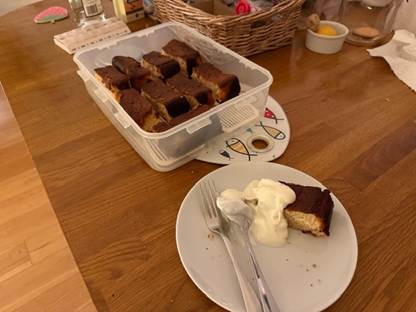
“I found this recipe for a lemon cake which was so weird I had to try it!”

“What was weird about it?”

“Well, first up it uses mayonnaise …..”

“Excuse me! Sorry! Mayo in a cake?”

“Well, as the writers of ‘Bake It Easy’, Tom Oxford and Oliver Coysh, say, mayonnaise is made from emulsified fat and eggs, and that’s half the ingredients of a cake!”

“What was it like?”

“Lovely …. and who doesn’t like lemon cake! Oh! I must tell you, Richard, of a conversation I had the other day after my weekly Pilates class. I was talking to a new student, who said that she’d come back after having her second child, now six months old. And I asked her if she had a nanny. ‘No! Man.’ I obviously looked expectant, wanting a little more information, so she said ‘partner’. Thinking about it later, I thought of these labels we use nowadays.”

At that moment Sami and Lisa came into the Hope Café and I wanted to talk to them, so said goodbye to Mo and …..

(To be continued)

Richard 21st March 2025

Hove

http://www.postcardscribbles.co.uk

Note 1 I cannot emphasise enough how beneficial it can be to talk, talk about your problems, share your thoughts, listen to your own voice.

Note 2 Love ‘Fat Tuesday’! In England the Notting Hill Carnival, first held in London in 1966, takes place in August, and is a celebration of all things Caribbean.

Note 3 The ‘working man’ is, I understand, the product of the ‘working class’ ……. but we try not to mention ‘class’ anymore ….. as most individuals who work could claim to be working. Falling over themselves to be ‘correct’, our new Labour Government suggests that the ‘working man’ is someone who will rely on the State Pension and no other income when they retire, stop working.

PC 430 Like and More

Sometime last year I read a book by an author I was not familiar with – and got exhausted by his use of the rhetorical device, the simile. A simile, well used, gives colour to a piece of prose, as it directly compares two things, using the linking words ‘like’ or ‘as’. Here are a couple of examples from a Jo Nesbø novel: ‘Oslo at this hour was hers, like sharing a stolen hour with a secret lover.’ and ‘The buildings on the city centre were black silhouettes, like a cemetery at sunrise.’ I loved these two enough to add them to my ‘Notes’. You could also say, because someone has years of experience, they were ‘as wise as an owl.’  But the repetitive use of a simile gets tedious. Grammar shouldn’t be left behind at school, as knowledge of good grammar makes what you write a pleasure to read. And grammar changes as our language and its usage evolve, although there is often a huge difference between how we speak and how we write.

A simile should not be confused with a metaphor, a figure of speech that implicitly compares two unrelated, typically by stating that one thing is another. Examples could be ‘the chef was a magician’, ‘you are an open book’ or ‘the exam was a piece of cake’.

The word that introduces a simile, like, has been highjacked by lazy speakers and it’s doing my head in. Here’s a great generalisation; anyone under 35 uses the filler ‘like’ so often its meaningless. Sometimes you hear: “I mean, like, well, you know, if I am totally honest …….” and you’re waiting for the conversation to start, let alone being irritated by ‘totally honest’, as you’re either honest or not.

Robert Crampton writing in The Times had this to say of Generation Z (Note 1):

“One big growth business, it was reported yesterday, is the provision of etiquette courses for awkward youngsters. Etiquette not so much as in how to get out of a sports car in a short skirt or which spoon to use for soup, but more everyday stuff such as introducing yourself with confidence, establishing eye contact, using the correct forms of address to a prospective employer, and so forth. Not mumbling, not looking at the floor and not calling your interviewer “bro”, basically. And maybe, like, not saying, like, like every third word? With an invisible question mark, like, at the end of every sentence? That all sounds very sensible to me.”

The vexed subject of fillers, lazy words and thinking time when talking – normally words not used when writing, even a text – reminded me of a client from my business coaching days. Many years ago Brian (Note 2), a new client, sat down at my table in The Institute of Directors members’ meeting room. I always started a series of coaching sessions with the question: “Tell me About Yourself”, expecting the response to last for at least a couple of hours; for me it was one of the most fascinating and intriguing parts of our interaction. After about ten minutes I noticed Brian kept filling his story with ‘you know’, when clearly, I didn’t know! So I started making little ticks in my folder every time he said it. After 30 or 35 ticks, his curiosity got the better of him and he asked what I was doing. He was a bright chap but completely unaware of this lazy habit he’d developed, that detracted from what he was saying.  

Being a bit of a pedant when it comes to our language, I am a paid-up member of the Apostrophe Society, railing against councils who can’t be bothered and those who say it simply doesn’t matter if the understanding of the phrase or sentence is obvious. There is a difference between ‘it is a fine day’ which can be written ‘it’s a fine day’, and ‘its a fine day’. Similarly, ‘this cheese is past its sell-by date’; writing ‘this cheese is past it is sell by date’ is nonsense. For me a slippery slope into muddy waters.

American English is fine, in America, but here we are seeing some of their phraseology creeping in and that’s sad. For example, we Brits are happy to meet someone, we don’t have to add ‘with’ as it’s obvious.

My regular readers will know that I am an enthusiastic follower of the sequence of 26 Hatha Yoga postures and two breathing exercises put together by Bikram Choudhury, an Indian American, in the 1970s, following an accident that left him wheelchair bound. The classic 90-minute sequence is brought to life by a dialogue that all teachers must learn, word-perfect; individual deviation is only allowed after many years! Unfortunately, Birkam’s grasp of the essentials of proper English is weak and there is much to scream about.

The word ‘more’ refers to greater quantities of something; there is one and there is more than one. The word ‘further’ refers specifically to more of something. ‘One more step’ refers to other steps being taken, whereas ‘One step further’ refers to where the steps lead to, one step closer to a goal. More is either a pronoun or an adverb; it can’t be an adjective. Bikram uses the word ‘more’ with gay abandon, in most cases it should be ‘further’. For instance ‘more back’, encouraging students to bend further backwards; ‘more higher’ is a real mangle – it’s either higher or not!

Sometimes we are encouraged to go ‘much more back’ or ‘lift more higher’ and nowhere in the dialogue is the word ‘further’. You might ask whether this matters, in the greater scheme of things and the answer is probably not. But when one is a pedant, it only gets more and more irritating, not further and further irritating (!), so much so that it becomes the subject of one of my weekly scribbles!

Richard 14th March 2025

Hove

www.postcardscribbles.co.uk

Note 1 Not only Gen Z but Millennials as well.

Note 2 I never had a client called Brian so safe to pull this name out of the anonymous hat.

PC 429 Behind the Glass

I don’t know about you, but I am often intrigued to know what goes on behind shop fronts that have frosted windows. They are the complete opposite of those using the shop window to entice potential customers, displaying something to make you want to go inside, maybe a poster showing a sale percentage reduction. Sometimes restaurants have an opaque window to give their customers some privacy and it’s the same for The Hove Practice, a private GPs’ surgery, which recently moved onto Church Road. Along the street is a massage clinic, with the obligatory hazy windows! We are lucky enough to have Kay Delphine, a very experienced masseuse, who comes to our apartment, otherwise we might have used one of these places. Some had a seedy reputation, offering more than a simple massage, but I sense those days have long gone.

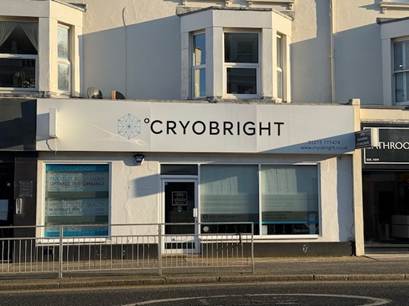
Opposite etch (note 1), a restaurant on the corner of Church Road and Hove Street run by Steven Edwards, a winner of MasterChef The Professionals, is one such place. A non-descript opaque window with its shop signage, ‘CryoBright’, offering no real clue to what goes on inside.

A voucher at Christmas gave us a couple of ‘experiences’ at CryoBright and in late January we pushed open the door. CryoBright provides ‘convenient, affordable access to the most advanced wellness and recovery techniques.’ These include an infrared sauna, red light therapy, fat freezing, leg compression therapy, physiotherapy, whole body cryotherapy and massage, mainly aimed at those recovering from some form of sports injury, which I am not! I was interested in the leg compression trousers, to improve blood circulation to my feet, and in the cold chamber – out of curiosity!

The ‘Compression’ trousers slide over your legs then go through a 20-second sequence of inflate/deflate, inflate/deflate for 20 minutes. It seems very gentle, too gentle almost and so I decide to concentrate on the cold chamber.

The idea is that extreme cold acts as a stimulus to your nervous system, particularly to the hypothalamus, responsible for reacting to dangerous situations; the ‘fight or flight’ trigger. It initiates several physiological reactions in the body, the main one being to restrict blood flow to the periphery, concentrating it around one’s vital organs.  

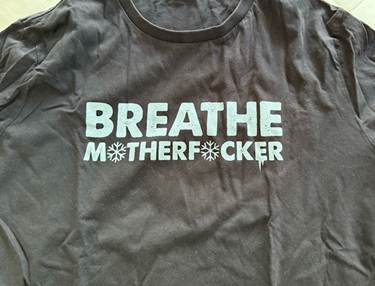
I said I am curious. Most of my experience of ‘cold’ is from winter weather, either skiing or on military exercises many years ago, when the wind chill can drop temperatures alarmingly. I am a pussy when it comes to swimming in a cold sea, such as in Estoril in Portugal, but the benefits of cold-water immersion are becoming more mainstream. Here in Hove many people swim in the sea all the year around, part of their daily routine, and swear by the invigorating afterglow. (Note 2) I guess we’ve all heard of Dutchman Wim Hof, aka the Iceman. In addition to plunging himself, and other paying customers, into freezing cold water, he markets a particular technique of breathing. Proper breathing is an essential part of practising yoga; in the hot yoga series you only breathe through your nose for the first hour.

My Wim Hof T Shirt

Hof’s technique involves inhaling through your nose or mouth, filling both belly and chest, and exhaling through your mouth. Each breath should be short and powerful; do 30 to 40 then stop. We all take our lungs for granted, never bothering to exercise them – it’s estimated we only use some 60% of our lung capacity. And I certainly hadn’t heard of COPD (Chronic Obstructive Pulmonary Disease) until those first COVID months. In summary, I breathe well but wouldn’t want to plunge myself into a bath full of ice. (Note 3)

But when we returned from Portugal in September last year, a new cold-water shower, installed in the outer courtyard as part of the yoga studio’s new sauna offering, offered an opportunity to cool down quickly. Now, at the end of my 90 minutes 40°C hot yoga class, I go straight out and have a cold shower. Strangely, I have begun to look forward to it; odd huh! It’s wonderful!

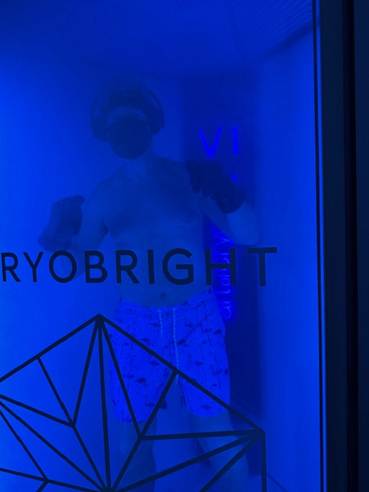
At CryoBright, Rob explains that the cold chamber is designed to give your body a thermal shock so, wearing shorts, a facemask, gloves, socks and slippers and with a set of headphones clamped around my ears, I open the door and enter. Oh! I should have said, it’s minus 85C. I have opted for 4 minutes but after 5 seconds my brain is already saying ‘fly!’. Fortunately, I decide to stay, moving around, glancing at the large clock on an iPad outside that’s counting down the four minutes, listening to music. I wonder how my body is reacting, why my nipples are feeling particularly cold, and resist the temptation to focus on the time. Just enjoy the experience. Outside, I put my clothes back on; my back is tingling in a delicious way and I feel fantastic. We sign up for a package of sessions; this Monday was my eighth and now I look forward to freezing my b******* off!

Our curiosity has encouraged chums to try it. Spread the word!

Richard 7th March 2025

Hove

www.postcardscribbles.co.uk

PS Celina also enjoys the cold chamber!

Note 1 Note the small ‘e’. Generally the first word of a sentence uses a capitalised first letter. There’s a distinction between ‘Etch’ and ‘etch’, although it’s personal! As a verb, to etch means to eat away the surface of something; I can only guess this is the tenuous connection for the title of the restaurant.

Note 2 In the summer of 1966, as an Officer Cadet at Sandhurst, I was attached to a Germany-based Artillery Battery for its two weeks Adventure Training near Oberammergau. I went with Staff Sergeant Curtis to recce a lake for some canoeing. The water looked inviting; he suggested I jump in. It was absolutely freezing, almost heart-stopping (!) and I got out as quickly as I had got in! Curtis laughed.

Note 3 The outdoor swimming pool water at Dauntsey’s School was fed directly from a cold spring. Maybe our lap times were quick as we wanted to get out as soon as possible.

PC 428 More of Life’s Observations

In PC 424 ‘We are Nothing Without Hope’ (31 Jan 2025) I scribbled about the lasting memories some have of the Holocaust, such as Eddie Jaku who wrote ‘The Happiest Man on Earth’. Those who survived have been encouraged to record their experiences of their time in the Nazi Concentration Camps, such as Buchenwald, Belsen Bergen Hohne and Auschwitz. Doing so has awakened long-buried memories of horror, so there has been a great reluctance; but without their courage, these stories will be lost and they cannot be.

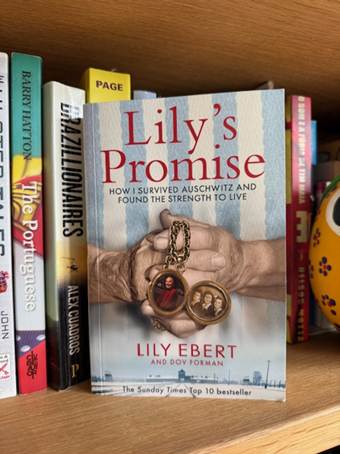
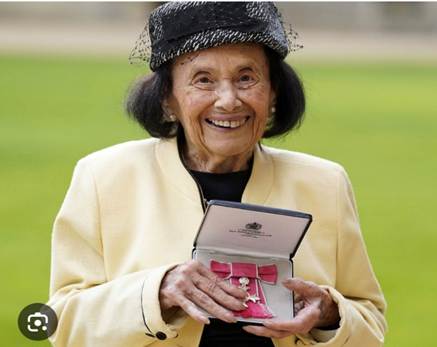
I recently finished ‘Lily’s Promise’ (Note 1), the autobiographical account of Hungarian Jew Lily Ebert’s time in Auschwitz-Birkenau from July 1944. In October 1944 she was moved to the Altenburg slave labour camp that provided the workforce for the HASAG munitions factory. In the first week of April the factory was closed and more than 2000 human skeletons of women and children were marched off – to somewhere. Three days later, on 12th April 1945, they realised their guards had gone. An American Army unit found them in a village called Pfaffroda, in Saxony, 5kms from the Czech border. The second half of Lily’s book is equally fascinating, hugely engaging, and I encourage you to read it.

Lily receiving her MBE

You know when you’re reading a book there’s sometimes a temptation to turn a corner of the page so you can reread a piece again? The rounding up of Hungarian Jews began at the end of June 1944. By 5th July, Lily and her two sisters find themselves herded like cattle onto a train for a journey of four days; with no food, no water, nowhere to defecate. It’s possible that cattle have more space. The train took them to Auschwitz. I had to read the following paragraph twice, so awestruck and horrified by its words:

“And now I must pause and think. Words can barely describe what happened next, but words are all I have. Even while I was living through this time, I could not comprehend it, so how could I convey the experience to someone who was not there? I try to go back in my head, to understand how our hearts kept beating, how our lungs kept breathing, how we did this, how we did that, the mechanics of our movements, how could this have possibly happened. I know it did, because I can’t forget it. I realise that at this point we simply went numb. I felt yet could not feel. I thought yet could not think. In the face of such brutality, nothing about me worked as it should. The idea that one human being could do this to another overwhelms me.”

Lily Ebert died on 9th October last year aged 100; her legacy, her promise, will hopefully be remembered for decades.

Needing to come back to today, to ‘now’, I head to the Hope Café and find Sami.

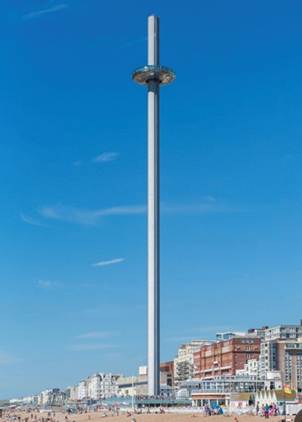
“Oh! Hi Richard” he said, looking up from his iPad. “Just trying to understand the debacle about the i360 (Note 2), how the council have written off the attraction’s debt of £53m and sold it to Nightcap for an undisclosed sum, rumoured to be between half and one-and-a-half million pounds. What do you think?”

“God! I had a very jaundiced view of the whole thing from its conception. Firstly 50% of the view from the top is the sea; no islands, no estuary mudflats, just the English Channel, so I thought it should have been called the i180! If you’ve been up The Spinnaker Tower in Portsmouth ……”

The Spinnaker Tower in Portsmouth

“Lisa and I have ……”

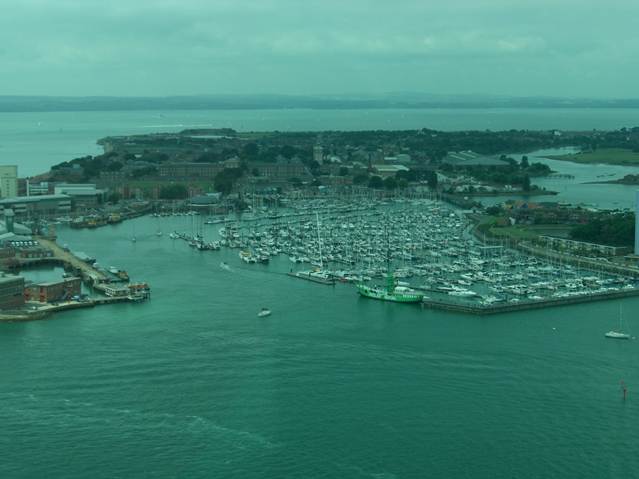
“….. you’ll remember there is something to see at every point of the compass. South and the whole of the Isle of Wight stretches in front of you, vertically down to HMS Victory and the dockyards, East towards Hayling Island and Chichester. Ferries, cargo ships, liners and yachts criss-cross The Solent.

The view across Gosport Marina to the Isle of Wight

Here in Brighton the offshore wind farm is the only thing that breaks the monotony of the view across The Channel.

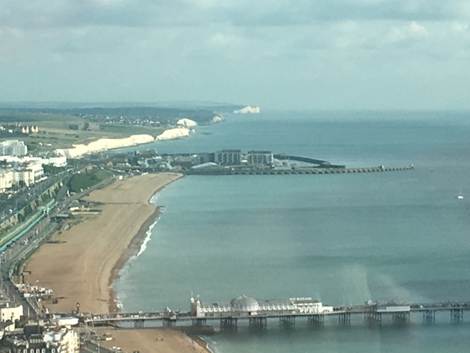
The view east over the pier and marina towards the Seven Sisters

Secondly The Green Party was running the council when it was conceived, but the glass came from Italy and the metal tubes from The Netherlands; hardly ‘supporting the local economy’ …… and actually a sad reflection on the UK’s manufacturing capabilities.

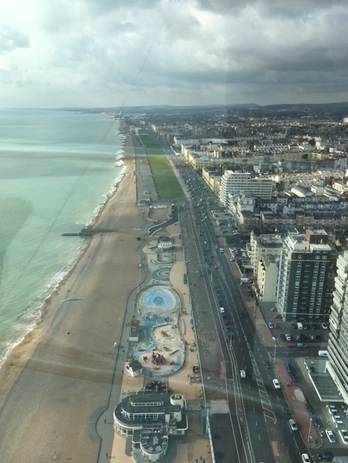
The view west. We live just inland from the top of the green strip (Hove Lawns)

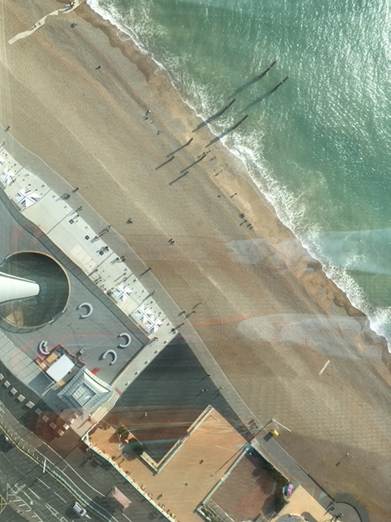
Thirdly, everyone wants to take photographs when they get to the top, so the glass should have been non-reflective. Didn’t anyone realise this was a major requirement? Too expensive? Then don’t build it!

Reflections of legs etc spoil the photograph

And lastly, it was never going to make enough money to pay off its debt; the council borrowed, inter alia, £36 million from the Government Public Works Loan Board. Currently it stands at £53 million!”

“It’s been bought by Nightcap, a company founded by Sarah Willingham-Toxvaerd in 2020, that runs some 46 hospitality sites across the UK. They take over the 115-year lease of the site. Do you know how many people have actually been up it Richard?”

“Well, Celina and I have, and my son-in-law Sam has climbed right to the top, but the wildly optimistic prediction was 739,000 per year. The reality is that the total number of visitors from when it opened in August 2016 and January 2023 was only 1,879,000; that’s only 268,000 per year, with some allowance for the pandemic lockdown. That tells you why it went into administration.”

“So often common sense is drowned out, this time by back-of-the-fag-packet predictions; the debt’s been written off to facilitate the sale and now the council take that on! Great!”

Richard 28th February 2025

Hove

http://www.postcardscribbles.co.uk

Note 1 In the depths of Auschwitz, Lily made a promise to herself that, if she survived, she would dedicate the rest of her life to ensuring the world knew what happened during The Holocaust.

Note 2 The so-called i360 is a 162m tower erected on Brighton’s seafront in 2016. It’s opposite the skeletal remains of the City’s West Pier, which burnt down in suspicious circumstances in 2003. A 200-person capacity observation capsule rises to 138m so visitors can take in the view.

PC 427 Hope Conversations

I had promised Libby I would offer what support I could after she’d confided in Josh and me that she’d been Love Scammed. Knowing she’d be finishing her Barista duty behind the Hope Café counter mid-afternoon on Tuesday, I popped in, grabbed a double espresso from Josh, and joined Libby at one of the more secluded tables.

“Good to see you Richard and I think talking about my experience will help put it behind me. It knocked my confidence so much and has made be both more anxious and also more suspicious of other people, and that’s horrible.”

“Jim died a few years ago, right?

“Dear Jim. Yes. We’d had some wonderful times, then he had a heart attack and died in his chair, watching some trashy Soap on telly. He was only 68.”

“Well, I think that’s a good way to check out, rather than in a hospital bed or in some smelly care home. Then you came to join Duncan’s team here?”

“Gives me an opportunity to engage with the customers; some are delightfully chatty and when Susie was here. (Note 1) I felt like I had another family. But it was lonely at home, so when Andrew, never sure it was his real name, made contact via Facebook, I answered. He claimed to have known Jim through work ….. and soon we were texting quite regularly. Over a few weeks I began to look forward to his messages, telling me of his time in the Army, of his divorce and his sad estrangement from his three children. He made out he’d been the victim in the divorce, had lost so much and was now struggling financially. My heart went out to him, how his story of loneliness resonated with mine. We all need the company of others, right?

“Absolutely Libby. I’ve had periods in my own life when I have felt very lonely, others when I am surrounded by people, people whom I trust and love. Don’t tell me, Andrew asked for some money, like a friend’s brother David? A 61-year-old divorcee, he was sucked into believing that Tatiana from Leningrad was in love with him; he took the bait, ‘hook, line and sinker’! She couldn’t wait to come to England but first needed, oh! I can’t remember, money for her grandmother’s operation, a new passport, to buy the flights that she kept putting off. Eventually she hoodwinked him out of £30,000. Apparently there is still a hesitation in David’s mind that Tatiana exists, that she loves him!”   

“Exactly! Silly isn’t it! I’ve thought how could educated people be so stupid, and yet here I was sending money to his UK bank account, so he could pay the outstanding solicitor’s bill of £750. I had some savings and I imagined our relationship would be strengthened; maybe he would finally meet me.”

“So what happened? What made you realise it was a scam?”

“He said he was going to take me to Rome for a long weekend to say Thank You. He gave me all the details, flight timings, the name of the hotel and so on. Then he admitted he didn’t have a credit card and the hotel needed one for security. Oh! Why oh why! I gave him the card details and the security number and arranged to meet him at Check-in at Gatwick Airport on the Friday afternoon.”

“And he never showed? And he used your credit card? Oh! Libby I am so sorry.”

“Exactly! I felt so let down, cried all the way back to Hove in the taxi and tried to stop my credit card being used fraudulently. He took £15,000. The bank said I had given him my details and there was little it could do. (Note 2) There! Now I have told someone it feels better, so thank you Richard. The more people who know the less others will fall for these scams. Now I had better say goodbye to Josh and get on with my day. See you soon.”

I see Sami munching on a croissant so go and say hello.

“Haven’t got long, but thought I could tell you a recent experience.”

Why not, Richard. If it’s quick.”

“Had to laugh the other day, both at myself and with Sandra, the Tesco member of staff. Although we naturally use Waitrose for our online weekly shop, there is a large Tesco’s supermarket a 5-minute walk away, opposite St Andrew’s Church in central Hove, which is handy for those few things you need right now. My regular but infrequent visits prompted me to apply online for a Tesco Clubcard, on the basis it costs me nothing and would occasionally reduce the bill at check-out. I downloaded it to my Wallet on my iPhone and on Monday thought I would try it out.

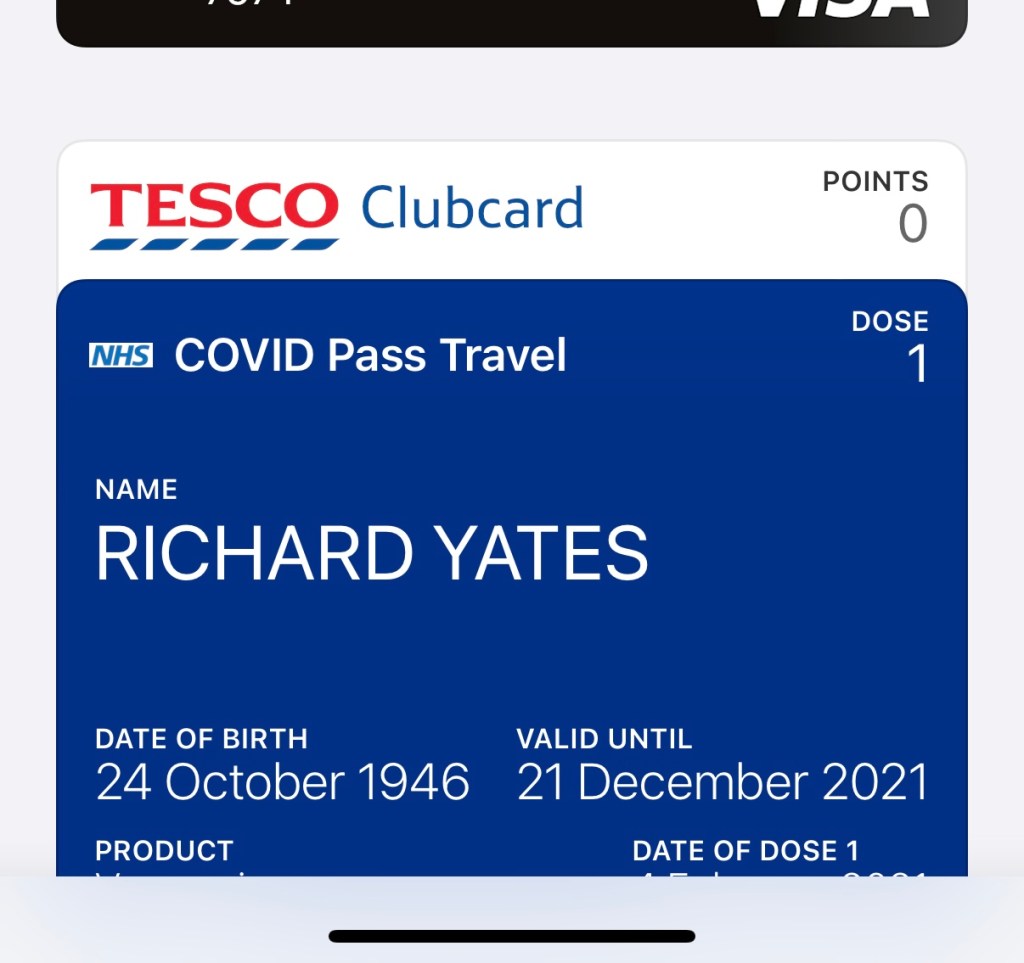
Arriving at the self-service checkout, I scanned my three items, opened the Wallet App, found the Tesco logo and presented the QR Code to the scanner. “We do not recognise this.” was its response. So I tried again ….. and got the same result. Whilst the supermarket wasn’t busy so I wasn’t holding up anyone, Sandra, who was just clearing empty plastic baskets, asked whether she could help. I explained I had never used my Clubcard before but …. and she took my iPhone and showed it to the scanner …. and got the same result. She then looked at my Wallet. The Tesco Clubcard QR Code was hiding behind an old Covid Travel Pass, which had expired in December 2021. We had a laugh.”

“Actually, that is funny Richard. Now, see you ….”

Richard 21st February 2025

Hove

www.postcardscribbles.co.uk

Note 1 Susie is Libby’s niece. After time in The Hope Café, Susie took a late Gap Year for six months in New Zealand and Australia before coming home to do a course in logistics.

Note 2 Victims of Romance Fraud lost more than £7 million in over 600 cases in Surrey and Sussex last year.

PC 426 It’s a Fine Line ….

I was going to scribble how it’s often a fine line between success and failure, between life and death …… but I thought I would consult my Oxford Illustrated Dictionary and see what it says about ‘line’. Wow! Over a column of the three-columns-to-a-page layout devoted to the word ‘line’.

Most would immediately understand it is a noun and that it joins two points. We have telegraph and power lines; lines marking the boundaries of, for instance, a tennis court; life lines on the palm of your hand; lines that connect points having common property, like an isobar, or the Equator or lines of longitude or latitude; lines to be learned by actors, as opposed to reading between the lines to discover a meaning not obvious or expressed; a line of poetry remembered years later; somewhere to hang your washing, the clothes line; words to be written out as a school punishment; naval ships in formation are often line astern or line abreast;

tram lines in cities or railway lines criss-crossing the country; in Rugby Union forwards form a line to receive the ball from the touchline, a ‘line out’. As a verb, troops could line the streets for ceremonial occasions; you could line a drawer with paper or you could line your stomach, anticipating drinking too much alcohol!

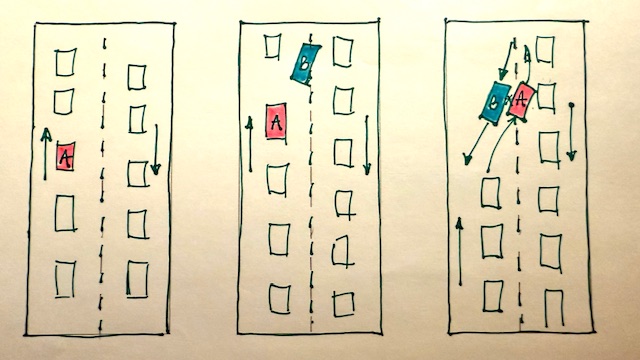
My own fine line, my brush with death in 1991, remains very clear today. As a passenger (in car A in diagram) being driven into Canberra, Australia during the rush hour, traffic was heavy in both directions. Suddenly we were aware of a car (car B) overtaking the oncoming traffic, coming at us head-on. There was nowhere to go. My friend decided to swing right, although instinctively left would have been the better option!

The oncoming car swung to their right; a collision seemed inevitable. The only touch was the paintwork on the passenger-side wing mirror; a very fine line indeed.

Writing about lines, fine or not, remined me of a question I often asked my clients in their first coaching session. I would draw nine dots on a piece of paper, thus:

then ask them to join them up, using four straight lines, without taking their pencil off the paper. We habitually see things that aren’t necessarily there, because it gives us a comfortable feel, recognition of the familiar. I recall that about 25% of my clients were successful. Trump is thinking ‘outside of the box’ with his ideas about Gaza – makes me wonder whether he would be in the 25% or not?

Last weekend in Europe we had the second round of the Six Nations (Note 1) Rugby Union Competition. England were playing France; it was a very good game to watch and the lead changed hands throughout, although a last minute try by England meant we won 26 points to 25 …. a fine line. (Note 2)

Words which mean the same are collectively called synonyms, like ask, question or inquire, or beautiful, gorgeous and dazzling. You can also have a phrasal synonym, like ‘fine line’ and ‘hair’s breadth’. Typically a hair strand is between 0.03mm and 0.08mm in diameter; one nominal value often chosen is 75µm. Such measures can be found in many cultures; for instance in the Burmese system of Long Measure a tshan khyee, the smallest unit is literally a ‘hair’s breadth’.

A straight line between two points can be at any angle, but geometrically graphs always have at least two axes, one horizontal and one vertical. My pedantic nature is offended if something isn’t level, horizontal or vertical. Sometimes it’s a fine line, even half a degree or so. When we moved into our apartment in Amber House after its conversion in 2012, a couple of light switches were not straight; given the availability of spirit levels, it was a good example of poor workmanship.  

When sailing, if the wind is coming from the direction you want to go in, you have to ‘beat’, with the sails as flat as possible. It’s a very fine line to steer the yacht at its optimum; too much into the wind and sails start being back-winded; too far off the wind and the yacht heels so much, reducing the efficiency of the sail area. When you get it right, it’s as if the yacht ‘lifts its skirt and flies’; yachts are always female by tradition so this expression should be safe in this sensitive world.

For James Howells it’s still a fine line between success and abject misery! In Wales in 2013 he had a bitcoin wallet worth £4 million; its password was stored on his hard drive. His girlfriend, possibly ex by now (?), threw out the hard drive with some rubbish, presumably without knowing what it was. Somewhere under a mountain of household waste in some council refuse tip is a hard drive which, if retrieved, could unlock, at current bitcoin value, about a billion pounds sterling. He’s even offered the council millions if he’s allowed to successfully search for it, so far without success. 

The polarisation of everything, including politics, views about this and that, personal opinions, is making society more fractious, the line between acceptable and unacceptable extremely thin, like living on a knife-edge. With the increase in false news stories and conspiracy theories, it’s surely time for us all to apply good old fashioned common sense and move towards the centre.  

David Lammy the UK Government’s Foreign Secretary: “There’s a fine line, as you know, between free speech and hate speech.” Maybe I could add that it’s also a fine line between love and hate, other extremes. So, let’s concentrate on ‘Love’, particularly on this romantic day?

Richard St Valantine’s Day 2025

Hove

www.postcardscribles.co.uk

PS Last Summer, a tree near my brother-in-law’s apartment in Estoril Portugal looked as though it could do with about one third taken off it. Someone asked whether that should be from the top or the bottom. (Just think about that?)

Note 1 The six nations comprise England, Scotland, Wales, France, Italy and Ireland

Note 2 The previous weekend Ireland had beaten England 27-22.

PC 425 Generation Z

The lyrics of Mike & The Mechanics’ song ‘The Living Years’ start: ‘Every generation, blames the one before, and all of their frustrations, come beating on your door.’ Nothing new under the sun then?

To those of my readers born between 1997 and 2012, although I doubt if my eldest grandson Jasper aged 13 is reading my postcards, and known collectively as Generation Z, thank you. (See Note 1 for generational definitions.) Thank you for what you have done for those of us who don’t want to drink alcohol or who don’t want to drink much alcohol or for those of us who believe you can celebrate anything without getting completely sozzled, hammered, out-of-it. In these scribbles I am exploring Generation Z, a decidedly different generation than those that have gone before, or is it? Is it solely that ‘Gen Z’ has a catchy ring to it, not something that could be levelled at ‘Millennials’!

I grew up in a household when there were two landline telephones, one in my parents’ bedroom and the other downstairs. Local telephone calls weren’t that expensive, ‘trunk’ ones more so ….. and international ones had to be booked through an operator. My Scottish step-father kept a tight control on the length of the latter. Then came mobiles, ‘cells’ if you are American, and talking to someone not next to you was easy. In fact telephone calls have become so ubiquitous that for some they’re a nuisance, an intrusion, and they’ve stopped answering their mobile. A rather odd choreography’s developed; you text someone to say you want to talk to them, asking if it’s convenient. The recipient, rather than call you, responds to your question.

A recent survey of 18 – 34-year-olds, so Millennials and Generation Z, found that 25% never answer their mobile; they either ignore the ringing, respond via text or, if they don’t recognise the number, search for it online. Psychologists have suggested that as they haven’t developed the habit of speaking on the phone, it now seems to Generation Z as weird and not the norm. Mind you we’ve all got fed up with cold calls and scammers. I do not answer my phone if I don’t recognise the number; if it’s important the caller will leave a message. My only exception is my local GP’s Surgery …. but for some very strange reason that comes up as ‘Majestic Wines’!

Generation Z have made more headlines about their beliefs and habits than previous ones but that probably reflects the exponential rise in fast communication. Traditionally there have been some big milestones in life; going to university, getting married, owning property and maybe having a baby (Note 2). According to Ceci Browning (aged 23): “The average cost of a house deposit is £50,000; the average age to be able to put that down is 34. The average age for getting married is around 31. With no savings, no hope of buying a house anytime soon and no desire to rush into lifelong monogamy, my generation are turning our backs on these objectives and finding alternative markers to measure the progress of our lives.”

They obviously think it’s the fault of previous generations that houses seem unaffordable, but then they display a rather ‘I want it, and I want it now’ attitude; the entitled generation. I reflect I was 31 when I first got married, 32 when I bought my first house; so maybe this is just a whinge?

For Ceci, her markers are running a Half Marathon; quitting her job …. to follow her dream; taking a sabbatical …. after getting qualified and knuckling down; go back-packing for six months before she’s 30; launching an entrepreneurial side-line to feel accomplished; moving abroad …. and finally, starting therapy.

It’s well known that Generation Z talk about their feelings more than any previous ones.  Robert Crampton, a Times writer: “I’m thinking, for instance, of hugging. Young people hug each other all the time, even at first meeting, boys with boys, girls with girls, girls with boys. Hugging just wasn’t done when I was their age, not even between parents and their kids, or not much anyway, and we missed out. I mean, c’mon, who doesn’t love a hug?” You will remember that worrying headline from Caitlin Moran from PC 421: ‘Too many boys are killing themselves. We have to encourage them to talk, cry and scream.

Having spent 15 years seeing business clients 1:1, I know how vitally important it can be to talk to someone, to engage. If it’s become normal for Generation Z, that’s all for the good. But, and it’s a big ‘but’, there is a large difference between coping with life’s ups and downs, experiencing, learning, making choices, and claiming ‘it’s bad for my mental health’! An extremely small number of people do need medication and care to simply survive, but the cry from a majority about their mental health is getting very boring.

More information about this generation appeared last month. Shock headlines: ‘They don’t own a car’ – if you live in a town, why would you? Costly to park, bad for the urban environment! ‘Forty three percent don’t drink alcohol’ – wonderful! ‘They think they are more hygienic than other generations.’ – now that can’t be a bad thing; we could all learn better hygiene habits. ‘They are food-aware ie about glucose and lactose and allergies but not obsessed with their size or shape.’ We have an obesity crisis in the UK so being more knowledgeable about food must be a good thing.

A final comment. If you belong to either Gen Z or are a Millennial, be aware of both the positive and the negative power of social media. Cancelling anyone is a good example of the latter.

Richard 7th February 2025

Hove

www.postcardscribbles.co.uk

Note 1 The Greatest (1901-1927), The Silent (1928-1945), The Baby Boomers (1946-1964), Generation X (1965-1980), Millennials (1981-1996), Generation Z (1997-2012), Generation Alpha ((2013-2024) and Generation Beta (2025-2039)

Note 2. The birthrate across most developed countries is dropping, despite their effects to encourage more procreation. Everyone is worried that the growing financial burden of an older population falling on the shrinking workforce is unsustainable. Fortunately, here in the UK net immigration seems to buck the negative trends seen elsewhere. But young adults no longer necessarily think having a baby is the next logical step along life’s path; according to Shane Watson, writing in The Times, they rather see it as ‘the single biggest drain on resources, time, freedom and mental stability …. and it’s voluntary’.

PC 424 We are Nothing Without Hope

There was a very good reason that Duncan named his café here in Hove ‘The Hope Café’, as on that single word hang our todays and our tomorrows. Without hope, in whatever form, we are nothing. Last Monday was International Holocaust Memorial Day, this year’s made even more poignant as it is the 80th anniversary of the liberation of Auschwitz.

Back in February 2022 I wrote about the atrocities sections of our global society have inflicted, one against another, in PC 268 Least We Forget. Whilst acknowledging that unspeakable horrors committed, man on man, have not been exclusively the preserve of the Nazis, the latter managed to create an industrial killing machine within their concentration camps. Just remember these words: ‘In Auschwitz it’s estimated that a million Jews were killed’; 1,000,000 individuals expecting, as we do today, to have a reasonable life expectancy, simply snuffed out because of their race. The testimonies of survivors at Monday’s Ceremony of Remembrance at Auschwitz shared a common theme, that current and future generations must heed the alarm bells already ringing from rampant antisemitism on display in the Middle East and elsewhere.

Last December I read ‘The Happiest Man on Earth’, the autobiographical account by Eddie Jaku (Note 1) of his life, particularly the years he spent in Buchenwald and Auschwitz. For those who are uncertain whether these camps existed, this story lays it out in all its horror and degradation. You may have already read what King Charles wrote on Monday in the Auschwitz Visitors’ Book: “Remembering what took place here, and those who were so cruelly murdered, is a duty, a sacred duty that must be protected. Being here today, hearing the stories of those who experienced its horrors, seeing the shoes of children whose lives were taken when they’d just begun, and walking the paths upon which such cruelty was inflicted is something I will never forget.”

Tova Friedman, now 86 but aged 6 when Auschwitz was liberated, should have a final word. “I stood and watched helplessly as little girls were marched away to the gas chamber. ….. I thought it was normal that if you were a Jewish child, you had to die.”

Let us hope.

I was hoping to have a chat with Lisa, Sami’s partner, when I went to The Hope Café on Wednesday, as I hadn’t seen her this year. Sure enough she’s at a table, tapping her laptop keyboard as if her life depended on it. Incidentally I hope that schools are teaching children to type properly and not just using two fingers. Unlike mine, their future is digital. Lisa’s happy to be interrupted.

Hi! Richard. I enjoyed your last postcard …. what was its title ….  ‘There Are Standards, Carruthers.’  Excellent! I bet it garnered a lot of comments?”

“It certainly did! Funny how we find something so simple as manners and common courtesies an interesting topic. There were a lot of new readers who ‘liked’ it, so I am pleased. How are you and Sami?”

“We’re very good, thanks. With the weather so vile we’ve probably watched more television that we usually do and really enjoyed a new drama called Patience, set in the City of York. The character of the title, Patience, played by Ella Maisy Purvis, has autism, as has Ella. I read “In an overcrowded crime drama market it is the slowly developing connection between Bea (Ed. Bea Metcalf is a detective working for Yorkshire Police) and Patience that is the Bechdel test-passing USP of this show.”

“Er! What’s the Bechdel test?”

“Glad you asked. I was aware of it but it’s become very popular of late, so I looked it up. Essentially it asks whether a work featuring at least two female characters have a conversation about something other than a man.”

“Can you imagine? But seriously, that is interesting. And I assume Patience is neurodiverse….”

“Absolutely! Just like Bill Gates and see where that got him.”

“Celina and I occasionally watch dramas on Channel Four which are sponsored by a user car dealership called Arnold Clark; the advertisements always feature a car … surprising huh! One of the latest shows a chap taking an electrical charging cable, walking to the charging point on the rear of his electric car, and plugging it in. Then he seems to stand there, holding the cable handle, looking up …… at an imaginary petrol station pump display ….. as he had always done!

Ah! Habits die hard.”

“You may remember in PC 422 ‘Back in The Hope Café’, right at the end, I admitted to Mo that I had asked someone who was due to have an acupuncture session whether it was online or were they going to the practice. Since then, the acupuncturist has confirmed he charges 25% more for online appointments!

Then I had an amusing exchange with our masseuse, Kay, who had a tree in her garden that needed trimming. She asked by text whether she could borrow a saw. She’d dictated her text and hadn’t checked it before pressing ‘send’. It came out as ‘I would love to borrow your soul if that’s possible.’ A day later she realised: ‘Just realised I’ve asked to borrow your soul. I’ll let you keep it and just stick with the saw. Anyway, didn’t you sell your soul a long time ago?’ My response was short: ‘Too long ago to remember; too short a time to forget.’”

“Brilliant! By the way, I noticed Libby’s looking very subdued and quietly asked Josh if he knew why.  Apparently, she’s admitted to him that she’d been the victim in a Romance Scam, has lost a lot of money and is feeling very embarrassed.”

“I am not surprised! I’ll have a chat with her sometime, not now, and see if she can put it behind her.

Richard 31st January 2025

Hove

www.postcardscribbles.co.uk

PS For clarity, I am not Jewish, simply a human being.

Note 1 Eddie Jaku OAM (Order of Australia Medal) was born Abraham Jakubowicz in 1920. He died in Sydney in October 2021.