PC 88 Coromandel

Maybe you’ve heard this word before, this name, maybe you haven’t? But some words just ooze intrigue, spiciness, even, dare I say it, sexiness …….. and I think ‘Coromandel’ is one of these. If you ‘Google’ it you get lots of hits!

Geographically the land of the Chola dynasty in south-eastern India was called Cholamandalam in Tamil, which literally translated as ‘the realm of the Cholas people’ from which the Portuguese derived the name Coromandel. Nowadays the Coromandel Coast is recognised as the coastal region between the southern tip of India and the western side of the Bay of Bengal.

fullsizerender-copy-2

As India was part of the British Empire until partition in 1947, it was inevitable that this evocative name would be used by its Royal Navy. In fact five ships carried the name HMS Coromandel. One of these ships arrived in Holdfast Bay in South Australia in 1837 with 156 English settlers. Maybe naval life didn’t really suit some of the sailors, as they fled inland, and made their home in a valley which became known as Coromandel Valley! Other minutiae about the name is that it’s been used to name one of the earliest Indian superfast trains – the Coromandel Express. And Chanel, the French perfumery, obviously think as I do about the sexiness of the name, as they have a scent called “Les Exclusifs de Chanel Coromandel” ……. ‘an inspired fragrance, a rich composition of Frankincense, Benzoin    and Patchouili’ ….. and ‘oriental-woody ……. enveloping notes of its amber vibrato before giving way to …..’ …. Whatever! Sounds like some of those descriptions of wine so beloved of wine snobs.

OK! So why have I launched into this PC about one word – Coromandel? Well, because, in addition to all of the above, an HMS Coromandel stopped in a harbour on a large peninsula to the east of Auckland on New Zealand’s North Island, in 1820, to purchase lengths of Kauri. Kauri is a tall tree with very dense wood, ideal for ship’s masts, and only grows north of 38 degrees S on the North Island. The name was adopted by both town and peninsula; and I started writing this on the Coromandel Peninsula, in a town with a population of 4500 called Whitianga. In the Maori language ‘wh’ is pronounced ‘f’, so it sounds like Fitianga; you could also get your tongue around Whangeri, Whangamata, Whakapapa (just say this one out loud for a laugh!) and so forth.

The Coromandel Peninsula extends 85kms north from the western end of the Bay of Plenty (another great name huh!) and forms a natural barrier from the Pacific for Auckland’s Hauraki Gulf. It’s quite mountainous, so the small population tend to live on the narrow coastal strip and some of the interior is virtually uninhabited. Originally settled in the 1960s by those wanting a somewhat alternative lifestyle (ie hippies!!) the Coromandel has become a magnet for seasonal tourists and more recently for those Aucklanders happy to commute the 2 hours or so  from New Zealand’s largest city.

I first came to New Zealand in 1986 on a business trip and at the time I had no inkling that my great great grandfather Henry Nation lay in a grave in the Parnell suburb of Auckland. It was another twenty years before I started to uncover my ancestor’s links with New Zealand and meet some of the distant relations. Despite having travelled extensively over both North and South islands, I had only seen photographs of The Coromandel ….. and wanted to visit it.

On a recommendation, we drove out to Optio Bay ……. and walked along the empty beach. A few beach houses, traditionally called batches but these more substantial and modern, hide behind the dunes.

fullsizerender

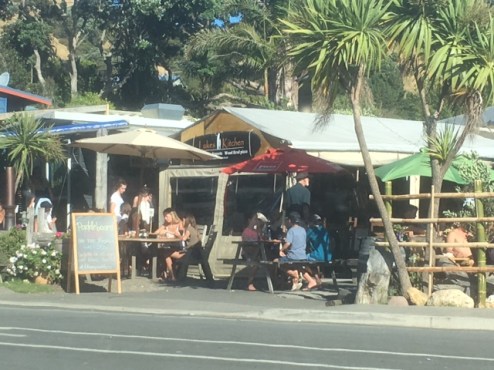
On the way back we stopped at Luke’s Kitchen for a rather late lunch. Around the corner a small café sold ice creams. It was clear that the size of the scoops reflected the enthusiasm the ladies who served us had for their own ice cream.
b27b3fe9-4d28-4058-acbf-5de763a518ce

Never one to duck a challenge, I ordered 2 scoops. The pile of ice cream must have been at least 12cms tall, dwarfing the little cone ……. and in the hot sun it  started melting as soon as one was outside. They could have doubled their profits by halving the quantity without anyone complaining – but where would the fun have been in that?

We had chosen to stay in some self-catering apartments in Whitianga – and a quick rifle through one of the drawers uncovered endless little colourful brochures for all the ‘normal’ attractions of a modern holiday destination …… glass bottomed boats, water-skiing, scuba diving, theme parks and hot pools, bush walks and eating ….. and drinking ……   but actually there is nothing nicer than finding a virtually deserted beach and walking barefoot along the water’s edge ……. particularly when  the sun on your back is warm!

New Zealand’s ‘Coromandel’ did not disappoint.

Richard 19th January 2017

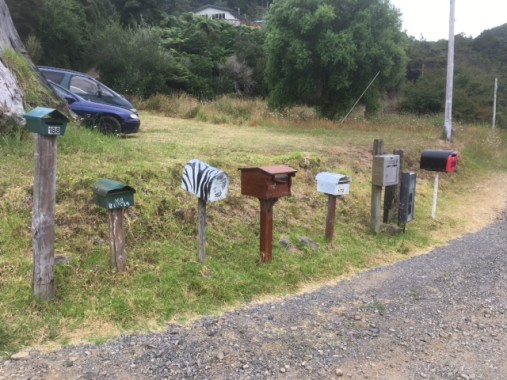
PS Some rather quaint post boxes in the interior

f25958e0-6f39-4257-8dae-4ed02b883ed7

PC 87 Travelling is such joy!!

Flew out of UK on 4th January to Australia but before we flew, 10 days before, we had our trip to Portugal.

Lisbon 29th December 2016. We checked in our bags, showed our boarding passes, paper ones although we could have provided them on our iphones from our EasyJet app, and made our way into that peculiar area where, depending on the airport and/or the country you have to separate your lotions & potions, electronic gear (which seems to be more and more these days), take off your shoes/belt/jacket etc and walk through the x-ray machine, hoping it doesn’t ping and you have to start again ……. and then to get dressed, fill your pockets with this and that, check you still have your passport and boarding pass and move into the departure area.

They called the gate at the appropriate time and we joined the throng …. to have our passports inspected – again. Sadly the eye recognition software booths were not working so we had to face up to a civil servant. Aware that seasonal freezing fog had disrupted travel in the UK we didn’t really expect to get away easily ……. but we did board as if we would, although instead of getting the bus we walked the 200 m to where the EasyJet aircraft stood expectantly, with its attendant vehicles and chaps is high-vis jackets.

Seems to take forever, as there is always uncertainty of which seat was where and where could one put cabin luggage and as the plane was full there was no free room anywhere  …. we had chosen those seats with a little more leg room by the emergency exits ……. eventually we were all in and settled ….. expecting the doors to be closed with that satisfying thick ‘clunk’.

Good evening ladies and gentlemen this is Mike from the flight deck, your captain for this evening’s flight to London Gatwick. Since we gave instructions to board, we have been informed by air traffic control (you heart sinks as soon as he says these words) our take off slot will be 2115 (one and a half hours late!) ……. So I’m going to top up on fuel in case we have to divert from Gatwick. (Ed Note: Aircraft expecting to land at Gatwick the previous evening had been diverted to Manchester (240 miles – about 5 hours by road) – good when your car is at Gatwick.) “Sit back and ……” As if … but there is nothing to be done and slots have a habit of being adjusted so advisable to be ready to fly …..

The Captain again. We have got a slot for a take-off at 2110 so this will see us into Gatwick at 2300, a little later than scheduled but ….”

Over the Bay of Biscay. “Just getting our instructions from UK traffic control and it looks (audible groan from other passengers) like we’ll go into a holding pattern north of Brighton.”

Approaching Gatwick. “Ensure your seat belt is tightly fastened, your table stowed in the upright position, and let the cabin crew have any rubbish as they come through the cabin. We’re going to land using ATLS (Automated Take-off & Landing System) as visibility is extremely limited. So all electronic devices switched off please, not simply in ‘aircraft mode.”

Gatwick 2320. Safely down …..with visibility about 100 m; we taxy to a stand (Easyjet, being a budget airline, keeps costs down by not paying to be attached to a finger) ….. and we wait and we ….. wait.

Well it’s the captain again. Those of you on the port side of the airplane will see the buses lined up to take you to the terminal. Unfortunately we do not have any steps to attach to the aircraft. Please sit down and be assured we are trying to locate some.” (I thought at this point, as we were sitting next to the emergency exit, we could practise our drills …. pull out the door, down the slide and …….. – just a passing thought!!)

30 minutes go past …… like in some bad dream ….. this is not Easyjet’s problem this is the company running the airport.

You must be getting fed up with me. The good news first; they found some steps. The bad news is that they are covered in ice (the temperature outside was -3°C) and it’s too dangerous to use them …. until we can get them cleared and de-iced. Oh! And the luggage is being offloaded so you should find your bags waiting for you in Baggage Reclaim.”

Another 20 minutes go past….. it’s now 10 minutes past midnight.

At last the steps are safe and we descend into a very cold and foggy night, onto the bus. I saw some airport staff just chatting, seemingly not concerned about the appalling service being offered. We head for Passport Control and telephone the company who has looked after our car “be out in 10 minutes”. ……. Down to the baggage reclaim area. The passenger information board showing which carousel we should go to says: ‘wait’ and we wait

Another 15 minutes go past (you lose track and interest …. you just want to get home with your bags.

Eventually ‘No 2’ comes up, no rhyme or reason why our bags which went into the system together are so far apart (5 minutes!!) but then through customs, out into the chilly night where all the cars are covered by a heavy frost ……. Find the car, load the luggage and drive slowly, in the fog, home to Hove where, shielded by the South Downs and warmed by the sea, it’s a balmy 2°C.

0145 – Home ….. and never, ever has it felt so good ……  to be home!!

Richard 9th January 2017

PC 86 Boxing Day

In the United Kingdom and in some countries of The Commonwealth the 26th of December is called ‘Boxing Day’. For most of the world it’s an unknown designation and somewhat meaningless. And if you Google it you’re immediately told the name has no reference to some pugilistic sport! Mind you, coming during the Christmas period when families and friends, some of whom you may have not seen for 364 days, descend expecting to be entertained and deigning to peel a potato or feigning allergy to a Brussel sprout, you could be forgiven for connecting Boxing Day to some physical activity of an aggressive type!

The name is thought to have originated way back, maybe even during the Roman occupation of Britain or more likely in the Middle Ages; a box for collecting money was kept in the church – the Alms Box. (Alms – money, food or other donations given to the poor or needy; anything given as charity and used in many religions.) On the day after the celebration of the birth of Jesus, the monks would go out and distribute the money, a little celebration for the needy. The practice continues today and in the UK there are many Alms Houses, where the focus is on giving charity and shelter. But I also sense a link between Boxing Day and the class divide somewhat; those who could afford to have servants would give them ‘a little something’ to allow them to give a present or buy some stuff for their family when they went ‘home’ during the Christmas period.

My step-father would produce lots of plain little brown envelopes, labelled in his well-formed but often difficult-to-read writing: Postman 1, Rubbish 1, Rubbish 2, Milkman, Grocer Deliveryman (for the groceries were often delivered – see PC 23) etc. He laid them out on the old oak hall table, in a neat and orderly fashion …… and over a week they all reached their intended recipient. In those days the Boxing Day tip was made up of coins, as in the UK you could buy quite a lot with an old Ten Shilling note …….. which now equates to a 50 pence piece.

Here in Hove we try and give something to the various people whose cheery disposition throughout the year deserves recognition. Rosie our Postie’s mail round changed mid-year so she doesn’t qualify this year; but we used to do our bit when it was raining and she would come in for a hot cuppa. Her replacement, Steve, had a bottle of wine and some chocolates; Peter the window cleaner likes red wine. And then it was the challenge to catch the rubbish collectors. Despite the Christmas season, there are still a few unscrupulous people about so we didn’t wish to simply leave some beer sitting on top of the bins (note the completely unscientifically-tested decision – wine for the postman, beer for the rubbish man!!) The lorry that collects plastic & paper for  recycling is a different sort to the one that picks up the glass; so two different crews for beer and biscuits, although looking at the size of some of these guys I suspect they get a great deal of biscuits – all year around!!

A letter in The Times described how a neighbour was observed opening the door to one of the local dustmen. “Good day sir!” the chap said, “I collect your rubbish all the year round and have come for my dues.” “Well! That’s very kind of you to collect my rubbish. It’s quite probable that I teach one of your children all the year around!” ……… and simply shook him by the hand!

Apart from the niceness of giving a little something, Boxing Day has traditionally been associated with taking long walks in the crisp air (This year the daily temperature here in the UK was about 14°C so hardly ‘crisp’!), going to the nearest racecourse to bet on horses running around, or going to the SALES! Bargain hunters queue from early morning at various large department stores all over the country anxious to bag that item reduced by 30-50% ……. although this year it seems the trend for online shopping is beginning to reduce the number of shoppers to the physical High Street.

So Boxing Day is over for another year, and I certainly hope that the true spirit of Christmas, kindness to your fellow human beings, demonstrated particularly on Boxing Day but more hopefully throughout the year, continues into the future.

Last scribbles for 2016, a year of real emotional highs and lows. Will 2017 be better? I guess it will be what it will be.


Richard 31st December 2016


PS We flew to Lisbon on Boxing Day to spend some time with Celina’s brother and family. They don’t do ‘Boxing Day’ in Portugal!

PPS The conductor Sir Neville Marriner died in October aged 92. He was world class and is particularly noted for forming The Academy of St Martin In The Fields, named after the Trafalgar Square church in London where they performed. Well known for his directness, there is a story he was getting tired of being interrupted during a rehearsal by the sound of a pneumatic drill a man was using to dig up the road outside. Storming outside, he went up to the chap and, in a loud voice, asked: “Are you interested in sex and travel, sir?” (ask me if you don’t understand this!)

PC 85 A Conundrum * ?

*“A confusing and difficult problem or question, often asked for amusement.” Or just some of the minutiae of life that runs around inside my head.

I lie on the floor wondering about this and that, sweat dripping onto my already soaked mat. Hang on! This PC is not, as you might be beginning to think, about yoga …… but about the application of scientific knowledge and guesswork …..  so read on.

bottle-1

My iced water

In common with most people who do any form of exercise, I find it useful to have a bottle of water standing by in case I get thirsty. I know that it’s a C21st sight these days, every tourists wandering around the attractions with a bottle of water as if their life depended on it – but I think we can all acknowledge that, as the body is about 60% water, it’s important to keep hydrated. Practising yoga in a hot environment, the requirement is no different, except that one is encouraged to drink as little as possible during the class, so you try to be well hydrated before it. Drinking during class asks too much of the stomach for one thing, those muscles that you want to help you attain a certain posture are also being asked to help the digestion process for the water you’ve poured in! But like most people I do drink, but not for the first hour.

I can’t abide drinking warm water and after 45 minutes in the hot room the water in an ordinary bottle is warm; so I have developed a taste for iced water. This is very personal and I’m told it’s bad for your tummy, gives you a headache and all sorts of other old wives’ tales (you know what I mean huh ) – so what!! So I go into the hot room with a water bottle I’ve taken from the freezer (see above). After an hour it’s melted somewhat, enough for me to be able to take a couple of gulps before starting the floor series. At about 75 minutes into my session, with 15 minutes to go, it’s melted further …… and this is when I have my conundrum????

By the by, if you have someone directly behind you, it’s good etiquette to have the bottle on its side, so that person can see the mirror when necessary but if you don’t …….

The ice has melted enough for it to be about half the size of the bottle, a 4cm thick cylindrical shape; the water comes up about a third of the way. By this time I am anxious that I have enough melted ice to use at the end of the class so want to encourage the melting process. Do I lie the bottle on its side, with the water about half way up the side of the iceblock, or have the bottle upright, with the bottom third of the iceblock in the water. Which position will increase the melting of the ice faster?


bottle-2

Or this

bottle-3

There are some constants here. As soon as I type the word ‘constant’ names come flooding from my memory: Planck ……. and Avogado ……. and Pi (You remember? The ratio of the length of a circle’s circumference to its diameter) (see below)

The amount of water inside the bottle is constant, whether the bottle is upright or prone. And you can dismiss the temperature as that has a constant effect on the bottle, whichever way it stands, right? But what about the fact that in the prone position its long side is in contact with the warm floor – and does this make a difference – you can see how this conundrum gets more and more complicated?

In the vertical position, the ice has more surface area in contact with the air inside the bottle whereas lying down is looks as though the block has only 50% in contact with the air. Does the plastic/air interface conduct heat better than the plastic/water interface?

So I guess now we get into which surface area is greater and is that in contact with a material (water or air) that has a greater conductivity that the other.

Just seems like a lot of hot air to me, sometimes, at others I am really curious to determine whether one position is better than the other. A packet of Maynard’s Winegums or Basset’s Liquorice Allsorts to someone who comes up with the most plausible answer.

Real (inane?) scribbles these ……

Richard 10th December 2016

PS Planck’s constant links the amount of energy a photon carries with the frequency of its electromagnetic wave. It is named after the physicist Max Planck. It is an important quantity in quantum physics.

In chemistry and physics, the Avogadro constant (named after the scientist Amedeo Avogadro) is the number of constituent particles, usually atoms or molecules, that are contained in the amount of substance given by one mole.

The number π is a mathematical constant, the ratio of a circle’s circumference to its diameter, commonly approximated as 3.14159. It has been represented by the Greek letter “π” since the mid-18th century, though it is also sometimes spelled out as “pi“.

PC 84 Hot Yoga Thoughts – the beginning

So what is it about yoga that encourages you to make it part of your life? Come to that, what is it about anything that it becomes, dare I say it, an addiction?  I started Hatha Yoga, the basis for all forms of modern Yoga, in 2002 …… and enjoyed it enough to do it once or twice a week. Then I saw a photograph in some magazine of a chap doing yoga, but streaming with sweat! I asked a neighbour about it and she said it was ‘Bikram’ Yoga and she said she’d take me. Well, I’m now in my nth year of ‘Bikram’ yoga and I sense that some of you might shout ‘boring’ if you reflect on this single fascination I have with a physical series that challenges the mind, body and spirit. Would you have the same reaction if I played golf every day? Maybe!! So what follows is simply an amalgam of thoughts that have run around the inside of my skull during seven years of classes and, please, don’t read on if you don’t want to!!

I always find it interesting to go somewhere for the first time, not knowing what to expect, just curious …… and if I am honest a little anxious! Not a great one for research about anything really, I just have a gut feel about something and if it works for me that’s fine. So without knowing much about ‘Bikram Yoga’ I got my lift on Wednesday 11th March 2009 and arrived at the Balham studio for the 90 minute 5.30pm class. Wow! Busy place! Eventually the room was full, yoga mats touching each other, each mat with someone on it – 72 someones! A chum observed that the mats were so close that other people’s sweat dripped on yours in certain postures, indicating a measure of shared intimacy not usual unless you’re married!!

And it’s hot – 40°C and 50% humidity. Before we start, the teacher aka facilitator tells us there are 26 different postures, each repeated once, and that you start and end with a breathing exercise. They don’t demonstrate and at worst simply recite instructions known as ‘the dialogue’. The sequence and dialogue don’t change wherever you are in the world; you might think this makes the whole thing very boring and some people do find this …. I don’t …. I like the certainty….. although sometimes you can simply go through the motions without thinking about it as it’s too familiar.

I’ve heard the names for these 26 postures now over 2000 times and I couldn’t for the life of me recite them with any accuracy!! And if you heard Dandayamana-Dhanurasana or Ardha-Kurmasana or …….. I don’t think you would either …… and it doesn’t matter!

So we start with a breathing exercise. “Clench your hands under your chin, elbows down. Inhale ….. and lift your elbows as high as possible. Exhale and force your elbows out in front, with your head back.” One of my problems is my neck movement. Oh I’ve had physiotherapists tell me to do the ‘yes – no’ exercise as if I’m some crazy from the Indian subcontinent …….. but once you’ve got metromateriolsis ie the vertebrae start crumbling, you begin to lose neck flexibility …. and there ain’t much you can do, which is why I was so taken by the neck mobility of those dancers from Grupo Corpo. (PC 79)

Pull your tummy in!’ Ah! Yes! Well! That’s another problem!! You may recall my PC about expanding waistlines (N° 55); no matter what I do, it doesn’t go down. Maybe it’s my love of sugar or puddings or that irresistible afternoon piece of toast with jam? (And we’re still in the ‘warm up’….. and I come every day!)

The first ‘posture’ … “Reach up …. arms up…  bend sideways!” (to the right then to the left) ….. my spare tyre bulges out and not much more …. “backwards” …. . “Go back, more back, drop back.” ‘More back’? When I first heard this I thought it funny, now it just grates that Mr Bikram Choudhury’s grasp of English was so poor – hadn’t he heard of the word ‘further’ – although ‘more back’ fits the pose!! Then “bend forwards ……hook your hands under your heels”. Pulling my chest against my thighs makes breathing difficult as I attempt to bring my head to my shins ‘Like a Japanese ham sandwich ….no space for light or air’ – the dialogue says. Being British I am really not sure what this expression means. Obviously Los Angeles where Bikram started is nearer to Japan than the UK, and I know that a lot of Japanese live in The States but what? Are the Japanese mean with the thickness of the ham? Is the bread wafer thin? Why not ‘jam’ sandwich?  Most sandwiches don’t let in ‘light or air’ do they? What does he have against the Japanese as I suspect this is a slightly derogatory remark?

Awkward pose was obviously named by someone who thought it so. Actually once you can stand on top of your tootsies and bend your knees …. nothing awkward about it (Ed. Note: For me my feet take about 0.75kg per sq cm pressure. In this pose, on your tiptoes it increases to about 15kg per sq cm!)

By now for most people the sweat is beginning to moisten their skin …… or on my case it starts running in rivulets down my back. This series is not for those who don’t like sweating. One or two people, when they are new, wipe the sweat away – but it keeps coming back, as it’s the body’s way of cooling. I sweat about 1 ½ litres in 90 minutes but you probably didn’t need or even want to know this?

We all know how difficult it is to rub your tummy and pat your head at the same time, well swinging one arm under the other and the same side leg over the other then wrap it around the back of the other leg …. oh! Don’t bother. Meant to be good for all the joints, ankle/knee/hip/shoulder/elbow/wrist – sweat drips from your fingers onto your knees. This is Eagle pose, although at this precise moment I could no more soar like an eagle than twist …. ‘like a rope’. You will probably know that lots of yoga postures are named after animals, such is its cultural heritage. The most famous is probably ‘downward dog’. Funnily enough it’s not a posture for this series …..

Break to drink …… or not. ……..

And so it goes on …….

Standing Head to Knee.  …. ‘Lock your knee….’ Lifting your knee towards your head. Balance on one leg …. easy huh …. Lift your other leg with the aid of a cupped hand forward until it’s horizontal …… or …… Standing Bow; Like Eros, you might imagine. Balance! Balance! …. or ….. T for Tommy or Tango. My Labrador was called Tommy and I can’t see him doing this posture any more than I can! Standing on one leg, lift the other behind you and both arms in front, until arms and legs are horizontal. Difficult for a four-legged creature huh!

t-fot-tommy

Standing Separate Leg Stretching pose …. Depending on how you go into this pose, the distance of the floor from your head varies a lot!! But if you listen to the dialogue and apply the instructions ……. eventually you will see it is possible …..

standing-head-to-floor

Triangle – by this time I’m out of air and exhausted, sweat’s dripping off my head, and my breathing is labourious. OK! I know that yoga is all about the breath ……. and controlling the breath ….. and this is where the fights starts …. your body asking for one thing, your mind suggesting an alternative … and sometimes in the middle of triangle, a posture requiring balance, we hear the teacher ….. “and now sing ‘Happy Birthday’ as it’s Stephanie’s birthday today woo woo woo’.”

The next posture you essentially have to bend double and lick your knee …. or something like that. Then two more little postures and it’s the end of the end of standing series. Phew!

Onto the floor ………. (to be continued!)

Richard 30th November 2016

PS A little small, but here’s an idea of what the 26 postures should look like

bikram-yoga-postures


PC 83 Godsons et al

You may have missed the fact that at the end of October I finished another decade ….. and started another ….. for such is the incessant nature of life. Until one dies, of course! Then it stops; the only certainty after birth!

Despite the fact I am not really a true believer in long term planning, I do recognize that in order to do anything, one has to make an effort, bring all the relevant issues into the mixing bowl, give it a good stir and …… make something. Decades need celebrating, don’t they? More than an ordinary run-of-the-mill birthday? I’ve scribbled before how lucky we are here in Western Europe in the C21st – with life expectancy well into the late 70s. It was not always so. Reading ‘Sextant’ by David Barrie, a wonderful book about a nautical instrument, and no I haven’t gone gaga, it truly is, I was struck by the fact that so many of the surveyors who mapped our oceans died quite young: comte de La Perouse disappeared aged 41, Matthew Flinders died at 40 as did his fellow navigator George Bass, as did George Vancouver who surveyed the western seaboard of Canada. James Cook made 60 and William Bligh 63; and here am I celebrating 70, my only major navigation racing a yacht from Tenerife to Bermuda!

Do you go away and spend a lot of money/a little on a very intimate personal celebration ……. or do you get all your chums together and have a good old-fashioned party?  Many years ago my lovely daughter asked if she could have a 21st party when she was at university in Cardiff. “How many people were you thinking of?” I asked, thinking not of her popularity but of my pocket. “Oh! About 300 and something – just my closest friends.” Before I went completely puce in the face she said she had found somewhere where they would do it for £1.75 a head or some such. She went ahead; it was a huge success but I often wonder how many of those ‘closest friends’ she is still in touch with? Friendships can be extremely transient! So a party at the Grand Hotel in Brighton for 100? I didn’t think so! But I like the intimacy of small groups ….. so we ended up with two dinner parties for 12, a Champagne & Cake get together for about 30 ……. and then the ‘Godsons’ dinner’.

Not sure how many God children you have, if any? I seem to have collected four that I am in touch with, still in touch with their parents, been to three of the weddings ….. that sort of thing, and one that I had completely lost contact with. How does that happen? So six months ago I looked for the lost soul, and invited all five and their other halves to dinner here in Hove. Even at six months’ notice we had to move the date to the weekend after my birthday, such is the busy lives they live.

We arrived at The Little Fish Market after bubbles here and had a really lovely meal. I had wondered whether I should say something after the obligatory rendition of ‘Happy Birthday’ had rung out. Was it expected of ‘The Godfather’? On the afternoon of the dinner  I decided I needed to … but what? …. a recap of my life so far?….. but they probably knew all that and anyway it’s dull. A comment on their success in life, the number of children, the pressure to get married/divorced/change careers?

And what was expected of a Godparent, anyway? Aren’t we meant to serve as role models, demonstrating kindness, honesty, integrity, dedication to one’s family, and responsibility, and to provide spiritual guidance? No sure how much of that I had done, but two words had came to mind – ‘plan’ and ‘moral guidance’; well, three actually! We all think we need a plan. Ok! School ….. university …. in the old days it was deemed the right thing to do to stay with one company – something to do with loyalty and duty and all that stuff which was quite admirable but potentially stifling. Do you know that in Europe most people have three careers and five jobs within each career? That’s what actually happens.  .. but I had a plan! ….. I was on track! ….. OK along came a recession I hadn’t planned for …..there was a change of family circumstance I hadn’t dreamed of…..  so the plan goes by the board and you react to circumstance. How flexible one can be has more of a bearing on one’s success in life than having a plan.

I hope I was open to give advice and guidance, but with a moral twist? Some would argue that my own life is not exactly a great example of a moral life, but hey when the parents chose me maybe I was full of promise? I would like to think my life has been defined by certain values, a huge self-belief, and an understanding that if you want to do something, do it yourself. And when anyone wants to listen that’s what they get!

So after the pudding, I blew out a candle on another birthday cake, a rather ragged ‘Happy Birthday’ followed and I portioned out eleven pieces. The men around the table were not, apart from my son-in-law, family; just sons of friends from the 1970s. How lovely to be able to bring them all together at least once in their lives …… and in mine.


Richard 12th November 2016


PC 82 Footwear

Over my lifetime there has been a huge change in the type and style of shoes, both for men and women, what has become acceptable and what not, so I thought I would scribble about footwear!! This is, I should hasten to add, a predominately male piece!

Unless you joined some institution like the Armed Forces or the Police, it’s unlikely you had any training in how to clean your shoes, for they were nearly all made of leather and that required cleaning. A toothbrush was useful for cleaning the welts and the piece between the heel and the sole needed as much attention as anywhere else. God forbid if, when you placed one leg over the other when sitting, the underside of your now exposed shoe was dirty. Despite the need to polish your own drill boots and George Boots, at the Royal Military Academy we had a batman who took care of the other leather items – Sam Browne’s, shoes etc. Your ‘best boots’ were shined to within an inch of their lives. Polish was applied and a spoon, heated over a candle, was used to melt the polish and soften the slight bumps in the leather; then you ‘bull’d’ your boots, applying spit and polish around in little circles to create a shine – hours and hours of work!!

Of course scribbles about shoes must include the lovely story that illustrates how you see life, the ‘half empty – half full’ glass. Back in the late 1880s, Clarkes the shoemaker decided that they wanted to enter the East African market. They planned to send two people, James who had been with the company a long time and was considered quite senior despite having a mixed track record of success, and a relatively new hire Mark. Recruited against the Company’s competency profile, he had a very positive attitude and was a good match. The pair duly caught the train to Dover for the long overland journey by train and boat to Mombasa.

Despite an initial telegram saying they had arrived, nothing was heard from the pair for a few weeks. Eventually James telegraphed from a hotel in Nairobi and wrote: “Been all over the country. No one wears shoes here. Completely wasted exercise. Returning home” A few days later another telegram arrived, this from Mark. “Been all over the country. No one wears shoes here. Great opportunities. Have opened office and initial order to follow.”

One of the main aims of joining the Army was to wear the traditional mess uniform – actually I joke somewhat but we did enjoy dressing up (overgrown schoolboys I guess!!). The formal attire for dinner was Mess Dress – a sort-of blouson jacket with skin-tight trousers, known as overalls. These had a thick red strip running down the outside and were strapped under the bottom of one’s Mess Wellingtons, a tall boot that almost reached one’s knee and worn on the inside. And spurs! Soldiers who went into battle on horses (before my time, I should hasten to add) used a metal spike in their boot to encourage the horse to gallop faster – to ‘spur it on’!! These accoutrements became part of one’s dress uniform, indoors and out, and they fitted into the heel of the boots in a special box. I was lucky enough to have my step-father’s, which had an old sixpenny piece as the roundel.

mess-wellingtons

In civilian clothes, in mufti, you wore leather shoes, which of course had to be polished to the same standard! I suppose the constant need to have one’s uniform shoes clean meant that when I could relax, I developed a penchant for light brown suede boots – a quick brush and they were good.

Avid readers of my postcards will know that I spent a great deal of my twenties sailing. Wet weather gear was essential and I bought some sailing wellingtons – yellow on the outside, blue on the inside with a sole which gripped on the yacht’s often wet slippery deck. They eventually perished as rubber will– but I loved those boots; I wore them to a party once!

At one time in my life I got stuck on having some red shoes and still have a pair of red Timberland boots. But then in Russel & Bromley I saw these lovely Italian red suede Chelsea boots. One of those ‘I must have these’ moments. I’m sure  Elvis would have been jealous as he had to do with blue ones.

red-suede-shoes

I should say at this point that I take a size 11 or 12 shoe, a size which often is not available in the more fashionable brands. I saw a gorgeous pair of Gucci loafers once and, despite the fact that there were a tad small, I bought them, thinking the soft leather would stretch. It didn’t and on one occasion I wore them on a long flight. Big mistake!! When I walked off the aeroplane I could only fit half my foot in!! They were too narrow a fitting and I would have benefited from using one of those machines that was in pride of place in a shoe shop. You never see them today; you climbed onto the step and looked at your feet in the shoes – in a vaguely green light. Then you could see if they were a good fit or not.

Do you remember Winklepickers, long and pointed shoes for men? Or Bovver Boots, so basic and chunky? Shoes with ‘Cuban’ heels for those of us who are vertically challenged? If I wasn’t so politically correct I should say ‘short’! Then there were Chelsea boots, Desert boots, George Boots, Boat shoes, canvas shoes, jellies for a rocky shore, the list could go on and on. Getting my first pair of Rugby boots was a defining moment in my upbringing, but they were black, because all rugby boots were black. Nowadays it’s as if the team wants to dazzle the opposition by the colour combinations of their boots

The only sort of ‘trainers’ were ones you used for sports or tennis and the latter had to be green flash Dunlop. Now, if you are a “Dedicated follower of fashion”, as The Kinks sang about in 1994, you will no doubt possess many pairs of ‘trainers’, for they have become the only form of footwear for the younger generation …… and for some of the older generation too. Mintel’s senior fashion analyst recently wrote that “there has been an increasing trend for consumers to integrate sports clothing into their wardrobe; trainers have become the second favourite item of footwear after flat shoes for women.”

It seems now that the world has turned full circle. From the time at home growing up, wearing socks and lace-up shoes, to our way of life now – the ubiquitous wooden-floored apartment, not wearing socks in the summer months and never wearing shoes inside. Now! Where are my slippers?

Richard 31st October 2016


PC 81 And the buses came along in threes

In England there is an old belief that if you’re waiting for a bus, eventually one will come, very closely followed by another  …… and then another! In reality the phenomenon has some truth to it, and even has a choice of names – bunching, clumping, convoying or even platooning. Mathematically it’s bound to happen if several buses are serving a single route. I mention this as in early September I lived through another 24 hours of amazing coincidences (see PCs 19 & 48 for previous examples).

Albany Villas where we live is a suburban street here in central Hove; like most inner city areas parking for cars is often difficult and the spaces fought over. Outside Amber House is a bay reserved for those drivers with disabilities; a ‘blue badge’ bay. There was often an ancient Jaguar XJ10, in immaculate condition, parked there. The driver, an oldish chap with a white ponytail (this being Brighton these things hardly raise an eyebrow) used it for driving his very elderly and infirm mother about. Seeing them regularly we got used to nodding, saying whatever greeting was appropriate depending on the time of day etc. And then they disappeared ….. completely ….. for over a year. On the first of September we remarked to each other: “I wonder what happened to them? Haven’t seen them for ages.” Later in the afternoon, the car is back. Weird or what?  First Bus!

We had spent the previous evening with Ted and Richard. Ted has taken some beautiful photos, not only of us towards the end of last year and then of Jade and her family, but also some gorgeous ones of our wedding in August. Before going out to a local restaurant for supper, we joined them on the terrace of their large apartment in Palmeira Square, famous for its large terraced houses of the Regency period. Over drinks we caught up with events over the summer and somehow the conversation came around to Scotland and the Orkneys. I hadn’t been so far north but Celina had. And then I mentioned that way out into the Atlantic Ocean is the island of St Kilda. Nowadays the only human inhabitants are Army personnel, manning the radars used to track the surface-to-air missiles test-fired from the range at Benbecula. The soldiers are commanded by a junior Royal Artillery officer and spend six months there. I would probably never have heard of St Kilda if I hadn’t been in the Royal Artillery, and ducked down when the postings branch started looking for the next Officer Commanding St Kilda! It was a posting most of us did one’s best to avoid; if you were an ornithologist it was OK, if you weren’t you soon became one, for there was nothing to do in your spare time, unless you liked counting seabirds and sheep. (This before the age of the internet – and ‘no’, that’s not called ‘The Stone Age’!)

Apart from a rock called Rockall (an original name you might think!!) even further west out into the Atlantic, this group of islands is Britain’s most westerly point, a speck in the North Atlantic more than 40 miles off the Outer Hebrides, over 100 miles from the mainland of Scotland. St Kilda is a place of extremes. It has the highest cliffs in the UK, plunging 1,400ft to the sea. It has recorded the highest wind speeds in the country, 198mph (320kph), which explains why there are no trees!! More rare seabirds nest here than anywhere else in Europe. Not for nothing are these islands described as “the edge of the world”.

The last permanent civilian inhabitants of Hirta, the main island of St Kilda and the only habitable one, requested evacuation in 1930. There were just 36 of them: with numbers of able-bodied men dropping year on year, the people were more and more dependent on supplies from trawlers that might sail past or, failing that, handouts from the Scottish mainland. During the winter months, the St Kildans could find themselves as cut off from the world as they had been in the Middle Ages.

the-high-street-in-the-village-on-hirta-st-kilda-by-dawn-menzies

The ruins of houses on St Kilda

Not surprisingly, neither Ted, a Canadian, nor Richard, English as the day is long, had heard of St Kilda. I hadn’t thought about it since the 1980s, so it was quite extraordinary to open the second section of The Times the following morning to find: “A composer, a piano and a concert at the edge of the world”, an article about recording the once-lost songs of the people of St Kilda (Times 2 September 8th 2016). Weird or what? Second bus!

To keep my little brain from turning to mush, most days I do a very quick crossword in The Times newspaper. The day after the St Kilda article was in the paper, the crossword contained a clue ‘senseless talk’ for which the answer was ‘Twaddle’. (Pretty easy crossword huh!) The dictionary says:  “Twaddle/ Trivial or foolish speech or writing; nonsense.” Such a lovely truly English word, ‘twaddle’; sort of rolls off the tongue after a glass of wine or three, in a speaking sense rather than a nonsense sense, but not one in common usage these days!


times-crossword


I love the author Bill Bryson’s works, especially his ‘Notes from a Small Island’ and the latest update to his amusing observations of Britain, ‘The Road to Little Dribbling’, a book I had been given for my birthday last year. And as part of my ongoing very necessary education, I also got given a copy of Bryson’s ‘A Short History of Nearly Everything’.  In six sections he attempts to explain the why, and where, and how of what Earth is and about life itself. Painstakingly researched and stuffed with amazing facts, figures and anecdotes, he’s traced scientific studies and the development of our understanding about ‘being’. You can plough though chapters such as ‘The Richness of Being’, ‘Cells’, ‘Darwin’s Singular Notion’, ‘The Stuff of Life’. And plough you do, as there is so much information there is a danger of overload; I suspect it’s a book to read more than once. Bryson of course clearly loved researching the very people who have contributed over the centuries, some earnestly , ……. and in the evening of the crossword containing ‘Twaddle’ day, I read …… “some very casually but significantly and some writing ‘twaddle’” Weird or what? Third bus!

Mere scribbles for autumnal reading

Richard 14th October 2016

PS Just in case you are reaching for your iPad, I also got the answer to 20 Across – ‘Walk Wearily’!

PC 80 It sat on the shelf

It sat on the shelf in the kitchen, all forlorn, sort of pulsating and sending out a message …. ‘my shelf life expires in April next year’ ….. ‘eat me’! All wrapped up and pretty, but sad and unloved. Should it be taken back to whence it came or would that be completely ridiculous, as it weighed over a kilo? The packaging looked good and neat; shame to unwrap it.

But unwrap it we did ….. yesterday ….  knowing that over a few days it would be reduced to a few crumbs.

It had been bought with the best intentions, flown for 11 hours, arriving without mishap ……. but the world into which it arrived had emotionally changed and its presence was really not wanted, not then …….. so it sat on that shelf ….. looking at those who went by, hoping that someone would pick it up and make a decision. Returning it to the country where it was bought would have been a little like the reality of that saying ‘coals to Newcastle’. (Ed: Newcastle is a university city in the north east of England. At one time its port would have shipped coal overseas …… and the last thing you would have done would have been to take coal back to Newcastle.) It could have been returned to the supermarket where it was purchased for on the packaging it offered: “Should you not be happy with this product please bring the packaging back to any Waitrose branch and we will replace the item and refund you.” What? Over a year ago? Really?

So maybe we could use it this year? …… Why not now? …… The weather in spring here has been so cold (OK! Tropical ‘cold’, not northern Europe ‘cold’) ……. So it was taken down off the shelf and the instructions read. Microwave or cook properly? Time saving at the possible expense of taste and texture – ‘for best results do not microwave’. What? Steam for three hours? You must be kidding; we’ll need shares in the company who supplies the gas. No! No! That’s what it says …….. in addition to making sure that the water is no allowed to bowl away.

So it was that on the last night of September we had a new pudding, a Christmas pudding. Does this sound ridiculous? Well maybe it does but do you know what away from all the over eating and stuffing both the birds and ourselves and eating rich food and drinking funny drinks and making merry etc etc  it was such a joy to open the cooked pudding, turn it out and smell that gorgeous aroma of fruits and currents and peel and cherries and ….. We didn’t have any Holly, as Holly doesn’t grow in the tropics, or indeed any brandy to ignite …… and actually no brandy butter because you need brandy and we didn’t have any.

Just a small plate …… with a little heap of Christmas pud on it ….. and a fork. Yum! Yum! Yum!

These are seriously inane scribbles

Richard 1st October 2016 Rio de Janeiro

PS There was sadly no Uncle Tommy (see PC 27) to watch our antics but perhaps that was just as well. Any more please?

uncle-tommy-1

‘Uncle Tommy’


PC 79 They make you want to get up and dance.

We Brits rather pride ourselves in doing things well and there is a general consensus that the opening ceremony of the 2012 Olympic Games in London was brilliant. A recent documentary on the BBC showed the year’s work that went into that spectacle; absolutely amazing. So we anticipated a similar spectacle for the 2016 Rio de Janeiro Olympics, particularly as the Brazilians know how to party. Straitened circumstances meant less money was available but all agreed it was, in the event, a great opening.

The closing ceremonies are often a little less dramatic, the contests over, the medals won, time to go home. But in Rio, somewhere in that kaleidoscope of colour, fireworks and electronics was a dance group that took my breath away. Probably if my memory serves me well, some 8 men and 8 women, dancing a modern composition  that I found completely mesmerising. Such fluidity, such confidence, such elasticity, such timing. You can tell I thought them pretty damn good! Further inquiry revealed them to be a troupe from Grupo Corpo, a dance company from the State of Minas Gerais, whose style is to mix their own Afro-Brazilian genre with other familiar contemporary styles. The group performed part of their show Parabelo and new dancers appeared dressed as clay dolls, a common sight in the festivals of Brazil’s north east.

grupo-corpo-parabelo

Grupo Corpo Parabelo

It helps to have a Brazilian wife! No sooner had I said I thought they were wonderful, she tells me who they are. I am not a dance aficionado but have watched classical ballet and don’t quite get the whole thing. The story of Billy Elliot, about a northern boy who wants to dance, was captivating from the story point of view but the dance? Nah! Have even fallen asleep watching Sylvie Guillem at Saddlers Wells. Actually if the truth were told, every time I go into somewhere dark and cosy and warm, be it a theatre, cinema or lecture theatre, I can nod off quite easily; even the latest James Bond movie we saw last year couldn’t compete with the need to close my eyes. But I digress.

Then out of the blue I am told we have been given some tickets, through a cousin’s father who worked at the Theatro Municipal here in Rio de Janeiro, for Grupo Corpo. Wow! What a great chance. The theatre itself dates back to 1905, when work started to provide the city, then the capital of Brazil, with a major venue for opera and music. Completed in 1909, it’s a wonderful example of eclectic architecture, where the imagination was allowed to run riot.

theatro-municipal-1

Theatro Municipal Rio de Janeiro

 Mosaic tiles, stained glass, gold leaf, and large sculptures adorn every nook and cranny of this building. It’s been given various make-overs during its lifetime and today just under 2500 people can watch ballet or listen to classical music. The restaurant Assírius in the basement is peculiar in its impressive Assyrian decor. The connection between ballet and the Assyrians somehow escapes me. Any learned readers out there?

We watched two pieces from Grupo Corpo’s repertoire, their recent Danca Sinfonica (2015) and Lecuona (2004). Both quite different and visually stunning in so many ways. There is something about watching people with skill and energy tell a story, interpret music, that gets under the skin, almost as if you want to get up and ….. dance?

grupo-corpo-2

I saw from the little programme that the group has toured extensively, particularly in the UK, including Brighton. Maybe we’ll see them when they come around again. Said cousin, Bel Gasparian, found the link for the Parabelo performance and has posted it on Facebook – and shared it with me. So if you didn’t see it at the time, go to my Facebook and have a look courtesy of ‘You Tube’.

And these definitively are mere scribbles …… but hopefully you’ll engage in the technology and see what I mean.


Richard 22nd September 2016

PS “If you can talk, you can sing; if you can walk, you can dance; anyone can juggle and ride a unicycle, including you; but you have to want to.”