PC 168 Singapore

PC 168 1

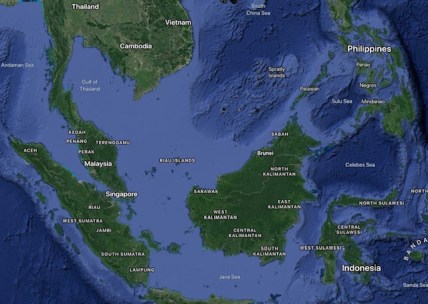
Singapore lies at the bottom of the Malaysian Peninsula, just north of Indonesia

It’s the warmth and smell of the tropics that hit you as you disembark at Singapore’s Changi Airport; that memory has stayed with me since I first came here in 1986. Sitting just north of the equator the Singaporean temperature ranges from a nigh-time low of 23°C to a high of 32°C; sometimes it rains and when it rains in the tropics, it rains, vertically …… but it’s warm rain!

After a year with Short Brothers, I took over the ‘India and the Far East’ sales patch. Singapore Airlines became my favourite and its hub was convenient to travel further into Asia. My last visit had been in 1991, staying as normal in the Marco Polo hotel on the corner of Grange and Tanglin streets.

PC 168 3

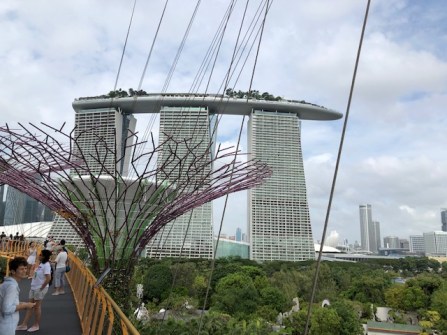
The architecturally interesting Marina Bay Sands hotel

Singapore has changed in 28 years! The Marco Polo hotel has been demolished and replaced by executive homes. Down in the business district what were ‘high rise’ are overshadowed by some stunning buildings reaching up into the clouds. We stayed in the Marina Bay Sands (MBS) hotel down on the waterfront, as it had featured in Giles Coren and Monica Galetti’s “Amazing Hotels: Life Beyond the Lobby” a BBC series covering six extraordinary hotels.

PC 168 2

The MBS infinity pool on the 57th floor

The statistics are mind-blowing: three towers joined together on top with an infinity swimming pool, fifty-seven storeys, 2560 rooms, 10,000 staff, the laundry department has 160,000 different uniforms. You don’t need to leave the ‘integrated resort’ as it’s called, as acres and acres of shops, restaurants and traditional food stalls occupy the lower levels. To the south huge trumpet-like towers herald the beginning of a future exotic garden.

PC 168 4

Singapore is a small island (50 kms east to west, 27 kms north to south; about 720 sq kms) strategically situated between the Indian Ocean, the South China Sea and the Pacific, on the trading routes from China and Japan to Europe. Its unique position was appreciated by Sir Thomas Stamford Raffles who in 1819 developed it as a trading port. In December 1941, during World War Two, Japan invaded Malaya at about the time it attacked Pearl Harbour. A few weeks later, in February 1942 it overran Singapore and some 90,000 troops became prisoners of war. It was subsequently reoccupied by British, Indian and Australian Forces following the Japanese surrender in 1945. In 1963 it gained independence from Britain as part of Malaysia and became an independent republic two years later. Its population is predominately Chinese, but Malays make up 15% and Indians 7% and there is a significant expat community amongst the 5.65 million people who live on this very crowded island.

PC 168 5

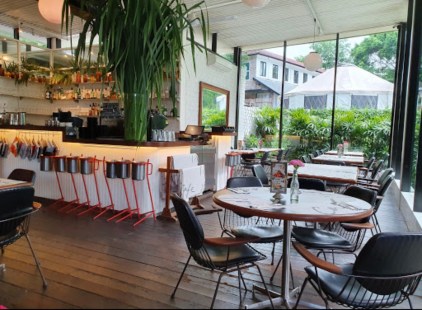
The Harding Road PS Café, one of several in the Island State

Lunch on our only full day was at the PS Cafe on Harding Road, away from the concrete and glass, in amongst colonial period buildings, tropical vegetation and monkeys. Very occasionally you hear a distant police siren and are reminded of the C21st! Alison had been a colleague at Morgan & Banks, moved to Sydney, then married and settled in Singapore. Today she and her family live across the causeway in Johore State, where she teaches at the Malaysian outpost of Marlborough College, UK. Her youngish children are almost bilingual in Mandarin and English.

After lunch we drifted (nothing happens very quickly in the tropical, humid heat!) down to the internationally famous Botanical Gardens, where fauna and flora compete. I used to jog here from the Marco Polo Hotel so knew them well, but for Celina it was a new experience.

PC 168 6

The orchids are simply stunning!

PC 168 7

After half an hour our stroll through these beautiful gardens was interrupted by a tropical storm, so we headed for the Mass Rail Transit (MRT) and back to MBS.

Mark started out as a client of mine in the UK in 2004 ……. and as often happens when you work closely with someone, we have kept in touch. So much so that in 2011 he contacted me to ‘chew the fat’ once again. He and his wife moved to Singapore in 2016, from where he covers his company’s Chinese interests. We both agreed that when you’re travelling on business, you don’t necessarily have the time to be a tourist. So, wanting to rectify this, we met in the MBS lobby and took the MRT to China Town,

PC 168 8

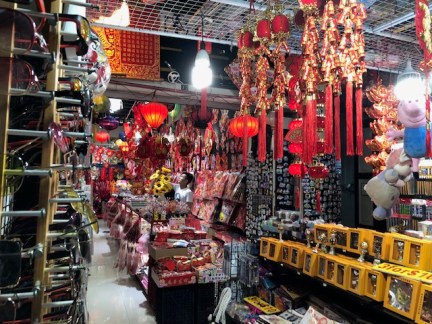
……… walked through stalls dripping in the torrential rain and popped into the Buddha Tooth Relic Temple and Museum. The reverential treatment of bits of hair, bone, teeth of those whose life is worshipped often suggests that the spiritual ‘body’ was a whole lot bigger than the physical one! Then back on the MRT to Raffles, the colonial hotel named after Sir Stamford Raffles and where a Singapore Sling was invented.

PC 168 9

We queued to have a drink in the Long Bar, with the obligatory peanuts’ shells scattered across the floor, and then back into the warm, damp air for a short walk to Chijmes. Situated in an old convent, the restaurant’s name cleverly echoes the historical connection, ‘Convent of the Holy Infant Jesus’ (CHIJ) and is on Victoria Street. It featured in the comedy film Crazy Rich Asians, as did the Gardens by the Bay on the seaward side of our hotel. Interesting to understand that food comes when it’s ready, and if cooked by two or more different chefs, can be more than 10 minutes apart! And so it was, Mark’s pasta dish came ten minutes after my Nasi Goreng.

Some say that Singapore is a ‘nice dictatorship’ but when you experience this clean city, where chewing gum is banned and no one dares to drop litter, where individuals show a huge respect for each other, you begin to think ‘Why not?’ Walking back to MBS through the government district, high into the night sky to our right rose the skyscrapers of the central business district, whilst ahead MBS shone like a beacon of consumerism, extravagance and bling!

PC 168 10

Singapore draws you in, it’s so unique ……..  and it calls you back!

Richard 27th December 2019

PS In our room at MBS the search for an adaptor for charging the iPhone etc was cut short by spying this nifty little socket. EVERY hotel in the world should have one!

PC 168 11


PC 167 “Where do You live, Brighton?” “Well, Hove actually.”

A well-known reply by residents of Hove, East Sussex, when asked if they live in Brighton, is “Hove actually!”, thus maintaining a distinction with their less genteel neighbour. Celina and I moved to Hove in October 2012, setting up home for the first time together and choosing it for its proximity to two Hot Yoga studios. Originally Hove was a small fishing village surrounded by farms, but it grew rapidly in the C19th and by the end of the Victorian era was granted Borough status. In 2001 it became a constituent part of the City of Brighton & Hove. (See also PC 13 posted in May 2014)

PC 167 1

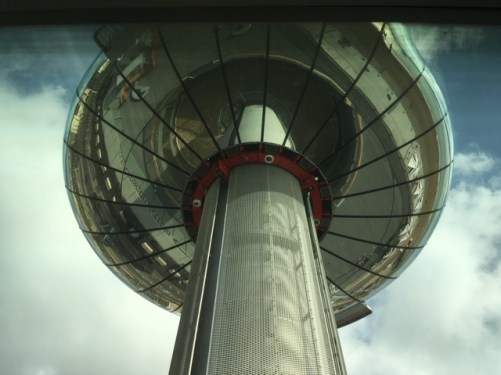
Looking west from the top of the i360. Hove starts at the Peace Statute (Note 1) you can just make out at the bottom of the green swathe of grass (Hove Lawns), and continues until Shoreham Harbour in the distance

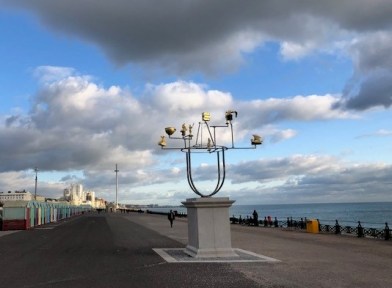
I am naturally not very inquisitive, just accepting of where I am and observing, but not initially digging into a location’s history. So it was a surprise when last year, on Hove’s promenade, a new plinth was installed, on which sat Jonathan Wright’s Constellation, based on an Orrery, a mechanical model of the solar system, except the planets have been replaced by local icons. Local icons?

PC 167 2

Looking East: the new plinth, with the i360 Observation tower in the background.

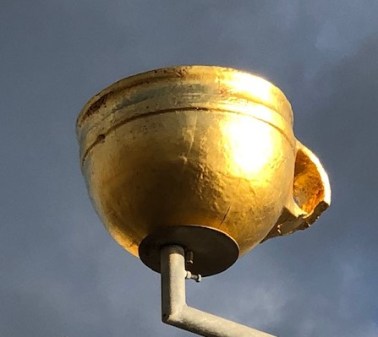
There are eleven. The first four are an Elm tree, a skateboarder (?), the Hove ship and West Blatchington Windmill, but of the others it is the ‘Amber Cup’ that I find most interesting ……. as we live in Amber House!!

PC 167 3

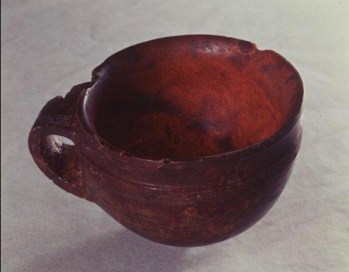
The ‘Amber Cup’ was unearthed here in Hove during landscaping in 1856 to create Palmeira Square, about a kilometre east of where I sit. An ancient 6 metre high burial mound was excavated and found to contain a coffin hewn from a tree-trunk. Dated from 1200 BC, it yielded many treasures including this cup, made of translucent red Baltic Amber and about the size of a regular tea cup. The find suggests trade links between Britain and the Baltic States over 3200 years ago??? Wow!

PC 167 4

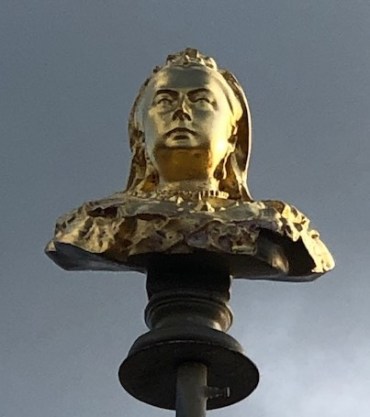
Naturally Queen Victoria features, for every town in Britain changed dramatically during her 64 years on the throne. She was our fourth female monarch and her reign saw the establishment of the British Empire, possible the greatest global empire ever created. Our current female monarch, Elizabeth II, has of course seen that empire relinquished, replaced in part by The Commonwealth.

PC 167 5

Queen Victoria 1837-1901

PC 167 6

A seagull and beach hut

Then there’s a seagull on a beach hut, the latter lining the promenade in a colourful display. Seagulls are noisy, chatty even, and numerous; part of the fabric of a seaside existence! The seagull is also the mascot of the local football team, Brighton & Hove Albion, which was promoted into the top tier of the professional English football league system in 2018. Currently they are enjoying a relatively successful 2019 season; their home ground is the AMEX Stadium on the outskirts of Brighton.

PC 167 7

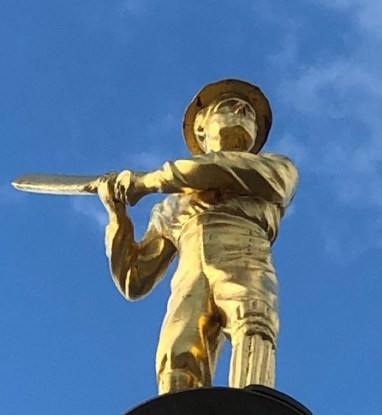
The Sussex County Cricket Club Ground is here in Hove. I am not a follower of cricket, although acted as the scorer for a prep-school team, if only to benefit from the cream teas that always accompanied a fixture!! So simply report that the club is the oldest of the eighteen first-class county cricket clubs, having been founded in 1839. They won the County Championship three times in the first decade of this century, and obviously deserve a place in this constellation.

PC 167 8

Another icon on the sculpture is the 35mm cine camera. Hove film-maker George Smith (1864-1959) bought a camera from the Brighton engineer Darling and create a special-effects short called ‘Grandma’s Reading Glass’!!

PC 167 9

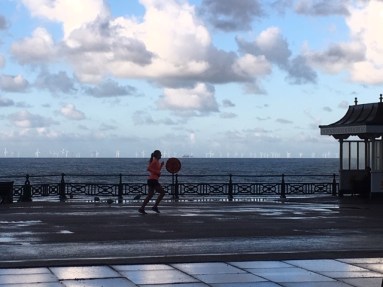
The Rampion Offshore Wind Farm 

The last ‘icon’ is very modern! On the plinth the turbine is quite small, but there’s nothing small about the Rampion Wind Farm, established 8 miles offshore in The English Channel at the cost of £1.3 billion. Its 116 wind turbines, 64m high, were connected up in November 2018 and at full capacity will provide enough power for 350,000 homes. The wind farm is named after the round headed Rampion (Phyteuma Orbiculare), also known as the Pride of Sussex and is the county flower.

I became a fan of the American author Bill Bryson from the moment I picked up ‘Notes from a Small Island’, his observations of living in Britain. Some twenty years later in ‘The Road to Little Dribbling: More Notes from a Small Island’ (2015) he reflected on what had changed since he first travelled across the country. In this second book he came through Hove from Littlehampton ……. on the No 700 bus.

PC 167 10

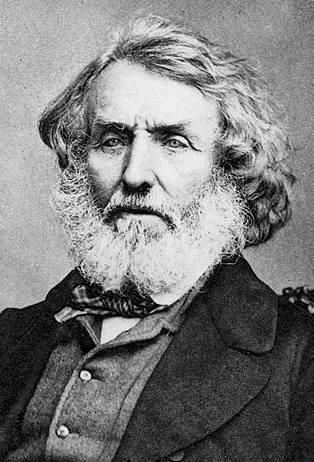
George Everest 1790 – 1866

Among the graves in St Andrew’s Church on Church Road, Bryson came across that of Colonel Sir George Everest. Everest was largely responsible for surveying from the southernmost tip of India north to Nepal, just under 2400 kms, a task which took 35 years. He was Surveyor of India from 1830 to 1843. As he was ending this mammoth task one of the mountains in the Himalayas was confirmed as the highest in the world; it already had multiple local names and Everest’s name was put forward for an internationally agreed one. He objected that he hadn’t discovered it, had never climbed it and was not a mountaineer …… but in 1865 his name was chosen. He died in London, but is buried in Hove, possibly as his sister had lived here; the family grave also contains his pre-deceased children.

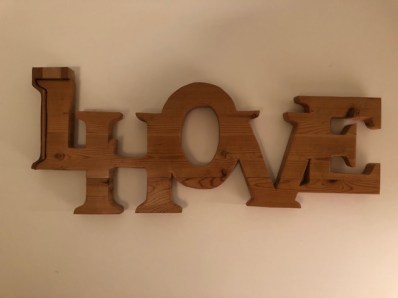
Six years ago the writer Ian McEwan published ‘Sweet Tooth’, a story of Serena Frome. She’s recruited from Cambridge into the intelligence service and tasked with establishing a relationship with a left-leaning author. “First she loves his stories, then she begins to love the man.” I was reading it on a trip to Rio de Janeiro when I suddenly came across: “Then, a few hours later, Brighton beach – strictly, Hove, which doesn’t chime romantically, despite the half-rhyme with love.” Pronounce ‘Hove’ with a long ‘o’ and ‘Love’ with a ‘u’ and I can see what he means, yet the two words share three letters. So in the sand of Barra’s beach I drew out the two words, interlocking the first two different letters. Back home in Hove I cut it out in some wood: I think the results fun huh!

PC 167 11

So that’s a suitable point to end these postcard scribbles, this intertwining with Love and Hove, this half-rhyme!

Richard 13th December 2019

Note 1. The Peace Statue, a winged female figure standing on a globe, was dedicated to Edward VII (1901 – 1910), who raised the profile of Brighton and Hove. It was erected in 1912 in recognition of the city providing a home for the Queen’s nurses and marks the old dividing line between Brighton and Hove.


PC 166 Mores and Milieu

I somehow managed to pass my English Language examination at school, but probably didn’t understand the complexities of English grammar and some of our rich language’s more unusual words in as much detail as I could have. I’m always slightly in awe of those who use long or strange-sounding words, wondering whether they are simply trying to imply some superiority or are just more intellectual than me! Such a shallow individual, huh!! The Physical Training teacher at boarding school, a Major Tim Wigmore, seemed to struggle with his vocabulary and we his pupils thought he tried to learn a new word every week. How horrible we were to take the mickey when he used a ‘new’ word in the wrong context.

But how is it possible not to know, for instance, what a zeugma is? Read PC 26 about this figure of speech. Since it was highlighted in The Times, I can now recognise a zeugma when I see one, as in: “In front of her lay a cup of coffee and another long day at work” from Jo Nesbo’s latest thriller The Knife.  Then people started asking how you could tell the difference between a zeugma and a syllepsis. Well, having not known of a zeugma for the first 60 years of my life, this was a step too far!

Two other words I have managed to live without for many many years are ‘mores’ and ‘milieu’! The first is nothing to do with Oliver Twist and his ‘more?’. ‘Mores’, pronounced ‘moreiz’, are the essential or characteristic customs and conventions of a society or community; they are more formalised versions of ‘norms’, particularly in a social context.

Milieu we borrowed from the French, where its meaning is slightly different; but it’s actually from a Latin base. Pronouncing it with slightly pursed lips, ‘mi:lja’ is a person’s social environment, the culture that the individual was educated and lives in, and the people and institutions with whom they interact. A nice way of understanding it is the ‘milieu is the surroundings that make you you’.

Rod Liddle, writing in his Sunday Times column last month, had a go at people eating smelly food on trains, to the annoyance of those around them. He went on to bemoan the lack of respect for others that is increasingly evident in our society. You remember that rock song from Freddie Mercury and Queen, “I Want it ALL, and I want it NOW!”? It came out in 1989 towards the end of Margaret Thatcher’s 11 year term as Prime Minister and seemed to capture the spirit that she had encouraged. Everything is possible (This I agree with!) and you can have it NOW (No! You have to work hard and earn it!). But the rise of our individualistic culture has been at the expense of the community spirit that we, we British, used to have in abundance. Thatcher famously said she believed there was no such thing as ‘society’, so how do you describe our very necessary interaction with others, the collective spirit that binds individuals into interest groups, giving them something other than their own ego? Liddle summed it up cutely: “The right has encouraged less reliance on others as in a social way, the left has tried to abolish blame and responsibility. And in the minds of the liberal left, we shouldn’t judge others by any ‘bourgeois’ standards as to whether or not they are behaving with dignity.”

Or you leave yourself open to accusations of class snobbery, of social mores that conflict and irritate? But surely they are some real basic standards of manners irrespective of what milieu you naturally swim in? For ‘Manners Maketh Man’ (see note). No one has a monopoly on manners, each ‘class’ demonstrating an abysmal lack of manners at times; the “I want it now …… it’s my right to have it now” sort of attitude with no thought or respect for those around them, who may disagree.

In my 40th postcard, posted in May 2015, I scribbled about habits – saying ‘Good Morning’ to strangers on your street, having the loo seat always down (when not in use, obviously!) and other issues I get excited about. Like “Thank you” notes. I wrote that my own social mores dictate you should always write a note of thanks if you have lifted a knife and fork in someone else’s home. Sometimes things get into your head and go around and around ….. until you write them down. The following was transcribed at 0245 one morning recently:

“I will not accept that the current generation don’t know how to wipe their arses and dispose of the paper. I will not accept that, just because those living in Georgian times imported sugar to Great Britain, over 200 years on everyone blames the Georgian for their own fatness, that they are so fat that they can’t even reach their arse even if they know where to put the paper. As one of the Baby Boomers who grew up with rationing and scarcity, it is no wonder that the 1960s explosion in the use of plastic was heralded as some reflection on Aldous Huxley’s Brave New World. And, no, we didn’t see its use would be so problematic to the planet; but you can’t dis-invent things and you shouldn’t blame the Baby Boomers! And I will not accept that two well-educated professional individuals, who probably swim in the same milieu as me, came to a carefully thought-through home-cooked lunch, seemingly enjoyed themselves, left through the front door ……. and disappeared like those on the Marie Celeste …… without a demonstrative thought to say ‘Thank You’ ……. in whatever form would convey appreciation. At its most basic, WhatsApp or text; maybe even a little email; even a telephone call: at best, a hand written card  …….. simply to signify that if you receive, you should say ‘Thank You’. If your life is SO busy, then don’t bother to ‘take’ in the first place!”

Sorry! In the words of one of my favourite FaceBook contributors Catherine, ‘Rant Over’!


Richard 28th November 2019

Note: Recorded by the headmaster of Eton William Horman (around 1500) “Manners are something used every day to make a good impression on others and to feel good about oneself …. Being polite and courteous means considering how others are feeling. If you practise good manners you are showing those around you you are considerate of their feelings and surroundings.”


PC 165 Growing up in Bath

I was born in Bath in October 1946 whilst my Royal Naval father worked at the local Admiralty Department, before he went off to join HMS Birmingham in a sea-going engineering role. We lived in the top flat of No 13 Marlborough Buildings; my grandparents lived around the corner, as it were, in the Royal Crescent.

PC 165 1

Outside No 13 in October 2019


PC 165 2

Outside No 15 Royal Crescent in 1951

My parents divorced in 1950 and we went to live in what would have been the old servants’ quarters under the roof of my grandparents’ house, No 15 Royal Crescent. The crescent had been built to accommodate the loads of Georgian tourists who came to sample the spa waters down in the City centre; the facades were all the same, the internal design and rear elevations completely different!! With my grandparents and their three dogs on the second floor, us in the attic, complete with goldfish on the shelf by the back stairs and my mother making bespoke hats for the ladies of the City, it was a secure existence.

PC 165 03

The back stairs to the attic flat (2019)

To the east of the Royal Crescent lies Julian Road; to the north was the home of Hermitage House a school for 5-8 year old boys and 5-14 year old girls. It was run by a Miss Bobers and sadly my only memories are of observing an eclipse of the sun and of learning one’s ‘Times’ tables by rote: ‘One four is four, two fours are eight, three fours ….. etc’. It’s a wonder I went on to do A Level Mathematics and an Engineering Degree!

PC 165 4

The home of Hermitage House school in the 1950s

My brother and cousin had attended a nursery school on The Paragon in the city, run by a ‘Captain Olsen’.

PC 165 5

How times change the way we perceive things! Looking at this group from 1951 you could make all sort of judgements, what is now acceptable and what’s not!!

Without doubt, it was a privileged upbringing, but the stigma of divorce cuts across the social class and it can’t have been easy for my mother. My step-grandfather, Thomas Tizzard (‘Uncle Tommy’ to us boys), was a well-known consultant ophthalmic surgeon who had his consulting room on the ground floor of No 15, across the hall from a room which doubled up as a dining room for family and a waiting room for patients. On the first floor was a wonderfully ornate ‘salon’, with parquet flooring, an Adam plastered ceiling and fireplace, and floor-to-ceiling mirrors. It was here that my grandmother Grace (neé Corbett, whose father had been born in Recife, Brazil) staged her quarterly concerts, raising thousands of pounds for local charities. The room was big enough for her two grand pianos and 100 guests!

PC 165 6

She was an extremely accomplished pianist, even if her constant practising of ‘The Arrival of the Queen of Sheba’ by GF Handel drove a six year old boy mad! Today their house has been incorporated into The Royal Crescent Hotel, whose main entrance is No 16. As a very generous birthday treat last month, we stayed a couple of nights; our room was in the No 15 ‘part’ and was Uncle Tommy’s old Consulting Room!

PC 165 7 Tommy's Consulting Room

Down the hill, at the bottom of Marlborough Buildings, is Victoria Park, with its obelisk in memory of the famous monarch for all to see.

PC 165 8

In the summer months of my childhood, an ice-cream van run by Giovanni, an Italian who had been interned during the war, would do a roaring trade.

I put my hand into the dirty pocket of my grey shorts and am reassured by the touch of my threepenny piece (see note 1), along with a piece of string and my penknife; enough for my favourite ice-cream! I queue. My turn!  I get the coin out of my pocket, reach up on tiptoe as high as I can and put it on the aluminium shelf. “A Vanilla block and wafer please?” He reaches into the ‘fridge, picks up a block, adds two wafers and hands it to me. “Thank you” I mutter hurriedly as I feel myself salivating.

PC 165 9

I turn away, carefully unwrap one side of the block, place one wafer on top of the ice-cream, turn it over and remove the remaining paper, replacing it with the other wafer. At last! Holding my ice-cream carefully between thumb and forefinger, I lift it to my open mouth. I smell it, inhale the dusty wafer crumbs, and take my first bite. Now I am happy.”

On Milsom Street there was a restaurant called Fortes (The site is now occupied by Waterstones!) where my grandmother often went for morning coffee. One of the waiters, a rotund dark-haired chap called Sam, always smiled when he brought the Bath Buns, an essential snack to have with a coffee. As a seven year old I wasn’t allowed to drink coffee (see note 2) but the buns were a real treat.

PC 165 10

They are made from milk-based yeast dough with crushed sugar on top. One variant included enclosing a lump of sugar in the bun, the lump retaining its shape if not its hardness; yum yum!

Discussions about which school and where were not in my compass but I felt dumped and abandoned when, in September 1955 and shortly before my mother remarried, I was placed, aged 8, in St Christopher’s School, up on North Road to the south of the city.

PC 165 11

The old St Christopher’s School, now occupied by King Edward’s

I was allowed out to go to the wedding, but my only concern was to obtain a letter excusing me from eating Macaroni Cheese (disgusting, particularly cold as you had to present an empty plate.)

PC 165 12

At my mother’s wedding, after three weeks at St Christopher’s

Any pleasant memories of my two years at St Christopher’s are completely submerged by an event that runs like a vein of shame through my life; never far from the surface, hidden under the ‘Stiff Upper Lip Caruthers’ code that prevailed, occasionally close enough to pick at. In the ground-floor loo block I was forced to masturbate an adult until they came. Who was he? I’ve blocked this! Did I report it? ‘Stiff Upper Lip Caruthers’. But I can’t get rid of the image! Disgusting!!

I left to go to another boarding school near Wells in Somerset, and then progressed to yet another boarding school; my parents remained 100 miles away, when ‘Exeats’ were twice a term for a half day, and ‘Half Term’ a mere two days. So I felt an affinity to Sandi Toksvig, Anglo-Dane and recently co-presenter on Channel 4’s The Great British Bake Off, when she says that her boarding school experience established an ache of loneliness that has never truly left her;  “proper emotional abuse of a child”.  I spent 10 years in boarding schools until, in 1965, I entered another institution, The Royal Military Academy Sandhurst, for Officer Training; I served Her Majesty for 20 years. But sometimes I wonder, ‘What if …..?”.

Grace died in 1974 aged 83, by which time my life was happening away from Bath. But it still feels like home, wandering around this warm, honey-coloured, gracious city, good memories or bad.

Richard 14th November 2019

Note 1: The Three penny piece (known as threepence, thruppence or thruppenny bit) was a twelve sided coin first minted in 1547. It was worth one 80th of a pound (ie four made a shilling and twenty shillings a pound sterling!!)

Note 2: Coffee in England in the 1950s was coloured, flavoured water, and there was nothing like the huge variety available today. It was probably produced on a Kona machine and allowed to sit, brewing (ie becoming more disgusting) as the pot sat on the hot plate. During our Alaska trip in 2015 I was reminded of the fact that today American coffee is similar to that available in 1950s Britain. When I asked for a double espresso in some café south of Fairbanks, the waitress, with her hand on the Kona handle, said “Oh! You want fancy coffee!”.

PC 164 The City of Bath

PC 164 1

Bath lies just over 110 miles to the west of London

Whether you think of the City of Bath as an ancient Roman one, a flamboyant Georgian one, or one that is finding its place in the C21st, the city has an appeal that spans the generations. There has been a settlement in what was an ancient volcanic crater in Somerset since Celtic times. The Romans built the city of Aquae Sulis in the 1st Century AD, attracted by the springs which produce a daily flow of a quarter of a million gallons of water, at 46°C. It was the health benefits of these waters that drew wealthy Georgians to the city and the need for accommodation created the expansion of some of the most glorious architecture in Britain. John Wood’s Queen Square and The Circus are by any standard fabulous, but they were trumped by his son’s designs for the Assembly Rooms and The Royal Crescent, the latter a semi-ellipse of 30 houses, built using a local oolithic limestone, characterised by its honey colour.

PC 164 2

I was lucky enough to have been born in Bath and consider it my spiritual home, home to so many memories, good and well as bad, for such is life. This postcard is about the city and a second will recount some of those memories.

Parts of Bath are unrecognisable from 50 years ago, such is the extent of the cleaning of the stonework, its public buildings relieved of the grime from coal fires and their facades provide a warm welcoming ambience.

PC 164 3 The Circus

The Circus: (My old dentist, a Mr Sharp, practised at No 13 (see PC 64))

Whilst the Royal Crescent and the Circus sit in an elevated position, walk down the hill, turn left into George Street and right into Milsom Street …….

PC 164 4 Milsom Street

……. and you’re in the beginning of the modern shopping area. Eventually you come to Bath Abbey, The Pump Rooms and the Roman Baths. Today you can actually enjoy the thermal springs in the Thermae Bath Spa and be pampered in the adjoining Gainsborough Bath Spa. The River Avon flows under nearby Great Pulteney Street, a weir slightly downstream regulating water levels.

PC 164 5 Pulteney Bridge

Pulteney Bridge over the River Avon

But it’s the Abbey that dominates here. The current building dates from 1499 although there had been places of worship on the same site from the C9th.

PC 164 6 The Abbey

I was last in the Abbey in 1958, over 60 years ago, when, as a boarding school pupil, we attended the Sunday morning service. We walked in crocodile formation a mile down the hill from the south west, dressed in grey suits, white shirts, and wearing, unimaginably, black ties in memory of Queen Victoria, who had died over 50 years before!

PC 164 7

The inside of Bath Abbey circa 1980

We had sat in the dark wooden pews and choir stalls and recited, by rote, the unchanging words of the service. On my recent trip to Bath I wanted to sit in those stalls, to relive that time, but was confronted with noise, light and space. The Abbey’s management are in the process of repairing its collapsing floor, lifting the countless slabs and the skeletal remains beneath, installing a heat-exchanging system using the natural hot spring waters, and reinstating everything. So the noise came from those working on a third of the floor, the light reflecting off much cleaner stonework and a sense of space created by the light wooden chairs that have replaced the pews. Quite a transformation!  Uplifting one might say?

PC 164 8

In 1956 there were pews here ……. And now they’ve gone!

Like all places of worship, the Abbey contains many hundreds of memorials to the good and the great; most originate from the 1700s and 1800s. In the South Transept lies the tomb of the wife of Sir William Waller. Waller fought for parliament in the English Civil War (1642-1651) and led the Parliamentarians in the nearby Battle of Lansdown. Although he retreated off the hill at the end of the battle, leaving the Royalists under Sir Ralph Hopton victorious, the latter suffered heavier losses and Waller was ‘ready to fight another day’. (Note 1)

Near the Abbey are the Roman Baths and Pump Room. I was last here in 2008 for the wedding reception of a godson. A wonderful occasion and quite a location! Just to the East of The Circus are The Assembly Rooms; completed in 1771, they were at the heart of fashionable Georgian society.

PC 164 9

The Assembly’s Tea Rooms

The noted novelist Jane Austen (1775-1817) would have met friends, attended balls and evening parties in The Assembly Rooms, for she lived in the city from 1801 until 1806, and during a visit to the grand rooms it’s easy, if you half shut your eyes, to imagine the noise, glamour and smell of that extravagant period. She set two of her novels, Northanger Abbey and Persuasion, in Bath and today you can join numerous tours focused on her fame; start at the Jane Austen Centre, just a few doors down from where she lived in Gay Street. (Note 2)

Like many cities in Britain, Bath suffered from World War Two air raids. A particularly heavy one in 1942 laid waste large sections of the city.

PC 164 10

The bomb that made this crater missed The Royal Crescent by 50ft, but hit St Andrew’s Church immediately behind it!

We are fortunate today for the publication of ‘The Sack of Bath’ by Adam Fergusson in 1973. This book highlighted how the 1960s city council had set about rebuilding the bomb-damaged city in a seemingly unplanned and haphazard way; large sections of Georgian houses were demolished and replaced by modern ‘chic’! This is an example on Julian Road. (yuk!)

PC 164 11 Julian Road

A powerful preservation organisation, the Bath Preservation Trust, came into being, and the results are evident today in some wonderfully restored buildings. And if you want to envelope yourself in how you could have lived in the 1700s, visit the renovated No 1 Royal Crescent, now a living museum.

Richard 1st November 2019

Note 1 The woman with whom my aunt Cynthia shared most of her life, Peggy Bryant, loved Jane Austen novels. But, maybe surprisingly, she admitted to me that she read Northhanger Abbey at least once, every year!!

Note 2 My first military posting was to a regiment in Devizes, Wiltshire. We were stationed in Waller Barracks. A mile down the road another military unit occupied Hopton Barracks!! The modern army shows no bias between Queen and country!


PC 163 Do I sell myself well?

For some of you this will be a meaningless question, given advancing age and complete comfort in one’s skin. For anyone else earning their crust, you need to grasp the importance, if you haven’t already, of being able to sell yourself.

Some things stay with one for a long time, such is their very fundamental impact. One such occasion was sometime in 1993 when I was working for an Australian company called Morgan & Banks. All the London Office consultants were gathered around the boardroom table, on which there was an old fashioned telephone. The ‘Sales’ trainer said he was going to ask one of us to make a cold call; a ‘cold call’ being one to an unsuspecting company, when you tried to interest them in the services your company offered. For those making the call it was the rump of the sales process, but very necessary; for those on the receiving end it was, 99 times out of 100, a nightmare.

You could see the outward behaviour of those around the table go onto a rollercoaster. For some, the head went down and their mind was screaming: “Don’t chose me!”; for others they simply looked neutral – for no one wanted to make the call.

OK! John. Here’s the number.”

John reddened and he felt his heart beat faster; the others visibly relaxed. But just as John picked up the receiver to dial the number, the trainer said: “I’ve changed my mind. Tim, could you do it?” Our emotions went haywire!

So why do we dislike the process of selling so much? My parents’ generation had a very firm distinction between the ‘professions’ and ‘trade’, and the salesman was very much part of the later, personified by Del Boy as a fast-talking archetypal South London ‘fly’ trader in a television series ‘Only Fools and Horses’. Fortunately we now all realise that ‘selling’ is as important to the manufacturer as it is to the lawyer. But as I grew up I never realised the importance of selling ‘myself’. Performance during one’s military career was marked annually by the Confidential Report, charting the highs and lows of one’s military career and I reflect I didn’t feel the need to ‘sell’ myself. At Short Brothers, despite a sales role, essentially I was approaching foreign governments with an offer to give a presentation of the weapon system. I hoped the system’s functionality and performance would sell itself.

PC 163 1

I just had to include this historic photo from 1909, showing the three Short brothers with aviation pioneers such as the Wright brothers and a Mr Rolls and a Mr Royce!

But then I got made redundant and had to set about selling my skills and abilities. Being one of life’s eternal optimists I always imagined there was someone out there that needed me! Three months later I joined Morgan & Banks. Geoff Morgan and Andrew Banks, the two Australian owners, had built a hugely successful recruitment business …… by selling its benefits through us consultants. The system was focused, tough, and very results-driven. It was not unusual for Andrew Banks to call your desk from Sydney around 0830 (UK time!) on a Monday morning to go through your previous week’s activities; there was nowhere to hide.

Which brings me to the boardroom and the sales trainer. I was never very good to statistics but, roughly, for every 100 cold calls you made you might get a positive response from 10, which might be converted into one piece of business! The only way to succeed was to embrace the sales process at every turn. There is a large library of books covering ‘sales’, but none better that one that dealt with the psychology of sales ‘Call Reluctance’. The authors suggest there are twelve different behavioural traits that inhibit one’s ability to sell oneself.

PC 163 2

If you are really interested, read the book (SPQ*Gold) or take a course with Dom Waters (See Note one) ….. but  ………

There are those of us who are never ready to sell themselves, always wanting more time to prepare (the ‘OverPreparer); those who always imagine the negative response rather than the positive one (The Doomsayer); those who spend so long developing their ‘professional’ image they have no time for actually selling (The HyperPro) (note two); those for whom the idea of giving a sales pitch/presentation is a complete anathema (Stage Fright) (linked to the negative behaviour) and those for whom the idea of making an actual telephone call is too emotional to contemplate – and too easy these days to hide behind emails or texts (Those with Telephobia). These are all learned behaviours and can be unlearned! (If in doubt, talk to me!)

I remember trying to win business from the Human Resources Director of Manufacturers Hanover, a now defunct bank. After six months I managed to get a meeting and took along one of the search consultants. Our imagined one hour meeting was immediately cut to 30 minutes, so we both explained what we could offer to Malcolm at breakneck speed. Then it was over; hands shaken, gathering papers, I just had to ask the all-important question: “So when will I get some business from you?” My colleague later said that took courage!!

Another person on my list was the HR Director for Freemans, a large mail-order clothing company. After months of frustration, I telephoned them after the PA had gone home, and got the lady herself. “Can I have 5 minutes of your time to explain what I do?” “OK! You’ve got five minutes!” So I launched into my sales pitch, having put my watch on my desk. After 5 minutes, in mid-sentence, I stopped talking.

Hello? Are you still there?” she asked.

You’ve had 5 minutes. You want more?” I cheekily asked. We set up a face-to-face meeting!!

In addition to embracing the results of SPQ, I did a NLP course. So much came out of this but for those anxious to simply get on with someone quickly, try some rapport building, especially a technique called mirroring. You simply copy whatever body language the other exhibits.

PC 163 3

Aware that a Departmental Director was very uptight and unwelcoming to new ideas, at my ‘sales’ pitch I simply copied his body movements; it took a while, but after 10 minutes he suddenly opened up and became very receptive! It was strange, but our subconscious likes people like ourselves!!

PC 163 4

Richard 18th October 2019

PS I ran my own executive coaching business for 16 years – and like everyone self-employed, had to sell the product before I could deliver it.

Note 1. ‘Earning What You’re Worth. SPQ; The psychology of Sales Call Reluctance’ by Dudley & Goodson. Or contact Dom Waters at paulwatersassociates.co.uk (01635 202750)

Note 2 One of the behavourial traits of these types is to have a hugely flashy signature. Such as:


PC 162 What Moisturiser Do you Use?

The question “What moisturiser do you use?” was one I seriously was not expecting! And the truth is that I do not use any moisturiser on my face. In the last century I did and used so much E45 cream that I bought some shares in the company that made it; well, I certainly helped their turnover, as I slathered the cream on every morning, trying to reduce the flakiness of my dry facial skin. But since then three things have happened. One, I gave up smoking in1994; two, I gave up alcohol in 2002 and we all know how bad both alcohol and smoke are for one’s skin; and three, I started Hot Yoga. These have combined to ensure my skin has regenerated itself to something more youthful. I hadn’t really anticipated this but am delighted by the result. Of course, these days we men can pick from a vast range of grooming products!

PC 162 1

Men’s grooming – Tom Ford Serum (2) £255 (!!) or Baxter of California Skin Concentrate (7) £28 or Heath Eye Serum (10) £14

So who asked the question? PC Christina Lane of Sussex Roads Policing Unit. Why? Well, she was imputing my details into her iPad after arriving at the scene of my traffic accident on 3rd September when she suddenly looked up at me. Having read my date of birth on the DVLA website for Driving Licence registration, she obviously thought I must use some form of moisturiser!! “Hot Yoga” I replied ……. and explained that sweating every day keeps the pores of the skin supple and open and my lack of wrinkles is clear evidence of this.

I consider myself a reasonably good driver – just like anyone else, I guess? Back in 1970 I even took The Institute of Advanced Motorists’ Driving Test, an exacting 90 minute examination and had passed (See PC 111). On Tuesday 3rd September, having collected Celina’s mother and cousin from Gatwick airport, we were making our way back into Hove along Shirley Drive, a residential street of upmarket, detached houses. It is also a rat-run for commuters …… and it was the beginning of the rush hour. This is a photo of the last memory I have before impacting with a Volkswagen Up!!

PC 162 2

And this is what my brain was suddenly aware of ………

PC 162 3

The stupid young woman had come out of the road to my left, had, according to both Celina and cousin Tony, looked to her left but not to her right, and simply driven into the space about to be occupied by my Audi.

PC 162 4

It wasn’t until a little later I thought about this complete blank as to how it had happened. Did I brake? – there was no rubber on the dry road! Did I take any evasive action? – the wheels were still parallel with the road suggesting I didn’t! The frontal airbags didn’t deploy and a little question to Mr Google informs me that they would deploy when ‘striking a parked car of similar size at about 16 to 28 mph’. I had thought my speed was about 20 mph (in a 30 mph zone) ….. so that checks out. (See note 1)

Our innate ‘flight or fight’ response kicks in in moments of stress and trauma. Benedicte, a good friend training to be a Paramedic, tells me the brain triggers the release of hormones, mostly adrenaline, which cause physiological changes such as increased heart rate, blood pressure, rapid breathing and sharper senses. This hormone release can lead to memory loss because stress taxes the body resources; acute stress may disturb the process that collects and stores memories. So, a three second blank; complete blank!

There are moments in life when you wish, with all the breath in your body, that you could rewind time, turn the clock back. You may recall this was exactly how I felt in October 2015 when I looked at my thumb whose side I had neatly sliced off with a mandoline (PC 52). But the passage of time is always forward, so here was a ‘situation’ that needed dealing with, no time to reflect about rewinding the clock (!), not least for the poor woman in the front seat of her car covered in glass from her broken window and shaking in shock. My military training taught me to be calm in a crisis; add almost 20 years of practising yoga and I feel I project a calm and unflustered demeanour; inwardly it may be a different matter!! Celina helped Maddy, the VW driver, to get out of her car; we called the police (see note 2); Michelle, the driver of the Mini immediately behind me, kindly offered to be a witness; photographs were taken and I reversed the Audi and parked it off-road. With a foot on the door pillar of the VW, I managed to pull open the crumpled door, brushed the glass off the seat and moved the car to the verge.

PC Christina Lane and I flirted whilst she filled out the online forms; and why not? She was gorgeous, half my age and it was all innocent fun in the aftermath of what might have been a life-changing accident. Reduces the stress does flirting! And for the first time in my life I was breathalysed!!

PC 162 5

A souvenir!

The firm of solicitors that were instructed by my insurance company to get in touch did so …… and didn’t believe no one was hurt. “But surely ….? Symptoms appear after a day or so …..” and telephoned me four times to check!! We live in litigious times so being able to push back felt good. The claims process is so joined-up these days that online reporting, choice of repair garage, choice of hire car etc etc – no hassle at all. A month later the generality of the incident is now just that, an experience. Thankfully no one was physically hurt although I am hope Maddy, the VW driver, will remember for a long time the day she didn’t pay attention whilst driving.

Richard 3rd October 2019

Note 1: The Volkswagen Up! is a lightweight car compared with my Audi Q3, so probably absorbed some impact. Interestingly the repair garage said that if the air bags deployed, ‘most cars are written off, such is the complicated engineering around the dashboard’.

Note 2: In the UK apparently it isn’t necessary to call the police if no one is injured in an accident. A simple exchange of information is sufficient.


PC 161 – The Atlantic 1976


Way back in 1975, on a cool autumnal evening in Dempsey Barracks, Sennelager in Germany, I was sitting in my room in the Officers Mess of 39 Medium Regiment Royal Artillery, thinking how the last training exercise had gone. The mess orderly knocked; I had a telephone call, someone called Major Mike May. Hard to believe these days, when communication devices are personal and in your face, or should that be at your ear (?), but the Mess’ telephone was housed in a little cubicle off the main ground floor corridor. Outgoing calls were made via an exchange operator! It was a somewhat airless and dimly lit space, but doubtless privy to countless intimate conversations over the decades. I had sailed with Mike May a few times and this was really our only connection; so I was expecting some sailing-related question, but not: “Would you like to navigate an Army entry in the STA Race next year?”

PC 161 1

The STA (Sail Training Association) was an umbrella organisation for offshore sailing in the UK, but more importantly organised an annual international race for square riggers and sailing ships. (See note 1) I had taken part in its 1969 race from Portsmouth to Skagen in Denmark, so was familiar with its ethos of encouraging youngsters to develop their character through sailing. Additionally in 1974 I had had a fortnight sailing as a Watch Officer on the TS Malcolm Miller, a three-masted schooner. The 1976 race was from Portsmouth, England to Newport, Rhode Island, USA via Tenerife, in The Canaries, and Bermuda. These four legs would be sailed by different crews; we were allotted the Tenerife to Bermuda leg, a distance of just under 3000 nautical miles. Bermuda, an island lying some 600 miles east of the USA state of North Carolina, is 22 miles long but only one mile wide!

PC 161 2

After some crew training in The Baltic we, Mike May as Skipper, me as Navigator and ten other army personnel, flew to Santa Cruz de Tenerife on 21st May 1976 and took over the Nicholson 55ft yacht HMY Sabre.

PC 161 3

Two days later the race to Bermuda started; there must have been about 50 vessels, from huge ‘tall ships’ to lesser mortals like us. Offshore racing is strange; you have a crowded, manic surge across the start line, the skippers set their course and off you go. Most modern yachts can sail just below 40 deg to the wind, the tall ships probably only manage 60 deg; but their speed was much superior to ours, so their passage quite different! I don’t think we saw any other competitors after that first night, such is the vastness of our oceans! It’s a long time ago (!) but I think we organised a watch system of 4 hours on/4 hours off with a ‘dog watch’ to change the routine …… for three weeks.

So ….. days of watch and sail changing, attempting to squeeze another knot out of the yacht and our inexorable progress towards Bermuda. Ripped sails needed mending, gear needed maintaining, bread needed making – or should that be kneading? And with twelve people in a small confined space, the crew needed managing!

PC 161 12

The trade winds are the prevailing pattern of winds found in the tropics, from the east towards the west. Tenerife is some five degrees north of the Tropic of Cancer so we were able to take advantage of these favourable winds, flying the large spinnaker sail almost for two weeks, before a final few days of head winds and heavy seas. Somewhere in the middle of the Atlantic we were becalmed and this gave us all an opportunity to have a swim, although prudence ensured only one crewman was in the sea at any time, the rest maintaining a lookout for sharks!

PC 161 6

…….. and me! (Not thinking how deep the water was!)

PC 161 7

Fresh water was rationed to 1.5 litres per person per day – although we had an extra splash in a whisky at drinks time. The eventual lack of fresh food and the constant exposure to salt water produced some skin issues but otherwise the planned menus worked well.  Sometimes the nights seemed very long …….

PC 161 4

…… and at other times the conditions required much concentration …….

PC 161 5

We checked in with the Race Controllers every day by two-way radio, giving our position and listening to those of the yachts we saw as our competitors! Into our final week and we had head winds which gave us more movement and surprisingly some seasickness!

PC 161 8

No two yachts were the same and there was a handicap system. We navigated by sexton with sun and moon shots, converting our data by way of navigational tables and a Hewlett-Packard calculator the size of a house brick that had some computing ability, to a position on the chart ……. and were very pleased to find the tiny island of Bermuda right on the bow on the 10th June.

PC 161 11

We had arrived in Bermuda at the beginning of the hurricane season, greeted by cloudy and extremely humid weather. The Tall Ships gradually filled up the harbours and small bays and celebrations were numerous and colourful; thousands of young people enjoying a tremendous achievement, crossing one of the great oceans of the world. And if you’ve never tried Planter’s Punch, do so, but do it in the environment for which it was created; doing so back in Germany some weeks later it wasn’t quite the same! But we had done well and somehow managed to win some trophy.

Richard 19th September 2019

PS I even managed to catch up with an ex-school friend who lived there.

Note 1. Founded in 1956, the Sail Training Association (STA) became the Tall Ships Youth Trust. The current Tall Ships’ Races are organised by the Portsmouth-based Sail Training International.

PC 160 Change

Change: Noun – “An act or process through which something becomes different

I can’t believe it’s a year since PC 132 (8th September 2018) when I wrote about September, the new start, the new ‘year’ …… life rushes by …… you seriously need to grab it! (The irony is that that PC ended with a cartoon about Brexit – plus ça change plus c’est la meme chose)

The Number 50 bus pulled into the stop on the south side of Palmeira Square in Hove; “All Change, please! All Change! This service terminates here.” announced the driver in a loud voice. We had been expecting the service to continue into central Hove and were momentarily incredulous and surprised. Some of the other passengers seemed equally uncertain, but the regulars knew this was their final destination and were already on their feet and disembarking, unfazed. I reflected, as my feet landed onto the pavement, that this was a little example of how we react to change. Change is a constant; for some it’s a surprise, welcome or not, for others it’s fact that you just deal with. In 1964 Bob Dylan sang about ‘The times they are a-changin’ as though change was unique to his ie my generation, but every generation copes with change, be it brought about by the Industrial Revolution that heralded the modern era, or the Digital Revolution that’s creating exponential change in every aspect of our life. (See Note 1)

Sometimes the change is totally outside of our control, like being made redundant from your job. Many years ago I had the privilege of working with people who had been made redundant, assisting them to find some other form of work, paid or not. Moving them from the old world ……. into a new one.

PC 160 1

We all know it’s not the individual that’s made redundant but the role, but we identify with the role, so feel it personally. I know, as it happened to me! For some, acceptance is a long time coming ….. but come it does. The key is to let go and look forward.
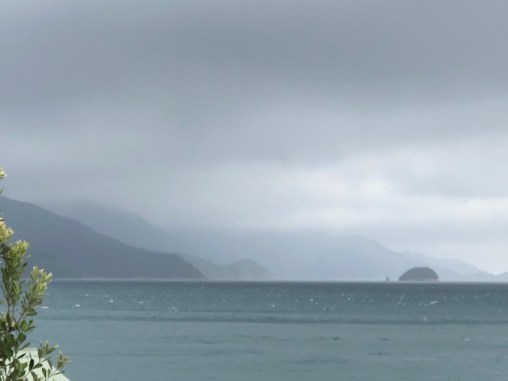
You might have wondered why we were on a bus coming back from Brighton; it doesn’t matter if you didn’t as I am going to tell you anyway. For the last seven years we have practised our daily hot yoga in Portslade, driving along the seafront and turning north by the beginnings of Shoreham Harbour. There was a free council car park we could use and, if that was full, there was always a space at the nearby Tesco supermarket. When we were in Portugal, the door to the studio was closed to us.
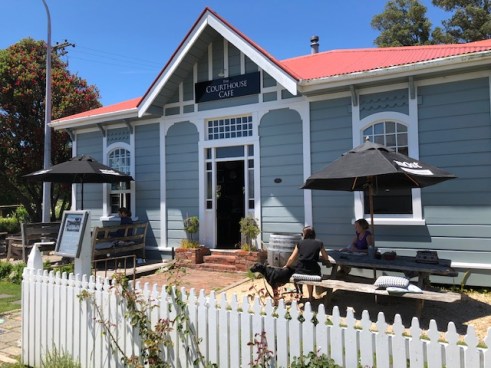
One door closes, one chapter ends, another opens, always. When we returned home we signed on at Yoga in The Lanes in central Brighton. The costs of car parking in the city are prohibitive, so we are using the frequent bus service along Western Road. It’s interesting to compare the cosy, isolated, insular car journey to the very public experience of a bus service. But it’s working well …… and this gets us back to Palmeira Square, and that terminating bus! We walked the rest of the way home.

This change of routine has also started me thinking about the necessity of owning a car. With no daily yoga commute, for the first week the car simply sat in its parking space, which costs me £600 per year. Add our Road Tax, insurance and servicing costs, factor in some depreciation, and my mind thinks ‘This is mad! Why don’t I just hire one when I need it?’ And we may get to that ….. but the immeasurable factor is the ownership issue, that at the drop of a hat I can walk down the road and get into my car and go somewhere, now, instantly. Heart and head in conflict.

Change to our daily routine has almost coincided with the start of the Academic New Year (see PC 132), so for thousands of our young it’s either the start of schooling, or a new form in the same school, or a different school or indeed later in September the start of university, flying the parental nest. Some of our chums’ children have done really well in the examinations, getting into their chosen university or with enough good grades to confirm their choice of the next level of academic study. Others of course have not been so lucky and the gentle discussions start to identify where and what the solution might be. There should be no losers, no labels attached at this stage of life.

My parents’ generation held great store by having a long career with one organisation, with one company, the ambition to rise up through the levels to senior management. I think myself fortunate that that view came to be seen as restrictive to the development of ones skills and talents, that exposure to a variety of cultures, company leadership, management and disciplines ensures a better, fulfilled, more able individual. Change!

You probably have heard of the analogy of the frog in a beaker of water? A frog is placed in some water and the water is slowly heated; the frog dies, quietly. Drop a frog in a beaker of hot water and the frog will jump out. Gradual insidious change kills! For we need to change the way we think, in order to change the way we feel, before we can change our behaviour. The great George Bernard Shaw is quoted as saying: “Those who can’t change their minds cannot change anything” ……. but a chum recently stayed in a hotel room so small that she had to leave it to change her mind!

Last Saturday in the evening, after another yoga session, we boarded a bus for home. Obviously I have a doppelganger living in the city, by appearance but not by character, for the driver took one look at me as I presented my Bus Pass and muttered: “I hope you’re not going to be any trouble this time?” My imagination went into overdrive as to what my look-alike might have done on an early journey! Life huh? They say, whoever they are, that ‘Change is as good as a rest’; that to enjoy life to the full it’s good to be having periods of challenge, of change. So go on, challenge yourself, to change …….

Richard 5th September 2019

Note 1: I subscribe to The Times newspaper and have both digital and paper editions in the UK, only the former abroad. And now, even if I wanted to, you can’t buy an international paper copy of The Times aboard. A sign of the times maybe!

Note 2: The Jewish New Year this year is 29th September.

Note 3: The numerate amongst you will realise, at one postcard a fortnight, this should be PC 158! You got a couple of extras this year.

PC 159 Ironing

In PC 158 I mentioned rather off-handedly that, in the evenings during my daughter’s stay in Estoril, I would collect her family laundry and return it sometime the next day, folded but not ironed. This may have given a false impression that, despite being a Metro man, I don’t iron. How wrong is that! I love ironing …… especially sheets!

Way before I was born, a block of iron, heated in some way, was used to smooth out the creases in clothes. There was even a song about this mundane aspect of our existence – “Dashing Away with The Smoothing Iron” written in 1859. In my lifetime we have come a long way from the old-fashioned non-steam iron and now great machines are available to ‘iron’.

PC 159 2

As an officer cadet at the Royal Military Academy Sandhurst (RMAS) it became a vital skill in one’s toolbag, the ability to iron. Any fool can be unkempt and in the same vein anyone can have the crumpled look, by design or by laziness. But at RMAS learning to have pride in one’s appearance dictated that you had to learn how to iron. Those of you who occasionally watch television may have seen documentaries about the Officer Cadet Academy and the incongruous sight of those joining on Day One carrying an ironing board into their accommodation block, and wondered whether the cadets were going to defeat some future foe with an ironing board? We ironed our shirts, our uniforms, our trousers, the latter with that crease front and back, so that the fall of the trouser over the boot was perfection.

Today I don’t have to prove anything anymore, and accept that ironing is perceived as a chore ……. but a simple change in thinking, a simple flip of the coin, makes it a pleasure, seeing beautifully ironed shirts on hangers, smooth squared-off sheets waiting to be put away. Pride in one’s efforts is often self-congratulatory, although I blushed slightly when a house guest, after an overnight stay and breakfast, asked whether we sent the bed linen to the laundry …… “They’re like a hotel’s!” Good to know we get something right!

Speaking of household laundry looking like something you would expect to find in a five-star hotel, my step-father’s family traced its lineage back to the 1500s in Scotland and, like all good wealthy clans, his father married into another. Whilst the wealth was diluted through families with twelve children or more, way down the line I inherited a couple of linen table clothes and linen napkins, of very good quality. Today there are few opportunities to sit twelve chums around the dining room table. Actually we don’t have one big enough, not that we don’t know twelve worthy people! But very occasionally for a party we have used the large Damask Linen table cloth to cover a serving table. This is not the sort of item to stick in your domestic washing machine, let alone try to iron and it goes to be professionally laundered. I lived in and around Clapham Common in London for some 25 years and in Clapham Old Town discovered Sycamore Laundry & Dry Cleaners. Blossom & Browne’s Sycamore was established in 1888, is still run by the Browne family and has Royal Warrants from HM The Queen, HRH The Duke of Edinburgh and HRH The Prince of Wales.

PC 159 3

It was such an experience; firstly to have the temerity to enter the establishment in the first place and, secondly, to address the rather imperious lady behind the counter. “Yes?” she would ask in an accent that was mid-way between the staff of Downtown Abbey and the resident family. She was of course delightful and the table cloth was laundered to perfection.

But most of the time it’s the weekly sheets, so a large ironing board is needed. Once, applying too much pressure on the iron to ensure a good result, a weld in one of the board’s legs broke and the whole thing collapsed. It was still under guarantee and, after a couple of photographs emailed to the store, a replacement was offered. Boards need to be long enough but also adjustable for tall people like me; if not you end up with back ache! It doesn’t seem to matter whether you spend a lot of money on an iron or a little, none of them seem to last that long, eventually spitting out lime scale despite repeated ‘decalcification’!!

In the Brazilian family home on Iposeria in Sao Conrado, Rio de Janeiro, Sandra, who lives in the Vidigal favela, would turn up on a Thursday and iron all day. This girl ironed to perfection; absolutely faultless!

Stella McCartney recently suggested that you should not wash your clothes ….. ‘just let them be!’ ……. a nod perhaps to her father’s song-writing ability. Her advice: “Let the dirt dry and brush it off.” What? Under the armpit, where the shirt has got a bit smelly – ‘brush it off?’ But McCarthy was trying to make a point that some of us have got too obsessed by personal hygiene. Pity we all haven’t!  Well, I know every time we do a load of washing some fantastical figure of microfibres (particles of plastic below ten micrometres) – about one fifth the diameter of a human hair) are shredded and eventually find their way into the oceans. Sixty per cent of our clothes contain some form of plastic ….. and we now wonder whether this really is progress?

But clothes undoubtedly need to be fresh and clean. Sitting in the Royal Festival Hall over ten years ago, listening to one of a series of Sibelius concerts, I was unfortunate enough to be two seats away from someone whose tweed jacket had not seen the inside of a dry cleaners since it was bought ….. and that was probably when the old man was a teenager. It’s that acrid, rancid, sharp smell that can’t be hidden or masked by mothballs ……… and whilst I sympathise with those who live on our streets and who have other, more urgent, priorities than the cleanliness of their clothes, the majority of us need to dress in clean ….. and well-ironed clothes.

Richard August 2019

PS Well ironed and put away neatly!!

PC 159 4


PPS When my daughter returned from Estoril, she found that her mother-in-law, bless her, had changed the bed linen, ironed the sheets and pillow-cases and remade the bed! She has been reminded just how nice it is to sink onto clean pressed linen.