PC 188 Did I Plan my Life? – A Sequel to PC 181

The current pandemic has laid bare a number of myths about the way we live. For instance we have always imagined that the government had stockpiles of ‘kit’ to cope with whatever contingency it faced, be it providing aid to a hurricane-devastated country, coping with heavy snowfalls or managing a health pandemic for instance. In the same vein I used to imagine, in my youth, that my National Insurance contributions were going into an account with my name on it, the government would match them and it was this money, with compound interest added of course, that would pay my state pension when I got to 65 or whenever. Sadly these are just myths!

I have a somewhat jaundiced view that politicians and civil servants often put off making decisions …… until Friday. That afternoon they look at their desk, thinking they should clear some of the stuff before the new week starts and by 1600 they have done so – having no thought to the on-going consequences of those decisions. When I worked in an Army headquarters in Salisbury back at the beginning of the 1980s, we reinforced the British contingent in Belize once and upped the troop numbers in Northern Ireland twice – the decision in each case coming on a Friday afternoon. As we laboured all weekend on the logistics needed to action the plan, the cynic might believe that the decision-maker was enjoying a glass of Pimms in his or her deckchair!

There is obviously a lot of planning within the Army, at all sorts of levels, but it’s widely recognised that at the very basic level, all planning goes out of the window when the first shot is fired. Fortunately individual and unit training kicks in as soon as the battle starts.

I planned to stay in the British Army for ever, but by the time I was 39 I felt I had had the most fun I was going to have; then I was offered a sales role with Short Brothers. Flattered by being asked without any attempt to solicit an offer, I made no effort to check what the alternatives were; no plan! Short Brothers was an interesting company. Founded in circa 1898 by three brothers who in addition to having the surname Short were all vertically challenged, they claimed the first global contract to build six aeroplanes for the Wright Brothers in 1906. Mr Rolls and Mr Royce were chums! During the interwar years Shorts built flying boats, for the government wanted to open up the empire and saw air travel as the way to do it. During the Second World War Shackleton and Stirling bombers came off the production line from their Belfast-based manufacturing facility. By the time I joined they were making short-haul aircraft for the commuter market, huge aircraft composite wing and tail assemblies and SAM missiles. I always thought it ironic that they made things that could fly and things that could destroy things that flew!

Working on the sales side out of a suitcase and the London Office, I took over the ‘India and the Far East’ patch. I planned to stay until I retired! What I hadn’t planned for was the 1991 recession, which was vicious and deep. Turning down the option to work at head office in Belfast, I took redundancy. Emotionally it’s like being punched in the face; in an open-plan office the ‘return to your desk and clear your things’ was accompanied by the awkward glances of those remaining. Even the rational me couldn’t uncouple the fact that it was the role that had been reorganised and I took it personally. How we handle change defines us and like all situations, there are pluses and minuses.

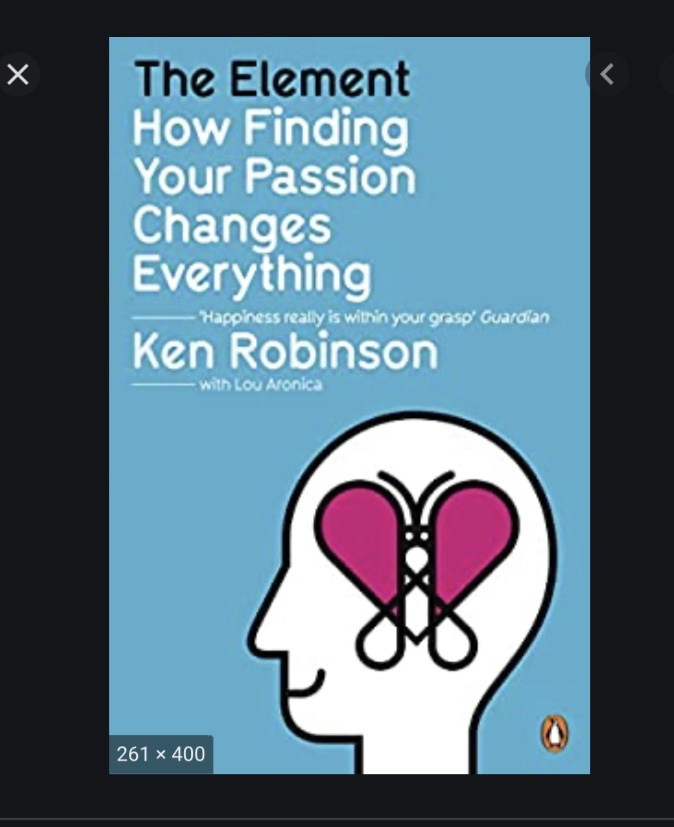
This recession was the first time companies here in the UK wanted to support their departing employees by giving them ‘Outplacement’. (Note 1) So I joined Morgan & Banks that, inter alia, provided this service, helping people repackage themselves, giving them the tools and techniques necessary to find new employment. I have Varina who ran the London office to thank for this opportunity, one I grasped wholeheartedly! I sense I grew from a rather dried wrinkled chrysalis into a butterfly; not an exotic one like a Red Admiral, more a Cabbage White – I felt I had found my ‘Element’ (Note 2)! Of the many successes, two will illustrate what made me smile. Carol had left a senior role in an animal healthcare company. After working with her for a few sessions, I asked her who she would like to work for, be it a company or an individual. There was no hesitation; “John Manners” (not his real name!) – and she went on to tell me why. So we hatched a plan for her to meet him …… and her enthusiasm got her a role that hadn’t been advertised.

Andrew came out of the financial services sector, one of thousands ‘let go’ in early 1993. “More of the same please” was his response, but given the lack of roles available, I suggested he explore alternatives. He had a passion for wine, for its production, for the whole viticulture world.

“So do you see yourself working in the industry?”

“If I could, of course! I’d work for Tony Laithwaite (note 2) like a shot!”

“Do you know him?”

“No!”

So we talked around how he might get to meet him; he rang me a few days later to say that he was going to a wine tasting evening and he’d been told Tony Laithwaite would be there. We met to rehearse that initial chat – this we planned! The long and the short of this tale is that he got invited to their Head Office for an interview.

So working one-on-one with individuals in a business coaching capacity became my next career …… one that lasted over twenty years ……. and one  certainly not planned!


Richard 24th July 2020

Note 1: It was such a hideous term but it stuck; I preferred Career Transition.

Note 2: Ken Robinson’s excellent book ‘The Element: How Finding Your Passion Changes Everything’ is a ‘must read’, particularly for those who haven’t found their element.

Note 3: Tony Laithwaite had become extremely successful at selling wine in the UK.


PC 187 Numbers (3)

My first two postcards about numbers (PCs 176 and 177) were written in April this year and I still have more thoughts about numbers running around inside my skull. For the past two weeks I have been engaged in a little creative constructive DIY. The result has been very pleasing even if I say so myself, but my mind has been full of numbers, for instance the measurements of bits of wood, both lengths and of cross-sectional size and of numbers and sizes of screws.

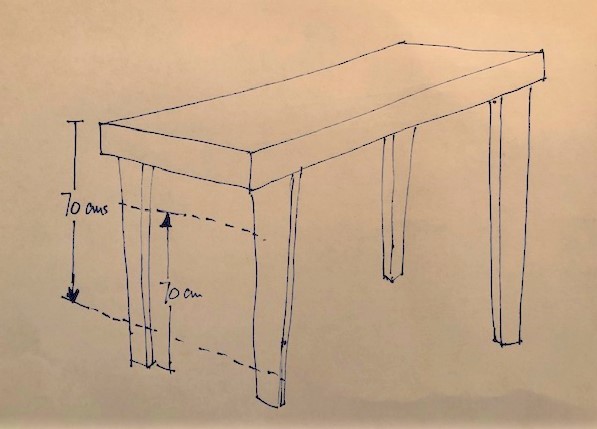
When engaged in some form of carpentry, there is a saying that you need to keep at the forefront of your mind: “Measure three times and cut once” and I was reminded of something that happened way back last century; a classic example of miscommunication if ever there was. My first wife and I had bought a marble-topped table in a second-hand shop and we both recognised it was too tall for where we wanted to put it. We ‘agreed’ to cut something off the legs, except she meant the finished height should be 70 cms from the top, whereas I thought it would be a low coffee table and took 70 cms off the bottom!!

PC 187 1

Map reading skills are a delight to acquire and we are lucky here in the UK that the Ordnance Survey produces maps with amazing detail; a glance as some other countries’ maps will make the difference obvious. Reading a map well gives you confidence moving across the country, although I appreciate that electronic maps and Global Positioning Systems can give you good accuracy without the romance of an old-fashioned map. Navigating using a map over land or a chart at sea requires taking a bearing and converting it to ‘magnetic’ for use with a compass, whose needle is affected by the earth’s magnetic field. When I was doing my military service or sailing offshore, the mnemonic ‘grid to mag add, mag to grid get rid’ served us well as the variation was some 4 degrees ……. and mistakes happened!

The tour of the French beaches and hinterland of Normandy was a highlight of my Staff College course, as those who had fought on D-Day on both sides recounted their stories at the very spot where the action had happened. For some of us it was an opportunity to sail the 60 miles from Gosport to Trouville on the north coast of France. I skippered a Nicholson 43 and we had an easy and safe passage. An hour after our arrival one of the other skippers, who I knew well, took me aside up on the harbour wall and quietly questioned whether you added the magnetic variation or not, as they had missed the channel entrance!! (Note 1)

But I now read that in September 2019 ‘magnetic’ north and ‘true’ north aligned, in Greenwich, London at least, for the first time in 360 years and will remain so for some years to come. A relief for some no doubt!

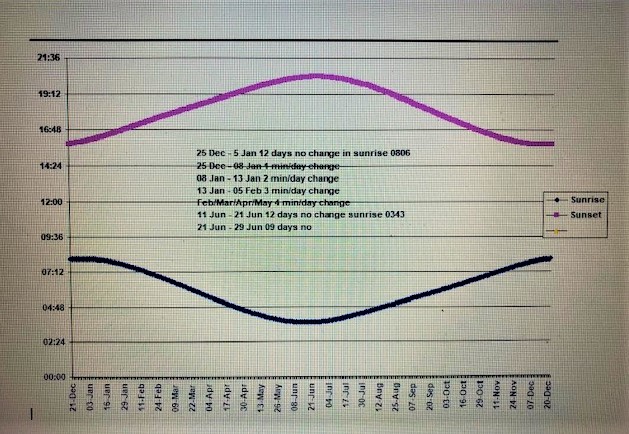
Some years ago I was sufficiently anal to record all the sunrise and sunset times over one year in London. I was keen to find out why and when it was noticeable that the days were getting longer/shorter. Then I plotted the results (times are GMT) thus:

PC 187 2

At this time of year in the Northern Hemisphere we are currently enjoying longer evenings as the sun had reached its northerly point on 21st June, the ‘summer solstice’, and that gives us here in Hove 16 ½ hours of daylight. At the top of the curve it appears as though the sun just hangs there before it starts its long descent towards the shorter days of winter. Actually the numbers support this. For a week after the longest day the sunset time doesn’t change (BST 21:18) and the sunrise time only by a mere 3 minutes (from 04:46 to 04:49). Now almost three weeks into the second half of the year we have lost 15 minutes of daylight.

I am sure you’re bored about my fascination and addiction to the 26 postures and 2 breathing exercise sequence, practised at 40°C (before Covid!), put together by Bikram Choudhury that was known as Bikram Hot Yoga. Now, because of Choudhury’s behaviour, the sequence has taken on the term 26-2 Hot Yoga. It’s coincidental that the distance of a modern marathon run is 26.2 miles.

When I was at school numbers were I, 2, 3, up to 9, essentially the decimal or Base 10 system. Other systems are the Binary, Octal and Hexadecimal. We have become familiar with the binary system, Base 2, as the basis for computer language, where 0 represents ‘off’ and 1 represents ‘on’. For example 348 becomes 101011100 – if you divide 348 successively by 2 you get a zero if it’s even and if odd you get a 1. Not sure why the bottle of scent by eccentric is called 01100101 but looks very modern – and smells wonderful!! And equates to 101 in the decimal system

PC 187 3

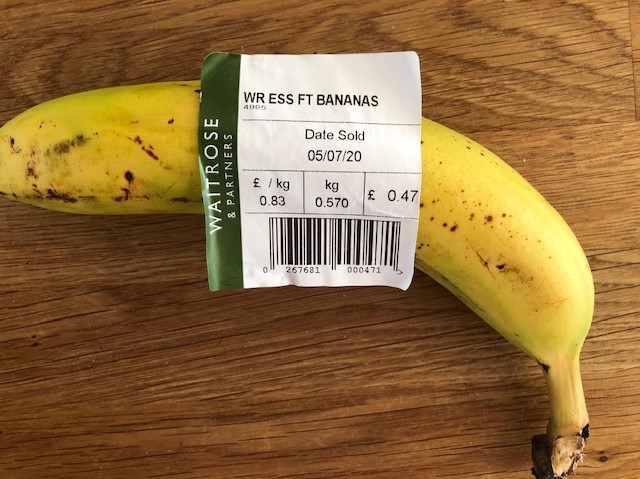
Of course the visible sign of the binary system is the barcode attached to every manufactured item – and actually even on non-manufactured items, like the weight-ticket from my online-bought bananas.

PC 187 4

Many years ago I read Aldous Huxley’s Brave New World, written in 1932 about life on earth in 2540. I don’t remember whether he imagined we would all have barcodes on our skin or a simple chip embedded in our shoulder but I can sense some benefits!

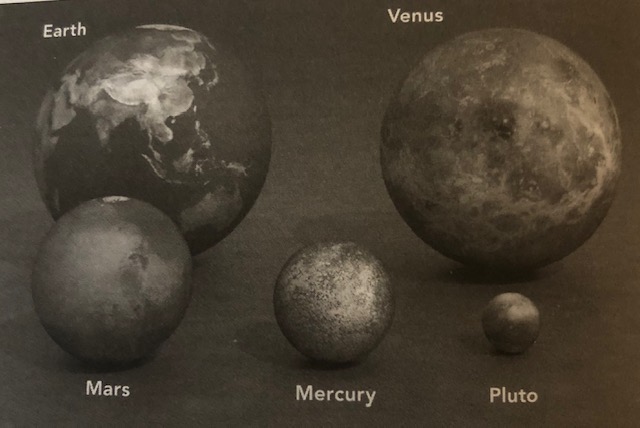
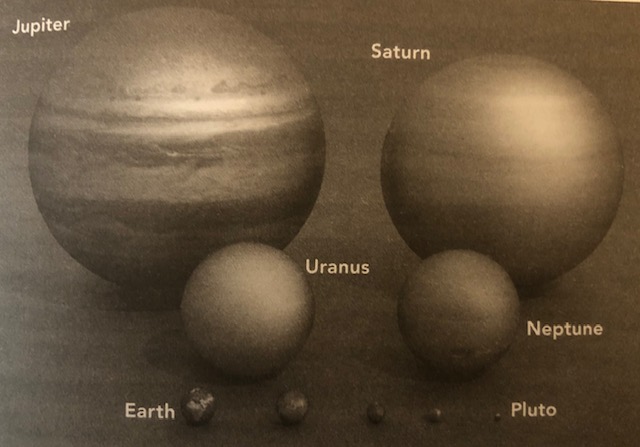
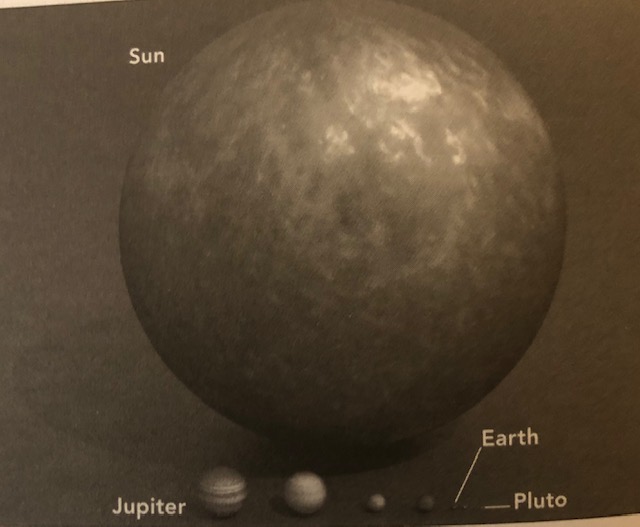
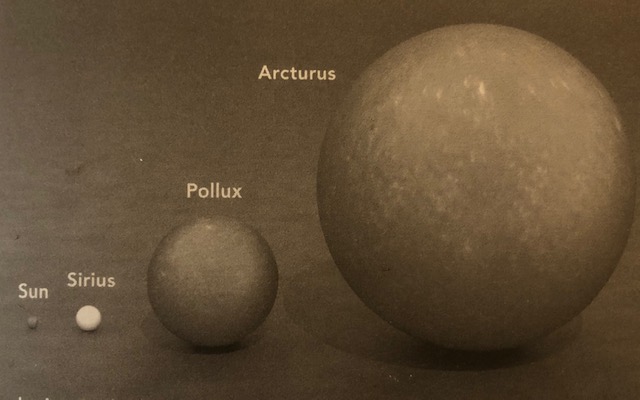
Some numbers are easy to understand, to assimilate, others just so mind-boggling they simply become ‘a number’. We are all vaguely aware that the earth revolves around the sun, along with a host of other planets, but do you have any concept of the scale of these rocks? Because I think this is a fascinating set of photos, I thought I should share them (Note 2) They don’t need any numbers, or indeed any commentary; the comparison of scale is just extraordinary.

PC 187 5

PC 187 6

PC 187 7

PC 187 8

And to bring you back to earth (!), remember that it’s only thirty seconds that stands between a soft or a hard-boiled egg or is the difference between catching one’s train or standing puffing at the barrier!

Richard 10th July 2020

Note 1 Each degree of variation over a distance of 60 miles will result in one nautical mile off course. A 4 degree variation would give you 4 nautical miles off course …… and the entrance to Trouville was a narrow dredged channel you approached on a transit and accessible only for a two hours either side of high water.

Note 2 Quoted by Ken Robinson in his excellent book ‘The Element: How Finding Your Passion Changes Everything.’ ….. a MUST READ for those who don’t enjoy the work they do, for they haven’t found their element.

PC 186 RUBBISH

You might think that rubbish with an exclamation mark is simply the shout of the drunk at an onstage comedian trying to earn their crust, or maybe a cry of derision at an attempted goal in some crucial football match. In either case the owner of the exclamation probably wouldn’t have the guts to be the individual on the receiving end. Hey! Ho!

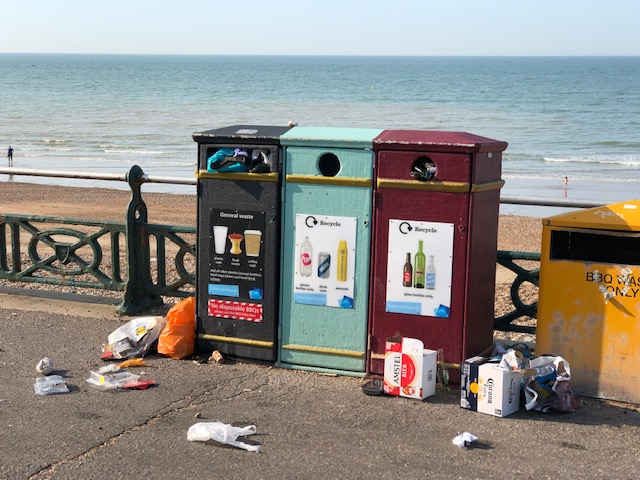
But rubbish, without that exclamation mark, has become one of the most important issues of our time, how to change our habits, how to deal with the detritus of our throw-away society and how to improve the environment. This PC is prompted by what happened in the last full week of June, here in Brighton & Hove. The weather that week was actually quite warm, about 30°C, and the pandemic lockdown was easing. It also coincided with the end of the virtual term exams for our 16 year olds. Hundreds of teenagers descended on the seafront, intent on ‘having a good time’. The mess they left should have shamed everyone who created it, but ownership and responsibility are sadly lacking. Plastic containers, beer bottles, coke cans, Nitrous Oxide gas canisters (note 1), cardboard pizza boxes smeared with tomato paste and grease, portable BBQs, soiled nappies etc.

PC 186 1

At the moment the Co-Op, an average UK supermarket, is offering two pizzas and four Budweiser beers for £5 – with no thought to how the pizza boxes and bottles will be disposed of. I know this because the distinctive blue bags that were part of the rubbish on the promenade!

PC 186 2

The local seafront rubbish bins are frequent but far too small for the summer season; designed to look good but they are not fit-for-purpose. On an average June day the council refuse staff remove 3 tonnes of rubbish from the seafront; on Thursday 25th June 2020 they picked up a staggering 11 tonnes. Social Media went into overdrive, everyone moaning about the appalling lack of this and disgusting lack of that, ‘what’s our society coming to?’ sort of thoughts. The advent of the ‘take out’ and ‘take-away’ has created habits which need changing: if you use a ‘take-away’, take away your rubbish to a bin large enough to receive it or take it home!

I was as horrified as the rest of us but I was certainly not blameless in the past!! Back in the 1970s, when I went sailing we always dumped our rubbish overboard – sans plastic bag (the boiled egg empty shells were, tradition had it, for Davey Jones’ locker!). Empty bottles of gin were thrown high into the air and used tonic bottles were aimed to intersect; the broken glass ended in the sea, without a thought to any harm it might have done.

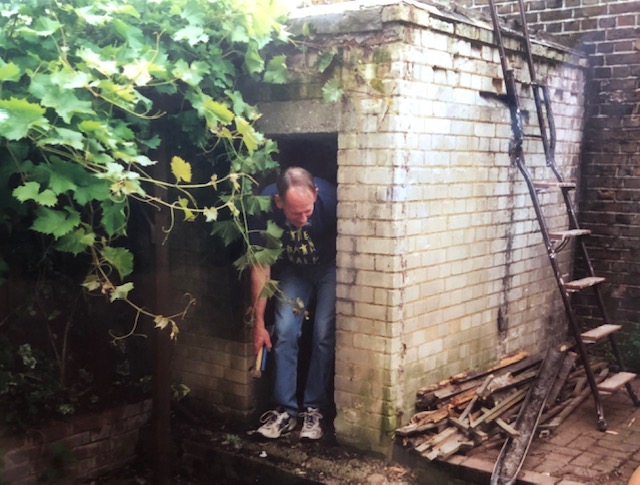
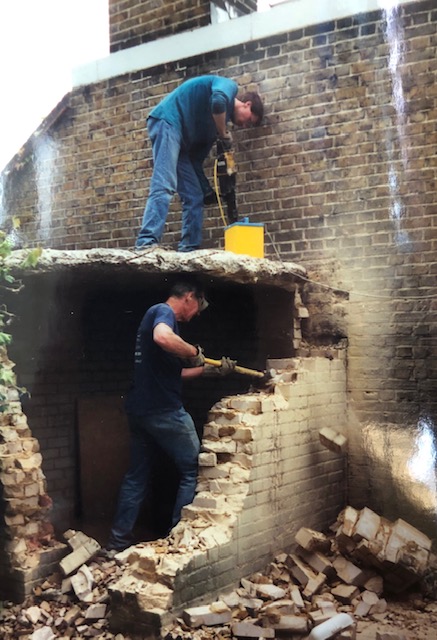
A house I brought in Battersea in 2000 had a World War Two air-raid shelter with walls two feet thick and a reinforced concrete roof. One weekend, with the aid of a jackhammer and a chum, it was demolished.

PC 186 3

Before, with Tony sizing up the task


PC 186 4

Didn’t take that long – but there was a lot of rubbish!

Most of the rubble ended up in a skip; the balance was put into sacks, fifteen in all, and stacked in the very small front garden to be disposed of later in the week. That night the doorbell rang. “Ev’ning Guv” said Paddy, his broad Irish brogue betraying his traveller roots, “Would yer like me to remove yer rubbish? £65?” I was shamed the next day to find the bags tucked away in other people’s skips only a street or two away!

In the first decade of this century, in company with scores of other dog owners, I walked my Labrador Tom on Wandsworth Common, London, a wide-open patch of grass, copses, lakes, paths etc, bisected with the London-to-Brighton railway line. The common was large enough for the local football league to lay out three pitches and these were well used during the weekends. Traditionally oranges have always been provided at half-time to provide some nourishment and moisture for parched mouths. There was no precedent for leaving the used orange peel, empty plastic water bottles and other player paraphernalia. I asked the referee whether they could take their rubbish home; one of the teams’ Captains came across and told me the Common had council workers who would clear it up! We had a few more words and I continued my walk, shaking my head in sheer disbelief.

Because of Covid 19, the five-day music event called the Glastonbury Festival that started at Worthy Farm in September 1970 is not happening. Last year over 200,000 people attended; the amount of rubbish, brand new tents, wellingtons, sleeping mats, cool boxes, old food etc covering the fields of the site took an army of volunteers a whole week to clear. How could you throw away a perfectly good tent????????

Jetsam and flotsam come to mind when thinking about rubbish: the former items jettisoned overboard to lighten a vessel in distress that have subsequently washed ashore, often to the benefit of the local communities! The latter is simply debris in the water that was not deliberately thrown overboard; an example would be a shipping container half-afloat and a real danger to yachts. I was scribbling some notes for this PC, flotsam included, and that very morning the word ‘flotsam’ came up in one of the word puzzles I complete. You may recall that a number of code words used in the planning for the invasion of northern France in June 1944 appeared in crossword clues in the week before D-Day. Just one of these strange coincidences.

There is often a circular motion to our lives and it simply takes a little observation to notice it. In Wandsworth in London the council ‘tip’ where you could take your old mattress, kitchen carcases, garden rubbish, old broken ironing boards, bottles and other recyclable and non-recyclable stuff was located in Smugglers Way. It was a busy place, particularly at the weekend and queues would form. Immediately opposite was the huge car park of B&Q (originally Block & Quayle) a British multinational DIY and home improvement retailing company. You could watch as drivers left the tip, having disposed of their rubbish, and went straight into the car park to shop for more ‘stuff’ which in a few years would no doubt end up in the tip and ……

I have no space to scribble about oceans of plastic, of fly-tipping, of the buying and selling of rubbish …… but it’s ironic that the generation who protest so much about the need for a cleaner, more environmentally friendly existence don’t care that much on an individual level. Responsibility begins with oneself!


Richard 3rd July 2020

Note 1 Nitrous Oxide, commonly known as laughing gas, is often used to fill balloons which are then exhausted causing those near to feel euphoric and relaxed. Currently it is illegal in the UK for ‘human consumption’ – although you can buy them on eBay! If Nitrous oxide is inhaled through the mouth from a pressurised gas canister or in a confined space it can cause sudden death through a lack of oxygen!

PC 185 Virtual Stuff – Funerals

One of the aspects of living through a global pandemic is that you experience a few ‘firsts’, such as city streets clear of traffic, skies empty of aeroplanes and their vapour trails, the air we breathe noticeably cleaner, and queuing for even the simplest of items. The hairdresser at the top of our road, Gentlemen Prefer Blondes, has been occupied cuckoo-like by a greengrocer; the chairs, mirrors and other paraphernalia remain. We hadn’t done ‘hot yoga’ online before and the little fan heater hasn’t really produced the 40°C heat we are used to. And as all of us, we have had to get used to strangers seeing what’s behind us as we practise – for us, as the laptop is perched on the dining room table, the fridge freezer with its attendant magnets form the backdrop!!

PC 185 1

I queued at our local Post Office Depot yesterday to collect a parcel. The sun was out and it was warm. When you queue with ‘social distancing’ you invariably look on the others in the queue with suspicion, imagining they’re Covid 19 carriers. In pre-pandemic days I would probably have passed the time in idle conversation with those in front or behind; not now!

PC 185 2

At lunchtime on Tuesday we were, and I struggle to find the right verb here, part of a funeral service at Mortlake Crematorium, except of course numbers were limited to immediate family and we were attending virtually. I have to say it was very strange, being rather like a spy on the wall, the camera showing us the scene an owl might have seen from the rafters, and there was no acknowledgement from the funeral celebrant of our out-of-crematorium online existence!!

Normally of course going to a funeral service requires a degree of thought as to what to wear, getting the right balance between being too Victorian and all in black or too colourful and offending other attendees. Given that no one else was going to see us, you might have thought we could have stayed in our PJs ….. but it was taking place after our 90 minutes strenuous yoga and shower, so a proper shirt and blazer seemed to be a brief nod to the solemnity of the occasion; the light green shorts were not in view!

The other thing that was odd was a lack of input into the other senses, the ones you take for granted when you walk into a chapel – a slight coolness maybe, smells of age and of dust and of sorrow and of sadness, and the sounds of silence, of noises outside the building intruding into the inner space. You could see the family mourners and the celebrant and the bier where the coffin would rest on its arrival ….. but the sound was turned off right up until the start-time so you couldn’t hear anything! Very weird!

David’s wicker casket arrived, the celebrant took us through the service, we listened to a poem read jointly by his sons, to the eulogy from his Godson and then sang Jerusalem. You might think I would know the words, and I can get 70% of them, but I needed to Google the lyrics to get really stuck in, for no one had thought to provide an online service sheet. Good to have an iPad handy!

The ‘Virtual Wake’ was more difficult, so we simply imagined that those who had been at the crematorium were having a lovely boozy lunch somewhere, social distancing notwithstanding, and raised a glass in David’s memory later in the evening.

Watching the proceedings got me thinking about other funerals I have been to or participated in – Monkey Mind invariably gets in the way here, despite trying to concentrate on the events from our pitch up on the rafters!

I think my first funeral was actually the worst to handle. During my Army days in Germany, one summer we were at the Bergan-Hohne NATO training grounds north of Hannover. Work hard, play hard was our motto and when we weren’t out on the ranges practising our art, we were propping up a bar somewhere. Two officers went off to a party at the local Officers’ Mess’ and, on the way back, their car left the road and impacted a large concrete culvert. Major Dick Jones, married to Hazel with three children, was in the passenger seat and died instantly; the driver climbed out unharmed. It was decided the funeral service would be in the nearest Garrison Church. As the senior Lieutenant I was added to the pallbearers’ list of his fellow Majors. I remember we practised with a filing cabinet full of sandbags and that dug into our shoulders. Fortunately the coffin was easier.

My nephew Hugh’s brother died of cancer aged 18 and his death came four days after my Mother’s. Attending two close family funerals within a fortnight freezes that period in a dark part of my memory. But my mother had lived her ‘four score years’ and some, as had both my father and my step-father, so their departures were more easily assimilated. Celina’s father Carlos also made those years (See PC 60) so the sadness is coloured by the celebration of a life well lived. All were cremated. For William the dice had rolled badly.

I have only attended four burial services. One was of my chum Alwin’s sister-in-law (see PC 22 October 2014). It fittingly rained, was a cool cloudy morning and the little village churchyard a very sombre place, made more so when I remember Victoria was only 60. The other concerned one of my daughter Jade’s uncles, Justin. With his wife Sue they suffered the heartache of the death of their first child Claire after six weeks. The only thing I remember about the funeral service was the sight of the baby’s coffin, and thinking about it now brings an ache to my heart that is as deep today as it was some forty years ago.


Richard 26th June 2020

PC 184 News? No news – no common sense.

There are a great deal of items in the newspapers here in the UK and on the television news that makes me shout: “Really? Wow! What a surprise!”

For instance, last week some government organisation announced that the UK economy had shrunk in April by 20%. This surely is not news? When you lockdown a population and close all the shops, no one indulges in their favourite activity so there is no exchange of goods for cash and the economy suffers. Pre-school mathematics I reckon – all that QED stuff! And as if to reinforce this, when on Monday the ‘non-essential shops reopened here in the UK, there were long queues outside Primark, a cheap outlet, from 0300!!

Another issue here seems to be the completely unsubstantiated link between Covid19 and the currently installation of our 5G mobile telephone network. One is believed to cause great harm to individuals but I am not sure which way around it is. To add to the mystery, our 5G network is being built in part by Huawei a Chinese company that is rumoured to be part State owned and often accused of being a front for the CCP ……. for the conspiracy theorists this is manna from heaven …… ergo Covid19 is a state-sponsored global pandemic. For other conspiracy theorists Covid19 doesn’t even exist and all the news reports from around the world are false, or as the Brazilian President Jair Bolsonaro claims: “it’s simply a bad ‘flu”. (Some Brazilians wish he would catch it!)

PC 184 1

Just love this representation of being in tune – heart and head!

A twenty year old footballer Marcus Rashford, who plays for Manchester United and for England, has shamed our government into continuing to provide free meals to disadvantaged children during the coming school holidays – a bit of a misnomer this year as most children have not been in school since March. He added weight to his singled-minded campaign that children would be going hungry in poor households by recalling his own childhood when he remembers a lack of food. Some of us might argue that if you have more children that you can afford to clothe and feed this is a result; in this case his mother had five and was a ‘single mother’ – whatever you can make of this statement.

The Black Lives Matter campaign has gained a great deal of traction here and in other countries. Britain was of course a maritime nation whose ships transported black slaves from the west African coast to the Americas. This is a fact, however you look at it; we recoil in horror at the very thought of it, this trade in humans, but it took a huge effort by William Wilberforce before the British Government banned it in 1833, such were the vested interests that supported it. You could, if you wanted to, blame the slave traders for making Britain in the C21st the fattest nation in Europe, as their ships brought sugar back to Georgian England …… and so started our addiction to sweet things. Good to blame someone distant from one’s own love of sugar ie the slave traders. Of course it’s convenient to forget who brought the slaves from the African interior to the ports and sold them to the European traders and it’s convenient to believe this is a single issue between Europe and North America. Ten times as many slaves, over five million, were transported to Brazil by the Portuguese. In PC 117 I wrote about ancient and modern slavery; as sure as eggs are eggs it still exists in certain countries, in differing forms.

Even before this country got a good grip on Covid 19, the Government was being blamed for the fact that more BAME (Black, Asian and Mixed Ethnicity) people are dying of Covid19 than their statistical representation would forecast; the latter is 14% of the British population and the former 36%.   No doubt statisticians will pore over the numbers to provide some ideas where healthcare policy might lead. We already know that 50% of those who have died were obese and a similar number were diabetic; the majority are men. If there are proportionally more BAME deaths due to Coivd19 then they must be more obese ….. and this comes down to life style, traditional food choices and a whole raft of other issues you can’t legislate against. Another statistic doing the rounds is that British people of South Asian origin are more likely to die of Covid19 due to a higher-than-normal incidence of diabetes And to add to the complexity, those with A positive blood group are more likely to die than those of us who are O positive! Oh! And BAME lack vitamin D ……. so they should now all take Vitamin D supplements. In summary, if you are a man of South Asian heritage over 65, have blood group A positive, have diabetes and a BMI over 30 ….. self-isolate until the end of next year (2021)

I read that those who suspect that Covid19 is not a real pandemic are also not supporters of vaccinations and of wearing facemasks. Funny world!

Every evening on the BBC news I listen as the newscaster highlights how many people have died from Covid19 and gives us the cumulative total. What needs checking is how these figures are compiled and how accurate are they. For sure, more people have had some form of the virus than the figures reflect: my daughter and son-in-law both got it …. but not badly enough to need calling any healthcare organisation, so not being counted. And there seems to be some variation about whether the death was caused by Covid19 or whether the fact they were 94 had some bearing on it?

And this week we are told that if we for instance break an arm or a leg, before you arrive at your local hospital you need to book an X Ray!

A few weeks ago the news was drenched by the fact that our Prime Minister’s adviser Dominic Cummings had broken the lockdown rules. This was a classic case of ‘Do as I say, no it as I do’. The sadness is he would have got more credit from the chattering classes if he had simply said: “I am sorry. I will resign.” But he didn’t …… and the whole episode left us with a nasty taste in our mouths. Of course those that expressed outrage the most were not necessarily behaving as saints!!

PC 184 2

Enough! Just some scribbles ….

Richard. The day after the Longest Day (Northern Hemisphere). 2020


PC 183 Beirut Lebanon 1983

PC 183 1

It had been a bit of a whirlwind but, as I sat in the back of the helicopter flying low over the sea towards the Lebanese capital Beirut, I had time to review what I had to do when I arrived and what had happened to get me here, at 0900 on Monday 25th April 1983. Commanding the only shoulder-launched SAM Battery in the UK, I was the obvious choice when Major David Godsell, running the armoured car squadron currently in Beirut as part of the Multinational Force in Lebanon (MNFIL), needed some advice.

pc 183 2

Since 1975 the Sunni Muslims and Christians who occupied the coastal cities, the Shi’a Muslims in the south and in the Beqaa Valley, and the Durze and Christians in the mountains, had been engaged in a civil war, each faction wanting to control this nation in The Levant. 120,000 people had died and the Paris of the East, as Beirut was known, was being destroyed street by street, square by square. The United Nations had authorised MNFIL to deploy as a buffer between the conflicting groups, so that peace talks might eventually start. The UK, France, Italy and the USA provided forces.

MOD Operations had called me at home in Fleet, Hampshire on Saturday just after breakfast. What did I think about deploying Blowpipe, a short range Air Defence missile system, to strengthen our forces in Lebanon? I really hadn’t appreciated what we had provided to the MNFIL but gave a considered opinion that the operational constraints would be too many to overcome. “Wait out!” was the reply. On the Sunday morning the telephone rang again. “Duty Officer MOD Operations here. There’s a C130 Hercules leaving for Cyprus at 2100 tonight from RAF Lyneham. Be on it. That will get you to Cyprus; I am working on how to get you to Beirut. Bye!”

Collecting some gear and a pistol from the Regimental Lines in Wing Barracks Bulford, I made my way to Lyneham. The cargo hold of the C130 was full of a spare jet engine and a Landrover …… and one seat ….. mine! The aircraft is noisy and vibrates quite a lot, so it was a relief to land at RAF Akrotiri in Cyprus …… in time for breakfast and a visit to the duty free shop to get some supplies for my host. Ninety minutes after landing, I walked across the apron to the waiting Puma, its rotor blades turning lazily in the morning warmth, and strapped myself in. We lifted off and headed east on the short flight.

I listen to the radio traffic as we approach the coast, am somewhat alarmed that the pilot can’t raise the French sector Air Traffic Controllers to say who he was, and more alarmed when he said “Oh! Well! I am sure it’ll be OK” to his crew. The side door is open and the GPMG Gunner alert.

PC 183 3

Beirut, reduced to rubble, still trying to function

We approach the city from the east, aiming for the Charles Helou bridge over the Beirut River. On arrival we bank to the right over the rush-hour traffic, and zigzag low along the deep-sided river banks, going south. Suddenly we lift up over the top and land on a dusty, sandy, local football pitch. The pilot gives me the thumbs up and I disembark, not at all sure where I am! As the dust subsides I spot a couple of British Army vehicles and make my way over, relieved to have made contact.

Once into the tower block that is the base for C Squadron, Queens Dragoon Guards, I meet my host and he briefs me. Operation Hyperion is part of MNFIL, whose task is to try and create the right conditions for peace talks to take place between the various fighting factions in Lebanon. “We have rules of engagement for fighting in the streets and we have contingency plans to deal with a suspected truck bomb aimed against us. What we don’t have is anything to protect us from a suicidal air attack.”

PC 183 4

The Ferret Scout Car used by C Squadron QDG

We talked through some of the options and then I was left to do a ground recce of likely approach routes etc. Later I gave my initial thoughts to the MOD. They didn’t change and by the end of the long afternoon of discussions, we drew a line under the idea of providing a Blowpipe section on the flat roof of the block. The problems were identification and reaction time (see note).

The British Army is always good at making the most of where it finds itself and after dinner in the little Officers Mess with its table silver and hunting prints on the walls, one or two frames disconcertingly showing a bullet hole, it was up to the top of the block to watch the locals firing at each other. Occasionally a tank shell went overhead, tracer rounds lifted into the night sky, a flare hanging from a small parachute illuminated a particular street corner  …….. and I sipped my coffee, drew on my little cheroot and hugged my glass of Port.

The following morning I was taken to the airport (note 2) and boarded a C130 for Cyprus. I realised as I landed I had about two hours before the RAF VC10 left for the UK. I bummed the use of a car and drove out into the countryside, to visit my then mother-in-law’s half-brother. I knew the name of the village but not much else; a few questions and we meet for a coffee. Then a mad dash back to RAF Akrotiri; I was so late I had to run to the steps of the waiting aircraft, the doors closing as soon as I was on board.

I was home in time to read a bedtime story to two year old Jade. At work the following morning I got a funny look when people asked where I had been on the Monday and Tuesday. “Beirut.”


Richard 12th June 2020

PS     In PC 182 I mentioned a Peter Brookes cartoon. I have since found an old photocopy of the cartoon; it wasn’t by Brookes but by Jak.

pc 183 6

Note 1. In every peace-keeping operation there are ‘Rules of Engagement’ defining when and how you can open fire. The difficulties of having Rules of Engagement for an ‘air’ scenario are huge, as the speed of the potential threat calls for advanced action. There was no ‘no fly’ zone in and around Beirut, so it would be impossible to distinguish a potential suicide pilot with a playboy out for a Sunday afternoon jolly ….. until it was too late!

Note 2 Someone took a photograph of me with the bombed city in the background ….. and promised to send it to me. Sadly it never arrived (Oh! For an iPhone!)

PC 182 Guns and Carnations

You may recall my conversation with Ron outside the tiny hamlet of Eagle in Alaska (PC 43 written in 2015) as he filled our hire care with petrol.  “What do you do?” he had asked, having already nailed his opinions to the mast of gun ownership.

I had felt that an expression of a liberal view would not go down well: safer to be succinct and, talking to someone I guessed would be an appreciative audience, I said was an ex-military man.  “Oh! Well! So you know how to shoot!” he said, visibly relaxing; “Of course only the criminals in England can get a gun! Here, you can walk into a shop, choose a gun from any number of types, buy a box of slugs, walk out the door and  …..”  I thought, “start shooting innocent people in Charleston”, but didn’t say it aloud! (Ed. This was days after a chapel shooting in Charleston in 2015)

PC 182 1

A British Sub Machine Gun circa 1950

A recent newspaper article explored whether, when push comes to shove as far as guns as concerned, there is an innate reluctance to kill a fellow human – despite the fact that in the UK 60 and in the USA 11,000 die each year from gunshot wounds. It seems the majority of us would find it difficult. Historical examples are numerous – after the American Civil War Battle of Gettysberg, fought over two days in early July 1863, of the twenty seven thousand muskets recovered 90 per cent were found to be still loaded. Six thousand had 3 musket balls in their barrels, suggesting that the soldiers had spent the battle loading their muskets, rather than firing them. George Orwell observed that during another civil war, this one in Spain in the C20th, most combatants always tried to miss!

We can all recall photographs of international demonstrations against the involvement of people in war – and the odd flower stuck down the barrel of a rifle. In Portugal the overthrow of the dictatorship of Marcello Caetano in 1974 became known as the Carnation Revolution as carnations were the flower of choice (In Georgia it was roses, in Kyrgyzstan tulips).Browning 9mm Pistol

The British Browning 9mm pistol (standard officer weapon!)

This article got me rummaging in the grey matter as to what guns I had fired, although I immediately realised none in anger. At school I belonged to the Combined Cadet Force; it was a welcome distraction from academic studies – and we were all trained to use a Lee-Enfield .303 rifle. They were heavy and old-fashioned.

Then I enrolled for my Officer training at the Royal Military Academy Sandhurst. Here the standard rifle was the SLR (self-loading rifle), with a calibre of 7.62. At the end of the 10 mile Battle Fitness Test not only did you have to carry your buddy 100m, climb a six foot wall, jump some ditch but also fire off a magazine of 20 rounds and get a qualifying score. We did have fun firing the General Purpose Machine gun …….. but it ate ammunition at an alarming rate and someone had to carry it!

PC 182 3

Before embarking on a three day exercise in Belgium as an officer cadet, we had to carry a lot!

At the Royal Military College of Science we studied other nations’ firearms – the Russian Kalashnikov AK47 and Israeli Uzi for example.

pc 182 4

The 25 Pounder we used during Young Officer training at the Royal School of Artillery

Then I joined the Royal Regiment of Artillery and was introduced to proper guns. My choice of arm meant I was teased by my Uncle Bill, who had had a career in The Somerset Light Infantry. As a young lieutenant during the invasion of Normandy in 1944, his battalion had suffered many casualties in the battle for the French city of Caen – often as a result of our own artillery fire falling short of its target – hence the rather snide moniker for the Royal Artillery of ‘drop shorts’! When I finished my training I joined a regiment in Devizes; in the Officers’ Mess was a cartoon of an elegantly uniformed artilleryman surveying the battlefield, with the infantry engaged in muddy hand-to-hand combat. The caption read: “Artillery brings a degree of dignity to what would otherwise be a vulgar infantry brawl.” I thought of my Uncle Bill.

This regiment was equipped with towed field guns of 5.5 inch calibre. They had been used in the Second World War and were large and unwieldy but were, for their time, accurate. We didn’t wear any ear protection in those days and if you were too close to a gun when it fired, you couldn’t hear anything for hours. This of course gave rise to another infliction – ‘gunner ear’!!

PC 182 5

The classic 5.5 inch Howitzer

The regiment moved to Germany and was equipped with another medium gun, the M109

PC 182 6

The M109, a self-propelled 155mm gun

Having served all my regimental time with ‘field’ artillery ie surface-to-surface, it was obvious to those who ran the officer posting system (AG6) that I should command an Air Defence Battery!! Lloyd’s Company was equipped with a ‘command-to-line-of-sight’ SAM system called Blowpipe that was fired from the operator’s shoulder; it had a range of about 3 kilometres. It was to the credit of the training of the soldiers that two Argentinian aircraft were destroyed during the Falklands War when the Battery was deployed in support of The Parachute Regiment.*

PC 182 7

Blowpipe Operator at San Carlos Bay, Falklands 1982

Fourteen of my soldiers were on a rotational six-month deployment to Belize in Central America. During my time in command I had to visit them …… and we conducted a practice live firing from a deserted caye tens of kilometres off the coast. Just us, the sound of the sea, pristine clear warm tropical waters; such hard work!

By the time I joined the sales force of Short Brothers, Blowpipe had been replaced by Javelin. The first name often made me think of natives in Amazonian jungles looking for their next meal. As a missile manufacturer based in Belfast, there were often unsavoury characters sniffing around, anxious to get their hands on one. Peter Brookes in The Times had a wonderful cartoon of two IRA thugs on the streets of Paris, negotiating to buy one, with the caption: “Seamus. Which end do you blow through?”

Apparently in the USA today liberal as opposed to republican Americans have been buying guns like they might go out of fashion. Their desire for gun ownership is driven by the effect the Coronavirus pandemic is having on society and a negative perception of what might happen; for this to make news in The Times last week suggests it’s serious! Three days later an African-American George Floyd is killed by a policeman in Minneapolis and it seems the difference between peaceful and violent demonstrations is a hair’s width touch on a trigger finger. One of the justifications of gun ownership in the USA is the fear of federal intervention in state affairs. Now, what is the President proposing? Using the 1807 Insurrection Act as his authority to deploy the US Army into State’s affairs.

Richard 4th June 2020

Note * I took over command during the conflict, did not deploy to the South Atlantic, but took part in the intensive debriefs of the operators.

PC 181 What Vague Idea? A Plan?


In an ideal world everyone would have food, water and housing and the state would provide  health care and education systems that ensured your life expectancy was as good as your lifestyle and genes allowed. Oh! And there would be no conflict between people, and peoples, and everyone would live in harmony with one another. Yeah! Right! Sadly the ideal is submerged by the rising tide of individual and state egos and we stumble on in a very imperfect world.

For those of you who don’t plan, letting life dictate what you do, take heart from Professor Lord May of Oxford, who died recently aged 83. “I began as an undergraduate engineer,” he said, “became a professor of physics, was transmogrified to an ecologist then got interested in infectious diseases as an epidemiologist. None of this was planned; it just happened.”

In the UK there has been much criticism of the Public Health England’s lack of contingency planning for the current pandemic. In that ideal world there would be warehouses up and down the country stacked to the rafters with all sorts of gear that multiple government departments might need in case of an emergency; every year it would be checked, the ‘use by’ dates ensuring a turnover and further purchase to top up stocks. If you live in the UK you may recall a really cold snap many winters ago – snow blanketed the country and it ground to a halt? People moaned that we didn’t have enough snowploughs to cope, adding flattering comments about Canada or Switzerland. But they would be the first people to criticise HMG if they found that the cost of buying, storing and maintaining snowploughs in the once-in-a-decade likelihood of their use could fund three secondary schools. In an ideal world …….

PC 181 1

The Civil Service has Contingency Plans for a whole myriad of scenarios, some more likely to happen than others. We now know there is one for a pandemic but that it wasn’t properly funded as other Government priorities demanded current attention. There will definitely be some for the funeral arrangements needed when the monarch dies. One that didn’t work well was for the coronation of Edward VII in 1902. Edward was the eldest son of Queen Victoria and ascended the throne on January 22, 1901 upon Victoria’s death.

Born in 1841 he had had to wait a long time to succeed to the throne, being 61 at the time of the coronation (Note 1); he had married Princess Alexandra of Denmark in 1863 who bore him three sons and three daughters. The coronation was originally scheduled for 26th June 1902, but a few days before it was due to take place Edward had to undergo an emergency appendectomy, so it was postponed for six weeks until 9th August 1902. Imagine the chaos of all the international guests assembled in London having to stay somewhere for longer than planned! Bet there wasn’t any contingency planning for that! No ‘What If …..?’!

PC 181 2

These scribbles are another example of how things in life evolve without any planning. Those of you who have been reading since the beginning look away now; briefly, on my second trip to Brazil in 2013 I got bored queuing for postage stamps in a Rio de Janeiro post office so sent my news electronically. Those addressees multiplied and when I returned home the ‘comments and thoughts’ email became a regular once-a-fortnight post on WordPress. This is now my 181st!

Some decades ago there was a potato shortage in Belgium caused by blight, and apparently Britain imported lots of Belgium potatoes to satisfy our demand for ‘fish ‘n’ chip’. For the sake of clarity as it doesn’t really matter, the price of potatoes in the UK went up from £50 per ton to £100 per ton. Charles Handy, a management guru whose books I devoured as much as Cadbury’s Whole Nut chocolate bars, met a chum, let’s call him Andrew, in a pub and in the course of conversation the potato shortage came up. He and Andrew simply moaned about the lack of chips!

Years later they saw each other again and Charles recalled the potato story. His friend said: “Well, you know what? I had a contact in India and was able to source 100,000 tons of potatoes at £55 per ton. Arranged transport and …….”.  By this time Charles is not listening as his brain is whirring: £45 per ton cheaper, 100 thousand tons, that’s £4.5 million profit minus transportation and distribution costs. Now, why is it some people are always able to find the upside of a crisis and exploit it? Why didn’t I think of it? He tuned back in as Andrew was saying “…… but there were problems in getting an export licence and the whole opportunity was lost. Another pint?”

I spent a year enduring the Army Staff College course at Camberley in Surrey. I came away with some good memories and some not-so-good, but it was drummed into us that “proper planning and preparation prevents piss poor performance”! I had already learned that it’s actually training and rehearsals that prevent fuck-ups.

No matter how you look at it, every crisis provides an opportunity for someone. At the north end of our street, Albany Villas, there is/was a traditional barbers shop: “Gentlemen Prefer Blondes” – whether you agree with the sentiment or not, you will probably agree it’s a lovely name for a place that cuts men’s hair? The owners had been wanting to sell the business for months but resisted the local Iranian cartel who planned to turn it into another restaurant (we already have a number within 100m!). Then came the lockdown and the doors closed, the scissors and electric razors silenced. Incidentally I had not been a customer of theirs, preferring the attentions of Monika and Sebastian at Aguavida a few blocks away.

PC 181 3

It remained that way until three weeks ago, when an enterprising Turk and his teenage son filled it with fresh vegetables and fruit, put up awnings outside to protect the produce from the unseasonally warm sun, and opened for business. Just a family wanting to make the most of these funny times; no planning, just thinking outside of the box ……… just happening.


Richard 21st May 2020

Note 1 There are parallels today as the current heir to the throne is 70!


PC 180 Individual Fear

To bring an old metaphorical story up to date ……..

Sitting around the bar-café table was part of their morning routine, these retired chaps who simply wanted to chew the fat, gossip and share their thoughts and news. Most days they played cards, having ordered their own personal coffee preferences, espresso, Americano, Latte, Cappuccino or indeed on a weekend a little glass of beer. They sit in the shade, smiling at the world around them.

PC 180 1

One morning Jim was being unusually quiet.

“What’s wrong Jim?” asks George, a retired plumber, “you look very troubled.”

Indeed Jim, looking as though he had the weight of the world on his shoulders, announces that he had had a really strange dream, actually a bit of a nightmare; that gets their attention:

“Somewhere outside of the city I came across, how would I describe it? ……. I don’t know, a sense, something I couldn’t touch, couldn’t see but I felt an emotion that whispered through the trees like a spirit; it felt evil and strange but there was no sense of smell. The earth shook …… trembled …. as if someone or something was stomping around. As I watched I saw people being embraced by this invisible vapour and running home. Everything was very black and white.

“How come it didn’t get you Jim?” asks Andres with a slight smirk on his face.

“I guess it didn’t like the smoke of my old pipe tobacco and kept away!!”

“Sensible spirit” says Andres, laughing at the same time as waving Jim’s smoke from his face. The conversation then relapses into the normal exchange of stories, reminiscences and how one of them had missed that hole-in-one on the golf course.

PC 180 2

But as the day passes the wind increases in strength, the forecasters warn of torrential rain and the town council announces that everyone should go home …… and stay there. Schools close early, restaurants shut. A horrendous storm broke over the town, trees were blown over and roads blocked; an elderly woman suffered a heart attack. The barman at the café had overheard Jim talking about his nightmare and mentioned it to the baker who delivered the loaves for the lunchtime sandwiches. He repeated it back at the bakery and very soon rumour control took it, enlarged it and it became a stated fact, that out in the fields there was something very evil. Jim’s family had worked the land for generations, knew all about the local folklore, and this only added to the credibility of the story. Fear took over and no one applied the ‘common sense’ filter. What he had seen in his dream somewhere beyond the bounds of the city was now a real terrifying spirit, a bogey man, a ghostly spectre.

There was a sort of self- imposed lockdown. Those who could packed their storerooms with quantities of stuff they thought they might need; those who couldn’t relied on friends and neighbours to buy basics for them.

A week later the gentlemen met to play Knock-out Whist. Their faces showed the strain of living with their wives for a whole week, as they had obeyed the general diktat and not gone out – except for essential supplies and exercise – and a game of cards was exercise for arthritic fingers! As they were moaning about how some things were no longer available in the shops, Angelo sidles up to the table.

“Psst! Want some flour?” asks Angelo, always wanting to make a fast buck.

“Piss off Angelo!” says George

“No flour? How about some loo paper, I can sell it to you for a big discount.”

Shortages had indeed begun to appear; loo paper had become a real sought-after item despite the population not developing any additional arsehole …..

“…….. although there are many arseholes by way of behaviour in the council!” jokes George. The old boys around the café table thought the politicians nincompoops who thought themselves quite intellectual but lacked an ounce of common sense. All they seemed to do was talk and mumble and give eloquent speeches which when analysed amounted to nothing of substance and the people suffered.

“Half of them don’t know their arseholes from their elbows” laughs Jim. “Did you see on the news that leader, the one with the blonde bouffant hair, wiping his elbow with loo paper?”

They all creased up at the absurdity ……. “You couldn’t make it up!” cries Matthew.

What people read about on the various social media platforms formed opinion; no one was sure whether the stories were true or fake or simply the origin of some mindless troll sitting in his back bedroom with a completely distorted view of his fellow human beings. They learned that other cities were suffering in the same inexplicable way and were arguing amongst themselves what to do, as well as looking for someone to blame, because there’s always someone to blame.

PC 180 3

After two months, during which the winds outside the city lashed the fields and brought down woods as if by some unseen giant hand, the population got restless. The unseen, invisible bogeyman that was causing so much havoc began to take on huge proportions and fear began to run through people’s minds ….. re-inforced by those who always saw the negatives.

One morning Jim suggested he go and see what was really out there ……. if anything! Andres, George and Matthew thought this was a grand idea although conspicuously not volunteering to accompany him!

So Jim started on the road out of the city, wrapped up against the driving rain and whipping wind, towards the forests; some townspeople criticised him for exercising too far from the town, but he was deaf to their pleas. But as he left the sanctuary of the city he immediately realised the wind was easing; 30 minutes later nearing the large five-barred gate into an area of broken tree-stumps the wind was barely rustling the bushes; a few steps further and it was so soft as to be a vague hint of down on his cheek. He bent down to pick up a single blade of grass and looking at it, noticed an extremely small man clinging to the stem.

“What’s your name?” asked Jim.

“Fear” mumbled the little figure, still in the palm of his hand.

‘Well, I don’t need you’, thinks Jim as he squeezes the stem between his thumb and forefinger, like snuffing out the flame of the candle.  He wondered why it had been so violent only moments before and then realised he had simply confronted his fear and that of his fellow citizens

“The end of Lockdown Phase One” cry the citizens as Jim returns.


Richard 14th May 2020

PS Back in the 1970s in Germany one year there was a fearful storm that swept through north of Hamburg. I was on an artillery live firing exercise on the ranges of Bergen-Hohne. The exercise was halted as the wind speeds increased to hurricane-force gusts. Driving back to our training base later it did look as though a giant’s fingers had simple swept forward and back through the pine forests, most of which now lay flat and broken.

PPS You will remember that line from “When Shepherds Watched Their Flocks” …… “Fear Not, for mighty dread had seized their troubled minds.”

PC 179 Just The Ticket

Funny how something so innocent as an old railway ticket can start my mind running; I wonder whether you have the same reaction when you see this, posted on Facebook last week?

PC 179 1

The basic details are evident: a used second-class ticket for a child, for a one-way journey from Hassocks to London (SR) (Ed: Southern Region), valid for three days from 2nd November 1972 in exchange for £0.49. It even has a number, 0348, although the relevance of this is not obvious. A stiff piece of card unlike today’s rather flimsy paper ticket.

Then the enquiring bit of my little brain takes over. Was this a train pulled by a steam engine? When did decimalisation in the UK take place; surely it was about this time? Who was the child and where was he or she going on this single journey? Were they accompanied or were they old enough to travel on their own? What was going to happen when they arrived in London? And maybe more importantly why had they kept this particular ticket and where had it lain for over forty years, as it’s remarkably clean? Indeed why do any of us keep stuff like this?

If my memory serves me well, the owner of the ticket, let’s call him Freddie Chumboy, attended a boarding school in the village of Hurstpierpoint a few miles from Hassocks. They were aged 13 at the time of this single journey and I think it was probably too late to be half-term, so why were they travelling to London? The validity of the ticket is three days and the second of November in 1972 was a Thursday, so possibly they travelled on the Friday or Saturday – or was he doing a runner, filled with a mixture of excitement and anxiousness, walking the mile or so from College to the Hassocks Railway Station, making his way to home in the London suburbs to plead not to be forced to board, hoping of course for a sympathetic ear? You may recall my own experiences of boarding school so I would certainly be on his side!

Hassocks has a railway station which is two stops north of Brighton. London-bound, you would travel through Burgess Hill, Wivelsfield Green and Haywards Heath before crossing the glorious Victorian construction of the Balcombe Viaduct.

PC 179 2

At the bottom of this photograph the road crossed the River Ouse on a little hump-back bridge. As a child I sat in the back of the bus and was lifted off the bench as the bus went over; simple pleasures huh!

In PC 58 ‘Going Home’ I recalled my 2015 visit to the house that my parents bought in Balcombe, 18 miles north of here, in 1956. My stepfather commuted to London Victoria from Balcombe railway station, tipping his hat to Mr Smart the Station Master; his office was in Tothill Street in Westminster. The trains were pulled by steam-powered locomotives up until 1967; the carriages had long corridors and compartments for 8 people, outward-opening doors and windows you could open by pulling up a leather strap and fastening the strap on some brass studs to ‘lock’ it open. As any child would have done, we loved putting our heads out of the window, careful not to get covered in soot or having one’s head taken off by a track-side signal pole! And the smell of burning coal ….. and steam ….. and soot ….. and oil …. remains seared into my memory.

But when he took this journey, Freddie’s train would have had a diesel-powered locomotive. I can imagine him delighting in his new-found freedom, even if he had to wear his shorts and school cap. He may remember the Ticket Inspector snipping the right-hand side, probably with some comment and smile:

“Why Thank You Sir! Enjoy your journey.”

North of Balcombe the railway line went through a long tunnel, a favourite spot for those wishing to end their lives, according to our local doctor, a Doctor Haire. Whenever he attended a drinks or supper party at our house he would tell some hideous stories of when he had had to help the rescue services in recovering the body. The whole London – Brighton railway line featured in a speeded-up film, taking one minute to travel the 58 miles.

PC 179 3

A box of treasures

But where has the ticket been? If you read PC 70 from May 2016 entitled ‘My man-drawer’, you will know that I have to have somewhere for those you-never-know-when-I-might-need-it items, but this is different. This is a memento, a treasured piece of cardboard which to their touch would immediately flood their mind with emotions, good or bad. I first meet Freddie on Wandsworth Common in London in 2002 where, in the early morning mist, we would walk our respective Labradors, my Tom and his Sam, Tia and Aero. So I wasn’t surprised to see he had found this old ticket, as I know him to be a hoarder extraordinaire. What I don’t know is whether there are boxes of other used tickets etc hidden somewhere. Incidentally on the reverse side would have been the Terms & Conditions of Carriage.

Much to Celina’s dismay ….. no, that’s the wrong word ….. resignation …… I have little cardboard boxes/folders/tins/plastic boxes full of stuff. The oldest stuff in the bottom, more recent treasures or mementos or ‘that might come in useful’ towards the top. You might detect that I have kept all my old passports and wallets? Why? Search me …… nostalgia I guess.

PC 179 4

Before 15th February 1971 Britain’s currency was based on the Roman system (Librum, solidus and denarius equated to LSD – pounds shillings and pence) There were 12 pence to a shilling and 20 shillings to a pound. To confuse Johnny Foreigner we also had a florin (two shillings), a Half Crown (two shillings and sixpence), a Crown (five shillings) and a Guinea (One pound and one shilling) (Note 1.) So Freddie’s ticket cost 49 pence, almost ten shillings in ‘old money’.

Opening a box of one’s mementos is like starting an archaeological dig through the strata of one’s life. Down in the ‘Teenage Era’ Freddie unearthed an old railway ticket from 48 years ago – ‘Just the ticket!’ you might say.


Richard 7th May 2020

PS     Do you have something that could make the subject of some future scribbles? Let me know ……

Note 1 When a thoroughbred race horse is sold in the UK the price is determined in Guineas; the original gold for the gold coin came from Guinea in West Africa. Some of the more famous UK horseraces retain the connection – for example the ‘1000 Guineas’ and the ‘2000 Guineas’.

Note 2 Podcasts for some 30 PCs are now available on http://www.podbean.com