PC 368 The Hope in 2024

My last scribbles about St James were posted on 29th December but I managed to fulfil my promise to Duncan to deliver my triptych by the end of the year, on the 31st; phew! He’d organised a few bottles of Nozeco, a French non-alcoholic bubbly which is quite good, and that got around the issue of The Hope Café not having a licence to serve alcohol. As it was the end of the afternoon he’d asked a few of the Hope regulars to come along; Teresa was providing some Brazilian nibbles.

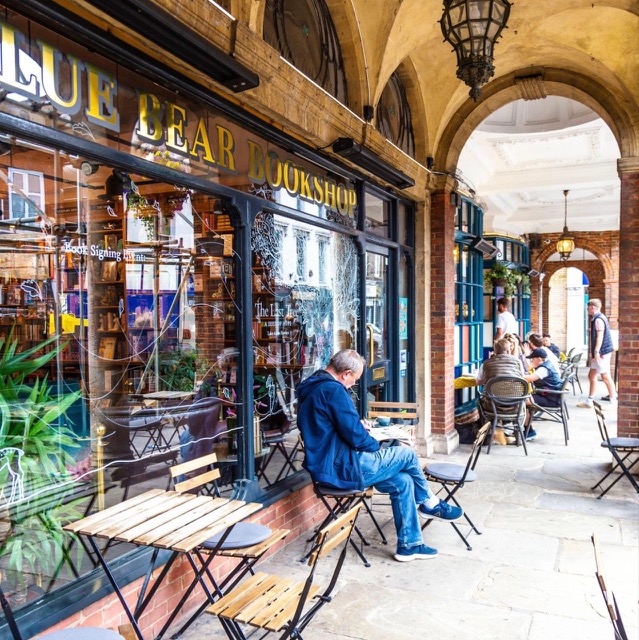
Apart from Mo, Robert and Anna, Sami was there but without Lisa, who was working on a piece for The Argus about Tony Bloom, the owner of the city’s Premier football club, who was awarded an MBE in the New Year’s Honours List and couldn’t make it.  Libby had come in specially and brought her niece Susie, who’d just returned from Melbourne and was looking suitably jetlagged. Kate was manning the counter. I had been in the day before, marked the wall where the triptych would hang and banged six nails in, two for each canvas.

So Richard, can we see it?” asks Duncan and I reach into my bag and put the three frames on the wall above the bench seating.

“Normally everyone takes photographs or paints the rows of beach huts along The Promenade from the sea side. I thought it would be good for its position on the wall here to take the eye through the rear of the huts out to the sea.”

Without wishing to blow my own trumpet (Note 1) I am pleased with my efforts and it was suitably admired! It was extremely good to see Susie back in the Hope and I went over to catch up. She gave me a big hug and smile.

Hey! Good to see you; great painting – well done! Funny being back in late December. Everyone looks pale and tired and I’ve been living in the southern hemisphere summer. Why do people live here?” she joked! “Bit worrying about Josh, isn’t it; Libby had told me that on his arrival and, after some very basic training, he joined a unit on Israel’s northern border with Lebanon.”

“Yes. And I read the other day that since Christmas both sides have increased their random shelling and drone flights over the border. Some of the latter have dropped bombs.”

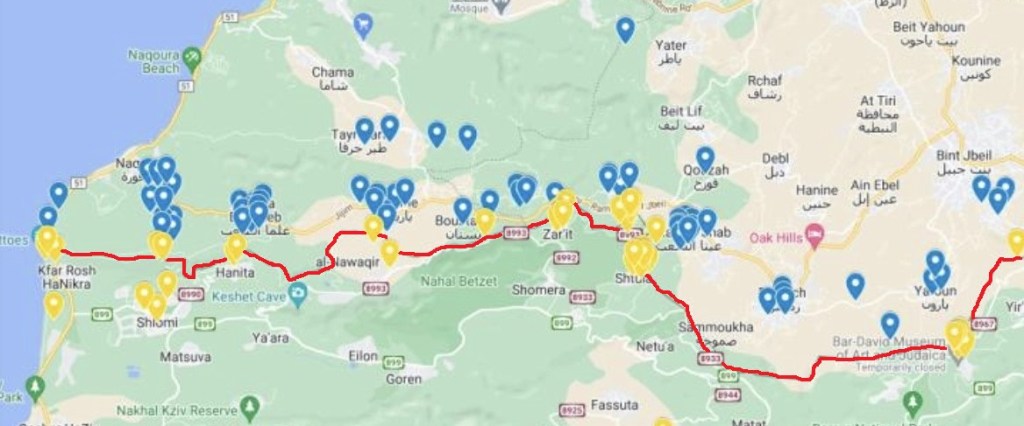
Israeli and Hezbollah skirmishes October and November 2023

Love the candle on the counter for him; like, very thoughtful. My OE (Note 2) was wonderful but it’s good to be home. Those three months working for Margie in Hobart were challenging and eye-opening, so I’m going to explore opportunities in wholesale catering here. Temporarily, I will be back behind the counter; with Josh away in Israel we’re a little light. Good to meet Kate and hope she stays, although she tells me she thinks she’ll resume her bus driving come the spring.

I really had no idea what New Zealand and Australia are like, you know. OK you can watch documentaries and see television dramas set in either country but it’s not the same as actually being there. It was like, really, like another world, so divorced from Europe although you could see the influence of those European settlers everywhere.

“Good to have you back and, if you’ll excuse me, I need to catch up with Sami. Maybe I can look at some of your photographs some time?”

There are only about 1500! Sure. Next week?”

I see Sami chatting to Mo. Perfect, I think, as I want to find out what constitutes a trashy novel, as someone had challenged me the other day, saying I only read ‘trashy novels’, the unspoken jibe being they didn’t as they were intellectually more superior; that’s my perception and could of course indicate a little chip on my shoulder?

“Sami, as far as I remember, when I first saw you in here you were reading the latest John Grisham novel, Judge’s List wasn’t it?

“God! That’s almost two years ago, Richard, but yes, I read his new one each year. I love a good story and I don’t think there’s anything ‘trashy’ about Grisham’s art of creating a believable story.”

“My late father-in-law apparently never read a ‘novel’, trashy or otherwise, preferring books about his professional medical speciality or his passion for the Christian religion. And Mo, you were reading the Act of Oblivion by Robert Harris, which presumably appealed as I later learned you had taught history in a secondary school?”

“Absolutely! Historical fiction is my reading preference but I love watching good dramas on television, providing they’re not violent or horrific. We have been writing stories, imaginary or otherwise, since we understood how to chisel signs or hieroglyphics on stone or slate tablets. My school taught all the Greek classics ……

“Mine didn’t, neither a Homer nor an Ovid …. more’s the pity you might think?”

“…… and their heroes became imbedded into my memory. Clearly, they were important and from them individuals like Marlowe and Shakespeare adapted the basics for their Elizabethan age and sensitivity. Do you know there are only seven story archetypes?”

Sorry! I don’t understand!” exclaims Sami.

Mo continues: “Christopher Booker argues in his book there are only 7 basic stories: ‘Overcoming the monster’, ‘Rags to Riches’, ‘The Quest’, ‘Voyage and Return’, ‘Comedy’, ‘Tragedy’ and ‘Rebirth’. For example, in the real world ‘overcoming the monster’ could be overcoming an addiction, beating an illness, getting out of debt etcetera.

The joy of understanding stories, through reading them, hearing them narrated or watching some screen director’s interpretation of them is a constant in my life. Their use in teaching morals, for instance in the wonderful book ‘Zen Flesh Zen Bones’ or indeed in the Christian gospels or in the Koran, is widespread. Sadly, for some the joy of reading has never been grasped, either through an inability to read or through a lack of education, but it’s never too late.”

We were in full flow when, out of the corner of my eye, I see Luke, Josh’s partner, come in and speak to Duncan, whose face pales. He announces to us all: “It’s about Josh …..

(To be continued)

Richard 5th January 2024

Hove

www.postcardscribbles.co.uk

Note 1 Way back in the dim and distance past I passed my Grade 5 Music exam playing a trumpet, so blowing my own trumpet came naturally.

Note 2 OE is a New Zealand term for ‘overseas experience’.

PC 367 Shells of the Camino

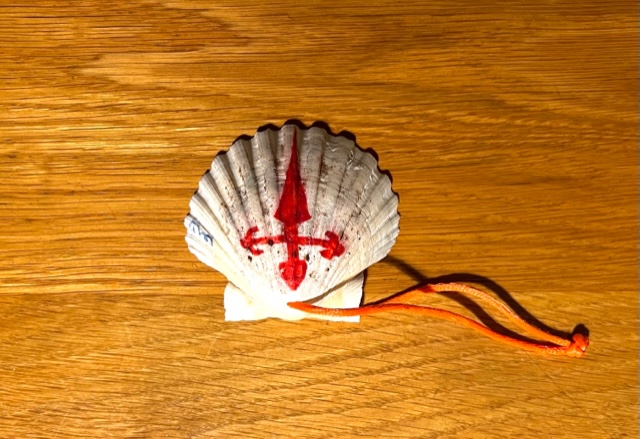
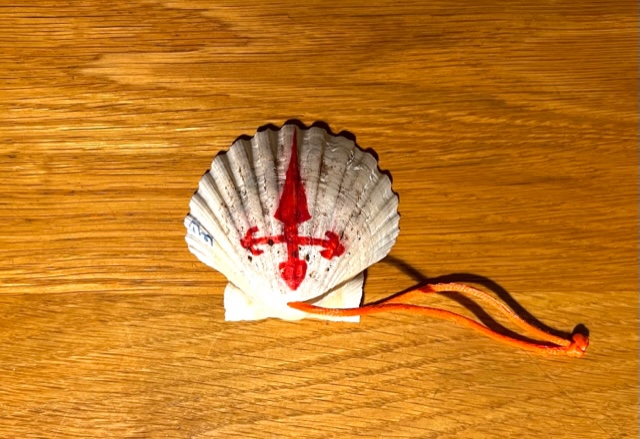
My friend and yoga chum Armi, an Italian from Naples who is a head trainer within the Schwarzkopf company, likes nothing better than sitting on a mountain top in solitude for days at a time, his antidote for the crazy modern world of his work and of his home city. Recently he walked the second piece of the Camino Trail from Santiago to Finisterre where Spain meets the Atlantic. On his return he gave me a little shell. Deeply touched, I asked what the cross was. “St James’. Obviously.”

Well actually it wasn’t obvious to me so I googled it and one thing led to another and hence these scribbles.

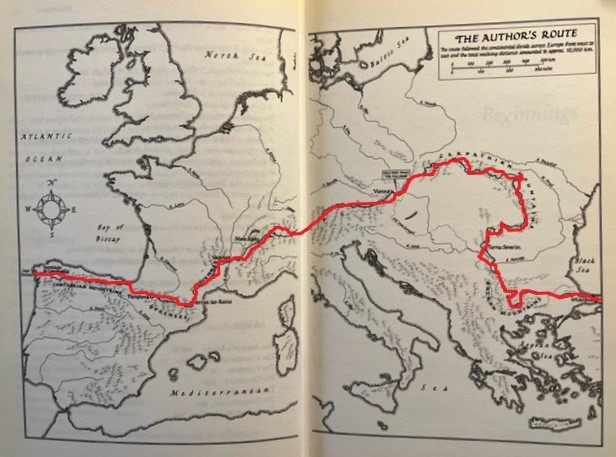
If you’re into walking, it’s possible you’ve thought of walking one of the Caminos, the famous pilgrim routes that converge on Santiago de Compostela in northwestern Spain. Regular readers will remember my mentioning the amazing walk undertaken by Nicholas Crane in 1992 from Cape Finisterre in the west of Spain to Istanbul, the capital of Turkey, recounted in ‘Clear Waters Rising’. Nicholas’ route was along the ridge of Europe; rivers to his left ran to the Bay of Biscay, the English Channel and the North Sea, those to his right south into the Mediterranean. His wife Annabel accompanied him on the first five-day 100kms, along the pilgrim way to Santiago de Compostela. (Note 1)

You may not be into walking but feel to need to get back in touch with yourself during a period of enforced solitude, for walking can do that; you could easily, of course, find yourself chatting to total strangers along these pilgrim trails, if you so wished. For those of a religious conviction and/or spiritually inclined, walking the path to the final resting place of St James is a way “to pay penance and seek forgiveness for one’s sins before arriving at his tomb”.

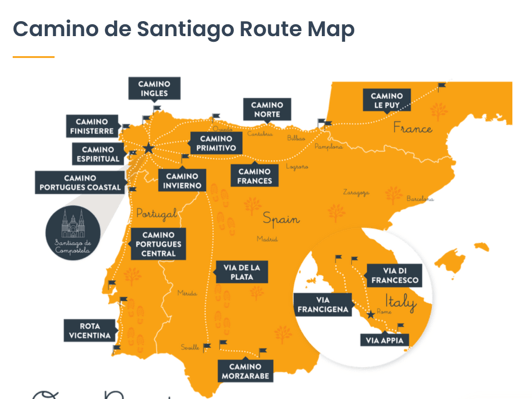
The most well-known camino is the French Way, Camino Francés, which starts in Saint-Jean-Pied-de-Port in the French Pyrénées and runs through Pamplona, Logrono, Burgos and Leon before reaching Santiago de Compostella; some 800 kms. The Portugues Way should start in Lisbon, run through Coimbra and Porto, then through Vigo to Santiago. The Camino Ingles, for those pilgrims coming from Ireland and England by boat, starts in Ferrol or A Corunna.

But who was Saint James and how did his remains end up in northwestern Spain? It’s believed that St James had travelled from Jerusalem across Europe, preaching the gospel and had ended up in present-day Galicia, where he recruited seven men to be his apostles. On returning to Jerusalem, he was arrested and in 44AD King Herod Agrippa ordered his beheading. Apparently, his head was placed under the altar of the Armenian Apostolic Cathedral of St James, where I suppose it remains.

Hearing the news, those seven local apostles travelled to Jerusalem, found his headless body and transported it by boat to northern Galicia. I understand the need in storytelling for the suspension of fact and the growth of mystery and there’s much in this history. Coming ashore, they laid his body on a rock, which proceeded to grow around the body forming a holy sarcophagus; you just have to believe this could happen! His body lay undiscovered until 813, despite someone having thoughtfully placed a sign on the rock which read “Here lies James, the son of Zebedee and Salome.” The discovery was reported to the King who visited the site, appointed James Patron Saint of the Galicia-Asturian Kingdom and built a church in his honour.

St James by the Dutch painter Rembrandt

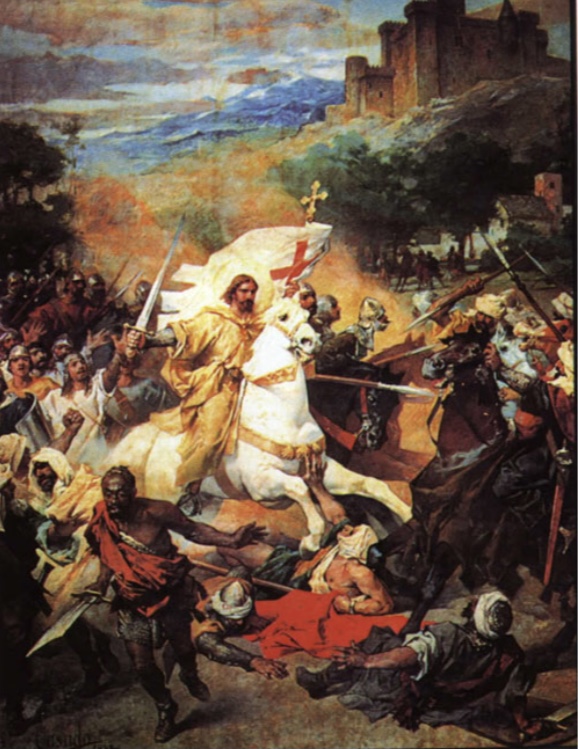
St James the Patron Saint of Spain, a simple disciple dressed in brown robes, somehow metamorphosed into a warrior saint complete with sword and became known as St James the Moorslayer (Santiago Matamoros). (Note 2) But the battle in which he was supposed to have appeared, the Battle of Clavijo, is a mythical one, believed for centuries to be historical but used as a popular theme of Spanish traditions regarding the Catholic expulsion of the Muslims.

Muslim bashing is no longer tolerated in modern Catholic Spain, those in power seeking more understanding and less offence and there’s been some debate about whether the paintings and statues of St James the Moorslayer should be removed, particularly as there’s no evidence of the battle taking place. Further reading revealed another image of James on a horse killing white faced men, so historical fact, myths, superstition all into the melting pot! 

Myths abound. After my medical decluttering postcard one could be forgiven for thinking that if you brought all the ‘sacred’ bits and bobs of Christian martyrs from all over the world together, you could make a number of bodies with quite a few extra bits. The authenticity of James’ remains has generated much debate and research. The difficulties of transferring his body to Galicia is just one of the gaps in this mixture of magical legend and historical fact. According to catholic tradition the corpse of James the Greater (minus his head because that’s under the altar in Jerusalem) was retrieved from a shipwreck near large scallop beds and buried in Santiago de Compostella (Note 3). So that’s how his cross is formed on a scallop shell, and why one of the best recipes for cooking scallops is Coquilles St Jacques.

So, St James’ cross is the sword with which he was beheaded, or the one the mythical St James used centuries later in his warrior role, and the three fleur-de-lis represent ‘honour without stain’, a reference to the character of the Apostles.

Phew, that took some explaining. Thank you Armi!

Richard 29th December 2023

Hove

http://www.postcardscribbles.co.uk

PS In ‘The Way’ (2010) Martin Sheen plays Dr Avery. a father who travels to Spain to retrieve the ashes of his son, killed during a storm walking The Camino. Avery decides to continue to Santiago with his son’s ashes in his backpack.

Note 1 Nicholas reckoned his trip would involve 20 million steps. It took him from May 1992 to October 1993.

Note 2 Moors from Morocco crossed the Straits of Gibraltar in 711 and ruled Spain until 1492, when they were finally defeated by the Catholic King Ferdinand and Queen Isabel

Note 3 Compostella translates into ‘Field of Stars’

PC 366 Medical Decluttering

It seemed apposite that the reviews of the latest production by British film director Ridley Scott, ‘Napoleon’, feature among other facts that Boney suffered from piles (aka haemorrhoids) and you will read more later. Interviewed by Jonathan Dean of The Sunday Times, Scott says he became obsessed with the fact that Napoleon had piles. “I believe the 1812 failed invasion of Russia could have been different if the man in charge had not had haemorrhoids. It’s like having a migraine up your butt and difficult to cope with if you spend a long time on horseback!”  

If, having read this paragraph, you feel reading about medical matters and medical decluttering is not for you ie TMI (?), stop and pick up my postcards next week. But I have just had enough of medical decluttering and I wanted to publicly reflect on my own medical journey, as bits fall off as we age, and some of us have lost more bits than others!

We start losing our primary teeth, those that pushed through the gums and were completely formed by 3, around 6 years old, although the second molars may not appear until early teens. It used to be that a sixpence was placed under your pillow when you lost a tooth to pay the Tooth Fairy, but that was pre-decimal coinage and now it’s about £5 per tooth! About two months ago I broke a piece off a wisdom tooth and it had to be removed. Do I feel any less wise? Never very wise in the first place maybe!

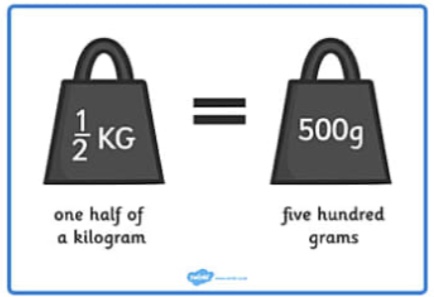
There is a constant decluttering of stuff the body doesn’t need and we don’t even appreciate it goes on. Did you know that you lose about half a kilo of the outermost layer of our skin, the epidermis which consists entirely of dead cells, over the course of a year? That translates to 25,000 flakes a minute; within

one month the outermost layer is completely renewed, albeit with dead cells! The average age of a body cell is 7 years but this is not the same as saying your body’s completely renewed after that time! Whilst memory cells in your brain are constantly changing, half of your heart cells remain with you all your life; red blood cells last about four months, but the core lens in your eye remains the same for your lifetime. Just as well as I had my first cataract removed yesterday!

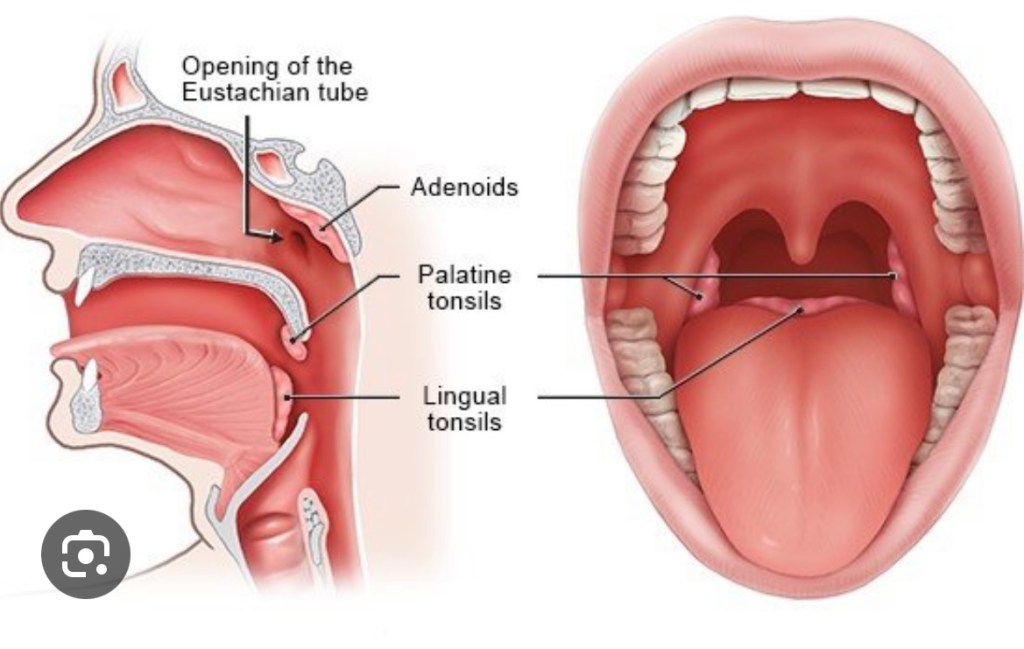
Tonsils, those lymph nodes in the back of the mouth and top of the throat that help filter bacteria, are often removed early in life, especially if the individual gets a lot of tonsilitis. For some reason I kept mine until my 30th birthday.

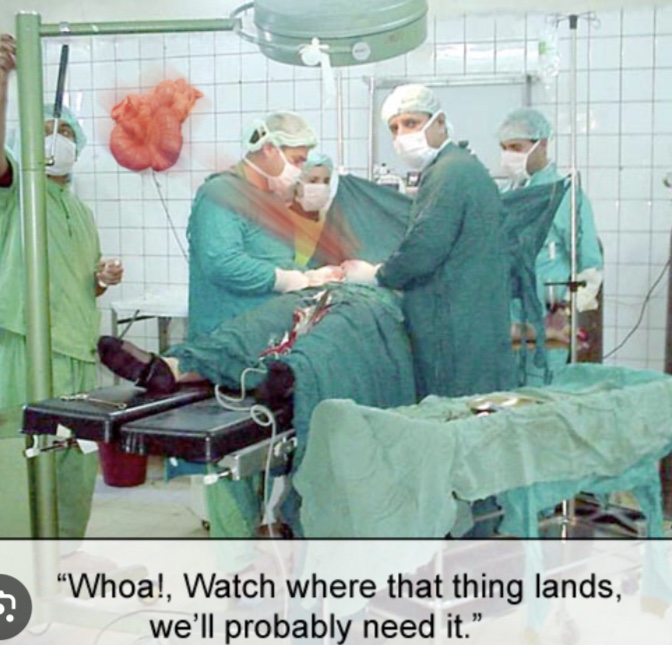
Another part of the body that’s routinely removed is the appendix, a small pouch that’s connected to the large intestine. Nobody seems to know why we have one! Mine became inflamed some seventeen years ago, became acute and was removed. I am reminded of one of Gary Larsen’s great cartoons of a hospital’s operating theatre.

Fluids like blood, mucus, breath and sweat regularly leave our bodies and most of the time we don’t notice.

Our hair grows about a centimetre a month and we have it cut regularly. Fingernails grow about 3.5cms a month but most individuals trim theirs before they become too long. Never quite understand how you cope with everyday life if you have nail extensions that are a centimetre or more long.

A little extreme?

I have been a sun-worshiper since my teenage years, certainly before the link between sun exposure and skin cancer became widely known. And I still am, although I take care, use screening lotions and doing a visual skin check. Two years ago I noticed a black mole on my flank and had it checked by my GP, who determined it was nothing to worry about. My recent review by a private doctor, who had more time than my harassed NHS one, covered a number of niggling issues but he noticed my black mole. “Think you need to get this checked out.” Fortunately within three hundred metres of home there’s The Hove Skin Clinic and the following lunchtime I saw Dr Bav Shergill. Thirty minutes later I am sewn up, without my black mole which went off to be scrutinised. One week later I get the results of the biopsy, a malignant Melanoma ‘in situ’ which I was told could be removed and 100% no need for further treatments. Phew! The hole was bigger this time; more medical decluttering!        

And while I am writing about cutting bits off, I am looking forward to a surgeon removing my growing lipoma on my upper arm; it could be mistaken for a deltoid or bicep but then anatomy is not everyone’s strong suit. Nothing to worry about, I am assured, just a fatty lump; often they just grow on their own, without the need to interact with the body’s blood supply. I am already thinking Sigourney Weaver’s ‘Alien’ as I scribble this. When it comes out in February maybe I should put it on then mantlepiece, as it’s about the size of a lemon!!  

Haemorrhoids, those things that Napoleon suffered from, are not a topic for a dinner party conversation, or in fact any chat apart from with those you live with and your GP, but they are exceedingly common. I was catching up with a chum on Weymouth recently and he admitted he had had to have his dealt with ….. just as I will mine next month. In the back of my mind I hear the comic Les Dawson talking about his mother-in-law’s piles …… and everyone’s laughing. I assure you that’s not an emotion I feel at the moment.

In 2013 my heart bypass used a large vein from my left leg, about 1metre long. My heart’s about the size of a fist! What happened to the surplus lengths?

Decluttering? I should coco.

Richard 22nd December 2023

Hove

www.postcardscribbles.co.uk

PS To all the readers of my scribbles, I really hope you have a wonderful Christmas and all you need in 2024.

PPS I learned a new insurance term the other day: ‘+/-’ You might think the symbols contradictory but ‘plus’ or ‘minus’ means a possibility in insurance speak.   

Note 1 The Latin word ‘pila’ can be roughly translated as ‘balls’ and often haemorrhoids look like small round balls.

PC 365 Hope and The Maldives (Continued)

That took you a long time Richard!”

“Ah! But I got you a long flat white and myself another double espresso! The Maldives?”

Hadn’t realised how difficult it is to get to one’s accommodation! We had booked a hotel complex run by an Italian company, because we knew their food would be first rate, compared with some of the British run ones. Everyone flies into Malé; after our ten-and-a-half hour flight from Heathrow we then had a three hour uncomfortable boat ride out to the atoll where we were staying.

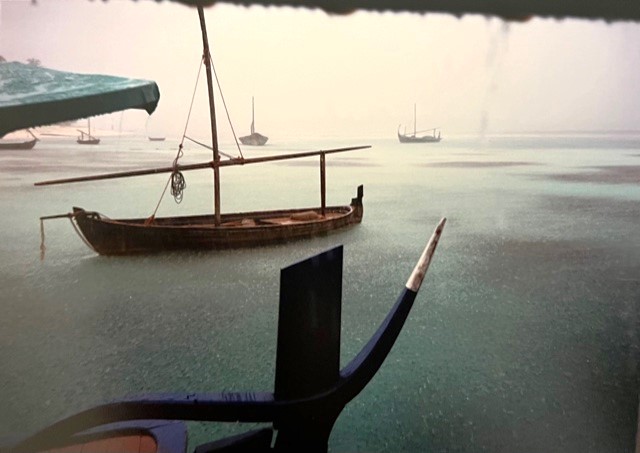
The rain-flattened sea

Great accommodation but the weather was 50:50. Some lovely warm days and then a real tropical thunderstorm would appear ….”

“Like the one I told you about that Celina and I experienced in Rio in February 2019?”

“Absolutely! Wet wipe-out! I’ll tell you what, though, the snorkelling is at another level, a stunning underwater world.

Interaction with the locals is much encouraged but it was somewhat uncomfortable as there’s a visible gap in affluence! We were spending a huge amount of money to get there for our two weeks and that probably equated to the Maldivian annual income. (Note 1)”

We chatted on for another half an hour and then I said I should say hello to Anna. When I was last in The Hope Café Libby, Susie’s aunt, had suggested I introduce myself to her (See PC 358) as she’d become quite a regular since Duncan’s renovations have made it easier for wheelchair users to access the café. Anna had an accident tombstoning and is now paralysed from the waist downwards. Sure enough she’s working on her notebook over in a corner.

My only real experience of interacting with someone who was confined to a wheelchair was at some stand-up drinks party for a military charity book launch a decade or so ago. Three men out of a hundred able-bodied individuals were in chairs. I wasn’t sure how one talked to someone whose head was about the same level as one’s lower abdomen. Initially I bent down, then went down on my haunches and when that got too much, stood up with a stiff back. Anna fortunately was sitting at a table.

I walked over, said I hoped I wasn’t interrupting, and introduced myself.

“Funny to find you in here today as wheelchair users featured in two Times’ articles recently.”

I saw the one about Sophie Morgan and her difficulties in getting a wheelchair which really suited her needs and how the charity Whizz Kids, of which she is an ambassador, has been doing great work with young wheelchair users. I know about them but I haven’t thought whether I could help.”

“I remember Sophie highlighting the public perception that users don’t want to be in their wheelchair. Is that right?”

“Oh! God! Absolutely! I just accept that I am in mine and have to make the most of my life. But apart from being physically disabled, I am me, capable, competent, intelligent and ambitious; I need more resources than able-bodied people to live but that’s it! People initially simply see the wheelchair ……!”

“You know that in the first three months of this year 342,000 working-age disabled people were unemployed, some 6.2% of the workforce compared with 3.4% for those who are not disabled. Such a waste. Is one major factor accessibility?”

“Society can be apathetic about its disabled people, and that’s a choice: ‘people can make things accessible if they want to, they can make the cost of living for disabled people more affordable …. if they want to.’ What was the other article you mentioned?”

“Spinal Column in the Times’ Saturday magazine. Melanie Reid is a tetraplegic after breaking her neck and back in a riding accident in 2010.”

“Ah! I’ve heard the name but don’t read her column. What was her piece about this week?

“How, since 2019, the Blue Badge parking scheme, ‘once purely the preserve of those receiving the mobility component of disability allowance, was opened to applicants with invisible disabilities such as autism, learning disability, dementia or mental illness’ and that’s resulted in those completely dependent on getting a parking space like her are often finding it impossible. That true, Anna?”

Too often ……..”

“Melanie doesn’t mince her words. ‘My pet hate is the adoption of those weasel words about self-identifying as disabled. They’re unforgiveable. The idea that disability is an identity, a whim, a choice, for the able-bodied to pick is utterly offensive to those of us who live with the reality.’”

“I like this woman! Must start reading her column. Listen, I need to finish a script for a marketing pamphlet …… nice to meet you!” (Note 2)

I sit on my own and think about this week’s postcard. Checking my emails, I find one from Duncan about my triptych. I reply, telling him it should be completed by Christmas.

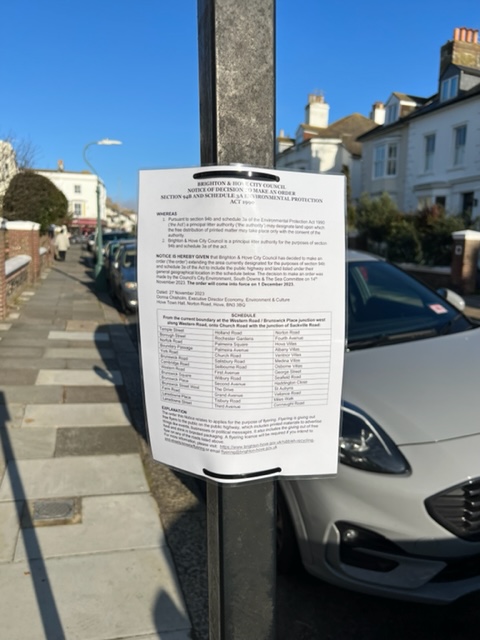
I think I am quite observant and the other day I noticed that the council had attached a piece of printed plastic to a lamppost in our street; a ‘flier’ of some description. Curious to see if this was notification of some planning application on which one could comment, I stopped and read it.

Seemed a wonderful example of irony; the notice told me it was extending the area of the city where ‘fly posting’ was prohibited.

There’s always debate about whether you should use ‘me’ or ‘I’ as in a recent Times headline “Are you as filthy as me?” – the alternative preferred by The King James bible “Are you as filthy as I?” sounds to me awkward. Rose Wild in her Feedback wrote that Kevin Lowe had got in touch. “I am reminded of the old story of St Peter hearing a knock on his pearly gates and calling out: “Who’s there?” “It is I.” said a voice, to which St Peter replied :“Not another bloody English teacher!”

Hey! Ho!

Richard 15th December 2023

Hove

www.postcardscribbles.co.uk

Note 1 Actually annual income per capita is $16.5k

Note 2 Yesterday in a minor reshuffle of government ministers, it was announced that there would no longer be a minister with specific responsibilities for Disabled People. Various charities who work in this sector cried ‘foul’ and said it was appalling and a retrograde step. Absolutely!  

PC 364 Hope Gossip and The Maldives

I had arranged to meet Sami and Lisa in the Hope Café on Wednesday afternoon but got there early enough to catch up with Mo, who was chatting on her phone. I raised my hand indicating I’d pick up a coffee and come over. Behind the counter was Kate, whom Duncan has recruited to replace Josh, while the latter is away in Israel. Kate is all smiles and obviously enjoying her new role: “It’s great Richard, something I have never done before, but such a change from driving a bus and I really enjoy the little chit-chat with our customers.

“That’s wonderful, I thought you’d be a shoe-in and as the café is becoming more and more popular maybe it’ll be a more permanent option?”

Mmmm! Good in the winter months but showing my bus passengers the wonderful scenery around The Seven Sisters and the Belle Tout lighthouse on the road to Eastbourne is also very rewarding. And we expect Susie back before January; what’s she like?”

“Like any late 20s young woman whose horizons had been limited by circumstance. The Kiwis have an expression for what’s needed, Overseas Experience, abbreviated to OE, and they see it as an essential part of learning about oneself and the world (See PC 155 OE June 2019). I really hope that Susie’s OE, travelling in the Antipodes, has opened her eyes to what opportunities are out there, out there and back here; so we will see who returns!! Incidentally did I see that the National Trust building at Birling Gap has had to demolish the long sea side of its building at Birling Gap, where its café was, as coastal erosion had put it in jeopardy?”

Kate smiles: “Yes that’s right. The café will now be on the other side of the building for the time being …. but your use of the word jeopardy makes my smile.

“Why’s that?”

“You’re old enough to remember the radio hit The Goon Show, with Spike Milligan, Harry Secombe (Note 1), Peter Sellers and Michael Bentine and ….

“Yes! Tales of Old Dartmoor for instance?”

Absolutely! You remember when the character in charge of Her Majesty’s Prison Dartmoor, ‘Seagoon’ narrated by Harry Secombe, is asked by the Superintendent how many convicts he had and he did a quick headcount and he came up with none?”

“And the Superintendent says something like you can’t walk around with an empty prison; your job will be in jeopardy …….”

and Seagoon replies: ‘In Jeopardy? I don’t want to go abroad!”

Kate and I had a good laugh at our own personal memories of that wonderful radio series. I pick up my coffee and walk across to Mo, who’s finishing her conversation.

“Hi! Richard. How are you? That was my mother, had some problem with the heating in her apartment. Might have to get in touch with Henri.”

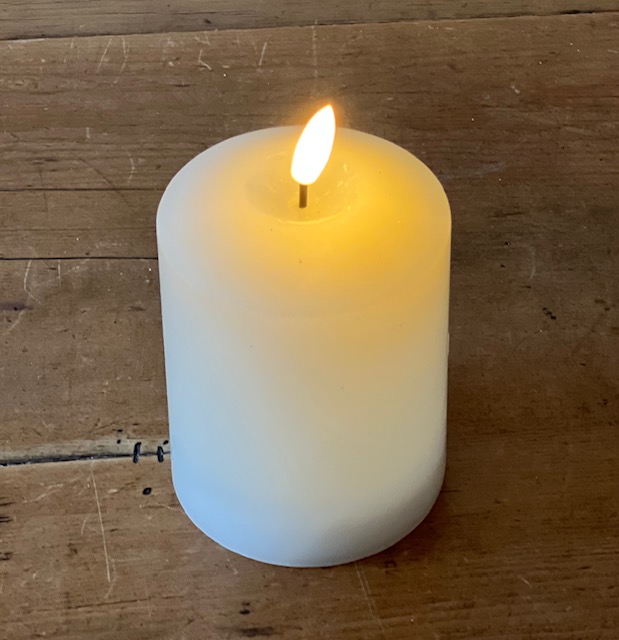
“Henri’s so good! Have recommended him to a number of people and he never fails to garner wonderful comments. Gather Josh is now on Israel’s northern border with Lebanon, facing Hezbollah. Hope he’s going to be OK now that the temporary ceasefire is over. Think the candle on the counter over there is a nice touch.”

“Yes isn’t it. Do you know what? I am so surprised by the polarisation of the public’s views here about the situation in Gaza and Israel. Most seem to side with The Palestinians in Gaza, forgetting that The Gaza Strip is completely under the control of Hamas, who are committed to the complete annihilation of Israel. I wonder how they would have reacted if some terrorism group had machine-gunned 1200 people at Glastonbury early in the year, And some of the accounts of the actions by Hamas on 7th October are inhuman, with gang rape of teenagers and then their murder commonplace. Janice Turner, writing in The Times, reflects that “the ♯MeToo crowd has been silent on Hamas rapes” and notes that some have questioned the veracity of the claims. She summed up her article: “In the absence of justice, all we can do is believe the Jewish women. Or if misogynists and antisemites struggle with that, they could at least believe Hamas rapists who are so proud of their crimes.”

“It’s such a complex situation but it seems there’s a growing acceptance even by the extremists that Israel will exist and it’ll have to come to some rapprochement with its neighbours. What’s that expression: ‘Real politik’?

The swing doors open and Sami and Lisa come in, see us and walk to a nearby table, dump their coats and come over. Hugs all round! Haven’t seen them since their Maldives trip. I had remembered a little gift of some olive oil from Portugal and they were suitably touched.

“Mo, catch up next week? Take care.” And I join Lisa and Sami.

“Look” says Lisa, “while Sami shows you some photos from our time in the Maldives, I’m going to say hello to Robert over there. I think you mentioned to him I am a fellow journalist and writer so maybe I can give him some pointers from my own journey.”

“OK! Talk later, Lisa. One thing you won’t know, Sami, about the Maldives is that the guy who ran the country between 2008 and 2012, Mohamed Nasheed, went to the same school in Wiltshire as I did, Dauntsey’s, on the edge of Salisbury Plain. He was there many years after me! Sadly his departure from politics was mired in claim and counter-claim; he was defeated in the last Presidential election. How was your trip?”

“You can see from this map that the country is a series of 20 atolls with 1190 islands lying southwest of India.

It’s described as ‘land scarce and low lying’; with future sea levels projected to rise somewhere between 10 and 100 cms by 2100, the entire country could be submerged! We decided to ……”

“I’m sorry but I just need to pop to the loo. Don’t go away!”

To be continued …..

Richard 8th December 2023

Hove

www.postcardscribbles.co.uk

Note 1 The late Harry Secombe was a great supporter of our Armed Forces, performing in charity concerts for free for instance. I was lucky enough to meet him when he came to visit 39 Medium Regiment RA when we were ‘keeping the peace’ in Londonderry over Christmas in 1973. Such a genuine lovely man.

PC 363 C Is For ……

We probably all remember, some of us with more clarity than others, the learning of the alphabet, those 26 letters that make up the English Alphabet? The word itself is a compound of the first two letters of the Greek alphabet, alpha and beta. It originated in the C7th to write Old English from Latin script. All the characters of the English alphabet are displayed in the pangram “The Quick Brown Fox Jumps Over The Lazy Dog.” There are many other alphabets, some 100 globally, but 99% of the world’s pure alphabets come from just nine, Latin, Chinese characters, Arabic, Devanagari (Hindi, Nepali and Sanskrit), Bengali, Cyrillic, Hebrew, Greek and Japanese.

“As easy as your ABC” became synonymous for something that was easy to do. And you might be right in thinking I only got as far as the letter C …… despite my surname being almost at the end of the alphabet. And that in itself can produce a sense of unfairness, always at the end, the last on any distribution list or handout. I could easily have developed a little chip on a shoulder about this and hope that at some stage in the future someone will decide to start something with Z!

So …. C…. sounding like ‘see’ or ‘sea’ ……

I seem to be in the centre of the letter C. My wife was christened Celina, and her brother Carlos. The parents were Carlos and Cecilia. Carlos junior married a Camilla and Celina’s first husband was called Chris. You might by now be thinking how come she’s chosen me, with a Christian name beginning with R. Ah! I know. Because my middle name is Corbett, through my grandmother’s father Richard Sydney Corbett being born in Recife Brazil and his father migrating to Brazil in 1830 from Lancashire.

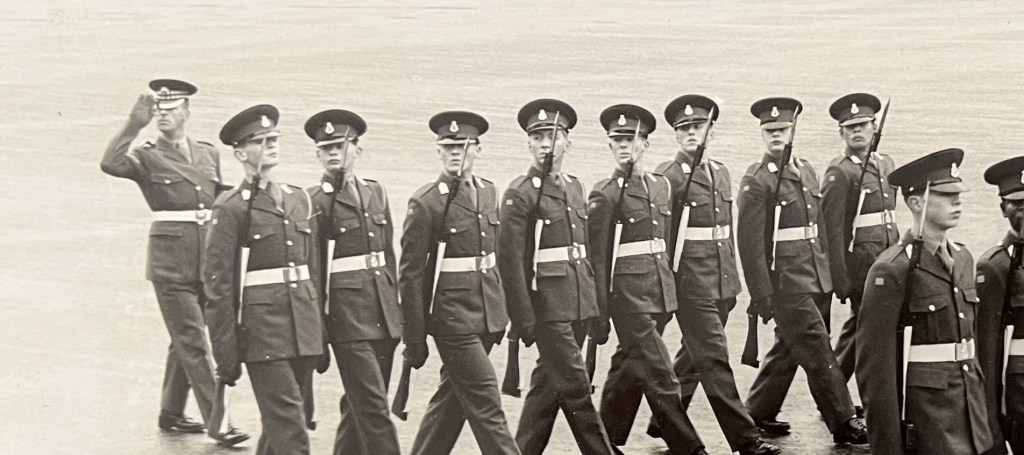
The idea for these scribbles began to germinate during a catch-up call with another C, a Crichton. You may think the only Crichton you’ve heard of is that one in the 1957 film The Admirable Crichton about an affluent family who get shipwrecked and come to rely on their butler, Crichton. It starred Kenneth More and Diane Cilento and it’s so long ago that not many people alive will have remembered it. My ‘Crichton’ was born a week after me and I met him for the first time in September 1965 when we joined Intake 39 Burma Company at the Royal Military Academy Sandhurst. Two years later, on commissioning, we went our separate ways, he into the Royal Gloucester Regiment (Note 1) and me into the Royal Regiment of Artillery. Our military paths never crossed but I touched base when a fellow Gloucester officer serving as the Defence Attache in Athens, Peter Saunders, was murdered in 2000. At Sandhurst we learned another alphabet ……

During our time at Sandhurst we both volunteered to take the Basic Parachuting Course, two jumps from a balloon (see PC 28 Balloons, Bloating and … ) and a number, including a night jump, from an aeroplane. The last was onto Hankley Common near Godalming, Surrey for a summer Teddy Bear’s Picnic. Although qualified as a Military Parachutist and entitled to wear the badge, irreverently known as the ‘light bulb’, we hadn’t taken part in the Parachute Regiment’s P Company selection so were no way able to wear the coveted red beret!

I mention this because Crichton’s eldest son John followed his father into an infantry regiment and has completed three tours in Afghanistan and two in Iraq. Apparently his chest is covered in medals, whereas in our time in the army the only campaign medals awarded were for service in Northern Ireland (see PCs 196, 197 & 198 September 2020) and the Falklands War in 1982. By comparison with John’s, my uniform was a little bare; we just did what came up and, depending on your viewpoint, were in the wrong place at the wrong time or the right place at the right time!

‘C’ was the beginning of the title (Note 2) of a heart-rending account of journalist and broadcaster John Diamond’s ultimately futile battle with oral and throat cancer (Note 3), which had been diagnosed in 1997. He was married to Nigella nee Lawson with whom he had two children, Cossima and Bruno, and died in March 2001 shortly before his 44th birthday. Nigella is now a well-known food writer and television cook; she was married to Charles (another C!) Saatchi from 2003 to 2013.

John and Nigella Diamond

Crichton’s first wife, with whom he had spent many decades, died in 2019 …… of cancer. So the letter C again!

So you can finish with a grin or a laugh, read this: “A man was walking along a street when he heard a crowd in the garden of a building on the other side of a fence. As he got closer he determined they were chanting: ‘thirteen’, thirteen’, ‘thirteen’ over and over and over again. Being a very curious individual, he wondered why they were doing this and, seeing a little hole in the wooden fence at about his height, stopped and put his eye to it. He recoiled as someone stuck a stick through the hole just missing his iris. The chanting continued: ‘fourteen’, ‘fourteen’, ‘fourteen’ ….”

Richard 1st December 2023

Hove

www.postcardscribbles.co.uk

Note 1. The Gloucestershire Regiment (The Glosters) existed as an infantry regiment from 1881 to 1994. At its peak it consisted of 18 battalions but after WW2 ended it was reduced to one single battalion of some 660 men. That unit covered itself in glory during the Battle of the Imjin River in 1951 during The Korean War. The Glosters were part of the four-infantry battalion 29th Brigade, some 2500 men, ordered to hold the south side of the river against 27,000 Chinese soldiers. For three successive nights they repelled numerous Chinese attacks, eventually withdrawing to Hill 235 where their stand enabled other parts of the United Nations force to conduct an orderly retreat. Just 63 men managed to get off the hill, subsequently christened Gloster Hill; 56 soldiers had been killed and 522 taken prisoner.  

Note 2 The full title was “C: Because Cowards get Cancer Too”

Note 3 A cousin of mine died of throat cancer aged 55. Awful!

PC 362 Eternity

I hadn’t thought of Arthur Stace for way over a decade, but his name came up in an excellent book, The Household Guide to Dying, by Debra Adelaide, recommended by my chum Chris Popham (See PC 348 Frogmore Devon).

Initially I wasn’t sure whether this was my sort of book, the title suggesting something mawkish and sad. How wrong I was! I finished it some weeks ago, sitting by the pool in Estoril, soaking up both the sun and the interesting story. It concerns Delia, an established author, who has written many family guide books, ‘The Household Guide to Laundry’, ‘…. to Gardening’ for example. Suffering from terminal cancer, she persuades her commissioning editor that she should write a guide for her family and others, so they can continue without her; they call it ‘The Household Guide to Dying’. Additionally, there are things she feels she needs to do while she still can, for example go to places that were pivotal in her life and the story is interwoven with these threads.

It took me a while to understand it was set in Australia but when Delia mentions Mr Eternity, Arthur Stace, it made sense.

In theology eternity means an endless life after one’s earthly death – the concept of one’s ‘immortal’ soul destined for eternity. This is a fundamental belief in Christianity, in Islam and in Hinduism. But Buddhism teaches something completely different, that there is no perception of an eternal metaphysical aspect of human personality. The only common ground is a belief that one’s spirit leaves the body. Buddhists believe that, as we are such a mixture of the physical and psychical, the spirit is ‘reborn’ is some form, depending on the laws of karma, the ‘cause-and-effect’ laws of our material existence. All religions believe where your spirit goes depends on how you perform in your life. You might go up, you might go down, you might go sideways although reincarnation in some animal form is viewed in a negative light and is seen as a backward step in the journey to self-mastery. So no concerns about ‘coming back’ as a snake, for instance!

Eternity is a noun and eternal an adjective. Classic philosophy defines eternity as what is timeless or exists outside time. Eternal and forever are synonymous but there is a subtle difference. Forever refers to an endless or seemingly endless period of time. Eternal means always lasting without a beginning or end: think of eternal as existing outside of time. Easy huh?

A British R&B girl group formed in 1992 called themselves Eternal and there are ‘eternal flames’ in cathedrals and public squares across the world that pay homage to those who died in battle. For me the word will always take me back to the closing minutes of the Sunday morning service at the Royal Military Chapel at Sandhurst. Kneeling on hassocks and, hoping our highly polished parade boots were not being scuffed by the flagstones, one thousand officer cadets sang quietly ‘Eternal Father’, in memory of Merchant and Royal Navy sailors who had lost their lives during conflict:

“Eternal Father, strong to save, Whose arm does bind the restless wave, Who bids the mighty ocean deep

Its own appointed limits keep; O hear us when we cry to thee For those in peril on the sea.”

From ‘Here to Eternity’ was the title of a 1953 American romantic war drama starring Montgomery Cliff, Burt Lancaster, Deborah Kerr and Frank Sinatra, based on the James Jones book of the same name. I guess we’ve all seen the B&W photograph of Burt Lancaster and Deborah Kerr on the beach?

James Jones found that the phrase ‘from here to eternity’ was first used by Rudyard Kipling in his 1892 poem ‘Gentleman Rankers’. Kipling wrote about soldiers of the British Empire who had lost their way and were ‘damned from here to eternity’. It had been incorporated into the ‘Whiffenpoof Song’ by junior students at Yale University and Jones liked it!

In the British Army in the C19th a ‘gentleman ranker’ was an enlisted soldier suited through education and social background to be a commissioned officer, It’s a long poem but the final verse is:

“We’re poor little lambs who’ve lost our way, Baa! Baa! Baa!

We’re little black sheep who’ve gone astray, Baa – aa – aa!

Gentleman rankers out on the spree,

Damned from here to eternity,

God ha’ mercy on such as we, Baa! Yah! Bah!”

Mr Eternity? Oh! Yes! Sorry … got distracted! Somewhere ‘Delia’ mentions Arthur Stace! Arthur Stace (1885 -1967) was the fifth child of alcoholics and brought up in poverty in the Sydney suburb of Redfern, By his 12th birthday, with no formal schooling and often in trouble with the authorities, he was an alcoholic, had already spent some time in prison and was made a ward of the state. In 1916 aged 32 he joined the Australian army and served for three years during World War One. Over ten years later Arthur Stace was moved to attend church and in 1932 heard these words from the Reverend John Ridley:

Eternity, eternity, eternity; I wish I could sound or shout that word to everyone on the streets of Sydney. You’ve got to meet it, where will you spend eternity?”

Something clicked inside the head of Arthur Stace; in some way the words spoke directly to him.

He was so touched that for the next 35 years Stace got up early and wrote the word ‘Eternity’ in yellow chalk wherever he could, on pavements, on buildings, on walls. For those living in Sydney at the time, the fresh yellow script was there during their morning commute into work, but whoever was doing it was a mystery; so the man who wrote ‘Eternity’ became a Sydney legend, only resolved in 1955 when the Reverend Lisle Thompson saw Stace take a piece of yellow chalk and write ‘Eternity’ on the pavement. It’s estimated he wrote it over half a million times.

So, see you in the next life …. or more likely, next week.

Richard 24th November 2023

Hove

www.postcardscribbles.co.uk

PC 361 Hope Returns

Before I scribble about my last visit to The Hope Café, I need to share a delightful ‘You Tube’ link, courtesy of my Greek dentist Rachil. I sent her PC 360 ‘Kaftans, Mimi & Toutou’ as two Greek singers were mentioned in the first part, Nana Mouskouri and Demis Rousos. You can watch them singing a duet, wearing Kaftans, at https://youtu.be/YqtT7fICQFY?si=N61nnthnpzD2-2U6

The first thing I notice when I push open the door of The Hope Café is that Josh, the barista who’s always there, is absent. Libby is manning (womaning doesn’t seem right?) the counter, but Duncan sees me and greets me in the middle of the floor.

“Afternoon Richard, glad I was here to see you as Josh wanted me to give you his best wishes and hopes to be back at some time.”

“At some time? Where’s he gone?”

“You remember back in March 2022 in PC 273 ‘Stories to Tell’ you wrote how Josh had told you his grandparents had escaped the persecution of the Jews in Ukraine in 1938 and fled to England ……”

“Yes! Absolutely! Oh! No! He’s not flown to Israel and joined the Army?”

“He has. He was watching the videos of the indiscriminate Hamas slaughter of 1400 Israelis, the young, the old, the babies and the festival goers, and those taken hostage in early October and sensed that he should do his bit to protect the country that was founded after The Holocaust.”

“Isn’t it amazing …. There’s no other nation on earth where individuals in its diaspora would have heard the unsounded call to leave their safe lives, family and jobs and travel to their mother country and sign up.”

“The whole situation, the Hamas slaughter and the subsequent huge loss of life in Gaza is so so sad, although here the country seems split on generational lines as to who to support, the young siding with the Palestinians and the older age group saying: “But what do you make of the Hamas spokesman who says we will repeat the attacks of 7th October again and again until Israel is annihilated?”

“Maybe we should keep a lit candle on the counter, until Josh returns?”

“Good idea! Libby’s been in touch with Susie and she’s going to finish off her Gap Year in Melbourne, not go to Western Australia, and return by the end of the year. So we’ll just muddle through without Josh until then.”

“I have an idea. You know I do hot yoga? Well, the other day I was talking to Kate, another aficionado and Hot Yoga teacher, who, it transpires, is a bus driver on the tourist route to Eastbourne. This is a seasonal job and she’s just finished for the winter months. Let me ask her whether she could stand in for Josh; she lives down by Hove Lagoon so not far. If she’s enthusiastic I’ll get her to call you.”

“That would be great. Before you go, how is the triptych coming on, you know, the one you promised by Christmas?”

“Er! Well, the idea’s taking shape, I just need to draw it out and then apply some paint! Don’t worry!”

I see Mo having a Latte, step over to her table and ask how she is.

“Loving the new layout and can’t resist some of the goodies from Teresa’s Brazilian Deli!”

“Ah! Yes. Difficult to stop them becoming a habit.”

“Can I buy you a slice of Queijadinha?”

“No! Please. I do not need another centimetre or two on my waistline!”

“Did Duncan tell you about Josh? He’s my daughter’s age and now he’s gone to assist in the defence of Israel, poor boy! Poor parents! I know from my history that there was nowhere else for the homeless Jews at the end of the second world war, those that hadn’t been exterminated in the concentration camps. Today, 75 years later, and Israel’s the only truly democratic country in the Middle East and it’s surrounded by countries who challenge its existence.”

Mo and I exchange views about The Middle East for some 30 minutes before ……

“It’s tragic whichever way you look at it. Let’s talk about less destressing stuff! Can’t see Sami and Lisa?”

“They were here earlier in the week and I think they have gone up to Derbyshire to get her house ready for renting.”

“Where is it? In Folding over Sheet?”

“Yes and now Sami’s got his compensation after the Post Office debacle they are going to buy something together down here. Seems to make sense. Incidentally I saw some of Sami and Lisa’s photos of their two weeks in the Maldives ……. I won’t spoil it for you as I know they’ll want to show you but what a serene and beautiful place. Did you know it’s at risk from rising sea levels due to climate change? If you’ve never been you need to go soon!”

“Incidentally, as you know, I love trivia – well trivia to some (!) but I read the other day that of those who were born globally between 1930 and 1946, only 1% are still alive.”

“Sorry! Run that past me again ….”

“Records of global births and deaths are difficult to ascertain, with data collections hugely unreliable in some places, but it’s claimed that of all the individuals born between 1930 and 1946, only one percent are still alive (aged between 77 and 93)! I did find out that 90 million people were born globally in 1950 and then 140 million in 2020 but this is probably completely irrelevant!”

“Think you should do more research then this weird percentage could become more interesting. Where are these 1% for instance?”

“Before I go, Mo, I think I’m going to introduce Robert Silcock, over there on the counter by the window, to Lisa when she’s next in. I know Robert struggles with the social aspect of life and, given her own journalistic background, she could give him some encouragement.”

“Good idea! See you next time! Big kiss!”

Richard 17th November 2023

Hove

http://www.postcardscribbles.co.uk

PC 360 Kaftans, Mimi and Toutou

I hope we’ve all done it, sitting around the table amidst the detritus of a lovely supper, an attacked cheese board and accompanying pear peel, some strawberries, an empty bowl of ice cream, soft lighting revealing dirty plates and contented faces, and the conversation just drifting with little direction. During the summer in Estoril with Celina’s mother and cousin, our shared experiences are often not the same, my knowledge of Brazil and growing up in Rio de Janeiro miniscule compared with my own English upbringing. After-dinner chats roll in a desultory way……

One word started the process, in this case ‘forever’, maybe referring to how long the redecoration of the four-apartment building on Avenida General Carmona was going to take …..

 ….. and I go ‘Forever and Ever’, being the title song from a 1973 hit ….. and someone poses a rhetorical question: Who was that chap, that big man, who wore a Kaftan or some other somewhat feminine garb, his falsetto voice at odds with his long black hair and mass of curly locks protruding from his chest? Maybe that’s what made him a star in his time. And sure enough the name Demis Roussos rises to the surface of one’s memory. Celina reaches for her iPhone, opens Spotify and suddenly he’s back with us in the room, and we remember one of his other smash hits, Goodbye My Love Goodbye.

“It says here (Wikipedia!) he died eight years ago at the early age of 68 …… oh! and had a huge hit here in Portugal with Vocé Vocé e Nada Mais (You, you are nothing more) in 1977.”

“Well, well! Who knew?! But he always performed in a Kaftan so he didn’t look so big as he was over 20 stone (130kgs)!

“So, no tutu for Demis!! And there was another Greek singer from about the same time …… Nana …..?”

“Nana Mouskouri.”

“Nana Mouskouri! Yes. The White Rose of Athens was her most famous song but did you know she recorded over 200 albums before she took a break to become a Greek member of the European Parliament? She’s still with us, aged 89!”

“I bet she never wore a Kaftan.”

“Actually she did!! Or so this photograph from some museum suggests!”

“But never a tutu!”

The word brought up another memory and I look across at Toni and ask:

“Did you ever hear the story of Mimi and Toutou (Note 1)?”

“Sounds like two very short skirts? (Note 2)

“No! No! Not Mini! Mimi ….. and Toutou with extra ‘o’s.”

“No! I haven’t. But I sense you’re going to tell me ….”

Many years ago I had been so taken by a Times review of the book ‘Mimi & Toutou Go Forth’ that I ordered it. It was before the Kindle so a paperback copy came through the post. Knowing everyone likes a good story, I thought I could give them a summary.………

“OK! We go back to the First World War and the minor skirmishes in East Africa. History buffs will know that the colony of German East Africa was surrounded by Belgian and British colonies, with Lake Tanganyika, a huge body of water some 670 kms long acting as the inland border. News reached the War Office in London’s Whitehall that the Germans had moved a naval ship to the lake via the railway from Dar es Salaam and we, the Brits, had nothing. Deep in The Admiralty a plot was conceived whereby a couple of armed boats would be shipped to South Africa, a British colony, then north by rail to Fungurume in the Belgian Congo and on overland to Lake Tanganyika.

This hairbrained scheme needed a wacky Boys’ Own Adventurer-type to carry it off; officer files were searched and eventually the oldest Lieutenant Commander in the Royal Navy, Geoffrey Spicer-Simson, twice court-martialled and known as a complete liar, was chosen.  

At his insistence the two 12m motor launches were commissioned as HMS Mimi and HMS Toutou and armed with 3 pounder Hoskiss guns. In July 1915 Spicer-Simson, twenty seven other naval personnel and the two launches arrived in Port Elizabeth after a month long voyage from Portsmouth. Loaded onto railway wagons they were then transported 3250kms northwards, and then the real adventure began. With hundreds of hired native Africans, they dragged the two launches across 140 rivers and gorges, building temporary bridges and using oxen and steam engines, the four hundred kilometres to the western shore of the lake.

HMS Mimi on route

Arriving on 28th September, HMS Mimi and HMS Toutou were deployed three days later. In their first skirmish with the Germans, they captured the Kigani and subsequently renamed her HMS Fifi. Eleven days later they attacked and sank the Hedwig von Wissman but sensibly did not engage the much more heavily armed Graf von Götzen. An Anglo-Belgian attack on German land positions the following year resulted in the scuttling of this large vessel (Note 3)

HMS Mimi with HMS Toutou behind her

The Battle of Lake Tanganyika was summed up as: “No single achievement during World War One was distinguished by more bizarre features than the successfully executed undertaking of 28 daring man who transported a ready made navy overland through the wilds of Africa to destroy an enemy flotilla on Lake Tanganyika.”

Lieutenant Commander Spicer-Simson never held a Naval command again and died in 1947 aged 71.

I think I still had Toni’s attention but Cecilia and Celina’s had wandered somewhat. Nothing worse than someone banging on …….

“Hey! Ho! Let’s clear the table …..”

Richard 10th November 2023

Hove

www.postcardscribbles.co.uk

PS There’s plenty of stuff on You Tube about this or you can read Giles Foden’s book, ‘Mimi and Toutou Go Forth’

Note 1 Mimi and Toutou are often known as childish onopatopoeia for cat and dog in French. (Meow and Fido in Parisian slang.) Mimi’s also the name of Celina’s bestest friend, although she was christened Marina.

Note 2 What’s that slang description of extremely short schoolgirl skirts – pussy pelmets?

Note 3 The ship was raised after the war and still operates on Lake Tanganyika as the MV Liemba

PC 359 Swimming Places

The temperature of the sea water on Portugal’s Atlantic coast doesn’t encourage many to swim unless you’re into triathlons or some such and swim in a wetsuit. Often it’s a very quick in-and-out and a wrap in your towel. Got me thinking about my own experiences of swimming, in seas, in rivers, in lakes and in pools.

My early years were spent in Bath and by nine was a boarder in a school on the southern hills of the city. The obligatory weekly swimming lessons required a walk down to the small public swimming baths. Larking about one day, suddenly the challenge was to swim under the rather grotty wooden steps by which one entered the water. It probably required three strokes – I was not a confident swimmer and almost, almost got stuck. I can feel the wood of the steps against my back today!

Balcombe Lake lay in the valley below my parents’ house. During the summer school holidays I used to walk down across the fields to the water’s edge, strip off, and wade in. The bottom was thick mud and I didn’t dwell on what might be living in it, absorbed by the sense of freedom and being close to nature, the thrill of naked swimming. ‘Wild Swimming’ has become very popular in Britain in the last few years although sadly its attraction has highlighted another issue in the United Kingdom, the poor quality of the water in our rivers and streams, often as a result of ‘permitted run off’ from farms, both cattle and chicken.   

During one Summer break from school Mr Proctor took a group of us to the Brecon Beacons in South Wales for some hill walking. We had some basic tents and blankets, sleeping bags being a luxury, and when not out on Pen y Fan or Cribyn were based in the Army’s hutted Sennybridge Camp. About a kilometre away lay the youthful River Usk, a cool, clear fast-flowing stream that eventually emptied into the Bristol Channel 120kms away. After a long day walking, it was heaven on earth to lower one’s body into the water and, hanging on to a boulder, let the stress of the day float away!

Dauntsey’s School had a long outdoor swimming pool built by the post-A Level students. It was fed by spring water, but a year after it was opened another project saw the water pumped into a large tank, from where it ran over some sun-heated corrugated panels; early solar heating I guess.

The first six weeks at The Royal Military Academy Sandhurst were designed to sort the ‘wheat from the chaff’, so to speak, with an accent on getting us physically fit. Part of that process was time spent in the large swimming pool. The eventual test was something like today’s: “Jump in and swim for 50 metres wearing a lifejacket. (Not in my time! More: “If you sink Mr Yates, Sir, an instructor will save you!”) Jump in with combat jacket and trousers, tread water for two minutes and then swim 20 metres.”

Almost without exception, when one swims one has a vague idea of how deep the water is; in a swimming pool it’s obvious, along a beach less so, but in the mid-Atlantic I knew the bottom was almost two thousand fathoms below my feet!

We imagined there were no shoals of fish here ….. so no sharks ….. but we kept a lookout and allowed only one person in at once. Very strange feeling, this during a transatlantic yacht race on a Nicholson 55 in 1976. (See PC 161 The Atlantic Sept 2019)

Have you ever thought to yourself: ‘God! I am a complete dickhead!’ or similar words? When I worked for Short Brothers’ Missile Systems Division my area of responsibility was ‘India and the Far East’ and on one trip in 1988 flew from Singapore to Brunei. I stayed in the capital Bandar Seri Begawan and gave a presentation at their Department of Defence. On the Saturday I drove out along the coast road to visit the Brunei Armed Forces’ Air Defence Battery, commanded by a friend of mine Andy Fellowes, seconded from the Royal Artillery.

Brunei lies due east of Malaysia

One particular stretch of the coast road ran parallel to the sea. On my return, it was a typical hot steamy late afternoon and I suddenly thought I could have a swim. There was virtually no traffic and certainly no visible humans, so I pulled off the road onto the sandy verge, locked the car and walked across the warm sand to the water’s edge. Toe in! Bliss! No one around and I thought just a quick swim, so stripped off my clothes and waded into the tropical water. Ah! After ten minutes of splashing around I thought I must get back, dry off somehow and return to my hotel. It was then I realised a little worrying undertow not only was taking me down the beach but also further out. I was only about ten metres from the shore but those ten metres were the longest in my life; major physical effort saw me back exhausted, lying on the sand thinking how stupid I had been. I sort-of saw the headlines in the newspaper: “Abandoned car and a pile of clothes! Mystery of the vanishing British sales executive.”

The river entrance is just north east of Aarosund

It was more of a hardship to jump into the fjord when sailing with chums in Denmark one year. We were in the south of the Little Belt and had sailed up the Haderslev Fjord to ensure a peaceful night at anchor in the river, only to find that the heads (WC to those of you unfamiliar with nautical nomenclature) was blocked. The only answer, it seemed, was to get over the side and reach under the water to the outlet pipe ….. and poke around until ….. it became unblocked! As the skipper, I didn’t ask for volunteers, just got on with it!

Richard 3rd November 2023

Hove

http://www.postcardscribbles.co.uk