PC 49 What are you worth?

No! No! No! I don’t mean to be nosey, and couldn’t care less whether you have a ‘Savings Account’ at the Co-Operative or millions sitting offshore somewhere. I just want to explore how you value yourself. Most of us need to earn money to buy the essentials for survival, if nothing else: – food, shelter, clothing etc. But as we in the developed world have got used to the basics, the majority of us start wanting to have enough money to, oh! I don’t know, go on holiday, buy a nicer/better/bigger car/house, the latest wide screen/flat screen/surround sound TV/tablet/stereo system, ‘designer’ clothes. Then we get on the treadmill, wanting more of this and more of that, not ‘needing but ‘wanting’.

So we develop a sense of worth, false or not!! Maybe you heard of Linda Evangelista, the model, who wouldn’t get out of bed for an assignment worth less than US$10,000? I suspect the majority of my readers would settle for far less. But what? It was a question that I often asked clients who were searching for some employment; “But what are you worth?” Would you, for instance, get out of bed for £10 an hour, £30 an hour, £150 an hour? (or in salary terms £30k, £50k, £70k or more.) Immediately you would see the intellectual tussle going on behind the eyes – mustn’t appear greedy, but the more the merrier …… but not obscene!! A recent programme about people living alternative lifestyles highlighted the use of barter, payment in kind and not with money. But you still need to value your expertise/work, even if you are simply exchanging your efforts for their hens’ efforts!

In the British Army you knew what everyone was paid as there were published pay scales, and that’s true across all public servants. And in some ways that’s very healthy; there’s no jealousy, no competition around pay per say. I remember when I first joined I was paid £65 a month! But that was in the days you could buy a nice house for £8000! When I left, I had to negotiate with my prospective employer what they thought I was worth, or maybe simply what the job was worth. After I joined I remember looking at other members of the team thinking “I wonder what they get paid?” I hope I am not alone in thinking like this!!

We were in Seattle in June, and there was much talk about Washington State’s minimum wage, and how the city of Seattle was going to raise the minimum wage for non-salaried people within the city to $15, from just under $10 – a 50% increase. (cf with the UK minimum wage for those over 25, of £7.20 an hour from next year) Wonderful idea, you might think. The reality is that those earning more than $15 an hour will get no pay rise ….. and then we get into the whole aspect of “What am I worth?” People are saying:  but I’ve got more experience/better qualifications, so deserve more; I come in early and go home late, so I deserve more; I’ve got a harder job so I deserve more …. more than those on the new minimum wage. You’ve read, I suspect, of the company where the boss decided everyone should be paid the same, including himself, and set that level at US$70,000. Great for those who got an increase, but not for those who got a decrease!

The hospitality industry is one of those where wages are comparatively low and I have grown up expecting to give a little bit extra to the waiter/waitress for good service. It helps, we understand, to supplement their paltry wage. Yesterday evening we went to a small Japanese restaurant in Brighton. It’s not at all pretentious and the food is well cooked. Whilst perusing the menu, I noticed at the bottom the words: “No Service Charge Added to Your Bill. Tipping at your discretion.”  God! It’s confusing! I’ve read recently that the term ‘service charge’ is not to be confused with a tip to your waiter. Sorry? I read it again; the, er, ‘charge for service’ is not a gratuity? So what is it? An overhead for the business? So why not include it in the costs of your meals?

Some years ago I remember having lunch in the English seafood restaurant Wheelers, in London. I opted to pay by credit card, only to find on the bill 12.5% had already added for ‘service’ and then the little blue paper slip had space for ….. a tip! I reflected that this was a somewhat sharp practice!

Why are we expected to award good service only in the hospitality industry? If you had taken your car to the garage for a service, were treated efficiently and well, but when you went to collect it they showed you the bill ….. and invited you to add 10-12% as a tip? I don’t think so! You wouldn’t tip the person taking your money for a tank full of petrol, unless it wasn’t self-service, when you might. So it’s all about the personal interaction with your waiter when you eat out, is it?

We were on the Alaskan ferry MV Colorado in June. The ferry is a State-run enterprise ….. so the staff, in the restaurant for instance, are Government employees. There was a large sign saying: ‘Please do not tip the staff’.  “No government employees are ever allowed to receive tips anywhere in the country. This applies to gifts as well; these are considered bribes, and therefore not acceptable. The government generally pays pretty well and has great benefits, so their employees shouldn’t need to rely on tips anyway.” – a Seattle resident writes.

It takes a while to get your head around this, we are so used to ‘tip’; normally we tip because it’s the ‘done thing to do’, but occasionally we tip because the person waiting on our table is really good at the job. Sometimes we decline to tip because it’s been so bad! The crew on the MV Colombia might have been on a good wage, but what’s so wrong in giving a little something for attentive service? How could I ‘bribe’ the waiter? Or are we ‘tipping’ in the private sector because we know the wages are so low? A recent survey, and you know how accurate ‘they’ are (!) found that the French tipped the least (7%) of all nationalities with the Americans the most generous (13%).

I’ve run out of space, so can’t get on my pet hobby horse, the one with ‘bonus’ written on its backside. Why should you receive a ‘bonus’ for doing your job properly?

This PC is rather muddled, like the thoughts mulling around inside my head. Still, it is what it is, mere scribbles.

Richard Yates – richardyates24@gmail.com

PC 48 Did you Notice that …….!!

Do you feel the same way as I do, that so much of life is immediately in front of us but sometimes we just don’t see it? Maybe you agree with the words of WH Davies “….. we don’t have time to stand and stare.”? In PC 19 (September 2014) I wrote about a number of coincidences that I have experienced. Prompted by a new one so bizarre, I have recalled a few more!

The other weekend we drove up the motorway to north London for lunch. On our way we were passed by a Range Rover with a distinctive number plate ‘1 BNT’. Vehicle number plates in the UK currently have two letters denoting place of registration, two numbers denoting year of manufacture, and three arbitrary letters. Older formats have simple numbers and letters, or letters and numbers. Some people pay huge sums of money to purchase a particular combination that might mean something to them, and clearly this owner had done so. What it stood for I am not sure, but ‘Number One Bint’ comes to mind. For those not familiar with the slang English vernacular ‘bint’ is a derogatory term for woman, but could in this case be the exact proud opposite! Anyway, having made some guesses, we thought nothing more of it as we journeyed onwards. We were later than planned in returning …… but you can imagine our complete amazement ….. to pass the same Range Rover traveling south later that evening. Here of course, in the same time and space, but recognising it purely because of its distinctive plate! What a coincidence! What a chance!

I am struggling to get to grips with Brazilian Portuguese, and currently have the benefit of a tutor here at home. We took a break while Celina and I went off to Alaska, but I did take some homework with me; good intentions etc … we all do it!! Day Two on the ferry on the inshore coastal passage on our way to Juneau, I’m sitting on the deck in the blazing sunshine trying to concentrate on ……. “Estar is used to express location and temporary qualities, while ser is used to express more permanent characteristics. Compare está frio (it’s cold – temporarily!) with Alaska é frio (Alaska is cold – permanently!)” But hang on, it’s 80F (27C) and it’s not cold!! Funny how these stereotypes get established in the belief system. But more importantly, what a coincidence to be in Alaska and read a comment about it in a book …… about the Brazilian language!

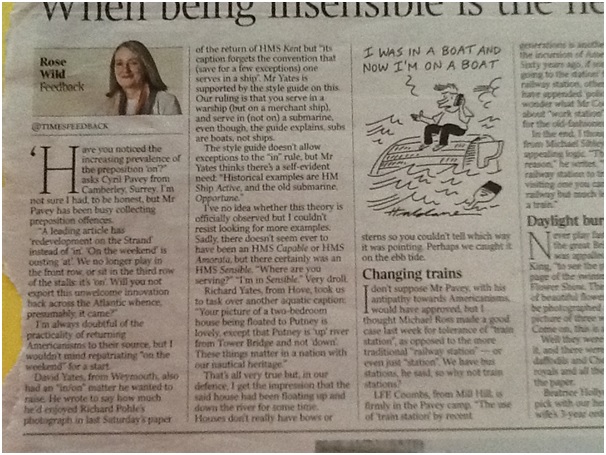
Back in May this year I noticed that The Times carried a photograph of a house being towed on a barge ‘down river to Putney’. As the picture was taken by Tower Bridge in London, my nautical knowledge told me that Putney is upriver by convention; so I wrote to the Editor to tell him!! It was not published! Unbeknown to me, my brother, who obviously shares with me a somewhat pedantic like for the correct English, had written in to remind the nation that in the Royal Navy the convention is you serve ‘in’ a ship and not ‘on’ a ship, after The Times got it wrong. His letter was not published either!! However, both our letters were referred to in the Saturday Feedback column with Rose Wild, without Ms Wild realising we were related. Now that’s a coincidence. We had a delightful email exchange!

PC48 1

Read from the third paragraph until ‘ebb tide’.

I mentioned in PC 44 that when we were in Whitehorse, Alaska, we went to the Vaudeville show. The compere had a lovely practiced way of engaging with the audience; he leaned towards the front row and asked a lady sitting there: “Where are you from?” “Portland, Oregon.” “Sorry!” he said. (Note this is an exclamation mark and not a question mark) She repeated herself: “Portland Oregon.” as anyone would. “No, I heard you the first time! Just sorry for you!” (Note: Actually he might be right! The city has a bumper sticker – “Keep Portland Weird”!) Then he asked: “Actually, where are you from, Portland being a big place?” “Albany” the woman sheepishly replied” Celina and I live on a street in Hove, just under 5000 miles away, called Albany Villas!

In the mid-1990s I spent one evening a week attending a Philosophy course at the School of Economic Science. Each week we would look at a particular topic: consciousness, mind/body/nature, beauty – for example, with a facilitator guiding the discussion, and looking at various texts and comments from writers across the centuries. The three hour session would finish with a self-centring exercise and the facilitator then closed the evening with some pertinent quotation. The quotations were from various sources, from poets and Greek philosophers, from playwrights such as Shakespeare to religious texts from the great religions of the world. One evening in early January, having just come back from a Christmas spent in Sydney Australia, I couldn’t keep my attention centred on my ‘self’ during these quiet few minutes at the end. I found my mind drifting around the world, like that DHL TV advertisement of a red tape wrapping the world. At the end of the tape was ……. Sydney, and I imagined myself walking up Darling Street, past a church. In the churchyard was one of those large advertising boards; it carried a quotation from St Matthew: “Come unto me all ye who labour and are heavy laden, and I will give you rest. … For my yoke is easy and my burden is light.”

I am brought back into the philosophy session with a jolt. Robin is reading that evening’s quotation: “Come unto me all ……” Now that is very, very spooky!!

Our minds generalise for us, cutting out much of what we see. For instance, we might see a tree, the mind having decided we don’t need to see the individual leaves, twigs, bark etc. So when we want to look at what is before us, we need to concentrate, to look, to observe, with every joule of our energy; the result is very enriching.

Just some scribbles for the end of the English summer.

Richard Yates – richardyates24@gmail.com
PC 47 Loo Paper!

It was Mark Twain who observed that travel broadens the mind; you don’t have to go far, however, even the local streets are full of rich pickings, if you care to look! I thought my own mind fairly broad, but it’s been stretched further by our recent North America travels, experiencing other places and other cultures. So when I encountered the thinnest, no, I really mean thinnest, loo paper in my life in Seattle, I thought this could be the subject of another PC ….. although it might need a little delicate handling ….. know what I mean? And if you had a rather prudish upbringing, maybe it’s best not to read any further!!

When I refer to ‘loo’ paper I encompass all the various descriptions of the genre; ‘toilet’ paper, ‘lavatory’ paper (very old fashioned maybe) …. and now the word ‘tissue’ is common-place. In France they refer to loo paper as PQ (a contraction of ‘papier cul’- ‘cul’ meaning ‘bum’ or ‘arse’); in German it’s ‘klopapier’ and in Portuguese ‘papel higiênico’. A couple of hundred years ago you might only have had the option of using some torn grass or old newspaper, but now the options are endless. The manufacturers of the ubiquitous ‘Wipes’, available for every cleaning job, have even developed the ‘toilet wipe’, which is ‘flushable’. Oh! Joy!

Back in the days of a less sensitive nation, in Britain there was ‘Jeyes Toilet Tissue’. Jeyes is now synonymous with cleaning products that get around the U-Bend but back then …. here was a cardboard pack of folded sheets of hard paper. The paper was a light brown in colour. It was neither absorbent nor comfortable; fortunately we have moved on. All loo paper used to be white, then coloured bathroom suites came into vogue and the manufacturers made a fortune in making loo paper that matched the various colours on offer – Avocardo, Peach etc. And we all know Andrex’s playful little puppy …… to advertise loo paper! I’m sorry, I simply do not see the connection here; what is the association between a sweet, soft, cuddly, youngster, having fun …. and wiping your bum?

If you worked for Her Majesty, as I did during my time in the British Army, we had ‘Government Issue’ loo paper; like the Jeyes stuff, but on every sheet it said ‘Government Issue’! If you were not a fan of a particular Government, the joke was obvious! And the ration that came in the ‘field pack’ had three small sheets per day; the common thought was ‘one up, one down, one polish’!

In Waitrose, an upmarket British supermarket, you can buy ‘Bathroom Tissue’ scented/coated in Aloe Vera, Jojoba or Cashmere. Do you sniff it before you use it, or do you really appreciate the difference in texture ……. by touching it? The mind boggles! In Yukon Territories, Canada, in a small place called Carmacks, a tourist emporium had a stack of loo paper wrapped as ‘Up North Toilet Paper’!?

The large, round container with a commercial-sized roll means less checking for cleaning staff , but have you ever found that the ‘free’ end is somewhere inside, almost stuck to the whole roll, and getting the free end usable takes forever? The ‘Seattle’ loo paper I think was designed for two (or more?) uses. The first is obvious, but the second? Well, it could easily have been used for tracing paper, it was so thin. And actually very difficult to take off the roll if the end was not obvious; a little like cling film/kitchen wrap when the effing end is completely invisible/undiscoverable!

One of the loos I use regularly (no pun intended!) is in our Bikram Studio complex. The overhead light is motion-activated (I’m sorry, this is just the way it comes to mind) which is fine unless you sit for longer than the timer allows – and the light goes off ….. and stays off until your flailing arms get noticed. In the Riverside Cottages we stayed in in Fairbanks, Alaska, they went one better, or worse! The shower/loo room had a timer for both light and extractor fan, and was customer-operated before you went in and locked the door. Well, here’s a conundrum. How long do you set it for before you enter? Get it wrong and you might end up in the dark, with your knickers around your ankles and …….

Bikram Yoga is practised in a studio where at least two walls have floor to ceiling mirrors. That’s fine, as part of the practice is to observed one’s half-hearted attempts to get into a certain posture; ‘must do better’, the voice in my head is often shouting! But in Brazil I encountered a mirrored wall …. in the loo! Aaaggghhhhh! The first time I used it, I was only wearing my Bikram shorts, ready for the session that would started shortly. After a minute or so sitting down, I suddenly looked to the right and ……. saw ……. well, Rodin’s Thinker is good to contemplate …… this sight was not! It sure hurried up my visit.

Recently I went into a loo, a rather narrow little room, sat down, did what I wanted to do, and then looked for the loo paper. After about 30 seconds, I located the roll, behind my shoulder. I almost dislocated said shoulder in trying to release a few sheets of paper; should I put my arm under my shoulder or above? Eventually the only way was to physically swivel on the loo seat through about 160°.

I don’t think we British have really got into using a Bidet, but I can understand its raison d’être! In an imagined nightmare scenario, you use the bidet ….. and look for a towel. There isn’t one! OK! There are probably some paper towels somewhere ….. but then you realise that in the C21st paper towels have been replaced by a Dyson Hot Air drier, fixed up on the wall. Success in the subsequent physical gymnastics required might guarantee you a place in the 2016 Olympics!!

Very mundane musings for a summer afternoon!

Richard Yates – richardyates24@gmail.com
PC 46 A Tale of Three Cities

Sandwiched either side of our trip to Alaska in June, we visited three cities in North America; Seattle, Vancouver and San Francisco, all part of great grandfather George’s travels. I know there are many of you who will know these cities intimately, some of you living there as I write, but I thought I could just record my own observations.

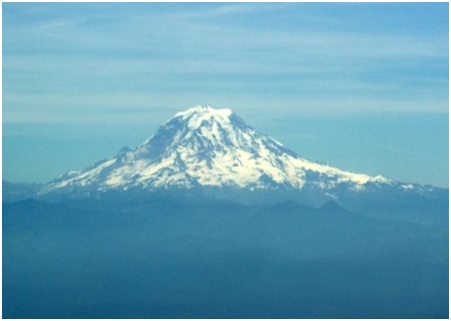
I think Seattle, up there in the top left corner of Washington State, is unknown to most Europeans – or perhaps that’s the way those that live here want it to be. It’s simply gorgeous, a city astride sea inlets and overshadowed by a huge mountain, Mount Rainier. I say ‘overshadowed’ but this is not strictly true as the highest mountain of the Cascade Range lies some 60 miles to the south; the snow-caped peak of this active volcano is clearly visible from the city – providing it’s not raining, and apparently it rains a lot in Seattle!

PC46 1

Mount Rainier

Seattle is the home of large American corporations such as Boeing, of Microsoft, of Starbucks …….. and of Nordstrom. Who? Nordstrom! Founded in 1901 by Swede John Nordstrom, it’s told that Swedish immigrants in America found it difficult to buy shoes big enough; maybe you didn’t know that they have big feet? Nordstrom started as a shoe shop but now has over 300 department stores in 38 states in the USA. It has an enviable reputation for exceptional customer service.

All waterfront cities offer their inhabitants the option to commute to work by boat and Seattle is no exception; ferries crisscross the harbour and even connect with Victoria, on the south end of Vancouver Island in Canada. On Puget Sound, Seattle’s surrounded by islands, evergreen forests and to the west the enormous Olympus National Park. It rains a lot in Seattle but they make good coffee; I have a T shirt from Seattle: “When it rains, we pour!” (Ho! Ho!) We were extremely lucky and had hot, dry sunny weather. Near the city waterfront is Pike’s Place Market, a jumble of little stalls and shops over three floors, and a magnet for tourists. On the street level there’s a fish stall where staff physically throw huge salmon between them, and rig fish with wires so that, when tweeked, they appear alive, much to the horror, and amusement, of the watching crowds.

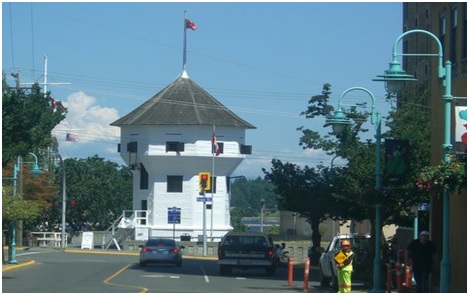
I have cousins in Vancouver who are descendants of great grandfather George’s brother Arthur, so we could not visit Alaska without dropping in here. A flight from Anchorage took us to Vancouver, and a short ride on the Skytrain dropped us close to our hotel on the harbour. Vancouver is a bustling coastal city of some 600,000 people of every colour and creed; there is a young vibrant feel about the place. Five years ago it hosted the Winter Olympics, and its location, surrounded by sea and mountains, invites outdoor pursuits of every variety. After a lovely catch-up over dinner, a 90 minute ferry ride the following morning took us to Nanaimo on Vancouver Island, home to a first cousin whom I had not seen for 40 years or so!

PC46 2

It was here I saw for the first time George’s original ‘My Darling Eva’ letters; my photocopies do not do justice to this wonderful personal treasure trove of local news, thoughts, feelings, worries and inquisitive questions about his family back in London. I forgave my hand for shaking slightly as I held these family heirlooms from over 100 years ago.

Vancouver Island is an absolute delight; it’s ‘Chill Out’ Island – with kayaking, sailing, flying, trekking, yoga (even Bikram!) and the like – but little swimming as the water is just too cold. We flew back to Vancouver after two nights by float plane; what a way to travel!

PC46 3

The historic octagonal Hudson’s Bay Company Fort, the Nanaimo Bastion, dating from 1854

George had lived in Reno, Nevada and in San Francisco from 1880 for at least a decade, working in the gold mines and sharing with Eva the joy of having their three children born here. When we were in the Pantanal in Brazil last year, we met a delightful American couple who said: “Do drop in if you’re passing San Francisco!” (as if!!) When we looked at some maps San Francisco seemed quite close to Vancouver; and I had a first cousin (once removed) living here …… so it seemed a good idea to tack onto this Alaskan trip another city connected with George, San Francisco.

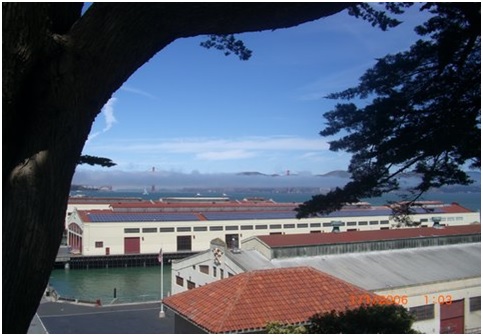
We stayed downtown, and on the first morning hired bikes and rode out over a fog-shrouded Golden Gate Bridge to Sausalito. We were not alone (!) and it’s the only place I have been where they have a huge carpark …… for bicycles! A light lunch and we were back on a bike-friendly ferry to the city. Some shopping and then dinner with my relative; interesting to learn of the opportunities of internet-savvy businessmen in this city. The following morning, up the hill, down the hill ….. to Fisherman’s Wharf, which was the jumping off point for the tour of Alcatraz, the notorious historic prison sitting on an island in the bay. Strange to stroll around a complex that once housed some of America’s most hardened criminals from 1934-1963, and was now a major tourist attraction. Remember the films, ‘The Birdman of Alcatraz’, ‘The Rock’ and ‘Escape from Alcatraz’? Well, the birdman was a psycho who had no birds in the prison …… and no one escaped and remained alive.

PC46 4

A fog-shrouded Golden Gate Bridge

We met our ‘Pantanal’ chums, had some lunch, drifted about Telegraph Hill, admiring the stunning views in all directions, and then drove inland to where they lived, a quaint little place called ‘Alamo’, (See PS below) about 30 miles east of San Francisco, near Walnut Creek. So nice to see where others live, away from a tourist city. After dinner we caught the Bay Area Rapid Transit back into the city centre and prepared for our flight back to the UK the following day.

So there you have it, memories of people, places and things from this summer; mere scribbles you might say.

Richard Yates – richaryates24@gmail.com

P.S. As a young boy I read about The Alamo, of Davey Crocket with his Racoon-skin hat and Jim Bowie with his knife; they were our comic book folk heroes, even if we weren’t American! In fact The Battle of The Alamo, a fort in the city of San Antonio, was between rebellious Texans and the Mexican Army. Fought in March 1836, all the 200 defenders of the fort were killed within 2 hours.

PC 45 Alaska Part Two (Continuing!!)

Part of our planning was to be in Alaska/Yukon on the longest day of the year!! Get your mind around this: in Dawson City the sun set at 00:47 on a bearing of 345° and rose at 02:59 on a bearing of 15°. So strange but actually it was wonderful, to have these long evenings, staying warm with a strong sun until you went to bed. Driving on unfamiliar roads, it was comforting to know you wouldn’t be wending your way up hill and down dale in the dark.

Dawson City developed a reputation for lawlessness and the Royal Canadian Mounted Police took a tough line. Consequently some Americans, wanting more freedom and fun maybe, took off down river to a newly established outpost called Eagle, which was over the border in Alaska, America. There is some speculation that Eagle was developed on the back of a half-truth, that a couple of prospectors staked out 50×100 foot plots, went to Dawson City with a bag of gold, sold the line that there was ‘gold in them thaar hills’, and gullible chaps, unable to find a free unclaimed creek around Dawson City to work, bought it! Eagle became a flourishing township of 2000, living in log cabins and tents. Obviously the London Alaska Syndicate that employed George bought several claims, particularly on the Fortymile River and at Colorado Creek and George spent several months here in 1901 and 1902.

The road to Eagle initially follows the Top of The World Highway, which is aptly named. This is emptiness writ large.

PC45 1

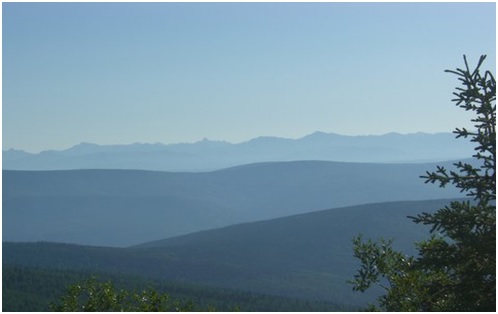
The view from the ‘Top of the World’ Highway

Mile after mile of dirt road, astride the tops of the hills. In every direction you see more of the same; trees, hills, greens, blues, golds ……. and sky …. and only one or two vehicles came in the other direction during our drive. We were blessed with wonderful warm weather and, driving along this unique road, we truly felt ‘on top of the world’. The entry onto this highway had been a ferry across the Yukon River, only open from late spring to early autumn due to the icing up of the river; also the snow of course would make driving on it during the winter months too difficult. Amusing to stop at the US Customs Post, go through the formalities, and drive onto tarmac – a modern surface, even boasting a middle yellow line ….. which stopped when you were out of sight of Canada and it reverted to a hard-packed dirt surface.

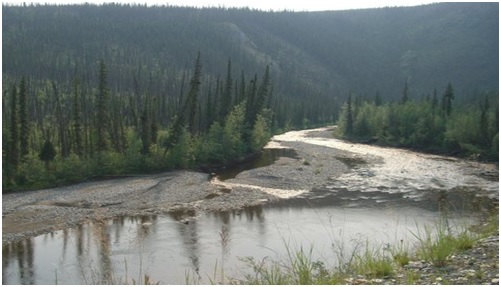
After some 170 miles, we turned off the Top of The World Highway and onto the 70 mile Taylor Highway. This was the one part of our trip I had felt might be rather daunting. The Taylor follows the trail developed by the gold prospectors who did not go down the Yukon River from Dawson City to Eagle. After 10 miles we crossed the Fortymile River, and followed the O’Brien Creek northwards. The road twisted around hills, down to the river and up over another shoulder, no wildlife visible apart from rabbits, on and on; sometimes the drop off the roadside was quite steep and there were no guard rails, so this was not a road to hurry on!

PC45 2

O’Brien Creek on the Taylor Highway

Two and a half hours later we drove slowly into Eagle. You remember I said earlier that Eagle had had a population of some 2000? Well! They left!! Currently there are about 109 people living here, swelled in the summer months by tourists to, maybe, 116. If you wanted to live away from it, here’s the place to come … Eagle City, only about 150 miles south from the Arctic Circle!!

PC45 3

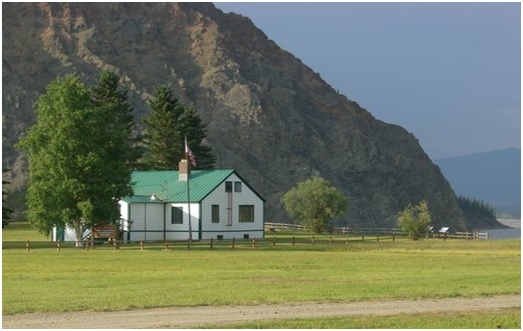
The Settlement of Eagle City (2015)

George wrote to Eva after his arrival at Eagle:

“I think I may say that I have at last reached the outermost edges of civilization. Dawson looks to me now as a place of refinement and luxury. Eagle City is a settlement of about fifty huts (log cabins), two large iron stores, and a board house used for Government purposes, and a little way out log buildings, round a space with a long pole flying the Stars & Stripes, of the Military barracks. The town site is a great improvement on Dawson. The hills stand well back from the town with a handsome bluff on the left, at the foot of which fans out Colorado Creek. A good view up and down the Yukon gives a feeling of breathing space.”

Everyone we met, from Theresa the postmistress who doubles up as the local historian, Mary the librarian, Terry who gave us the guided tour (and hoped we would spend money in the museum’s gift shop), and Philip, who was in the Visitors’ Centre and who looked old enough to have known George when he was here, were unfailing helpful, courteous and engaging. Lovely, lovely people! The restaurant was being refurbished and we had to improvise supper. We could cook at our B&B, so we looked in the village store for some provisions. The store owners were stocking the shelves; we looked into the freezer. Well, funny ‘burger’ shaped blocks called sausages, chunks of meat of all sorts (Moose? Caribou?), all very suspect – particularly if you’re a vegetarian as Celina is!

PC45 4

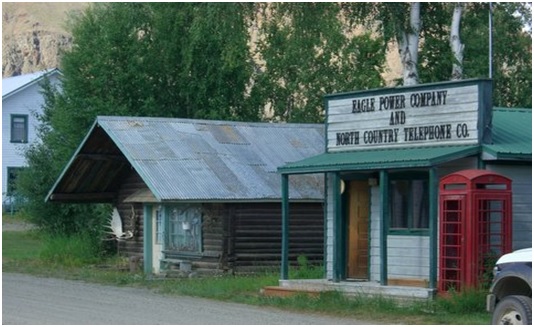
The old and the modern in Eagle

George trekked out of Eagle up to the mines they were working. He wrote to Eva:

“I can only describe the trail as the worst on earth. Mostly swamp – one moment nearly dragged off by the scrub, the next floundering in black mud. All the time the mosquitoes were in swarms, driving us both mad, the animals to madness. Really the mosquitoes question is terrible. We all wear netting and gloves, but you can’t keep them on always. We have to burn smoke fires round camp day and night, but still are covered with bites. I had been warned about the Alaskan mosquito – but dear me, I had no idea they could be so persistent and so hungry. They have learnt to climb through the netting; I watched them do it! The inside of our tent is splashed with our blood and squashed mosquitoes.”

After a lovely peaceful mosquito-free night (!) in the Falcon Inn B&B we left, filled up with petrol at Ron’s (See PC 43), and made our way back to the ‘Top of The World Highway’ and turned west. There is no record of George having been in this direction, so we mentally left him at Eagle, ruminating about his London-based syndicate and the uncertainty of the whole project. After a few hours we got back onto tarmac and drove into Chicken. Only in Alaska maybe would a place be called ‘Chicken’! And you know what? One night, as the prospectors sat around the fire after a hard day panning for gold at the creeks, it was agreed that their settlement was large enough to be christened. The area was abundant with a wild bird, the Ptarmigan, and this was the popular choice. Unfortunately no one knew how to spell the word, and when someone helpfully suggested that a Ptarmigan looked vaguely like a chicken, a show of hands adopted that name instead! (Nice story huh?)

The roadhouse shop and petrol station at Chicken was a favourite stop for the large Recreational Vehicles (RVs) – and the place was fairly busy. In an adjacent steamy café, the menu board had all sorts of fried this and fried that, fizzy this and that ….. but what I really wanted was a decent coffee. “What sort of coffee do you do?” “Fancy coffee!” “Do you do expresso?” “Yes, fancy coffee! In the roadhouse they don’t know what an expresso is, so they do ordinary coffee and we do ‘fancy’ coffee.” And this is the C21st!! Bless their little cotton socks.

I have mentioned RVs. In America everything is bigger and this includes RVs (and some of the inhabitants!!); if you live in Europe, I don’t think you will have ever seen the size of the RVs we saw in Alaska. The biggest ones tow the family 4×4 and are the size of the biggest coaches you will see in the UK! In Tok (pronounced Toke) we blagged our way on board one, to see just how big they are inside. The elderly couple proudly showed us around; expanding sides gave an extra 6 feet when you were parked up, the fully-equipped kitchen came complete with an ‘American-style’ refrigerator, and there was the king-sized bed and walk-in shower. Wow! “How much?” I rather cheekily asked. “$300,000, but we don’t own a real house; this is it.” One could see the attraction, sort of, and we had also met people in Whitehorse who toured Alaska all summer in their RV, before heading back to Florida for the winter. The Australian writer Tim Winton observed that many people in Australia bought a RV when their retired, and drove around the coast of their island continent. He called them SAD – See Australia (and) Die! If they completed the circumnavigation before one of them passed on, they simply reversed and went around the other way!

PC45 5

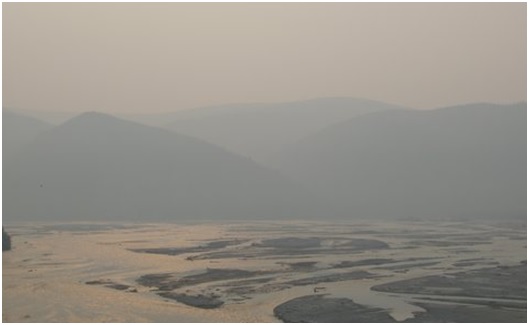
A smoke-shrouded Delta River on the way to Fairbanks

We arrived in Fairbanks in the gloom – there was sunshine somewhere but smoke from hundreds of forest fires had reduced visibility to a mile at best; not pleasant! Alaska’s second city, Fairbanks is fairly modern, sitting astride the Chena River and roughly in the centre of Alaska. Go north along the Dalton Highway for 500 miles and you arrive at Prudhoe Bay on the Beaufort Sea, the largest oilfield in North America. The Dalton Highway has become famous as the road the ‘Ice Road Truckers’ travel on. After a night beside the river, we head down to the railway station and board the Alaska Railroad train, bound for Anchorage. Over twelve hours the train would wind its way through some of the remotest, beautiful and rugged scenery in North America, past the entrance to the Denali National Park and hopefully, if the visibility improved, there would be a glimpse of the highest mountain in North America, Mount McKinley (20,320ft), in the distance.

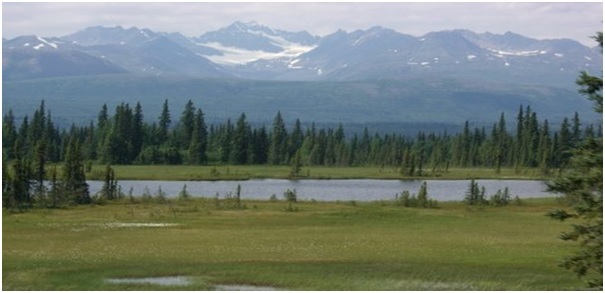
This journey was stunning and a fitting end to an amazing trip. We sat in the observation car, or stood on the open platform at the back of the carriage, watching Alaska unfold; around every bend, across rickety bridges, close-at-hand streams and woods and way-off the snow-covered mountains – the mournful whistle of the train forever announcing our presence.

PC45 6

View from the train

People got on, people got off; it was a busy day – but what I will never understand was something they served at breakfast on the train – “biscuit & sausage gravy”. The biscuit is like the English scone …. and cold; the sausage gravy is warm, grey, with bits of unmentionables in it. Absolutely disgusting – and they had announced its inclusion in the breakfast meal with some pride! Over my breakfast plate we talked to Jason and Bob, two guys who had been hunting moose, and who were now making their way down to Denali to do some fishing. Jason hunted with a bow & arrow – proudly telling vegetarian Celina how he liked nothing better than to kill a moose, do all the butchery, and fill his family freezer in Montana. We didn’t check how many chest freezers he had but an adult moose regularly weighs 300kg! We had seen a mother and calf beside the road out of Tok – wonderful, powerful, magnificent creatures.

We arrived in Anchorage late in the day and prepared to fly down to Vancouver early the following morning. Our Alaska adventure was over. We had followed George for some part of his journey, we had driven over 1000 miles and travelled on one of the most scenic railroads; we had had virtually no rain in over three weeks and were blessed with hot sunny weather for the most part. We felt extremely privileged to have been able to visit this wild and beautiful state – and grateful to George for having planted the seed.

PC45 7

Thanks George, my sentiments entirely!!

Richard Yates – richardyates24@gmail.com
P.S. You remember that Frank Sinatra song about traveling (?) “It’s very nice to go traveling, …. but it’s so much nicer to come home.” How true!!

P.P.S.   If you have read this and PC 44, and are tempted to go to Alaska yourself – GO!!

PC 44 Alaska Part One

Years ago I wouldn’t have been able to locate cities in Alaska, simply aware that it was that bit of North America up in the top left hand corner. Wasn’t it Russian at some stage? ’Cold and dark’ was another thought; you can tell I can’t have paid much attention in my geography lessons, or maybe we didn’t cover it. Since then a number of television programmes have been made about this vast American state, focused generally on survival, darkness, cold and oil;  “Ice Road Truckers” or Ben Fogle’s “New Lives – Alaska” for instance, or dramas like ‘Insomnia’ with Al Pacino.

Alaska is the largest state in the United States but has a population of only 750,000. It was bought from the Russians in 1867 for $7.2m – about 2 cents an acre – and most of the then population could not understand why US Secretary of State William Seward had paid good money for it – “Seward’s Folly” or “Uncle Sam’s Attic” were two descriptions! Eventually it became a fully-fledged state of the Union in 1959; Alaskans refer to the other states as ‘The Lower 48’!

Some eight years ago I uncovered the history of my mother’s father’s family, the Nations. I know few are interested in all the details, particularly of someone else’s ancestors; “They are dead; why the interest?” so I’ll be short, but it helps if you understand a little! George M Nation was born in India in 1848, moved with his family to New Zealand in 1860, and after marrying Eva Fosbery, moved to California in 1884. They arrived in London in 1890 with three children. I surmise that George was involved in gold mining in California, gaining valuable experience, because in 1900 he was hired by a London Gold Syndicate to manage their claims in The Yukon, in Canada. He returned in 1901 and 1902 to Alaska.

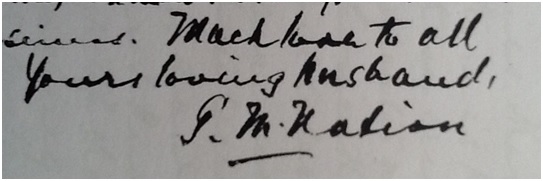
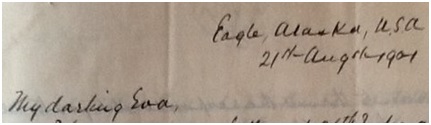
My great grandfather George was a prolific writer and some of the letters he wrote to his wife have been preserved, and are in the care of a cousin living on Vancouver Island. His beautiful writing covers sheet after sheet, all the letters beginning with “My Darling Eva” and finishing with ‘your loving husband, GM Nation” such was the formality of the time.

PC44 1

Transcribed, they are a delightful insight into a world that now seems so distant from ours. Travel needs a purpose; it doesn’t have to be anything deep or exotic, but here a seed began to germinate. What if I followed his path, up into Alaska, to see what he saw, feel what he felt, be emotionally closer to an ancestor, but with the benefits of modern comforts?

George journeyed from London, across the Atlantic by steamer to New York, took a train north to Winnepeg, another across Canada and eventually arrived in Seattle, after about 3 weeks travelling! We jumped the ‘pond’ and continental North America and arrived in Seattle – 11 hours later! There was no sign of the Hotel Butler he had stayed in, demolished years ago for some more modern development. Cruise ships are popular on this coast, going north into south east and southern Alaska, but we chose to follow George by taking a ferry up the Inland Passage on what’s known as the Alaskan Marine Highway; this was a smaller ship used by locals, campers, hikers and the like. George wrote of his trip:

“The steamer we left in is only really intended for river travel and very top heavy. We met with very rough weather and it was nervous work to see how the boat rolled. As usual she was overloaded with freight, horses and sheep and crammed with managers. However we got to Skagway after calling at several canneries two days late. Of course the winter scenery was wonderful to see.”

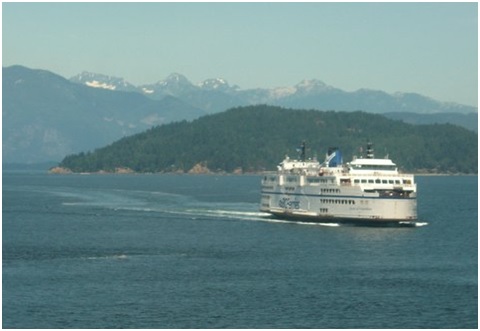
There was a period of rolling swell crossing the Queen Charlotte Sound, but otherwise ours was generally a smooth passage; whilst it was summer, there is still snow on the tops of some of the higher mountains. A brief stop in Ketchikan, the little town a magnet for the cruise ships, enabled us to access the internet to keep in touch with the outside world. Some people got off our ferry, some got on! (CF The Hurtigruten along the Norwegian coast)

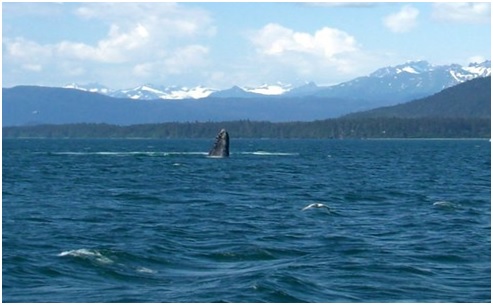
George had stopped at Douglas Island, lying opposite Juneau, the capital of Alaska; we stopped here for a couple of nights. There had been a huge mining operation that only closed in 1944, and now the town focuses on tourism and State administration. We took a ride out to the Mendenhall Glacier and looked astonished at this slow-moving icefield. The Park Rangers pulled a large chunk of clear ice from the lake; 200 years old?? Staying in Juneau enabled us to book a ‘Whale Watching’ trip. “Guaranteed!” they said: “or your money back”; they haven’t given much back, they say! A small boat took us out into the Sounds, and we watched and waited. Sure enough, more than 6 humpback whales, some mothers with calf, hunted for herring, forming those famous bubble circles and then rising up to snap the fish. Neither of us had experienced this, being close to some of the most enormous mammals in the world. Did you know that all their fins are unique, similar to the the ears of the reindeer? It enables researchers to keep a track of individual whales. To pinch an overused American word ….it was ‘awesome’.

PC44 2

A Humpback Whale off Juneau

We completed our journey to Skagway, from where the gold prospectors started their trek, on a smaller ferry and had a night at the Mile Zero B&B – see PC 43! When the cruise ships are in, Skagway’s sort of crowded; when they depart, it’s a ghost town, but the museum was interesting and the snow-plough engine used to keep the railway line to Whitehorse open in the ‘Gold Rush’ days was a wonderful piece of engineering. George took the train; we hired a car …… and went to Whitehorse, a sprawling town on the Yukon River, crossing over the international border to do so. We had imagined Alaska would be full of fast-flowing rivers, crystal-clear and freezing. Well, some were! They were fast-flowing for sure and the water was pretty cold, but the Yukon River itself was grey, like diluted cement. Its waters originate in a glacier in British Columbia, and consist of fine-grained, silt-sized particles of rock; the water appears cloudy and is sometimes referred to as Glacial Milk.

In Whitehorse we watched The Frantic Follies Vaudeville Revue, which claims to have been entertaining ‘visitors from around the world for over 40 years’. Actually a clever mixture of music and dance and …… gags, the latter hardly changed since they started: eg. “Where are you staying in Whitehorse?” “The Fiddler Hotel.” “Oh! I’ve heard it’s a vile inn!” (Violin? Fiddle? Get it?). But we did go on board the SS Klondike, an old paddle steamer that historically took the gold prospectors and supplies down river to Dawson City, which gave one a feel for travel in this part of the world in the late 1890s. And we did practise panning for gold!! Well, in the hands-on museum we took the pan of soil/grit/sand and washed it, slowly, to get rid of everything except specks of gold; it’d helped that our pans was seeded with $5 worth of the precious metal!!

The world has become very sensitive to the issues of original exploitation of ‘first nation’ people by the ‘early settlers’, almost exclusively European. In New Zealand the local Maori population have reclaimed some of their ancient rights; in Australia the Aboriginal people have gained much long-deserved recognition; in the USA, the native-born Americans have are no longer ‘redskins’ and in Canada the various tribes who inhabited the country long before the Europeans arrived have achieved huge acceptance of their ancient rights, and their wish to retain their customs and not integrate into the ‘white man’s society’ ….. but in Whitehorse you see evidence of those who partially integrated and failed, and who are now alcohol and drug dependant. It’s the same the whole world over, sadly. In Canada ‘Eskimos’ became ‘Inuit’ …… became ‘First Nation’ ….. became ‘Aboriginal’.

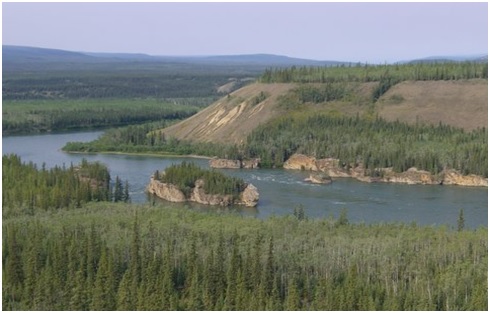
The drive up the Klondike Highway to Dawson City was some 330 miles long and took seven hours. It was uneventful except a close encounter with a grizzly bear, awful coffee, the lack of petrol stations …… and after a while, one Black Spruce fir tree looks like another ……. and there were millions of them, one ‘wow’ comment on the simply stunning scenery loses its poignancy with multiple use …… and you wonder when it will …. er ….. end! We passed Five Finger Rapids, where both paddle steamers and melting ice got stuck as they made their way down river to Dawson City.

PC44 3

Five Finger Rapids

If you really want to see what we drove through, go onto YouTube and watch the 3 minutes of ‘Whitehorse – Dawson City’, except that that trip was recorded in the winter. We even bought a ‘pot luck’ CD from the first and only place to get breakfast – ‘The Greatest Hits of Shania Twain’. I really can’t comment on songs she might have sung that were not ‘greatest hits’, but out of the 21 on this Canadian singer’s CD, two, possibly three, were bearable!! Sorry, fans of Shania!

George took a horse-drawn sleigh from Whitehorse to get to Dawson City. He wrote:

“…. over deep rivers and lakes, always following the trail  worn by the traffic. Of course the cold was far beyond anything I had ever felt, especially when the wind blew a little. Every morning we started at 4 o’clock to take advantage of the morning frost. We took our meals at Road houses (Rough Cabins), regular labourers’ food on tin plates and cups and their beds of course, stretched across poles between one another, the blankets I found moist as they had been used by every one who had come  along through the winter. Of course we washed and slept in our day underclothes. Marvellous to say we escaped all vermin and disease and after a good soaping with hot water wash we are  more the warmer.”

Amazing that this trip in March 1901 took less than a week!!

At the height of the Gold Rush in 1898, Dawson City was home to some 30,000 souls. Most had made the arduous trek too late, arriving to find that all the creeks had been staked out and claimed; such is the lure of gold that most apparently felt an achievement simply in getting here. Today, Dawson City claims to be a bit of a cultural centre; maybe that’s because there is nothing for miles in any direction!! It’s C21st meets the wild west! Our hotel was Swiss run and great, good food, WiFi etc. The town museum’s a solid building housing good memorabilia of the city’s heydays but the rest of the place is dusty, with dirt roads and replica facades of buildings. Interestingly, they have allowed some of the older structures to show the long-term effects of building on permafrost, slopping and sinking in all sorts of different directions. If George hadn’t come here, there was not much to recommend it!!

PC44 4

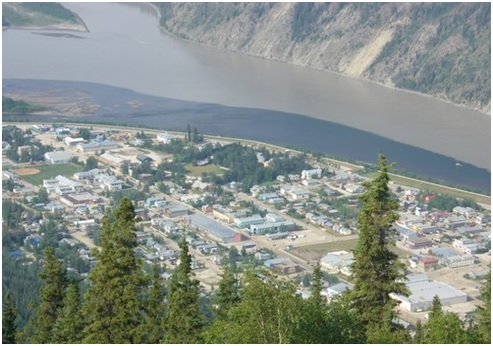
Dawson City with the confluence of the Klondike River (the dark one) and the Yukon River (the grey one)

(To Be Continued ………..)

Richard Yates – richardyates24@gmail.com
PC 43 Guns and America

We’ve just returned from a real adventure, following in the footsteps of great grandfather George, who was in Alaska in 1900, 1901 and 1902. Whilst I gather my thoughts on the trip and how to share some of our experiences through my PCs, in the following I simply report what I heard!

The gold prospectors arrived in Alaska in the 1890s at Skagway, a town lying at the northern end of a sea inlet; so did we! We stayed at the Mile Zero B&B, appropriately named as the starting point for the trip into the Klondike and Yukon. At breakfast the following morning, we heard of the horrific attack by a white supremacist on a bible study group within a church in Charleston; nine people were dead. “Oh! This is so awful!” exclaimed our host as she watched the morning TV. I don’t think I have talked to an American about their views on gun ownership before, although I am aware that there are very polarized positions. Without knowing anything about this lady, I simply said that the United States seemed very wedded to their gun culture, so this news wasn’t very surprising. Wow! It was as if I had stuck a stick into a hornet’s nest!

“I think everybody should carry a gun, then people like this man wouldn’t do it (not quite sure why she really believed this, but I could not interject!). I have guns in my house (not in the B&B thank God!) and we leave the doors open ….. so anyone coming in we don’t like will get shot. Mind you, I have been personally affected by shootings. One of my brothers shot the nose off the other when he was quite young; well! Just nicked a bit! But my! Was it bloody! Then my niece and nephew had a fight over a gun when they were young, 7 and 5 I think, and it went off ……. and my niece is in a wheelchair for the rest of her life! (So you have had 2 extended family members injured by guns, and yet you don’t bat an eyelid when it comes to having a gun in the house?) But it’s in the Constitution! We must be free to carry guns!”

At this point I decided that it was too difficult to influence this lady in any way, especially as my toast was getting cold. I emailed my daughter Jade to tell her of this experience. She replied: Oh! A gun law conversation over breakfast! Punchy! Next PC sorted then.” And so it was! I was pleased to read later that Barack Obama had said: “At the very least we should be able to talk about this issue. At some point we will have to reckon with the fact that this kind of mass violence doesn’t happen in other advanced countries.”

The polarised positions have their own way of proving their case, so it’s not easy to get definitive data, but accept that some 60 people are shot in the UK every year ….. and in the USA it’s about 11,000. So the comparative figures are, for every 100,000 people, 0.1 of a person (!) in England & Wales and 3.6 people in the US. (But per 100k, 3.5 people in the UK and 11 people in the USA are killed in automobile accidents every year!) Another startling figure is that there are 88 guns per 100 residents in the US!

I am sure Americans choose bits of their Constitution that they like, and ignore those they don’t. In this case Article 2, amended in 1791, states: “A well-regulated Militia, being necessary to the security of a free state, the right of the people to keep and bear arms, shall not be infringed.” I am not sure the lady in the Mile Zero B&B was a member of some militia, but there you go.

Just outside Eagle, a hamlet sitting beside the Yuk,on River, lies Ron’s garage cum scrap yard cum workshop cum timber yard; we pull in for some ‘gas’. “Where’yer from?” asks Ron , mid 60s, bearded, fit. “England!” And without further prompting, Ron launches into: “Oh! You let everyone in, anyone from Europe, migrants, asylum seekers. Here I have a white friend who wants to settle here but she ain’t black, homosexual, with HIV, from Haiti, and unless you’re black, homosexual, with HIV and from Haiti, you can’t come here! Of course we have a Communist president so it’s kinda weird! What did you do?” I felt immediately that expressions of liberal views would not go down well: safer to be short and, talking to someone I guessed would be an appreciative audience, I said I was an ex-military man.  “Oh! Well! So you know how to shoot!, he said, visibly relaxing; “Of course only the criminals in England can get a gun! Here, you can walk into a shop, choose a gun from any number of types, buy a box of slugs, walk out the door …..” and, I thought, “start shooting innocent people in Charleston”, but didn’t say it aloud! “That’ll be 25 dollars …… cheap huh compared with where you’re from ….  you pay by the gallon or by the litre?? Have a nice day!” This all at half past eight in the morning!

It may have been we would have got a different view if we had raised the issue in Vancouver or in San Francisco, where we would be a week or so later. Maybe Alaska is still pretty much a wild state, where residents naturally keep guns for hunting and for protection. We all remember Sarah Pallin? But do you really need a semi-automatic rifle? For what? Maybe if you live in an environment where the law-enforcers are always armed, unlike in the United Kingdom, there is a tacit acceptance that this is the norm, to carry a gun. Any conflict, however minor, requires a range of responses, generally more serious with each step. But it seems to me that having a personal weapon takes away a huge part of the gradual response, and that’s sad.

Just musings whilst the memory is still fresh!

Richard Yates – richardyates24@gmail.com
PC 42 Life and …….

Recently there have been headline-grabbing news items of madness …. bikers in Waco in the USA having a fight over ‘who ran over whose toe’ ….. and nine motorcyclists died! Or a family, husband, wife and housekeeper, gunned down and the house set on fire …… probably caused by someone ‘slighted’ in some way. A father in the Balkans not happy with whom his son had married, so he shot them all, the new wife and her parents. We seem so quick to take offence! The continuing barbarism of ISIS in the Middle East, in our C21st world, suggests that the human race has not developed and evolved as one would wish, that in a blink of an eye we can revert to the very basics in behaviour, as exemplified in the C13th and earlier. These headlines remind me how precious this life of ours, this existence, is and how we must try to live it to the full.

Do you remember that glorious television series “Life on Earth” by the indefatigable David Attenborough? There were many memorable pieces but one particular one has stayed with me, the life cycle of a fly on Lake Malawi. The eggs geminate on the lake bed, the larvae float to the surface, become adult, and rise up into the sky in such numbers that it looks like a cloud, or smoke from a fire, as there are billions of them. The females mate, the eggs fall to the lake surface and thence to the bottom, and the cycle starts again – apparently every month near the time of the new moon, such is the rhythm of some of nature’s wonders! The adults get eaten by birds – and their existence is over in a few hours!! Do you think they know? Know that their life, their existence, is measured in minutes ….. and in this short existence they have to mate, to ensure the longevity of the species? Or maybe for them, it feels like days/months/years – their perception of time is, well, their perception of time!

I imagine it’s only us humans who know that life is finite. Did the fly above Lake Malawi know? Did an oak tree know it would finally develop a disease, grow weak and fall to the ground? Did my lovely Labrador Tom, when his body began to pain him and he looked more mournful that normal? I don’t think so!

Babies certainly don’t as their focus is on the immediate needs of food and sleep. The young don’t care, don’t think, spending all their energies on growing, on learning and on living this exciting existence; and why not?! It’s only in middle age when you begin to think that time has come to matter …. and by the time your parents are both in another world, you really really know. It’s funny this feeling, as if there is no one ‘above you’. You start seeing obituaries of people you know …. and think “Oh! No!Not him/her, not yet, .. surely!”

I have a wonderful ‘Anthology of Great Lives’ culled from the obituary pages of a British newspaper; it’s a good book to leave in the loo. The editor has ensured that the stories of the lives who grace its pages are mirrored by the title, “Thinker, Failure, Soldier, Jailer” a nod to “Tinker, Tailor, Soldier, Sailor”! The people whose existence is written about certainly had a colourful time.

A chum encapsulated a thought beautifully the other day, walking above Brighton on the South Downs. “But we are intrigued as to what comes after death …… and we will never know!” he said, with a slight smile on his face. Various religions make cast-iron suggestions, describe a heaven with numerous virgins or pearly gates and someone welcoming you, or some vision of purgatory if you don’t follow this or that doctrine. There was that film ‘Flatliners’ in 1990 when a group of medical students tried to journey into the ‘afterlife’ and return ….. so they could tell everyone what it was like.

The insignificance of the human race in relation to the scale of space is mind-boggling. Have you heard how you could fit the entire global population into a sugar cube? Let me explain! We are all a mass of atoms; but each atom is formed of a nucleus and a spinning electron. In scale terms, if the nucleus was on the altar in the centre of St Paul’s Cathedral in London, the electron could move from alongside it to up into the Whispering Gallery in the dome. Take all that space away within each atom, and between each atom, and …….. we could fit into a sugar cube. (Does anyone still use cube (loaf) sugar anymore?) Well, some nice nerds did some mathematical calculations on Goggle and reckoned that actually the cube would be about 72 cubic metres ie approximately 4x4x4 metres; an enormous sugar cube but the image of scale is easier to understand.

I guess we’ve all known friends or relatives whose existence has not been the biblical four score years and ten; in early adulthood, too soon, too young. My PC 22 observed this uncertainty of life. There is no certainty in the length of our existence ….. and how we cope with that uncertainty can colour our own existence here on this earth.

I must have seen it somewhere, sometime, a picture of God holding the Universe in the palm of his hand – sorry I’m being sexist here, thinking of an old man with a flowing beard, not a woman-God. He’s looking at it with a smile on his face as if he has a sense of humour – and why wouldn’t he? He could be looking within the universe at ….. a single sugar cube? And those who leave their existence, leave this sugar cube, are simply dust …… just like the seeds of a dandelion blown by the wind from his breath.

Mere musings at the start of our summer here in the Northern Hemisphere.

Richard Yates – richardyates24@gmail.com
PC 41 Weddings and the institution of Marriage

OK! OK! I know I am not the greatest example of the lasting strength of marriage but maybe that gives me a different slant on this institution, just as we prepared for a family wedding in deepest Dorset. So it’s with slight trepidation that I write about this social event.

Some of you may be single, some may have been married for a short while, for some it may seem for ever, to the first person you ever met, to someone you ‘courted’, some of you may be on your second or even third marriage. No one starts a relationship believing it will only last for a specific time; it’s always going to last forever … and ever! Maybe some of you have taken advantage of more liberal laws that allow same-sex marriages, and we know of one such couple expecting their first baby next week. It’s a funny world!

It seems that marriage as an institution is still the aim of many, remaining socially the ‘thing to do’. A modern habit is to live together for months, even years – to try it out, so to speak. Imagine if, after a long courtship, you got married and you suddenly found you were not compatible; he/she squeezed the toothpaste in the middle/end, left the loo seat up/down, didn’t imagining empty the rubbish bin, taking her/his iPad to bed, left their clothes all over the place. Am I admitting to pet hates here? Ooopps!

We heard that my nephew and his long term girlfriend had got engaged!! How exciting this news, wondering when they were getting married, where, imagining the flowers, the whole ceremony …. that lovely film “Four Weddings and a Funeral” comes to mind ….. everyone in their best clothes, gorgeous food, champagne, speeches .… and awful jokes from the best man.

The invitation indicated ‘morning suit’ or suits, a nod to the ‘younger’ generation perhaps, although it’s obvious they like making an effort too. I suppose I have a predilection for ‘dressing up’, having been seduced to join the army for the dress uniforms (well, not really!!), so I looked forward to the prospect of wearing a morning suit and all the accoutrements. Some men turned up in suits, but a couple looked as if they were wearing their gardening ones ….. and I wondered what they would wear to a more formal occasion? Am I missing something here? Did they want to appear ‘different’, perceiving themselves as rather ‘above’ the social convention? It’s not that they were not educated ….. maybe an unconscious need to ‘cock a snoop’ at the rest of us, who had made the effort? There was a nice story from an Army chum who had been Officer of the Watch at the Tower of London when the Queen dropped in for supper; well, she has to eat somewhere! One officer was wearing his soft mess shirt and not a stiff one. The queen remarked on it: “Oh! Stiff ones are for more formal occasions.”!! I think dressing up for a wedding is de rigueur!

The small church in the village of Abbotsbury, a mile or two from the coast in Dorset and nestling under an escarpment, was the location for this wonderful celebration. Abbotsbury dates from the C10th and had a thriving Abbey until it was dissolved by Henry VIII; a huge barn is all that remains of the abbey, but on a hill overlooking the village stands a lovely little chapel used by monks for private contemplation. Nowadays Abbotsbury is famous for its swannery; started 600 years ago as a source of food for the monks, it has a large colony of mute swans, and is an important nesting and breeding ground.

Time before the service to gather one’s thoughts, admiring the wonderful flowers and looking at the other guests, wondering who they all were!! The church had a large wooden board above the altar with the Ten Commandments written in gold letters. Made me think of a discussion with Celina’s father about when to use ‘shall’ and when to use ‘will’ in English! The Commandments are all ‘shall’! But I was intrigued to read that, whereas numbers 6 to 10 start “Thou shalt not  ……”, the one concerning taking another’s life read: “Thou shalt do no murder.” Rather quaint wording for a serious subject!

The bride’s parents’ initials are ‘H’ and ‘H’, and my nephew and his now bride’s – H&H, or H² as it was written on their wedding invitation. The vicar made much of this, and added Hope and Hospitality in his homily about the benefits of marriage and how these two could embrace hope and hospitality in their union. The bridesmaids and the page boy and girl looked gorgeous. H² exchanged the traditional vows: “…… for better for worse, for richer for poorer, in sickness and in health, to love cherish and (maybe?) obey, till death do us part ……..”. It’s good to have a faith and a belief.

All too soon the dinner, the speeches and the dancing at the reception were behind us, the live music group was packing up, the newlyweds departing and ‘mwah mwah’ everywhere; it was time to wend our way back to our Bed &Breakfast, The Old Rectory in Winterbourne Steepleton – doesn’t that sound just wonderfully English? And it was!

My father’s father married three times, my father married three times, and me? Well, yes, following the family tradition, but I really really didn’t set out to!! “Rather be an “incurable romantic than love’s loser with an estranged wife” as Cosmo Landesman says. Funny world, innit?

Richard Yates – richardyates24@gmail.com
PC 40 Habits ….. die hard ….. or not at all!

I’m no petrol head but like most of us (?) enjoy driving, so was intrigued when I saw a question in a magazine about whether one should use the car brakes to slow down or change down a gear and use the engine to brake. I had been taught to use the engine as it was safer and produced less wear on the brake pad. So I was surprised that, with the advent of disc brakes, the perceived wisdom is now to use the brake … and not the engine. Old habits die hard, so I remain deaf to this new advice!

Got me thinking about how habits scope our behaviour … and wondered what other habits I had that belonged to the last century (and why not?!) Gosh, so many, but one or two stand out from the crowd!  For those of you who sometimes judge me to be hypocritical … and talk of glass houses and stones … or pots and kettles and the colour black …. I’m only human!

I am a morning person. I love getting up early; it feels good to occasionally see the dawn. When Tom my Labrador was alive, in his last year (2011/12) I used to get up at 0520 to walk him, before going off at 0610 to the 0630 Bikram Yoga class. There were not many people about, and we always passed an oldish chap, walking with a rolling gait, on our way and said “Good Morning!”. No response – nothing; but I persevered! After 3 months he eventually said: “Er’! Yer not English, are yer?” “Well, actually I am, from the West Country.” I said, rather affronted!! “Well, I’m a Londoner and no one says ‘good morning’!!” “Well, I do!” …. and we said hello and from then on we both felt good at acknowledging each other! A cheery “Good morning!” never hurt anyone, except those whose head hurt from too much wine the night before. In the institutional setting of the Officers’ Mess dining room, it was not ‘done’ to say ‘Good Morning’ – and the breakfast crowd hid behind their newspaper. The paper was placed on a wooden stand, rather like a music stand, thoughtfully provided by the Mess in front of their place. Celina’s father has a similar tale of an Oxford college’s lecturers’ accommodation; “Good Grief, man, Sssshhhhh!!” Even in our morning Bikram session, the teacher’s enthusiastic ‘Good Morning!’ is often met at best with a grunt!

An old habit of mine that has driven my early mornings for many years is to have three boiled eggs for breakfast. I love the ritual of correctly cooking them, of cracking the shell with a teaspoon, the wonderful deep yellow of the gooey yolk – and the salt & black pepper!! Can’t have a boiled egg without salt. I have however dispensed with the ‘soldiers’! For those readers unfamiliar with English habits, traditionally a boiled egg came with fingers of buttered toast that looked like soldiers on parade. You could dunk the ‘soldier’ into the soft yolk and eat; yum! yum! (In Australia they make ‘marmite’ soldiers.) On Northcote Road in Battersea there was even a café called ‘The Boiled Egg and Soldiers’!

Why do they make a cover to fit over the loo seat (sorry, I hate the word ‘toilet’ although it was very socially acceptable to use ‘lavatory’. Maybe it still is!!?)? They make a cover so that the place for one’s daily deposit is covered; never sure how some people don’t develop some very basic standards here …. but there you go. So why do some people leave the loo seat UP and not down? Our local Bikram studio fitted one of those self-closing lids ….. to the men’s loo. This is somehow sexist, isn’t it? Is it only men that leave the seat up? I don’t think so! Anyway, I can’t abide a raised loo seat, so wherever I am, in someone’s house, in a restaurant or even a motorway service station loo ….. and I find the loo seat up, I ensure it’s down when I leave. So if you unexpectedly find the loo seat in a motorway service station down, you know I may have been there recently!! …. And I think this is a good habit!

Then there are “Thank you letters”. This is such a generational thing, this need to say ‘thank you’ properly. You read about it in agony columns (what? You think I don’t occasionally read an agony column? Well, very, very occasionally). A grandmother moaning that their carefully chosen gift to their grandchild has gone unacknowledged. Asking whether she should simple stop sending a present! Then there’s the ‘After Supper’ note. I was always led to believe that if you use a knife and fork in someone else’s home, you should write a note of thanks; ie after cocktails, no – after a meal, yes! Is email OK? Better than nothing and in some countries where the postal service is abysmal maybe the better option. But a manuscript note is best, simply expressing gratitude at their efforts. Some people have come to dine with us, clearly enjoyed themselves and not a squeak of appreciation …  nothing .. da nada … niente!

Someone close to me has kept all of his bank statements, I mean all, ever since he first started banking; what he will do as more and more banks dispense with paper statements and go digital I don’t know. But it’s worth keeping a monthly check, isn’t it? So, back in the last century, when I eventually mastered an Excel Spreadsheet, I created one of my income and expenditure. So ever month I take the figures off my bank statement and put them into the spreadsheet, making sure the figures correlate. But then what? What do you mean? That’s it! They all check out, and I’m happy. Do I use the data in any other way? No! Er! So why do you do it? I need to keep a handle on my finances! This is a habit I sense I should just give up, the spreadsheet I mean, but I am wedded to it.

Just some mumblings on this first day of May.

Richard Yates – richardyates24@gmail.com