PC 164 The City of Bath

PC 164 1

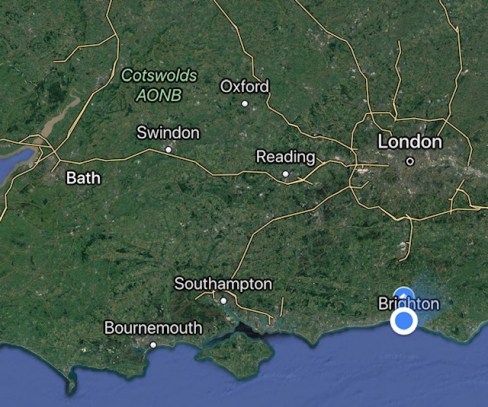
Bath lies just over 110 miles to the west of London

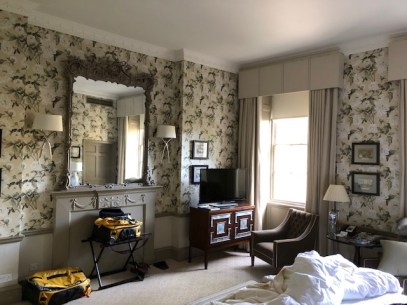
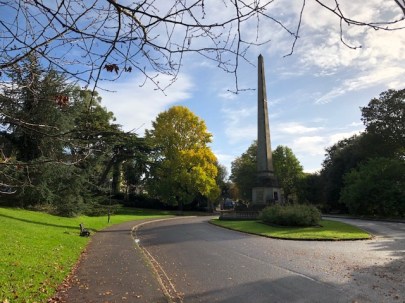
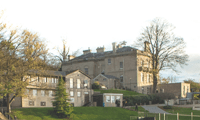
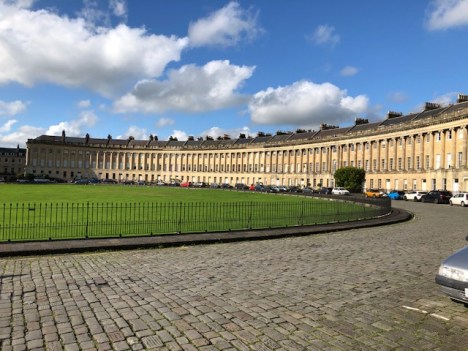
Whether you think of the City of Bath as an ancient Roman one, a flamboyant Georgian one, or one that is finding its place in the C21st, the city has an appeal that spans the generations. There has been a settlement in what was an ancient volcanic crater in Somerset since Celtic times. The Romans built the city of Aquae Sulis in the 1st Century AD, attracted by the springs which produce a daily flow of a quarter of a million gallons of water, at 46°C. It was the health benefits of these waters that drew wealthy Georgians to the city and the need for accommodation created the expansion of some of the most glorious architecture in Britain. John Wood’s Queen Square and The Circus are by any standard fabulous, but they were trumped by his son’s designs for the Assembly Rooms and The Royal Crescent, the latter a semi-ellipse of 30 houses, built using a local oolithic limestone, characterised by its honey colour.

PC 164 2

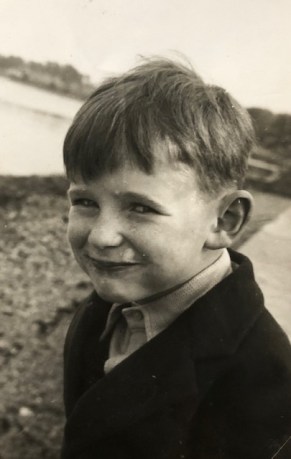
I was lucky enough to have been born in Bath and consider it my spiritual home, home to so many memories, good and well as bad, for such is life. This postcard is about the city and a second will recount some of those memories.

Parts of Bath are unrecognisable from 50 years ago, such is the extent of the cleaning of the stonework, its public buildings relieved of the grime from coal fires and their facades provide a warm welcoming ambience.

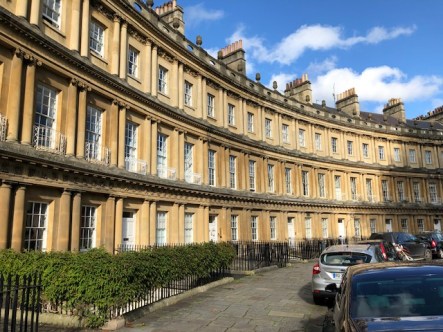
PC 164 3 The Circus

The Circus: (My old dentist, a Mr Sharp, practised at No 13 (see PC 64))

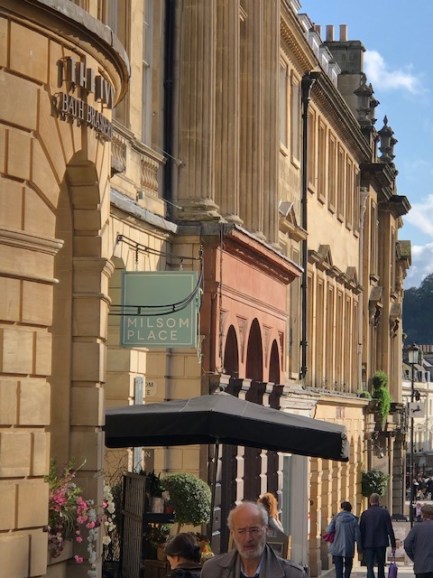
Whilst the Royal Crescent and the Circus sit in an elevated position, walk down the hill, turn left into George Street and right into Milsom Street …….

PC 164 4 Milsom Street

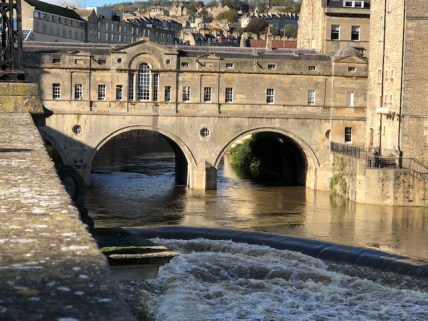
……. and you’re in the beginning of the modern shopping area. Eventually you come to Bath Abbey, The Pump Rooms and the Roman Baths. Today you can actually enjoy the thermal springs in the Thermae Bath Spa and be pampered in the adjoining Gainsborough Bath Spa. The River Avon flows under nearby Great Pulteney Street, a weir slightly downstream regulating water levels.

PC 164 5 Pulteney Bridge

Pulteney Bridge over the River Avon

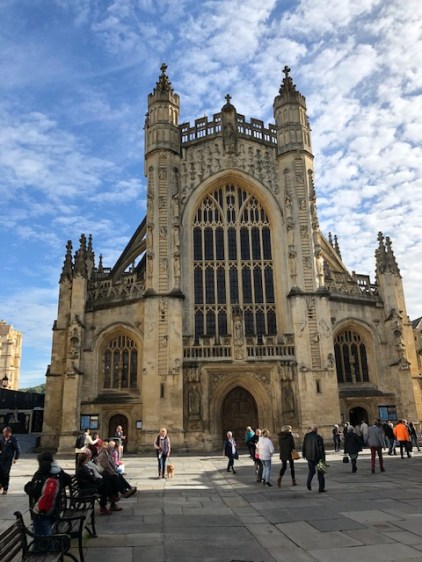
But it’s the Abbey that dominates here. The current building dates from 1499 although there had been places of worship on the same site from the C9th.

PC 164 6 The Abbey

I was last in the Abbey in 1958, over 60 years ago, when, as a boarding school pupil, we attended the Sunday morning service. We walked in crocodile formation a mile down the hill from the south west, dressed in grey suits, white shirts, and wearing, unimaginably, black ties in memory of Queen Victoria, who had died over 50 years before!

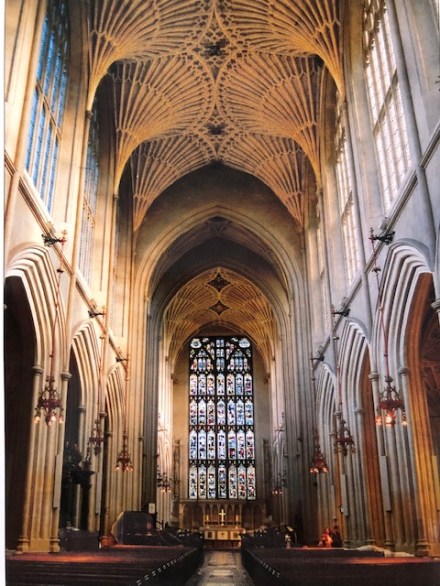
PC 164 7

The inside of Bath Abbey circa 1980

We had sat in the dark wooden pews and choir stalls and recited, by rote, the unchanging words of the service. On my recent trip to Bath I wanted to sit in those stalls, to relive that time, but was confronted with noise, light and space. The Abbey’s management are in the process of repairing its collapsing floor, lifting the countless slabs and the skeletal remains beneath, installing a heat-exchanging system using the natural hot spring waters, and reinstating everything. So the noise came from those working on a third of the floor, the light reflecting off much cleaner stonework and a sense of space created by the light wooden chairs that have replaced the pews. Quite a transformation!  Uplifting one might say?

PC 164 8

In 1956 there were pews here ……. And now they’ve gone!

Like all places of worship, the Abbey contains many hundreds of memorials to the good and the great; most originate from the 1700s and 1800s. In the South Transept lies the tomb of the wife of Sir William Waller. Waller fought for parliament in the English Civil War (1642-1651) and led the Parliamentarians in the nearby Battle of Lansdown. Although he retreated off the hill at the end of the battle, leaving the Royalists under Sir Ralph Hopton victorious, the latter suffered heavier losses and Waller was ‘ready to fight another day’. (Note 1)

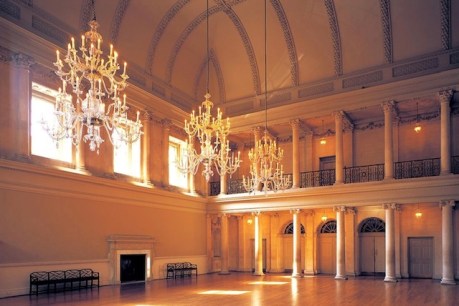
Near the Abbey are the Roman Baths and Pump Room. I was last here in 2008 for the wedding reception of a godson. A wonderful occasion and quite a location! Just to the East of The Circus are The Assembly Rooms; completed in 1771, they were at the heart of fashionable Georgian society.

PC 164 9

The Assembly’s Tea Rooms

The noted novelist Jane Austen (1775-1817) would have met friends, attended balls and evening parties in The Assembly Rooms, for she lived in the city from 1801 until 1806, and during a visit to the grand rooms it’s easy, if you half shut your eyes, to imagine the noise, glamour and smell of that extravagant period. She set two of her novels, Northanger Abbey and Persuasion, in Bath and today you can join numerous tours focused on her fame; start at the Jane Austen Centre, just a few doors down from where she lived in Gay Street. (Note 2)

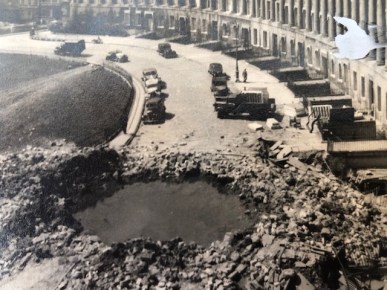
Like many cities in Britain, Bath suffered from World War Two air raids. A particularly heavy one in 1942 laid waste large sections of the city.

PC 164 10

The bomb that made this crater missed The Royal Crescent by 50ft, but hit St Andrew’s Church immediately behind it!

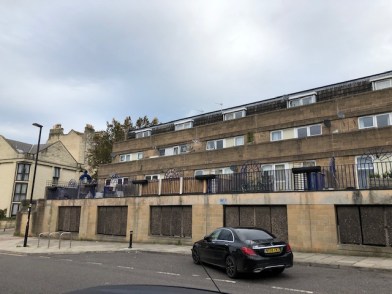
We are fortunate today for the publication of ‘The Sack of Bath’ by Adam Fergusson in 1973. This book highlighted how the 1960s city council had set about rebuilding the bomb-damaged city in a seemingly unplanned and haphazard way; large sections of Georgian houses were demolished and replaced by modern ‘chic’! This is an example on Julian Road. (yuk!)

PC 164 11 Julian Road

A powerful preservation organisation, the Bath Preservation Trust, came into being, and the results are evident today in some wonderfully restored buildings. And if you want to envelope yourself in how you could have lived in the 1700s, visit the renovated No 1 Royal Crescent, now a living museum.

Richard 1st November 2019

Note 1 The woman with whom my aunt Cynthia shared most of her life, Peggy Bryant, loved Jane Austen novels. But, maybe surprisingly, she admitted to me that she read Northhanger Abbey at least once, every year!!

Note 2 My first military posting was to a regiment in Devizes, Wiltshire. We were stationed in Waller Barracks. A mile down the road another military unit occupied Hopton Barracks!! The modern army shows no bias between Queen and country!


PC 163 Do I sell myself well?

For some of you this will be a meaningless question, given advancing age and complete comfort in one’s skin. For anyone else earning their crust, you need to grasp the importance, if you haven’t already, of being able to sell yourself.

Some things stay with one for a long time, such is their very fundamental impact. One such occasion was sometime in 1993 when I was working for an Australian company called Morgan & Banks. All the London Office consultants were gathered around the boardroom table, on which there was an old fashioned telephone. The ‘Sales’ trainer said he was going to ask one of us to make a cold call; a ‘cold call’ being one to an unsuspecting company, when you tried to interest them in the services your company offered. For those making the call it was the rump of the sales process, but very necessary; for those on the receiving end it was, 99 times out of 100, a nightmare.
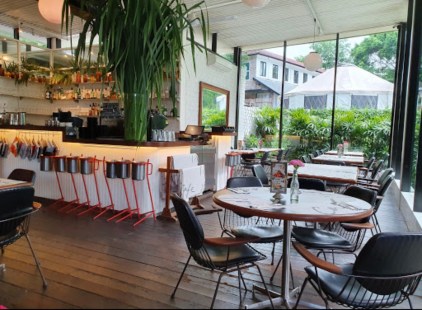
You could see the outward behaviour of those around the table go onto a rollercoaster. For some, the head went down and their mind was screaming: “Don’t chose me!”; for others they simply looked neutral – for no one wanted to make the call.

OK! John. Here’s the number.”

John reddened and he felt his heart beat faster; the others visibly relaxed. But just as John picked up the receiver to dial the number, the trainer said: “I’ve changed my mind. Tim, could you do it?” Our emotions went haywire!

So why do we dislike the process of selling so much? My parents’ generation had a very firm distinction between the ‘professions’ and ‘trade’, and the salesman was very much part of the later, personified by Del Boy as a fast-talking archetypal South London ‘fly’ trader in a television series ‘Only Fools and Horses’. Fortunately we now all realise that ‘selling’ is as important to the manufacturer as it is to the lawyer. But as I grew up I never realised the importance of selling ‘myself’. Performance during one’s military career was marked annually by the Confidential Report, charting the highs and lows of one’s military career and I reflect I didn’t feel the need to ‘sell’ myself. At Short Brothers, despite a sales role, essentially I was approaching foreign governments with an offer to give a presentation of the weapon system. I hoped the system’s functionality and performance would sell itself.

PC 163 1

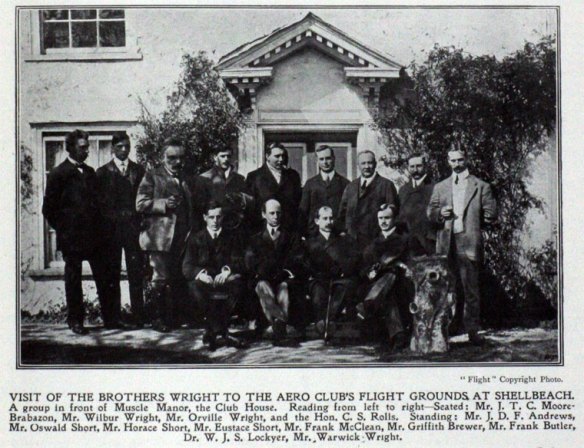
I just had to include this historic photo from 1909, showing the three Short brothers with aviation pioneers such as the Wright brothers and a Mr Rolls and a Mr Royce!

But then I got made redundant and had to set about selling my skills and abilities. Being one of life’s eternal optimists I always imagined there was someone out there that needed me! Three months later I joined Morgan & Banks. Geoff Morgan and Andrew Banks, the two Australian owners, had built a hugely successful recruitment business …… by selling its benefits through us consultants. The system was focused, tough, and very results-driven. It was not unusual for Andrew Banks to call your desk from Sydney around 0830 (UK time!) on a Monday morning to go through your previous week’s activities; there was nowhere to hide.

Which brings me to the boardroom and the sales trainer. I was never very good to statistics but, roughly, for every 100 cold calls you made you might get a positive response from 10, which might be converted into one piece of business! The only way to succeed was to embrace the sales process at every turn. There is a large library of books covering ‘sales’, but none better that one that dealt with the psychology of sales ‘Call Reluctance’. The authors suggest there are twelve different behavioural traits that inhibit one’s ability to sell oneself.

PC 163 2

If you are really interested, read the book (SPQ*Gold) or take a course with Dom Waters (See Note one) ….. but  ………

There are those of us who are never ready to sell themselves, always wanting more time to prepare (the ‘OverPreparer); those who always imagine the negative response rather than the positive one (The Doomsayer); those who spend so long developing their ‘professional’ image they have no time for actually selling (The HyperPro) (note two); those for whom the idea of giving a sales pitch/presentation is a complete anathema (Stage Fright) (linked to the negative behaviour) and those for whom the idea of making an actual telephone call is too emotional to contemplate – and too easy these days to hide behind emails or texts (Those with Telephobia). These are all learned behaviours and can be unlearned! (If in doubt, talk to me!)

I remember trying to win business from the Human Resources Director of Manufacturers Hanover, a now defunct bank. After six months I managed to get a meeting and took along one of the search consultants. Our imagined one hour meeting was immediately cut to 30 minutes, so we both explained what we could offer to Malcolm at breakneck speed. Then it was over; hands shaken, gathering papers, I just had to ask the all-important question: “So when will I get some business from you?” My colleague later said that took courage!!

Another person on my list was the HR Director for Freemans, a large mail-order clothing company. After months of frustration, I telephoned them after the PA had gone home, and got the lady herself. “Can I have 5 minutes of your time to explain what I do?” “OK! You’ve got five minutes!” So I launched into my sales pitch, having put my watch on my desk. After 5 minutes, in mid-sentence, I stopped talking.

Hello? Are you still there?” she asked.

You’ve had 5 minutes. You want more?” I cheekily asked. We set up a face-to-face meeting!!

In addition to embracing the results of SPQ, I did a NLP course. So much came out of this but for those anxious to simply get on with someone quickly, try some rapport building, especially a technique called mirroring. You simply copy whatever body language the other exhibits.

PC 163 3

Aware that a Departmental Director was very uptight and unwelcoming to new ideas, at my ‘sales’ pitch I simply copied his body movements; it took a while, but after 10 minutes he suddenly opened up and became very receptive! It was strange, but our subconscious likes people like ourselves!!

PC 163 4

Richard 18th October 2019

PS I ran my own executive coaching business for 16 years – and like everyone self-employed, had to sell the product before I could deliver it.

Note 1. ‘Earning What You’re Worth. SPQ; The psychology of Sales Call Reluctance’ by Dudley & Goodson. Or contact Dom Waters at paulwatersassociates.co.uk (01635 202750)

Note 2 One of the behavourial traits of these types is to have a hugely flashy signature. Such as:


PC 162 What Moisturiser Do you Use?

The question “What moisturiser do you use?” was one I seriously was not expecting! And the truth is that I do not use any moisturiser on my face. In the last century I did and used so much E45 cream that I bought some shares in the company that made it; well, I certainly helped their turnover, as I slathered the cream on every morning, trying to reduce the flakiness of my dry facial skin. But since then three things have happened. One, I gave up smoking in1994; two, I gave up alcohol in 2002 and we all know how bad both alcohol and smoke are for one’s skin; and three, I started Hot Yoga. These have combined to ensure my skin has regenerated itself to something more youthful. I hadn’t really anticipated this but am delighted by the result. Of course, these days we men can pick from a vast range of grooming products!

PC 162 1

Men’s grooming – Tom Ford Serum (2) £255 (!!) or Baxter of California Skin Concentrate (7) £28 or Heath Eye Serum (10) £14

So who asked the question? PC Christina Lane of Sussex Roads Policing Unit. Why? Well, she was imputing my details into her iPad after arriving at the scene of my traffic accident on 3rd September when she suddenly looked up at me. Having read my date of birth on the DVLA website for Driving Licence registration, she obviously thought I must use some form of moisturiser!! “Hot Yoga” I replied ……. and explained that sweating every day keeps the pores of the skin supple and open and my lack of wrinkles is clear evidence of this.

I consider myself a reasonably good driver – just like anyone else, I guess? Back in 1970 I even took The Institute of Advanced Motorists’ Driving Test, an exacting 90 minute examination and had passed (See PC 111). On Tuesday 3rd September, having collected Celina’s mother and cousin from Gatwick airport, we were making our way back into Hove along Shirley Drive, a residential street of upmarket, detached houses. It is also a rat-run for commuters …… and it was the beginning of the rush hour. This is a photo of the last memory I have before impacting with a Volkswagen Up!!

PC 162 2

And this is what my brain was suddenly aware of ………

PC 162 3

The stupid young woman had come out of the road to my left, had, according to both Celina and cousin Tony, looked to her left but not to her right, and simply driven into the space about to be occupied by my Audi.

PC 162 4

It wasn’t until a little later I thought about this complete blank as to how it had happened. Did I brake? – there was no rubber on the dry road! Did I take any evasive action? – the wheels were still parallel with the road suggesting I didn’t! The frontal airbags didn’t deploy and a little question to Mr Google informs me that they would deploy when ‘striking a parked car of similar size at about 16 to 28 mph’. I had thought my speed was about 20 mph (in a 30 mph zone) ….. so that checks out. (See note 1)

Our innate ‘flight or fight’ response kicks in in moments of stress and trauma. Benedicte, a good friend training to be a Paramedic, tells me the brain triggers the release of hormones, mostly adrenaline, which cause physiological changes such as increased heart rate, blood pressure, rapid breathing and sharper senses. This hormone release can lead to memory loss because stress taxes the body resources; acute stress may disturb the process that collects and stores memories. So, a three second blank; complete blank!

There are moments in life when you wish, with all the breath in your body, that you could rewind time, turn the clock back. You may recall this was exactly how I felt in October 2015 when I looked at my thumb whose side I had neatly sliced off with a mandoline (PC 52). But the passage of time is always forward, so here was a ‘situation’ that needed dealing with, no time to reflect about rewinding the clock (!), not least for the poor woman in the front seat of her car covered in glass from her broken window and shaking in shock. My military training taught me to be calm in a crisis; add almost 20 years of practising yoga and I feel I project a calm and unflustered demeanour; inwardly it may be a different matter!! Celina helped Maddy, the VW driver, to get out of her car; we called the police (see note 2); Michelle, the driver of the Mini immediately behind me, kindly offered to be a witness; photographs were taken and I reversed the Audi and parked it off-road. With a foot on the door pillar of the VW, I managed to pull open the crumpled door, brushed the glass off the seat and moved the car to the verge.

PC Christina Lane and I flirted whilst she filled out the online forms; and why not? She was gorgeous, half my age and it was all innocent fun in the aftermath of what might have been a life-changing accident. Reduces the stress does flirting! And for the first time in my life I was breathalysed!!

PC 162 5

A souvenir!

The firm of solicitors that were instructed by my insurance company to get in touch did so …… and didn’t believe no one was hurt. “But surely ….? Symptoms appear after a day or so …..” and telephoned me four times to check!! We live in litigious times so being able to push back felt good. The claims process is so joined-up these days that online reporting, choice of repair garage, choice of hire car etc etc – no hassle at all. A month later the generality of the incident is now just that, an experience. Thankfully no one was physically hurt although I am hope Maddy, the VW driver, will remember for a long time the day she didn’t pay attention whilst driving.

Richard 3rd October 2019

Note 1: The Volkswagen Up! is a lightweight car compared with my Audi Q3, so probably absorbed some impact. Interestingly the repair garage said that if the air bags deployed, ‘most cars are written off, such is the complicated engineering around the dashboard’.

Note 2: In the UK apparently it isn’t necessary to call the police if no one is injured in an accident. A simple exchange of information is sufficient.


PC 161 – The Atlantic 1976


Way back in 1975, on a cool autumnal evening in Dempsey Barracks, Sennelager in Germany, I was sitting in my room in the Officers Mess of 39 Medium Regiment Royal Artillery, thinking how the last training exercise had gone. The mess orderly knocked; I had a telephone call, someone called Major Mike May. Hard to believe these days, when communication devices are personal and in your face, or should that be at your ear (?), but the Mess’ telephone was housed in a little cubicle off the main ground floor corridor. Outgoing calls were made via an exchange operator! It was a somewhat airless and dimly lit space, but doubtless privy to countless intimate conversations over the decades. I had sailed with Mike May a few times and this was really our only connection; so I was expecting some sailing-related question, but not: “Would you like to navigate an Army entry in the STA Race next year?”

PC 161 1

The STA (Sail Training Association) was an umbrella organisation for offshore sailing in the UK, but more importantly organised an annual international race for square riggers and sailing ships. (See note 1) I had taken part in its 1969 race from Portsmouth to Skagen in Denmark, so was familiar with its ethos of encouraging youngsters to develop their character through sailing. Additionally in 1974 I had had a fortnight sailing as a Watch Officer on the TS Malcolm Miller, a three-masted schooner. The 1976 race was from Portsmouth, England to Newport, Rhode Island, USA via Tenerife, in The Canaries, and Bermuda. These four legs would be sailed by different crews; we were allotted the Tenerife to Bermuda leg, a distance of just under 3000 nautical miles. Bermuda, an island lying some 600 miles east of the USA state of North Carolina, is 22 miles long but only one mile wide!

PC 161 2

After some crew training in The Baltic we, Mike May as Skipper, me as Navigator and ten other army personnel, flew to Santa Cruz de Tenerife on 21st May 1976 and took over the Nicholson 55ft yacht HMY Sabre.

PC 161 3

Two days later the race to Bermuda started; there must have been about 50 vessels, from huge ‘tall ships’ to lesser mortals like us. Offshore racing is strange; you have a crowded, manic surge across the start line, the skippers set their course and off you go. Most modern yachts can sail just below 40 deg to the wind, the tall ships probably only manage 60 deg; but their speed was much superior to ours, so their passage quite different! I don’t think we saw any other competitors after that first night, such is the vastness of our oceans! It’s a long time ago (!) but I think we organised a watch system of 4 hours on/4 hours off with a ‘dog watch’ to change the routine …… for three weeks.

So ….. days of watch and sail changing, attempting to squeeze another knot out of the yacht and our inexorable progress towards Bermuda. Ripped sails needed mending, gear needed maintaining, bread needed making – or should that be kneading? And with twelve people in a small confined space, the crew needed managing!

PC 161 12

The trade winds are the prevailing pattern of winds found in the tropics, from the east towards the west. Tenerife is some five degrees north of the Tropic of Cancer so we were able to take advantage of these favourable winds, flying the large spinnaker sail almost for two weeks, before a final few days of head winds and heavy seas. Somewhere in the middle of the Atlantic we were becalmed and this gave us all an opportunity to have a swim, although prudence ensured only one crewman was in the sea at any time, the rest maintaining a lookout for sharks!

PC 161 6

…….. and me! (Not thinking how deep the water was!)

PC 161 7

Fresh water was rationed to 1.5 litres per person per day – although we had an extra splash in a whisky at drinks time. The eventual lack of fresh food and the constant exposure to salt water produced some skin issues but otherwise the planned menus worked well.  Sometimes the nights seemed very long …….

PC 161 4

…… and at other times the conditions required much concentration …….

PC 161 5

We checked in with the Race Controllers every day by two-way radio, giving our position and listening to those of the yachts we saw as our competitors! Into our final week and we had head winds which gave us more movement and surprisingly some seasickness!

PC 161 8

No two yachts were the same and there was a handicap system. We navigated by sexton with sun and moon shots, converting our data by way of navigational tables and a Hewlett-Packard calculator the size of a house brick that had some computing ability, to a position on the chart ……. and were very pleased to find the tiny island of Bermuda right on the bow on the 10th June.

PC 161 11

We had arrived in Bermuda at the beginning of the hurricane season, greeted by cloudy and extremely humid weather. The Tall Ships gradually filled up the harbours and small bays and celebrations were numerous and colourful; thousands of young people enjoying a tremendous achievement, crossing one of the great oceans of the world. And if you’ve never tried Planter’s Punch, do so, but do it in the environment for which it was created; doing so back in Germany some weeks later it wasn’t quite the same! But we had done well and somehow managed to win some trophy.

Richard 19th September 2019

PS I even managed to catch up with an ex-school friend who lived there.

Note 1. Founded in 1956, the Sail Training Association (STA) became the Tall Ships Youth Trust. The current Tall Ships’ Races are organised by the Portsmouth-based Sail Training International.

PC 160 Change

Change: Noun – “An act or process through which something becomes different

I can’t believe it’s a year since PC 132 (8th September 2018) when I wrote about September, the new start, the new ‘year’ …… life rushes by …… you seriously need to grab it! (The irony is that that PC ended with a cartoon about Brexit – plus ça change plus c’est la meme chose)

The Number 50 bus pulled into the stop on the south side of Palmeira Square in Hove; “All Change, please! All Change! This service terminates here.” announced the driver in a loud voice. We had been expecting the service to continue into central Hove and were momentarily incredulous and surprised. Some of the other passengers seemed equally uncertain, but the regulars knew this was their final destination and were already on their feet and disembarking, unfazed. I reflected, as my feet landed onto the pavement, that this was a little example of how we react to change. Change is a constant; for some it’s a surprise, welcome or not, for others it’s fact that you just deal with. In 1964 Bob Dylan sang about ‘The times they are a-changin’ as though change was unique to his ie my generation, but every generation copes with change, be it brought about by the Industrial Revolution that heralded the modern era, or the Digital Revolution that’s creating exponential change in every aspect of our life. (See Note 1)

Sometimes the change is totally outside of our control, like being made redundant from your job. Many years ago I had the privilege of working with people who had been made redundant, assisting them to find some other form of work, paid or not. Moving them from the old world ……. into a new one.

PC 160 1

We all know it’s not the individual that’s made redundant but the role, but we identify with the role, so feel it personally. I know, as it happened to me! For some, acceptance is a long time coming ….. but come it does. The key is to let go and look forward.

You might have wondered why we were on a bus coming back from Brighton; it doesn’t matter if you didn’t as I am going to tell you anyway. For the last seven years we have practised our daily hot yoga in Portslade, driving along the seafront and turning north by the beginnings of Shoreham Harbour. There was a free council car park we could use and, if that was full, there was always a space at the nearby Tesco supermarket. When we were in Portugal, the door to the studio was closed to us.

One door closes, one chapter ends, another opens, always. When we returned home we signed on at Yoga in The Lanes in central Brighton. The costs of car parking in the city are prohibitive, so we are using the frequent bus service along Western Road. It’s interesting to compare the cosy, isolated, insular car journey to the very public experience of a bus service. But it’s working well …… and this gets us back to Palmeira Square, and that terminating bus! We walked the rest of the way home.

This change of routine has also started me thinking about the necessity of owning a car. With no daily yoga commute, for the first week the car simply sat in its parking space, which costs me £600 per year. Add our Road Tax, insurance and servicing costs, factor in some depreciation, and my mind thinks ‘This is mad! Why don’t I just hire one when I need it?’ And we may get to that ….. but the immeasurable factor is the ownership issue, that at the drop of a hat I can walk down the road and get into my car and go somewhere, now, instantly. Heart and head in conflict.

Change to our daily routine has almost coincided with the start of the Academic New Year (see PC 132), so for thousands of our young it’s either the start of schooling, or a new form in the same school, or a different school or indeed later in September the start of university, flying the parental nest. Some of our chums’ children have done really well in the examinations, getting into their chosen university or with enough good grades to confirm their choice of the next level of academic study. Others of course have not been so lucky and the gentle discussions start to identify where and what the solution might be. There should be no losers, no labels attached at this stage of life.

My parents’ generation held great store by having a long career with one organisation, with one company, the ambition to rise up through the levels to senior management. I think myself fortunate that that view came to be seen as restrictive to the development of ones skills and talents, that exposure to a variety of cultures, company leadership, management and disciplines ensures a better, fulfilled, more able individual. Change!

You probably have heard of the analogy of the frog in a beaker of water? A frog is placed in some water and the water is slowly heated; the frog dies, quietly. Drop a frog in a beaker of hot water and the frog will jump out. Gradual insidious change kills! For we need to change the way we think, in order to change the way we feel, before we can change our behaviour. The great George Bernard Shaw is quoted as saying: “Those who can’t change their minds cannot change anything” ……. but a chum recently stayed in a hotel room so small that she had to leave it to change her mind!

Last Saturday in the evening, after another yoga session, we boarded a bus for home. Obviously I have a doppelganger living in the city, by appearance but not by character, for the driver took one look at me as I presented my Bus Pass and muttered: “I hope you’re not going to be any trouble this time?” My imagination went into overdrive as to what my look-alike might have done on an early journey! Life huh? They say, whoever they are, that ‘Change is as good as a rest’; that to enjoy life to the full it’s good to be having periods of challenge, of change. So go on, challenge yourself, to change …….

Richard 5th September 2019

Note 1: I subscribe to The Times newspaper and have both digital and paper editions in the UK, only the former abroad. And now, even if I wanted to, you can’t buy an international paper copy of The Times aboard. A sign of the times maybe!

Note 2: The Jewish New Year this year is 29th September.

Note 3: The numerate amongst you will realise, at one postcard a fortnight, this should be PC 158! You got a couple of extras this year.

PC 159 Ironing

In PC 158 I mentioned rather off-handedly that, in the evenings during my daughter’s stay in Estoril, I would collect her family laundry and return it sometime the next day, folded but not ironed. This may have given a false impression that, despite being a Metro man, I don’t iron. How wrong is that! I love ironing …… especially sheets!

Way before I was born, a block of iron, heated in some way, was used to smooth out the creases in clothes. There was even a song about this mundane aspect of our existence – “Dashing Away with The Smoothing Iron” written in 1859. In my lifetime we have come a long way from the old-fashioned non-steam iron and now great machines are available to ‘iron’.

PC 159 2

As an officer cadet at the Royal Military Academy Sandhurst (RMAS) it became a vital skill in one’s toolbag, the ability to iron. Any fool can be unkempt and in the same vein anyone can have the crumpled look, by design or by laziness. But at RMAS learning to have pride in one’s appearance dictated that you had to learn how to iron. Those of you who occasionally watch television may have seen documentaries about the Officer Cadet Academy and the incongruous sight of those joining on Day One carrying an ironing board into their accommodation block, and wondered whether the cadets were going to defeat some future foe with an ironing board? We ironed our shirts, our uniforms, our trousers, the latter with that crease front and back, so that the fall of the trouser over the boot was perfection.

Today I don’t have to prove anything anymore, and accept that ironing is perceived as a chore ……. but a simple change in thinking, a simple flip of the coin, makes it a pleasure, seeing beautifully ironed shirts on hangers, smooth squared-off sheets waiting to be put away. Pride in one’s efforts is often self-congratulatory, although I blushed slightly when a house guest, after an overnight stay and breakfast, asked whether we sent the bed linen to the laundry …… “They’re like a hotel’s!” Good to know we get something right!

Speaking of household laundry looking like something you would expect to find in a five-star hotel, my step-father’s family traced its lineage back to the 1500s in Scotland and, like all good wealthy clans, his father married into another. Whilst the wealth was diluted through families with twelve children or more, way down the line I inherited a couple of linen table clothes and linen napkins, of very good quality. Today there are few opportunities to sit twelve chums around the dining room table. Actually we don’t have one big enough, not that we don’t know twelve worthy people! But very occasionally for a party we have used the large Damask Linen table cloth to cover a serving table. This is not the sort of item to stick in your domestic washing machine, let alone try to iron and it goes to be professionally laundered. I lived in and around Clapham Common in London for some 25 years and in Clapham Old Town discovered Sycamore Laundry & Dry Cleaners. Blossom & Browne’s Sycamore was established in 1888, is still run by the Browne family and has Royal Warrants from HM The Queen, HRH The Duke of Edinburgh and HRH The Prince of Wales.

PC 159 3

It was such an experience; firstly to have the temerity to enter the establishment in the first place and, secondly, to address the rather imperious lady behind the counter. “Yes?” she would ask in an accent that was mid-way between the staff of Downtown Abbey and the resident family. She was of course delightful and the table cloth was laundered to perfection.

But most of the time it’s the weekly sheets, so a large ironing board is needed. Once, applying too much pressure on the iron to ensure a good result, a weld in one of the board’s legs broke and the whole thing collapsed. It was still under guarantee and, after a couple of photographs emailed to the store, a replacement was offered. Boards need to be long enough but also adjustable for tall people like me; if not you end up with back ache! It doesn’t seem to matter whether you spend a lot of money on an iron or a little, none of them seem to last that long, eventually spitting out lime scale despite repeated ‘decalcification’!!

In the Brazilian family home on Iposeria in Sao Conrado, Rio de Janeiro, Sandra, who lives in the Vidigal favela, would turn up on a Thursday and iron all day. This girl ironed to perfection; absolutely faultless!

Stella McCartney recently suggested that you should not wash your clothes ….. ‘just let them be!’ ……. a nod perhaps to her father’s song-writing ability. Her advice: “Let the dirt dry and brush it off.” What? Under the armpit, where the shirt has got a bit smelly – ‘brush it off?’ But McCarthy was trying to make a point that some of us have got too obsessed by personal hygiene. Pity we all haven’t!  Well, I know every time we do a load of washing some fantastical figure of microfibres (particles of plastic below ten micrometres) – about one fifth the diameter of a human hair) are shredded and eventually find their way into the oceans. Sixty per cent of our clothes contain some form of plastic ….. and we now wonder whether this really is progress?

But clothes undoubtedly need to be fresh and clean. Sitting in the Royal Festival Hall over ten years ago, listening to one of a series of Sibelius concerts, I was unfortunate enough to be two seats away from someone whose tweed jacket had not seen the inside of a dry cleaners since it was bought ….. and that was probably when the old man was a teenager. It’s that acrid, rancid, sharp smell that can’t be hidden or masked by mothballs ……… and whilst I sympathise with those who live on our streets and who have other, more urgent, priorities than the cleanliness of their clothes, the majority of us need to dress in clean ….. and well-ironed clothes.

Richard August 2019

PS Well ironed and put away neatly!!

PC 159 4


PPS When my daughter returned from Estoril, she found that her mother-in-law, bless her, had changed the bed linen, ironed the sheets and pillow-cases and remade the bed! She has been reminded just how nice it is to sink onto clean pressed linen.

PC 158 Airbnb

One of the greatest expansions of ‘holiday rental space’ has come about through a company called Airbnb (such a clever name huh?). There are others but this one, started in 2008 in San Francisco and now with an annual turnover of $2.6 billion, is the sort of go-to when you need someone to stay, whether at home or overseas. Some of my readers may of course be on the other end of this, providing their accommodation for others to use. We have chums in our street who have very successfully let out their duplex to enable them to travel; this year’s renters have all been cricketers, here in Hove for the summer season of county cricket.

My daughter had jumped at the chance of a week or more in Estoril at the end of the academic year and rapidly did her research for Airbnbs within 500 m of Celina’s mother’s apartment. I should add that Celina’s brother’s apartment is below, and he has two sons, so good for all the boys to meet up occasionally. Always difficult juggling the costs versus the distance from the beach and everywhere is at its most expensive in this holiday period. Eventually they found a top floor apartment 7 minutes’ walk away on Avenida Dom Alvares Pereira, for £1400 for 11 nights.

PC 158 1j

The email exchange answered her various questions and at the end of the School Year they duly picked up an early morning TAP Portugal flight from London’s Heathrow and some 4 hours later arrived in Estoril. The apartment is accessed through a little metal gate and a climb up some outside steps. It’s advertised as four bedded, one double and three singles … so for a family of two plus three boys under 8 ideal …… so why are there only four modern Ikea dining room chairs up against someone’s grandmother’s old mahogany polished table? It has that ‘clean but worn’ look, the worn look mirrored in the parquet flooring, with its glorious patina and smooth from decades of use. The sort of thing you would covet back home!

PC 158 2

Two large windows face west and the setting sun streams in. Both opened with one of those old-fashioned central long bars with a handle; turn the handle 90° and the top and bottom slot into place –providing they haven’t been too enthusiastically painted over – nothing that a bash with a hammer didn’t fix! You might think that you would have them open in Estoril at the height of the summer but there’s often a strong onshore wind and that necessitated them closed sometimes.

The old stone chimney mantle in the kitchen now covers the gas hob, but its height, and of course the Portuguese are not famous for their tallness, is perfect for head banging. The fridge/freezer is placed against the wall in a corner; no one has bothered to change the direction in which the doors open so it’s a faff to take out, for instance, the milk. These little things!

There is an odd selection of plates, bowls and cutlery, suggesting that every now and again something gets broken and is replaced, but all miss match; doesn’t take a lot to go to Ikea and replace in sets, surely? And after two nights we took around a couple of spare mattresses as the thinness of those supplied didn’t encourage a comfortable night’s sleep. To be fair, it was very clean and did what it said on the tin. And if you have every trudged to the laundrette on holiday with a large bag of washing, you will think my daughter spoilt. There was no washing machine but yours truly picked up the bags of dirty clothes every two days…… and miraculously returned them the following day all washed and folded; ironed? No ….. too much love!

The occasional sun burn, the odd insect bite or ten (bed bugs? No!), a visit to A&E for a flare-up of an on-going burst eardrum, but all these pale into insignificance with the option of either the swimming pool or the sea. The former has inflatable rings and pump-action water guns, the latter the ability to dig a hole and wait for the tide to come in. Fortunately my techie son-in-law has a watch which does everything, from paying the bills and keeping a tally of the daily expenditure (Ed: Who would want to know?), to telling him the state of the tide. The timeless pleasure of digging a hole in the sand for the sea water to eventually fill it can be disappointing if the tide just keeps on going out!

PC 158 3

Sometimes burying oneself and one’s brothers can be equally amusing!

The family’s only nod to culture was a train ride to Lisbon; the subsequent appraisal? “Absolutely Amazing”! To be fair I think this was probably the sights in the aquarium rather than some mouldy old ruin or the castle overlooking the city, as when you are 7 or 6 or even 3, fish can be absolutely amazing up close.

PC 158 4

Just to the north east of the Estoril Casino is an Arts & Crafts Fair, open in the evenings in the summer months. One evening was spent drifting around, eating, drinking, staying up late! In the past I have bought two dark navy blue Hoodies here for the boys, and this year was no exception. And the youngest Theo, bless him, has to make do with hand-me-downs!

PC 158 5

We met the mother of the owner of the Airbnb after Jade has left, returning a borrowed bowl! She spoke English fluently and one could have assumed she was English, as we have been coming to Portugal for decades; buying second homes or holidaying, particularly down south in the Algarve. But she was Portuguese and had taught English in Primary school; what better way to supplement your income than placing a few self-contained rooms on an international market place website.

PC 158 6

Richard 8th August 2019

PS If you want to know more about Portugal and its people, you couldn’t go far wrong with Barry Hatton’s The Portuguese.


PC 157 Does it Matter if No One Knows?

Somehow I associate life with sunshine and death with winter gloom, so it’s odd to post something about the end of life in a gloriously warm summer’s week. But that’s how it goes sometimes; just scribbles!

There’s an old Latin saying from the days of Socrates, ‘Memento Mori’, which I came across the other day in a novel by Victoria Hislop about the Spanish Civil War (1936-1939). I don’t know much about the latter, apart from the fact it ripped Spain apart, and hadn’t heard the former before. It means ‘Remember you must die’ and before you think it’s the sort of thing Bruce Willis or Clint Eastwood might have said, the point of this reminder is not to be morbid or promote fear, but to inspire, motivate and clarify ……. and I like that …….. get on and live life to the full.

A couple of months we were driving through deepest Surrey and I suddenly realised we were in Shottermill, passing St Stephen’s Church. A decade ago this would have meant nothing to me, this little church on a triangle of land surrounded by busy roads; but then, in the process of researching family history, I found that somewhere in their cemetery were the graves of my great grandparents and their second son who had died aged 48 in the 1936 TB epidemic.

I had been. Eventually I found my great grandparents in one grave and looked around for the other, for their son Cecil. Then I realised that Cecil had joined his parents in the same grave. I could just about make out the names on the stone slab and side bars.

PC 157 1

Shottermill 2007

Various methods have been used down the ages to mark the ‘end-of-life’. The Anglo-Saxons built earth and stone burial barrows; you can still see them particularly across the county of Wiltshire. We’ve all seen footage of the cremation of Hindus in Varanasi, India’s oldest city, where they come to die, believing that cremation on its funeral pyres on the ghat will release them from the cycle of reincarnation and allow them to progress to nirvana. The way the Vikings laid their dead to rest on their ship and set it alight feels romantic and spiritual; although if you feel this is for you, in the UK it’s not currently legal and you have to be cremated first, then sent off to sea!!

Christian graveyards in the UK, Protestant ones in particular, are very sombre, boring affairs. Rows of small head stones, atop a space a coffin’s width and length, cover a few acres. If you’re lucky the grass in between is mowed; but there are few benches as though neither contemplation and nor remembrance is encouraged. Those of you who read PC 60 following the death of my father-in-law Carlos Rocha Miranda, a Catholic, in January 2016 may recall: “The crematorium is surrounded by the graves of the departed. Some huge edifices have been erected ….  the artist obviously having been given free reign  …… winged angels stand guard  …..  women lie draped in distress across the cold stone  bust  …. Mausoleums, large and frankly ridiculous, dot the landscape. Is this glorifying death …… or life? Not sure! Maybe just highlights our awkwardness about what to do and how to do it??”

Religions differ in how they see the passage from life into death, into heaven or into the after-life vary. Muslims commonly believe that the present life is a trial in preparation for the eternal life. If they’ve done good, they go to Paradise. The body is buried as soon as possible and placed in a grave oriented towards Mecca. Muslims cannot be cremated and neither can Jews. The Jewish funeral consists of a burial as soon as possible after death. No flowers are allowed in a Jewish Cemetery but there is a lovely tradition of visitors placing a stone or pebble on the grave. Burial was normal for Christians in the UK, whether Protestant or Catholic, although now cremation is quite common. No one seems to be in a hurry and it can be a fortnight or more before the funeral takes place!

Back to Shottermill. We pulled into the car park and went and stood; the ravages of 10 years have made it almost impossible to read anything. Talk about death and decay! Stone is not immune! So I wrote to the Protestant Church of England church to ask whether I could place a brass plaque of some sort, to some agreed design, to make it easier for future generations to locate their ancestors, otherwise no one will know. Their initial response suggests I could replace the stonework or have the letters recut! Both these options are very expensive and I may have to argue for something more affordable. George’s father was buried in another St Stephen’s cemetery, (there’s a coincidence!) this one in the Auckland suburb of Parnell in New Zealand, where he’d been the mayor. At the time, 1891, a family financial crisis meant they could not afford any form of headstone or grave marker, and it was only by looking at the cemetery plan was I able to determine where he was buried. In 2011 some 40 of his descendants gathered to dedicate an appropriate plaque; otherwise no one will know. (This is what I have in mind for his son George’s grave here in the UK.)

PC 157 2

PC 157 3


His father, another Stephen but no Saint, is buried in the Christian Cemetery in Cawnpore, India, where he succumbed to Cholera in 1828 aged 49. Sadly the ravages of time, of heat, of climate have mean the large tombstone, with a huge inscription from his fellow officers, has crumbled and disintegrated. I saw where the spot should have been, well, within 10 feet, such was the unkempt nature of the cemetery.

Stephen Nation's here somewhere

Searching for Stephen Nation in Cawnpore, India

My own father was cremated and his ashes scattered on the River Clyde on the west coast of Scotland, so no physical place to go to, should I have ever wanted to. My stepfather and mother were cremated and their ashes were scattered together in Worth Crematorium north of Brighton. I am sure there’s a little plaque on a wall somewhere but I’ve never been. But I was excited by finding George and Eva; the idea that their skeletons rest beneath the gravestone attracts me more than a place where ashes were scattered. But to recognise the place you need to be able to read the carved words!

And if you can’t read the words, you won’t know. If no one knows, does it matter?

Richard Estoril, Portugal 26th July 2019

PS Katrina Spade, an appropriate surname for the CEO of Recompose (!), has just been granted a licence in Seattle, Washington State, to turn human cadavers into compost. Great idea but would you want to know if the food you’re eating had been grown using this compost, I wonder?


PC 156 Time to Stand and Stare?

Travel and time seem to be a theme that I keep mulling over, keep coming back to; sometimes it comes out in the written word. My last scribbles about having some overseas experience prompted a number of readers to comment. “I was posted to New York with my company two decades ago. Changed my perspective on those pesky American cousins.” and “Teaching for two years in China in my early thirties was life changing, and life affirming.” and “I was reluctant to leave my parents when we went to Singapore on posting …..” (This from a chap who worked for a law firm) “ …… but they visited us and our children, who went to the local schools, now have some great experiences of Malaysia and Borneo. Never regretted it for a moment.” Whilst these are all positive, go-and-do-it sort of comments, I recognise that there will be some for whom my postcard brought back negative thoughts!! Hey! Ho! You never know ……. unless you try it?

Last December we flew to Portugal, just before some numskull decided to operate a drone within London Gatwick airport’s airspace. Flights were cancelled and the airport effectively closed for three days, so ruining a few thousands’ people’s holidays. Personally I thought they should have caught the bastard(s) and left them in the terminal building with all the disgruntled passengers – maybe with a note around their necks saying something like “It was us wot done it” or words to that effect. It would have been cheaper than putting them in prison!

As we descended into Lisbon’s Portela Airport I reflected how the last time we had travelled to Portugal we had taken the overnight ferry from Portsmouth to Santander in Northern Spain and driven. Five slowish days, west towards Santiago de Compostela and then south to Porto and on to our destination of Estoril, compared with seven hours door to door. Time to experience ….. we hear that saying ‘travelling is a journey not a destination’ so often these days it’s become a cliché but we all understand the sentiment; it broadens our outlook, our knowledge. Throughout our limited time on the planet, we need to suck as much as we can from every day!

The daily chore


Whilst we haven’t developed the ability to tele-transport yet (aka Startrek and ‘Beam me up Scotty’!), fairly instant travel over long distances by airplane is something our forebears may have envisaged but not experienced. Jumping from one place to another, from one continent to another; no time for reflection or for acclimatisation – in, bang! George Nation, my great grandfather, went to Alaska as fast as he could in 1900. Firstly on the US Mail Ship St Paul; five days across the pond, days of sea air, of formal dinners, of gambling and of conversation. (Round trip on Queen Mary 2 in 2019 would cost £2650!) Tired out by the time he arrived in New York he spent two days in the Grand Union hotel. If you’d never been to NY, you’d probably have a look around, walk in Central Park. He left by train from Grand Central Station for Montreal in Canada, took the train to Winnipeg, where it was 15°below zero, passed through Calgary and arrived in Vancouver some 8 days later. (Today the train journey would take around 4 days and six hours and cost £275). Flying Air Canada from London’s Heathrow will get you there in ten hours and cost £470. In 2015 we followed in his footsteps, his letters to his wife Eva in London being the inspiration, but we flew to Seattle. We both caught the ferry up the Alaskan Marine Highway (See PCs 44-46) to Skagway, although George’s ferry was an old river steamer and very crowded compared with ours.

He then took the train to Whitehorse; we drove. On to Dawson City by horse-drawn sleigh; we drove our rental car. George stayed in basic roadhouses; we did it in a day. In a romantic sort of way it would be wonderful to experience a horse-drawn sleigh, but for five days in the snow?

Some moons ago I drove from Sydney to Coffs Harbour on Australia’s East coast. Whilst the view from 30,000 feet might be dramatic ……..

PC 156 2 Sydney to the north

……… you can’t feel the heat, smell the dust, get bitten by the mosquitoes or put your toes in the Pacific!

PC 156 3

Nambucca Heads

Walking from home to Hove station you pick up the street vibe, amuse yourself with observations and judgments, up George Street then past Dean’s fresh fruit and veg stall with a ‘How’s it going?’ sort of exchange, past the gentlemen who like to spend their day on the bench on the corner and up Goldstone Villas towards the station. Past Osman’s new 24/7, past the Small Batch Coffee café, which gives you an instant whiff of coffee beans being ground, and arrive at the station in touch with your surroundings. If you get in the car drive there and drive back, insulated and isolated from other people, you get none of that.

Working for Short Brothers, after a year of sale’s trips around Europe, my first venture out East was to Singapore. As we disembarked, I remember exiting the aircraft door and being overwhelmed by the smell, the warmth, the humidity, the excitement of a Singaporean evening, the essence of the Orient. That particular memory, that particular moment, will stay with me forever.

A reality TV programme a few months ago offered £20,000 to the first couple to reach Singapore from London – without using an aircraft. Credit cards and mobile telephones were taken off them and they were given the cash-equivalent of the airfare (economy I suspect!). With this limited budget it was clear they would have to work somewhere, somewhen (A delightful English word from 1300 or there abouts; originally spelled sumwhanne and meaning exactly what it says!!). Of course there was a sameness of the cheap rail or coach travel, one long distance train or bus as uncomfortable as the next, but instead of hopping Europe to South East Asia by air, they saw Delphi, made their way to Baku in Azerbaijan, then through the Stans – Turkmenistan, Uzbekistan, Kazakhstan and Kyrgyzstan, and into China. South to Cambodia and on to Singapore. Now there’s a journey with time to stand and time to stare!!

Last month in a Yin yoga session with the brilliant Sam Goddard, she finished with a wonderful quotation from Pico Iyer.

“In an age of speed, nothing could be more invigorating than going slow. In an age of distraction, nothing can feel more luxurious than paying attention. In an age of constant movement, nothing is more urgent than sitting still.”

Twiddling your thumbs? Travel ……. quickly or slowly! Or simply enjoying twiddling your thumbs. Always your choice!

Richard 11th July 2019

PC 155 OE (Overseas Experience)


The New Zealanders among my readers will immediately recognise the two letters OE – something everyone tried to do after school, to travel, to broaden their horizons and see something of the world. These days I gather Millennials and Generation Z believe it is less of a necessity, less of a need, more a want. Mind you, an ex-sister-in-law left NZ for her OE and never got further than Queensland in Australia! A year travelling, living in another culture, in another country, working in a different environment, and then back to New Zealand with all its delights and opportunities – or not. Some of course never return to the Land of the Long White Shroud, as the inhabitants irreverently refer to their country!

Two months ago Tony Buzan died. Some of you will never have heard of him, but for those who want to draw out the thoughts that run around inside your skull, his simple ‘Mind Mapping’ technique is brilliant. You can make these maps/diagrams as simple or as complicated as you want. They assist you to determine what’s important and what’s dross!

PC 155 1

I come back to this term OE. Many decades ago our Duke of Edinburgh suggested that, as a way of having some OE, anyone should be able to go around the world on £5. Let’s say it was at a time when a day’s pay was twenty pounds: clearly you were not going to get around the earth without working, using your wits, charm, having some luck etc. I am sure many people acted on his idea; certainly one took up the challenge and, having come back after 10 months overseas with £25 and a diary full of good experiences and adventures, wrote a book “Around the World on a Fiver”.

My own Nation ancestors lived in Somerset; then Stephen travelled to India, his eldest son to NZ, his second son to America and thence to London some one hundred years later; travelling is in my DNA. In the same time period the Everets, a family of Yorkshire solicitors, lived in Beverley, and travelled to York, Scarborough, Wetherby and Thirsk. For them the confines of the county of Yorkshire gave them a very fulfilling and rewarding life, but I would suggest that in 2019 OE could give you a greater, richer, more educational perspective. You may remember that wonderfully time-frozen comment by the father of Billy Elliot, the 11 year old given the unlikely chance of an audition for the Royal Ballet School in London. On the coach from Durham, Billy asks his father: “What’s London like, Dad?” “Don’t know, son, never been!” “But it’s the capital city, Dad!” Billy exclaims! “So! I have everything I need in Durham.” (And this is 1984)

These days I thought this would be unusual; we move around more and now overseas travel is commonplace. Then I had lunch with a chum last week who lives in Upper Wield in deepest Hampshire. He, like me, had worked for Her Majesty so the peripatetic life was the norm, but he told me of friends in the village who had lived there for 30 years, yet had never been to their sister village of Lower Wield, some 1.5 miles away, a thirty minute walk across the cornfields. Takes all sorts, I guess!

I have used the latter part of William Penn (1644-1718)’s prayer: “Life is eternal; and love is immortal; and death is only a horizon; and a horizon is nothing save the limit of our sight.” with clients, for too often I found that their outlook was quite parochial. Due to the curvature of the earth, at sea level we can only see just over 3 miles (5kms); climb a 30 metre tower and you can see almost 13 miles (20kms). From the battlements of Tattershall Castle in Lincolnshire you can see 20 miles. In 1434, the Lord Treasurer to King Henry VI, a Ralph Cromwell, famously exclaimed that all the land you could see from the top was his!! (some 1260 square miles)

PC 155 2

The view from Tattershall Castle

Are you intrigued by what’s over the horizon, do you need to lift your eyes, to explore, to experience? Do you really know what’s out there? We can see everything on the internet, through other people’s eyes, but you don’t get the smell, the heat, the cold, the sounds, the emotions, the tangible cultural stuff without actually going and doing and experiencing. Somehow the physical limitations of our sight become our mental and emotional ones, except for those who acknowledge that travel and OE can be so enriching and rewarding. It doesn’t always end well, however.

PC 155 3

In 1972 Douglas Robertson took his family (his wife, their 18 year old son and twin 11 year old boys) on an ‘educational around the world trip’ in his 43ft schooner. Having crossed the Atlantic and transited the Panama Canal, they set out into the Pacific. West of the Galapagos Islands the yacht was attacked by killer whales and sunk. Confined to an inflatable raft, the family ‘Survived The Savage Sea’ (the title of his subsequent book) and was eventually picked up by a Japanese fishing vessel after 37 days adrift. Some OE huh?

This illustration may alarm some people, particularly those who don’t like sailing, but there are hundreds of other ways of gaining OE, dovetailing the adventures into the educational needs of one’s family. Some of course home-educate whilst away and these days the internet has made this so much easier. But most of us who live overseas for a while survive easily, assimilate the cultural differences and gain from the experience. And of course the only sure thing about life is that plans you make will have to change, to adapt. Too often external forces over which you have no control force a change; what’s that saying – ‘Nothing changes but the reasons for change’?

The Roman Emperor Marcus Aurelius (121-180) was a well-known philosopher. Here’s his take on change:

“Is any man afraid of change? What can take place without change? What then is more pleasing or more suitable to the universal nature? Can you take a hot bath without the wood for the fire undergoing a change? Can you be nourished unless the food you eat undergoes a change? Can anything else that is useful be accomplished without change? Do you not see then that for yourself also to change is just the same?”

Couldn’t have put it better myself. Whenever, wherever, get some OE before change comes and bites you in the bum!

Richard 27th June 2019