PC 173 “Water, Water, Everywhere ……”

We recently spent three weeks in the sultry warmth of Celina’s home city, Rio de Janeiro, a visit memorable for two things. Firstly the torrential summer rain that fell during the majority of days we were there (Note 1) and, secondly, the state of the City’s tap water.

PC 173 1

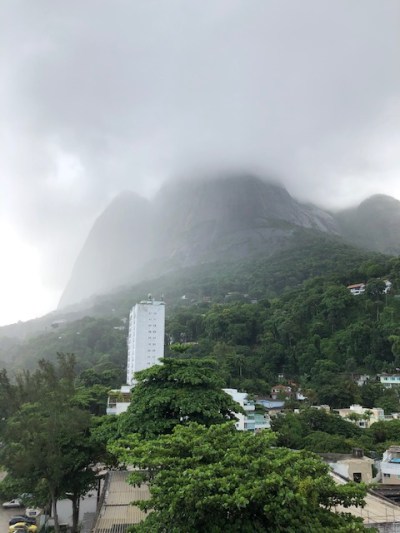
Pedra da Gavea shrouded in rain-clouds

It had been the same last year. You may recall PC 145 about the tropical storm with extreme winds and torrential rain that caused havoc across Rio last February? The City’s engineers have yet to come up with a permanent solution to the landslips that closed the Niemeyer Road from Leblon to Säo Conrado and threatened the Vidigal favela, where houses cling precariously to the steep side of the Dois Irmaes Mountain. The road remains closed and the traffic forced into the only other thoroughfare, the tunnel under the mountain.

A large wall behind Celina’s family home, knocked over by the sheer force of the rainwater, is only now being rebuilt and the road into the condominium has yet to have proper drainage pipes, so is still susceptible to heavy rainfall.

PC 173 2

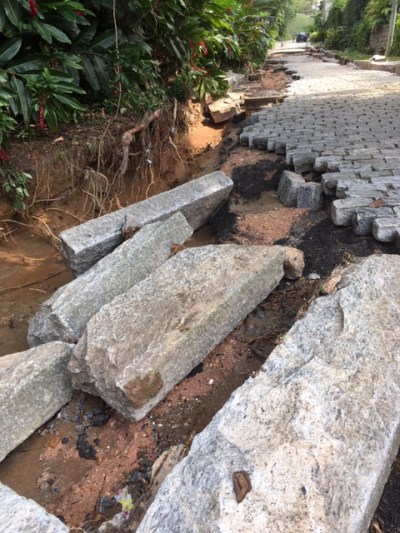
Huge granite edging stones lifted by the torrents of water

This year we were hoping for a drier time but I don’t think William Shakespeare would have written, in 2020: ‘The quality of mercy is not strain’d. It droppeth as the gentle rain from heaven upon the place beneath’ (Note 2)!! There is nothing gentle about tropical rain; it’s sometimes like water gushing from a shower head ….. but you’re not in control of the tap! While we were in Rio, Säo Paulo had an even bigger deluge and flooding occurred across the city. The local paper had diagrams showing how the incidents of heavier rainfall, in some cases twice historical levels, have increased this century.

Cleaning up Rio’s water and sewage system was supposed to be part of the 2016 Olympics legacy, but as so often happens in Brazil the allocated money disappeared, drained away one could say! Four years on and the tap water has a strange taste said to be caused by an organic compound called Geosmin. The city’s publicly-owned water company insists the water is safe to drink, but the city’s 6.7 million people beg to differ. For those who can afford it, buying bottled water is the preferred option; those too poor suffer – as always! Fortunately the tap water in Celina’s mother’s house in the Iposeria Condominium is drawn from an underground cistern filled with rainwater straight off the slopes of Pedra da Gavea and is safe! Personally I love ‘tap water’ but in the UK we seem to be wedded to buying bottled water!

PC 173 4

I am never sure why but some things you hear during the course of your existence stay with you ……. echoing down the decades ….. coming to the surface at odd moments. I never read Samuel Taylor Coleridge’s ‘The Rime of the Ancient Mariner’ but somehow the line ‘Water, water everywhere and not a drop to drink’ got ingrained in my memory. Scribbling about water ….. and it bubbled to the surface ……. and now it reminds me of that crossing of the Atlantic (PC 161) in the Services yacht Sabre. The fresh water tanks provided some 1000 litres – but for a crew of 12 for a three week trip this is only some 4 litres per person per day …. and this included that needed for cooking and teeth cleaning. A small exception was made if you wanted a splash of water in your sundown whisky! Surrounded by water and none of it drinkable!!

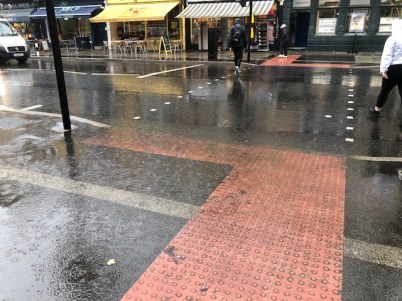
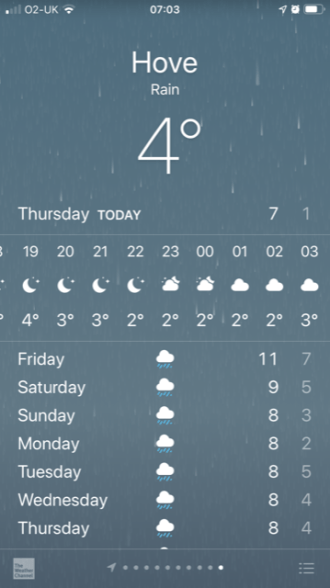
Here in Hove the council updated a pedestrian crossing with studded paving slabs to help the visual impaired and improved wheelchair access. Unfortunately the improvements weren’t well designed and when it rains the PedX (as Kiwis tend to call them!) is one big puddle.

PC 173 3

Interestingly the council blame staff shortages and having to spend the money by a certain date!! (Note 3) But remedial work is due this month – at more cost! In the course of an email exchange with the responsible department, the subject of our drainage system came up. The Victorian sewers and drains quickly reach capacity in these increasing periods of heavier rainfall. Acknowledging the out-of-this-world expense of replacing these across the country, maybe there is a need to have ‘monsoon’ type roadside culverts to cope with future downfalls?

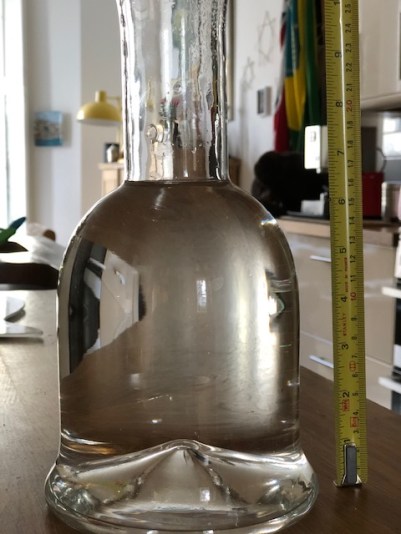
In the UK last month Storm Dennis followed Storm Ciara and deposited 158mm (6.2 inches) in 48 hours, caused by a weather bomb – for those of you who appreciate the science, the barometric pressure dropped 50mbars in 24 hours. In a rather perverse way there is a tendency to claim your dry/wet/cold/hot spell has been worse than someone else’s …….. but this is what 158mm of rain would look like ……..

PC 173 5

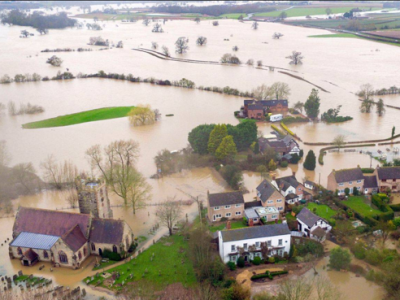
……. it’s an enormous amount and here in the UK it fell on saturated ground …… the rivers overflowed and the land flooded.

PC 173 6

This the flooded village of Severn Stoke in Worcestershire (Note 4)

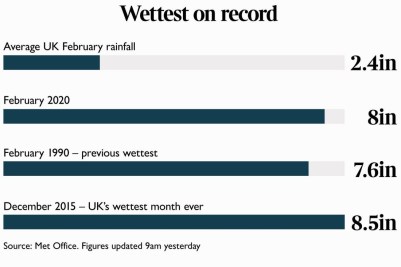
So was this February’s rainfall unusual for the UK? Well, here are the figures:

PC 173 7

And as Paul Simons, The Times’ weather expert says: “The behaviour of the Atlantic and our weather varies over the years and decades, and trying to tease out the natural fluctuations from any influence of man-made climate change is challenging. What is clear is that climate change is expected to lead to more rainfall in the UK, making flooding more likely.”

As we move into March properly I hope that February 2020 remains simply a soggy memory:

PC 173 9

Richard 5th March 2020 ( a very wet day in Hove!)

Note 1 It has continued to rain in Rio virtually every day since we left in mid February – God ignoring Barbra Streisand’s plea in her song “Don’t Rain on my (Carnival) Parade”!

Note 2 The Merchant of Venice Act IV Scene 1

Note 3 Very simplistic but …. HM Treasury money allocated to public bodies often needs to be spent within the Financial Year. If it’s not spent, the treasury believes it wasn’t needed enough and reduce the following year’s tranche. For instance, in the Armed Forces this often resulted in the unnecessary redecoration of Married Quarters – just to spend the money. There must be a better way of managing Public Finances?

Note 4 After the flood water has receded, houses need to be completely disinfected, as ‘flood water’ carries every imaginable bacteria …. and some! Poor people!

PC 172 Francisquinha*

She stares at me with her soulful eyes.

“What do you mean you’re stopping my pocket money? You’re saying I’ve overspent on your credit card at The Ivy and the tab at Mixologist is due? Well, what do you want me to do? Do the washing up?”

She turned her back on me and sulked.

My relationship with Francisquinha is complex. When she is asleep and calm, I really love her. When she is bouncing up and down at some perceived slight I wonder why I bother. And why do I bother?

The relationships we have with our fellow human beings develop over time, time when their depths rise and fall as regularly as the tide. Some give us great satisfaction and joy, others drive us to distraction. The relationship we have with our pets, our cats, dogs, canaries, tropical fish, snakes, and rabbits, particularly if you’re English, can often be better and deeper. But what about a relationship with a stuffed animal – not the one a friendly taxidermist could do for your recently-departed Chihuahua – but a real stuffed animal, made of material, kapok and in the old days buttons for eye (now replaced by cloth as too many babies took the buttons as sweets)? I guess we will all immediately think whether we had or even still have ‘something’ in which we invested emotions, characteristics and a quasi-life.

PC 172 1 Chilling Out

Francisquinha

Oh! So now you’re going to write about me? At last! Do you want me to suggest what you should say?”

“Actually I am going to write about more famous stuffed animals than you.”

Someone’s more famous than me? How come?”

I ignore her question. A couple of ‘bears’ come to mind. For me the first is Winnie-the Pooh; not that I had a physical example but loved AA Milne’s Christopher Robin’s bear that came down the stairs ….. ‘bump, bump, bump!’

PC 172 2

Milne’s genius was assisted enormously by the illustrations of EH Shepard and of course by Pooh’s friends, Piglet, Tigger, Kanga, Roo and Owl.  Pooh’s home-spun philosophy rings as true today as it did when the stories were written 94 years ago. More recently Benjamin Hoff made much of this little bear in his ‘Tao of Pooh’, using the characters to explain modern life:

“By the way, Pooh, how do you spell Tuesday?”

“Spell what?” asked Pooh.

“Tuesday. You know, Monday, Tuesday ….”

“My dear Pooh,” interjects the all-knowing Owl, “everybody knows it’s spelt with a Two.”

“Is it?” asks Pooh.

“Of course,” said Owl. “after all, it’s the second day of the week.”

“Oh! Is that the way it works?” asked Pooh.

“All right, Owl, I said. “Then what comes after Twosday?”

“Thirdsday,” said Owl.

“Owl, you’re confusing things. This is the day after Tuesday, and it’s not Thirdsday – I mean Thursday.”

“Then what is it?” asked Owl.

“Today!” squeaked Piglet.

PC 172 3

Older generations will remember Beatrix Potter’s animal creations such as Peter Rabbit – “But round the end of a cucumber frame, whom should he meet but Mr McGregor, planting out young cabbages.” – and Jemima Puddle-Duck. And you remember Paddington, who came to England from Peru in 1958, was the creation of Michael Bond and eventually became the star of two films? In fact, inevitably, these delightful characters from the written word have been mercilessly exploited by consumerism and merchandising. My parents’ bedroom mantelpiece had a large collection of Beatrix Potter china figurines – which gathered dust and required constant cleaning!

“What are you scribbling? Is it about me?”

“Not everything is about you …..”

…… and off she went mumbling about something under her whiskers ……

At the Royal Military Academy Sandhurst there was ‘The Edward Bear Club’. Edward Bear was a proper teddy bear who had become the mascot for the Parachute Course. One Easter leave I spent two weeks voluntarily throwing myself out of an aeroplane to earn my ‘Military Parachutist’ badge (Very different from the punishing P Company Course run by the Parachute Regiment for those wanting to enter their ranks and earn the parachute wings (Note 1)).

PC 172 4

Edward Bear Club tie motif

Some weeks after qualifying 70 of us parachuted onto Hankley Common near Aldershot for a ‘Teddy Bear’s Picnic’. Edward Bear had badges from the French Saint Cyr Academy and from West Point, as well as British ones; and of course he had his own parachute and was always the first out of the aeroplane!

PC 172 5 Edward Bear

In 1981 British Sunday evening television had us glued to a series called Brideshead Revisited staring Jeremy Irons and Antony Andrews. Based on the 1945 Evelyn Waugh novel of the same name, it featured a Lord Sebastian Flyte who always carried his stuffed teddy bear called Aloysius. Waugh had been at Oxford with John Betjeman who had a teddy bear he called Archibald Ormsby-Gore, and this might have been the inspiration for Aloysius.

PC 172 6 Aloysius the teddy bear

Jeremy Irons, Antony Andrews and Aloysius

Actually I am jealous of one thing that Francisquinha has and that’s her removable tummy. Wouldn’t it be wonderful if after a heavy meal you could simply open up the Velcro fastening and take out your tummy? Francisquinha’s is made of microwaveable beans; 45 seconds at full power and you have a warm-tummied cuddly rabbit!  When she’s come with us on some trip, to the Marina Bay Sands hotel in Singapore for instance, she leaves the tummy behind so she can just chill with the Room Service menu and other amenities

PC 172 7

“So what else are you writing about?”

“I bet you didn’t hear of the stuffed rabbit known, not surprisingly, as Bunny (original huh!), that was sucked out of a gun-port on a ‘Flying Legend’ World War Two bomber over Canada last year?”

“No! I didn’t see that on the Rabbit TV News programme. Tell me more …..”

The stuffed pet owner’s father had previously borrowed his daughter’s pet when with the RAF on a tour in Afghanistan so was mortified when he lost it. The power of social media ensured that when Bunny was found on the roof of a care home two weeks later, she/he/it (?) was reunited with Victoria.

PC 172 8 Canadian Bunny

“Wow! That’s so cool. Must be a very special rabbit: like me! Did I tell you someone in The Ivy asked me whether I wanted to star in a soap opera they were going to start filming, to be called The Warren? No? Oh! Well! You shouldn’t be surprised given my good looks etc. And by the way, did you ever see me doing one of those 26/2 hot yoga postures you love doing? “

PC 172 9

Francisquinha’s ‘Half Lotus’

……and so off she hopped, full of herself, looking for her passport and hoping that she could stow away in our cabin luggage for our trip to Rio de Janeiro; She has complained so often that the cargo compartment is so cold her Caipirinha freezes! And over her shoulder she couldn’t resist another jibe: “And if Boris thinks he can hibernate all winter, he can think again!

PC 172 10 Boris in hibernation

Boris hibernating

Richard 20th February 2020

Note * Francisquinha is the diminutive form of Francisca, a common Christian name in some parts of the world. Brazilians love adding ‘…..quinha’ to names!)

Note 1. Delighted to read yesterday that Captain Rosie Wild RHA has become the first woman to complete this gruelling selection course and has received her coveted maroon beret.


PC 171 Belonging to One’s Nation

You may have read of the French President’s desire to bring back conscription in France? The service, compulsory for all 16 year olds, would include a month-long placement focusing on civic culture and a voluntary three-month placement where participants would be encouraged to serve “in an area linked to defence and security”. It was an idea first suggested by Emmanuel Macron during his election campaign. He said he wanted French citizens to have “direct experience of military life”. The cynic might have linked it to France’s high youth unemployment rate (20% compared with an EU average of 14% and the UK at 11%)

Here in the UK, for the past three years politicians have been arguing about how we should leave the EU; last week we left. But for those who in their hearts feel European first and foremost, there are some interesting ways to stay one. The other day I learned that a few people have been enquiring about Austrian citizenship. The sting in that tail is if you are under 35 you would be required to do ‘national service’ which means joining the army or air force (they don’t have a navy as such, being a landlocked country!!).

PC 171 1

In the UK we have played with the idea of some form of service to the nation since National Service was abolished in 1957 ….. and the country heaved a great sigh of relief. However, this from a neighbour who was old enough to have spent two years in the Royal Air Force:

“Knowing many friends who “endured” National Service, I can think of few who regret the experience. There may have been awkward moments but you were all in it together and could mostly laugh off the occasional stupidity. More importantly it taught the importance of discipline, how to act in a team and the added advantage of making good friends in a close environment. I am still in regular contact with two fellow National Service men from different parts of the country, who I served with over 60 years ago. You also learned how to understand Scouse and Geordie! (Ed The regional dialects from Liverpool and Newcastle) Today is different  …… and it would be a strong government who could introduce such a plan, however beneficial that would be.”

For those who wish to read more about the experiences of those who undertook National Service, read Leslie Thomas’ ‘The Virgin Soldiers’ (1960)

As part of his Big Society initiative, the then Prime Minister David Cameron launched the National Citizen Service in 2011 in the UK; it was formalised in law by an act in 2017. The scheme takes place in the school holidays for 16 and 17 year olds – the focus being on outdoor team building activities. Some participants go on to get involved in a local social project. The scheme has become more popular as it’s developed. In the first year, 2012, 26,000 teenagers took part; in 2017 there were 99,000 in the programme …… but this was still only some 16% of those eligible (600,000). The target for 2020-21 was 360,000 which like all targets was probably inflated to encourage political and financial acceptance. Cameron’s idea was not compulsory and it might be argued that the sectors of society who would benefit most were the ones least likely to sign up voluntarily.

PC 171 2

Our Armed Forces had and probably still have no wish to administer any such scheme and yet for those of us who did serve the nation in a military capacity, the appreciation of how such service can mold and develop young adults is very strong. And perhaps never as strong as it is today when we look around at our feckless, unfocused, ‘I want it all and I want it now’ youth.  Of course I am very biased, as I scribble how undertaking such service gave us a sense of duty and a sense of responsibility, about how an institution took 18 year olds and made us into men (well, most of us!), creating friendships that have lasted a lifetime. Michael Caine the actor has suggested that bringing back some form of service to the nation would give young people ‘a sense of belonging rather than a sense of violence’.

Melanie Philips, writing her column in The Times last month, was reviewing Sam Mendes’ film ‘1917’. She writes: “In our era of narcissistic self-absorption, with identity politics and victim-culture putting self-interest first at the expense of others, this (film) is a timely reminder.” She goes on to suggest that it is in the military that emotional restraint and the overriding obligations of duty and service to others remain most conspicuous. Hear! Hear!

In my PC about mores and milieu (No 166) I wrote about our current very individualistic society. So is it in any sense important for all individuals to establish some connection with the country, with the ‘nation’ we live in? Shouldn’t it be part of our development to become contributing, responsible members of our society? We do accept, after all, compulsory education! Conservatives with a small ‘c’ don’t like state intervention, preferring a hand up rather than a hand out …. but this seems to contradict their inherent sense of duty to the nation state. Voluntary? Compulsory?

Some form of mandatory service need not be military. For instance, early last year the Food Farming and Countryside Commission here in the UK suggested that youngsters on gap years could work on farms and in the countryside, to give them a taste of environmental and rural matters. Or as a football-focused nation, could we not involve some of the training activities of the 44 Premier and Championship clubs, or the 140 Football League organisations?

Americorps worker CJ Sanchez helps gut a house being renovated into affordable housing by PUSH, a non-profit organization working to rebuild the West Side of Buffalo

 Refurbishment of old buildings?

Around Europe we find many countries have some form of ‘national service’. For example Switzerland has a compulsory 21 weeks of military service for those aged between 18 and 34. Sweden reintroduced conscription in 2017 and 4000 men and women will be called up from the target 13,000 people born in 1999. Both Turkey and Greece require their male 19-20 year olds to serve about 9 months, and in Israel military service is compulsory; men serve for three years, women for about two years.

This PC is really just like lobbing a pebble into a pond, fascinated and mesmerised to see the ripples such an action creates. I don’t know how it would work, some form of compulsory commitment for a month or two, voluntary for longer; but I don’t doubt the benefits this would bring.


Richard 6th February 2020


PC 170 100% Pure New Zealand

PC 170 1

A glass Kiwi by Flame Daisy, a Nelson artist

Adrift on Tasman Bay! Despite the Captain wanting the boats to stay together as far as possible, the lifeboat, cutter and the Captain’s Gig carrying the 26 passengers and 24 crew drifted independently away from The Queen Bee, stranded fast on the sand and taking on water. There were few oars, no sails and little provisions. (See PC 169)

The lifeboat carrying a Mrs Gibbs, some of her 8 children, and other passengers and crew, slipped to the east of Separation Point and south into the estuary of the Awaroa River, where it beached a day and a half later.

PC 170 2

Awaroa River entrance

PC 170 3

Today Awaroa is part of the Able Tasman National Park, an area of immense beauty and wilderness, attracting walkers and bird watchers, those wanting quiet and those wanting a chance to unwind. Abel Tasman, a Dutch explorer, had charted both North and South Island in 1642. Today his name also lives on in the Tasman Sea which separates Australia and New Zealand and in Tasmania, originally named Van Diemen’s Land.

There are no roads through the park and access is on foot or by ‘sea-shuttle’, out of Kaiteriteri. (I had a real problem pronouncing this little resort, as initially I took the first four letters …. and then had nowhere to go! As soon as I thought ‘Kai…..’ it was easy as in Kai … teri…teri. Funny life huh!) The trip up to Awaroa took some 80 minutes; we stopped to let people on and off, we detoured to look at seals and rock formations ……

PC 170 4

… and the colour of the cool water just made you feel good to be alive. We stayed in the Awaroa Lodge, tucked in the bush a few hundred metres from the beach.

PC 170 5

East of Awaroa across Tasman Bay, D’Urville Island forms the western edge of the Marlborough Sounds, an area of some 4000 km² of islands, sounds and peninsulas. The island was named after the French explorer Cesar Dumont D’Urville, who had sailed through in his corvette Astrolabe in 1827. Whilst the Captain’s gig beached on its northern tip, 35 kms down on its southern tip, the cutter carrying Eva and her two sisters ran into Te Puna Bay.

PC 170 6

Te Puna Bay

Here they stayed until the following day when they rowed up the treacherous channel between the mainland and D’Urville Island, through the narrows of French Pass, where the sea rushes through at around 8 knots in a series of violent eddies and whirlpools, and around the corner into Elmslie Bay.

PC 170 7

The Narrows of French Pass

PC 170 8

D’Urville Island and the narrows of French Pass

PC 170 9

Elmslie Bay

The first settler to put down roots on this remote headland had been an Arthur Elmslie in 1857. Twenty years later the overloaded, leaking cutter carrying twenty two survivors from the Queen Bee arrived, after a traumatic 55 hour passage, the men, women, children and one ten day old baby, often up to their waists in water and continually baling to keep the boat afloat.

PC 170 10

We walked on that pebbly beach  …….. and I imagined the sheer relief as the crunch of the keel of the cutter  carrying Eva and the others announced their deliverance. Hours later the ship Aurora, out of Nelson, anchored offshore, the survivors taken on board and eventually, after awaiting a change in the tide, the ship returned to a huge welcome in the town.

PC 170 11

The second pier (circa 1950) at Elmslie Bay replaced the 1907 one

I am in awe of nature and the landscape and out on the road to and from French Pass, I can’t not stop for another photograph, another look, another ‘soak-up-the-scenery’. Looking east from the road towards Hallam Cove and the little community of Cissy Bay, the vegetation is draped across the hills like gathered velvet, or like the facial skin folds of a Pug puppy.

PC 170 12

It’s breathtaking, it’s 100% pure New Zealand …… and around every bend there was another photo opportunity! Celina looked resigned! It’s 60 kilometres from the start of Rai Valley to this isolated community and the road took four years to build, scraped from the hillside by the bulldozer of the Blake Brothers who won contract after contract to finally complete it in 1957.

PC 170 13

The road snaking along the hills

Eva’s traumatic experience drew us to French Pass; without that we probably would never have gone (Note 1). Fifty people live here, but the nearest provisions are effectively in Nelson, 90 minutes away. We were self-catering, so we had to take everything we needed for three nights ….. but we didn’t count on having no electricity for 20 hours …… and that meant no water, as in rural communities water is pumped; for while we were there in December last year South Island suffered some torrential rain and long-lasting thunderstorms. Further south in Timaru someone recorded 250 mm of rain in 24 hours!

PC 170 14

 Thunderstorms over D’Urville Island

We had left Collingwood, right up on the north-west corner of South Island, to start our Farewell Spit Tour.

PC 170 15

The Collingwood Old Courthouse Café – a good place for lunch

We had stayed at ‘Adrift at Golden Bay’, near Takaka (another interesting pronunciation. My instinct was to accent the ‘k’s …. as in TaKaKa, but was corrected by the girl behind the bar at The Mussel Inn who said the locals pronounce it Taaaakaka.). Run by a lovely chap originally from Bolton, Lancashire, it was a wonderful oasis of calm with its own private beach.

PC 170 16

The view from our chalet across the immaculate gardens to the sea.

Then around the crescent of Tasman Bay, through Nelson, and out to French Pass, along that long dirt road. Everywhere we went we encountered friendly and curious Kiwis, interested in what we were doing. If it hadn’t been for that old yellowing front page of The Nelson Evening Mail from 11th August 1877, we might never have known about the Queen Bee and never have gone, but by God we are glad we did. One hundred percent pure New Zealand you might say?

Richard 23rd January 2020

PS Before flying home, from Nelson we flew up to Auckland for the weekend and caught up with distant relatives (the connection is the great great grandfather!!) who have become good friends.

PPS When thinking about this trip, I went to Google Maps, zoomed in on Nelson on South Island, found a travel agent (worldtravellers.co.nz) and sent them an email. If anyone knew about the local area, they would. The whole trip, including international flights and our Singapore stay, was organised by email through them. When we were on the ground, having a local contact was invaluable. Highly recommended!!

Note 1 In 2015 we drove a similar journey to Eagle in Alaska. Seventy miles down the Taylor Highway, Eagle on the Yukon River is another isolated community at the end of a long dirt road! George Nation, whom Eva had married in Dunedin in 1884, managed a gold mining operation there in 1901 (See PC 44 & 45).

PC 169 Shifting Sands and Feathers


Flying back to the UK from Wellington, New Zealand, having participated in the first gathering in Auckland of my great great grandfather Henry Nation’s descendants, I happened to glance out of the aircraft’s starboard window ……….. and saw Farewell Spit, on the northern tip of South Island. It was March 2011 and by then I understood its significance in my life, for it was there in August 1877 that a 17 year old girl, Eva Constance Fosbery who became my great grandmother, was shipwrecked and survived – for without her survival I would not be here!

PC 169 1

In the summer of last year I hatched a plot to go and stand as near as possible to where the ship was stranded and also visit where Eva and two of her sisters came ashore 3 days later. (PCs 152 & 154 refer).

PC 169 2

The Queen Bee

There are few spits of sand that grow as much as Farewell Spit. It is estimated that in the 150 years since a lighthouse was first constructed the Spit has lengthened by 5 kilometres; it’s now 32 long, from Cape Farewell at its western end to its tip. It has also widened considerably; at low water the lateral distance from north to south is over 10 kilometres! Access by the public is limited to the first 4; the Farewell Spit Tour Company runs regulated visits out to the lighthouse at low water, another 23.

PC 169 3

 Notice the little green blob South East of the light. We went beyond that!

The lighthouse’s 1870 wooden structure was built on the sand-blasted end of the Spit, with no vegetation and no shelter. The staff that managed it brought soil from nearby fields, planted trees and bushes ….. and in over one hundred years transformed the site into a little sheltered oasis.

PC 169 4

Farewell Spit Lighthouse today

The steel-lattice tower replaced the wooden structure in 1897. From an oil-burning lamp to large bulb to a small 50w tungsten halogen bulb with magnifying lenses, it’s now completely automatic and stands over four kilometres from the end of the Spit at high tide. Its ‘light characteristics’ are white with red sectors flashing once every 15 seconds. Of course during the stranding of the Queen Bee, one of the passengers was heard to ask the captain if the red light showing on the lighthouse was a warning. “It’s nothing you should worry about, Mrs Gibbs; leave the sailing of the boat to us professionals.” Talk about famous last words: an hour later the Queen Bee grounded!

PC 169 5

Looking east down the spit

Beyond this, nature holds sway …… some two kilometres past the lighthouse is a huge Australasian Gannet colony. Gannets usually nest on rocky cliff faces but here 60 breeding pairs arrived in 1982 and now the colony has some 9000 birds nesting on a shell bank; they stay for about four months.

PC 169 6

Conservation authorities limit the numbers of tourists able to visit this colony so we were lucky ……. as I could imagine …….. back in August 1877 ……… that it was somewhere just here the 726 ton Queen Bee grounded on the sand and juddered to a halt. Despite the efforts of the crew to get her off, she stuck fast and as the tide receded her predicament became far too obvious. Large waves crashed onto the deck, the strain on her timbers showed as water started leaking into her hold and by breakfast time the captain decided to abandon ship. One lifeboat came ashore at Awaroa Bay, on the western coast of Tasman Bay, a cutter beached 70 miles across Tasman Bay on the south coast of D’Urville Island three days later and the Captain’s gig ended up on the northern tip of the same island. The ship was uninsured and at auction the wreck sold for £335 and its 30 tons of cargo for £385. This ‘cargo’ included the passengers’ personal possessions, which they then had to buy back from those who had bought the wreck!!

PC 169 7

This the little green blob on the second photo, with the lighthouse barely visible to the west.

Today there is nothing to see …… but maybe, just maybe, ten feet, twenty feet under the sand where we stood lay the skeletal ribs of that great ship.

PC 169 8

It got a little soggy underfoot and I saw our guide Charles Mersmans, from the Farewell Spit Tour Company, looking at his watch, checking the tide times. Time to go! As when the land is so flat, the tide can rush in at an alarming rate.

PC 169 9

The Gannets don’t care about wrecks and such like, their sole purpose to replicate their species; every year the numbers increase and the Spit is one of those places so important on the global migration routes of seabirds. I am no ornithologist, although I can tell the difference between a white and black swan, the latter abundant here from their native Australia. And of course I know there is no difference between a shag and a cormorant but the first has rather smutty connotations, the latter a rather regal ring, so prefer the second name. But our guide Charles was hugely knowledgeable about our feathered friends. Did you know, for instance, that the red bill of the Oyster Catcher will change shape within weeks depending on what food is available?

PC 169 10

Red-billed Oyster Catchers. Apparently they stand on one leg to conserve energy.

Sand is deposited on the spit from the northerly-going current up the west coast of South Island, mainly from the shrinking Franz Josef glacier ….. so it’s grey, granite sand. And it shifts! We saw the ribs of an old coal trading ship that came ashore in the late 1800s; our guide hadn’t seen it for six months and had a story about its sinking concerning debts and insurance and such like.

PC 169 11

We climbed a sand dune and from the top saw the extent of the spit, as far as our eyes could see; and then we ran down its steep side like children. And we were lucky with the weather; normally the wind blows above 25kph, picking up the fine sand and reducing visibility. On the day of our visit you could see for miles.

PC 169 12

We saw a whale blowing on the north side of the spit, apparently unusual at this time of year. And on the south side of the Spit, in Golden Bay, pilot whales and dolphins are frequently caught by the rapid-changing tides and strand. Last year about 300 died in January and February, despite huge efforts by the local population to keep them hydrated until the tide changed. It’s a hugely upsetting occurrence. We saw seals close up ….. which they found unsettling and generally headed as quick as their flippers and tail could power them across the sand to the sea.

PC 169 13


PC 169 14

Looking East across Golden Bay

When we think of shipwrecks, we probably think of rocks and cliffs and raging pounding seas. In this case the ship grounded on a sandbar. (Note 1) …….. and that gave us an opportunity to connect geographically and emotionally with Eva. We will connect with her again in PC 170. Farewell Spit is a very special place.

PC 169 15

Richard 9th January 2020

Note 1: When sailing in shallow estuarial waters, where the underwater contours shift and change, one has to be careful! I remember many years ago being on a 32 ft yacht when it grounded on the sandy seabed off Ryde on the Isle of Wight. Fortunately there wasn’t a great deal of wind, but we had to wait until the tide started to rise again before we could sail off; God’s way of saying: “Time for tea & toast?”

PC 168 Singapore

PC 168 1

Singapore lies at the bottom of the Malaysian Peninsula, just north of Indonesia

It’s the warmth and smell of the tropics that hit you as you disembark at Singapore’s Changi Airport; that memory has stayed with me since I first came here in 1986. Sitting just north of the equator the Singaporean temperature ranges from a nigh-time low of 23°C to a high of 32°C; sometimes it rains and when it rains in the tropics, it rains, vertically …… but it’s warm rain!

After a year with Short Brothers, I took over the ‘India and the Far East’ sales patch. Singapore Airlines became my favourite and its hub was convenient to travel further into Asia. My last visit had been in 1991, staying as normal in the Marco Polo hotel on the corner of Grange and Tanglin streets.

PC 168 3

The architecturally interesting Marina Bay Sands hotel

Singapore has changed in 28 years! The Marco Polo hotel has been demolished and replaced by executive homes. Down in the business district what were ‘high rise’ are overshadowed by some stunning buildings reaching up into the clouds. We stayed in the Marina Bay Sands (MBS) hotel down on the waterfront, as it had featured in Giles Coren and Monica Galetti’s “Amazing Hotels: Life Beyond the Lobby” a BBC series covering six extraordinary hotels.

PC 168 2

The MBS infinity pool on the 57th floor

The statistics are mind-blowing: three towers joined together on top with an infinity swimming pool, fifty-seven storeys, 2560 rooms, 10,000 staff, the laundry department has 160,000 different uniforms. You don’t need to leave the ‘integrated resort’ as it’s called, as acres and acres of shops, restaurants and traditional food stalls occupy the lower levels. To the south huge trumpet-like towers herald the beginning of a future exotic garden.

PC 168 4

Singapore is a small island (50 kms east to west, 27 kms north to south; about 720 sq kms) strategically situated between the Indian Ocean, the South China Sea and the Pacific, on the trading routes from China and Japan to Europe. Its unique position was appreciated by Sir Thomas Stamford Raffles who in 1819 developed it as a trading port. In December 1941, during World War Two, Japan invaded Malaya at about the time it attacked Pearl Harbour. A few weeks later, in February 1942 it overran Singapore and some 90,000 troops became prisoners of war. It was subsequently reoccupied by British, Indian and Australian Forces following the Japanese surrender in 1945. In 1963 it gained independence from Britain as part of Malaysia and became an independent republic two years later. Its population is predominately Chinese, but Malays make up 15% and Indians 7% and there is a significant expat community amongst the 5.65 million people who live on this very crowded island.

PC 168 5

The Harding Road PS Café, one of several in the Island State

Lunch on our only full day was at the PS Cafe on Harding Road, away from the concrete and glass, in amongst colonial period buildings, tropical vegetation and monkeys. Very occasionally you hear a distant police siren and are reminded of the C21st! Alison had been a colleague at Morgan & Banks, moved to Sydney, then married and settled in Singapore. Today she and her family live across the causeway in Johore State, where she teaches at the Malaysian outpost of Marlborough College, UK. Her youngish children are almost bilingual in Mandarin and English.

After lunch we drifted (nothing happens very quickly in the tropical, humid heat!) down to the internationally famous Botanical Gardens, where fauna and flora compete. I used to jog here from the Marco Polo Hotel so knew them well, but for Celina it was a new experience.

PC 168 6

The orchids are simply stunning!

PC 168 7

After half an hour our stroll through these beautiful gardens was interrupted by a tropical storm, so we headed for the Mass Rail Transit (MRT) and back to MBS.

Mark started out as a client of mine in the UK in 2004 ……. and as often happens when you work closely with someone, we have kept in touch. So much so that in 2011 he contacted me to ‘chew the fat’ once again. He and his wife moved to Singapore in 2016, from where he covers his company’s Chinese interests. We both agreed that when you’re travelling on business, you don’t necessarily have the time to be a tourist. So, wanting to rectify this, we met in the MBS lobby and took the MRT to China Town,

PC 168 8

……… walked through stalls dripping in the torrential rain and popped into the Buddha Tooth Relic Temple and Museum. The reverential treatment of bits of hair, bone, teeth of those whose life is worshipped often suggests that the spiritual ‘body’ was a whole lot bigger than the physical one! Then back on the MRT to Raffles, the colonial hotel named after Sir Stamford Raffles and where a Singapore Sling was invented.

PC 168 9

We queued to have a drink in the Long Bar, with the obligatory peanuts’ shells scattered across the floor, and then back into the warm, damp air for a short walk to Chijmes. Situated in an old convent, the restaurant’s name cleverly echoes the historical connection, ‘Convent of the Holy Infant Jesus’ (CHIJ) and is on Victoria Street. It featured in the comedy film Crazy Rich Asians, as did the Gardens by the Bay on the seaward side of our hotel. Interesting to understand that food comes when it’s ready, and if cooked by two or more different chefs, can be more than 10 minutes apart! And so it was, Mark’s pasta dish came ten minutes after my Nasi Goreng.

Some say that Singapore is a ‘nice dictatorship’ but when you experience this clean city, where chewing gum is banned and no one dares to drop litter, where individuals show a huge respect for each other, you begin to think ‘Why not?’ Walking back to MBS through the government district, high into the night sky to our right rose the skyscrapers of the central business district, whilst ahead MBS shone like a beacon of consumerism, extravagance and bling!

PC 168 10

Singapore draws you in, it’s so unique ……..  and it calls you back!

Richard 27th December 2019

PS In our room at MBS the search for an adaptor for charging the iPhone etc was cut short by spying this nifty little socket. EVERY hotel in the world should have one!

PC 168 11


PC 167 “Where do You live, Brighton?” “Well, Hove actually.”

A well-known reply by residents of Hove, East Sussex, when asked if they live in Brighton, is “Hove actually!”, thus maintaining a distinction with their less genteel neighbour. Celina and I moved to Hove in October 2012, setting up home for the first time together and choosing it for its proximity to two Hot Yoga studios. Originally Hove was a small fishing village surrounded by farms, but it grew rapidly in the C19th and by the end of the Victorian era was granted Borough status. In 2001 it became a constituent part of the City of Brighton & Hove. (See also PC 13 posted in May 2014)

PC 167 1

Looking west from the top of the i360. Hove starts at the Peace Statute (Note 1) you can just make out at the bottom of the green swathe of grass (Hove Lawns), and continues until Shoreham Harbour in the distance

I am naturally not very inquisitive, just accepting of where I am and observing, but not initially digging into a location’s history. So it was a surprise when last year, on Hove’s promenade, a new plinth was installed, on which sat Jonathan Wright’s Constellation, based on an Orrery, a mechanical model of the solar system, except the planets have been replaced by local icons. Local icons?

PC 167 2

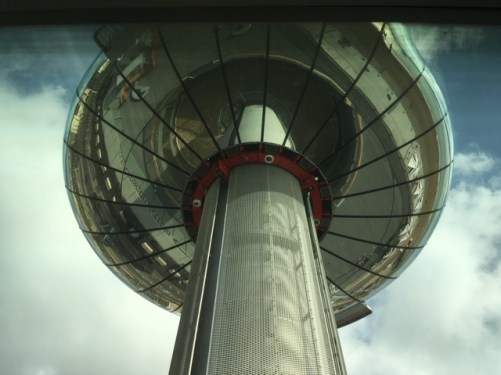
Looking East: the new plinth, with the i360 Observation tower in the background.

There are eleven. The first four are an Elm tree, a skateboarder (?), the Hove ship and West Blatchington Windmill, but of the others it is the ‘Amber Cup’ that I find most interesting ……. as we live in Amber House!!

PC 167 3

The ‘Amber Cup’ was unearthed here in Hove during landscaping in 1856 to create Palmeira Square, about a kilometre east of where I sit. An ancient 6 metre high burial mound was excavated and found to contain a coffin hewn from a tree-trunk. Dated from 1200 BC, it yielded many treasures including this cup, made of translucent red Baltic Amber and about the size of a regular tea cup. The find suggests trade links between Britain and the Baltic States over 3200 years ago??? Wow!

PC 167 4

Naturally Queen Victoria features, for every town in Britain changed dramatically during her 64 years on the throne. She was our fourth female monarch and her reign saw the establishment of the British Empire, possible the greatest global empire ever created. Our current female monarch, Elizabeth II, has of course seen that empire relinquished, replaced in part by The Commonwealth.

PC 167 5

Queen Victoria 1837-1901

PC 167 6

A seagull and beach hut

Then there’s a seagull on a beach hut, the latter lining the promenade in a colourful display. Seagulls are noisy, chatty even, and numerous; part of the fabric of a seaside existence! The seagull is also the mascot of the local football team, Brighton & Hove Albion, which was promoted into the top tier of the professional English football league system in 2018. Currently they are enjoying a relatively successful 2019 season; their home ground is the AMEX Stadium on the outskirts of Brighton.

PC 167 7

The Sussex County Cricket Club Ground is here in Hove. I am not a follower of cricket, although acted as the scorer for a prep-school team, if only to benefit from the cream teas that always accompanied a fixture!! So simply report that the club is the oldest of the eighteen first-class county cricket clubs, having been founded in 1839. They won the County Championship three times in the first decade of this century, and obviously deserve a place in this constellation.

PC 167 8

Another icon on the sculpture is the 35mm cine camera. Hove film-maker George Smith (1864-1959) bought a camera from the Brighton engineer Darling and create a special-effects short called ‘Grandma’s Reading Glass’!!

PC 167 9

The Rampion Offshore Wind Farm 

The last ‘icon’ is very modern! On the plinth the turbine is quite small, but there’s nothing small about the Rampion Wind Farm, established 8 miles offshore in The English Channel at the cost of £1.3 billion. Its 116 wind turbines, 64m high, were connected up in November 2018 and at full capacity will provide enough power for 350,000 homes. The wind farm is named after the round headed Rampion (Phyteuma Orbiculare), also known as the Pride of Sussex and is the county flower.

I became a fan of the American author Bill Bryson from the moment I picked up ‘Notes from a Small Island’, his observations of living in Britain. Some twenty years later in ‘The Road to Little Dribbling: More Notes from a Small Island’ (2015) he reflected on what had changed since he first travelled across the country. In this second book he came through Hove from Littlehampton ……. on the No 700 bus.

PC 167 10

George Everest 1790 – 1866

Among the graves in St Andrew’s Church on Church Road, Bryson came across that of Colonel Sir George Everest. Everest was largely responsible for surveying from the southernmost tip of India north to Nepal, just under 2400 kms, a task which took 35 years. He was Surveyor of India from 1830 to 1843. As he was ending this mammoth task one of the mountains in the Himalayas was confirmed as the highest in the world; it already had multiple local names and Everest’s name was put forward for an internationally agreed one. He objected that he hadn’t discovered it, had never climbed it and was not a mountaineer …… but in 1865 his name was chosen. He died in London, but is buried in Hove, possibly as his sister had lived here; the family grave also contains his pre-deceased children.

Six years ago the writer Ian McEwan published ‘Sweet Tooth’, a story of Serena Frome. She’s recruited from Cambridge into the intelligence service and tasked with establishing a relationship with a left-leaning author. “First she loves his stories, then she begins to love the man.” I was reading it on a trip to Rio de Janeiro when I suddenly came across: “Then, a few hours later, Brighton beach – strictly, Hove, which doesn’t chime romantically, despite the half-rhyme with love.” Pronounce ‘Hove’ with a long ‘o’ and ‘Love’ with a ‘u’ and I can see what he means, yet the two words share three letters. So in the sand of Barra’s beach I drew out the two words, interlocking the first two different letters. Back home in Hove I cut it out in some wood: I think the results fun huh!

PC 167 11

So that’s a suitable point to end these postcard scribbles, this intertwining with Love and Hove, this half-rhyme!

Richard 13th December 2019

Note 1. The Peace Statue, a winged female figure standing on a globe, was dedicated to Edward VII (1901 – 1910), who raised the profile of Brighton and Hove. It was erected in 1912 in recognition of the city providing a home for the Queen’s nurses and marks the old dividing line between Brighton and Hove.


PC 166 Mores and Milieu

I somehow managed to pass my English Language examination at school, but probably didn’t understand the complexities of English grammar and some of our rich language’s more unusual words in as much detail as I could have. I’m always slightly in awe of those who use long or strange-sounding words, wondering whether they are simply trying to imply some superiority or are just more intellectual than me! Such a shallow individual, huh!! The Physical Training teacher at boarding school, a Major Tim Wigmore, seemed to struggle with his vocabulary and we his pupils thought he tried to learn a new word every week. How horrible we were to take the mickey when he used a ‘new’ word in the wrong context.

But how is it possible not to know, for instance, what a zeugma is? Read PC 26 about this figure of speech. Since it was highlighted in The Times, I can now recognise a zeugma when I see one, as in: “In front of her lay a cup of coffee and another long day at work” from Jo Nesbo’s latest thriller The Knife.  Then people started asking how you could tell the difference between a zeugma and a syllepsis. Well, having not known of a zeugma for the first 60 years of my life, this was a step too far!

Two other words I have managed to live without for many many years are ‘mores’ and ‘milieu’! The first is nothing to do with Oliver Twist and his ‘more?’. ‘Mores’, pronounced ‘moreiz’, are the essential or characteristic customs and conventions of a society or community; they are more formalised versions of ‘norms’, particularly in a social context.

Milieu we borrowed from the French, where its meaning is slightly different; but it’s actually from a Latin base. Pronouncing it with slightly pursed lips, ‘mi:lja’ is a person’s social environment, the culture that the individual was educated and lives in, and the people and institutions with whom they interact. A nice way of understanding it is the ‘milieu is the surroundings that make you you’.

Rod Liddle, writing in his Sunday Times column last month, had a go at people eating smelly food on trains, to the annoyance of those around them. He went on to bemoan the lack of respect for others that is increasingly evident in our society. You remember that rock song from Freddie Mercury and Queen, “I Want it ALL, and I want it NOW!”? It came out in 1989 towards the end of Margaret Thatcher’s 11 year term as Prime Minister and seemed to capture the spirit that she had encouraged. Everything is possible (This I agree with!) and you can have it NOW (No! You have to work hard and earn it!). But the rise of our individualistic culture has been at the expense of the community spirit that we, we British, used to have in abundance. Thatcher famously said she believed there was no such thing as ‘society’, so how do you describe our very necessary interaction with others, the collective spirit that binds individuals into interest groups, giving them something other than their own ego? Liddle summed it up cutely: “The right has encouraged less reliance on others as in a social way, the left has tried to abolish blame and responsibility. And in the minds of the liberal left, we shouldn’t judge others by any ‘bourgeois’ standards as to whether or not they are behaving with dignity.”

Or you leave yourself open to accusations of class snobbery, of social mores that conflict and irritate? But surely they are some real basic standards of manners irrespective of what milieu you naturally swim in? For ‘Manners Maketh Man’ (see note). No one has a monopoly on manners, each ‘class’ demonstrating an abysmal lack of manners at times; the “I want it now …… it’s my right to have it now” sort of attitude with no thought or respect for those around them, who may disagree.

In my 40th postcard, posted in May 2015, I scribbled about habits – saying ‘Good Morning’ to strangers on your street, having the loo seat always down (when not in use, obviously!) and other issues I get excited about. Like “Thank you” notes. I wrote that my own social mores dictate you should always write a note of thanks if you have lifted a knife and fork in someone else’s home. Sometimes things get into your head and go around and around ….. until you write them down. The following was transcribed at 0245 one morning recently:

“I will not accept that the current generation don’t know how to wipe their arses and dispose of the paper. I will not accept that, just because those living in Georgian times imported sugar to Great Britain, over 200 years on everyone blames the Georgian for their own fatness, that they are so fat that they can’t even reach their arse even if they know where to put the paper. As one of the Baby Boomers who grew up with rationing and scarcity, it is no wonder that the 1960s explosion in the use of plastic was heralded as some reflection on Aldous Huxley’s Brave New World. And, no, we didn’t see its use would be so problematic to the planet; but you can’t dis-invent things and you shouldn’t blame the Baby Boomers! And I will not accept that two well-educated professional individuals, who probably swim in the same milieu as me, came to a carefully thought-through home-cooked lunch, seemingly enjoyed themselves, left through the front door ……. and disappeared like those on the Marie Celeste …… without a demonstrative thought to say ‘Thank You’ ……. in whatever form would convey appreciation. At its most basic, WhatsApp or text; maybe even a little email; even a telephone call: at best, a hand written card  …….. simply to signify that if you receive, you should say ‘Thank You’. If your life is SO busy, then don’t bother to ‘take’ in the first place!”

Sorry! In the words of one of my favourite FaceBook contributors Catherine, ‘Rant Over’!


Richard 28th November 2019

Note: Recorded by the headmaster of Eton William Horman (around 1500) “Manners are something used every day to make a good impression on others and to feel good about oneself …. Being polite and courteous means considering how others are feeling. If you practise good manners you are showing those around you you are considerate of their feelings and surroundings.”


PC 165 Growing up in Bath

I was born in Bath in October 1946 whilst my Royal Naval father worked at the local Admiralty Department, before he went off to join HMS Birmingham in a sea-going engineering role. We lived in the top flat of No 13 Marlborough Buildings; my grandparents lived around the corner, as it were, in the Royal Crescent.

PC 165 1

Outside No 13 in October 2019


PC 165 2

Outside No 15 Royal Crescent in 1951

My parents divorced in 1950 and we went to live in what would have been the old servants’ quarters under the roof of my grandparents’ house, No 15 Royal Crescent. The crescent had been built to accommodate the loads of Georgian tourists who came to sample the spa waters down in the City centre; the facades were all the same, the internal design and rear elevations completely different!! With my grandparents and their three dogs on the second floor, us in the attic, complete with goldfish on the shelf by the back stairs and my mother making bespoke hats for the ladies of the City, it was a secure existence.

PC 165 03

The back stairs to the attic flat (2019)

To the east of the Royal Crescent lies Julian Road; to the north was the home of Hermitage House a school for 5-8 year old boys and 5-14 year old girls. It was run by a Miss Bobers and sadly my only memories are of observing an eclipse of the sun and of learning one’s ‘Times’ tables by rote: ‘One four is four, two fours are eight, three fours ….. etc’. It’s a wonder I went on to do A Level Mathematics and an Engineering Degree!

PC 165 4

The home of Hermitage House school in the 1950s

My brother and cousin had attended a nursery school on The Paragon in the city, run by a ‘Captain Olsen’.

PC 165 5

How times change the way we perceive things! Looking at this group from 1951 you could make all sort of judgements, what is now acceptable and what’s not!!

Without doubt, it was a privileged upbringing, but the stigma of divorce cuts across the social class and it can’t have been easy for my mother. My step-grandfather, Thomas Tizzard (‘Uncle Tommy’ to us boys), was a well-known consultant ophthalmic surgeon who had his consulting room on the ground floor of No 15, across the hall from a room which doubled up as a dining room for family and a waiting room for patients. On the first floor was a wonderfully ornate ‘salon’, with parquet flooring, an Adam plastered ceiling and fireplace, and floor-to-ceiling mirrors. It was here that my grandmother Grace (neé Corbett, whose father had been born in Recife, Brazil) staged her quarterly concerts, raising thousands of pounds for local charities. The room was big enough for her two grand pianos and 100 guests!

PC 165 6

She was an extremely accomplished pianist, even if her constant practising of ‘The Arrival of the Queen of Sheba’ by GF Handel drove a six year old boy mad! Today their house has been incorporated into The Royal Crescent Hotel, whose main entrance is No 16. As a very generous birthday treat last month, we stayed a couple of nights; our room was in the No 15 ‘part’ and was Uncle Tommy’s old Consulting Room!

PC 165 7 Tommy's Consulting Room

Down the hill, at the bottom of Marlborough Buildings, is Victoria Park, with its obelisk in memory of the famous monarch for all to see.

PC 165 8

In the summer months of my childhood, an ice-cream van run by Giovanni, an Italian who had been interned during the war, would do a roaring trade.

I put my hand into the dirty pocket of my grey shorts and am reassured by the touch of my threepenny piece (see note 1), along with a piece of string and my penknife; enough for my favourite ice-cream! I queue. My turn!  I get the coin out of my pocket, reach up on tiptoe as high as I can and put it on the aluminium shelf. “A Vanilla block and wafer please?” He reaches into the ‘fridge, picks up a block, adds two wafers and hands it to me. “Thank you” I mutter hurriedly as I feel myself salivating.

PC 165 9

I turn away, carefully unwrap one side of the block, place one wafer on top of the ice-cream, turn it over and remove the remaining paper, replacing it with the other wafer. At last! Holding my ice-cream carefully between thumb and forefinger, I lift it to my open mouth. I smell it, inhale the dusty wafer crumbs, and take my first bite. Now I am happy.”

On Milsom Street there was a restaurant called Fortes (The site is now occupied by Waterstones!) where my grandmother often went for morning coffee. One of the waiters, a rotund dark-haired chap called Sam, always smiled when he brought the Bath Buns, an essential snack to have with a coffee. As a seven year old I wasn’t allowed to drink coffee (see note 2) but the buns were a real treat.

PC 165 10

They are made from milk-based yeast dough with crushed sugar on top. One variant included enclosing a lump of sugar in the bun, the lump retaining its shape if not its hardness; yum yum!

Discussions about which school and where were not in my compass but I felt dumped and abandoned when, in September 1955 and shortly before my mother remarried, I was placed, aged 8, in St Christopher’s School, up on North Road to the south of the city.

PC 165 11

The old St Christopher’s School, now occupied by King Edward’s

I was allowed out to go to the wedding, but my only concern was to obtain a letter excusing me from eating Macaroni Cheese (disgusting, particularly cold as you had to present an empty plate.)

PC 165 12

At my mother’s wedding, after three weeks at St Christopher’s

Any pleasant memories of my two years at St Christopher’s are completely submerged by an event that runs like a vein of shame through my life; never far from the surface, hidden under the ‘Stiff Upper Lip Caruthers’ code that prevailed, occasionally close enough to pick at. In the ground-floor loo block I was forced to masturbate an adult until they came. Who was he? I’ve blocked this! Did I report it? ‘Stiff Upper Lip Caruthers’. But I can’t get rid of the image! Disgusting!!

I left to go to another boarding school near Wells in Somerset, and then progressed to yet another boarding school; my parents remained 100 miles away, when ‘Exeats’ were twice a term for a half day, and ‘Half Term’ a mere two days. So I felt an affinity to Sandi Toksvig, Anglo-Dane and recently co-presenter on Channel 4’s The Great British Bake Off, when she says that her boarding school experience established an ache of loneliness that has never truly left her;  “proper emotional abuse of a child”.  I spent 10 years in boarding schools until, in 1965, I entered another institution, The Royal Military Academy Sandhurst, for Officer Training; I served Her Majesty for 20 years. But sometimes I wonder, ‘What if …..?”.

Grace died in 1974 aged 83, by which time my life was happening away from Bath. But it still feels like home, wandering around this warm, honey-coloured, gracious city, good memories or bad.

Richard 14th November 2019

Note 1: The Three penny piece (known as threepence, thruppence or thruppenny bit) was a twelve sided coin first minted in 1547. It was worth one 80th of a pound (ie four made a shilling and twenty shillings a pound sterling!!)

Note 2: Coffee in England in the 1950s was coloured, flavoured water, and there was nothing like the huge variety available today. It was probably produced on a Kona machine and allowed to sit, brewing (ie becoming more disgusting) as the pot sat on the hot plate. During our Alaska trip in 2015 I was reminded of the fact that today American coffee is similar to that available in 1950s Britain. When I asked for a double espresso in some café south of Fairbanks, the waitress, with her hand on the Kona handle, said “Oh! You want fancy coffee!”.

PC 164 The City of Bath

PC 164 1

Bath lies just over 110 miles to the west of London

Whether you think of the City of Bath as an ancient Roman one, a flamboyant Georgian one, or one that is finding its place in the C21st, the city has an appeal that spans the generations. There has been a settlement in what was an ancient volcanic crater in Somerset since Celtic times. The Romans built the city of Aquae Sulis in the 1st Century AD, attracted by the springs which produce a daily flow of a quarter of a million gallons of water, at 46°C. It was the health benefits of these waters that drew wealthy Georgians to the city and the need for accommodation created the expansion of some of the most glorious architecture in Britain. John Wood’s Queen Square and The Circus are by any standard fabulous, but they were trumped by his son’s designs for the Assembly Rooms and The Royal Crescent, the latter a semi-ellipse of 30 houses, built using a local oolithic limestone, characterised by its honey colour.

PC 164 2

I was lucky enough to have been born in Bath and consider it my spiritual home, home to so many memories, good and well as bad, for such is life. This postcard is about the city and a second will recount some of those memories.

Parts of Bath are unrecognisable from 50 years ago, such is the extent of the cleaning of the stonework, its public buildings relieved of the grime from coal fires and their facades provide a warm welcoming ambience.

PC 164 3 The Circus

The Circus: (My old dentist, a Mr Sharp, practised at No 13 (see PC 64))

Whilst the Royal Crescent and the Circus sit in an elevated position, walk down the hill, turn left into George Street and right into Milsom Street …….

PC 164 4 Milsom Street

……. and you’re in the beginning of the modern shopping area. Eventually you come to Bath Abbey, The Pump Rooms and the Roman Baths. Today you can actually enjoy the thermal springs in the Thermae Bath Spa and be pampered in the adjoining Gainsborough Bath Spa. The River Avon flows under nearby Great Pulteney Street, a weir slightly downstream regulating water levels.

PC 164 5 Pulteney Bridge

Pulteney Bridge over the River Avon

But it’s the Abbey that dominates here. The current building dates from 1499 although there had been places of worship on the same site from the C9th.

PC 164 6 The Abbey

I was last in the Abbey in 1958, over 60 years ago, when, as a boarding school pupil, we attended the Sunday morning service. We walked in crocodile formation a mile down the hill from the south west, dressed in grey suits, white shirts, and wearing, unimaginably, black ties in memory of Queen Victoria, who had died over 50 years before!

PC 164 7

The inside of Bath Abbey circa 1980

We had sat in the dark wooden pews and choir stalls and recited, by rote, the unchanging words of the service. On my recent trip to Bath I wanted to sit in those stalls, to relive that time, but was confronted with noise, light and space. The Abbey’s management are in the process of repairing its collapsing floor, lifting the countless slabs and the skeletal remains beneath, installing a heat-exchanging system using the natural hot spring waters, and reinstating everything. So the noise came from those working on a third of the floor, the light reflecting off much cleaner stonework and a sense of space created by the light wooden chairs that have replaced the pews. Quite a transformation!  Uplifting one might say?

PC 164 8

In 1956 there were pews here ……. And now they’ve gone!

Like all places of worship, the Abbey contains many hundreds of memorials to the good and the great; most originate from the 1700s and 1800s. In the South Transept lies the tomb of the wife of Sir William Waller. Waller fought for parliament in the English Civil War (1642-1651) and led the Parliamentarians in the nearby Battle of Lansdown. Although he retreated off the hill at the end of the battle, leaving the Royalists under Sir Ralph Hopton victorious, the latter suffered heavier losses and Waller was ‘ready to fight another day’. (Note 1)

Near the Abbey are the Roman Baths and Pump Room. I was last here in 2008 for the wedding reception of a godson. A wonderful occasion and quite a location! Just to the East of The Circus are The Assembly Rooms; completed in 1771, they were at the heart of fashionable Georgian society.

PC 164 9

The Assembly’s Tea Rooms

The noted novelist Jane Austen (1775-1817) would have met friends, attended balls and evening parties in The Assembly Rooms, for she lived in the city from 1801 until 1806, and during a visit to the grand rooms it’s easy, if you half shut your eyes, to imagine the noise, glamour and smell of that extravagant period. She set two of her novels, Northanger Abbey and Persuasion, in Bath and today you can join numerous tours focused on her fame; start at the Jane Austen Centre, just a few doors down from where she lived in Gay Street. (Note 2)

Like many cities in Britain, Bath suffered from World War Two air raids. A particularly heavy one in 1942 laid waste large sections of the city.

PC 164 10

The bomb that made this crater missed The Royal Crescent by 50ft, but hit St Andrew’s Church immediately behind it!

We are fortunate today for the publication of ‘The Sack of Bath’ by Adam Fergusson in 1973. This book highlighted how the 1960s city council had set about rebuilding the bomb-damaged city in a seemingly unplanned and haphazard way; large sections of Georgian houses were demolished and replaced by modern ‘chic’! This is an example on Julian Road. (yuk!)

PC 164 11 Julian Road

A powerful preservation organisation, the Bath Preservation Trust, came into being, and the results are evident today in some wonderfully restored buildings. And if you want to envelope yourself in how you could have lived in the 1700s, visit the renovated No 1 Royal Crescent, now a living museum.

Richard 1st November 2019

Note 1 The woman with whom my aunt Cynthia shared most of her life, Peggy Bryant, loved Jane Austen novels. But, maybe surprisingly, she admitted to me that she read Northhanger Abbey at least once, every year!!

Note 2 My first military posting was to a regiment in Devizes, Wiltshire. We were stationed in Waller Barracks. A mile down the road another military unit occupied Hopton Barracks!! The modern army shows no bias between Queen and country!