PC 183 Beirut Lebanon 1983

PC 183 1

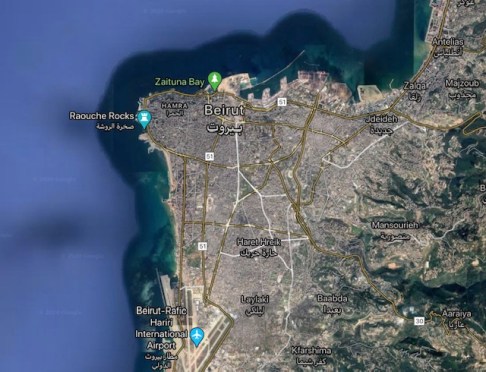
It had been a bit of a whirlwind but, as I sat in the back of the helicopter flying low over the sea towards the Lebanese capital Beirut, I had time to review what I had to do when I arrived and what had happened to get me here, at 0900 on Monday 25th April 1983. Commanding the only shoulder-launched SAM Battery in the UK, I was the obvious choice when Major David Godsell, running the armoured car squadron currently in Beirut as part of the Multinational Force in Lebanon (MNFIL), needed some advice.

pc 183 2

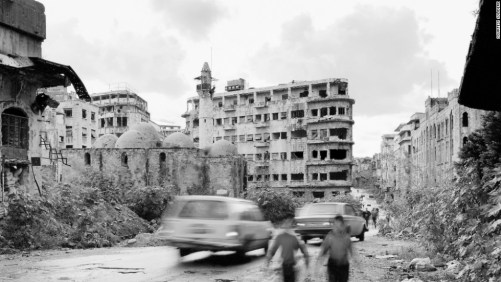
Since 1975 the Sunni Muslims and Christians who occupied the coastal cities, the Shi’a Muslims in the south and in the Beqaa Valley, and the Durze and Christians in the mountains, had been engaged in a civil war, each faction wanting to control this nation in The Levant. 120,000 people had died and the Paris of the East, as Beirut was known, was being destroyed street by street, square by square. The United Nations had authorised MNFIL to deploy as a buffer between the conflicting groups, so that peace talks might eventually start. The UK, France, Italy and the USA provided forces.

MOD Operations had called me at home in Fleet, Hampshire on Saturday just after breakfast. What did I think about deploying Blowpipe, a short range Air Defence missile system, to strengthen our forces in Lebanon? I really hadn’t appreciated what we had provided to the MNFIL but gave a considered opinion that the operational constraints would be too many to overcome. “Wait out!” was the reply. On the Sunday morning the telephone rang again. “Duty Officer MOD Operations here. There’s a C130 Hercules leaving for Cyprus at 2100 tonight from RAF Lyneham. Be on it. That will get you to Cyprus; I am working on how to get you to Beirut. Bye!”

Collecting some gear and a pistol from the Regimental Lines in Wing Barracks Bulford, I made my way to Lyneham. The cargo hold of the C130 was full of a spare jet engine and a Landrover …… and one seat ….. mine! The aircraft is noisy and vibrates quite a lot, so it was a relief to land at RAF Akrotiri in Cyprus …… in time for breakfast and a visit to the duty free shop to get some supplies for my host. Ninety minutes after landing, I walked across the apron to the waiting Puma, its rotor blades turning lazily in the morning warmth, and strapped myself in. We lifted off and headed east on the short flight.

I listen to the radio traffic as we approach the coast, am somewhat alarmed that the pilot can’t raise the French sector Air Traffic Controllers to say who he was, and more alarmed when he said “Oh! Well! I am sure it’ll be OK” to his crew. The side door is open and the GPMG Gunner alert.

PC 183 3

Beirut, reduced to rubble, still trying to function

We approach the city from the east, aiming for the Charles Helou bridge over the Beirut River. On arrival we bank to the right over the rush-hour traffic, and zigzag low along the deep-sided river banks, going south. Suddenly we lift up over the top and land on a dusty, sandy, local football pitch. The pilot gives me the thumbs up and I disembark, not at all sure where I am! As the dust subsides I spot a couple of British Army vehicles and make my way over, relieved to have made contact.

Once into the tower block that is the base for C Squadron, Queens Dragoon Guards, I meet my host and he briefs me. Operation Hyperion is part of MNFIL, whose task is to try and create the right conditions for peace talks to take place between the various fighting factions in Lebanon. “We have rules of engagement for fighting in the streets and we have contingency plans to deal with a suspected truck bomb aimed against us. What we don’t have is anything to protect us from a suicidal air attack.”

PC 183 4

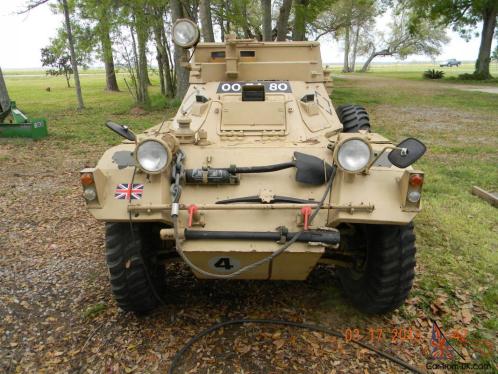
The Ferret Scout Car used by C Squadron QDG

We talked through some of the options and then I was left to do a ground recce of likely approach routes etc. Later I gave my initial thoughts to the MOD. They didn’t change and by the end of the long afternoon of discussions, we drew a line under the idea of providing a Blowpipe section on the flat roof of the block. The problems were identification and reaction time (see note).

The British Army is always good at making the most of where it finds itself and after dinner in the little Officers Mess with its table silver and hunting prints on the walls, one or two frames disconcertingly showing a bullet hole, it was up to the top of the block to watch the locals firing at each other. Occasionally a tank shell went overhead, tracer rounds lifted into the night sky, a flare hanging from a small parachute illuminated a particular street corner  …….. and I sipped my coffee, drew on my little cheroot and hugged my glass of Port.

The following morning I was taken to the airport (note 2) and boarded a C130 for Cyprus. I realised as I landed I had about two hours before the RAF VC10 left for the UK. I bummed the use of a car and drove out into the countryside, to visit my then mother-in-law’s half-brother. I knew the name of the village but not much else; a few questions and we meet for a coffee. Then a mad dash back to RAF Akrotiri; I was so late I had to run to the steps of the waiting aircraft, the doors closing as soon as I was on board.

I was home in time to read a bedtime story to two year old Jade. At work the following morning I got a funny look when people asked where I had been on the Monday and Tuesday. “Beirut.”


Richard 12th June 2020

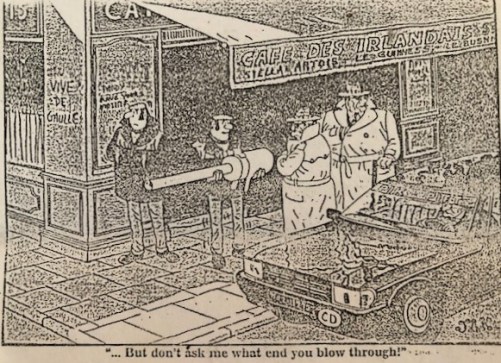
PS     In PC 182 I mentioned a Peter Brookes cartoon. I have since found an old photocopy of the cartoon; it wasn’t by Brookes but by Jak.

pc 183 6

Note 1. In every peace-keeping operation there are ‘Rules of Engagement’ defining when and how you can open fire. The difficulties of having Rules of Engagement for an ‘air’ scenario are huge, as the speed of the potential threat calls for advanced action. There was no ‘no fly’ zone in and around Beirut, so it would be impossible to distinguish a potential suicide pilot with a playboy out for a Sunday afternoon jolly ….. until it was too late!

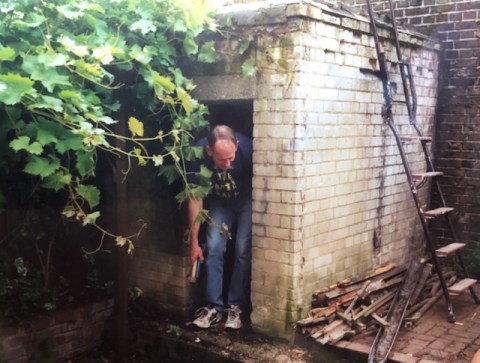
Note 2 Someone took a photograph of me with the bombed city in the background ….. and promised to send it to me. Sadly it never arrived (Oh! For an iPhone!)

PC 182 Guns and Carnations

You may recall my conversation with Ron outside the tiny hamlet of Eagle in Alaska (PC 43 written in 2015) as he filled our hire care with petrol.  “What do you do?” he had asked, having already nailed his opinions to the mast of gun ownership.

I had felt that an expression of a liberal view would not go down well: safer to be succinct and, talking to someone I guessed would be an appreciative audience, I said was an ex-military man.  “Oh! Well! So you know how to shoot!” he said, visibly relaxing; “Of course only the criminals in England can get a gun! Here, you can walk into a shop, choose a gun from any number of types, buy a box of slugs, walk out the door and  …..”  I thought, “start shooting innocent people in Charleston”, but didn’t say it aloud! (Ed. This was days after a chapel shooting in Charleston in 2015)

PC 182 1

A British Sub Machine Gun circa 1950

A recent newspaper article explored whether, when push comes to shove as far as guns as concerned, there is an innate reluctance to kill a fellow human – despite the fact that in the UK 60 and in the USA 11,000 die each year from gunshot wounds. It seems the majority of us would find it difficult. Historical examples are numerous – after the American Civil War Battle of Gettysberg, fought over two days in early July 1863, of the twenty seven thousand muskets recovered 90 per cent were found to be still loaded. Six thousand had 3 musket balls in their barrels, suggesting that the soldiers had spent the battle loading their muskets, rather than firing them. George Orwell observed that during another civil war, this one in Spain in the C20th, most combatants always tried to miss!

We can all recall photographs of international demonstrations against the involvement of people in war – and the odd flower stuck down the barrel of a rifle. In Portugal the overthrow of the dictatorship of Marcello Caetano in 1974 became known as the Carnation Revolution as carnations were the flower of choice (In Georgia it was roses, in Kyrgyzstan tulips).Browning 9mm Pistol

The British Browning 9mm pistol (standard officer weapon!)

This article got me rummaging in the grey matter as to what guns I had fired, although I immediately realised none in anger. At school I belonged to the Combined Cadet Force; it was a welcome distraction from academic studies – and we were all trained to use a Lee-Enfield .303 rifle. They were heavy and old-fashioned.

Then I enrolled for my Officer training at the Royal Military Academy Sandhurst. Here the standard rifle was the SLR (self-loading rifle), with a calibre of 7.62. At the end of the 10 mile Battle Fitness Test not only did you have to carry your buddy 100m, climb a six foot wall, jump some ditch but also fire off a magazine of 20 rounds and get a qualifying score. We did have fun firing the General Purpose Machine gun …….. but it ate ammunition at an alarming rate and someone had to carry it!

PC 182 3

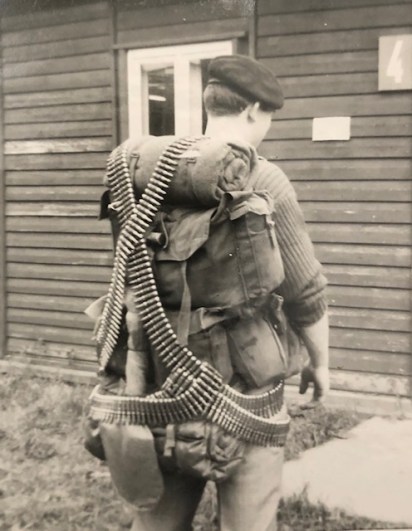
Before embarking on a three day exercise in Belgium as an officer cadet, we had to carry a lot!

At the Royal Military College of Science we studied other nations’ firearms – the Russian Kalashnikov AK47 and Israeli Uzi for example.

pc 182 4

The 25 Pounder we used during Young Officer training at the Royal School of Artillery

Then I joined the Royal Regiment of Artillery and was introduced to proper guns. My choice of arm meant I was teased by my Uncle Bill, who had had a career in The Somerset Light Infantry. As a young lieutenant during the invasion of Normandy in 1944, his battalion had suffered many casualties in the battle for the French city of Caen – often as a result of our own artillery fire falling short of its target – hence the rather snide moniker for the Royal Artillery of ‘drop shorts’! When I finished my training I joined a regiment in Devizes; in the Officers’ Mess was a cartoon of an elegantly uniformed artilleryman surveying the battlefield, with the infantry engaged in muddy hand-to-hand combat. The caption read: “Artillery brings a degree of dignity to what would otherwise be a vulgar infantry brawl.” I thought of my Uncle Bill.

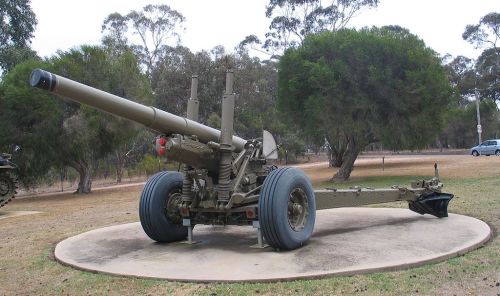
This regiment was equipped with towed field guns of 5.5 inch calibre. They had been used in the Second World War and were large and unwieldy but were, for their time, accurate. We didn’t wear any ear protection in those days and if you were too close to a gun when it fired, you couldn’t hear anything for hours. This of course gave rise to another infliction – ‘gunner ear’!!

PC 182 5

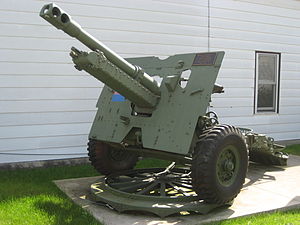
The classic 5.5 inch Howitzer

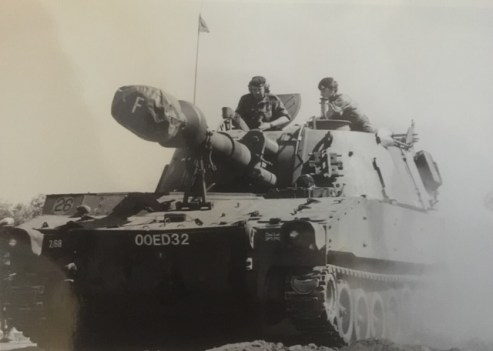
The regiment moved to Germany and was equipped with another medium gun, the M109

PC 182 6

The M109, a self-propelled 155mm gun

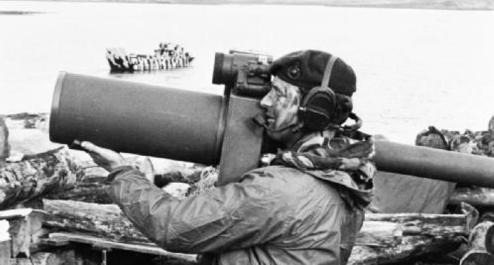
Having served all my regimental time with ‘field’ artillery ie surface-to-surface, it was obvious to those who ran the officer posting system (AG6) that I should command an Air Defence Battery!! Lloyd’s Company was equipped with a ‘command-to-line-of-sight’ SAM system called Blowpipe that was fired from the operator’s shoulder; it had a range of about 3 kilometres. It was to the credit of the training of the soldiers that two Argentinian aircraft were destroyed during the Falklands War when the Battery was deployed in support of The Parachute Regiment.*

PC 182 7

Blowpipe Operator at San Carlos Bay, Falklands 1982

Fourteen of my soldiers were on a rotational six-month deployment to Belize in Central America. During my time in command I had to visit them …… and we conducted a practice live firing from a deserted caye tens of kilometres off the coast. Just us, the sound of the sea, pristine clear warm tropical waters; such hard work!

By the time I joined the sales force of Short Brothers, Blowpipe had been replaced by Javelin. The first name often made me think of natives in Amazonian jungles looking for their next meal. As a missile manufacturer based in Belfast, there were often unsavoury characters sniffing around, anxious to get their hands on one. Peter Brookes in The Times had a wonderful cartoon of two IRA thugs on the streets of Paris, negotiating to buy one, with the caption: “Seamus. Which end do you blow through?”

Apparently in the USA today liberal as opposed to republican Americans have been buying guns like they might go out of fashion. Their desire for gun ownership is driven by the effect the Coronavirus pandemic is having on society and a negative perception of what might happen; for this to make news in The Times last week suggests it’s serious! Three days later an African-American George Floyd is killed by a policeman in Minneapolis and it seems the difference between peaceful and violent demonstrations is a hair’s width touch on a trigger finger. One of the justifications of gun ownership in the USA is the fear of federal intervention in state affairs. Now, what is the President proposing? Using the 1807 Insurrection Act as his authority to deploy the US Army into State’s affairs.

Richard 4th June 2020

Note * I took over command during the conflict, did not deploy to the South Atlantic, but took part in the intensive debriefs of the operators.

PC 181 What Vague Idea? A Plan?


In an ideal world everyone would have food, water and housing and the state would provide  health care and education systems that ensured your life expectancy was as good as your lifestyle and genes allowed. Oh! And there would be no conflict between people, and peoples, and everyone would live in harmony with one another. Yeah! Right! Sadly the ideal is submerged by the rising tide of individual and state egos and we stumble on in a very imperfect world.

For those of you who don’t plan, letting life dictate what you do, take heart from Professor Lord May of Oxford, who died recently aged 83. “I began as an undergraduate engineer,” he said, “became a professor of physics, was transmogrified to an ecologist then got interested in infectious diseases as an epidemiologist. None of this was planned; it just happened.”

In the UK there has been much criticism of the Public Health England’s lack of contingency planning for the current pandemic. In that ideal world there would be warehouses up and down the country stacked to the rafters with all sorts of gear that multiple government departments might need in case of an emergency; every year it would be checked, the ‘use by’ dates ensuring a turnover and further purchase to top up stocks. If you live in the UK you may recall a really cold snap many winters ago – snow blanketed the country and it ground to a halt? People moaned that we didn’t have enough snowploughs to cope, adding flattering comments about Canada or Switzerland. But they would be the first people to criticise HMG if they found that the cost of buying, storing and maintaining snowploughs in the once-in-a-decade likelihood of their use could fund three secondary schools. In an ideal world …….

PC 181 1

The Civil Service has Contingency Plans for a whole myriad of scenarios, some more likely to happen than others. We now know there is one for a pandemic but that it wasn’t properly funded as other Government priorities demanded current attention. There will definitely be some for the funeral arrangements needed when the monarch dies. One that didn’t work well was for the coronation of Edward VII in 1902. Edward was the eldest son of Queen Victoria and ascended the throne on January 22, 1901 upon Victoria’s death.

Born in 1841 he had had to wait a long time to succeed to the throne, being 61 at the time of the coronation (Note 1); he had married Princess Alexandra of Denmark in 1863 who bore him three sons and three daughters. The coronation was originally scheduled for 26th June 1902, but a few days before it was due to take place Edward had to undergo an emergency appendectomy, so it was postponed for six weeks until 9th August 1902. Imagine the chaos of all the international guests assembled in London having to stay somewhere for longer than planned! Bet there wasn’t any contingency planning for that! No ‘What If …..?’!

PC 181 2

These scribbles are another example of how things in life evolve without any planning. Those of you who have been reading since the beginning look away now; briefly, on my second trip to Brazil in 2013 I got bored queuing for postage stamps in a Rio de Janeiro post office so sent my news electronically. Those addressees multiplied and when I returned home the ‘comments and thoughts’ email became a regular once-a-fortnight post on WordPress. This is now my 181st!

Some decades ago there was a potato shortage in Belgium caused by blight, and apparently Britain imported lots of Belgium potatoes to satisfy our demand for ‘fish ‘n’ chip’. For the sake of clarity as it doesn’t really matter, the price of potatoes in the UK went up from £50 per ton to £100 per ton. Charles Handy, a management guru whose books I devoured as much as Cadbury’s Whole Nut chocolate bars, met a chum, let’s call him Andrew, in a pub and in the course of conversation the potato shortage came up. He and Andrew simply moaned about the lack of chips!

Years later they saw each other again and Charles recalled the potato story. His friend said: “Well, you know what? I had a contact in India and was able to source 100,000 tons of potatoes at £55 per ton. Arranged transport and …….”.  By this time Charles is not listening as his brain is whirring: £45 per ton cheaper, 100 thousand tons, that’s £4.5 million profit minus transportation and distribution costs. Now, why is it some people are always able to find the upside of a crisis and exploit it? Why didn’t I think of it? He tuned back in as Andrew was saying “…… but there were problems in getting an export licence and the whole opportunity was lost. Another pint?”

I spent a year enduring the Army Staff College course at Camberley in Surrey. I came away with some good memories and some not-so-good, but it was drummed into us that “proper planning and preparation prevents piss poor performance”! I had already learned that it’s actually training and rehearsals that prevent fuck-ups.

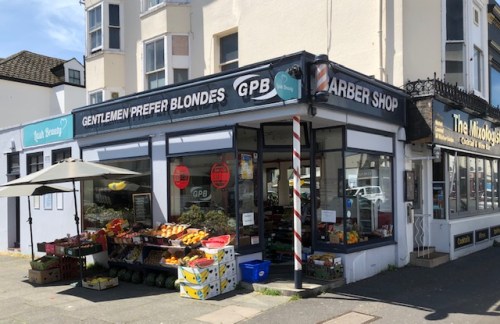
No matter how you look at it, every crisis provides an opportunity for someone. At the north end of our street, Albany Villas, there is/was a traditional barbers shop: “Gentlemen Prefer Blondes” – whether you agree with the sentiment or not, you will probably agree it’s a lovely name for a place that cuts men’s hair? The owners had been wanting to sell the business for months but resisted the local Iranian cartel who planned to turn it into another restaurant (we already have a number within 100m!). Then came the lockdown and the doors closed, the scissors and electric razors silenced. Incidentally I had not been a customer of theirs, preferring the attentions of Monika and Sebastian at Aguavida a few blocks away.

PC 181 3

It remained that way until three weeks ago, when an enterprising Turk and his teenage son filled it with fresh vegetables and fruit, put up awnings outside to protect the produce from the unseasonally warm sun, and opened for business. Just a family wanting to make the most of these funny times; no planning, just thinking outside of the box ……… just happening.


Richard 21st May 2020

Note 1 There are parallels today as the current heir to the throne is 70!


PC 180 Individual Fear

To bring an old metaphorical story up to date ……..

Sitting around the bar-café table was part of their morning routine, these retired chaps who simply wanted to chew the fat, gossip and share their thoughts and news. Most days they played cards, having ordered their own personal coffee preferences, espresso, Americano, Latte, Cappuccino or indeed on a weekend a little glass of beer. They sit in the shade, smiling at the world around them.

PC 180 1

One morning Jim was being unusually quiet.

“What’s wrong Jim?” asks George, a retired plumber, “you look very troubled.”

Indeed Jim, looking as though he had the weight of the world on his shoulders, announces that he had had a really strange dream, actually a bit of a nightmare; that gets their attention:

“Somewhere outside of the city I came across, how would I describe it? ……. I don’t know, a sense, something I couldn’t touch, couldn’t see but I felt an emotion that whispered through the trees like a spirit; it felt evil and strange but there was no sense of smell. The earth shook …… trembled …. as if someone or something was stomping around. As I watched I saw people being embraced by this invisible vapour and running home. Everything was very black and white.

“How come it didn’t get you Jim?” asks Andres with a slight smirk on his face.

“I guess it didn’t like the smoke of my old pipe tobacco and kept away!!”

“Sensible spirit” says Andres, laughing at the same time as waving Jim’s smoke from his face. The conversation then relapses into the normal exchange of stories, reminiscences and how one of them had missed that hole-in-one on the golf course.

PC 180 2

But as the day passes the wind increases in strength, the forecasters warn of torrential rain and the town council announces that everyone should go home …… and stay there. Schools close early, restaurants shut. A horrendous storm broke over the town, trees were blown over and roads blocked; an elderly woman suffered a heart attack. The barman at the café had overheard Jim talking about his nightmare and mentioned it to the baker who delivered the loaves for the lunchtime sandwiches. He repeated it back at the bakery and very soon rumour control took it, enlarged it and it became a stated fact, that out in the fields there was something very evil. Jim’s family had worked the land for generations, knew all about the local folklore, and this only added to the credibility of the story. Fear took over and no one applied the ‘common sense’ filter. What he had seen in his dream somewhere beyond the bounds of the city was now a real terrifying spirit, a bogey man, a ghostly spectre.

There was a sort of self- imposed lockdown. Those who could packed their storerooms with quantities of stuff they thought they might need; those who couldn’t relied on friends and neighbours to buy basics for them.

A week later the gentlemen met to play Knock-out Whist. Their faces showed the strain of living with their wives for a whole week, as they had obeyed the general diktat and not gone out – except for essential supplies and exercise – and a game of cards was exercise for arthritic fingers! As they were moaning about how some things were no longer available in the shops, Angelo sidles up to the table.

“Psst! Want some flour?” asks Angelo, always wanting to make a fast buck.

“Piss off Angelo!” says George

“No flour? How about some loo paper, I can sell it to you for a big discount.”

Shortages had indeed begun to appear; loo paper had become a real sought-after item despite the population not developing any additional arsehole …..

“…….. although there are many arseholes by way of behaviour in the council!” jokes George. The old boys around the café table thought the politicians nincompoops who thought themselves quite intellectual but lacked an ounce of common sense. All they seemed to do was talk and mumble and give eloquent speeches which when analysed amounted to nothing of substance and the people suffered.

“Half of them don’t know their arseholes from their elbows” laughs Jim. “Did you see on the news that leader, the one with the blonde bouffant hair, wiping his elbow with loo paper?”

They all creased up at the absurdity ……. “You couldn’t make it up!” cries Matthew.

What people read about on the various social media platforms formed opinion; no one was sure whether the stories were true or fake or simply the origin of some mindless troll sitting in his back bedroom with a completely distorted view of his fellow human beings. They learned that other cities were suffering in the same inexplicable way and were arguing amongst themselves what to do, as well as looking for someone to blame, because there’s always someone to blame.

PC 180 3

After two months, during which the winds outside the city lashed the fields and brought down woods as if by some unseen giant hand, the population got restless. The unseen, invisible bogeyman that was causing so much havoc began to take on huge proportions and fear began to run through people’s minds ….. re-inforced by those who always saw the negatives.

One morning Jim suggested he go and see what was really out there ……. if anything! Andres, George and Matthew thought this was a grand idea although conspicuously not volunteering to accompany him!

So Jim started on the road out of the city, wrapped up against the driving rain and whipping wind, towards the forests; some townspeople criticised him for exercising too far from the town, but he was deaf to their pleas. But as he left the sanctuary of the city he immediately realised the wind was easing; 30 minutes later nearing the large five-barred gate into an area of broken tree-stumps the wind was barely rustling the bushes; a few steps further and it was so soft as to be a vague hint of down on his cheek. He bent down to pick up a single blade of grass and looking at it, noticed an extremely small man clinging to the stem.

“What’s your name?” asked Jim.

“Fear” mumbled the little figure, still in the palm of his hand.

‘Well, I don’t need you’, thinks Jim as he squeezes the stem between his thumb and forefinger, like snuffing out the flame of the candle.  He wondered why it had been so violent only moments before and then realised he had simply confronted his fear and that of his fellow citizens

“The end of Lockdown Phase One” cry the citizens as Jim returns.


Richard 14th May 2020

PS Back in the 1970s in Germany one year there was a fearful storm that swept through north of Hamburg. I was on an artillery live firing exercise on the ranges of Bergen-Hohne. The exercise was halted as the wind speeds increased to hurricane-force gusts. Driving back to our training base later it did look as though a giant’s fingers had simple swept forward and back through the pine forests, most of which now lay flat and broken.

PPS You will remember that line from “When Shepherds Watched Their Flocks” …… “Fear Not, for mighty dread had seized their troubled minds.”

PC 179 Just The Ticket

Funny how something so innocent as an old railway ticket can start my mind running; I wonder whether you have the same reaction when you see this, posted on Facebook last week?

PC 179 1

The basic details are evident: a used second-class ticket for a child, for a one-way journey from Hassocks to London (SR) (Ed: Southern Region), valid for three days from 2nd November 1972 in exchange for £0.49. It even has a number, 0348, although the relevance of this is not obvious. A stiff piece of card unlike today’s rather flimsy paper ticket.

Then the enquiring bit of my little brain takes over. Was this a train pulled by a steam engine? When did decimalisation in the UK take place; surely it was about this time? Who was the child and where was he or she going on this single journey? Were they accompanied or were they old enough to travel on their own? What was going to happen when they arrived in London? And maybe more importantly why had they kept this particular ticket and where had it lain for over forty years, as it’s remarkably clean? Indeed why do any of us keep stuff like this?

If my memory serves me well, the owner of the ticket, let’s call him Freddie Chumboy, attended a boarding school in the village of Hurstpierpoint a few miles from Hassocks. They were aged 13 at the time of this single journey and I think it was probably too late to be half-term, so why were they travelling to London? The validity of the ticket is three days and the second of November in 1972 was a Thursday, so possibly they travelled on the Friday or Saturday – or was he doing a runner, filled with a mixture of excitement and anxiousness, walking the mile or so from College to the Hassocks Railway Station, making his way to home in the London suburbs to plead not to be forced to board, hoping of course for a sympathetic ear? You may recall my own experiences of boarding school so I would certainly be on his side!

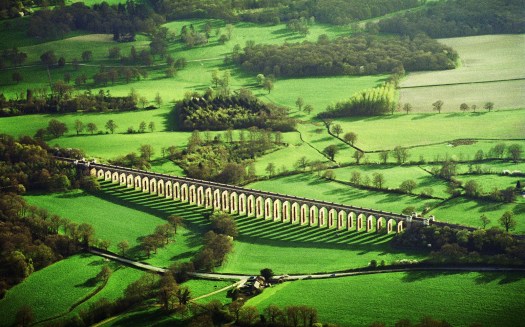
Hassocks has a railway station which is two stops north of Brighton. London-bound, you would travel through Burgess Hill, Wivelsfield Green and Haywards Heath before crossing the glorious Victorian construction of the Balcombe Viaduct.

PC 179 2

At the bottom of this photograph the road crossed the River Ouse on a little hump-back bridge. As a child I sat in the back of the bus and was lifted off the bench as the bus went over; simple pleasures huh!

In PC 58 ‘Going Home’ I recalled my 2015 visit to the house that my parents bought in Balcombe, 18 miles north of here, in 1956. My stepfather commuted to London Victoria from Balcombe railway station, tipping his hat to Mr Smart the Station Master; his office was in Tothill Street in Westminster. The trains were pulled by steam-powered locomotives up until 1967; the carriages had long corridors and compartments for 8 people, outward-opening doors and windows you could open by pulling up a leather strap and fastening the strap on some brass studs to ‘lock’ it open. As any child would have done, we loved putting our heads out of the window, careful not to get covered in soot or having one’s head taken off by a track-side signal pole! And the smell of burning coal ….. and steam ….. and soot ….. and oil …. remains seared into my memory.

But when he took this journey, Freddie’s train would have had a diesel-powered locomotive. I can imagine him delighting in his new-found freedom, even if he had to wear his shorts and school cap. He may remember the Ticket Inspector snipping the right-hand side, probably with some comment and smile:

“Why Thank You Sir! Enjoy your journey.”

North of Balcombe the railway line went through a long tunnel, a favourite spot for those wishing to end their lives, according to our local doctor, a Doctor Haire. Whenever he attended a drinks or supper party at our house he would tell some hideous stories of when he had had to help the rescue services in recovering the body. The whole London – Brighton railway line featured in a speeded-up film, taking one minute to travel the 58 miles.

PC 179 3

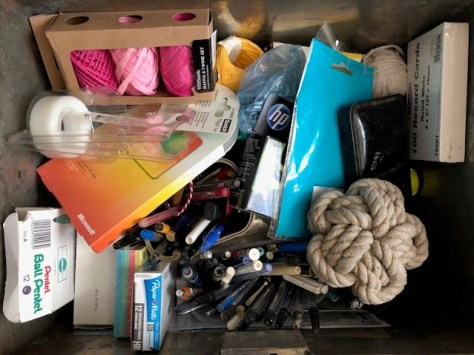
A box of treasures

But where has the ticket been? If you read PC 70 from May 2016 entitled ‘My man-drawer’, you will know that I have to have somewhere for those you-never-know-when-I-might-need-it items, but this is different. This is a memento, a treasured piece of cardboard which to their touch would immediately flood their mind with emotions, good or bad. I first meet Freddie on Wandsworth Common in London in 2002 where, in the early morning mist, we would walk our respective Labradors, my Tom and his Sam, Tia and Aero. So I wasn’t surprised to see he had found this old ticket, as I know him to be a hoarder extraordinaire. What I don’t know is whether there are boxes of other used tickets etc hidden somewhere. Incidentally on the reverse side would have been the Terms & Conditions of Carriage.

Much to Celina’s dismay ….. no, that’s the wrong word ….. resignation …… I have little cardboard boxes/folders/tins/plastic boxes full of stuff. The oldest stuff in the bottom, more recent treasures or mementos or ‘that might come in useful’ towards the top. You might detect that I have kept all my old passports and wallets? Why? Search me …… nostalgia I guess.

PC 179 4

Before 15th February 1971 Britain’s currency was based on the Roman system (Librum, solidus and denarius equated to LSD – pounds shillings and pence) There were 12 pence to a shilling and 20 shillings to a pound. To confuse Johnny Foreigner we also had a florin (two shillings), a Half Crown (two shillings and sixpence), a Crown (five shillings) and a Guinea (One pound and one shilling) (Note 1.) So Freddie’s ticket cost 49 pence, almost ten shillings in ‘old money’.

Opening a box of one’s mementos is like starting an archaeological dig through the strata of one’s life. Down in the ‘Teenage Era’ Freddie unearthed an old railway ticket from 48 years ago – ‘Just the ticket!’ you might say.


Richard 7th May 2020

PS     Do you have something that could make the subject of some future scribbles? Let me know ……

Note 1 When a thoroughbred race horse is sold in the UK the price is determined in Guineas; the original gold for the gold coin came from Guinea in West Africa. Some of the more famous UK horseraces retain the connection – for example the ‘1000 Guineas’ and the ‘2000 Guineas’.

Note 2 Podcasts for some 30 PCs are now available on http://www.podbean.com

PC 178 Smarties

If you have every worked for a public sector organisation you may be sympathetic to some of the news stories that abound at the moment? If you have worked for a private sector company you may read some of them with profound disbelief.

After attending Staff College I was posted to be GSO2 (W) (SHORTAS & UGS) (Note 1) in the GW(E) Directorate of the MOD (PE) based in Fleetbank House, just of Fleet Street in London. You see; bored already! I will not try to explain the intricacies of the Ministry of Defence’s buying department (PE – short for ‘Procurement Executive’, an unfortunate choice that word: ‘procurement’!) , save to say they have been reformed, reorganised, criticised and left alone to fester, and still they remain an immoveable monster which has eaten many a capable senior civil or military servant.

One of the features of the current ‘normal’ is that apparently we dream more than during the old ‘normal’. Last night I had a real nightmare and it was so vivid I scribbled it down. Does it make sense? I will let you be the judge of that.

“Down in the bowels of a NHS (Nutritional Happiness Supply) government building, rarely seeing the daylight, I sit with Jon and Marion, awaiting the other committee members. We are responsible for the supply of Smarties, a national favourite and one without which the country would simply grind to a halt. I’ve called a crisis meeting; people from all over the country have come, as their department is always invited, whether they have anything sensible to contribute or not. Three people could have made the decisions necessary but twelve will guarantee no decisions today.

PC 178 1

I call the meeting to order and put up an agenda as my first PowerPoint slide:

“The Menu for lunch.”

Good morning! First I can confirm lunch is fixed in Room 201 for 1230; coffee and biscuits on the table as normal. (Note 2) We have a crisis of supply …. so, George, why don’t you summarise where we are?”

George, the Midland Hub Warehouse Manager (NHS), looks sheepish, unused to the spotlight.

You may have read the minutes of a meeting thirteen years ago when it was decided to find a cheaper supplier and that that supplier is overseas.”

Many heads nod and recall that decision, taken after a great deal of heated debate, to place the contract in Germany. (Some people have been in their posts for years!)

Well,” continues George, “the world has fallen in love with Smarties and there is projected to be, in Quarter 2, a shortage. The price is expected to go through the roof and we will not have the budget to pay for them.”

“But there must be someone here in Britain who could produce them?” asks Alice who’s new and innocent to government by committee.

Well! There used to be quite a manufacturing base in the country but we have been seduced by cheapest is best, never mind the quality, crowing about how much money we have saved as we went to you-know-where, so now there’s no one who can produce Smarties here in the UK. I have photocopied off the General Smarties Specification (GSS) so please grab one and have a look.”
Antony interrupts: “Surely that place up in Yorkshire could be restarted?”

The meeting has a period of general discussion; I allow everyone to have their say.

“Can we work through lunch?” asks Alice.

Tut Tut” says Godfrey who’s travelled in from Reading and wants his lunch, the highlight of his month. He also seems to have a cough!

PC 178 2

We reconvene after lunch. Meanwhile the GSS has been emailed to a number of companies the committee thought might have been able to manufacture Smarties in the UK. Jon adds that he’s had two entrepreneurs he has never heard of ask for a copy. Antony says rather disdainfully they will have to do due diligence on these people: “We can’t let a government contract to anyone.”

“Surely that takes months?” asks Alice.

“Ah! Yes! But we could have a shortened ‘crisis’ version – I’ve been reliably informed it could be done in 5 weeks.”

“Would it help if the GSS had an option for alternatives in terms of size, or shape or packaging for instance?” asks Alice.

What? Like 50% smaller? Or less sugar? Or a softer coating? Or in a square box as opposed to a hexagonal tube? Or a bigger tube?” queries Jon

Brian, who’s been very quiet as he’s nearing retirement after a career spanning forty years and doesn’t want to do anything that might jeopardise his pension, complains. I glance at him across the windowless room; Brian is one of those ‘beige’ men, always dressed in shades of beige and often looking as though he needs a good bath, with his clothes heading for the washing machine. Brian always complains. “If the Smarties come in anything other than a tube then I will not be able to play the game of seeing how far the plastic end of the tube will travel.”

Everyone looks at him; they know that the cylindrical cardboard tube was discontinued in 2005.

“But Brian,” says Jon, “they have been available in all sorts of little boxes and bags and large tubes for some time!! Where have you been?”

I say I know a company who make something similar, a little chocolate button called M&Ms or maybe they’re called N&Ns ……. but they’re not Smarties.

“No, but they could make Smarties for us surely, for this is a national crisis.” Says Alice

“What? Ask a competitor to make a Smartie?” sneers Antony.

“Should we respond to the entrepreneurs quickly ….. simply to say give us your suggestion and we will get back to you in a few days? Bring them in to a GSS meeting with all interested parties.”

“How many tubes of Smarties do we need?” asks Marion, always focused on the important facts.

“Well the nation gets through 18 million tubes a day …… each tube currently sells for costs £0.60 (for 32 Smarties at 38 grams each) and we’ll need enough to last until September at least.”

Committee members reach for their calculators and crunch some numbers …… and there’s a clamour …… everyone starts shouting at once ……. even Brian seems to be more animated than normal …….. Godfrey coughs loudly.


PC 178 3

There’s another sound in my ear; the alarm is ringing. I wake up in a sweat. Thursday morning and still in ‘lockdown’ …… another sort of nightmare!


Richard 30th April 2020

Note 1. For those unfamiliar with service abbreviations GSO (2) W- (SHORTAS & UGS) stands for General Staff Officer (grade 2) Weapons (ie technical!) Short Range Target Acquisition Systems & Unattended Ground Sensors. As if you ever wanted to know!

Note 2 Important issues always addressed first!

Note 3. In our real world, the news reported that some Dutch trader had a warehouse full of personal protection equipment and was offering it at a big mark-up – masks normally £0.15 for £3 or aprons normally £0.02 for £0.30.

PC 177 Numbers (2) 484065


Was mathematics created or simply there to be discovered? Discuss …… or not! A natural number 1, 2, 3 and so forth is represented by a symbol called a numeral; for example ‘5’ is a numeral representing the number five. A zero, ‘0’, was included at some point. When I was commissioned my officer cadet number 24067711 (See PC 176) was discarded and I was given my officer number, 484065.

PC 177 1

Whenever I idly think someone’s late I remember, for whatever reason (?), “Come in No 35, you’re time is up!” spoken over a loudspeaker to someone who had hired a dinghy for 30 minutes or so and needed to be encouraged to come back to the jetty.

In June 1968 the sailor Robin Knox-Johnston left Falmouth to take part in the Sunday Times non-stop, single-handed, Golden Globe Race, sailing his 32ft yacht Suhaili on to victory. He reached his home port 51 years ago yesterday, on the 22nd April 1969. At some point during the race his on-board generator, essential for powering the limited electronics in those days, failed. Robin determined that the spark plug gap was not right but didn’t have any feeler gauges. (note 1)

PC 177 2

Here is a clear case where necessity really was the mother of invention. Long hours of thought produced a light bulb moment (cf Thomas Edison and the electric light bulb – 1000 ways of not working!). Robin took a book and measured its depth; let’s say it was half an inch (these were pre-metric UK days!). Then he counted the pages and found the book contained 100; so each single page was 5 thousandths of an inch ……. and he needed a gap of 0.025 thou. He counted out 5 pages and that thickness was the gap needed for the electricity to jump the gap, to spark, and so ignite the fuel vapour and bring the generator to life. So clever! (Note 2)

The current credit-card sized UK Driving Licence has been around for a few decades but when it was first introduced there was some sensitivity about whether it should show the bearer’s age. The Driving Licence number is in the following format: one’s name followed by a sequence of numbers and letters. It didn’t take long to realise it shows your date of birth, albeit in a convoluted way. For example …..CAMERON610096DWD58CP …. is for a David Cameron whose birthday is 9th October 1966 …. and the last sequence is random (I think!!)

PC 177 3

Some numbers have become simply part of our day-to-day language. We know that 7-11 means the shop is open from 7am to 11pm and that ‘24/7’means the enterprise is open all-day, every day. Sadly 9/11 had also become imbedded in our memory, just as in the UK 11 o’clock on the 11th day of the 11th month (November) 1918 marks the end of the First World War.

When you travel you travel with numbers!! Holding your passport B265371 and your Boarding Pass, with its e-ticket 349623492634 for flight BA 249 departing from Gate 56 at 1120, you board looking for your seat number!

PC 177 4


Numbers featured highly in my Royal Artillery days. Not only did we serve in regiments with differing numbers (for me in 27 Medium Regiment, in 39 Medium Regiment and in 32 Guided Weapons Regiment), the batteries within these regiments had numbers and a strict order of seniority dating back over two hundred years. It seems a long time ago now, having retired over 33 years ago in 1987, but I served for instance in 132 Medium Battery The Bengal Rocket Troop RA (raised in India in the days of the Raj) and commanded 43 Air Defence Battery (Lloyd’s Company) RA, established for the Battle of Waterloo in 1815 by a William Lloyd. (See note 3)

PC 177 5

Being reasonably numerate helped in the technical art of field artillery; in those pre-computer days taking down, with some urgency and accuracy, the 6 figure grid references of potential targets over a crackly radio link required a clear head. I am reminded, as I scribble this, of an error I made on a Colloquial German Course. I was play-acting handing over an observation post to another officer, a German, and was asked to tell him there was a large enemy tank behind the barn (one that you could see some distance away). Full of ill-found confidence I said: “Hinter der grossen Bauer befindet sich ein feindlicher Panzer.” In fact I had mistaken the word for barn (Scheune) with the word for farmer so we had the large tank hiding behind a fat farmer – makes me smile to remember it and the laughter of my fellow students!

In PC 174 I scribbled about the issue of the functionally illiterate, meaning that their grasp of our language is actually so poor that they can’t contribute to the society in which they live in any meaningful way. I also highlighted the statistic that some 47% of 16 year old school leavers (2006) didn’t achieve a basic level of functional mathematics. Since 2015 it has become compulsory for a teenager to be in either education or some form of training until their 18th birthday, but I am not sure this will necessarily alter this percentage much. I am ashamed when I watch someone reach for their calculator to do some basic mathematics, an addition or subtraction or even answer a ‘Can I have a 10% reduction?” question. Doing a daily Killer Sudoku puzzle may help my mental arithmetic – certainly keeps the brain from atrophying.

In English there’s an expression “Give him an inch and he’ll take a mile” meaning that if you are generous to someone be careful as they’ll demand even more. Somehow it doesn’t have the same ring about it if converted to the metric system: “Give him 2.54cms and he’ll take 1608 metres.”!!

You may remember PCs 43 & 44 about our trip to Alaska in 2015, following in the footsteps of my great grandfather George Nation? Outside the tiny settlement called Eagle, itself 66kms from the Arctic Circle, was a workshop/timber yard/scrap heap that had a couple of rusted pumps for fuel, one diesel and one petrol. It was run by Ron who chatted while he operated the filler. He had an interesting perspective on the world and I chose my words carefully, not wanting to irritate him at 0830 in the morning, or at any other time come to think of it! When I asked how much I owed for the 40 litres of petrol, he said US$25 and then “cheaper huh compared with where you’re from ……. you pay for your petrol by the gallon instead of by the litre?” Blink twice and you almost believe it!

Richard 23rd April 2020

Note 1 A feeler gauge is a tool used to measure gap widths, eg a clearance between two parts. A spark plug has a central electrode that protrudes through an insulator into the combustion chamber. A spark is initiated between this and the earth electrode. The size of the gap needs to be accurate in order for this to work!

Note 2 It’s possible that this tale was not about Robin Knox-Johnston but someone else sailing around the world. I can’t verify it as I no longer have the book in which I read it!!

Note 3 Completely coincidentally my Honda Accord, which eventually rusted to bits, had as its number plate SAM43S. Lloyd’s Company was a Surface-to-Air Missile (SAM) battery whose number was 43.


PC 176 Numbers (1) 24067711

This postcard was prompted by a conversation with an acquaintance, one who had changed his Christian name late in life and then, intriguingly, admitted he would be happy to be called No 16!! It brought back memories of a cult television series from 1967 called The Prisoner. Patrick McGoohan plays a secret service agent incarcerated in a village in Wales. The village administrator, No 2 and representing ‘collectivism’, assigns the individualistic McGoohan the title No 6. Any attempt to escape is prevented by an enormous white balloon called Rover. The image of McGoohan lying on the beach, having been chased by Rover in and out of the surf, has stayed embedded in my memory!

PC 176 1

The current pandemic has produced a deluge of figures as bad as a Rio tropical rainstorm; statistics and projections, seeking to explain, seeking to reassure, seeking to give us all hope there will be light at the end of the tunnel and that the new world into which we emerge might be better. Notwithstanding the very serious nature of our situation, it’s worth remembering that in the UK about 500,000 people of all shapes and sizes, of all ages, from every background, die every year (about 9600 each week); of those, 170,000 die of cancer and 10% of that figure of winter influenza. This graph explains!PC 176 2

Currently almost 13,000 have died of Covid 19 in the UK, although many of these had underlying health problems; men and the elderly feature most (that’s me!!) Balancing those exiting this life are those entering our world, for example 731,213 babies were born in 2018 here in the UK. (Note 1)

There has been much comment here in the press about people not respecting the government’s guidance about daily exercising. The population of Brighton & Hove is about 290,000; normally there are an additional 180,000 students and tourists but they can be ignored because they are not here! If only 50% of us want to exercise once a day, that’s 145,000 spread, say, over 10 hours, spread over the city of 88 square kilometres that’s a density of 165 people per sqkm per hour. But then you realise the majority of that 88 sqkms is covered by housing and roads, that there will be more popular times to be out running, walking or cycling and most people will be drawn to the flat seaside promenade than the hills behind Tesco. You do the maths …… it’ll be busy! Just a thought for all those people scaremongering and moaning.

When there is not a great deal to smile about, it’s good to read of stories that make one laugh, such as the President of Belarus saying working on a tractor, having more Vodka than normal and a daily sauna will protect you from the virus, or the Russian doctor who claimed, as she walked into a Moscow church, that she felt safe as you couldn’t get the virus in a holy place. For a period  here in the UK there was panic buying of loo paper but some weeks on there is now plenty in the shops, not to mention stacked in Mrs Smug’s fourth bedroom. According to Caitlin Moran, a Times Journalist, Americans use TWICE as much loo paper as other Western Nations, about 50lb per person per year. We know that in the US food & beverage portion sizes are enormous but I hadn’t realised that the average American arse needed twice as much paper to clean it than anywhere else! Our chum in Michigan posted that she’d been able to find a 48 roll pack – now I wonder how long that will last her?

Our health is often reduced to a series of numbers and of course we start with a NHS Number; mine is 6124727978 if you’re interested? Height and weight obviously …….

PC 176 3

An extract from my PE School Report card circa 1964

…….  and now that gets configured into a measure called Body Mass Index (Weight in kilograms divided by height in metres (squared)). To be healthy your BMI should be 18.5 to 25; 25 to 30 is overweight and 30 to 40 Obese. Sixty-four per cent of adults in the UK have a BMI of over 25 giving us the unflattering accolade of being the most obese country in Western Europe. The fattest nation in Europe can’t afford to get any fatter – otherwise the NHS will be inundated with other health issues that being overweight brings – so use the lockdown to stay fit/get fitter.

An optimal blood pressure level is 120/80 mmHg whilst 139/89 mmHg would put you in the higher range. In 2013 I attended a NHS Well Man clinic – and was assessed as having an 83% chance of not having a heart attack. Great I thought …… and then six weeks later had a triple heart bypass ……. so much for statistics and chance …. but someone has to be in that 17%!! Did you ever wonder about the claim that “99.9% of bacteria will be destroyed by this product”? So it’s the 0.1% not killed by it that will get you!

You may be beginning to wonder why I have added ‘24067711’ to the postcard title? Just as those who have fallen foul of the law are often portrayed with a number across their chest in the police mugshot, so I was given a number when I signed up for service in the British Army, at the Brighton Army Careers Office in Queens Street, in early September 1965 – ‘24067711’. Strange to finds myself living here 55 years later – well, in Hove, actually.

PC 176 4

The flyleaf of my little pocket-book sized New Testament

Later during officer training at the Royal Military Academy Sandhurst we had to endure, among other stuff, the Respirator Confidence test – wearing full NBC kit (trousers, jacket and respirator), standing in a gas chamber full of CS gas (Note 2), you had to remove your respirator and state your number (24067711), rank (Officer Cadet) and name (YATES) …… and then head for the door to spew up your breakfast in the fresh air outside. It’s worth remembering that the use of chemical or biological weapons by the Warsaw Pact in any conflict was considered likely and NATO had to be prepared.

Part 2 of this postcard on numbers will follow shortly.

Richard 16th April 2020

Note 1. Just to keep a perspective on these numbers, some 3 million people died from Typhus in World War 1 on Germany’s Eastern Front. My own grandfather died aged 49 in the 1936 TB epidemic in England; my mother was 16.

Note 2.The compound 2- chlorobenzalmalononitrile, a cyanocarbon, is the defining component of tear gas, commonly referred to as CS gas, used as a riot-control agent. NBC stands for Nuclear Biological Chemical.


PC 175 POD(s)

My Oxford Illustrated Dictionary, circa 1962 and given to me by my Godmother for my 16th birthday, is a mine of information laid out in a delightfully old-fashioned way, with some gorgeous little drawings. The thick blue-bound, rather battered reference book smells a little musty if I am honest and therefore not the Go-To tome if you are allergic to dust!

PC 175 1

From it, this is an example of “A. Dry Fruits and B. Succulent Fruits.” And No 2 is labelled ‘Legume (pea)’ and the figure 14 says Pod or Hull. If you then go to ‘Pod’ further down the alphabet you get the description: “Long seed-vessel, especially of leguminous plants (eg pea or bean); cocoon of silkworm; case of locust’s eggs; narrow-necked eel net”. Marvellous language, English, isn’t it? One word meaning many many things!

If you buy your Broad Beans frozen, providing of course that Iceland or your local supermarket has not been raided by those with two chest freezers in their double garage, you have missed the sexiest thing possible to do with raw vegetables. When they are in season, buy some broad beans in their pods (better still, go to a pick-your-own farm), break open the pod to expose not only the broad beans but also the inside of the pod itself, covered in light green, silken hairs. Run your fingers over these hairs – sexy huh?

PC 175 2

If you have the time it’s worth taking the outer skin off the broad bean to reveal the tender inner one. Do this by placing the beans in a small saucepan of boiling water for two minutes, drain and then dunk in a bowl of cold water. Pop the bean from their thick, leathery skin by squeezing gently – so-called double–podding. (You see, you probably didn’t know this is a verb?)

The dictionary also informs me that pod is the name for the socket of a brace and bit (of a drill) ……. and a small herd of seals or whales. I imagine everyone has watched at least one of David Attenborough’s nature programmes and somewhere will have seen either pods of dolphins, or killer Orcas, or poor little Sardines forming pods to present a more intimidating sight for feasting whales.

In our C21st we tend to ‘Google’ – so ‘pod’ gets Pay on Demand (Note 1), Print on Demand, Payable on Death and ‘POD’, an American-Christian nu (sic) metal band formed in San Diego in 1992. Here in the seaside city of Brighton & Hove we have the British Airways i360, locally irreverently called The Doughnut, which offers passengers an opportunity to see the city and the sea from 138m high up in its 18m diameter observation pod.

PC 175 3

In the last century if you went camping you took a canvas tent and pitched it in some farmer’s field. Nowadays you can hire a camping pod, complete with running water and electricity. Glamping anyone?

PC 175 4

Any excess luggage needed for your stay can be packed into your car’s roof-rack storage pod.

If you are a foodie you will recognise the term Chocolate pods. Whilst the natural ones are the seed pods on the cocoa shrub, nowadays you can buy pods from Galaxy, from Nespresso, from Hotel Chocolat etc to create your perfect Chocolate drink.

PC 175 5

And if you are involved with the Armed Forces there are fuel pods of varying capacity and weapon pods, slung underneath fighter aircraft or infra-red flare pods to be activated against SAMs or AAMs

PC 175 6

The current Coronavirus pandemic has created a whole new lexicon, words I hadn’t known existed or have been specifically invented – ‘social-distancing’, ‘lock down’ ‘self-isolating’ ‘herd immunity’ to name but a few. Who knew you could have a NHS Coronavirus ‘Priority Assessment Pod’?

PC 175 7

And the word pod has been attached to the word sky to describe a new transportation system to be developed in Dubai, where Skypods on a monorail will whiz commuters around the city by 2030. A British company, BeemCar, has just signed a contract for this new form of travel.pc 175 8

We have all heard of the iPod, I imagine – “a pocket-sized portable music-playing device produced by Apple” – which first hit the shops in October 2001 and currently on its 7th iteration. What you may not know is that ‘pod’, in this case, is thought to mean ‘portable open database’.

Then we come to Podcast – a joining together of iPod and broadcast – ‘An episodic series of digital audio files that a user can download to a personal device in order to listen (to?).’ So for those who normally spend a lot of time in a car or travelling by train, this is a way to listen to every imaginable type of broadcast, from songs, to comments, to news, to reviews.

I have signed up to a Podcast platform giving me space to ‘publish’ my audio PCs. I have recorded the first 30 or so and published them on the platform. To ensure a free posting, I am limited to the number of hours of published content. In a month or so when I have recorded more I will start deleting the earliest ones. I only have just over another 140 to record so that’s some 16 hours of talking into a microphone, so don’t hold your breath, although with the self-imposed (Government diktat?) isolation for three months it seems a good time to tackle it ……… after clearing out this cupboard and that drawer, pulling out the fridge, moving the bed and vacuuming underneath, turning the mattress, clearing out the wardrobe, pulling out the outline chapters for that book you started in the last century etc or trying again to learn some basic Brazilian Portuguese.

And the name of the Podcast platform? Podbean! (Note 2) Bringing me nicely full circle to pods and broad beans!

PC 175 9


Richard 2nd April 2020

Note 1: Payment on Delivery used to be called Cash on Delivery COD

Note 2: Simply download the Podbean App and search for The Postcardscribbles.

PC 174 Can’t Read well. Can’t Write well.

The Coronavirus pandemic is currently dominating our lives; we will get through it! The fundamentals of life remain and this PC is about one of these basics.

I find it truly sad that in 2020, in such a well-developed society as that of the United Kingdom, by any standards one of the richest countries in the world, there remain pockets of almost Dickensian poverty. In addition to a small percentage of our inhabitants whose income levels are extremely low (Note 1), there is another poverty that shouldn’t happen, be allowed to happen …… and that’s the lack of the ability to read and write well.

If you are poor, you naturally worry about your ability, first and foremost, to feed, clothe and provide shelter for your family; schooling takes a back seat. But here in the UK it’s been compulsory for over a hundred years; in 1880 your child had to attend school until his or her 10th birthday, then the Education Act of 1996 raised the age limit to 16. In 2015 it became compulsory for a teenager to be in either education or some form of training until their 18th birthday. And yet some 10-15% of these teenagers leave without an ability to read and write well. That last adverb is important! ‘Lacking the essential (reading) skills needed to participate effectively and productively in society’ is not the same as ‘being unable to read or write’; this percentage for functional illiteracy is similar to that of, for instance Sweden, Germany, France, the USA or Ireland.

The UK’s Department of Education reported in 2006 that 47% of school children left aged 16 ‘left without having achieved a basic level of functional mathematics and 42% without a basic level of functional English. Every year 100,000 pupils leave functionally illiterate!! (You have to believe the statistics!)

Some parents believe it’s the State’s job to school the next generation; that they don’t have to take any part, don’t have any responsibility in the education of their children, so abrogating their role as parents. Additionally, if they themselves have never understood the value and benefits of learning how to read and write well, it’s possible their children will be raised in a cultural and literacy vacuum, develop an inverted snobbery for the theatre and for opera, for instance. I can’t imagine it but I am sure there are homes where there are no books or magazines.

PC 174 1

The ancient wisdom and spellbinding poetry of Homer’s Iliad  and Virgil’s Aeneid have formed the backbone of Oxford University’s classic degrees – read in Latin and Greek – and I will put my hand up and admit to never having read them, these stories of myths and daring-do from centuries gone by, but I devoured novels as a schoolboy. My father gave me a 14th birthday present of membership of the Companion Book Club. Everyone month the chosen book would come through the post, together with a magazine encouraging me to spend hard-earned pocket money on other published works. One should remember, however, that there was little television and the internet-enabled visual and audio offerings unknown; time to read.

It’s through reading that you develop your vocabulary, your understanding of language, of its nuances and subtleties. And if you can’t read and write well, you’re not able to fill out forms confidently, read legal documents, carefully the label on a medicine bottle, understand instructions for instance on how to put together some IKEA flatpack furniture  –  you know, the one with an illustration of a woman with a smile and a screwdriver?

“I’m not well read, but when I do read, I read well.” Kurt Cobain

During my time in the British Army one of my senior NCOs couldn’t write well and it became apparent when he had, for instance, to complete his soldiers’ annual reports. He felt ashamed that, as a man aged 30 something, he couldn’t express himself. I got him some professional help although recognised he had been too ashamed to ask for help before!

In the film Renaissance Man, Danny De Vito plays a redundant advertising executive who is sent to teach English to a bunch of underachieving army recruits. They are portrayed as a class from hell and De Vito finds it impossible to engage with them, until he introduces them to Shakespeare’s Hamlet. They hadn’t heard of Shakespeare let alone Hamlet but gradually, by setting the story in a situation with which they could identify, they started to understand. Watching them, it was like Daffodil buds opening in the warm spring sunshine.

So how do we encourage parents to break the mold, to get them and their children to become proficient at reading? Their children might be very dextrous when it comes to using a mobile, to playing games, texting, using instagram but the cornucopia of the literary world remains unknown. Some schools have engaged with a local old persons’ care home and found a symbiotic relationship when it comes to reading; the older population encouraging the younger generation to read.

PC 174 3

Writing well? In the C21st, this may be debatable, the ability to write cursive script …… as opposed to tapping away at a keyboard ……. but however you ‘write’, George Orwell warns: “If people cannot write well, they cannot think well. And if they cannot think well, others will do their thinking for them

If you are in this category, of lacking confidence to read fluently, it’s unlikely you’ll have signed up to read my inane scribbles …… but I am planning to create a podcast and record past PCs so they will become available to listen to. But will you bother, if you don’t value the richness of our written words, of our histories, of our stories both fact and fiction?

In the UK we have a current prison population of about 85,000. And it’s estimated that 50% of those locked up for whatever misdemeanour are functionally illiterate; so they weren’t able to even read and understand the charge sheet? In an effort to reduce reoffending rates why not make it a condition of those expecting being granted the standard 50% reduction of their sentence that they must pass a basic English language examination?

I was slow to appreciate the writing of the late American author Philip Roth; then I watched the film ‘The Human Stain’ with Anthony Hopkins and Nicole Kidman, a story based on Roth’s book of the same name. (Note 2). I was hooked – and read this book and others. Roth once called the current US President “humanly impoverished, ignorant of government, of history, of science, of philosophy, of art, incapable of expressing or recognising subtlety or nuance, destitute of all decency, and wielding a vocabulary of 77 words that is better called Jerkish than English.”

Does it matter? Hell yes!

Richard 19th March 2020

PS “Writing is thinking. To write well is to think clearly. That’s why it’s so hard.” David McCullough

Note 1. Poverty in the UK means not being able to heat your home, pay your rent, or buy essentials for your children. The constant stress of your financial circumstances deprives you of the chance to play a full part in society.

Note 2. Coincidentally one of its chapters was titled “What Do You Do with the Kid Who can’t Read?”