PC 203 A Milk Bottle

When I was eighteen I applied to join the British Army and the selection process was a three night/four day assessment at The Regular Commissions Board (RCB) situated at Westbury in Wiltshire; I went in May that year. You can probably guess some of the items on the agenda: taking a team of four across a raging river, simulated by white tape, with only two barrels, a broken branch, a bucket of luck and some rope; an obstacle course to test fitness and agility; listening to lectures on why the Army might/might not be for you, being interviewed by a psychologist and by the selection board, and being observed 24/7 to see how you behaved. Being able to think on your feet was tested by the ‘Five Minutes’ talk.

I stood in front of my fellow applicants and was given my task: “Speak for five minutes about a milk bottle.” ‘Gulp’ I thought, looking across the room of expectant faces, not to mention the officer who was going to mark my efforts.

So I started, (Ed: without slides of course but I have added photos to assist you!) my brain struggling to get some salient points in order before I ran out of either time or things to say:

Three words; ignore the indefinite article so only two: ‘Milk’ and ‘Bottle’.

Milk is, er, the white stuff that comes from animals and humans. It’s a nutrient-rich liquid food produced by their mammary glands for their offspring. Dairy milk is extracted from cows (Note 1): one will produce about 2 gallons each day.

The Holstein-Friesian cow makes up 90% of the UK dairy herds

Glass I think comes from melting sand, soda ash and limestone in some ratios. (Note 2). Seem to remember it was the Egyptians who made the first glass containers around 1500BC.

Humans have being drinking milk for millennia but it wasn’t until 1880 it was first sold in a glass bottle. If you raid the fridge and drink milk straight from the bottle, inevitably it dribbles down your chin and leaves a tell-tale white rim around your mouth.

Combining the two words, my first real memory of a milk bottle was that one-third pint bottle that was dished out daily at morning break at school. This amount of milk, roughly 200ml, was deemed essential for our physical development, particularly its calcium component which helps bone structure. At Dauntsey’s School, just up the road from here in West Lavington, the bottles, some 5 inches tall and 2⅓inches in diameter (13cms and 5.5cms), were available from a crate in the Tuck Shop, run by a Mr Pickford; one for each boy.

Mr Pickford was a slight short man with a white moustache; for some reason he always wore a white laboratory coat. (Note 3) He liked Wagner and would often play the wonderful overture to Tannhäuser. At break-time we sat at Formica tables, drinking our milk and playing Cribbage.

The ⅓ pint bottle was unique to the educational establishments. It came into being with the School Milk Act of 1946, not only providing children with something good but also as a bolster to the Dairy industry in a time of a depressed economy.

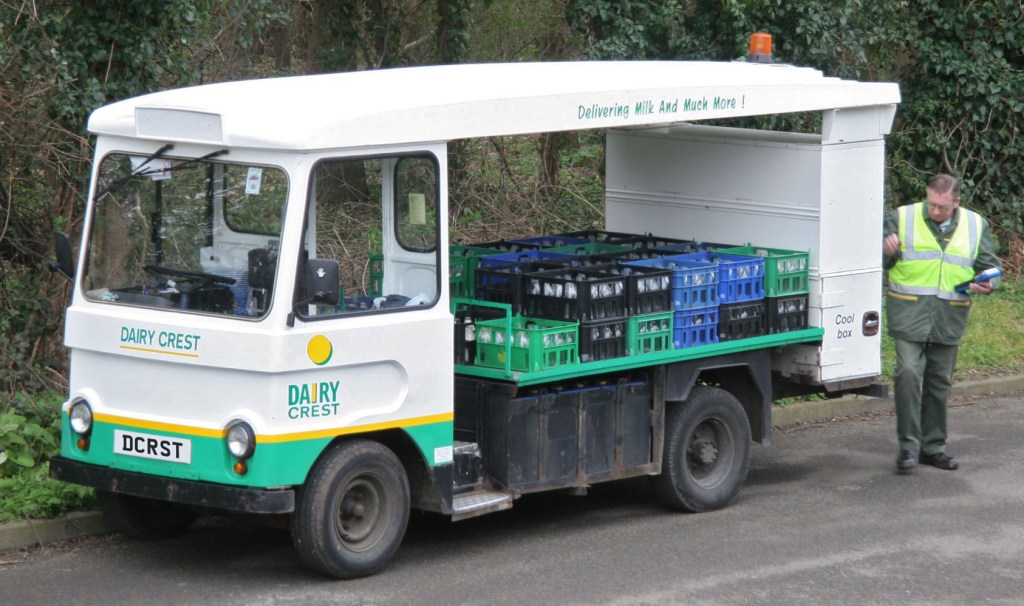
In residential street milk in bottles was delivered by electric milk floats – the origins of why ‘float’ are lost but it’s a romantic image, the electric delivery vehicle floating down the streets of our cities. Light sleepers will know just how early the milk is delivered, as the noise of rattling bottles was as familiar as that of fighting foxes!

Somehow birds learned that the gold-foil topped bottles contained milk with the most cream and many a morning it was apparent that the birds had drunk from your milk bottles, but only from the gold-capped ones!! Needless to say you could buy a cover for the four-bottle container to stop them; a simple counter could also be set to indicate how many bottles you needed.

Er! Er! ………

……. and I know this talk is on Milk Bottles but it would be remiss of me not to mention Mrs Adams, the wife of the Headmaster of a preparatory school at Wookey Hole near Wells. The school milk was not delivered in bottles but in churns, some 2ft 4ins tall and over a foot in diameter, which contained 10 gallons. A gallon of milk weighs just over 8.5lbs (almost 4kgs). I remember watching her lift a couple of churns in from the road where they had been left by the farmer; she had very big arms! ……….”   (Note 4)

I am sure somewhere in my unrehearsed 5 minutes on ‘A Milk Bottle’ I launched into the ‘what it wasn’t’, when you start running out of ideas. It shouldn’t have been an empty container for artist’s brushes, for water to wash out water-based paint. And I don’t think it was a big enough bottle for those who were dextrous enough to create little models of sailing ships and slide them in, pulling the rigging upright and plugging it with a piece of cork. Whilst I have always admired the craftsmanship of those who did, collecting them didn’t appeal and I guess these days a cruise liner inside a bottle doesn’t cut the mustard!

Today in the UK a company called Milk & More are building a very good business with home deliveries of milk and milk products. They sell whole, semi-skimmed and organic milk in 1 pint (568ml) glass bottles. A group called ‘Friends of Glass’ say that “milk in glass bottles is left closer to its original state than milk in other packaging; more enzymes remain. It is therefore easier to digest and those who have intolerance to milk can drink it.” There is always a counter-view; …. the nutritional content is negatively affected by glass. Apparently essential amino acids in milk such as tryptophan and tyrosine break down due to light; vitamin A and riboflavin are also degraded. Remember when butter was good for you, then bad for you, then good for you??

When I first started Hot Yoga back in 2009, I would be gagging for some energy infusion after a 90 minute class. There was nothing like a bowl of fresh Kellogg’s Cornflakes with Granulated (not Caster) sugar and cold, full-fat milk; so bad for you ……. yet so good!!  

There is something romantic about the old-fashioned shape of the milk bottle, something that modern cartons don’t convey. Today you can once again buy the glass bottles – not with milk in but for flowers, pencils, etc. What goes around comes around!

Richard 6th November 2020

Note 1. I gather some children don’t make the connection between a dairy cow and milk bought in a supermarket.

Note 2. Factually, in case you didn’t know, glass uses generic silicate known as silicon dioxide. Soda-lime glass with some 70% silica accounts for almost 90% of manufactured glass. 

Note 3. It could be he associated a brown coat with ‘trade’ and wanted to inhabit the next level up, that of the technician or assistant?

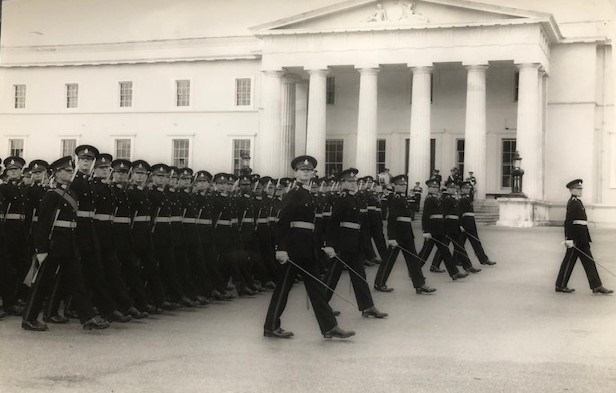
Note 4. I must have done OK, as I passed and entered the Royal Military Academy Sandhurst in September 1965.

Major-General Sir James d’Avigdor-Goldsmid, whose signature appends this note, was President of the RCB.

PC 202 Other’s Manners

Stating the obvious ….. one’s observations about life are very personal! You and I may see the same thing, experience the same event, be in the same space and in the same time, but our own memory will be different as we have developed our own filters through which we make such observations. I have always wondered how autobiographical writers have remembered conversations from months or years ago; yesterday’s difficult enough for me!

Then I read ‘The Spaces In Between’ (Note 1), an autobiographical account of the early life of Caroline Jones, a yoga enthusiast and good friend. She writes about one’s ability to recall experiences: “…..  I don’t want to hurt anyone’s feelings – and who is to say that my version is true anyway? Who is entitled to say what is true in any family’s history? It is all shades of grey, interpretations and misinterpretations: something that passes one person by might be the thing that tips another onto a different journey; and all, in the end, coloured by imagination and weakened by unreliable memory.” Exactly: so simply put. (Note 2)

On the UK TV’s Channel Four there’s an interesting Belgium drama called The Twelve; fortunately subtitles are provided for those of us who don’t speak Flemish! A jury has been selected to try a case of double murder. As the story unfolds, it focuses on the background of the individuals who make up the jury, making us very aware that their judgments and values are unconsciously coloured by their own experiences, good and bad, despite hearing in the courtroom exactly the same thing.

Normally we try and celebrate my Scorpio birthday with a supper party of some sort. This year we wondered how to do that living in the half-life of Covid 19. So we planned a couple of suppers, maximum 6 to abide by the rules, and Celina would shout a dinner at The Ivy in central Brighton. The name The Ivy is familiar as part of the upmarket London ‘eating & be seen’ scene; actually I ate there once …… didn’t recognise anyone else!  

The original restaurant started life as an unlicensed Italian café in West Street in London’s theatre-land in 1917. Over the decades it’s maintained a reputation as a very special place to eat and remains hugely popular; mobile phones and cameras are banned. In the last decade the company has established The Ivy Collection, a number of similarly-themed restaurants all serving the same good quality food and staffed by well-trained individuals.

Part of the dining area in The Ivy Brighton

There are Ivy Collection restaurants in a number of British cities; for instance we ate in The Ivy in Bath (See PCs 164 & 165) last year. The Ivy in Brighton opened in early summer 2018. Intrigued, we had a drink there a year ago and then in November were delightfully included in the wedding and Ivy luncheon of chums Sandie & Dom.

When you book a table in a restaurant you have no control over the behaviour of the other diners or where you sit, although I appreciate there is probably a difference between those in McDonalds and those dining in The Ritz (Probably better in McDonalds?)  Obviously you imagine that most people are well mannered and sensitive in shared spaces. Some of you may recall our irritating experiences of sharing a sun-terrace in Sicily with some Russians in PC 134? And you may have seen cartoons of an airline passenger sitting in an aisle seat and being next to a giant of a man; I think Gary Larson did one of a huge man coming down the aisle towards his seat?

The Ivy had no free tables on the day of my birthday, last Saturday, so we went earlier on Thursday. With current restrictions the restaurant has to close at 2200 and by 1845 it was full; we were shown to our table, one with places for 4. I guess it’s rude to stare directly at the people at the next table, but I remember clocking them and thinking “Oh! Dear!” Too quick to make a judgment, me, you might suggest; I couldn’t possibly comment.

Mr & Mrs Overweight were accompanied by a couple who in the course of the evening said little and laughed, actually ‘screamed’ is a better word, a lot, in a way that grated on my sensibilities. Mr Overweight clearly appreciated their unconscious admiration at his jokes and stories. It was Mrs Overweight’s birthday so a time for celebration and the alcohol in the form of cocktails (with umbrellas of course) flowed. Halfway through the evening I met him on the stairs to the loo; I was on my way up, returning to our table. No recognition! No ‘after you’ suggestion as one of us had to give way. Gravity and potential energy (Note 3) was of course on his side! During the course of the evening, Mr Overweight’s language, liberally doused with swear words, and the volume at which he spoke got more irritating, all the time ‘stuffing his face’ with food and washing it down with glasses of wine. Twice they left to have a cigarette outside; the smell of stale smoke from their clothes on their return wafted across our table. I have to say I was much relieved when they paid their bill and left. Don’t read this incorrectly! We had a lovely meal of food that we do not normally eat, served by some skilled waitresses, and ignored the riff-raff manners. Celina took a photograph of birthday boy.

In PC 50 from September 2015 I scribbled about suffering a house & pool party of 450 people next to Celina’s parents’ house on Iposeria in the Sān Conrado suburb of Rio de Janeiro? We are often in conflict with others’ behaviour but nowadays there is a growing lack of respect for our fellow human beings and our tolerance levels are extremely low; mine included, sometimes!! Ironic words huh!!

Richard 30th October 2020

Note 1 On the book jacket the typeface had “the spaces in between” with no capitals! Very casual and calming.

Note 2 The late great Clive James’ first autobiographical book was titled “Unreliable Memoirs”.

Note 3 Potential energy is defined mathematically as mgh – ‘m’ mass in kg, ‘g’ acceleration due to gravity and ‘h’ height. Mr Overweight had lots of mass!

PC 201 Facts and Dying

In one of my posts from Estoril in the summer, PC 194 ‘Waiting for ……’, I mentioned the larger-than-life character who owned one of the apartments where my brother-in-law lives in Portugal. Early sixties-something Glenda told us last year that she had been diagnosed with cancer. With typical joie de vie she laughed and said how she was going to try everything but Chemo to beat it. When we saw her at the end of July this year you would not have known she was losing the battle, but by the time we left on 9th September it was quite clear her time left was measured in weeks rather than months. She had laughed and said that when it becomes unbearable, she’ll check out; she did so on the 15th of October. As someone recently said about a chum: “She loved this earth but could not stay.”

How often have looked up into the sky at the end of a holiday, after a get-together with friends off the beaten track or on Sunday afternoon when thoughts inevitably turn to the working week ……. ‘but can’t we stay’?

Someone suggested that we are the architects of our own demise and I agree. Most of us know that drinking alcohol to excess damages our livers, most of us know that smoking can cause lung cancer, most of us acknowledge that eating too much makes us fat, and we read that exercising is good for us. Only this week I read that swimming in cold water reduces the onset of dementia. We ignore the data if it suits us; a look on the bathroom scales can be fact, but we mitigate the unwelcome rise with some excuse. Those of us who smoked pointed to the 90 year old smoking 30 a day or thought that one might get hit by a bus crossing the road, so why not! We make our own luck but sometimes, inevitably one can be in the wrong place at the wrong time! Some people subscribe to the fatalist view, that no matter what they do, the outcome will be the same …… as it’s predetermined.

I never used to read obituaries published in the quality press, but do so regularly now because it’s more likely I might know someone whose life was noteworthy enough! It’s not only the rich and famous or the well-connected who feature. Often an ‘ordinary’ person whose life was fascinating appears and the compilers of the pieces clearly research their subjects with relish. I used to wonder why the accompanying photograph was of the person at 53 or 64 but never 86! We all can see that the ageing process is not flattering. Here’s an example of the little stories that often colour the summary of a life. Philip Ayrton-Grime was an established vet in Windsor and was entrusted with the health and well-being of the royal Corgis. Sharing a glass of Sherry with The Queen after one of his last visits in post, the elderly Philip was asked whether he was forgetting names and faces. As he nodded in agreement, the Queen sighed: “Fortunately everyone seems to know me!”

For the last few years I have got used to watching what is known on the BBC channel as the ‘Early Evening News’, broadcast at 1800. Since the start of the pandemic and repeated every evening since, the newsreader has solemnly read out the number of Covid deaths for the day and the cumulative total ie people who have died having a positive test. Initially it was sort of shocking, as if these deaths could have been prevented. Then it became apparent that the majority of the deceased had had ‘underlying health issue’ – suggesting that the virus had simply hastened their demise. A few months ago the public body for reporting the deaths, Public Health England, admitted that they used a different measure to that used by the other nations of the United Kingdom. Reworking the figures took over 5000 deaths off the total and introduced a measure of scepticism with the published data. So now I often scream at the television when they give the total as gospel! Now it’s just morbid mumbo jumbo. Next they will be announcing how many people have died as a result of a car accident. (Fact (check it?): In July 2020 the UK had 38,179 deaths. A daily average of 450 from cancer, 180 from heart problems …. and 17 from Covid 19)  

A headline in the newspaper concerned Russia and fake news.

You and I might think this is absurdly childish and pathetic, but if it is absorbed as the truth by those unable to make more informed judgments, it becomes a real concern, as such people are easily swayed.

Writing in The Times this week, Hugo Rifkind says: “Ideas that thrive are not necessarily the best or wisest ones. Witness a tweet saying a recent study had shown half of all positive Covid tests were false. It hadn’t at all, but that tweet was re-tweeted thousands of times. Various scientific brains tried to set the record straight, but the reality was boring and complicated and nobody wanted to hear it. What do we do with these people? Ignore them? Argue with them? Shut them up?

Recently I watched the Netflix documentary ‘The Social Dilemma’ about how people use the interconnected world to spread all sorts of news. Watch it and I imagine you like me will think it’s kinda scary? Sometimes the headlines are skewed by those with a particular bias. My dear friend Jonathan, who had fought in the Falklands War of 1982, drew my attention to a claim that veterans of that conflict were committing suicide at a higher rate than the average for their age profile. He investigated; of the 21,432 service personnel who had fought in the war, by December 2012, 1335 had died (compared with 2079 civilians for that age group). Seven per cent of the veteran deaths were due to intentional self-harm, making them 35% less likely to kill themselves than their civilian peer group. So what point was the claimant trying to make? I leave that to you to figure out. Of course I accept that the figures Jonathan quoted are accurate!

Funny world, inn’t?

Richard 23rd October 2020

PC 200 Another Milestone!

On the 2nd July 2017 I posted my 100th postcard …… and thought that was quite an achievement; quite proud of myself! And now, just over three years and three months later, I am trying to pull together my thoughts for the second one hundred, and doing that with the grey fog of Covid 19 hanging over me like a wet blanket. I assumed that Covid 19 was named as ….. CoronaVirusDecember2019 but if I Goggle it I find I am wrong; it’s happened before!

Despite everything being in digital form these days I wanted to have a paper record of my first three volumes of 50 PCs each. The local printer in Portland Road produced these ………

…… and in anticipation I created a frontispiece for the fourth volume PCs 151-200! They are possibly the most expensive single colour copies ever produced. (Note 1)

I am always amazed when people say they remember conversations they had with their mother/father/sister/brother/dear friend/boss/ex-boss/lover/ex-lover/dinner party guest/whoever months or even years afterwards. Can I remember what I was doing in July 2017, or even July 2018, let alone remember conversations? Nah! So I scroll back through my ‘Articles’ folder in Word and am reminded what’s happened over the last three years, events and thoughts that have prompted me to put pen to paper, so to speak!

Scribbling about this milestone, I sense I am looking back into a forgotten world, one where we could travel freely, could mix socially and could use our unmasked faces to express what we really felt and not have to rely solely on our eyes.

Boy did we travel! In addition to annual trips to Rio de Janeiro in Brazil, the establishment of a Rocha Miranda base in Estoril has given us an excuse to travel to Portugal at the drop of a Panama hat. In 2018 we took the ferry to Santander, drove through north-west Spain and south to Estoril (PCs 129 & 130); this year we spent six weeks there.

September 2018 found us in Sicily for a week (PC 134). Apart from going to Rio, these were all shortish journeys compared with our long haul out to the Far East at the end of 2019. Singapore (PC 168) and then, putting some of my family history into context, visiting Farewell Spit on the north of New Zealand’s South Island.

You may have got bored by my interest with the Fosberry and Nation families but if not, PCs 127, 152, 154, 169 &170 will put you right. Some of you will have read my PCs about our Alaska trip in 2015, following the escapades of George Nation who married the girl who was shipwrecked on Farewell Spit in 1877. There are some simply beautiful places to experience on this planet of ours, and I reckon New Zealand’s landscapes rate as some of the best.

In amongst the second one hundred PCs I have written about visits in the UK to The Anchor at Warbleswick (Courgette Neutral PC 153) and to the city of my birth, Bath (PCs 164 & 165).

Under the wooden representation of entwined ‘Love’ and ‘Hove’ that I carved from a pine board ……

……. around our dining table we have entertained some of the people whom we have met since arriving in Hove eight years ago this week. Some have come much more than once, such is how relationships develop. Sometimes one of the couple has had a passion for hot yoga. One of the real negatives of the current pandemic is that the social aspect of following our yoga practice has come to a halt, frozen in the fear of contagion and social infection. It will recover.

In addition to scribbling about social mores and changing behaviours, a hot topic of the moment, I have written about Virgins (PC 120), Bananas (PC 121 – and not related to the previous PC!), Night & Day (PCs 124 & 125) and September (PC 132).

My beautiful gorgeous Labrador Tom only spent a few months here in Hove before finally hanging up his collar, but the stay of my daughter’s American Labrador Margo prompted a PC about animals I have owned (PC 122). If we didn’t want to travel so much I am sure we would have another one – although Celina is more of a cat person.

Three PCs about my time in Northern Ireland came at the end of this batch of 100. Odd that after two tours there in the 1970s I should find myself working for a Belfast-based company when I left the Army in 1985. There is often something circulatory about one’s life’s events.

When lockdown was imposed in March I decided to increase the frequency of my fortnightly posts to weekly; if I hadn’t, this PC would have appeared sometime in May 2021. I imagined, rightly or wrongly, people would have more time to read (See Note 2). I have also tried to bang the drum for everyone to read more, given that the numbers of people in the UK who can’t read and write well is far too high (PC 174). (Note 3)

And I guess we have all been watching more Netflix than usual? One documentary that was recommended by Celina’s mother was The Social Dilemma, about the insidious invasion of our lives by postings on social media platforms, and the potential to alter our own judgements through fake or biased news items. Scarry!

Stay Safe. Stay Healthy. Now …… for the next one hundred.

Richard 16th October 2020

Note 1. Think you can make out postcards being sucked up into a Royal Mail red postbox? Now to collate another 50 and take the memory stick to the printer.

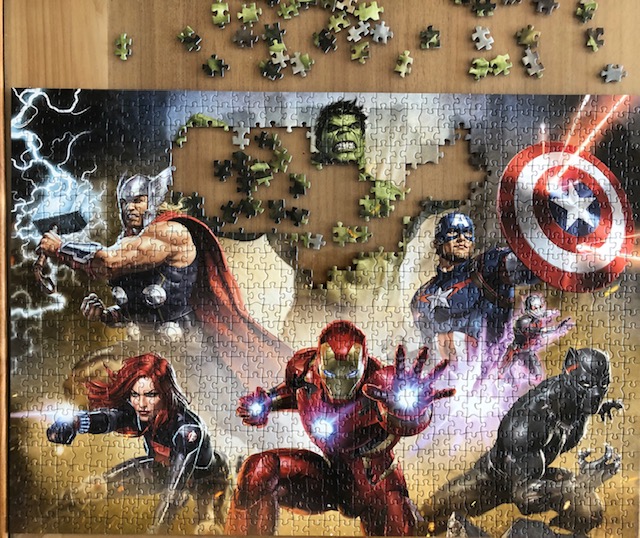
Note 2. In Estoril in the summer we were challenged to complete a 1000 piece jigsaw puzzle of the Marvel’s Avenger characters.

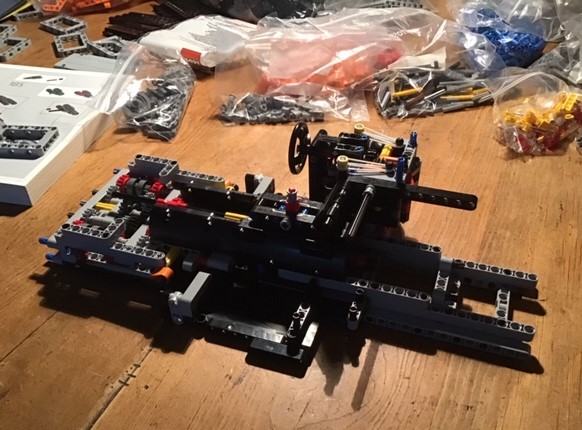
More recently Simon & Benedicte have very kindly lent us a 4000-piece of Lego Techic – a Porche 911 GT3 RS. Now that’s going to give days of ….. fun!

Note 3. One of my favourite authors Lee Child (He, real name James Grant, and his wife often referred to their daughter Ruth as ‘le child’ (the child)!) has co-written his next book about Jack Reacher (The Sentinel) with his brother Andrew. The intention is that after a few more, Lee will hang up his pen, leaving it to Andrew to continue.

PC 199 The Way We Are?

On my kitchen island I have a piggy money box ……

….. into which I drop the odd one pound coin. The habit of desultorily collecting spare coins started back at university when I wanted to stop smoking. In those days a packet of cigarettes was £0.50, so I bought a Snoopy money box and dropped a 50 pence piece into it every day. It was a few decades ago but that fund paid for a week’s holiday in Spain. (Note 1& 2)

The money box came to mind the other evening when Bill came to supper. Do you have an Anxiety Box? Somewhere you can drop those anxious thoughts about this and that ….. and leave them to fester, as opposed to not putting them there and seeing them in the cold light of day and seeing them for what they are …… often things completely outside of your control ….. and just let them go ….. let the wind take them? 

He sat opposite me, replete after a bowl of lovely fresh pasta and some yummy pudding. Relaxed and at ease with himself, he started talking about the next few months and then mused about the next few years. This was unusual for a bloke, talking about his feelings and thoughts, exploring the inner recesses of himself. In the climate of the Covid 19 pandemic, making any definite plans is fraught, for we don’t know, if we ever did, what tomorrow is going to bring.

For some, this uncertainty is easy to accept, for most of us it’s irritating to say the least, as exploring the future from the benefits of your armchair is what we do. For armchair read on top of a cliff, possibly windswept and bracing but with an horizon with which to stretch your thoughts; on a yacht using nature’s forces to go somewhere or just enjoy the experience; on a beach with the ‘lonely sea and the sky’; at the top of the spire of some cathedral; the theme is somewhere where you can see …. “an horizon is nothing save the limit of our sight” (note 3) …… and not snuggled under a duvet. And now those ideas and dreams are tempered with the uncertainty of when, if ever, life will return to some semblance of what we had previously considered normal! Some seem to believe life is on hold; naturally we are all a little anxious.

Smugly, I am OK thanks! I have reached a point in my existence where I am extremely happy in my own skin, think I know what I like, what I love and what I don’t like and what I don’t love – oysters for example! Some of you will, of course, be right at the beginning of adult life (I have to assume no teenagers read my scribbles?), as some of the children of chums are, reaching university and all that that rite of passage entails, for some onto their second or third careers, for some battling with health issues, for some fighting with relationship trauma. It’s happened before and it will happen in the future; don’t think you are the only one! For example, back in 1978 the mortgage interest rate was over 16%  and that sure gave one sleepless nights!

“So” he muttered “should I stop work and if I did what would I do? Would I continue to live in my current house now my children have left? What should I do? Learn to play bridge?”

“Oh! Come on Bill! That’s such a cliché!”

With a climate of anxiousness, ‘mental health’ issues have come under the microscope in 2020 and about time too. (See PC 136) But I am afraid all we hear are the negatives and not the positives. I wrote “On the day of my recent birthday the quotation in the yoga studio was very serendipitous: “Happiness involves taking part in the game of life, not standing on the edge of things and frowning.” Mental Health was a minority issue that has moved mainstream; failure to address it properly will have major consequences for the nation.”

If you read PC 195 ‘Snippets …..’ you will have read of the death of Ken Robinson. Maybe if you hadn’t done so before, you went onto You Tube and watched his TED talk about finding your element, that issue, that topic, that sport, that experience that engaged all of your emotions. I get that, for many, being in love with your work is not always possible. We get drawn into something that gives us an income and that pays for the art classes, the singing lessons that, whilst acknowledging you will never be Adele or Caruso, give us so much pleasure and we think that’s it, that that’s all there is. In fact just this last week someone admitted over supper that their job pays the bills, but what they really wanted to do was sing, preferably in the ‘chanson’ style as that suited their voice ……. and that was a real passion.

Bill again: “It’s too difficult and it’s alright for you, you …….” and the defensive self-justification comes rolling in from left field.

“But I’m OK! I thought it’s you who are coming up with all these situations that for no reason make you anxious. Does it make you feel comfortable to pop these anxious thoughts into your box and leave them there to look at in the small hours, when the churning starts? Please, just get them out and let them fly away.”

Richard 9th October 2020

Note 1 I stopped smoking then and at various other times during my life, always tempted back through smoking little cigarillos. My last cigarette was on 14th March 1994 – at 1230 if you are that interested?

Note 2 Additionally I have, like most people I guess, an old coffee tin into which I drop my monetary shrapnel (1, 2 and 5 pence coins) when I come back from a shopping trip. At Christmas it’s given to charity – ie my daughter!!

Note 3 Father Bede Jarrett (1881-1934) was an English Dominican friar

PC 198 Tales from Northern Ireland (3)

I went back to Northern Ireland in October 1975. This time 39 Medium Regiment’s area of responsibility was centred on Her Majesty’s Prison (HMP) The Maze (aka Long Kesh). The prison housed members of the various paramilitary groups, IRA, Provos, UVF, etc. The UK Government had introduced a policy of ‘internment’ where those out to cause trouble were imprisoned, without the benefit of a proper trial by jury. As I write this over forty years later I wonder how it had become a politically-acceptable policy.

Our primary responsibility was the prison’s external security; others included an area of North Armagh and a permanent VCP at Aughnacloy, just before the border with The Republic.

Aughnacloy is due west of Portadown and south west of Belfast

This was an intellectually challenging tour as I was the regimental Public Relations (PR) Officer dealing with the press from our recruiting area of Birmingham, interfacing with the PR offices at HQ Northern Ireland in Lisburn and keeping the soldiers’ families aware of what their loved ones were doing.

I decided to produce a fortnightly magazine and called it TNT, for Three Nine (39) Times, although the pun was very obvious in the context in which we operated. The four Regimental batteries were cajoled, encouraged and hounded to produce some news and stories about their particular operations!

In my office. I wore civilian clothes most of the time and grew my hair!

My TNT magazines were printed by a company in Portadown, a town some 20 miles from The Maze. For travelling around I had a hard-topped Land Rover that, in an effort to disguise its military ownership, was painted grey and cream; except that is for parts of the inside….. which were Army green!! Portadown was a reasonably peaceful place and Gerry was a small bundle of Protestant energy. We got on famously and during the tour produced some 300 copies each of the 8 issues.

Visiting a recently blown-up farmhouse. The bodies were inside.

For the battery guarding HMP The Maze’s perimeter, this was an extremely tedious, repetitive and boring task, although the possible reaction to a unprofessional job was obvious. There was the added frustration that the sentries in the watch towers could see into the prison, could see a regime and culture that had many critics and maybe secretly wished the roles were reversed! HMP The Maze was run by the Prison Service of Northern Ireland. One example of allowed prisoner behaviour was the blanket protest when the inmates wore only a blanket and smeared their own excrement over the cell walls. Our soldiers took a dim view of this behaviour.

My role during the tour put me on the duty officer rota, manning the operations room on a shift basis. I was due to take over from Major John Harman, the Regimental second-in-command, one morning at 0800, he having completed the graveyard shift (midnight to 0800). He greeted me with a big smirk on his face and said:

I was just completing the handover notes and thought I might be late for breakfast in the Officers’ Mess. So I picked up a telephone handset (ed. from one of the bank of three) and dialled the Mess number. Just at that instant one of the other phones in the operations room rang. I reached across and said: “Ops Room 39! Just a minute, I am on the other line.” …… only to hear my own voice in the earpiece. I had phoned myself!”

Piggy-backing on the relationship that Zack Freeth (PC 197) had established with Julia Morley and the Miss World Organisation, I persuaded Julia to bring the then current Miss World, 18 year old Wilnelia Merced to Northern Ireland (Note 1). We visited a children’s home …. and entertained the new Miss World for three days, flying down to the VCP at Aughnacloy and around North Armagh.

As part of the visit the Sergeants’ Mess invited her and Julia to dinner. In my capacity as escort (!) at an appropriate time I knocked on Wilnelia’s bedroom door to take her across to the mess. She looked like someone off the set of West Side Story, leather bomber jacket and extreme short skirt. At another time and in another place completely gorgeous but she would have been eaten alive by the randy chaps in the mess!! I persuaded her with some difficulty to change into something less, how should I say it, sexy!

On the last day of her visit the officers’ mess laid on a curry lunch (Note 2), where Wilnelia was the guest of honour. The word got out and it was possibly the best attended curry lunch I have ever been to!! After lunch I borrowed the CO’s staff car and driver and took Wilnelia and Julia to Aldergrove Airport. There we were met by the VIP conducting officer and taken to a private room. Black Bushmills whiskey, one of the best things to come out of Ireland, was produced. After thirty minutes we were warned the flight gate was closing. Another twenty minutes and a member of the cabin crew came and escorted the VIPs to the foot of the aircraft steps.

A few weeks later another four months ‘at Her Majesty’s pleasure’ ended.

Little did I know then that in 1986 I would join the Belfast-based global aerospace company Short Brothers. As part of the sales team I travelled internationally a great deal from the London office – but occasionally had to visit Belfast. On my one-week company induction I was booked in to the La Mon Hotel. Someone had a sense of humour; in February1978 the hotel had been bombed by the IRA in one of the worst atrocities of the troubles which had killed 12 people and wounded another 30.

Richard 1st October 2020

Note 1 In 1983 the Puerto Rican married the British entertainer Bruce Forsyth and became Lady Forsyth-Johnson.

Note 2 A ‘Curry Lunch’ was an established monthly Sunday event in most officers’ messes throughout the world.

PC 197 Tales From Northern Ireland (2)

December 1973 …….

It was in the Shantallow housing estate, in a follow-up to a particularly frustrating time when my soldiers’ patrols were targeted by bottles and bricks, that I recognised one particularly active participant, as he always wore the same striped sweater. We managed to pick him up and the RUC took him away for questioning. We learned later he was 11 years old! He’d be 57 now – I wonder what he became?

A Shantallow patrol. No way of knowing whether Bombardier Elrick and Gunner Foster were coming or going! Patrols always had the last soldier occasionally looking backwards! A still from a cine film

Apart from patrolling the Shantallow Estate we manned a permanent Vehicle Check Point (VCP) just short of the border and the Southern Ireland village of Muff. The road was not heavily trafficked and it was a tedious and repetitive task, checking documents and the contents of car boots. However on the weekends the youth of Londonderry made their way over the border to a popular disco; they returned before midnight, boisterous and with a confidence boosted by alcohol. One of the prime tasks of the VCP was to look for those wanted for questioning; these buses coming over the border provided a near perfect cover for trouble-makers to move into the city. Around 2330 on the top deck of a very full bus, I was looking at faces. Satisfied I couldn’t see anyone of interest, I turned on my heels to exit the bus; someone kicked me hard on the back of my leg. I looked around to see who it was, couldn’t identify the individual, so just took the nearest and marched him down between the seats to the stairs. My sergeant, a loveable competent soldier called Williams, gave me a wry grin, suggesting it wasn’t my most sensible decision. I looked behind me; everyone was up and coming off the bus!

Today if I smell cheap diesel I am immediately taken back to Londonderry, particularly to the road north out of the city to the Muff VCP.

We often drove up to Muff in a 1 ton armoured vehicle, known colloquially as a pig, with the back doors open and, as it laboured up the hill, the exhaust fumes were sucked into the back and up our noses. Yuk!

The ‘Pig’ in the background; the wit might say the foreground?

One of the most poignant memories of this tour was a particular visit by the padre; every regiment going to Northern Island had a padre attached to it for the four months. Desmond was a Baptist minister and an extremely likeable man. One evening just before Christmas he asked to visit some of my troop, and I took him up to the Muff VCP just after midnight. Around the static VCP were some sentry towers and we visited each one. It was an extremely cold night and a severe frost covered the fields. As he chatted about this and that to Gunner Batchelor, probably aged 19 or so, I could see Batchelor’s face; he couldn’t believe that someone was taking time to show him love and interest, especially at this Christmas time.

I mentioned that we had three days ‘Rest & Recuperation’(R&R) sometime after the first two months. Married soldiers flew back to Germany, single ones to somewhere in the UK; I flew to London. After landing at Heathrow I met some friends in a pub in Putney. When you are on duty or on call every day and night, your senses and emotions are sharpened, always ‘street aware’, conscious of your surroundings. It was extremely strange to sit in a pub and look at ‘normal life’ happening around me, unable immediately to relax.

Like all good soldiers we read both the more intellectual newspapers as well as the ‘red-tops’, as the Mirror and The Sun were known. One morning the PR officer, an effervescent character called Zack Freeth (Note 1), noticed that in the overnight Miss World Competition Miss UK had not been crowned. He contacted the Mecca Organisation and after some discussion, Miss UK was persuaded to come out and bring a smile to the troops. This visit was such a success that Julia Morley, the owner of the competition, did two things. Firstly, every soldier in the regiment was given a Christmas stocking, full of sweets, chocolate, cigarettes and even a Lad’s Magazine. Secondly, in January 1974, she brought the woman who had been crowned Miss World, Marjorie Wallace, (Note 2) to see the soldiers.

WO(2) Paddy Surgenor, Sergeant Williams and 19 year old Marjorie Wallace – and me!

As I write this it sounds fairly unemotional. Believe me, when you haven’t been near a woman for weeks (Note 3) this was a major morale boost. Another time Harry Secombe, a British comedian who was always supportive of Armed Forces charities, came and shared his humour with the soldiers.

Returning to Fort George after a patrol it was essential all weapons were cleared of live ammunition.

Daily routines often create a numbness and boredom can be dangerous; we were always attempting to do things better, be cleverer at identifying and defeating the terrorists.

Towards the end of the tour, in February 1974, the regimental rugby team started training in a makeshift circuit room, as we faced a crucial match soon after our return to Sennelager. Work hard play hard I guess!!

To be continued ……..

Richard 24th September 2020

Note 1 One of Zack’s sons, Ben, farmed in Zimbabwe and is in and out of the news, trying to get justice for the thousands of white farmers who had their livelihoods taken from them.

Note 2 Marjorie Wallace’s reign lasted 103 days. She had become engaged to an American Formula 1 driver Peter Revson (Ed. Good surname for a racing driver!) but was photographed kissing the Welsh singer Tom Jones on a beach in Barbados. “Tut! Tut!” said the Miss World organisation; “This violates your contract!” 

Note 3 No women served in our regiment, as this was long before gender equality and opportunity were addressed.

PC 196 Tales from Northern Ireland (1)

Northern Ireland has, for reasons which will become apparent if you read these tales, featured a number of times in my life. For those unfamiliar with how this part of the United Kingdom came into being and without writing three volumes of a book (!), the island of Ireland was partitioned in 1922 as a result of pressure to create a southern Catholic republic. Protestants who had settled mainly in the north wanted to have their own ‘province’. Part of the island became the six counties of Northern Ireland and de facto part of the United Kingdom; the south eventually became the Republic of Eire. Nationalist elements in the south agitated for a united Ireland; some still do! For a time the north was a mecca for employment and over the years many Catholics migrated there. Today the Province is evenly populated by both Protestants and Catholics. Fifty years ago the nationalists, mainly in the form of the IRA, banged the drum for change; they were resisted by various Protestant paramilitary groups.

In August 1969 the then Prime Minister of the UK, Jim Callaghan, announced that troops were to be deployed to Northern Ireland to try to calm the inter-sectarian violence that was spreading across the province. I was sailing in the Baltic; it was the summer after all and I was due to go to university the following month. My period of military service so far had been in the UK and in Germany, and rather dull; I remember thinking I might miss an opportunity for some action. Little did anyone realise the conflict would go on for almost thirty years until the Good Friday Agreement was signed in April 1998 (Note 1). It defined a large chunk of my military service, as I took part in two operational tours, 1973-74 and 1975-76, each time spending four months in the Province. When I resigned my commission in 1985, I joined Short Brothers’ London Office; its Head Office was in Belfast!

I had graduated in July 1972 and, with my Civil Engineering degree in my back pocket, returned to my Regiment in Lippstadt, Germany. A year later I got promoted and moved to a regiment, based in Sennelager near Paderborn; 39 Medium had been earmarked for a Northern Ireland tour in October that year.

We put our artillery equipment into ‘light care & preservation’ and practised infantry roles such as patrolling, dealing with unrest, intelligence gathering and searches. In mid-October 1973 450 of us flew to RAF Aldergrove to start our ‘24/7’ tour; we had three days off in four months.

Our regimental home was Fort George, an old Royal Navy Storage depot on the western bank of the River Foyle. Alongside in the river was a Royal Navy ‘depot, maintenance and repair’ ship, HMS The Rame Head. Those officers posted to her seemed to include the more incompetent, lazy, and dangerous members of Her Majesty’s Navy.

Fort George, Londonderry. A still shot from a cine film!

We were accommodated in a mixture of Nissen huts and large draughty old storage hangars, in racks of bunk beds; The Hilton it was not! Incongruously, between the huts was a caravan that sold everything you needed – cigarettes (obviously), crisps, fizzy drinks, lads’ magazines, newspapers, sweets and chocolate. Over the centuries the tradition had been established that these entrepreneurs, these Chogy Whallahs, mainly of Indian decent, would provide such a service. The Regimental Second-in-Command engaged them, agreeing a percentage of the turnover that went into regimental funds. He once remarked that these guys often knew if you were going to be deployed operationally before the Ministry of Defence told you!

Our regimental patch covered the centre of Londonderry, the grand city bisected by the River Foyle know to the Catholic population as Derry, west to the border at Buncrana and north to the border at Muff. It was a real mixture of commercial properties and shops, dense housing and countryside and included the sprawling Catholic council housing estate of Shantallow. (Our area of responsibility did not include the City’s Bogside.)

Shantallow Estate shops A still shot from a cine film!

Sadly the time when the British Army had been seen as a force for good, coming between the Protestants and Catholics, each with their own years of deep-rooted bigotry and hatred, had long past; Bloody Sunday in January 1972 was the pivot on which it turned. Suffice to say as we patrolled the streets, either on foot or in Land Rovers, looking for trouble-makers and those out to bomb, kill and maim, we became the target of hate, suspicion and loathing. I recalled the ‘Internal Security’ training during my time at Sandhurst. In the films, the ‘rioters’ in some outpost of Empire were always led by a red T-shirted chap; the colour of their skin also made them stand out. Not so in Northern Island where everyone looked like everyone else!

I guess I had lived a very privileged life up to this point and had little experience of those living at the bottom of the societal heap. That all changed when my soldiers got to know Shantallow. Sometimes we searched these houses, acting on an intelligence tip-off that ‘someone of interest’ (Note 2) would be there. Sometimes we were lucky and were able to hand over an individual to the RUC (Note 3). During our tour we found weapons stuffed in garden sheds and a small amount of Semtex, the explosive of choice of the IRA; sometimes hundreds and hundreds of hours of effort produced scant results.

Hidden in a garden shed in Shantallow

On one early morning house visit I realised there were no beds in evidence, just piles of dirty clothes and coats on top of mattresses on the floor. In four months I only saw one bed and was ashamed to see this level of deprivation in the United Kingdom.

To be continued ……

Richard 17th September 2020

Note 1: Incidentally, John Hulme, a Northern Ireland politician who was largely responsible for keeping the search for peace on track, and was awarded the Nobel Peace Prize for his efforts, died on 3rd August 2020 aged 83.

Note 2: One of the ‘people of interest’ was a Martin McGuiness, who denounced violence after the Peace Accord and became the Deputy First Minister, alongside his bête noire, Dr Ian Paisley.

Note 3 The Royal Ulster Constabulary (RUC) was seen as a Protestant police organisation and therefore another target for the bombers and stone-throwers

PC 195 Snippets …….

The title of this PC is already open to debate and criticism according to a number of articles about the modern trends in punctuation or indeed non-punctuation as every punctuation mark be it a colon semi colon or full stop is coming under the magnifying glass of those who text and twit. Note that there was no punctuation in this sentence; did the sense of what I have written come across? So what did I mean when I wrote ‘Snippet’ with five stops? Indicating perhaps that  the title has no end, that I couldn’t think of the right word to add to ‘snippets’ or that I was just lazy and believed that my readers would read and understand it in whatever way they wanted to ….. and that that might depend on their age. ‘Snippets’ is often used to pull together a number of ‘new items’ that don’t in themselves merit a whole essay – the dictionary saying “a small part, piece, or thing; a brief quotable passage.”

Maybe the common theme in this PC is “…..ation” – punctuation and education.

I hope most of you have read Lynne Truss’ ‘Eats Shoots and Leaves’ (see PC 26) about punctuation where the addition of a comma after Eats changes the whole meaning of the title; particularly when a Panda is concerned. (Note 1)

Susie Dent, writing in The Times last month, suggests ‘kids are killing the full stop’. By way of illustration, Dent offers a text response to a friend who’s had a pay rise: “great” or “great!” or “great.” “Most of us would choose the second, the first being a little muted and the third hints either at envy or absolute indifference.” Despite my pedantic view on punctuation, I begrudgingly admit she and those she’s observing have a point (aka full stop?). 

One morning in 2010 I was in The Institute of Directors on London’s Pall Mall, heavily engaged in a leadership and business coaching session with Frank Fletcher. Frank is the CEO of the Ellen MacArthur Cancer Trust, a charity that provides wonderful sailing opportunities to teenagers recovering from cancer. En passant, Frank asked whether I had seen the RSA animation of Ken Robinson’s Changing Education Paradigms.

I hadn’t and we spent the next twelve minutes watching this delightful representation of Robinson’s view on modern education from his 2010 TED talk. Having a pictorial preference to learning, I found the cartoon brought a hugely important message to life. Subsequently I watched the TED talk and bought his book ‘The Element: How Finding Your Passion Changes Everything’ and devoured it as if it was the first book I had read which really resonated with my inner emotions.

Our brains need to be activated – a bit like applying an activation code to some new App on my iPhone – and that brain switch-on is often achieved through education. Yet Robinson suggests that our current educational structure actually crushes creative thought, so pure in the young. Ken illustrates his book with some interesting vignettes, such as the one of a child who normally paid little attention in class. In art one day the teacher asked her what she was drawing.

“A picture of God.”

“But no one knows what God looks like!”

To which the girl replied: “They will in a minute.”

In his book he described meeting Dame Gillian Lynne, the choreographer behind Cats and Phantom of The Opera. Lynne had been a disruptive child in school and in desperation her parents took her to see a specialist. After chatting to her for a while, the psychologist said that he wanted to talk to her parents alone outside the room and, as they left, he turned on the radio. Through the little glass panel in the door they saw that Lynne immediately got up and danced. Rather than medication to calm her behaviour, she was sent to a dance school, igniting her creativity.

In PC 72 I told of a little shopping expedition to buy a light bulb and, as it seemed appropriate, wrote of my experiences a little in the style of James Frey’s ‘A Million Little Pieces’. His prose was continuous, with little punctuation. Initially I didn’t like it and looked for the colons and semi-colons, not to mention the paragraphs! Now I admit it works well …. occasionally!! And on punctuation, if you have ever looked at some legal document, maybe your will, you will realise that legalise is not a fan of punctuation, anywhere.

Robinson describes creativity as the process of having original ideas that add value. “Creativity is putting your imagination to work.”  When I am at my most creative, I sense I am extremely focused, in my zone, ignoring the outside world and consciously concentrating (back to Pooh: “My brain hurts.”)

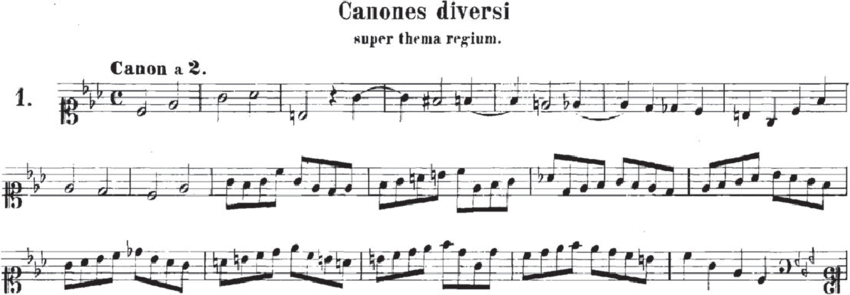
Snippets can be musical of course and often one hears a few bars, chords or semi-quavers and think “Oh! That’s Ed Sheeran or that slow movement from Tchaikovsky’s piano concerto.” Recently in a novel I read of Bach’s Crab Canon used as a mobile ringtone – and immediately found it on YouTube. I never knew!

Robinson banged the drum to have creativity of equal importance as numeracy and literacy in our education system, but the idea failed to gain mainstream traction. He died aged 70 of cancer late last month, still using his metaphorical drumsticks. I will miss his contributions to our lives.

Sir Ken Robinson 4th March 1950 – 21st August 2020

My scribbles, started six years ago, have challenged my own ability to write something that people might want to read. In that process I find myself using a number of full stops as ……. to suggest my mind is catching up with my typing fingers.

What really concerns me is the current assault on the full stop. Note I have naturally put one at the end of the sentence. Lauren Fonteyn, a linguistics expert has suggested that not using a full stop is ‘neutral’, but using one adds a sense of ‘being peeved … or that you’ve done texting’. Really? Are we so concerned of slighting someone that we can’t even put a full stop at the end of a sentence? God help us! Dent on punctuation again: “The TV listing once included the actor Peter Ustinov interviewing ‘Nelson Mandela, an 800 year old demigod and a dildo collector’. The right punctuation can save a certain embarrassment!

If you only text or twit, writing in an abbreviated language that is understood by your recipients, that’s all well and good. But it’s unlikely you will understand the breath, richness, depths and grammatical constructs that make English one of the most glorious languages on the planet. If that’s still OK, that’s OK; I sincerely hope it’s not.

Richard 10th September 2020

Note 1 The original, seen by Truss, was a notice on a Panda paddock. It should have read ‘eats shoots (ie green bamboo) and leaves’; someone had added capital letters and a coma after Eats which changed the meaning – almost ‘Gun Fight at the OK Corral’ Panda-style?

PC 194 Waiting for …….

The wonderful lines “What is this life if full of care, we have no time to stand and stare.” from the poet William Davies remind me why, in observing life with all its complexities, nuances and interactions, we need to engage our brain; as Pooh would say: “sometimes my brain hurts.” Of course often you are waiting for …….

PC 194 1

I have never seen the play ‘Waiting for Godot’ (1953) by the Irish playwright Samuel Beckett. Apparently two men chat on the stage, exchanging ideas about this and that, and admit they are waiting for Godot, whoever he is. A slave and his master enter …… and exit. Godot sends a message that he won’t be coming today – maybe tomorrow? By the end of the play Godot has not made an appearance and the two men have waited and waited, hoping for enlightenment from Godot. For whatever reason, the phrase ‘Waiting for Godot’ has lodged itself in my psyche although I am in no hurry to watch the play; just doesn’t appeal.

Some things worth waiting for are outside of our control, like the weather. Waiting for the rain to stop before walking the dog/hanging out the washing/gardening is literally in the lap of the gods  ….. and no end of pacing and getting anxious is going to change that. In my last PC I recounted our experience stuck in the apartment lift – waiting for help!

PC 194 2

I love classical music and particularly that composed by Jean Sibelius (see PC 109). Heavily scored for the brass section his Symphony Number 4 is a wonderful romp through some Finish landscape until it reaches a crescendo and pauses ….. waiting …. and different conductors stretch the waiting seconds ….. for ever. If like me you want to faux-conduct and you have raised your arms in anticipation, getting it right is ….. well …. waiting!

My dear mother stayed in a nursing home for the last year or so of her life, for some reason reading, inter alia, ‘To War with Whittaker’ over and over again (Note 1). To visit her I would work my way through multi-cultural, mixed-ethnicity of Clapham Junction and take the two-hour-plus train to Sherborne in Dorset; I arrived on another planet where ‘ethnic diversity’ was something they read about or saw on television. At home one evening, I got a call from the staff to say they thought my mother was fading. I said I would take the first train in the morning. I walked up Sherborne High Street, picking up a bunch of flowers as I did so, and headed into the nursing home. My mother’s room was on the first floor. As I walked down the corridor a nurse popped her head out of an office to say that, sadly, my mother had died a couple of minutes previously. I walked into my mother’s room, now still and lifeless, and before I thought about grief and sadness, I couldn’t help saying out loud: “You could have waited a few more minutes, Ma!”

That experience came to my mind here in Estoril where someone is dying of cancer, too young. The prognosis is a matter of months rather than years. An extrovert, larger-than-life character, they have been hugely philosophical about their various treatments and diagnoses of the last twelve months. Now it seems the end is in sight, although there is huge denial that that will happen. I was struck the other afternoon when I saw them, in their silk pyjamas, opening the shutters of windows that overlook the pool …….. where life was going on as normal ……. whereas they were waiting …….. I am sure we all feel an unspoken sadness and helplessness, only able to offer love, prayers and lots of gin.

TAP Portugal aircraft at Lisbon Airport

One of the many modern afflictions is waiting for some call centre to answer. For instance, I had been on the telephone to TAP Portugal for over two hours before Andrea was able to do what I wanted. Initially the system doesn’t seem to acknowledge anyone is waiting until you have been listening to the musak for 22 minutes. Fortunately the ‘speaker option’ on your ‘phone allows you to leave it on the table, playing the musak to itself while you get on with other things – providing you stay within reach. Then Katrine answered, working from home, God knows where. It didn’t matter; could she solve my problem? In these circumstances the worst words you can hear are: “Let me put you on hold”. Later, having taken me off hold, she asked if it was OK if she transferred me to another department. What can you say: “No!” – as that would have resulted in the continuous tone, one’s disbelief that after 55 minutes the call has ‘dropped out’ – either accidentally or on purpose! Then Bruno took all my details, again, and put me on hold ……. I waited, read more of my digital Times newspaper, made myself another coffee ….. until Bruno came back ……. and then the call dropped out. Ninety minutes and counting. Another attempt, another requisite 22 minutes before Andrea answered. By now I had a ‘Case Number’ that comprised so many numbers another minute went by just speaking them. And so it went ….. more waiting …… more ‘on hold’ ……. but eventually after close to two hours and a half ……. the waiting ended and I heard those most lovely of words: “We will send you an email confirming everything! Have a nice day.” Easily pleased huh?

And lastly we British have a reputation for queuing patiently. We don’t acknowledge many saints in England apart from our patron St George although the phrase ‘having the patience of a saint’ comes to mind …. waiting for …….?


Richard 3rd September 2020

PS My chum David Morley, who has a beautiful mansion in south west France (see PC 18), has solved the puzzle of the street numbers (see PC 193). They are measured from the start of the street, in metres. No 240, the old No14, should be 240m from the bottom, No16 is another 52m up the street. So I used my calibrated ‘pace’ and walked the street; ‘tis true!

Note 1 ‘To War With Whitaker’ was the title of the wartime diaries of Hermione, Countess of Ranfurly. My aunt’s colleague Peggy (see PC 114) read Jane Austin’s Northhanger Abbey at least once every year for her last twenty years. Must be something in the water?