PC 382 Hope ……

After talking to Josh almost exclusively last time I was here in The Hope, I thought I should try potluck and find out who was in on Tuesday. Josh himself was behind the counter, on his own and very busy although, while I was ordering a double espresso, I quickly said:

“You know I write a weekly blog, my postcard scribbles as I call them?”

“Er? I think so ……”

“Well, someone read the one where I reiterated what you had said about your time in Israel and they said: ‘Great reporter style, concise. Fun read with an undertone of serious analysis peppered with humour. So many more questions brought up and that could be further explored.’ ”

“Yes! Richard. So many questions and few with any meaningful answers that will bring about peace. Whilst I felt I had to go and ‘do my bit’, I get incensed that, for instance, some elements in Israel think building their own settlements in the Palestinian West Bank is OK, despite being illegal – and no one does anything to stop them. Sorry, I could go on and on but I need to attend to my customers. See you next time maybe?”
Lisa is sitting by herself and looks up as I pick up my cup, so I join her. 

You’re looking pleased with yourself. Why so?”

“Well, a month ago, I started my 16th year of trying to do OK practising the Classic 26/2 Hot Yoga sequence. What a journey! The names of the teachers are scattered across my memory like confetti; Paul, Jasmin, Simi, Olga, Richard, Raj, Sanjay, Ted, Sam amongst them …. and currently Simon and BA.”

“Amazing! And I remember you saying that you’d met Celina in the Balham studio! Wow! Incidentally we all know Sami wants to move on from how his life was turned upside down by what’s become known as the Post Office Scandal, but he was watching the TV news the other evening and an item brought it all back. Another local sub postmaster, Sami Sabet, was being interviewed, saying he was rejecting the offer of £600k. He was wrongly convicted of stealing £50,000 in 2009 and given a 12-month suspended sentence. He owned three POs in Portslade and Shoreham and reckons he paid the PO more than £100k. He’s had a heart attack, developed type two diabetes, and has PTSD. Feel so sorry for all of them.”
“I read there was some secret report indicating they knew that Horizon engineers could remotely change figures in a Post Office account without anyone knowing, but for two years continued to prosecute and deny it. The then CEO, Vennells, told MPs: “I need to say it’s not possible.”, knowing full well it was! More to come no doubt!”

Richard, I need to have a chat with Robert, so if you don’t mind ……”

Robert’s a lonely figure at a counter, tapping away at his laptop. Apparently he’s split up with his partner and his life is not much fun. Pleased to see Lisa doing something to encourage him.

I see Mo at one of the bench seats; she beckons me over.

“You were in the army, Richard, weren’t you? And you spent some time in Northern Ireland?

“Yes! I was and I did. (See PCs 196, 197 & 198). When troops were committed to aid the police in 1969, I was on a yacht in The Baltic and about to go to university. I genuinely thought I might miss it. No one imagined then it would roll on for 30 years.”

“Did you see that Rose Dugdale had died?”

“Remind me who she was, Mo? The name is stirring the muddy memory.”

“Born into an extremely privileged life, she rebelled and, in distancing herself from her parents, particularly from her mother, at 31 she joined the provisional IRA. To raise funds, she and her boyfriend carried out the theft of some Old Masters from Russborough House in County Antrim in 1974, owned by friends of Dugdale’s parents. She was sentenced to nine years in prison.”

“Ah! Yes! That woman, another upper-class nationalist and republican like, for instance, Erskine Childers and Roger Casement. Wasn’t Dugdale responsible for making many IRA bombs, notably one for the Baltic Exchange attack in London in 1992; three people died and 91 were injured? There will always be those who feel so passionate about their cause that, right or wrong, they firmly believe the end justifies the means, but I wonder whether she could have looked in the eye those who had lost loved ones, had their lives torn apart by injury and trauma and say it was for a good cause?”

“Probably not! Now, what else is happening? I hear Kate has gone back to her bus driving; we’ll miss her!

“Indeed she has and, yes, we’ll miss her. Do you remember one of my PCs, No 371 ‘Driving Along’ from January 2024, about my daughter meeting me at the Cobham Service Station before Christmas? Well, in The Sunday Times on 4th February 2024 there was a fascinating article about some incompetent ‘detectorists’ who found gold jewellery and coins buried in a field since 878, thought to be worth some £10m. They didn’t follow any of the established procedures, didn’t report the find, and ended up with lengthy prison sentences. As part of their efforts to fence the coins, one of them met an antique coin collector and his wife in a secluded corner of the Costa coffee shop at the M25 Cobham service station. I read this and it reinforced the thought; we have no idea what is going on around us!”

“That’s funny! I was reading that higher wages and rising coffee bean prices are driving up the cost of a cup of coffee by 30%. I must have a word with Duncan to see how he’s coping. I expect he’ll put off developing the idea of a bookshop next door until after the General Election, don’t you think?”

……. to be continued.

Richard 12th April 2024

Hove

http://www.postcardscribbles.co.uk

PC 381 ID Please

Here in the United Kingdom we don’t have national Identity Cards, although most would argue we do by default! It’s an issue at the heart of libertarians, wishing the State has a rather light hand on our personal lives. (See Denis Macshane’s view from Wednesday’s Times) (Note 1). Why should someone know how old I am? Apparently, some people don’t want others to know, but if you drive it’s not a State Secret! Rather clumsily, the Driving & Vehicle Licensing Authority (DVLA), responsible for issuing driving licences, got around the problem with its format of one’s Driving Licence number!

For example, my identification/driving licence number is:

‘YATES410246RC8CS 37’. My birthday is 24.10. 46, hidden (?) between the ‘S’ and the ‘R’. The year wraps the month and the day. If you hadn’t realised this, I am sure you’re going to check your own driving licence?!

My regular readers will remember that at the end of last year I embarked on a medical MOT. As part of this review, I had to have a couple of day-surgeries in local hospitals, one the Montefiore here in Hove and the other the Nuffield hospital in Woodingdean (Note 2), which lies to the east of Brighton and has stunning views over the English Channel.

Being a day-patient requires inter alia two things. One is to accept the white plastic wristband that carries useful information, your hospital ID if you like; name, date of birth, patient identification number, possibly your address or postcode and the name of one’s consultant. The second is to resign oneself to the fact that every time the bell rings, someone will ask you for your date of birth and postcode. Even the chap from the catering department with his smart iPad ready to take my order for lunch had to ask: “just confirm your date of birth and postcode?” Not sure who else might have been sitting in a chair with DVT socks and a backless gown – apart from me?

At some point within one of the hospitals I went to a waiting room and interrogated the complicated coffee machine to get a double espresso. Was I imagining it when I heard a computer-generated voice from within the machine ask: “Date of birth and postcode please.”?

I am not sure I had any identification number until I signed up for military service in August 1965, in the nearest Army Recruitment Office to my parent’s house in Balcombe, here in Brighton. My soldier’s number was 24067711 and, although it was superseded by an officer’s number when I was commissioned, it remains on the tip of my tongue.  

Part of the prompt to write about identification was reading the obituary of Josette Molland (1923-2024), who survived the inhuman Nazi concentration camps and illustrated her experiences through her art. She probably had a number tattooed on her wrist as well.

During my two operational tours in Northern Ireland I was required to wear a set of ‘dog tags’ (Note 3) around my neck. In addition to my name, obviously, they had my Army officer’s number, in this case 484065, my blood group, O Positive, and my declared religion – CS standing for Church of Scotland.

Made of metal, they clanked together; not good if you were on some operation which required stealth! Most were therefore covered with duct tape! There was probably some regulation about their use in the event of their owner being killed; ie one with the body, one to the file, but one never wanted to find out!

I still have my Army ID card, albeit a ‘reserve’ one and that reserve commitment lapsed when I turned 55. Many years ago I was in Copenhagen on business and a friend was going to Malmo on the ferry in Sweden (Note 4). I thought I would go with them, but my passport was back in the hotel. So I chanced it by just waving my ID card. There and back; no problem!

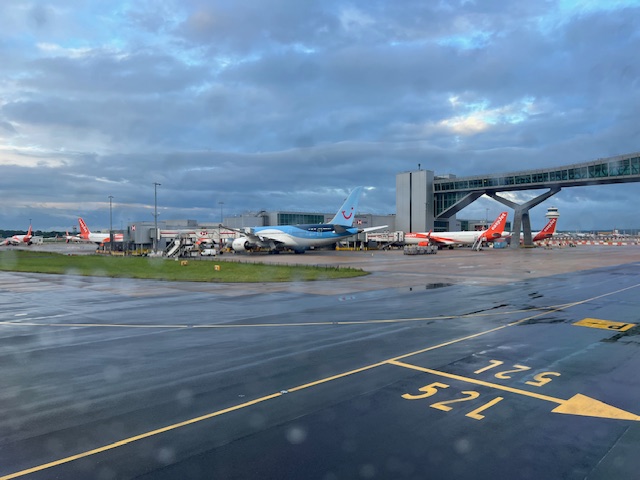
Celina gifted me a haircut with Simon Webster, a skilled hairdresser with a salon in the North Laines in Brighton. Such a pleasure to be pampered occasionally and Simon’s a lovely character. As you do, we chatted about this and that and he revealed something fascinating. Returning to the UK after a holiday in Portugal, he tried the ‘Face Recognition’ Passport machine at Gatwick Airport. It didn’t work and, after a second attempt, he reluctantly joined the queue to present his passport to a human. Simon asked the Border Force individual why his passport always failed using the Face Recognition software. The answer’s amazing:

Someone with the same name has a criminal record, so we will always do a physical check on your identity.”

 “But my face is my face! Surely those biometric details are unique to me?”

Apparently ‘the rules are the rules’.

In PC 134 I scribbled about a week in Sicily, the largest Mediterranean island. My memories of our time there are tainted by the experience of getting our Avis hire car when we first arrived, around 2000. Eventually finding the outside cabin that was their office, on opening the door we were confronted by some ten would-be renters like us. One agent was on duty; ‘take a number and wait’. We took an identity number, 69, and immediately did the maths; we were in for a wait of 90 minutes or more as currently they were dealing with ‘55’! Very fortunately a couple has taken two numbers and, having successfully hired their Fiat, gave us their spare – 60! Still, it was almost midnight when we arrived at our apartment south of Syracuse.

In Brazil they have a CPF (Cadastro de Pessoas Fisicas – Natural Persons Register) with its 11-digit number issued by the Brazilian Inland Revenue service. If you want to purchase anything more than your normal groceries, you have to present your CPF, making it pretty much essential for life in Brazil. Brazilians also must carry a traditional ID card, complete with a photograph and date of birth.

Richard 5th April 2024

Hove

http://www.postcardscribbles.co.uk

PS EU countries will not accept a passport issued more than ten years ago.

Note 1 “ID cards are the key to knowing who is in this country.” https://www.thetimes.co.uk/article/12144546-2b16-4e3f-9b85-08e66307aeb2?shareToken=48334f5b085167a7abc7487cd64b7113

Note 2 Spelt dean, but originally in old English ‘dene’, it’s a common name for a valley and frequently found as a compound to place names. To the east of Brighton are Rottingdean, Ovingdean, Saltdean and Woodingdean. Two of the city’s northern suburbs are called Coldean and Withdean.

Note 3 The UK Armed Forces refer to them as Identity Discs but ‘dog tags’, the American term, is almost universal.

Note 4 This was before the long, beautiful bridge that now spans the Oresund was built. 

PC 380 Left Right

I have always been reasonably observant and notice, among other things, those who write with their left hand and the differing ways in which they hold their pen. Writing of course may be a dying art and you may remember that some schools in Finland are experimenting with not teaching cursive script. Presumably this would mean that in future you would sign a document, say, with, er, a cross?! We are probably all becoming a little ambidextrous when it comes to more frequent use of a keyboard – exercising one’s digits and becoming able to enter data with either hand. Those of you who are left-handed when it comes to writing could tell me whether it makes any difference when you are using a keyboard?

Do you remember the successful 2011 film ‘One Day’ staring Anne Hathaway and Jim Sturgess? It was based on David Nicholls’ book which had come out a couple of years earlier. In February this year Netflix’s version was available, starring Ambika Mod, the actor who played the junior doctor in ‘This is Going to Hurt’, as Emma and Leo Woodall as Dex. Maybe I am being a bit nerdy here, but did you notice that both actors are left-handed?

As is one of the opticians in our local Boots, Emma.

I hope you don’t mind but I notice you’re left handed; I am always interested to see how individuals hold their pen.”

She explained one thing I hadn’t realised, that if you use a fountain pen or felt tip, it’s possible the fleshy edge of your hand gets dirty from contact with the ink ….. as its direction of travel is over the still-drying ink. She held up her hand by way of confirmation!

Do right-handed people always answer a telephone with their right hand and left- handed with their left? I continue to be amazed that so often you see someone, a right-handed person, on TV only capable of using the telephone, placed on the right of the desk, with their right ear. If they want to jot down something, they transfer the phone to their left ear, almost strangling themselves in the process!  It’s actually the same for a cordless mobile; it’s much easier if you get into the habit of putting the phone to your left ear in the first place. (See PC 228 Thinking Out Loud April 2021.)

Driving on the left hand side of the road is something almost exclusively done by past members of the British Empire and now of The Commonwealth; for example Cyprus, New Zealand and Australia. The Republic of Eire, Ireland, drives on the left, reflecting its past linkage to England. Nigeria, a member of the Commonwealth but surrounded by countries that had been French colonies which drove on the right, changed from left to right in 1972. There was a rumour that certain car registration numbers would change one weekend, and the balance the following weekend; it was just a wind-up! India drives on the left, but not Pakistan, another Commonwealth country, even though they have a land border. Mind you if you have ever driven in rural India, you will have experienced both those who drive on the left and those who drive on the same road, on the right; very disconcerting!

I wondered why soldiers take the first step in a march with their left foot. Apparently it started in ancient Egypt; it’s the side of the body that your heart’s on and therefore your first step is taken with what your heart symbolises: “The heart, like the sun, is the central source of life, the seat of power, of courage and strength.” To avoid confusion, this is not the same as ‘by the right … quick march.’ The ‘right’ in this case refers to the side which is keeping the line; it could be ‘by the centre’ or even ‘by the left’.

Dressing ‘by the right’

I googled why we have ended up with left wing and right wing as definitions in our politics. We have the French to thank. At a pivotal point in the French Revolution in 1789, National Assembly members were asked to divide; those supporting the ‘Ancien Régime’ to line up to the right of the president and those supporters of the revolution to his left. Most democracies have examples of left-leaning liberal and conservative right-wing ideologies. On the extreme right of the political spectrum is Fascism, an authoritarian, ultra-nationalistic political ideology characterised by dictatorial leadership and suppression of an opposition.

Our brains are essentially two semi-hemispheres. The left is associated with logic, analytical thinking and language processing; ‘left-brained’ people pay attention to details and are ruled by logic. The right is linked with creativity, intuition and holistic thinking. ‘Right-brained’ people tend to do well in careers that involve creative expression and free-thinking, such as becoming an artist, psychologist or writer. Recent research suggests however that, whilst the two hemispheres function differently, they work together and compliment each other. Bundles of nerve fibres tie the two together creating some form of information highway!  

The words ‘left’ and ‘right’ are translated in Portuguese as ‘esquerda’ and ‘direita’, in German as ‘links’ and ‘rechts’, in Spanish as ‘izquierdo’ and ‘derecho’, in Italian as ‘sinistra’ and ‘destra’ and in French as ‘gauche’ and ‘droite’. I love the way that ‘left’ in Italian sounds like ‘sinister’ in English and the unintended connection to left-wing politics. In French the word for ‘left’ has another meaning, one who’s clumsy and awkward. It could be that left-handed people might appear awkward trying to manager in a mostly right-handed world or perhaps because right-handed people appear awkward when trying to use their left hand. Anyway, it’s a nice word to describe someone who’s unsophisticated and socially awkward: “a shy and gauche teenager.”

In the western world we probably forget that traditionally Arabs eat and drink with their right hand, as it’s believed that the devil would eat with his left. If you are left handed, you need to learn to use your right for eating and for handshakes. And the left hand is exclusively used for wiping your ……

Right?

Richard 29th March 2024
Hove

http://www.postcardscribbles.co.uk

PC 379 Cataract

Those of us of a certain age will have heard of Arthur Conan Doyle’s fictional character Sherlock Holmes and his sidekick Dr Watson, who first appeared in his novel ‘A Study in Scarlet’ in 1887. He went on to write four books and 56 short stories about the two crime fighters, with worldwide success. Tourists still come to London to visit 221b Baker Street, the site of the office where they worked and now the sight of The Sherlock Holmes Museum. I am not sure I ever read any of the books but by a process of osmosis know that the series ended with Sherlock Holmes’ death near, I think, near some cataract in, er, Switzerland? Google provided me with confirmation, which I paraphrase:  

“Sherlock Holmes’ constant foe is a Professor Moriarty, a successful criminal mastermind. In the final drama, Holmes, ignoring the fact that Moriarty has vowed to kill him, delivers appropriate evidence to the police, so Moriarty and those who operate his network will face justice in a few days. Holmes flees to Switzerland and Watson joins him. Moriarty follows and confronts Holmes at the top of a cataract known as the Reichenbach Falls. After some vicious hand-to-hand combat occurring at the cliff edge near the waterfall, both men fall to their deaths.

“Cataract n. 1. Waterfall, especially large precipitous fall or series of falls. 2. Progressive opacity of lens of eye which impairs one’s vision and, if left untreated, leads to blindness.” Note 1

The highest waterfall in the world is the Angel Falls in Venezuela, the fall a staggering 979 metres.

In 2015 Celina and I were lucky enough to visit Las Cataratas del Iguazú on the borders of Brazil and Argentina, staying on the appropriately named Belmond Hotel da Cataratas (see PC 51 Foz!)

You may remember the joke that went around the school playground:

The biology teacher asked her class: “Which organ of the human body increases tenfold when stimulated?” One rather prudish girl in the front row, Mary, said: “Miss, you shouldn’t be asking a question like that. I am going to tell my parents and you’ll be in trouble.” Ignoring her, she asked the question again and Billy at the back said: “It’s the pupil of the eye, Miss.” Turning to Mary, the teacher said: “As for you, young lady, I have three things to say. One, you obviously have a dirty mind; two, you didn’t do the set homework and three, one day you are going to be very disappointed.”

My step-grandfather Tommy Tizzard was a well-respected ophthalmic surgeon in Bath and had his consulting room on the ground floor of Number 15, The Royal Crescent. It was off-limits to a seven-year-old but a quick peep revealed cabinets full of optical equipment and trays of lenses. I have to assume in amongst his other skills was the removal of a cataract, as the modern cataract procedures were first pioneered in 1747 by Frenchman Jacques Daviel.  

Old people start talking about cataracts. “I’m having my cataracts done.” In much the same way they say: “I’m having my hips replaced.”, but until you’re in need yourself, it’s just something old people do! I hope to demystify the process, although accept that for some sensitive people anything to do with operating on one’s eye is too much information.

I had been short sighted for ever and worn contact lenses since 1969 when I wanted to sail and be able to see – salt water on glasses is a complete no-no. Aware that I had growing cataracts, the situation came to a head in October last year when the local optician said he couldn’t prescribe glasses until my cataracts has been removed.

I couldn’t better this little series of diagrams of what happens:

The Optegra Eye Hospital in Brighton is taking NHS patients to reduce the current 5 months NHS backlog so, after the appropriate checks, I had my first operated on before Christmas. Very straight forward, lots of anaesthetic drops in the eye, onto the operating chair, stare at a very white light and five minutes later done. Here in the UK there’s a standard 8 weeks between the first and the second eye operations but I know in Turkey, for instance, if you go private, they will do both eyes at the same time.

After the cloudy lens had been removed and a clear one inserted, the outer surface seals together very quickly but for 12 hours or so the eyelid’s interaction with its microscopic bumpy surface is discomforting. It was only after I’d had the second one done I realised how my balance had been affected by effectively being only one-eyed for eight weeks!

There’s a certain conveyor-belt feel about the clinic, inevitable I guess as there’s a repetitive nature to what they do, but each person is treated with great care and attention and nothing seemed too much trouble. Given that they deal almost exclusively with the elderly, I am sure at times their patience is tested, but to their great credit it doesn’t show.

Cataracts also interfere with the way you interpret colour. Everything might start to look like an old Polaroid or one of those sepia-tinted photos. This happens because the deteriorating proteins in your lenses can become yellowed or brown-ish. The difference ante and post operation was absolutely stunning! What happened three hundred years ago when one’s eyes developed cataracts? I guess you slowly went blind; how blessed we are with these commonplace operations.

I wrote to Optegra after my second operation:

“Thank you for my new vision, thank you for your professionalism and thank you for changing the outlook of those fortunate to be your patients.”

And to end on a note of amusement, when Holmes and Watson were on a camping trip, Holmes woke Watson in their tent in the middle of the night and asked him to look up and tell him what he saw.

I see millions of stars, Holmes.”

“And what do you conclude from that, Watson?”

Watson talked for a few minutes about the universe, distant galaxies and how God is all-powerful. He then asked Holmes what it told him.

Watson, you idiot! Someone has stolen our tent!”

Richard 22nd March 2024

Hove

www.postcardscribbles.co.uk

Note 1 Cataracts on the surface of the eye’s lens cause increasingly fuzzy and cloudy vision, like looking through a tumbling waterfall.

PC 378 Josh is Back in The Hope

I thought I should catch up with Josh while his experiences of his time in Israel are still fresh in his mind. Mind you, given the fact he was wounded, I suspect they will forever be just below the surface of his memory. He and Libby are behind the counter and Libby’s happy to let him come and chat so, grabbing a couple of coffees, we find a secluded corner table.

“It’s good to see you back, Josh, relatively in one piece! I hadn’t imagined you would have travelled to Israel in November until Duncan told me. Why did you go? You know we had a candle on the counter while you were away?”

“Yah! Luke told me. You know I’d never thought about my Ukrainian grandparents much, not interested in where they had come from – well, not until they had both died and then I rued the day I hadn’t spoken to them more. I had no idea about their lives in Lyviv and why they fled to Britain. You’re old enough to remember the 1988 hit The Living Years aren’t you?”

“Absolutely. No idea who sang it …..”

“Mike & the Mechanics ….”

“Ah! Yes! But you’re thinking about those poignant lines ‘it’s too late when we die’ to regret not asking the questions, although the song was more about a relationship with one’s father!”

“Exactly! Well, I felt I had to do something after the horrific Hamas assault on kibbutz in October, me and many other members of the Jewish diaspora. After some very difficult conversations with Luke, I reported to the London embassy in early November and before I knew it, I was in Israel, in uniform and in the midst of some extremely intensive training, mostly about weapon handling and survival. I don’t think they intended to use those of us who had absolutely no military experience anywhere but in static observation posts!!”

“You were up on the border with Lebanon?”

“Yes – not that the Lebanese have any say in what happens there; completed dominated by Iran’s proxy Hezbollah.”

“I was within a month of being commissioned at The Royal Military Academy when Israel launched its assault on Egypt, Jordan and Syria in what’s now called The Six Day War (5-10 June 1967). That’s when they annexed The Golan Heights in the north.” Note 1

“I never knew Richard you were in the Army. How long did you serve?”

“Almost twenty years! I left before you were born! Actually in my company at Sandhurst we had a chap called Tim Daghestani who was from Jordan. I remember how badly he took that conflict!”

“You would, wouldn’t you! They say, whoever ‘they’ are, that warfare used to be 90% boredom and 10% action but up there looking out over southern Lebanon it was full on. Drones have totally altered the battlefield and we had to be alert all day and all night; no respite!”

“So how long had you been up on the border before you got injured?”

“About six weeks. Fucking drone flew overhead and dropped some grenades. It was raining, dark and windy and no one saw it until it was too late. Israel has, for its entire existence, coped with minor conflicts so the process of recovery, rehabilitation and repatriation was a well-oiled machine.” 

“Now you’re back, do you think you made the right decision, to go?”

“Oh! God! It’s so complicated ….. this heart and head thing! Obviously Hamas decided that enough was enough, that their often reiterated raison d’être was the destruction of the Jewish State, and that the time was right. Did anyone in their leadership think what the response to their murder, rape, torture and kidnapping operation might be? (Ed It sounded as though Josh was talking ‘bold’.) I assume they couldn’t care; bit like Stalin, ‘one death is a tragedy, a million deaths a statistic.’ And no one can be anything but aghast at what is happening to the Palestinian people, with no end to their suffering.

So, yes! I am pleased I went, pleased I came back in one piece, pleased to identify as a Jew, but saddened how many innocent people die or are simply displaced in conflicts, whether it’s this one, or in Syria or Ukraine with whole cities flattened, with the Rohingya and Uyghur genocides, not to mention the Sudanese conflict. I came back on 1st February and am having a few counselling sessions to make sure I put the experiences in context.”

“Well done you, Josh! I was going to say you can tell your children about it but I have no idea whether you and Luke want children?”

“A conversation for another time maybe?”

 “Before you go back to help Libby, you might like to hear this, extracted from the obituary of a civilian doctor who had gone to help out during our military operations in Afghanistan:  

“As someone who had gone on peace marches, I thought soldiers were stupid and unreasoning. After my ‘vicars and tarts course’, a six weeks’ intensive training at Sandhurst for professional recruits such as doctors, lawyers and dentists (Ed: Dr Chris Bulstrode was the oldest ever Officer Cadet at 56) I was posted to Afghanistan. After six months working as a front-line doctor in Camp Bastion, I changed my view. I liked and admired many of the men and women I met. They were a team of hugely loyal, talented, committed individuals who were passionate about their jobs. There are plenty of things I don’t like about the army, like the staggering weight of full-combat gear and the gut-challenging responsibility of going out on patrol, but I did savour the absolute simplicity of the life.” (Dr Chris Bulstrode CBE surgeon 1951 – 2023)

“That’s exactly it! Spot on! Hey! Must go! Thanks for listening.”

While Josh returned to his barista duties, I looked around this delightful café, so pleased to be part of its vibe. Must catch up with Mo on my next visit.

Richard 15th March 2024

Hove

http://www.postcardscribbles.co.uk

Note 1 Possibly the shortest ‘war’ was the military conflict between the United Kingdom and the Sultanate of Zanzibar in August 1896. It lasted about 45 minutes and if you don’t know its details, it’s worth finding out.

PC 377 Societal challenges

I imagine sociologists are having a field day observing how we are developing, or not! That is, is society worse now than twenty years ago, one hundred and twenty years ago, before the pandemic? Both individuals and groups are interacting with each other in different ways. Rather than drift inexorably towards one another, with more shared than oppositional views, for the greater good of mankind, it seems we are moving apart in some form of macro polarisation.

Two observations illustrate this at the micro level.

Just before Christmas Celina and I, after our morning yoga session, were waiting for the No 6 bus in Churchill Square to take us home. The square is a magnet for shoppers, with M&S on one side and the huge shopping centre, recently bought by Ikea, on the other. Given the time of year, the bus was pretty full when we got on, trying not to let our wet yoga mats get in the way, but there were a few spaces. Normally I leave the seats reserved for the elderly or those unable to stand and we found a couple behind such a row, which was already occupied.

Then an oldish bald chap got on, wearing a gilet and shorts, as you do in winter, presumably wanting to make a statement, looked around for a seat and said to the two people in front of us “These are reserved for the old ….. move!” Quite shocked by the tone of his voice, the two women got up and started to move to the back, one of them telling the chap she was pregnant. No recognition, no empathy, no: “Oh! I’m so sorry! Please! Stay there.” The whole situation highlighted the difficulties we have in recognising invisible disabilities or early-stage pregnancy.

The bus moved off, everyone settled, until Mr ‘Couldn’t Give a Monkey about Others’ noticed a chap staring at him, presumably wondering why someone could be so rude. Well, that started 5 minutes of “What the f**k are you looking at?” “You got a problem?” ……. and without getting any response repeated himself, glaring at those around him, confronting their non-responsiveness. Other passengers were shocked but these days there’s a reluctance to challenge rudeness for fear of exacerbating the situation. Fortunately, he got off at the next stop and the bus’s passengers, heaving an audible collective sigh of relief, started chatting to those next to them. (Note 1)

Everyone accepts that for well-referenced reasons we are in a ‘cost of living’ crisis. You could blame Putin for his invasion of another sovereign country and its effect on energy costs, a general increase in labour and raw material prices globally or countries wanting to implement better environmental policies which are often more costly, but its effect, particularly for those struggling at the bottom of the societal heap, is profound. And when your back is against the wall, desperate times call for desperate measures. Not able to afford the basics, you might go to your local Food Bank whose number here has seen an exponential rise, or you might be tempted in the supermarket to pop some bacon or a loaf of bread into your bag with the intention of not paying at the checkout. I read somewhere that some people, presumably not shop owners, think it’s acceptable and that’s extremely worrying.

An individual on their own does not constitute a society; you need at least one other, with whom you agree certain acceptable behaviours. If you can’t agree it’s back to the law of the jungle. Over generations we like to think the basics are right but introduce new laws to cope with changing values; we think we become more civilised in the process. But I also understand that within a country’s borders there may be many different societies who don’t sign up to the majority view. A recent documentary focused on petty criminals and their love of Rolex watches – other people’s that is. Asked whether they thought it morally wrong to steal, often in a violent manner, the response was: “I don’t do morals.” (Note 2)

The other day I was in George Street, in Bert’s, a store that provides the solution to the question: “God! I have to buy something for my best friend/brother/work colleague/sister/friend’s baby/an anniversary/to take to a supper party etc.” The range runs from cuddly toys, greeting cards and mugs, through every conceivable cooking gadget known to women and men to plates, bowls and paper napkins looking like £20 notes. Lots of items, none of which cost a fortune, which could convey whatever message they need to: “Congratulations/thank you/you need this/love you/the mug caption made me smile and think of you etc.”

Clutching a couple of cards in one hand, I made my way around the central shelving unit to see whether anything else caught my eye, before arriving back near the cash desk, staffed by Bridget, just in time to hear someone kick off.

“Wot! You fink like I didn’t pay for this? How dare you!” shouted a woman wrapped fashionably in a parka with fake fur lining.

“Like you fink my money’s not as good as like these other customers ….

“Madam! I am sorry! I must have made a mistake (Ed: You could tell from her eyes she was thinking: ‘No! I haven’t’). I am sorry if I’ve offended you.”

“Trouble with you lot, with your toffee-nosed attitude, like you looks at me and fink I might put something in my pocket like without paying. Shame on you ….. and your grovelling attempts at an apology? F**k you!”

…… and, turning to the rest of us who, rather saddened at this display of ‘you said/she said/you said’ and feeling particularly sorry for the cashier, were looking on without making eye contact, shouted:

“And you lot! You’re like so judgemental! You go f**k yourselves too!” Off she strode, out into pedestrianised George Street, shouting to those who would listen ‘Don’t shop in Berts! Don’t want my money! Fuckers!’

Maybe she was a relative of Mr ‘Couldn’t Give a Monkey About Others’?

Richard 8th March 2024

Hove

http://www.postcardscribbles.co.uk

Note 1 Of course I have no idea why this chap behaved the way he did; the imagination runs riot. Maybe it was as simple as getting out of bed the wrong side?

Note 2 It could be an examination question: “I don’t do morals. Discuss.”

PC 376 That’s it – Medical MOT Complete!

If you read PC 366 ‘Medical Decluttering’ (December 2023) you will remember that, following enough time to describe a number of health issues with Celina’s private doctor, Simon Glew at The Hove Practice, I embarked on a few procedures to declutter and get a medical MOT for the year ahead. It started with the removal of a malignant melanoma before Christmas and then removal of big haemorrhoids in January. (See PC 373 Anally Focused February 2024)

In the UK there is an annual vehicle check by the Ministry of Transport (MOT) on its roadworthiness after the first three years. It looks at things like tyre tread, brake pads, steering etc and costs about £40. It seems appropriate to call this postcard a Medical MOT, as I have sold my six-year-old Audi Q3 to replenish the coffers. The car was due its MOT, insurance and Road Tax and was broadly costing me £3,000 per year – for 1350 miles!

I had a lipoma. “Lipomas are tumours which develop as well-circumscribed, encapsulated masses that have a doughy feel and are freely mobile beneath the skin. ….. Their slow, usually painless growth can lead to a large size. (Mine had grown over 7 years!) ….. Previous studies have defined a giant lipoma of the upper extremity as larger than 5cms; these are extremely rare and must be removed.” … say MDs Brian Allen, Christine Rader and Alan Babigian in a paper in the magazine Pulsus Plastic Surgery.

Most lipoma is unsightly although benign but mine was about 10cms long so I was referred to a consultant in the Montefiore Hospital here in Hove. I am no stranger to this private hospital as I had had a L4/L5 microdiscectomy on my back here in July 2017, (see PC 99 Montefiore June 2017) after my failure to get the NHS to do anything more than prescribe Gabapentin, a horrific painkiller!

Just to confirm my lump was a lipoma, Joideep Phadnis, the Orthopaedic Consultant who specialises in Shoulder and Elbow Surgery, whom I saw before Christmas, said I should have a MRI to ‘confirm the lesion is benign before removal’. Meanwhile, given his busy timetable, I was provisionally booked in for surgery on 21st February 2024 – nine days ago.  

My MRI Scan. Not sure what the pike-looking shape is?

Gradually the day dawns and, following the appropriate pre-admission checks, I am into the hospital at 1230 for afternoon surgery. Sitting in my room, dressed for the occasion complete with DVT socks and backless gown, I begin to wonder whether ‘afternoon’ would become early evening! Fortunately I have brought my Kindle, so immerse myself in Chris Hammer’s latest Australian novel. Strangely, Ivan, the Homicide Detective Sergeant investigating a murder, is remembering his mentor – Morris Montifiore!

Eventually I am summoned, walked along the deserted hospital corridor and arrive at the theatre. Normal sort of chat …… ‘just feel a small prick and breathe the oxygen in ….. and out ……’ and then I am back in my room!

After the shift change at 2000, I get given some painkillers and told not to get the wound wet for a fortnight ….. and I can go. Celina arrives at the main entrance which is now closed but she spies the cleaners going in round the back and makes her way up to my room. There’s something weird about empty hospital corridors at night; I sense we are not alone!

Back home at 2130

The following morning I look at the Limbo, a ‘waterproof protection for casts and dressings’, that I was given to enable me to have a shower.

I stick my arm in but the Limbo’s too short, the elasticated ring below my wound. I cut off the bottom end so my hand can come out, but my wound is too high for the ring to get around it. Useless!! Nice idea but in this instance useless!

When I was involved in sales and giving presentations to prospective clients, one well-proven method of getting rid of nervous negative thoughts was to snap a rubber band against one’s wrist. It hurt; the ‘negative thought’ was no longer the focus! Walk to the bathroom in the night and bang your foot, the natural reaction is to bend down to rub it. As you bend, if you bang your head, your head hurts – toe? Nah! So it is with another operation within a month of the first, any residual pain from the first disappears. Which is a delight! But actually there is very little pain after the second so I haven’t taken any painkillers.

Our NHS struggles. It does brilliantly with emergencies but waiting lists for elective appointments and operations grow longer and longer. We are starting to hear of isolated trials in ways to improve the way the NHS serves the nation. Too many individuals who dial 999 are generally picked up by an ambulance and taken to a hugely overstretched A&E department. There was news the other evening of a trial in Kent where representatives from over six NHS specialities, A&E, Social Services, GP, Critical Specialist Nurses etc all sat in a Call Centre, discussed the 999 call details and offered alternatives to putting the individual in an ambulance. Thinking outside the box, at last!

I had my second cataract removed yesterday at the Optegra Eye Hospital in Brighton. Now I have 20/20 vision in both eyes and popped into Tesco’s to buy some reading glasses; in a few weeks I might select a ‘designer’ pair.

Healing nicely

MOT complete; all I have to do now is encourage my intestines, ravaged by two lots of heavy anaesthetics within a month, to return to some form of equilibrium. Maybe I should eat a raw leek as it’s St David’s Day?

Richard 1st March 2024 – St David’s Day

Hove

www.postcardscribbles.co.uk

PS Two medical stories appeared in the news a few weeks ago. In the first, a biochemist who worked for the NHS won a discrimination claim after she was listed on a London hospital spread sheet under the name ‘Paininarse’. Funny to read but insensitive and traumatic if it described you.

PC 375 Hope and a Hot Topic

I like Lisa, Sami’s partner, a lot and I have watched their relationship develop into something secure and exciting since they first met on a tour of the sites of the 1857 Indian Mutiny in November 2022 (see PC 309). Lisa herself suffered in a horrid coercive relationship and it’s worth reading PC 335 ‘Lisa Wallace – My Story’ (May 2022) if you haven’t (?), so I know she’s taking one day at a time. She’s alone in The Hope Café on Wednesday afternoon when I drop in and, seeing me, lifts an arm to suggest I should join her; so, coffee in hand, I do just that.

“Hi! Lisa. Good to see you! You on your own this afternoon? No Sami?”

“Sami had to go to the dental hygienist. He used to smoke and drinks too much coffee so it’s important he has regular check-ups; gum disease is preventable … so I am told.”

“Where does he go?”

“The Hove Dental Practice in Salisbury Road; we both go there. The hygienist Jenny is absolutely brilliant and you’d hardly know she’s inspected, checked, cleaned and polished. Has the touch of an angel!”

“Ah! Yes! Celina and I both started going there when the BUPA practice in New Church Road was slow in opening after Covid. It’s delightfully international, isn’t it, with Jenny who’s Scottish and Greek dentists Rachil and Dimitri! How’s life here in Hove?”

“Very different from The Peak District but the constant sea air is so invigorating. Listen, The Argos have asked me to write something about the current railway strikes, how bad they are for the local economy and how can we the public persuade the union to settle the dispute. Any ideas?”

“There are always two aspects; pay and conditions of employment. We know about pay because that affects us all, but if I understand some of the issues about their working conditions correctly, I want to either laugh or cry.”

“Not sure I understand.”

“Take technology. I assume a train driver has to have a good grasp of technology so you would think they would embrace anything that makes their job easier. The leaders of their union, in this case ASLEF (The Associated Society of Locomotive Engineers and Fireman) don’t, seeing it as a threat to their employment.”

“Well, if we have trains, we need drivers! I read that ASLEF has some 21,000 members earning approximately £65,000 per year, for a four-day week. Sounds good to me!”

“OK! So, laugh or cry? A rule introduced in 1980, 44 years ago, allows drivers to take paid time off work to have a six-monthly check up on the harmful effects from the microwave that they use to heat their meals. I have to assume they do not have a microwave in their domestic kitchen, like 99% of the population.”

Lisa is laughing!

“Your nieces and nephews have iPads or some other similar device?”

Of course, although I think my sister has strict rules about their use.”

“Clearly ASLEF members’ families don’t and the union wants an extra technology allowance agreed before their employer can introduce some iPads, which would be used, for instance, to notify them of temporary speed limits. Would make their job easier. Actually no laughing matter; pathetic! Next I imagine they will want to bring back the chap with the red flag to walk the track in front of the train!”

“I read that one train had to terminate one station before its proper destination because the driver hadn’t had lunch.”

“Sorry?”

“Apparently, he forgot his tin opener so couldn’t open his can of soup! A manager offered him a sandwich but he wanted his soup; a train load of passengers had to disembark one station from where they had planned. Ridiculous – and probably badly handled by ‘management’?”

“God! Help Us! We’re extremely lucky that the Victorians developed a passion for building railways but sad that some of our unions’ attitude seems stuck in that Victorian era. You have enough to write your article now?”

Yup! I have already researched union resistance to the use of drones for track inspections and restrictions on engineering teams and their composition. So yes, should be able to get it to the Features Editor by Monday.”   

“What do you think about Duncan’s idea of developing next door as a bookshop?”

“Sami mentioned it to me. Once up and running I am sure it would make money and increase turnover in here; personally I would be wary of having so much debt, but I am not Duncan! You read The Times, don’t you? Did you see Matt Rudd’s column about an experiment devised by two psychologists? Half the participants had to engage in lively conversation with the café barista from whom they had ordered their coffee, the other half had to simply get through the process. The chatty half reported a sense of belonging and an improved mood as a result of the interaction. The miserable monosyllabic half did not. No one asked how the barista felt!”

“Wouldn’t happen here! The flow of conversation across the counter’s wonderful and I watch our baristas Kate and Susie really engage, with enthusiasm and a smile. I must show Duncan my latest triptych, those beach huts over there painted from the sea side.”

“Have you got a photograph?”

“Yes” I said and opened my iPad and my ‘Art’ album in ‘photos’. Here”

“That’s great Richard; very gifted. Duncan will want another! I saw Luke and Josh the other day and Josh starts back here at the beginning of March.”

“Excellent! Before I go, I must tell you …… I was in Rahmi’s the other morning just before 8 o’clock buying a magazine and some milk. A chap came in, walked down the aisle to the alcohol section and, grasping a few bottles of beer as if they were nectar, joined me in the queue to pay. Somewhat ironic as next door the local Alcoholic Anonymous group had just finished their breakfast meeting. Maybe others would come in to buy some essentials?”

“Ha! Ha! That’s lovely. I’m off too, Richard; I’m meeting Sami in Semola for a spot of lunch. See you next time; take care!”

          Wishing each other a fun rest-of-the-day, we nodded to Susie and went out into a misty late morning Hove.

Richard 23rd February 2024

Hove

http://www.postcardscribbles.co.uk

PC 374 What’s in a Name?

One afternoon over the Christmas/New Year period I watched the 1964 film Zulu starring inter alia Michael Caine and Stanley Baker. It wasn’t the first time I’ve watched it and it probably won’t be the last, but I was reminded how soldiers with the same surnames, like Williams or Jones, were referred to in the 24th Regiment of Foot, a regiment recruited exclusively from Wales. (See my postscript below)

Got me thinking and, delving into my ‘Notes for future PCs’ folder, I pulled out some examples of serendipity. For instance, on the fifth of November, Guy Fawkes Night, we have expend an enormous amount of money igniting fireworks, to remember the ‘Gunpowder Plot’ of 1605. Guy Fawkes and fellow Catholic conspirators attempted to blow up Parliament and assassinate King James. They were betrayed and the barrels of gunpowder in the Parliamentary cellars made safe, presumably by an EXPO (Note 1). Sadly for Guy and the others, they were executed. That evening last year I was watching the early BBC News & Weather and the weather presenter was, appropriately enough, Chris Fawkes. My daughter says Chris lives in the same village and is really nice!

Screenshot

There are apparently some 45, 000 different English surnames (Note 2) and their origins can be grouped into seven subsets:

Firstly, patronymic names reflect the male line; names such as Davidson or Richardson, just like adding -sen in Scandinavia. The alternatives are matronymic ones following the female line, such as Madison, from Maud, and Marriott, from Mary. We are surrounded by occupational surnames such as Carpenter, Knight, Taylor and Fisher; others, such as Cartwright, someone who fashioned wooden wheels for carriages and carts, reach back in history.

One rather interesting set are those fashioned by the characteristics of the person, their appearance for instance giving us White, Black or Grey. If your family lived near some recognisable geographical feature, it might be you’re called Hill, Moor, Lake or Wood, or connecting you with a physical town or county like Essex or Hampshire. One small set’s surnames reflect the land they owned and another the fact that they worked for a certain family, for example ‘Kilpatrick’, someone who worked for the Patrick family.

Notorious errors were created when the person entering the details of a baptism was literate enough to write but when hearing a surname like Smith for example, didn’t know whether it was Smith, Smyth, Smithe or Smythe. They all vaguely sounded the same and, not wanting to show personal uncertainty, wrote it how they thought it should be spelt!

I worked with an Antony Cook, undertook my officer training with David Miller, known to everyone as Dusty, and my bestest friend is called Stewart Baker, who may or may not love bread? I saw an artisan baker’s van the other day; the company was called Coburn & Baker – seemed very appropriate.

Lovely to have our weather forecasters with names like Amy Freeze, the BBC’s Sara Blizzard and Greg Dewhurst; nothing like the dew of an early summer’s morning, glistening on the grass and inviting a bare-foot walk.

The medical professions have their share of appropriate-sounding surnames, such as a clinical neurologist Lord Brain or an ophthalmologist Ashley Seawright; Joshua Butt would have to work in gastroenterology wouldn’t he (?)  and a Trauma Team was led by Dr Michaela Blood. In ‘All The living and the Dead – a personal investigation into the Death Trade’ – Hayley Campbell recalls a master embalmer working in the mortuary in Margate, Kent called Dr Gore. A Professor of Viruses at the University of Kent is called David Strain and my dentist in Bath in the 1950/60s was a Mr Sharp; memories of needles and chain-driven drills!

The other day on Facebook a chap was looking for recommendations for a local electrician. His surname? ‘Cable.’; felt he could have done it himself! And some months ago on a news item, an investigative journalist was commenting on the country’s ‘Open Door Policy on Immigration’ – seems appropriate she was called Ms Knocker.

More research on Google finds a firefighter in the USA called Leo McBurney, a lawyer called Sue H Yoo, a cashier named Ka Ching, a music teacher called Ms C Sharp and a librarian whose name is perfect – Wilbur Bookendorf. One of Edinburgh’s top restaurants is run by chef Tom Kitchin and a lecturer in weight loss from University College London doesn’t need to say anything, as his name is Dr Mike Loosemore.  

Singer Olly Murs was the subject of “A Life in The Day” in The Sunday Times and told us readers his girlfriend Amelia is a competitive bodybuilder. Her surname? Tank. Sort of goes with her passion! Again in that paper, a letter  caught my eye; the writer commented that the title of the Style Section’s Barometer column, which identifies products or trends that are getting ‘hotter or colder’, was a misnomer. He asserted it should correctly be called Thermometer. His name? Roy Muddle!

Here in the United Kingdom the Member of Parliament for Tamworth was suspended after accusations of groping and bottom-pinching were found to be true. His name? Chris Pincher. A ‘Dementia Research & Support Centre’ is run by a Professor Crutch and why wouldn’t Wake & Paine and Grieve & Son be two companies of undertakers? My parents’ cleaner in Balcombe was a Dolly Bacon and judging by her size she enjoyed rashers enormously. And what about Katherine Gill, narrating a news story about the huge resurgence in the global number of Blue Whales, showing these huge creatures surfacing, blowing, and submerging. Finally I could mention an Andrew Drinkwater at our Water Research Centre, two winners in an international tree climbing championship Josephine Hedger and Scott Forrest, and from my service days, Major Major.

So did my wife’s surname, Burn, originate from a geographical location, a stream for instance or, was it something altogether more firey?

Richard 16th February 2024

Hove

www.postcardscribbles.co.uk

PC Seemed appropriate to visit my local Audi garage yesterday and meet Jacob Gwilliam. I suspect in some long-ago baptism the Recorder asked for the surname and was given the ‘family name’ initial G and William as the surname, hence Gwilliam.

Note 1 Explosives Police Officer. In the British Army known as Felix

Note 2 This postcard is purely focused on English surnames, for I have no knowledge of other nations’ name characteristics, especially those of Arabic, Chinese etc origins!

PC 373 Anally Focused

If you were never really aware of the importance of your anus, you just had to be the object of a drill sergeant’s sense of humour for that to be rectified! Sorry, couldn’t resist the little play on words here! Staff Sergeant Cameron, Scots Guards, was an imposing Drill Instructor at The Royal Military Academy Sandhurst in 1965. You can see him with his Pace Stick under his left arm at the rear of Burma Company Intake 39 during a drill competition and, yes, that’s me in front of him!

Of the many phrases that were designed to shock and insult in equal measure, their object of course to improve our abilities on and off the Drill Square, was this:

Mr Yates! Sir! You are IDLE Sir! (Ed One imagined every word was followed by an exclamation mark.) What are you, Sir? Idle Sir! So, if you don’t get a move on and b’have, I’ll shove my pace stick where the sun don’t shine (Ed A reference to one’s anus!) and open it 30 inches! Do I make myself clear? … Sir!” (Note1) (Ed. But then there’s that expression: “The sun shines out of their arse!” Where the sun don’t shine???)

Some of my postcards that have received the most comments are ones concerning our habits of getting rid of bodily waste (PCs 47 Loo Paper (Aug 2015) and 54 The Loo (Nov 2015)), which is quite surprising as it’s not a subject for dinner parties, just that for lavatorial humour and historically smutty postcards.

We joke about our bottom! We call someone who cares too much about small details, about how things are organised, anally retentive. It apparently starts with poor parenting, shaming the child who becomes frightened of making a mess when pooing, obviously conscious they shouldn’t and tries to hold their faeces in. In adulthood they become anally fixated, meticulous, orderly, rigid and frugal! There’s the slang expression “Get one’s arse in gear” which means to start to do something seriously and quickly, but arse can also be used to describe a stupid person.

I often wonder why our creator, so wise and omnipotent, placed the entrance for procreation in the female body within a centimetre of the exit for our waste. Maybe designed by a committee?

One of my favourite songs is Rod Stewart’s “I don’t want to talk about, how you broke my heart ….” but I need to talk about it, my recent operation at the Nuffield Hospital in Brighton.

It was ‘day surgery’ so I had to be there at 0700 and was hardly awake when registering, but aware that the receptionist was commenting to a nurse about my hair. “Men can let their hair go naturally grey, but we find that a problem!” she said. I sort-of sleepily agree. ‘What’s your date of birth and postcode?’ is a question asked by any one of the number of people who come into my room to explain this, tell me that, give me an enema, take my order for lunch and they included the surgeon who has Tigger characteristics …… bounces in, asks some questions and bounces out.

Oh! By the way. This form sets out what we are doing today and you need to sign it here and here.” I might have commented that this is you and the hospital covering your arse, but it’s not an expression to use today.

The enema record is 10 minutes!” exclaims a nurse. Well, I am not one for breaking records and certainly not of this sort!

Why can’t the fashion industry design a full-proof hospital gown? I get that they are back-to-front but the little ties that would have closed the back were 10 cms long and no matter how I tried, they would not tie together. I am always envious of women’s ability to tie stuff behind their back, muscles used every day to connect their bra-straps. Feel a bit foolish, completely unable to gather some dignity but hey! ho! My assigned nurse, Denice, originally from Paraná State in the south of Brazil, has seen it all before so for the journey down to the operating theatre she puts another gown over my naked back! 

That trip is so odd; a male nurse pulls my trolley/bed, presumably in case I need to rest (?), and Denice and I follow. It’s so slow I am thinking ‘funeral procession’ and say to Denice, out loud: “Feels like a death march”. This produces a selection of responses from the various people up and down the corridor, from laughter to grim looks. Gallows humour?

This is not the first time I have undergone surgery so am relaxed as the anaesthetist mentions something about a canula and there’s a small prick and …… I am back in my hospital room.

Denice checks up on me: “You’ll need to pee and eat something before you are discharged.” Before the operation, I had liked the sound of ‘cold chicken on roasted vegetables’. Presented with some cold ratatouille under some dried chicken, I make an effort, sufficient to get discharged by 1530. Another long form, ‘sign here and here; just covering our arses’!

That night the peppers come back to haunt me!  

Since my return to the land of the living I have been trying somewhat unsuccessfully to cope with a continuing sensation of wanting to poo – all day. Too much information maybe, but I do take my hat off to those women who have given birth, as I am sure what I am experiencing is deemed normal postnatal. Celina and I discover one friend and one relative who have both had this operation. The length of recovery seems to be anything from 6 to 8 weeks and here’s me thinking a couple of weeks at most. I thought about writing a book entitled ‘Things the Consultants Don’t Tell You’ then decided I couldn’t be arsed.

Richard 9th February 2024

Hove

www.postcardscribbles.co.uk

Note 1 As an aspiring officer, an NCO was required to address me as ‘Sir’. They joked that when you called them ‘Staff’ you meant it, whereas when they called you ‘Sir’ they didn’t. Their pace stick was like a large pair of dividers; it could be opened so the ends were 30 inches apart, the regulation length of a marching pace.