PC 443 ‘ere in the ‘ope!
Almost a month has gone by since I was last in the Hope Café and it was good to be back in its familiar surroundings. As I was getting a double espresso I put a little card on the counter, with Josh’s permission of course! It read:
‘If you have a favourite quote about the ear, would you come across and tell me? Richard’
I have scribbled about teeth (see PCs 64 & 66 Molars and Wisdom March 2016) and eyes (see PC 94 Sight and Eyes April 2017) but not, surprisingly, about one’s ears. So why now, I sense you ask. After my food poisoning and virus infection, I managed to develop an inner ear problem which affected my balance big time.
The diagnosis is Benign Paroxysmal Positional Vertigo (BPPV – see note 1), which causes short periods of intense dizziness or vertigo when the head is moved in certain directions. It’s thought to be caused by tiny solid fragments in the inner ear labyrinth. Who knew?
So a quick revision. The ear:

The inner ear includes the cochlea, responsible for one’s hearing, and those ‘semi-circular canals’. These are small shell-like structures containing narrow fluid-filled channels called the labyrinth. They sit in the three planes, two horizontal and one vertical. Just like in a gyroscope, small movements send signals to the brain, essentially telling it which way is up!
“In your shell-like ear – having a quiet word with someone – but a poetic simile comparing the shape of the outside of an ear to that of a shell” Sami’s contribution
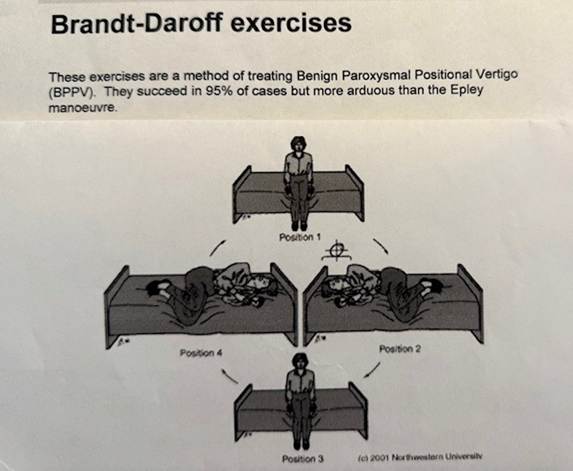
BPPV can be treated by a series of simple exercises devised by Brandt and Daroff. I assume these two are doctors specialising in the ear, but nowhere could I find out more details!
This is the first time I’ve had an ear problem, apart from the frequent removal of wax and temporary deafness caused by being near a loud noise. I spend twenty years in the Royal Artillery; being near a field gun firing a shell with a large charge can be instantaneously deafening. In my early years no one had ear-deafeners and the joke was we all had Gunner-ear (just say that out loud!).
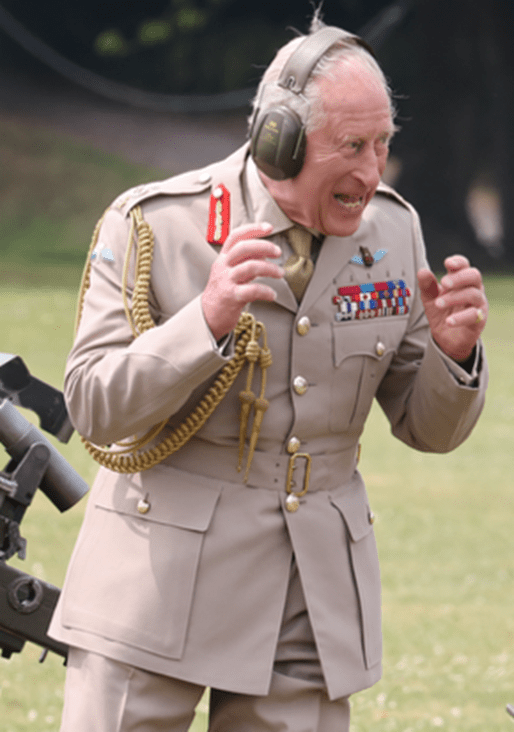
The King, who is Captain General of the Royal Artillery, having just fired a L118 Light Gun on a visit to RSA Larkhill. Wearing Ear Defenders of course! (Photo Times)
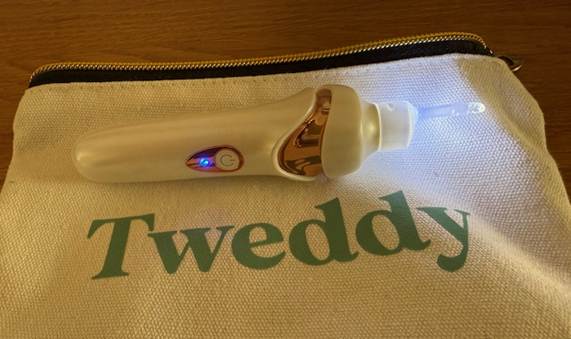
I know I shouldn’t, but I love using a cotton bud to keep my ears wax-free. There’s something very satisfying about carefully digging around and this reminds me of something else. In my military service it was vitally important to keep one’s weapon clean. Getting rid of explosive residue in its barrel required a ‘pull-through’; a cord with a weight at one end and a little slit at the other, into which you could thread a piece of ‘four by two’, a strip of cloth 4 inches by 2 inches. Drop the weighted end into the barrel, pull it through and hey presto the barrel was spotless. Sometimes I think it would be good to insert one into one’s ear and pull it through the mush inside; a sort-of brain cleaner! Or you could use this Chinese ear vacuum cleaner?
Kay our masseuse swears by the benefits of using an ear candle to get rid of wax. In for a penny, in for a pound; I tried it. She’s very good and some wax came out. But the general consensus amongst health professionals is that you don’t need to remove it at all, as it’s beneficial!
One of my yoga teachers, Carrie, said her father often massages his ears using the QiGong technique. The Chinese believe that the ear has Qi energy connections with the whole body. I have scant knowledge of Chinese medical traditions, although had a few sessions of acupuncture a decade ago. Apparently, the outside of the ear, its ridge, connects with the spine, the lobes the liver and heart, and the inner part with the kidneys and lungs. So go on, get massaging. I also read that a study in China found that those who wore dangly earrings lived longer than others. I must try and find a suitable pair.
Most of the sayings about ‘ears’ are to do with hearing. On cue, Lisa comes over and offers: “Friends, Romans and countrymen, lend me your ears. I come to bury Caeser not to praise him.” Everybody should recognise these first lines from Mark Antony’s speech in Shakespeare’s Julius Caeser.
The statistics tell me that one in three adults in the UK have some form of hearing loss, tinnitus or are deaf. In a recent TV drama, ‘Code of Silence’, one of the main characters was played by Rose Ayling-Ellis, deaf since birth and a user of British Sign Language. Good to see those with disabilities getting major roles.
Mo, who’s sitting at a table close by, leans over with a piece of paper: ‘The War of Jenkin’s Ear’. Ah! Yes, I know about this, fought by Great Britain and Spain between 1739 and 1748. Most of the fighting took place in the Caribbean. The name derives from Robert Jenkins, a British captain whose ear was allegedly severed in April 1731by Spanish coastguards searching his ship for contraband. It’s commemorated annually on the last Saturday in May at the Wormsloe Plantation in Savannah Georgia.
Duncan gives me three: “I’m all ears”, “In one ear, out the other” and “playing it by ear”.
Anna, who’s been listening, comes across in her wheelchair; “How about – ‘Walls have ears’? That was World War 2, but it’s not new! In 1645 a poet wrote: ‘For the halls of our masters have ears and hear, and the walls of the palace have eyes and watch.’”
And the free coffee goes to Robert, who came up with “‘ere in the ‘ope”! (Note 2). I loved his play on ‘ear’ and here!
Richard 13th June 2025
Hove
PS No mention of ‘cauliflower’ ears!
Note 1 Benign – not serious; Paroxysmal – symptoms come and go without warning; Positional – certain positions of the head trigger symptoms; Vertigo – you feel unsteady on your feet, a little like being at sea on a ship.
Note 2 ‘aitch-dropping’ is the deletion of the ‘voiceless glottal fricative’ (H-sound). It’s common in most English regions, but often seen as a sign of uneducated speech, due to its strong association with the lower class.
 postcards