PC 445 Nowhere Street? Somewhere surely?

As regular as clockwork, Monday to Friday, Celina and I take the bus from Hove to Churchill Square in Brighton. From there we walk across the square, down Cranbourne Street to West Street, across into Duke Street, right into Middle Street and down to the Yoga in the Lanes studio, behind the synagogue. The green line gives you an idea:
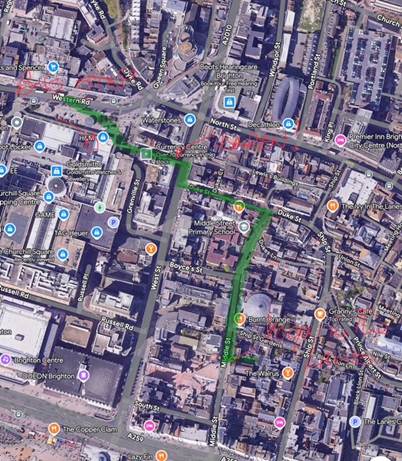
Cranbourne Street is a short street, no more than 70m long; I know as I measured it. Not with a tape measure or by some smart App on my iPhone, but with my calibrated pace! Joining the Royal Artillery involved undertaking the Young Officers’ Course run at the Royal School of Artillery at Larkhill, north of Salisbury, Wiltshire. We learned, inter alia, how to lay out a position for six field guns and measure the distance of each gun from the Command Post. We ‘calibrated’ our normal stride by counting how many steps one took to reach a measured 100m. One’s height matters; the shorter you are, it’s likely to be more than 100!

We are all guilty, I guess, of walking along streets from A to B without really taking in the streetscape so, prompted by seeing someone unique outside the Crowns pub, I thought I could scribble about Cranbourne Street.
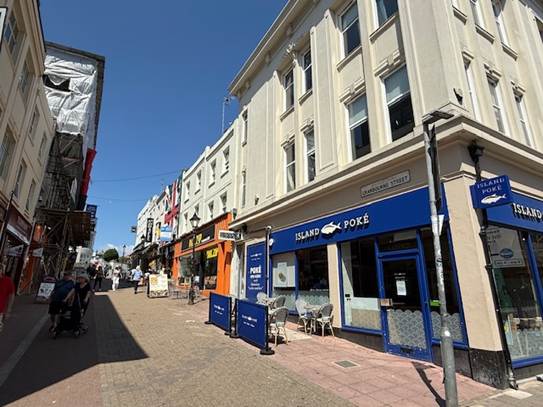
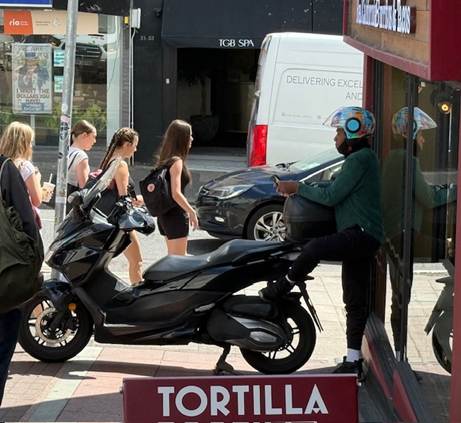
At the bottom end, at its junction with West Street (note 1), Deliveroo drivers congregate with their scooters, to chat about their day, share a cigarette or vape, await their next call to deliver a pizza to Mr Smith, some pasta to Mrs Jones or a full meal from The Ivy to Mr & Mr Brown. Most seem to be Brazilian and it amuses Celina to half-hear some of the conversations.
This street is a microcosm of Brighton, its somewhat incongruous mix of retail outlets and the people who visit them, walk down or struggle up the steep slope. The retail mix is incongruous because, amongst the fast-food outlets and two pubs, there’s Timpsons and Scribbler.
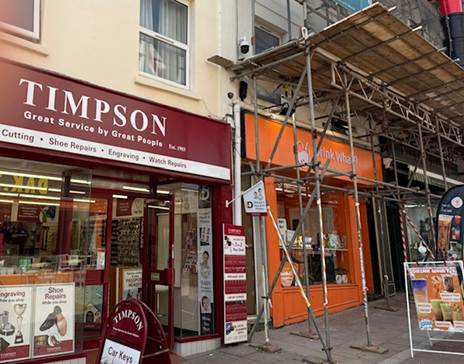
Timpson Group is a British and Irish service retailer with 2100 stores, covering dry cleaners (Johnsons), photo printing (Snappy Snaps), watch repairs (The Watch Lab) and shoe repair and key cutting (Timpsons). It was founded in 1865 by William Timpson and is still owned by his descendants. The ethos of their founder lives on today; for instance, a belief in giving people a second chance is reflected in their workforce, 12% of whom have a past criminal conviction.
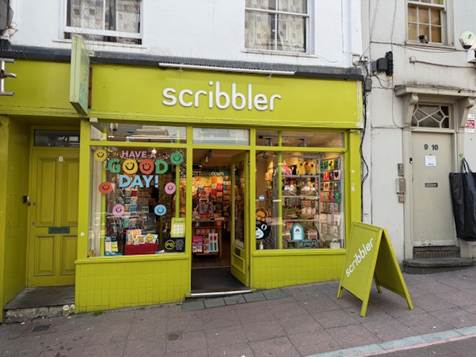
Scribbler sells stationery and wrapping paper but is best known locally for its vibrant and diverse selection of cards, praised for their humour and uniqueness. Apart from a traditional men’s barbers, a mobile/lap top repair shop and a currency exchange, the remainder of the shops feed the soul. ‘Real California Burritos & Tacos’ is opposite a taste from the Pacific, Island Poké, which sits next to Dak.Zip, a Korean Street Food offering. There’s a strange outlet called ‘Drink What?’ and I have no idea what it offers, but there’s no uncertainty in the Belgian Chips shop, with its large sacks of potatoes in the window!

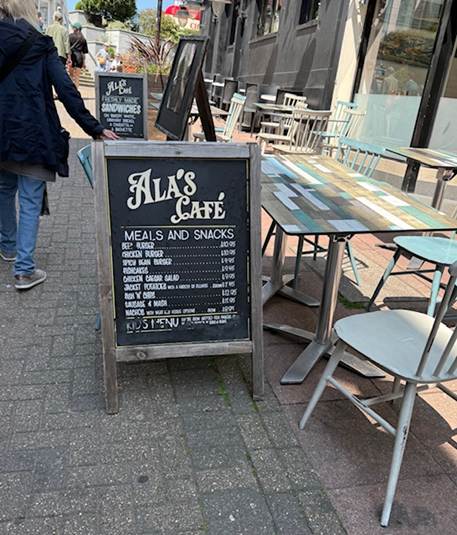
Ala’s himself shuffles out to the tables of his café, which offers everything from freshly cut sandwiches with various bread options to burgers, fish ‘n’ chips and Nachos.
Sadly, Cranbourne Street is no different from other inner-city streets, with their regular homeless individual, usually a male, sitting on a blanket or box on the pavement, hoping you’ll feel a couple of quid means more to him than you. We have got so used to Daren that we wonder, when he isn’t there, whether he is OK, being looked after; we have no way of knowing. Daren is in his late 50s so doesn’t qualify for the support offered by The Clock Tower Sanctuary, just around the corner and open for 18–25-year-olds; he has a tent ‘somewhere’.

Most of those we see on the streets have complex issues, some of course are heavily influenced by drugs or alcohol, but Daren is always sober, just homeless and suffering from Raynaud’s disease. This disorder affects the small blood vessels in the body’s extremities, which causes tingling, numbness, throbbing and pain. Daren’s feet and hands are often freezing ….  and he has Gall stones. We have passed him twice, every day, for over three years; we have given him gloves and thick socks in the winter; somehow he never manages to have them when he needs them. One of us would pass him some cash, particularly when it was wet, and when we returned almost three hours later he was still there.

Living in the city of Brighton & Hove we have got used to the wonderful inclusivity of our fellow inhabitants and little raises our collective eyebrows anymore. Initially when Celina’s mother would visit, you could tell she was somewhat shocked but now is used to the so many variations. However, the other morning l did a double take, my mind processing what I witnessed! Outside The Crowns pub, with awnings sheltering the outside tables from sun or rain, customers can sit, drink, smoke and watch the pedestrian traffic flowing up and down the street. “What is this life if, full of care, we have no time to stand and stare?” (Note 2)

It was about 1150 and I noticed a chap with greying hair and small, nicely trimmed beard, sallow complexion, with a jean’s material bolero jacket. As he leaned forward to take a sip of his beer, I noticed his very white T shirt and two perfectly formed largeish breasts, their nipples showing through the material. A double take, more like a triple take; I quickly got Celina’s attention, she turned and saw what I saw …… we sort-of shrugged and thought ‘It’s Brighton’ and walked on to catch our bus home. Later I thought of Kenny Everett. (Note 3)

Cranbourne Street – now somewhere!

Richard 27th June 2025

Hove

www.postcardscribbles.co.uk

Note 1 West Street runs north-south but was named as it was on the west side of the little town of Brighton, before the town expanded.

Note 2 WH Davies’ poem ‘Leisure’.

Note 3 Kenny Everett (1944 – 1995) was a radio and TV entertainer, known for his zany comedic style. He loved dressing up as a female with large breasts!

PC 444 More Observations and thoughts

My last scribble, PC 443, ‘ere in The ‘ope’, reached Ian, one of the school chums with whom I went to Greece in 1965. (See PC 346 Puds to Greece August 2023) Ian commented that his wife Julie suffers from BPPV but uses the Epley Manoeuvre to ‘pop the rocks back’; always good to know what works! Ian’s note reminded me of Ray, one of us six, who died in Toronto in March; otherwise we’re all still pumping blood!

Funny how often something you read or see brings back memories. The other weekend, in one of those colour magazines accompanying the newspaper – I buy a hard copy at the weekend but read the digital version during the week – there was a fascinating article about Caroline Scott who, with her husband James, had fostered many many children over ten years. Faced with some stark choices for the future of their last one, Scarlett, they decided to adopt her themselves.

Caroline’s own mother had spent a lot of her early life in a Liverpool orphanage, “enduring a regime so brutal that she couldn’t recall a moment of kindness.” It was the next memory that pulled me up short. “When she frequently wet her bed out of fear and misery, she was made to stand alone in the corner of an empty room with the soiled sheet over her head for hours until it dried.” Sadly ‘the casual violence of adults’ continues in the C21st, as does ‘the utter powerlessness of little children’. I read that a couple of times, the image forming in my mind of a poor little girl standing alone and unloved.

I don’t imagine Ian would have remembered, but as an early teenager I suffered the indignity of wetting my bed; if he does, it’s not the sort of thing to mention. In our boarding school, there was no privacy and those who ended up with wet sheets were the focus of ridicule and derision. It lasted for a few months, probably brought on by a sense of abandonment, left in a school over a hundred miles from my parents. (“Do you good Caruthers! Man up!” sort-of thinking).

This week The Times carried the obituary of Joy Schaverien, a Brighton resident, who coined the term Boarding School Syndrome and, in 2015, published Boarding School Syndrome: The Psychological Trauma of the “Privileged” Child. She noted the ABCD of trauma: abandonment, bereavement, captivity and dissociation. Growing up in an institution without much love or appropriate touch, she explained, can lead to depression, broken relationships and problems with intimacy. “Children need to grow among people who love them,” she said in 2011. “Things have improved but children are still exposed to regimented lifestyles, loneliness and separation. They often turn into very successful adults — look at the cabinet — but they can suffer from a poverty of emotion.”

Losing bladder control when frightened is known as ‘stress incontinence’, because the ‘fight or flight’ response triggers involuntary muscle contractions and a temporary weakening of the pelvic floor muscles. These muscles are responsible for holding urine in and preventing leaks. When scared the body releases adrenaline, causing muscles throughout the body to tense. This tension can disrupt the normal control of the bladder and lead to involuntary leakage, even if the bladder isn’t full. Of course, delightfully, the same can happen when something is hysterically funny, a little loss of control!! (Note 1)

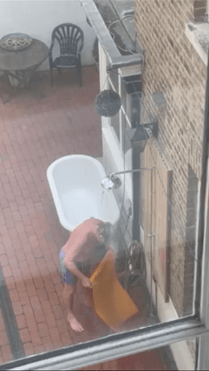
My postcard titled ‘The Man in The Window’ (PC 384 April 2024) was the result of thinking about the chap who worked at his desk, in the front window of the house across Albany Villas. Delightfully Simon has become a friend and happy to chew the fate about this and that. The postcard itself ventured into voyeurism, initiated by that James Stewart film Rear Window. Voyeurism could have been levelled at whoever took the photograph of me having my cold shower after a hot yoga session!

I knew nothing of it until it appeared on a social media platform. Would I have minded? Of course not? But it got me thinking whether the person who took the photograph should have asked my permission before posting it online. Unprompted, maybe after thinking about it themselves, they did take it down after a few hours!

Not taken by a drone!

In Castle Combe in Wiltshire, one of the ‘prettiest villages in England’, voyeurism is taken to another level. The village is a magnet for drone operators who want to capture its beauty. Unfortunately for its residents they have become a real issue; “Somebody was sitting in their bath, looked out the window and there’s a drone filming them.”!! Voyeurism again?

We live with plastic, although there is a great deal of effort to negate its lasting effect on the planet. I assume this is the reason that my morning ‘Orange Juice with bits’, which comes in a plastic bottle, now has its top connected to the main body by two little thin strips of more plastic; I guess it’s to stop them separating and polluting the earth.

The trouble is if the top isn’t completely clear of the bottle, it’s easy for some juice to drip into the cap. When you put the cap back on, it runs down the outside of the bottle. God! These First World C21st problems!

My landlord, Southern Housing, is trying to enter the century by updating its IT systems. I now have an on-line account through which I can notify them of repairs etc. I have owned our apartment since 2012 so you would think they had my personal details correct. I was asked to check. Apparently, my date of birth is 1st January 1900! Gulp! I knew I was getting on but over 125 years of age. Unlikely!

Richard 20th June 2025

Hove

www.postcardscribbles.co.uk

Note 1 There was a joke about Eastbourne, a town popular with pensioners to the east of Brighton: “Near The Continent (ie north coast of France) and incontinent.” Of course, we start life wearing a nappy and some will end it doing the same!

PC 443 ‘ere in the ‘ope!

PC 443 ‘ere in the ‘ope!

Almost a month has gone by since I was last in the Hope Café and it was good to be back in its familiar surroundings. As I was getting a double espresso I put a little card on the counter, with Josh’s permission of course! It read:

‘If you have a favourite quote about the ear, would you come across and tell me? Richard’

I have scribbled about teeth (see PCs 64 & 66 Molars and Wisdom March 2016) and eyes (see PC 94 Sight and Eyes April 2017) but not, surprisingly, about one’s ears. So why now, I sense you ask. After my food poisoning and virus infection, I managed to develop an inner ear problem which affected my balance big time.

The diagnosis is Benign Paroxysmal Positional Vertigo (BPPV – see note 1), which causes short periods of intense dizziness or vertigo when the head is moved in certain directions. It’s thought to be caused by tiny solid fragments in the inner ear labyrinth. Who knew?

So a quick revision. The ear:

The inner ear includes the cochlea, responsible for one’s hearing, and those ‘semi-circular canals’. These are small shell-like structures containing narrow fluid-filled channels called the labyrinth. They sit in the three planes, two horizontal and one vertical. Just like in a gyroscope, small movements send signals to the brain, essentially telling it which way is up!

“In your shell-like ear – having a quiet word with someone – but a poetic simile comparing the shape of the outside of an ear to that of a shell” Sami’s contribution

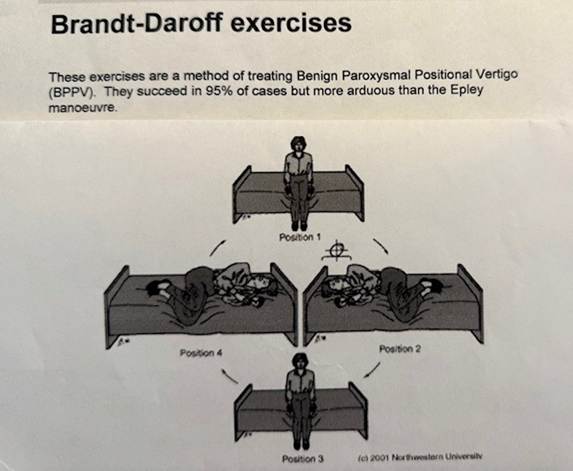
BPPV can be treated by a series of simple exercises devised by Brandt and Daroff. I assume these two are doctors specialising in the ear, but nowhere could I find out more details!

This is the first time I’ve had an ear problem, apart from the frequent removal of wax and temporary deafness caused by being near a loud noise. I spend twenty years in the Royal Artillery; being near a field gun firing a shell with a large charge can be instantaneously deafening. In my early years no one had ear-deafeners and the joke was we all had Gunner-ear (just say that out loud!).

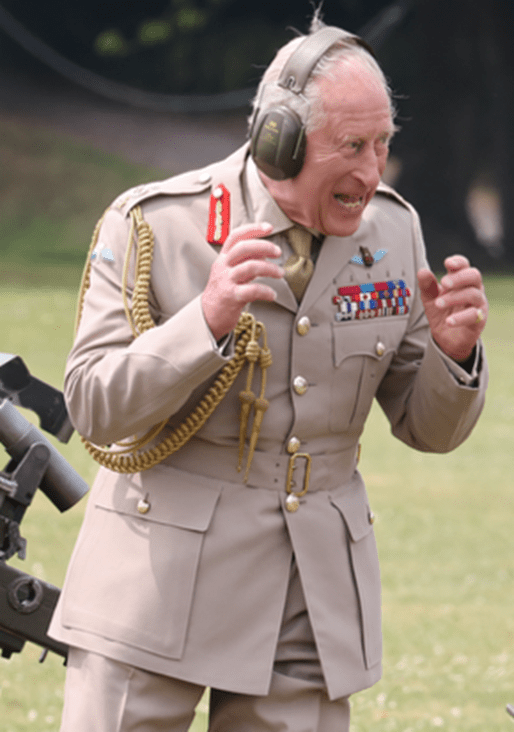
The King, who is Captain General of the Royal Artillery, having just fired a L118 Light Gun on a visit to RSA Larkhill. Wearing Ear Defenders of course! (Photo Times)

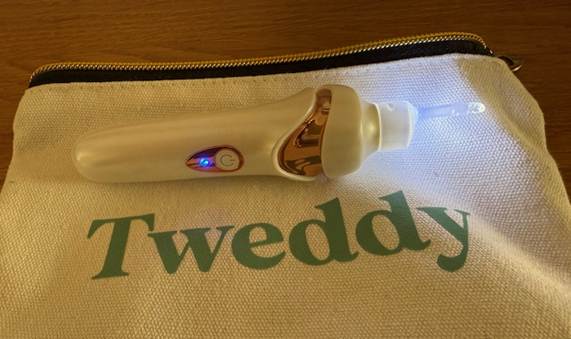
I know I shouldn’t, but I love using a cotton bud to keep my ears wax-free. There’s something very satisfying about carefully digging around and this reminds me of something else. In my military service it was vitally important to keep one’s weapon clean. Getting rid of explosive residue in its barrel required a ‘pull-through’; a cord with a weight at one end and a little slit at the other, into which you could thread a piece of ‘four by two’, a strip of cloth 4 inches by 2 inches. Drop the weighted end into the barrel, pull it through and hey presto the barrel was spotless. Sometimes I think it would be good to insert one into one’s ear and pull it through the mush inside; a sort-of brain cleaner! Or you could use this Chinese ear vacuum cleaner?

Kay our masseuse swears by the benefits of using an ear candle to get rid of wax. In for a penny, in for a pound; I tried it. She’s very good and some wax came out. But the general consensus amongst health professionals is that you don’t need to remove it at all, as it’s beneficial!

One of my yoga teachers, Carrie, said her father often massages his ears using the QiGong technique. The Chinese believe that the ear has Qi energy connections with the whole body. I have scant knowledge of Chinese medical traditions, although had a few sessions of acupuncture a decade ago. Apparently, the outside of the ear, its ridge, connects with the spine, the lobes the liver and heart, and the inner part with the kidneys and lungs. So go on, get massaging. I also read that a study in China found that those who wore dangly earrings lived longer than others. I must try and find a suitable pair.

Most of the sayings about ‘ears’ are to do with hearing. On cue, Lisa comes over and offers: “Friends, Romans and countrymen, lend me your ears. I come to bury Caeser not to praise him.” Everybody should recognise these first lines from Mark Antony’s speech in Shakespeare’s Julius Caeser.

The statistics tell me that one in three adults in the UK have some form of hearing loss, tinnitus or are deaf. In a recent TV drama, ‘Code of Silence’, one of the main characters was played by Rose Ayling-Ellis, deaf since birth and a user of British Sign Language. Good to see those with disabilities getting major roles.

Mo, who’s sitting at a table close by, leans over with a piece of paper: ‘The War of Jenkin’s Ear’. Ah! Yes, I know about this, fought by Great Britain and Spain between 1739 and 1748. Most of the fighting took place in the Caribbean. The name derives from Robert Jenkins, a British captain whose ear was allegedly severed in April 1731by Spanish coastguards searching his ship for contraband. It’s commemorated annually on the last Saturday in May at the Wormsloe Plantation in Savannah Georgia.  

Duncan gives me three: “I’m all ears”,In one ear, out the other” and “playing it by ear”.

Anna, who’s been listening, comes across in her wheelchair; “How about – ‘Walls have ears’? That was World War 2, but it’s not new! In 1645 a poet wrote: ‘For the halls of our masters have ears and hear, and the walls of the palace have eyes and watch.’”

And the free coffee goes to Robert, who came up with “‘ere in the ‘ope”! (Note 2). I loved his play on ‘ear’ and here!

Richard 13th June 2025

Hove

www.postcardscribbles.co.uk

PS No mention of ‘cauliflower’ ears!

Note 1 Benign – not serious; Paroxysmal – symptoms come and go without warning; Positional – certain positions of the head trigger symptoms; Vertigo – you feel unsteady on your feet, a little like being at sea on a ship.

Note 2 ‘aitch-dropping’ is the deletion of the ‘voiceless glottal fricative’ (H-sound). It’s common in most English regions, but often seen as a sign of uneducated speech, due to its strong association with the lower class.

PC 442 Wooden Spoons

Don’t you just love a good wooden spoon?

(Note 1)

A wooden cooking spoon is versatile and can be used for stirring soups and sauces, stirring eggs when you want them scrambled. (Note 2) They are heat resistant and don’t melt or warp – although they can burn! They can be cracked – it doesn’t’ matter; they are great for your non-stick saucepan as they won’t scratch it. And we don’t seem to worry that a little bit might come off and be ingested!

My daughter has spent five months doing everything possible to make her late grandmother’s house habitable and moved in at the end of March. The renovations aren’t complete by any stretch of the imagination, but it is dry, with working kitchen, working bathroom and downstairs loo, rewired, replumbed, with a new roof and new windows. This is the third house she’s owned with her husband Sam, so I had to scratch my head as to what to give her for a Housewarming present. I imagined she would want something that will be useful, not a pointless knick-knack; she probably threw out lots of stuff when she was packing, ‘ours not to reason why’, so it could replace something old and tired that went. There’s a tradition of giving someone in her situation a wooden spoon ….. and you can’t have enough wooden spoons in your kitchen!

Spoons have been a symbol of love all over Europe for hundreds of years. In particular in Wales, ‘love spoons’, small and carved out of wood, a material which is considered to be capable of keeping away evil, were given by a man to his girl, hoping she would accept it as a token of their engagement.

And often, like everything else in life, there is another meaning seeming at odds with love! In C19th British slang, ‘spoon’ meant simpleton, a meaning that might have been influenced by the shallowness of spoons. To be given the wooden spoon doesn’t say much about your performance as it’s given to those who finish last. The custom began in 1811 at Cambridge University when there were three classes of honours degrees awarded; the First Class winners were called Wranglers, said to have been born with golden spoons in their mouths; Second Degree winners were called Senior Optimes, born with silver spoons and the third class went to Junior Optimes, referring to lead spoons. The unfortunate who was last was called the ‘wooden spoon’ and the university adopted the custom of presenting a wooden spoon to the individual placed lowest in the Mathematical Tripos. But it was still a pass!

I went online to find a large one ….. and ordered it. It arrived and had a crack in it. Without question I was given a refund with no need to return it.

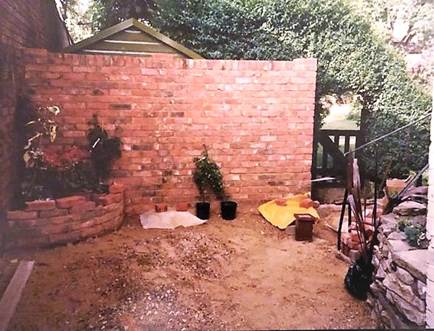
Back to square one! I was still undecided when I saw two old scaffolding-type planks on the street, leaning up against the recycling bins. I can’t abide waste so thought I could use them somehow. That’s when the idea came to me. Perhaps I could fashion a large wooden spoon out of a plank, so large that it would have to be up on the kitchen wall. I have a modicum of DIY skill, supported by some very basic tools, but more importantly a strong belief that I can do anything. Whatever I do, I accept that the end result might not be the greatest example but ….. if someone showing the cheeks of their bum can do something, I am sure I can make a passable attempt. My regular readers may remember the little brick wall I built at the back of the patio of my basement flat off Clapham Common.

It probably took me about a week, evenings and the weekend, whereas a bricklayer would have taken a day. But there’s something very satisfying in achieving something way out of one’s comfort zone.

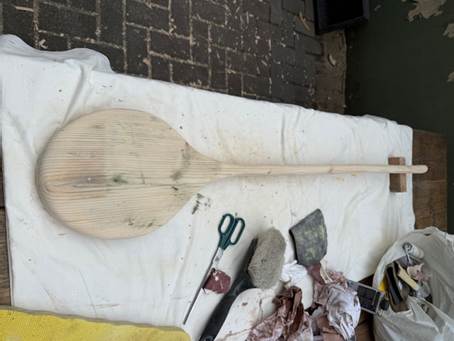
Back to the spoon. The first thing I had to do was to determine its size. The plank was 18cms wide by 1.8m long, so I cut 50cms off it. Mapping out the head of the spoon wasn’t an exact science but soon I had an outline that I could attack with tools that cut/sawed/planed/chiselled/sanded.

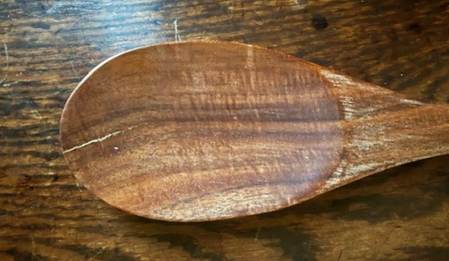
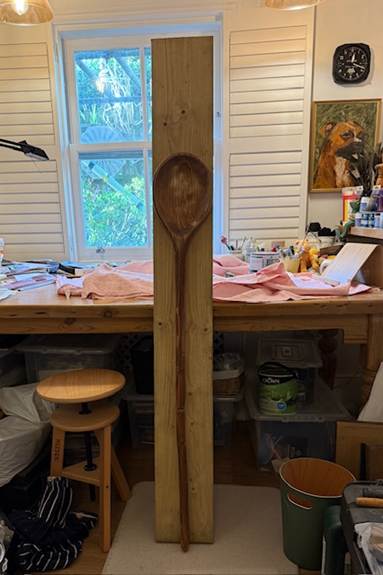
Eventually I had a sanded ‘spoon’ which then, after some staining and some polish, I liked so much we kept it!!

So the other plank was used to make Jade’s!!

The first spoon in front of the other plank

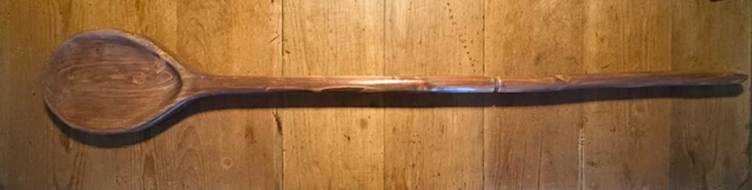
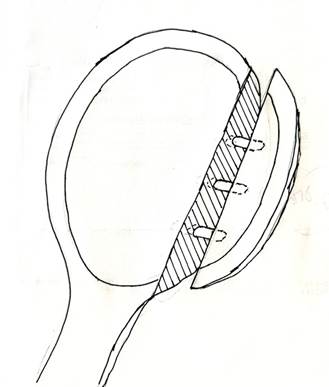
I have made four so far, one for Scarlet Anderson who founded a London-based production company called Spoon Studios. I had fashioned almost all of the spoon end of one when it cracked into one third/two thirds. I had a fit, swore a little, but then thought I could glue them back together using some dowels.

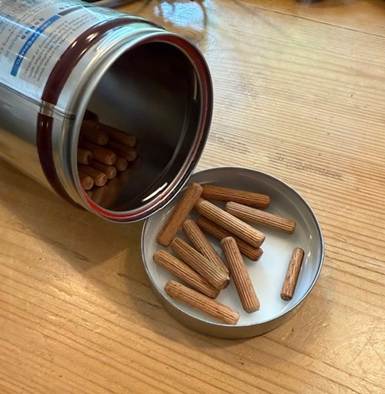
Wooden dowels

For those of you unfamiliar with woodworking – and here’s me suggesting I am (not) – these little wooden pegs are ideal for fixing pieces of wood together when you don’t want to use a metal screw. Just drill a hole in each side of the pieces of wood you want to join, apply some glue, place a dowel in one side and bring them together, clamping as necessary. Sounds so easy, except that the holes in each side need to be exactly lined up.

YouTube has some helpful videos. In short, you hammer a small nail into one side, cut off the top, and bring the two pieces together. The nail will make a mark on the other piece of wood. Drill!

I am not going to start a production line, but it’s been a fun experience!

Richard 6th June 2025

Hove

http://www.postcardscribbles.co.uk  

Note 1 You will notice amongst the spoons a wooden spaghetti quantity measurer and some other thing used for I know not! Looks nice!

Note 2 The trick to making good scrambled egg is to turn off the heat just before they’re ready. The eggs will go on cooking a little and then they’re perfect.