The visit of Celina’s mother and partner Toni has become an annual occurrence, and we have always tried to organise a few days away during their time in the UK. We have been to my home city of Bath (see PC 337 An American in Bath – June 2023), visited Arundel Castle, the home of the Duke of Norfolk, and spent two nights in Lymington in the New Forrest (see PCs 388 & 389 May 2024). This year, prompted by Toni mentioning his mother had much enjoyed Osborne House on the Isle of Wight, we organised a two-night stay there. Being an island itself, Great Britain has a long coastline stretching some 1800 kms with numerous offshore islands. Apart from the largest groups such as the Inner and Outer Hebrides, the Orkneys and Shetland Isles, the larger ones include Mull (875 sq kms), the Isle of Man in the Irish Sea (572 sq kms), Arran in the Firth of Clyde, and then the Isle of Wight on the south coast. This triangular shaped island covers some 381 sq kms – I read that for comparative purposes it’s about half the size of Singapore ……. if that’s useful? (Better than comparing it with Wales!)
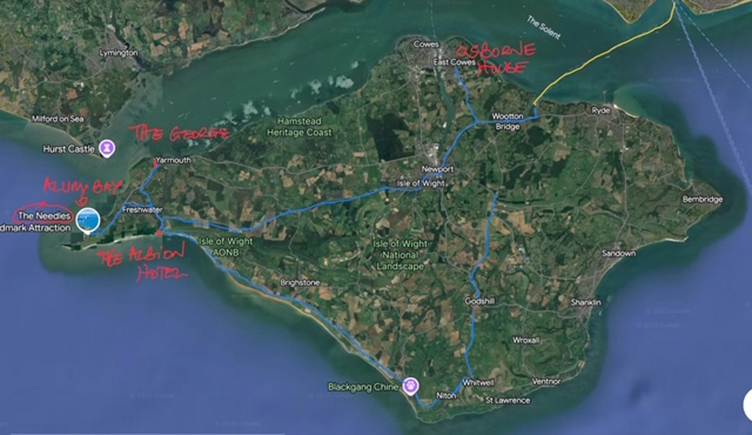
Ferry in yellow, journeys in blue, places in red
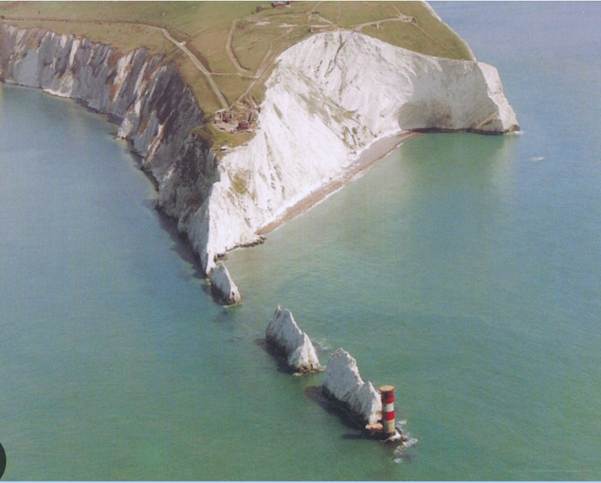
On its western tip are the famous Needles, three huge, white chalk rocks marked by a C19th lighthouse.
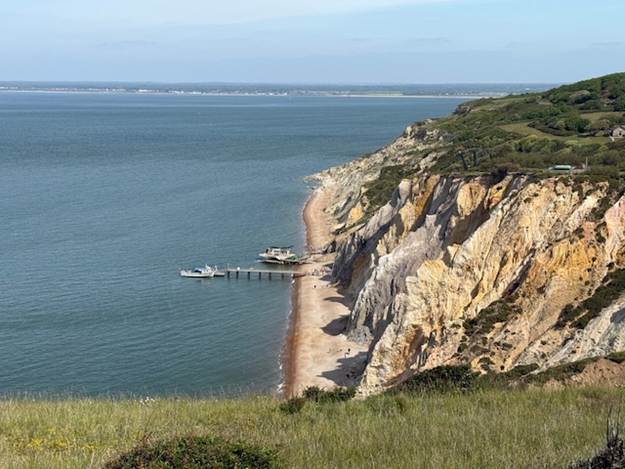
And nestling into that western coast is Alum Bay, famous for its strata of coloured sands
The western entrance to The Solent narrows by Hurst Castle on the mainland.
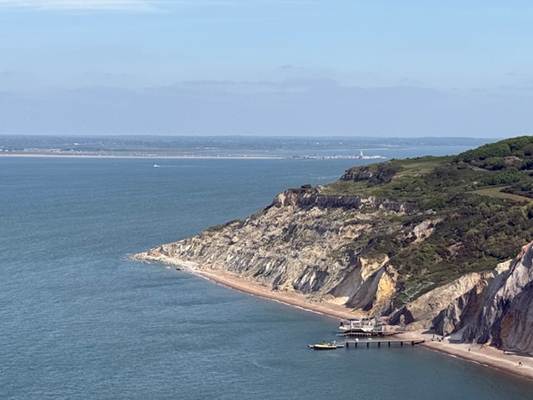
Hurst Castle is at the right hand end of the line of pebbles in the distance
Actually, you can see the Isle of Wight when visibility is good from the high ground on the north side of Brighton & Hove, some 55 miles away.
Most of my experiences of the Isle of Wight come from my love of sailing. I have taken part in Mermaid dinghy regattas off Seaview; I have swum in Cowes harbour way past midnight and possible having had too much to drink (!); moored up in Yarmouth harbour numerous times, once having to go over the side of the yacht to unwrap a rope from the propeller; anchored outside as the harbour was full, and had to cope with a dragging anchor in strong winds and spring tides; on returning from the Channel Islands one year, we hit the sand off Ryde, between Cowes and Bembridge, and had to wait for the tide to change; and once, as the tide was favourable, we nosed our way into Newton Creek, a wild nature reserve between Cowes and Yarmouth. For a few years I took part in Cowes Week, the August international yachting regatta that attracts thousands of entrants. In 1969 I took part in a Sail Training Association race from Cowes to Skagen in the northern tip of Denmark, and then on to Malmö in Sweden. I feel at home in this part of the United Kingdom.
The island is served by two ferry companies, Red Funnel from Southampton and Wightlink from Lymington, Portsmouth Harbour and Portsmouth. During my career as an executive coach I worked for Sea Containers, who at the time owned Wightlink and Hoverspeed, the latter running ferries to Calais and Boulogne-Sur-Mer.
I guess the most famous town on the Isle of Wight is Cowes, although its capital is a town called Newport, right in the centre of the island and where the Medina River starts being deep enough to be navigable. Most of the east-west island traffic flows through its congested streets, as north at Cowes the only way to cross the river is on a ‘floating bridge’ which can only take 20 cars on each trip. On the south coast are the Victorian holiday resorts of Ventnor and Shanklin.
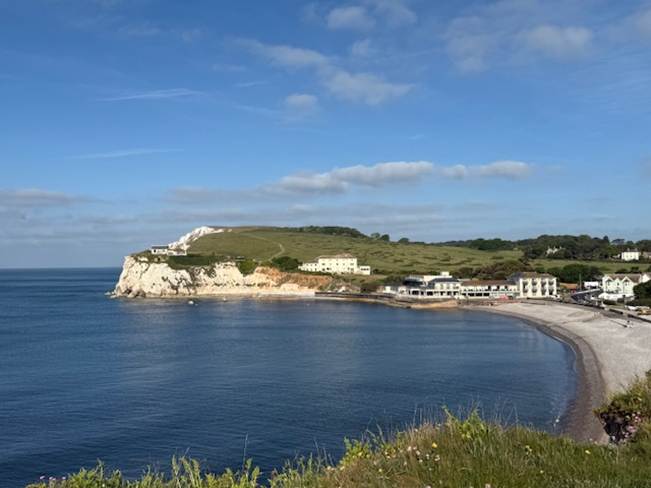
The Albion Hotel overlooking Freshwater Bay
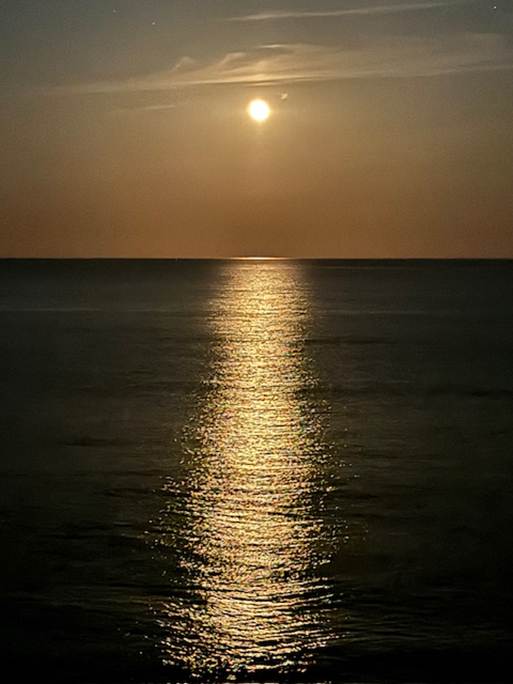
You will see from the map that we stayed a couple of nights in the renovated Albion Hotel in Freshwater on the southwest corner. A C18th hostel overlooking Freshwater Bay was destroyed in a big storm in 1824 and the Royal Albion Hotel dates from 1860. The building of Osborne House drew tourists and courtiers alike to the island and the hotel prospered. Today its 40 rooms offer a tranquil setting to unwind after cycling or walking around the island or, as we did, visiting Osborne House. And if you’re lucky, you wake up at just the right time, in this case 26 minutes past midnight, to take a photograph of the full moon over a calm sea.
Nothing is very far on the Isle of Wight and on our second evening we drove north to Yarmouth – yes, the mouth of the river Yar! Our friends from Lymington, whom we had seen last year, came across on the Wightlink ferry for supper at The George Hotel. The tourist and yachting season hadn’t really got underway and it wasn’t at all crowded; in the summer months it becomes very busy and to guarantee a mooring in the harbour you need to be there by 1600, which is too early!
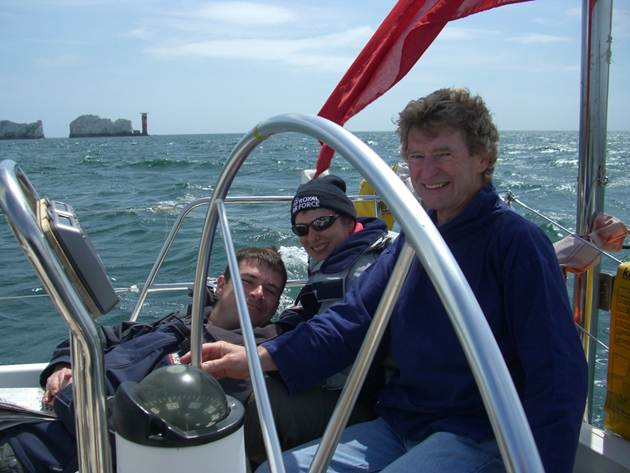
On the last morning we took a quick trip out to the coast above The Needles; in stunning warm sunshine we looked down at the iconic lighthouse, which I have sailed passed many, many times.
From there we drove east along the south coast before heading north to the ferry terminal at Fishbourne. One’s unlikely to go to the IoW with a car for a day trip, as the ferries are expensive; if you live on the island you get a discount but it does tend to isolate the island community – maybe they like it that way? We caught the 1300 ferry back to Portsmouth and were home in Hove by 1510.
We were lucky with our weather; wall-to-wall sunshine with 20°C and little wind. Next week’s scribbles will cover our visit to Osborne House.
Richard 23rd May 2025
Hove
PS Flights to Portugal from Gatwick pass over the IoW. Often the view is amazing

Looking south over the Isle of Wight. Cowes is in the centre of the photograph.
 postcards