
“They say (Ed. Whoever ‘they’ are?) that if a butterfly flaps its wings in the Amazonian rain forest, it can change the weather half a world away. This is the theory of chaos. What it means is that everything that happens in this moment is an accumulation of everything that’s come before it. Every breath; every thought. There is no innocent action. Some end up having the force of a tempest. Their impact cannot be missed. Others are the blink of an eye, passing by unnoticed. All I know today is that you can think that what you’ve done is only the flap of a butterfly wing, when it’s really a thunderclap, and both can result in a hurricane.” Catherine McKenzie ‘Fractured’
So, the butterfly …….
Away from our unvarying regime of five sessions of hot yoga a week in Brighton, there’s an opportunity to indulge in some less strenuous activity, like swimming or walking. My mother-in-law’s apartment in Estoril is just under 4kms from the better known town of Cascais, so I have devised a triangular route that takes me down to the little Praia da Poça, west along the promenade to the Cascais railway terminus and back north east ….. to a shower and breakfast!
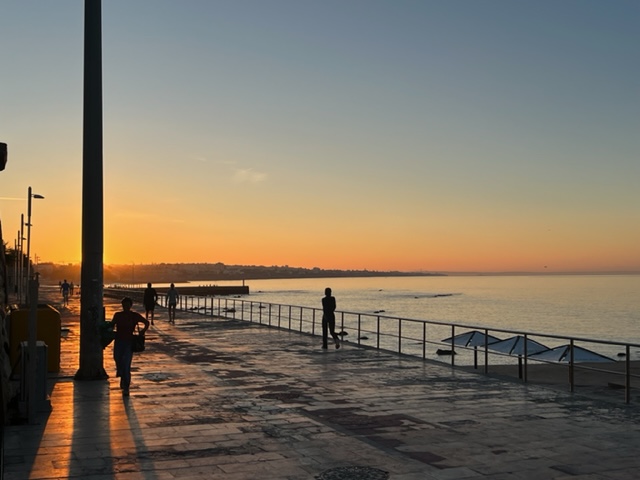
It takes about 80 minutes and after a while you begin to recognise some of the locals out for their early morning constitutional; roughly the same time, same place!
On my return route, I use a small pedestrian underpass below the railway lines; at the end are some steps, with a metal handrail to assist those who need assistance!
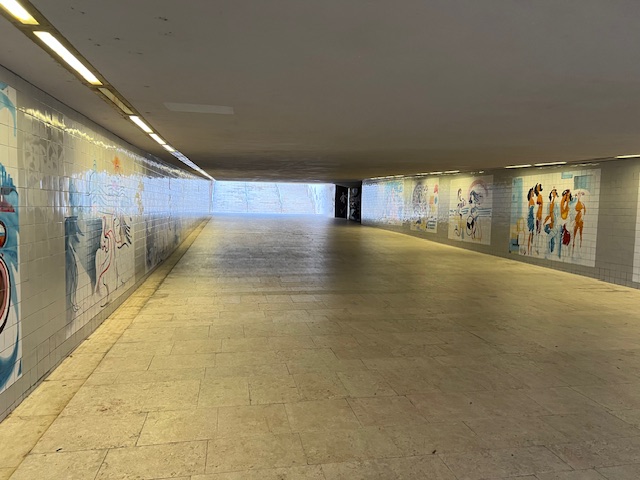
About a week ago I noticed that someone had placed a sticker illustrating a butterfly on one of the rails. Our masseuse Kay Delphine is a great fan of butterflies and has one as her logo; it was automatic to think of her when I saw this little illustration.
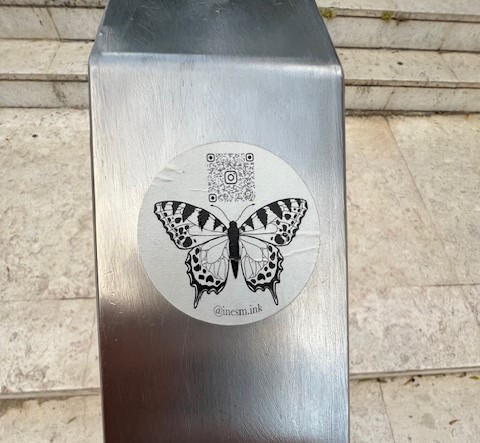
Yesterday morning I decided to take a photograph of it, to send to her via WhatsApp. Twenty minutes later she responded:
“That’s so weird, as I’ve just had this tattoo done yesterday. It was meant to be for my 50th – so only ten years late!”
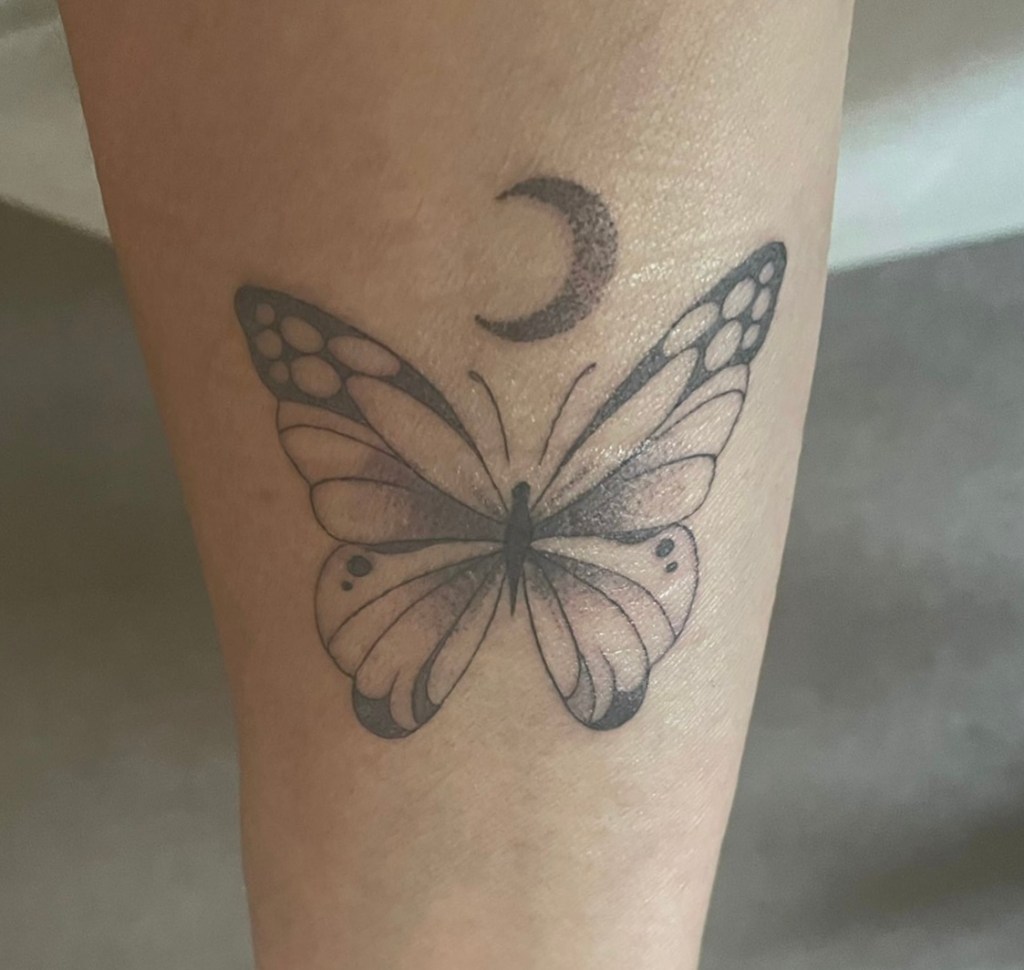
I just LOVE these coincidences, these very weird connections that appear out of nowhere.
It’s rare to think of natural disasters and their possible occurrence when planning an overseas trip; if you did, you wouldn’t go anywhere. (Note 1) I’ve been to both New Zealand’s North and South islands where earthquakes happen quite frequently, the last in Christchurch, South Island in 2010, when some 185 people died. The Hawkes Bay, North Island earthquake of 1931 devasted the city of Napier and killed 256 people. Nearer to home last year’s Turkish 7.7 magnitude earthquake in southern and central Turkey and northern Syria killed some 60 thousand and displaced some 16% of the Turkish population.
For most people Monday mornings are the start of the working week, a time to get up …. and get on with it …. but not too early a start! Last Monday, the 26th August, started at 0511. Our bedroom was shaking, things were rattling, noisily waking us from our slumbers and although it only lasted for some 5-8 seconds, if you count those out in your head you will realise this was an earthquake with a magnitude of 5.4!

Celina, naturally anxious, is out of bed heading for her mother’s room to check on her. Peace returns, nothing was broken, nothing cracked, but the emotions take some time to subside. I remember making some reassuring comment that earthquakes are extremely rare in this part of Europe, and we should all go back to sleep. Later I remember that Lisbon, 30kms to the East, and the areas around the city, were almost completely destroyed in a 7.7 magnitude earthquake in 1755; over 30,000 people died! (Note 2)
On returning from my walk, over breakfast we compare thoughts. Toni was wondering about after-shock Tsunamis, just how high these walls of water can get. We see on a contour map that the apartment is some 60 metres above sea level, so feel safe.
After many weeks, I have finally returned to and finished Simon Winchester’s Atlantic (see PC 392 Hope Continues 21 June 2024), recommended to me by Sami. This is a fascinating book, chocked full of so much information that you need to absorb the facts in bite-size bits! “As he travels around its edges (the Atlantic Ocean) and across its expanse, he reveals its most captivating stories – the age of exploration; the colonization of the Americas; the rise and fall of the slave trade and history’s great naval battles.”
In his Epilogue, he reveals that the results of extensive modelling suggest at some point in the future the southern tip of South America will join with the Cape of Good Hope and the Atlantic Ocean will cease to exist. The forecast for this major event is some 170 million years in the future so, whilst this should not worry us, today’s movement of the world’s tectonic plates will continue to cause earthquakes and tsunamis. And whilst the visible horror of these movements is too obvious, the scale of movement isn’t. The Sumatran tsunami of Boxing Day 2004 may have killed a quarter a million people and passed into human history as one of the greatest natural disasters of all time, but it only moved the sea floor south of Sumatra a few metres northward and that sea floor is many thousands of miles wide.
A butterfly flaps its wings ……
Richard 30th August 2024
Estoril
http://www.postcardscribbles.co.uk
Note 1 Of course one should avoid, for instance, sailing in the Caribbean during the hurricane season, June to November, or going to some of the Gulf states in their summer, but natural events are hard to forecast.
Note 2 The wooded houses were lit by candles. The shaking caused them to fall over, setting the houses alight. The 30m tsunami completed the destruction.
 postcards
Very weird!! Love it. Sent from my iPhone
LikeLike
😊😊😊❤️
LikeLike