
PC 455 A Nation State? Or the State of the Nation

Writing in the summer months should be light-hearted, tackling subjects like the size of the marrows in the annual Village Fete, one’s recollections of, or lack of, attendance at one of the many festivals, either musical or book-related, or even, if you’re of a certain age or persuasion, at one of the many summer Scouts Camps. The 16th World Scout Jamboree Parade was held this year in the Portuguese city of Porto. Or, of course, of one’s memories of taking part in the 2025 Fastnet Race.

Recently two pieces in The Times prompted this postcard, inevitably a little more serious than posting a selfie on Instagram of you and your friends at the Edinburgh Fringe Festival (1st – 25th August). One was the personal view of the United Kingdom by author Lionel Shriver who has moved abroad and the other The Sunday Times’ survey of 2,113 British adults (excluding Northern Ireland), carried out by More in Common between 22nd and 24th July.

It’s fashionable at the moment to be critical of Britain, not where it stands in the world, but of the mess that our society, you and me, us, are perceived to be in.

I remember reading Lionel Shriver’s 2003 book ‘We Need to Tak About Kevin’, a fictional story of a school massacre in the United States, written from the first-person perspective of the teenage killer’s mother. It was Shriver’s seventh novel, won the 2005 Orange prize and was made into a film in 2011. I have read a number of Shriver’s other novels; some I’ve liked and some I’ve found hard going.

Lionel Shriver’s piece started: “An American based in the UK for 36 years, in 2023 I absconded to Portugal (She’s aged 68). So how dismal does Britain look from a distance? I’m still emotionally and politically enmeshed in British affairs. But my personal fate is no longer joined at the hip with the increasingly distressing fate of the UK.” Nice huh! Diving straight in!

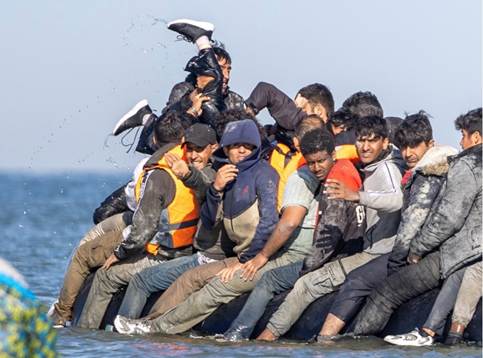
The easy target for anyone concerns the levels of immigration, legal and illegal, and the way the state meets its humanitarian obligations. The current Labour Government won last year’s General Election with a promise to ‘stop the small boats’; so far, they have failed miserably! This tide of humanity, mainly but not exclusively single men aged 18-30, has been washing up on the Kent shore for some years, increasing year-on-year; so far this year 28,000 have made the crossing. Every shade of the political spectrum claims to have an answer, but so far the stream continues unabated.
Shriver continues:

“Small boats and sky-high legal immigration will continue to wreak demographic havoc. This change is permanent. Millions of immigrants from clashing traditions will bring only more of their friends and families.”

If you look at the projected demographic changes in European countries and the shifting burden of increasing pension provision onto a smaller workforce, most show their populations in decline; apart from Britain, due to net immigration! The trick will be to assimilate these immigrants into our society and no one seems to be very creative in this respect. We haven’t insisted, for instance, on immigrants learning English within a few years, as a prerequisite of citizenship; in some towns there are enclaves of people who arrived in the latter half of the last century, still unable to speak the language. Across the North Sea, potential Danish immigrants have to have proof of a certain income level, proficiency in speaking Danish, passing a citizenship test and integrating into society. This policy, introduced last year, has slowed the flow of potential immigrants to a trickle.

From the Times survey for ‘More in Common’, when asked the main reasons people crossed the Channel in small boats to get to the UK, voters agreed the government needs to crack down on the UK’s black market for labour and welfare payments. According to the poll, 54 per cent believed the most likely reason people came was to access the UK’s welfare system. This was followed by claims it was easier to gain asylum in the UK than elsewhere (49 per cent) and because they were fleeing conflict in other countries (37 per cent).

In one focus group, Peter, a dockyard manager from Plymouth, described Britain as a “soft touch” because as “soon as [migrants] land on our shores, they’re entitled to healthcare, food and a roof over their head. There won’t be many countries in the European nation[s] that will offer them that. I think we need to harden our borders and take advice maybe from America or Australia, which I appreciate. Seems harsh, but the country is on its knees.” He speaks for the silent majority.

Shriver followed up with: “Supposedly, a leading “British value” is “fair play”. So let’s talk about fairness. Amid an ever-escalating housing shortage, itself powered by mass immigration, your government uses your money to provide a free water-taxi service to your shores and to put up low-skilled, overwhelmingly male foreign citizens in four-star hotels. No one’s putting locals in free hotels.”

This sort of popularist comment is swallowed by the unquestioning masses. It’s recognised, for instance, that successive governments have failed to ensure sufficient houses are built to meet national demand; the current immigration crisis has simply exacerbated an already bad situation. Until their asylum application is processed, it’s perceived that these immigrants might make our streets unsafe. But, as Fraser Nelson says: “It chimes with what a great many Brits now believe. Poll after poll finds the public convinced that crime is getting far worse. The reality is different; NHS hospital data shows knife assaults last year fell to a 25-year low, with the number treated for violent assault close to half what it was in 2000. Crime surveys agree. By such measures our streets have seldom, if ever, been safer.”

I am as concerned as Shriver is when she writes: “Ten million working-age inhabitants are on benefits. Almost half of universal credit recipients need neither work nor look for work, and over a million are foreign-born.” If I understand it correctly, you can apply for benefits online, with no face-to-face meeting. Self-diagnosis? Absolute nonsense. A quick way to reduce this ridiculous figure would be to have face-to-face reviews; those who genuinely need support can be identified from those who are gaming the system.

Fraser Nation gives a final perspective. ‘Perhaps the ultimate sign of national confidence is the migration figures: not so much the arrivals, but the departures. Last year, just 77,000 Brits emigrated, the lowest since records began. Among those who remain, I like to think, are some who share my deeply unpopular belief: that in spite of our problems, this is an amazing country. And that now, more than ever, there is no better place in the world to call home.’

Richard 5th September 2025

Hove

www.postcardscribbles.co.uk

PS Shriver makes the point that Portugal has an immigration backlog of over 400,000 cases.

PPS Jeremy Clackson’s column in last weekend’s Sunday Times was titled: ‘Britain is awful. But here’s why you shouldn’t leave.’  This made me smile: ‘Then there’s the problem of Europe’s unpredictability. One minute Portugal has the welcome mat out for Brits who wish to escape from the menace of Keir Starmer, but then they change their minds.’ 

PPPS The queue at Passport Control Lisbon Airport yesterday morning was enormous; 55 minutes? Almost Third World!!
PC 439 A Global Contentious Issue

In January I posted a card entitled ‘Contentious Issues in the UK’ (PC 420) as a focus to the New Year. I should have added something about the definition of a woman, as events have defined this also as ‘contentious’. After years of acrimonious debate about the ins and out of changing sex, from man to woman, from woman to man, and for those who would prefer to stay somewhere in between, some LBGT pressure groups were, in my opinion, demanding unhealthy, skewed and biased changes to societal rules.

I left the world of paid work some time ago, so this issue is one I read about, care about, but have no real experience of. I read that everyone was being forced to declare themselves I/me/moi/my etc ….. or else! Thankfully the pendulum has swung back from its extreme position. Those who wish to identify in a certain way, by certain criteria, should be allowed to do so. But it’s rubbish to assume that if you don’t declare your pronouns for yourself, you’re somehow against the whole idea. Sadly the polarisation of any topic, any issue seems to be a feature of the current times and that shuts down reasonable debate and acceptance of opposing views.

Britain has a tolerant attitude, in the main, to diversity, but it seems that, anxious to be tolerant, accepting, we allowed pressure groups like Stonewall to bulldoze their way through and into government departments’ policies, dictating their slightly skewed agenda. The threat to individuals was that if they didn’t sign up to the propaganda they would be cancelled. We have enough bullies at the moment. It really was a clear example of the tail wagging the dog (see PC 421 Not The Way to Go January 2025)

It’s not the end of the debate for sure, but on 15th April 2025 the UK’s Supreme Court unanimously ruled that a woman is defined by biological sex under equalities law. Chris Mason, the BBC’s Political Editor, headlined it as one of the most contentious issues for 2025. It’s worth just quoting one of those who got the case heard: “For years, a lot of us have felt just completely gaslit. That the truth is no longer the truth, that women cannot speak up. That we should allow anyone who wants to be in our sporting categories, our bathrooms, our hospital wards, our lesbian dating sites, that we should just allow anyone that wants to, to just come in. We’ve been told that we’re cruel and unkind, transphobic, discriminatory, that we’re breaking the law. All these things are completely untrue.”

In late April, the European Court of Human Rights (EHRC) released an update on the practical implications of the Supreme Court’s clarification, saying that in places such as hospitals, shops and restaurants, “trans women (biological men) should not be permitted to use the women’s facilities”. It is now compulsory for workplaces to provide sufficient single-sex lavatories, as well as single-sex changing and washing facilities where needed. The EHRC added that “where possible, mixed-sex toilet, washing or changing facilities” should also be offered. (Note 1)

So now local councils will have to provide ‘safe’ places, changing rooms, loos etc for the transgender community. Let’s just put this in perspective. In England and Wales 0.5% of the population, some 262,000, have a gender identity that is different from the one they were assigned at birth. And we have allowed individuals, under pressure from Stonewall, to self-identify, the idea that they are the sole authority to determine their sex, regardless of biology.  Compare their needs with those who have some form of long-term illness, impairment or disability. Shockingly, almost a quarter of the UK’s working-age population meet this criteria. It’s also shocking that 45% of those of pensionable age fit this group. There are estimated to be 1.2 million wheelchair users, who are often unable to travel due to poor wheelchair access. So when councils are asked to allocate dwindling financial resources, surely those with the greater need, the majority, come first?  Of course, in an ideal world everyone would be accommodated but it’s unlikely there will ever be an ideal world!

Even among jubilant women’s rights campaigners, there is a feeling that this is just the beginning. They want to challenge the institutions where they believe gender ideology — and specifically self-ID, the idea that an individual has the sole authority to determine their sex, regardless of biology — has taken root.

Kate Barker, the chief executive of the LGB Alliance, which made a submission to the Supreme Court about the importance for lesbians of the primacy of biological sex, argues this anger is misplaced:

“Why are they so mad at women for protecting our spaces and at gay people for protecting our rights [to same-sex relationships] and not mad at the people who have fed them duff legal advice for the past ten years?” Barker asked. “Stonewall and all those groups have spent ten years pushing the idea of self-ID, saying that it might not have quite been the law but it was practically the law. And institutions — particularly places like the BBC — were captured by Stonewall.”

So common sense will need to be applied to this judgment. Organisations will have to try to accommodate the trans community in whatever way they can, in a climate of stretched financial resources. Already many sports governing bodies have said that trans women will not be able to compete in women’s only events; surely common sense?  

We don’t live in an ideal world and the silent majority need their voice heard; not drowned out by a vocal minority.

Richard 16th May 2025

Hove

www.postcardscribbles.co.uk

Note 1 On 2nd May Stonewall posted this: ‘It’s important to remember that the ruling is not law as of yet and organisations should wait to see how statutory guidance is changed before making policy changes.” Actually the Supreme Court’s judgement is exactly that, legal clarity as to how a woman is defined and Stonewall’s advice is encouraging organisations to act unlawfully!

PC 421 Not the way to go

I hope most of my readers will be aware of the phrases ‘cancel culture’ and ‘ghosting’. The latter was the subject of a book entitled ‘Ghosts’ by British millennial author Dolly Alderton; an interesting if heartbreaking story. What concerns me is the long lasting, often traumatic, effect that either action has on its victims. Last year there was an article in The Times entitled “Cancel Culture on Campus; ‘Most of us are terrified’” by Alice Thomson. She was prompted to investigate what is going on by the death of Alexander Rogers, an Oxford undergraduate who committed suicide after being ‘cancelled’. Someone killed themselves because they were cancelled?

The coroner, Nicholas Graham, seemed to think that the punishment of ostracization exacted immediately before Roger’s suicide played an influential role. He cited an independent review commissioned by his college, Corpus Christi, describing an establishment and normalised culture in which students would rush to judgement without knowledge of all the facts and shun those accused. Finally, he urged those in positions of responsibility to take cancel culture, ‘the exclusion of students from social circles based on allegations of misconduct, often without due process or a fair hearing’, seriously. Thomson wrote that whilst at 20 one is old enough to take responsibility for one’s actions, nothing should be unforgiveable.

Blimey! Actually ‘blimey’ doesn’t do it! ‘What the f**k?’ would be a better expression of my reaction. What a very sad reflection on the realities of the social scene for our young adults, a time when they should be experiencing and learning about relationships in real life, not shunning them for fear of being cancelled; in real life and not on-line! A graduate of Cambridge, Ceci Browning, wrote: “This is the paradox of my generation. We are meant to be the most tolerant and liberal, yet when one of our friends slips up and falls out of step, they become the enemy. We cut friends and acquaintances from our lives on the basis of second-hand information about something deemed morally iffy that they may or may not have done. But we are also perpetually afraid that precisely the same thing could happen to us.”

We know that the difficulties of learning how to start, continue and stop relationships start in one’s teenage years. My own childhood, although privileged, was very mixed. Whilst I have fond memories of the second preparatory boarding school where I spent my pre-teenage years, I shudder at some of the early memories I had of my teenage ones. Bullied and ostracised, rather wet by nature, feeling abandoned by my parents, I took a long while to find my feet and my confidence. Then of course there was no instant messaging, no aggrieved soul venting their hurt on social media, for others to share with God knows who. So rumours rose and died, snuffed out by the smallness of the audience.  

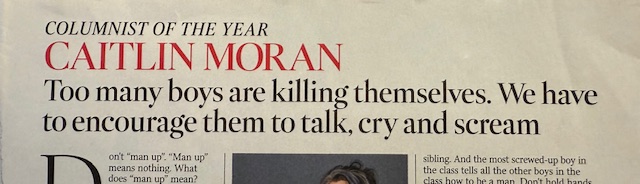
The suicide of Alexander Rogers is another statistic to some, but Caitlin Moran’s recent article ‘Too Many Boys are Killing Themselves.’ highlights a worrying trend. I read her book ‘About Men’ last year, an unusual topic for her, and subsequently wrote PCs 352 & 354 (About Men and More About Men) in September 2023. Moran writes that too many boys/young men are killing themselves. I have three grandsons so this subject is right there, on the front burner for me, trying to understand the modern pressures and how the three of them will be able to develop sensible values and self-discipline, able to filter out the crap peddled by influencers like Tait, who want to encourage boys to become incel – ‘unable to find a romantic or sexual partner’.

Socially relationships are key to our social fitness. The concept is not new; Aristotle, writing more than 2000 years ago, said that ‘man is by nature a social animal’. Moran described the difficulties of both sexes interacting in the digital world. For instance, what to one person might be an attempt to give an affectionate ‘touch of the neck’ could be construed by the object of their actions, someone who perhaps has watched too much internet porn, as a preliminary move towards a strangle hold and shock and revulsion is their response; a touch of the lower back easily extrapolated into an imagination of unwanted sexual advances. And this at a time when everyone is experimenting, trying what works for them, understanding what doesn’t.

It’s also important to remember that the ‘squishy part of the brain responsible for sensible decision-making’ isn’t completely developed until one’s mid to late 20s. ‘Students are still especially susceptible to making stupid mistakes and perhaps overreacting to perceived slights’. Rather than try and discuss and understand and accept an apology, they reach for their social media account. Stories are gobbled up in such an insatiable way there is no thought to pause, to think if it’s true or somewhat exaggerated; ‘share’ and ‘share’, part of the herd. So when someone is cancelled by those whom they believed to be in their ‘friends and acquaintances’ circle, it doesn’t take much to understand how their whole world comes crashing down.

I wonder whether those involved in the story of Alexander, either personally or by association, feel any lasting blame for their actions, any lasting shame. What has changed since the independent report commissioned by Corpus Christi? Has it really made it easier for students to talk about the inappropriate behaviour of other students, as part of a normal discourse about growing up and developing proper boundaries, or has the college decided that its reputation is more important than that of one individual?

In the final analysis we think and no one else can do that for us; we feel what we think, these feelings coloured by past experiences and expectations; then it’s our responsibility whether we act …. or not.

Richard 10th January 2025

Hove

www.postcardscribbles.co.uk

PS Read ‘The Happiest Man on Earth’ by Eddie Jaku if you’re a bit down; time to reflect.