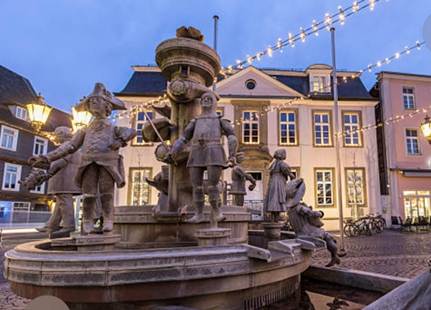
Memories aren’t necessarily concentrated – my mind sees one, remembers other, hears a third, from the general collective memory of ‘my time in Germany’. We generalise our memories to make them manageable. For instance: I remember the funeral of Major Dick Jones, killed in a car accident whilst on exercise, and having to practise carrying his coffin with a weighted filing cabinet; the restaurant in the Lippstadt town square where the Pfeffersteak was to die for;
spending a long weekend at the regimental Ski Hut down in Southern Germany; my left-hand-drive blue Volkswagen Variant; taking the train to Turin to collect a new Lancia Fulvia from the factory; formal mess dinners once a month,
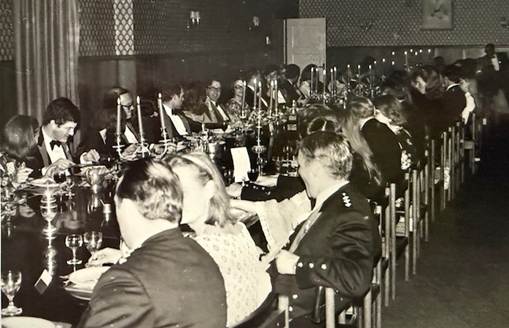
all booted and spurred – the meal followed by mess rugby; what was known as ‘the porcelain telephone’ in the gentleman’s in the Officers’ Mess in Lippstadt, essentially somewhere to vomit when you have drunk too much (!); pretending to be a private soldier and collecting the late Richard Clarke, a newly-joined officer at that time, at RAF Gutersloh in a little Ferret Scout Car;
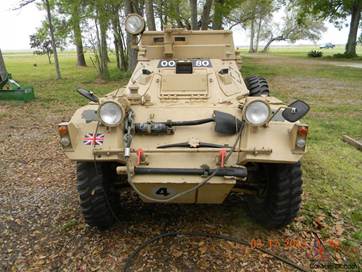
Not a lot of room inside one of these!
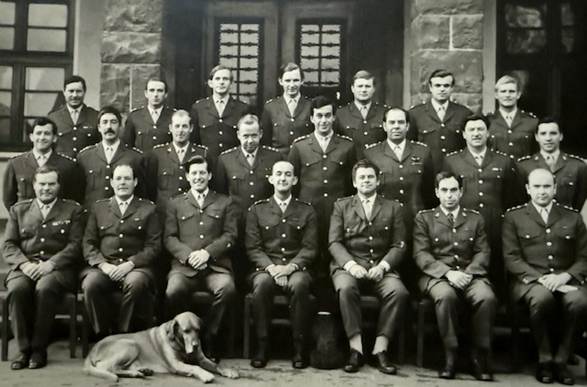
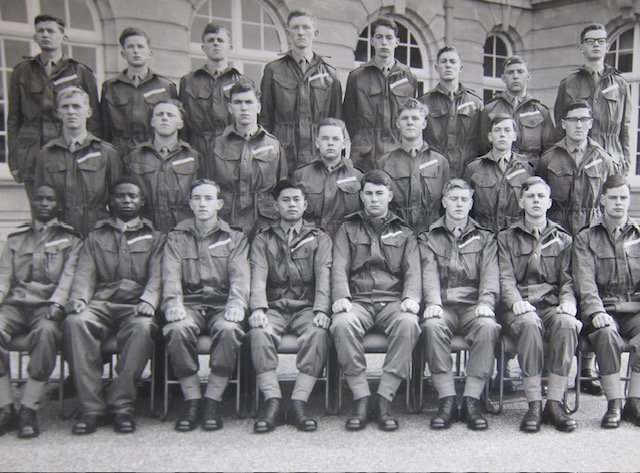
studying for academic exams for entry to the Army Staff College, a prerequisite to promotion beyond the rank of Major; learning that the wives of my soldiers could also be charged with offences under Military Law – a Sergeant’s wife lost her temper, smashed a bottle over someone’s head (nice huh!) and ended up in a Military Court; listening to the first ever moon walk – ‘One small step for man, one giant leap for mankind’ – by Neil Armstrong on 20th July 1969, on a small battery-powered radio in a tent in Trauen Camp; sitting for the annual Regimental Officers’ photograph, which often included a dog or two – this one of 27 Medium Regiment Royal Artillery in Lippstadt in 1972;
travelling to the German North Sea island of Sylt one Easter for a long weekend. Accessible by a man-made causeway …
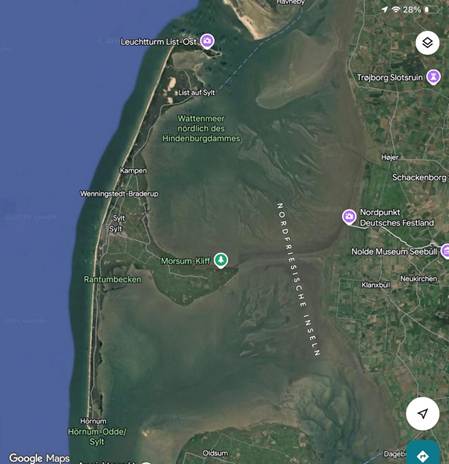
….. an up-market place for Germans to be seen, to promenade, to eat cake; another memory is easy – the extension cable I used in my Officers’ Mess accommodation, to take power to a stereo system, is still in use (see PC 108 ‘I’m Long and Black’ October 2017): attending a ‘Colloquial German’ course in Mülheim, near Düsseldorf, and embarrassingly translating a message to the effect there was a tank (hiding) behind the large farmer – confusing bauer (farmer) for scheune (barn).
Travel to East Germany was almost impossible, although one could drive or fly to Berlin with the correct paperwork. In the British sector of West Germany, troops occasionally patrolled the border with the East, more for its Public Relations value than any suggestion it was a deterrent! I undertook one such week’s fascinating patrol with sixteen of my gunners and am glad I did. We stayed in farmers’ barns, although a young Guard’s Second Lieutenant, who was attached to us, and I shared a room in the main house. I remember our first morning; out of nowhere, in his rather plummy voice: ‘Drat! He didn’t pack my razor!’ ‘What’s the problem, Brian/Andrew/Toby/etc?’ ‘My man (ie batman) forgot my razor!’ I lent him a spare and hope he learned a little lesson; if you want to guarantee something, do it yourself!
I have mentioned that 39 Medium Regiment spent two Christmases (1972 and 1975) on operations in Northern Ireland (see appropriate postcards). Prior to my second tour, the commanding officer, Mike Hudson, decided we should get used to working well into the night, so shifted our working day from 0800 – 1630 to 1230 – 2200. Previously, we just accepted that training went on into the evening. Now we could have a nice relaxing morning and the ‘working day’ never went beyond 2300.
Twice in my Army career I organised an Officers’ Mess Summer Ball, the second time in Bulford north of Salisbury, the first time in the Lippstadt Officers’ Mess. In the latter I was assisted by Anna Clements, the wife of the resident dentist John. I saw a lot of both of them and their three young boys, but it was Anna whose artistic ability gelled with mine in designing the decorations.
Memories of food outside the Officers Mess are of the wonderful German sausages and their extravagant cakes. Their little ‘Schnell Imbis’ (‘Fast Snack’ (Obviously!)) caravans were everywhere in die Parkplätze and the ‘Currywurst mit pommes frit’, served on a white cardboard tray with a little wooden two-pronged fork, became the easy answer to hunger pangs. Writing this, another memory surfaced! On big exercises in Germany, we tended to operate on Greenwich Mean Time, the time zone adopted by the Royal Air Force. In the summer months that meant we were two hours behind the locals. At the end of one gruelling day, the lieutenant colonel of the armoured regiment I was attached to suggested we had a snack in the local pub – the kitchen of which to our dismay had already closed!
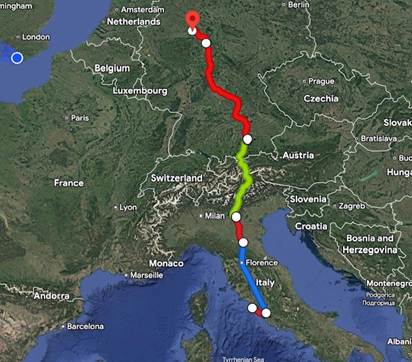
Living on continental Europe had its advantages from a travel point of view. In 1976, a conversation over lunch in England led to an offer; ‘come out to Palau, Sardinia and help Merry Andrews, the old friend of a friend, crew his yacht’. Two weeks on and off sailing, ‘fed, watered and accommodated for free’; I jumped at the chance. Late one Friday afternoon, with some sandwiches for supper, I set off in my little Lancia Fulvia for Civitavecchia, the port city to the west of Rome, from where I could catch a ferry to Olbia on Sardinia.
It’s just under 1500kms; Google Maps today tells me it would take around 18 hours. I drove until I felt the need to sleep, pulled into a layby, dropped the seat down, covered myself with a sleeping bag and slept. I reached Civitavecchia in time to book for the 2300 sailing; my car was hoisted onto the ferry deck by crane and I headed off in search of the bar. Two Gin & Tonics went down in quick succession! It was a very good fortnight.
And finally, our world was a diet of Alphabet soup. For example:
RA JDSC 2IC CO BC BAOR FOO TEWT NAAFI CPX GPO ADC AFV ADJ OP AG6 NSI SGT BDR GNR FP FUP GCM
Richard 20th February 2026
Hove
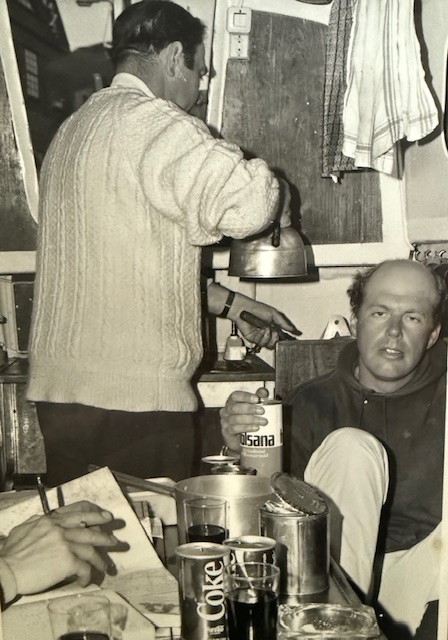
PS Oh! And I managed to find time to race from Tenerife to Bermuda in a 55ft ketch:
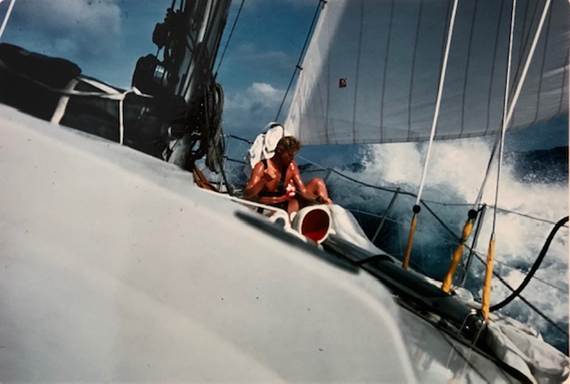
see PC 161 The Atlantic 1976 (Sep 2019)



 postcards