PC 468 Only The Lonely

For those of a certain age, the title should immediately take you back to the early sixties and Roy Orbison’s hit song and its lyrics: ‘Only the lonely, know the way I feel tonight; Only the Lonely, know this feeling ain’t right.’ Or, taking the last word of the title, Justin Bieber’s 2021 hit ‘Lonely’. Mud had a 1975 hit single ‘Lonely This Christmas’, about a relationship breakdown at a time of family get-togethers.

My dictionary defines ‘lonely’ as ‘solitary, companionless, isolated.’ Not to be confused with ‘alone’ – standing by oneself.

“What are you writing about?” asks Francisquinha, looking over my shoulder.

Francisquinha – read PCs 172 and 217 for more understanding

“Well. I was thinking about scribbling ….”

“I like that word, scribbling, gives a sense of free-flowing thoughts!”

“Thank you; probably about right! Anyway, I was drafting some thoughts about friends, family and that sort of stuff …..”

“I know I’m very much ‘family’, but I’m not sure about George.”

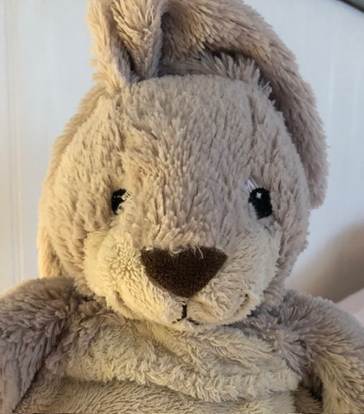
“Ah! Yes! George, the bear given to you by the staff of the George Hotel in Christchurch. To add to the bear given to you by the crew on our Singapore Airlines flight, and the stuffed little lamb from the manager of the Sofitel Viaduct hotel in Auckland. Weren’t you spoilt? But you’ve kept George?”

“I have. I had a choice and something gelled with him and me; choosing who your friends are is so important. In the back of my mind, I know I have a family who live in The Warren but that doesn’t make them friends, just because they are kith and kin. I sense he’s going to be a good friend but not sure what really makes a ‘good friend’. What do you think?”

“It must start with mutual attraction, and this could be physical or mental, shared or even contrasting interests, possibly shared experiences and background. You need to be able to trust someone, for without trust there’s nothing. It may be anecdotal now, but there was that initial exercise individuals attending a Family Institute course did on the first evening: ‘Without speaking, pair up with someone else.’ Once everyone had paired up, well 99% of them because there’s always someone who can’t, for some deep-seated reason, they were asked to discover why you were attracted, one to the other. Shared backgrounds trigger a feeling of attraction without any conscious awareness, just as an unconscious bias and filtering colour our preference for people we might be familiar with.”

“Are we friends?”

“What, you and Celina and me?

“Yes! I have been with you for many years; you take me on all your adventure, I have my own passport, but you often talk about me behind my back.”

“Bit unfair! Think we both wonder what you would have said, how you would have behaved, given certain criteria and given that you’re a fluffy rabbit. And we value your contribution to our love and friendship, often offering a nicely nuanced opinion.”

“I guess to be a real friend you need to be able to accept someone for who they are, not what you would like them to be!”

“Now that is often the nub of the issue, acceptance, allowing others to be who they want to be. Here in Brighton & Hove there are countless examples of individuals feeling comfortable in their own skin, feeling unconsciously accepted by everyone. One major issue, Francisquinha, is that we often, almost certainly, change over our lifetime and sometimes our friends don’t respect our decisions and choices and one wonders whether they remain a real friend.”

“You have an example?”

“Actually, I do! You know I got addicted to Hot Yoga, so much so that it’s part of who I am, what I do, what Celina and I do. I love the mental and physical challenge, although I appreciate it’s not for everyone. Someone who was a good friend has often asked, in a snide and derisory manner: ‘Still doing your yoga?’. So, I question that ‘real’ friendship.”

“Can we, you and me, be friends for life?”

“Oh! Yes. One of the things we love about you is that you listen and that’s such an important part of being a friend. When people want you to listen, they want you to listen to what they’re saying, patiently, not for you to second guess what they might say. Sometimes people are more interested in speaking than listening, looking into their own memory bank to match your experience, your situation. To fully process what’s being said, you need to listen, and listen good. That’s another attribute of a good friend.”

“George told me he was lonely before he came to stay with me, I mean us.”

“And now?”

“Well, he’s always liked being alone, happy with his own company, but he now appreciates he was also lonely.”

“Loneliness is a huge issue for human society, particularly when individuals haven’t made or kept long-term friendships, not making the continual effort that these require. Real loneliness can lead to a gradual reduction in how one takes care of oneself, the ‘why bother?’, and fortunately in the UK this is being recognised by the NHS. The new term is a ‘Social Prescription’, which helps to connect people to community groups and services, to meet social, emotional and practical needs that affect their health and well-being. Instead of medication, the links help a person to find groups like art classes, walking groups or gardening clubs for instance. These are particularly beneficial for those with loneliness, long term health conditions or complex social needs, aiming to improve overall health and therefore reduce pressure on the NHS.”

“You were reading an article the other day about how schools and residential homes for the elderly were coming together to encourage higher standards of reading.”

“Indeed. That seems a Win -Win, relieving aspects of potential loneliness in the elderly and improving children’s reading ability.”

“Would you drop everything for a friend in need?”

“Genuine need? Of course. That’s what friends are for!”

“I have one final question: “What’s Love Got To Do With It?”

“Ah! Yes. The one and only Tina Turner. What indeed?”

Richard 4th December 2025

Hove

www.postcardscribbles.co.uk

PS Posted on Thursday 4th as am under the knife tomorrow, Friday!

PC 457 Low Level Health Care in the United Kingdom

(Following on from PC 456; I was talking to Lisa in the Hope Café)

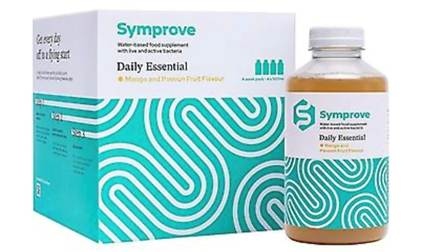
“Earlier this year I recognised that my ‘gut health’ was in a poor state following three general anaesthetics in 14 months, so started taking a probiotic, Symprove, one recommended by a dietician/nutritionist called Caroline Laidlaw.”

“Surely you can just eat more fermented fruit and vegetables and drink Kombucha. Isn’t that the same?”

“Possibly!! According to the various health bibles, ‘you can support your gut health by eating a diverse, fibre-rich diet, managing stress, prioritising sleep, exercising regularly and staying hydrated, while also limiting processed foods, sugar and excessive alcohol.’ I wish! Anyway, I decided to follow Caroline’s advice and sense a big improvement. Sadly the ‘original’ flavoured liquid tasted like cat’s piss, so now I’ve opted for the Strawberry & Raspberry flavour.

“Cat’s piss? How would you know what that tastes like? Actually don’t answer that!”

“We use ‘piss’ in a variety of ways. There’s ‘weak beer’s the colour of piss’ and then ‘he’s pissed’, in informal English suggesting someone’s angry and annoyed, a contraction of ‘pissed off’. Confusingly ‘he’s pissed’ might also mean ‘he’s drunk’, probably because one’s subsequent actions may piss off those around you.” 

“Come on Richard. Forget about gut health for a moment, I need you to concentrate on GPs etcetera. Having done lots of research already I suspect that low level healthcare provision in the United Kingdom is not in a good shape.”

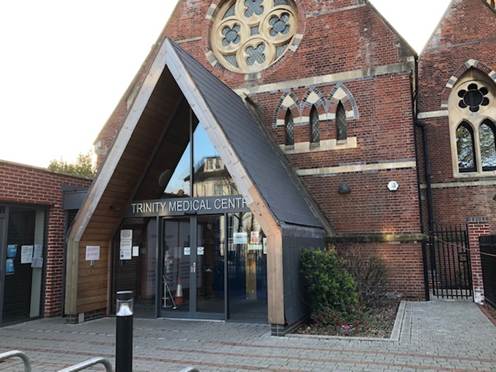
“Well, I looked at my own, Trinity Medical Centre, the one I am registered with in Hove.”

“Ah! I am just up the road with Charter. And ……”

“According to their website, they have eight doctors who are partners and eight who are salaried general practitioners, but not all the doctors spend five days a week in the practice, carrying out other roles within the NHS, committee work, training research etc.”

There’s a certain symmetry in having a medical centre in a decommissioned church!

“So, 16 doctors in total. The World Health Organization norm is one doctor for 1000 patients. Here in the UK the average is some 2250, an increase of 17% in ten years. ….”

“That’s a huge increase!”

“My doctor at Charter says they plan on some 8-12 minutes per patient ….. and you can only present one issue!”

“Trinity has, according to their website, about 24,000 registered patients. GP Surgeries are paid £136 per patient per year for the Practice’s operational costs, including heating, staff wages and administration. There are separate funds for specific patient care services such as specialist referrals or prescription drugs. Twenty-four thousand registered patients give them an income of £3,264,000. One of the doctors told me that unscrupulous practices just sign up as many individuals as possible, giving them more revenue and making that patient/doctor ratio unworkable.

“You know that one in seven GP Practices have closed since 2018? There are now 6,229 active practices in England, down 14 per cent on seven years ago. Just at a time when there are additional 5 million individuals registered”

“I had an interested comment from one of the GPs at Trinity. Some years ago, very few patients needing to see a doctor were in the 18-50 age bracket, so a practice could cope with a large number of registered individuals. Today everyone clamours to see a doctor – especially the ‘worried well’ and the anxious Millennials and Generation Z; and they want to be seen ….. now!”

“I assume that, when they can’t get an appointment, in frustration they head to the private practices, of which there are more and more.”

“Well I have certainly done that …….”

“I’ve got this note: The Royal College of General Practitioners’ plan ‘Fit For the Future’ urges new investment and retention measures, warning of a mass exodus of nearly 19000 GPs in the next five years.”

“That’s interesting; I have first-hand knowledge of this. I asked a couple of GPs, actually friends, actually a couple, how they were. “We are in the process of moving out of NHS general practice in the main due to the issues outlined in the RCGP’s ‘Fit for The Future’ plan. We as a bunch are highly resilient, committed and actively excited by the ability to change, to suit our patients’ needs, but the clunky system is no longer able to deliver this and we are fatigued. For a long time we’ve been squeezed financially and our newly qualified GPs don’t have job prospects. And those of us with experience have to work longer hours to earn the same pay, as our practices are aware they can employ someone willing to earn less because there is such demand. Morale is low! All a bit gloomy I’m afraid! But we are fine!” This really annoys me! On the one hand we have a high wastage rate of skilled individuals, on the other the Department of Health and Social Care saying: “GPs are front of centre of the Ten-Year Health Plan ……..  that’s why they will benefit from an increasing proportion of NHS funds, and we’ve already made great progress, including recruiting over 2,000 extra GPs in a year”.

“Wouldn’t it be better to try and reduce the wastage rate? I was told about 30% of trained doctors leave within five years. This seems such a waste of time, talent and experience.”

“My daughter says it’s the same, the wastage rate, in the teaching profession. Maybe it would be possible to work on some retention scheme ….. or improve the working conditions. No business would accept this loss of skill; they would start looking as to why it was happening and how to lessen the wastage.”

“Richard this has been really useful and I’ve probably got enough copy for my article. Thank you!”

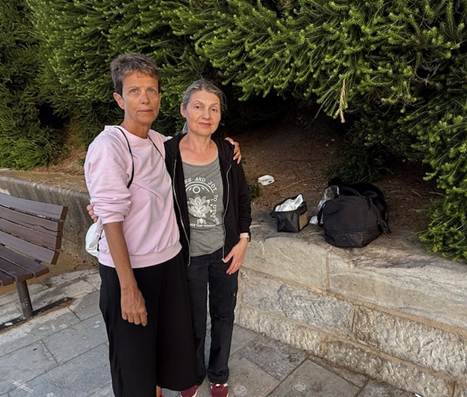
“No problem. Before you go …… we were talking about cat’s piss ….. in Estoril, Portugal Celina feeds a black cat that lives on the street and has also made friends with Mirela Gatos (Note 1), a Romanian who looks after dozens of strays down on the promenade.

Celina and Mirela

Ah! We always need examples of good deeds. Enjoy Singapore, Perth and New Zealand.”

“Thank you. We will.”

Richard 19th September 2025

Perth Australia

www.postcardscribbles.co.uk

PS The provision of both good health care and education are the bedrocks of a mature society.

Note 1 ‘Gatos’ is Portuguese for Cat!

PC 429 Behind the Glass

I don’t know about you, but I am often intrigued to know what goes on behind shop fronts that have frosted windows. They are the complete opposite of those using the shop window to entice potential customers, displaying something to make you want to go inside, maybe a poster showing a sale percentage reduction. Sometimes restaurants have an opaque window to give their customers some privacy and it’s the same for The Hove Practice, a private GPs’ surgery, which recently moved onto Church Road. Along the street is a massage clinic, with the obligatory hazy windows! We are lucky enough to have Kay Delphine, a very experienced masseuse, who comes to our apartment, otherwise we might have used one of these places. Some had a seedy reputation, offering more than a simple massage, but I sense those days have long gone.

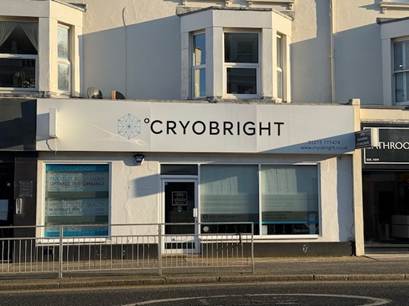
Opposite etch (note 1), a restaurant on the corner of Church Road and Hove Street run by Steven Edwards, a winner of MasterChef The Professionals, is one such place. A non-descript opaque window with its shop signage, ‘CryoBright’, offering no real clue to what goes on inside.

A voucher at Christmas gave us a couple of ‘experiences’ at CryoBright and in late January we pushed open the door. CryoBright provides ‘convenient, affordable access to the most advanced wellness and recovery techniques.’ These include an infrared sauna, red light therapy, fat freezing, leg compression therapy, physiotherapy, whole body cryotherapy and massage, mainly aimed at those recovering from some form of sports injury, which I am not! I was interested in the leg compression trousers, to improve blood circulation to my feet, and in the cold chamber – out of curiosity!

The ‘Compression’ trousers slide over your legs then go through a 20-second sequence of inflate/deflate, inflate/deflate for 20 minutes. It seems very gentle, too gentle almost and so I decide to concentrate on the cold chamber.

The idea is that extreme cold acts as a stimulus to your nervous system, particularly to the hypothalamus, responsible for reacting to dangerous situations; the ‘fight or flight’ trigger. It initiates several physiological reactions in the body, the main one being to restrict blood flow to the periphery, concentrating it around one’s vital organs.  

I said I am curious. Most of my experience of ‘cold’ is from winter weather, either skiing or on military exercises many years ago, when the wind chill can drop temperatures alarmingly. I am a pussy when it comes to swimming in a cold sea, such as in Estoril in Portugal, but the benefits of cold-water immersion are becoming more mainstream. Here in Hove many people swim in the sea all the year around, part of their daily routine, and swear by the invigorating afterglow. (Note 2) I guess we’ve all heard of Dutchman Wim Hof, aka the Iceman. In addition to plunging himself, and other paying customers, into freezing cold water, he markets a particular technique of breathing. Proper breathing is an essential part of practising yoga; in the hot yoga series you only breathe through your nose for the first hour.

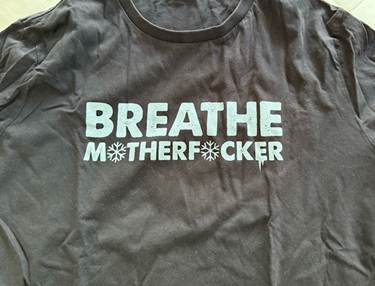
My Wim Hof T Shirt

Hof’s technique involves inhaling through your nose or mouth, filling both belly and chest, and exhaling through your mouth. Each breath should be short and powerful; do 30 to 40 then stop. We all take our lungs for granted, never bothering to exercise them – it’s estimated we only use some 60% of our lung capacity. And I certainly hadn’t heard of COPD (Chronic Obstructive Pulmonary Disease) until those first COVID months. In summary, I breathe well but wouldn’t want to plunge myself into a bath full of ice. (Note 3)

But when we returned from Portugal in September last year, a new cold-water shower, installed in the outer courtyard as part of the yoga studio’s new sauna offering, offered an opportunity to cool down quickly. Now, at the end of my 90 minutes 40°C hot yoga class, I go straight out and have a cold shower. Strangely, I have begun to look forward to it; odd huh! It’s wonderful!

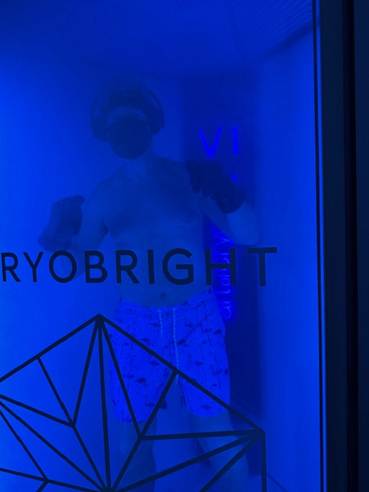
At CryoBright, Rob explains that the cold chamber is designed to give your body a thermal shock so, wearing shorts, a facemask, gloves, socks and slippers and with a set of headphones clamped around my ears, I open the door and enter. Oh! I should have said, it’s minus 85C. I have opted for 4 minutes but after 5 seconds my brain is already saying ‘fly!’. Fortunately, I decide to stay, moving around, glancing at the large clock on an iPad outside that’s counting down the four minutes, listening to music. I wonder how my body is reacting, why my nipples are feeling particularly cold, and resist the temptation to focus on the time. Just enjoy the experience. Outside, I put my clothes back on; my back is tingling in a delicious way and I feel fantastic. We sign up for a package of sessions; this Monday was my eighth and now I look forward to freezing my b******* off!

Our curiosity has encouraged chums to try it. Spread the word!

Richard 7th March 2025

Hove

www.postcardscribbles.co.uk

PS Celina also enjoys the cold chamber!

Note 1 Note the small ‘e’. Generally the first word of a sentence uses a capitalised first letter. There’s a distinction between ‘Etch’ and ‘etch’, although it’s personal! As a verb, to etch means to eat away the surface of something; I can only guess this is the tenuous connection for the title of the restaurant.

Note 2 In the summer of 1966, as an Officer Cadet at Sandhurst, I was attached to a Germany-based Artillery Battery for its two weeks Adventure Training near Oberammergau. I went with Staff Sergeant Curtis to recce a lake for some canoeing. The water looked inviting; he suggested I jump in. It was absolutely freezing, almost heart-stopping (!) and I got out as quickly as I had got in! Curtis laughed.

Note 3 The outdoor swimming pool water at Dauntsey’s School was fed directly from a cold spring. Maybe our lap times were quick as we wanted to get out as soon as possible.

PC 425 Generation Z

The lyrics of Mike & The Mechanics’ song ‘The Living Years’ start: ‘Every generation, blames the one before, and all of their frustrations, come beating on your door.’ Nothing new under the sun then?

To those of my readers born between 1997 and 2012, although I doubt if my eldest grandson Jasper aged 13 is reading my postcards, and known collectively as Generation Z, thank you. (See Note 1 for generational definitions.) Thank you for what you have done for those of us who don’t want to drink alcohol or who don’t want to drink much alcohol or for those of us who believe you can celebrate anything without getting completely sozzled, hammered, out-of-it. In these scribbles I am exploring Generation Z, a decidedly different generation than those that have gone before, or is it? Is it solely that ‘Gen Z’ has a catchy ring to it, not something that could be levelled at ‘Millennials’!

I grew up in a household when there were two landline telephones, one in my parents’ bedroom and the other downstairs. Local telephone calls weren’t that expensive, ‘trunk’ ones more so ….. and international ones had to be booked through an operator. My Scottish step-father kept a tight control on the length of the latter. Then came mobiles, ‘cells’ if you are American, and talking to someone not next to you was easy. In fact telephone calls have become so ubiquitous that for some they’re a nuisance, an intrusion, and they’ve stopped answering their mobile. A rather odd choreography’s developed; you text someone to say you want to talk to them, asking if it’s convenient. The recipient, rather than call you, responds to your question.

A recent survey of 18 – 34-year-olds, so Millennials and Generation Z, found that 25% never answer their mobile; they either ignore the ringing, respond via text or, if they don’t recognise the number, search for it online. Psychologists have suggested that as they haven’t developed the habit of speaking on the phone, it now seems to Generation Z as weird and not the norm. Mind you we’ve all got fed up with cold calls and scammers. I do not answer my phone if I don’t recognise the number; if it’s important the caller will leave a message. My only exception is my local GP’s Surgery …. but for some very strange reason that comes up as ‘Majestic Wines’!

Generation Z have made more headlines about their beliefs and habits than previous ones but that probably reflects the exponential rise in fast communication. Traditionally there have been some big milestones in life; going to university, getting married, owning property and maybe having a baby (Note 2). According to Ceci Browning (aged 23): “The average cost of a house deposit is £50,000; the average age to be able to put that down is 34. The average age for getting married is around 31. With no savings, no hope of buying a house anytime soon and no desire to rush into lifelong monogamy, my generation are turning our backs on these objectives and finding alternative markers to measure the progress of our lives.”

They obviously think it’s the fault of previous generations that houses seem unaffordable, but then they display a rather ‘I want it, and I want it now’ attitude; the entitled generation. I reflect I was 31 when I first got married, 32 when I bought my first house; so maybe this is just a whinge?

For Ceci, her markers are running a Half Marathon; quitting her job …. to follow her dream; taking a sabbatical …. after getting qualified and knuckling down; go back-packing for six months before she’s 30; launching an entrepreneurial side-line to feel accomplished; moving abroad …. and finally, starting therapy.

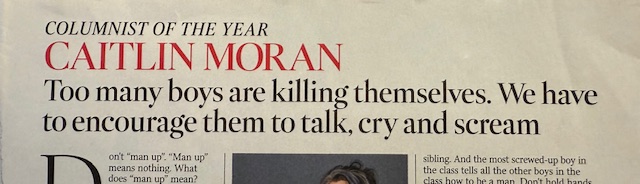
It’s well known that Generation Z talk about their feelings more than any previous ones.  Robert Crampton, a Times writer: “I’m thinking, for instance, of hugging. Young people hug each other all the time, even at first meeting, boys with boys, girls with girls, girls with boys. Hugging just wasn’t done when I was their age, not even between parents and their kids, or not much anyway, and we missed out. I mean, c’mon, who doesn’t love a hug?” You will remember that worrying headline from Caitlin Moran from PC 421: ‘Too many boys are killing themselves. We have to encourage them to talk, cry and scream.

Having spent 15 years seeing business clients 1:1, I know how vitally important it can be to talk to someone, to engage. If it’s become normal for Generation Z, that’s all for the good. But, and it’s a big ‘but’, there is a large difference between coping with life’s ups and downs, experiencing, learning, making choices, and claiming ‘it’s bad for my mental health’! An extremely small number of people do need medication and care to simply survive, but the cry from a majority about their mental health is getting very boring.

More information about this generation appeared last month. Shock headlines: ‘They don’t own a car’ – if you live in a town, why would you? Costly to park, bad for the urban environment! ‘Forty three percent don’t drink alcohol’ – wonderful! ‘They think they are more hygienic than other generations.’ – now that can’t be a bad thing; we could all learn better hygiene habits. ‘They are food-aware ie about glucose and lactose and allergies but not obsessed with their size or shape.’ We have an obesity crisis in the UK so being more knowledgeable about food must be a good thing.

A final comment. If you belong to either Gen Z or are a Millennial, be aware of both the positive and the negative power of social media. Cancelling anyone is a good example of the latter.

Richard 7th February 2025

Hove

www.postcardscribbles.co.uk

Note 1 The Greatest (1901-1927), The Silent (1928-1945), The Baby Boomers (1946-1964), Generation X (1965-1980), Millennials (1981-1996), Generation Z (1997-2012), Generation Alpha ((2013-2024) and Generation Beta (2025-2039)

Note 2. The birthrate across most developed countries is dropping, despite their effects to encourage more procreation. Everyone is worried that the growing financial burden of an older population falling on the shrinking workforce is unsustainable. Fortunately, here in the UK net immigration seems to buck the negative trends seen elsewhere. But young adults no longer necessarily think having a baby is the next logical step along life’s path; according to Shane Watson, writing in The Times, they rather see it as ‘the single biggest drain on resources, time, freedom and mental stability …. and it’s voluntary’.

PC 421 Not the way to go

I hope most of my readers will be aware of the phrases ‘cancel culture’ and ‘ghosting’. The latter was the subject of a book entitled ‘Ghosts’ by British millennial author Dolly Alderton; an interesting if heartbreaking story. What concerns me is the long lasting, often traumatic, effect that either action has on its victims. Last year there was an article in The Times entitled “Cancel Culture on Campus; ‘Most of us are terrified’” by Alice Thomson. She was prompted to investigate what is going on by the death of Alexander Rogers, an Oxford undergraduate who committed suicide after being ‘cancelled’. Someone killed themselves because they were cancelled?

The coroner, Nicholas Graham, seemed to think that the punishment of ostracization exacted immediately before Roger’s suicide played an influential role. He cited an independent review commissioned by his college, Corpus Christi, describing an establishment and normalised culture in which students would rush to judgement without knowledge of all the facts and shun those accused. Finally, he urged those in positions of responsibility to take cancel culture, ‘the exclusion of students from social circles based on allegations of misconduct, often without due process or a fair hearing’, seriously. Thomson wrote that whilst at 20 one is old enough to take responsibility for one’s actions, nothing should be unforgiveable.

Blimey! Actually ‘blimey’ doesn’t do it! ‘What the f**k?’ would be a better expression of my reaction. What a very sad reflection on the realities of the social scene for our young adults, a time when they should be experiencing and learning about relationships in real life, not shunning them for fear of being cancelled; in real life and not on-line! A graduate of Cambridge, Ceci Browning, wrote: “This is the paradox of my generation. We are meant to be the most tolerant and liberal, yet when one of our friends slips up and falls out of step, they become the enemy. We cut friends and acquaintances from our lives on the basis of second-hand information about something deemed morally iffy that they may or may not have done. But we are also perpetually afraid that precisely the same thing could happen to us.”

We know that the difficulties of learning how to start, continue and stop relationships start in one’s teenage years. My own childhood, although privileged, was very mixed. Whilst I have fond memories of the second preparatory boarding school where I spent my pre-teenage years, I shudder at some of the early memories I had of my teenage ones. Bullied and ostracised, rather wet by nature, feeling abandoned by my parents, I took a long while to find my feet and my confidence. Then of course there was no instant messaging, no aggrieved soul venting their hurt on social media, for others to share with God knows who. So rumours rose and died, snuffed out by the smallness of the audience.  

The suicide of Alexander Rogers is another statistic to some, but Caitlin Moran’s recent article ‘Too Many Boys are Killing Themselves.’ highlights a worrying trend. I read her book ‘About Men’ last year, an unusual topic for her, and subsequently wrote PCs 352 & 354 (About Men and More About Men) in September 2023. Moran writes that too many boys/young men are killing themselves. I have three grandsons so this subject is right there, on the front burner for me, trying to understand the modern pressures and how the three of them will be able to develop sensible values and self-discipline, able to filter out the crap peddled by influencers like Tait, who want to encourage boys to become incel – ‘unable to find a romantic or sexual partner’.

Socially relationships are key to our social fitness. The concept is not new; Aristotle, writing more than 2000 years ago, said that ‘man is by nature a social animal’. Moran described the difficulties of both sexes interacting in the digital world. For instance, what to one person might be an attempt to give an affectionate ‘touch of the neck’ could be construed by the object of their actions, someone who perhaps has watched too much internet porn, as a preliminary move towards a strangle hold and shock and revulsion is their response; a touch of the lower back easily extrapolated into an imagination of unwanted sexual advances. And this at a time when everyone is experimenting, trying what works for them, understanding what doesn’t.

It’s also important to remember that the ‘squishy part of the brain responsible for sensible decision-making’ isn’t completely developed until one’s mid to late 20s. ‘Students are still especially susceptible to making stupid mistakes and perhaps overreacting to perceived slights’. Rather than try and discuss and understand and accept an apology, they reach for their social media account. Stories are gobbled up in such an insatiable way there is no thought to pause, to think if it’s true or somewhat exaggerated; ‘share’ and ‘share’, part of the herd. So when someone is cancelled by those whom they believed to be in their ‘friends and acquaintances’ circle, it doesn’t take much to understand how their whole world comes crashing down.

I wonder whether those involved in the story of Alexander, either personally or by association, feel any lasting blame for their actions, any lasting shame. What has changed since the independent report commissioned by Corpus Christi? Has it really made it easier for students to talk about the inappropriate behaviour of other students, as part of a normal discourse about growing up and developing proper boundaries, or has the college decided that its reputation is more important than that of one individual?

In the final analysis we think and no one else can do that for us; we feel what we think, these feelings coloured by past experiences and expectations; then it’s our responsibility whether we act …. or not.

Richard 10th January 2025

Hove

www.postcardscribbles.co.uk

PS Read ‘The Happiest Man on Earth’ by Eddie Jaku if you’re a bit down; time to reflect.