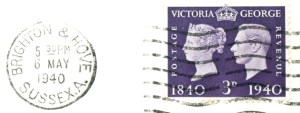
Towards the end of my teenage years, I wanted to be an architect …… but architecture was going through a difficult time and my stepfather suggested I join the British Army. He thought was that by the time I had spent three years or so serving Her Majesty, architectural opportunities might be better; I did 20 years!
To gain entry to the Royal Military Academy Sandhurst (RMAS) I had to attend the Regular Commissions Board, then located in Westbury, Wiltshire, to be assessed!

Fortunately I passed the various physical and mental tests, including the ‘speak for 5 minutes about … a milk bottle’!
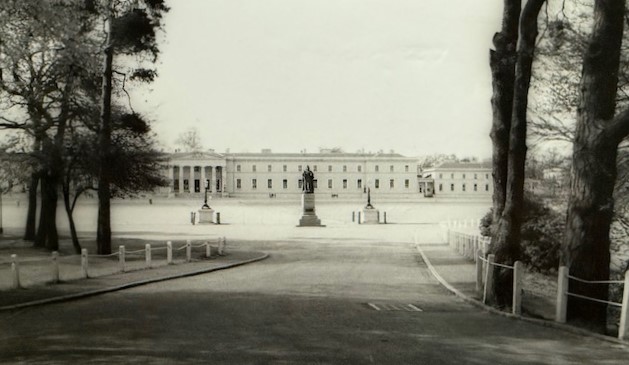
The transition from boy to man, girl to woman, is, for some, complex and unnerving, for others it’s like water off the proverbial duck’s back. Everyone’s experience is unique, can never be otherwise and it could be forced upon one through the diktats of family life, the loss of a parent for instance, or tribal customs very early, but for most it happened after one’s 16th birthday; nowadays I sense it’s much earlier – more’s the shame! Of course there are those who never really grow up, still maintaining a childish outlook on life, the Peter Pans. The syndrome, used to describe those adults who are socially immature, refers to people who have reached an adult age but cannot face their adult sensations and responsibilities.
The Royal Military Academy (Note 1) turns boys into young men, girls into young women, ready to be deployed into combat should that be necessary, ready to lead. Nowadays the course is a year (Note 2) but in 1965 it was a two-year course mirroring and, in some respects, equalling the first-degree courses at many universities. The Academy had four intakes of Officer Cadets at any one time; commissioning took place in December and July. Some 60% of our time was spent on academics, the rest on learning our new craft, the military and the art of warfare (Note 3).
Our neighbour Meryl, an avid reader of my postcards, suggested I wrote something about my memories of the two years I spent at RMAS. Why, I am not quite sure; maybe she wanted to find out why I am how I am (?) but I doubted whether, in 1000 words or less, I could encapsulate my time growing, from teenager to adult, from schoolboy to Army Officer. Maybe I would need two or even three PCs? It was a disparate bunch of teenagers who formed up on the Victory College square as Burma Company Intake 39 in September 1965 and included three from overseas, Sid Sonsomsouk from Thailand, Ngambi from Uganda and Jo Nakamet from Kenya. No one was sure what we had let ourselves in for. It didn’t take long to find out!
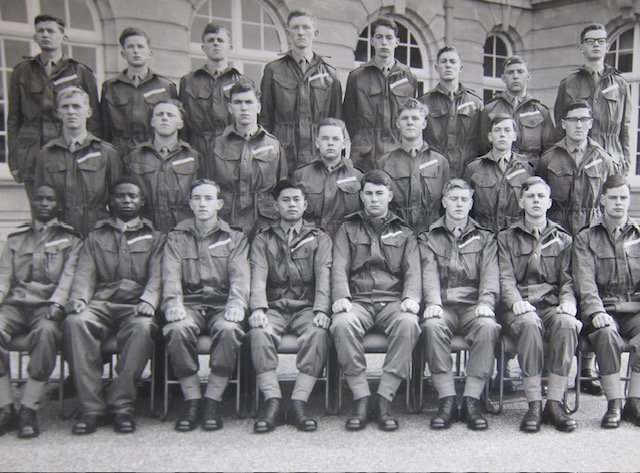
How would I describe the first six weeks, when the days began very early and ended very late, when others dictated what you did? Challenging? Draining? Character building? Probably all of the above and more besides. A good example was ‘Changing Parades’, when we had to appear in the corridor outside our room in one form of dress, be inspected with infringements resulting in press-ups, before going back and changing into another form of dress – from full combat gear, to Service Dress, to PT Kit (Blue Blazer, Blue shorts, White T-Shirt, White ‘plimsols’ (Does anyone know what these are?)) to Parade Ground Uniform. Our rooms had, during the whole process, to remain immaculate. The instructors would scream and shout at any visible laziness or inattention. Faced with an external threat (the instructors!) we all began to coalesce into a group, safety in numbers and focusing our hate on our instructors. I think this was where the military saying ‘Kit on! Kit off!’ comes from.
Within the first month one of the platoon was suddenly diagnosed with leukaemia, disappeared to the Military Hospital in Aldershot ….. and died two months later.

I have written before how the experience of becoming proficient at drill, in marching in time, swinging the appropriate arm, showing off our skills and being part of something, belonging, wanting, gets imbedded within one. Imagine being on parade with another 889 officer cadets, moving in formation to the familiar marching tunes, bursting with pride. That’s a great memory, acknowledging the hard work that preceded it, to get to the required standard. For those who have never had the privilege and opportunity, your life is missing something!

The main Sandhurst parades started at 1100. There were always little niggles, so the Academy Sergeant Major, a chap called Phillips, the most senior non-commissioned officer and otherwise known as ‘God’, would insist we would be lined up on Old College Square at 1030, to ensure there was no last-minute panic. Old College Square was a 10-minute march from New College Square, so College Sergeant Major Murphy, Irish Guards, (‘Spud’ behind his back, but never to his face!) insisted we were ready to leave at 1000, as there were always little niggles. Burma Company Sergeant Major Hewlett, Coldstream Guards, insisted we formed up for him at 0930, as there were always little niggles. Staff Sergeant Rooney, a Welsh Fusilier, insisted the platoon for which he was responsible formed up at 0900, as there were always little niggles. This is probably where the phrase ‘5 minutes before 5 minutes before …..’ originates.
(to be continued)
Richard 11th October 2024
Hove
http://www.postcardscribbles.co.uk
Note 1 Naval Officers are trained at the Royal Navy College Dartmouth and Air Force Officers at Cranwell
Note 2 A new term started last month with 288 Officer Cadets joining CC 243 for the 44-week course. There are 40 international cadets from 23 countries as diverse as Columbia and Kazakhstan. Of the 248 British cadets, just over half were educated in the state sector, 80% are university graduates and the average age is 22.
Note 3 The War Studies Department was run by John Keegan. The recent obituary of Duncan Anderson, who took over as its head in 1997, had an interesting snippet! Keegan’s successor was a chap called John Pimlott, who had died after two grenades he picked up during a battlefield tour in France exploded in his study at home.
 postcards