During my 20 years serving Her Majesty and her elected governments, I spent almost six years in Germany, when it was divided into West and East, and home to the British Army of The Rhine (BAOR). In the 1970s 1st (BR) Corps, which was headquartered in Bielefeld, had a strength of about 53,000. NATO forces faced the combined might of the USSR and Warsaw Pact armies. To quote a former commander of 7th Armoured Brigade: “These were huge armies that we were going to have to take on, and we were inevitably going to be overwhelmed by numbers. Therefore, it was the amount of damage that we could do …. to limit their advance before ‘nuclear release’, before we actually used tactical nuclear weapons.” I reflect that we never practised ‘advancing’, always refining the managed retreat!
I write these memories at a time of heightened tension across Europe, with Russia reinterpreting history to justify its own belligerent nature. Sad when you read its president talking about war with Europe. Why can’t he refocus, on, say, raising the living standards of his people?
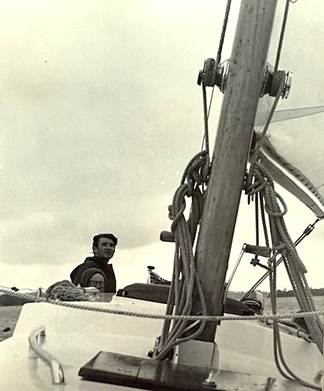
Sailing a 30ft engineless Danboat with the late Bill Pender
In my first year in Lippstadt, before going to university, I was often sailing in The Baltic, on yachts from the British Kiel Yacht Club on the western side of the Kieler Fjord (See PC 106 Sailing in The Baltic 2017, PC 229 Kiel to Oslo 2021 and PC 231 Ropes and Sheets 2021.) I continued to introduce soldiers to the rigours of offshore sailing when I returned to Lippstadt in 1972, before moving down the road to Paderborn the following year.
My absence from barracks was noticeable! So much so that when the Second-in-Command, Major John Harman, wanted to reinforce a point in his lecture to junior NCOs, he allegedly asked: “So where would you expect the FOO of 132 Battery (Note 1), Captain Yates, to be at this stage in the battle?”, a wag at the back shouted: “Sailing in The Baltic, Sir!” In my accommodation in the Officers’ Mess, I had a wall covered with charts of The Baltic, with coloured lines marking different expeditions. Good times!
In August 1969 I heard on the radio Prime Minister Jim Callaghan announce that British troops would be sent to Northern Ireland ‘to aid the police’. I was, naturally, on a yacht, this time near the little Danish village of Aerøskøbing and within three weeks of returning to England and starting university. I genuinely thought I might miss some action, with the prospect of three years studying Civil Engineering. Surely in that time ‘they’ could sort out what would become known as the Troubles? No one forecast the civil conflict would last for 30 years. My own ‘Tales of Northern Ireland’ can be found in PCs 196, 197 & 198 from 2020.
I was a single officer during my time in Germany and life revolved around training in and out of barracks, sport,
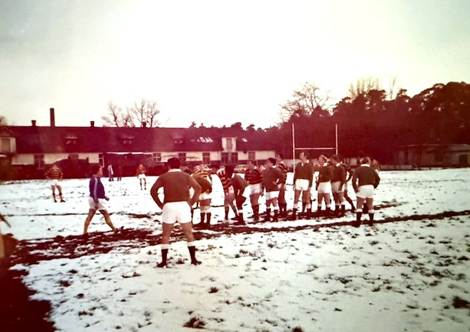
An inter-regimental rugby match in February 1973
and the Officers’ Mess. It was here we congregated for a mid-morning coffee, a drink in the bar before lunch, a drink or two in the bar before dinner and possibly a nightcap. I sensed we ‘worked hard and played hard’! There was no watchable television, the newspapers were at least a day old and the only telephone was a landline contained in a little kiosk in a corner of the Mess hallway. For international calls, you had to talk to the operator and book it! The Mess in Lippstadt was a grand building with a double-height dining room and a Minstrel’s gallery at one end. During morning coffee in one of the anterooms, Captains David Morley and the late Bill Pender would read, with appropriate accents, Punch magazine’s Idi Amin column. (Note 2) Somehow a wonderful memory, although the subject was evil! Idi Amin was the dictatorial President of Uganda (1971-1979) whose regime was responsible for the deaths of anywhere from 100,000 to 500,000 Ugandans and the expulsion of some 50,000 Ugandan Asians, who owned the vast majority of the country’s businesses; economic collapse followed.
We enjoyed a life of duty-free alcohol, cigarettes and other goods like cars. The British Forces were supported by the NAAFI (Naval, Army & Air Force Institute), which had a large supermarket near the barracks in Schloss Neuhaus. Living as a single chap in the Officers’ Mess, my victualing needs were met, and I rarely went to the NAAFI. On the odd occasion I did, I was disappointed. Looking for some ink cartridges for a fountain pen, I tried the NAAFI: “Sorry love; no, we don’t stock those ….. but you’re the third person this month who’s asked for them.” I left, thinking well why don’t you order some in if there is a demand.
Training for the four-month infantry-role deployment to Northern Ireland took a huge chunk out of our normal Artillery training schedule; I did it twice!
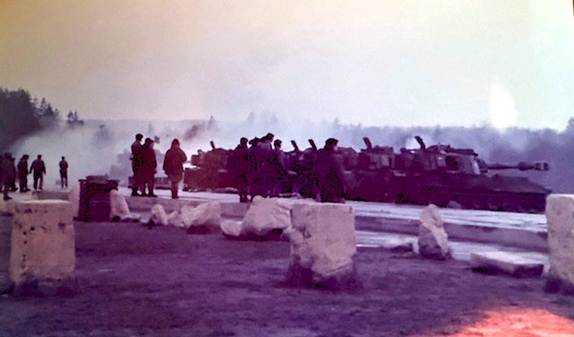
M109s in the direct as opposed to indirect fire role
The artillery training programmes at regimental level hadn’t changed for decades; individual/personal training advanced into sub-unit and regimental exercises, then in the autumn much larger Divisional formations practised over the north German plains. Farmers were paid compensation if dozens of tracked vehicles ripped through, for instance, their fields of Sugar Beet. These exercises naturally never used live ammunition; we practised that with 155mm shells on the Hohne-Bergen and Münsterlager Training areas.
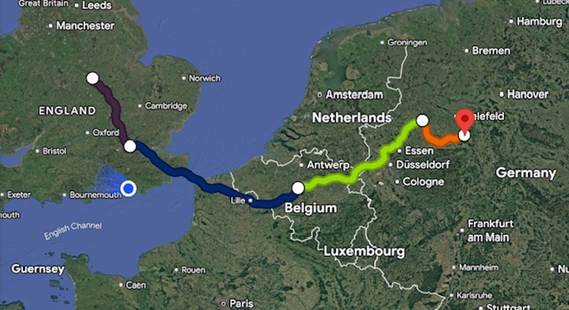
We did some mad things but then we were in our twenties, and everyone does mad things in their 20s, right? One Friday afternoon I got in the car after work, and drove to Calais, some 550kms. I then caught the 2300 ferry to Dover and drove to Leicester. On the Sunday afternoon, I drove back to Dover, caught the ferry to Ostend in Belgium and drove back into Germany, arriving for breakfast in the Officers Mess.
(To be Continued)
Richard 16th January 2026
Hove
Note 1 An artillery Forward Observation Officer (FOO) would be attached to an infantry or tank regiment, to bring indirect fire support as necessary.
Note 2 Regular articles by Alan Coren appeared in Punch, “utilising phonetic spelling and current idiom to lampoon this odious dictator. Sadly, its success won the attention of the Politically Correct Commissars, who pompously halted the satire.”

 postcards