PC 473 You had a What?

One Sunday last month, the day of the Winter Solstice, I walked down to the Fish Shack, a small kiosk on Hove’s beach, open three days a week to sell extraordinarily fresh fish – hence its name, I guess.

I love the little crayfish tails they sell, so buy a large tub and some anchovies in oil. It was two days after I had had the all clear from the nursing staff at The Montefiore about my post-operative Hernia wound. Jim recognises me and asks:

‘How are you, Richard?’

“On the mend after my hernia repair.”

There’s a tendency when we hear something, we automatically want to recount our own experiences, rather than ask a question to further the conversation; not really listening!! 

“Hernia huh! I had one of those, so you don’t need to tell me how painful it is. (Ed: Actually, I wasn’t going to!) It was about 5 years ago, and I was working in The Billingsgate Fish Market in Central London …….

One of the Billingsgate stalls

I was supervising the unloading of a lorry, a fork-lift taking the pallets off the back. One partially split and I instinctively went to hold it together ….. well, that was stupid wasn’t it …..  got a shooting pain down my arm and suffered a rupture, later diagnosed as a hernia.”

As I am listing to this tale of woe, I realise another customer, a woman, has arrived to buy some fish. I turned to her and apologised about the rather distressing medical story: “Don’t worry, I know all about Hernias …. my husband, my brother and my son have all suffered.”

We will all suffer something going wrong with our physical bodies during our lifetime, that much is guaranteed. What’s not is which particular ailments might come our way, maybe affected by lifestyle, our level of risk, eating habits, genetics and possibly bad luck – wrong place, wrong time. A Hernia? I had heard the name, knew that one of our yoga chums had had a bad one, whatever that meant, but my knowledge was minimal. Three weeks after mine and I apologise to the Waitrose delivery chap that I shouldn’t lift the green plastic crates containing our order (ie my wife Celina had told me not to!), as I am recovering from a hernia operation. “I’ve had one of those, know all about it!” He looked about 17 (actually he was 22!) and his had occurred when he was 18 – so age is no differentiator!

You can skip the next paragraph if you know all about hernias.

A hernia occurs when an organ or tissue pushes through a weak spot in the surrounding muscle or connective tissue. Common types of hernias include an Inguinal hernia, occurring in the groin area; an Umbilical hernia, occurring near the belly button; a Hiatal hernia, occurring when part of the stomach pushes through the diaphragm and lastly a Femoral hernia, occurring in the upper thigh near the groin. Symptoms may include a noticeable bulge, discomfort, or pain, especially when lifting or straining. Treatment often involves surgery.’

Then I found a diagram; I like diagrams, having a preference for pictural representation rather than a verbal description. I learned the other day that some 1-4% of people have a real phenomenon called Aphantasia; they are completely unable to imagine images in their head. For example, they can’t consciously create pictures in their head, like ‘seeing a red apple when you think of one.’ Thankfully I am not so afflicted, as I can’t imagine not being able to visualise, picture something.

Sorry, I digress!

Note the ‘weak point’ in the surrounding muscle. To confirm I had a hernia, I went off for an Ultrasound at The Nuffield Hospital, the other side of Brighton, on 12th August 2025. (Note 1) The Radiologist explained that, in men, the testes left the abdomen to drop down into the scrotum. OK, I understood this basic biology; they are there because they need to be kept at a cooler temperature than within the abdomen. What I hadn’t known was that where they exited the abdomen, they left a weak spot; that is often where inguinal hernias in men occur.

I was put on the NHS list in mid-August and attended the clinic on 7th November 2025 at The Montefiore. Given the delicate nature of a hernia repair, I was motivated to find out more about the consultant. These days, with LinkedIn and other online platforms, it’s easy to find out some basics, such as the fact he was born overseas, arriving in England as a child, and completing his medical training at Cambridge University. After our initial meeting he booked me in for late February 2026 and followed up with lots of information about the procedure, for me to digest. I was impressed – he ‘did what he said he would.’! We exchanged emails and I learned for instance his favourite composer is Bach. I warmed to him as a human being when he wrote: “I always say how lucky I am to have been accepted here and never cease to admire the tolerance and civility of this nation and its people. It is my duty to give back as much as I can.” Currently there’s often derogatory comment in our press about Britain and its place in the world. It was nice to read something positive and fundamental.

We managed to bring the operation forward to 5th December 2025. I checked in with Helen at the Reception Desk at 0655, got briefed by Abbi the Anaesthetist, felt confident everyone knew what they were about to do ……. zzzzzz ….. then into the recovery room!

I left around 1400 just as Helen, the receptionist, was finishing her shift. Seemed a fitting closure. Three weeks later I was back in the hot yoga studio, albeit being careful in some postures.

Richard 9th January 2026

Hove

http://www.postcardscribbles.co.uk

Note 1 Paying for medical treatment is, for some, an option, either through their Health Insurance or from their deep pocket. The cost of the scan was so exorbitant that I wrote to the CEO of The Nuffield, essentially asking him to justify it. I received a reply explaining this and that and the other – but no real justification for the cost.

PC 412 Memories of Sandhurst (part 3)

The link between mental fitness and physical fitness is well researched. Thankfully we got physically fit, through sessions of PT, time in the swimming pool, ‘Battle PT’ runs, wearing kit and carrying one’s rifle, and undertaking long treks, particularly in the Brecon Beacons in South Wales. One evening towards the end of our first term, so probably early December, we got dropped off, at night, in the middle of nowhere! The first checkpoint was at the top of Pen y Fan, the highest mountain in this National Park, with a notoriously steep ascent to start; hard work, particularly carry full kit. Don’t forget this was light years before GPS and mobile phones; we had learned the basics of land navigation and worked with paper maps and old-fashioned compasses.

Pen y Fan

It was probably midnight when we got to the top and were given our next  checkpoint, some 16kms away. There we had to inflate a rubber boat and paddle some 10 kms to the next point. Oh! I think there was a stretcher race in there somewhere. Sometime the following evening we gathered in a pub carpark, without any permission to enter so psychological torture (!) and were given our next task, a four-point speed-march over the Sennybridge Impact Area. Sleep deprived and mentally and physically exhausted, I remember distinctly seeing a three-masted sailing ship slide across the face of the full moon, as we laboured from one water-filled hole to another.

Once I realised sleep deprivation was something one had to deal with, I learned how to catnap. The memory of hallucinating that wonderful sailing ship triggered another, sleeping standing up! It was before dawn on day three of an exercise on the local training area known as Barossa. My platoon was to be the assault unit for a company attack at daybreak.

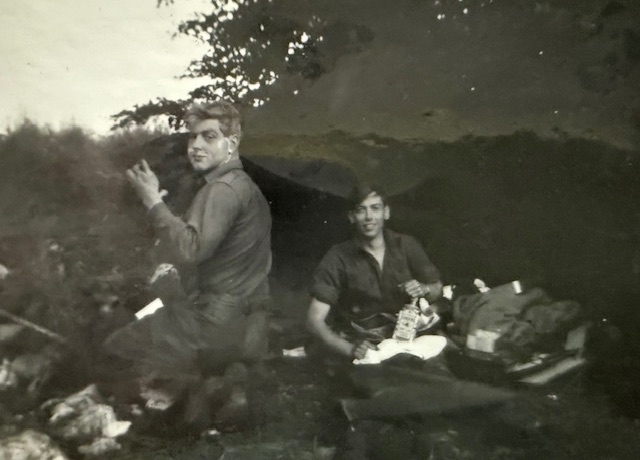
John Thewlis and Martin Ward-Harrison – somewhere

After a night in trenches, with patrols and sentry duty, everyone was knackered but, fortified by breakfast cooked over ‘hexy’ burners and a hot coffee, we formed up in our sections and silently made our way to the FUP (forming up point), some 1000 metres away (actually it was probably 1093 yards as this was pre-metric UK!). We tried to move quietly through the darkness, every now and again stopping to ensure everyone was together. I fell asleep upright and only woke because John Webster, who was behind me and who had expected me to move, had shuffled into me!

As our understanding of military tactics, albeit at a low level, grew, so did the opportunities to show how much we had learned. The gathering of intelligence is often achieved by patrolling and the memory of one night patrol exercise has stayed with me. I am not sure who the platoon commander was, but I was his radio operator, equipped with an A41 radio set, about the size of a ream of A4 paper and weighed as much; its aerial was about 5 feet long. My task was to keep in touch with the controlling station, callsign Zero, and relay information as necessary. The problem was I had Laryngitis, so all my communications were barely audible, irrespective of how loud I wanted them to be! In the exercise debrief, the Directing Staff praised the quietness of the patrol; there are some benefits of being ill!

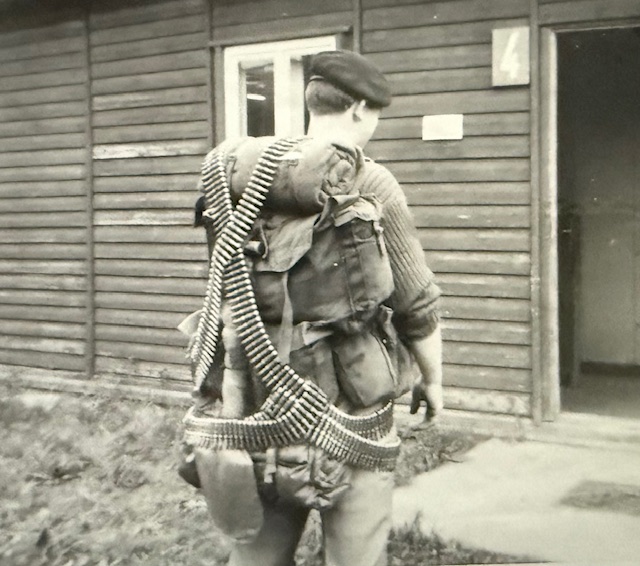
Sometimes we had to carry a lot of equipment. Preparing for an exercise in Belgium.

One aim of our training at Sandhurst was to teach us how to work as a team, both as a team member and as a team leader. Seems obvious, doesn’t it, but it is potentially one of the most difficult things confronting a leader. In each of the six Sandhurst terms, there was some Academy competition, be it the inter-company Drill Competition or the dreaded Assault Course, the winner the quickest team over a number of obstacles. The latter loomed at the start of the term in which it was placed as some mountain to climb. Actually that isn’t far from the truth as the ‘mountain’ was a ten foot wall. We were used to six-foot walls and one’s ability to climb up and over on one’s own. The 10ft wall required teamwork, technique and belief, particularly for the first and last person. To get the first person (A) on to the top of the wall, the tallest in the squad would stand with his back to the wall, with his hands cupped in front. Running from 10 metres or so, the second person (B – lightest and strong!) then placed his boot into the cupped hands of (A) and lifted himself up towards the top of the wall. His ascent was aided by (A) twisting his body and extending his arms upwards. Once on top, (B) could lean down and grab the next person (C), who was aided by (A). After the other five members of the section were over, this left (A) on his own at the bottom! (B) and (C) would both lean down, grab one of (A)’s arms, haul him up and over they all went. All this with the timekeeper’s stopwatch clicking away the minutes and seconds.

I am not sure the current training includes Bicycle Drill. Back in 1966 we were instructed how to stand next to a bicycle, how to mount, how to move off and how to stop. Saluting an officer whilst on a bicycle was not encouraged; we simply had to brace our arms, keeping looking forward! No helmets!

Sandhurst offered a full career to a pensionable age of 55. One loses contact with people, so I have little idea of how others’ careers developed. But I do know that my dear friend Martin Ward-Harrison was killed in Oman, that Sid Sonsomsouk retired as a general in his home country of Thailand and that Crichton Wakelin retired at 55, then took on a retired officer’s role for another ten years.  

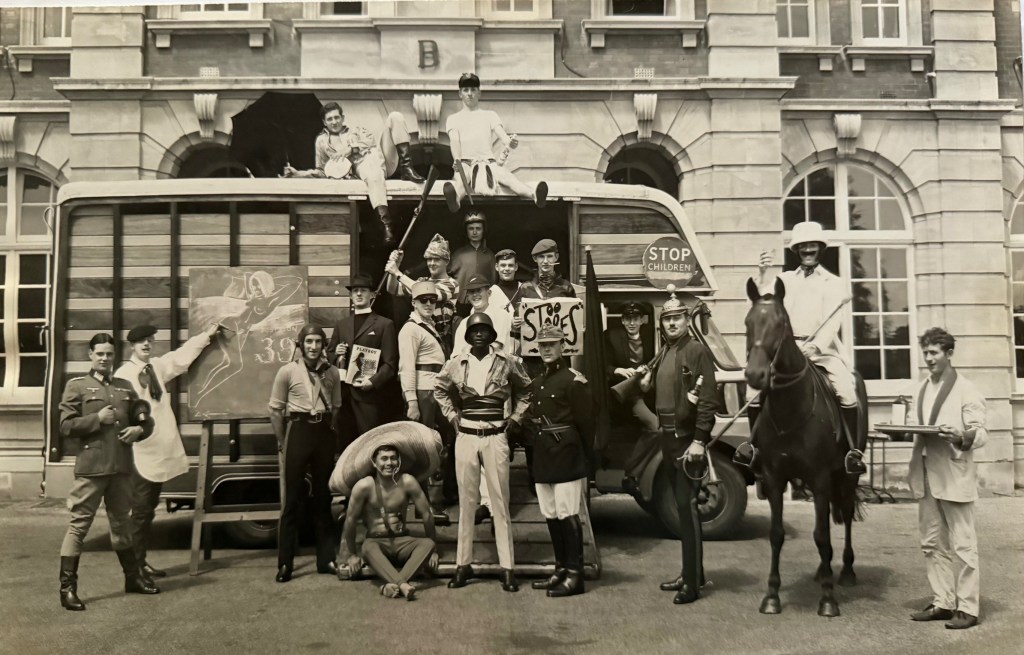
The lighter side of Burma 39. I spent two years with these guys – apart from the chap on the far right, Martin Ward-Harrison’s groom.

There have been many television programmes following recruits, from the time they cross the threshold of various training establishments, to when they ‘pass out’, get their commission. Some have followed Marine recruits at their school in Lympstone, some Police Cadets at their Hendon training establishment, some recruits at the Army Foundation College at Harrogate and there was one for those going through RMAS – ‘Sandhurst’ (ITV 2011). All have shown that given the right fertiliser, anyone can grow from boy to man, from girl to woman.

Richard 8th November 2024

Estoril Portugal

www.postcardscribbles.co.uk

PS I did well at Sandhurst, becoming a Company Junior Under Officer and winning the Benson Award. This was awarded ‘to the cadet commissioned into the Royal Artillery who has shown himself most deserving on grounds of general efficiency and character at Sandhurst’. ‘From little acorns, mighty oak trees grow!