PC 421 Not the way to go

I hope most of my readers will be aware of the phrases ‘cancel culture’ and ‘ghosting’. The latter was the subject of a book entitled ‘Ghosts’ by British millennial author Dolly Alderton; an interesting if heartbreaking story. What concerns me is the long lasting, often traumatic, effect that either action has on its victims. Last year there was an article in The Times entitled “Cancel Culture on Campus; ‘Most of us are terrified’” by Alice Thomson. She was prompted to investigate what is going on by the death of Alexander Rogers, an Oxford undergraduate who committed suicide after being ‘cancelled’. Someone killed themselves because they were cancelled?

The coroner, Nicholas Graham, seemed to think that the punishment of ostracization exacted immediately before Roger’s suicide played an influential role. He cited an independent review commissioned by his college, Corpus Christi, describing an establishment and normalised culture in which students would rush to judgement without knowledge of all the facts and shun those accused. Finally, he urged those in positions of responsibility to take cancel culture, ‘the exclusion of students from social circles based on allegations of misconduct, often without due process or a fair hearing’, seriously. Thomson wrote that whilst at 20 one is old enough to take responsibility for one’s actions, nothing should be unforgiveable.

Blimey! Actually ‘blimey’ doesn’t do it! ‘What the f**k?’ would be a better expression of my reaction. What a very sad reflection on the realities of the social scene for our young adults, a time when they should be experiencing and learning about relationships in real life, not shunning them for fear of being cancelled; in real life and not on-line! A graduate of Cambridge, Ceci Browning, wrote: “This is the paradox of my generation. We are meant to be the most tolerant and liberal, yet when one of our friends slips up and falls out of step, they become the enemy. We cut friends and acquaintances from our lives on the basis of second-hand information about something deemed morally iffy that they may or may not have done. But we are also perpetually afraid that precisely the same thing could happen to us.”

We know that the difficulties of learning how to start, continue and stop relationships start in one’s teenage years. My own childhood, although privileged, was very mixed. Whilst I have fond memories of the second preparatory boarding school where I spent my pre-teenage years, I shudder at some of the early memories I had of my teenage ones. Bullied and ostracised, rather wet by nature, feeling abandoned by my parents, I took a long while to find my feet and my confidence. Then of course there was no instant messaging, no aggrieved soul venting their hurt on social media, for others to share with God knows who. So rumours rose and died, snuffed out by the smallness of the audience.  
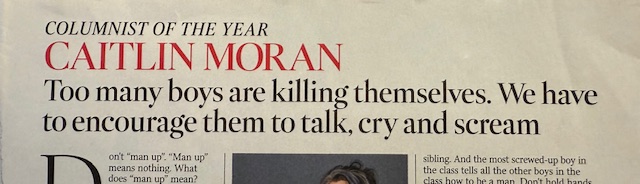
The suicide of Alexander Rogers is another statistic to some, but Caitlin Moran’s recent article ‘Too Many Boys are Killing Themselves.’ highlights a worrying trend. I read her book ‘About Men’ last year, an unusual topic for her, and subsequently wrote PCs 352 & 354 (About Men and More About Men) in September 2023. Moran writes that too many boys/young men are killing themselves. I have three grandsons so this subject is right there, on the front burner for me, trying to understand the modern pressures and how the three of them will be able to develop sensible values and self-discipline, able to filter out the crap peddled by influencers like Tait, who want to encourage boys to become incel – ‘unable to find a romantic or sexual partner’.

Socially relationships are key to our social fitness. The concept is not new; Aristotle, writing more than 2000 years ago, said that ‘man is by nature a social animal’. Moran described the difficulties of both sexes interacting in the digital world. For instance, what to one person might be an attempt to give an affectionate ‘touch of the neck’ could be construed by the object of their actions, someone who perhaps has watched too much internet porn, as a preliminary move towards a strangle hold and shock and revulsion is their response; a touch of the lower back easily extrapolated into an imagination of unwanted sexual advances. And this at a time when everyone is experimenting, trying what works for them, understanding what doesn’t.

It’s also important to remember that the ‘squishy part of the brain responsible for sensible decision-making’ isn’t completely developed until one’s mid to late 20s. ‘Students are still especially susceptible to making stupid mistakes and perhaps overreacting to perceived slights’. Rather than try and discuss and understand and accept an apology, they reach for their social media account. Stories are gobbled up in such an insatiable way there is no thought to pause, to think if it’s true or somewhat exaggerated; ‘share’ and ‘share’, part of the herd. So when someone is cancelled by those whom they believed to be in their ‘friends and acquaintances’ circle, it doesn’t take much to understand how their whole world comes crashing down.

I wonder whether those involved in the story of Alexander, either personally or by association, feel any lasting blame for their actions, any lasting shame. What has changed since the independent report commissioned by Corpus Christi? Has it really made it easier for students to talk about the inappropriate behaviour of other students, as part of a normal discourse about growing up and developing proper boundaries, or has the college decided that its reputation is more important than that of one individual?

In the final analysis we think and no one else can do that for us; we feel what we think, these feelings coloured by past experiences and expectations; then it’s our responsibility whether we act …. or not.

Richard 10th January 2025

Hove

www.postcardscribbles.co.uk

PS Read ‘The Happiest Man on Earth’ by Eddie Jaku if you’re a bit down; time to reflect.

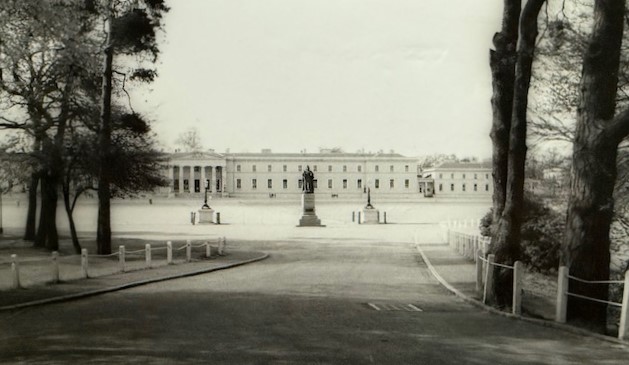
PC 408 Memories of Sandhurst – The United Kingdom’s Royal Military Academy

Towards the end of my teenage years, I wanted to be an architect …… but architecture was going through a difficult time and my stepfather suggested I join the British Army. He thought was that by the time I had spent three years or so serving Her Majesty, architectural opportunities might be better; I did 20 years!

To gain entry to the Royal Military Academy Sandhurst (RMAS) I had to attend the Regular Commissions Board, then located in Westbury, Wiltshire, to be assessed!

Fortunately I passed the various physical and mental tests, including the ‘speak for 5 minutes about … a milk bottle’!

The transition from boy to man, girl to woman, is, for some, complex and unnerving, for others it’s like water off the proverbial duck’s back. Everyone’s experience is unique, can never be otherwise and it could be forced upon one through the diktats of family life, the loss of a parent for instance, or tribal customs very early, but for most it happened after one’s 16th birthday; nowadays I sense it’s much earlier – more’s the shame! Of course there are those who never really grow up, still maintaining a childish outlook on life, the Peter Pans. The syndrome, used to describe those adults who are socially immature, refers to people who have reached an adult age but cannot face their adult sensations and responsibilities.

The Royal Military Academy (Note 1) turns boys into young men, girls into young women, ready to be deployed into combat should that be necessary, ready to lead. Nowadays the course is a year (Note 2) but in 1965 it was a two-year course mirroring and, in some respects, equalling the first-degree courses at many universities. The Academy had four intakes of Officer Cadets at any one time; commissioning took place in December and July. Some 60% of our time was spent on academics, the rest on learning our new craft, the military and the art of warfare (Note 3).

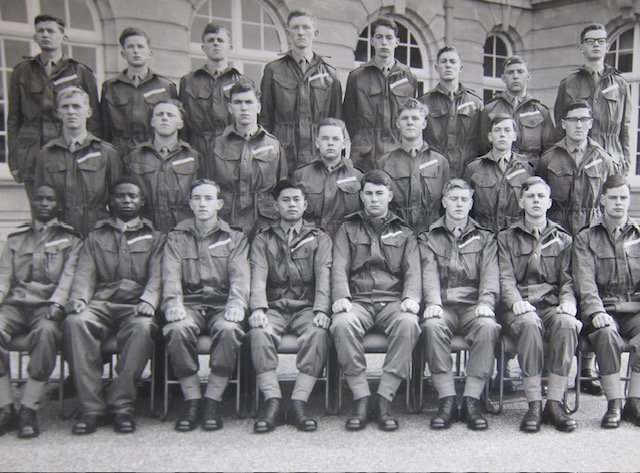
Our neighbour Meryl, an avid reader of my postcards, suggested I wrote something about my memories of the two years I spent at RMAS. Why, I am not quite sure; maybe she wanted to find out why I am how I am (?) but I doubted whether, in 1000 words or less, I could encapsulate my time growing, from teenager to adult, from schoolboy to Army Officer. Maybe I would need two or even three PCs? It was a disparate bunch of teenagers who formed up on the Victory College square as Burma Company Intake 39 in September 1965 and included three from overseas, Sid Sonsomsouk from Thailand, Ngambi from Uganda and Jo Nakamet from Kenya. No one was sure what we had let ourselves in for. It didn’t take long to find out!

How would I describe the first six weeks, when the days began very early and ended very late, when others dictated what you did? Challenging? Draining? Character building? Probably all of the above and more besides. A good example was ‘Changing Parades’, when we had to appear in the corridor outside our room in one form of dress, be inspected with infringements resulting in press-ups, before going back and changing into another form of dress – from full combat gear, to Service Dress, to PT Kit (Blue Blazer, Blue shorts, White T-Shirt, White ‘plimsols’ (Does anyone know what these are?)) to Parade Ground Uniform. Our rooms had, during the whole process, to remain immaculate. The instructors would scream and shout at any visible laziness or inattention. Faced with an external threat (the instructors!) we all began to coalesce into a group, safety in numbers and focusing our hate on our instructors. I think this was where the military saying ‘Kit on! Kit off!’ comes from.

Within the first month one of the platoon was suddenly diagnosed with leukaemia, disappeared to the Military Hospital in Aldershot ….. and died two months later. 

I have written before how the experience of becoming proficient at drill, in marching in time, swinging the appropriate arm, showing off our skills and being part of something, belonging, wanting, gets imbedded within one. Imagine being on parade with another 889 officer cadets, moving in formation to the familiar marching tunes, bursting with pride. That’s a great memory, acknowledging the hard work that preceded it, to get to the required standard. For those who have never had the privilege and opportunity, your life is missing something!

The main Sandhurst parades started at 1100. There were always little niggles, so the Academy Sergeant Major, a chap called Phillips, the most senior non-commissioned officer and otherwise known as ‘God’, would insist we would be lined up on Old College Square at 1030, to ensure there was no last-minute panic. Old College Square was a 10-minute march from New College Square, so College Sergeant Major Murphy, Irish Guards, (‘Spud’ behind his back, but never to his face!) insisted we were ready to leave at 1000, as there were always little niggles. Burma Company Sergeant Major Hewlett, Coldstream Guards, insisted we formed up for him at 0930, as there were always little niggles. Staff Sergeant Rooney, a Welsh Fusilier, insisted the platoon for which he was responsible formed up at 0900, as there were always little niggles. This is probably where the phrase ‘5 minutes before 5 minutes before …..’ originates.

(to be continued)

Richard 11th October 2024

Hove

http://www.postcardscribbles.co.uk

Note 1 Naval Officers are trained at the Royal Navy College Dartmouth and Air Force Officers at Cranwell

Note 2 A new term started last month with 288 Officer Cadets joining CC 243 for the 44-week course. There are 40 international cadets from 23 countries as diverse as Columbia and Kazakhstan. Of the 248 British cadets, just over half were educated in the state sector, 80% are university graduates and the average age is 22.

Note 3 The War Studies Department was run by John Keegan. The recent obituary of Duncan Anderson, who took over as its head in 1997, had an interesting snippet!  Keegan’s successor was a chap called John Pimlott, who had died after two grenades he picked up during a battlefield tour in France exploded in his study at home.