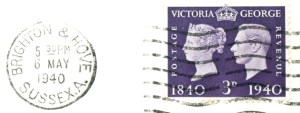
PC 460 Perth and The Margaret River WA

I sent this WhatsApp to Mo, who’d asked why we were going to WA.

“Many years ago, someone recommended ‘Cloudstreet’ by Western Australian author Tim Winton. I read it and loved it enormously.
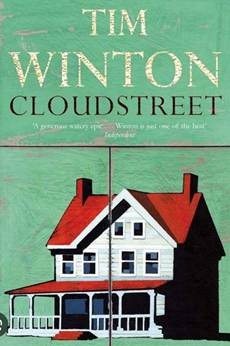
In summary: ‘The novel opens in 1943. Two poor families, the Lambs and the Pickles, flee their rural homes to share a large house called Cloudstreet in Perth, Western Australia. The two families contrast each other; the devoutly religious Lambs find meaning in hard work and God’s grace, while the Pickles hope for good luck and do not share the Lambs’ appetite for hard work.

Since then I have read most of his subsequent books, like Dirt Music and Breathe and had Western Australia on my bucket list for years. And it’s true, it’s roughly the same distance from Singapore to Perth and from Perth to Sydney; Perth is also in the same Time Zone as Singapore.”

“Now I understand. So, what have you been up to?”

“Perth in September is between seasons and we caught a rather cool wind, especially compared with Singapore! So, we didn’t take the 30-minute train ride to visit Fremantle on the coast, nor the ferry to Rottnest Island to sit on the beach or look for the Quokka marsupial, but we did walk up to Kings Park and admire its views across the city.
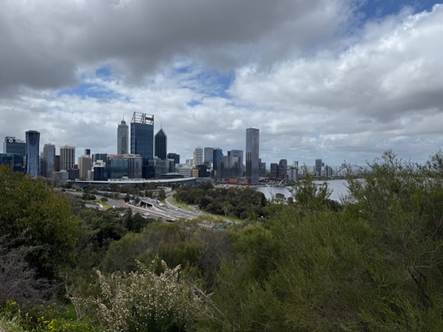
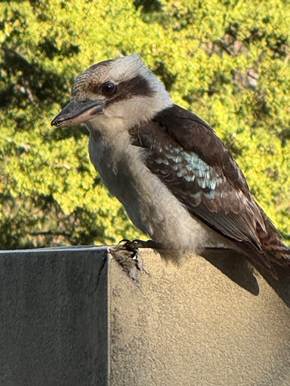
In the park I took a few photos of a kookaburra up in a tree, but for some strange reason they failed to materialise. Doesn’t happen very often and when it does it’s infuriating. Fortunately, we found another one in Cape Lodge’s grounds that was equally photogenic. To round off the outside activities we walked Elizabeth Quay …… which was basically closed!”

“OK! Richard. I’ll catch you when you’re back. Safe travels and enjoy WA.”

 Later we went to Perth’s Art Gallery of Western Australia and I was very taken by Mrs Bundamurra’s painting ‘Kira Kiro spirits’. The card said:

She often painted the Kira Kiro spirits that reside in and around the town of Kalumburu where she lived. There are good spirits and traditional dancers who sing about the yam and fruits that can be gathered when the wet season begins. Mrs Bundamurra had a strong connection to them which is how she was able to illustrate their animated, quirky nature.”
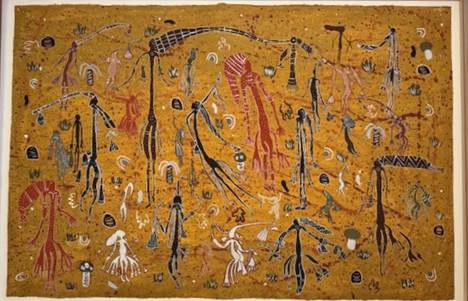
We all dream and sometimes our dreams are very vivid, sometimes they evaporate as soon as we wake, at other times their weirdness or strangeness lingers in our conscious. I wonder how I would paint these colourful thoughts, even the odd ethereal spirit, if indeed I could. Could you? I look at Mrs Bundamurra’s painting and marvel big time.

Normally I get very bored very quickly with museums, maybe 90 minutes max, but we spent about three hours in the WA Museum Boola Bardip, a fascinating collection of local culture and history. And somewhere in one of the galleries, one detailing skeletons of prehistoric animals found in this part of Australia ……

……. we found this little chap, the only living non-human on three floors of the museum. Felt he, or she (?), must have been lonely.

We checked out of our hotel, picked up a hire car, and headed south towards the Margaret River area which lies between Cape Naturaliste in the north and Cape Leeuwin in the south. The latter is the place where the Indian Ocean meets the Southern Ocean – the Indian Ocean current going north and the Southern Ocean current south.
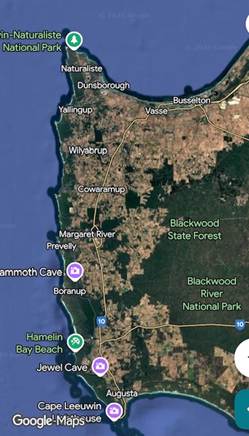
Indulging ourselves, we’d booked three nights in Cape Lodge – “offering intimate accommodation and an award-winning restaurant, Cape Lodge is a hidden gem situated in a private paradise within Yallingup and the renowned Margaret River wine region. Its restaurant was recognised in Australia’s top 1% at the 2025 Good Food Guide Chef Hat Awards.”

Driving around this region, everywhere one looked were vineyards, some smaller than others; Cape Lodge has its own – ‘Sous Ciel’.
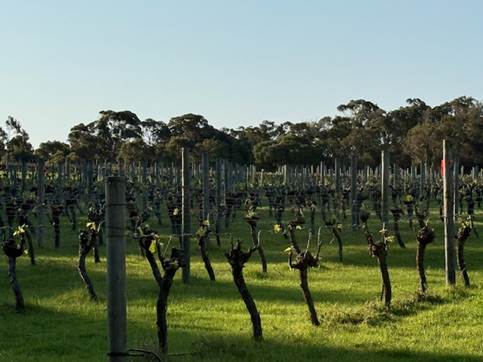
The stand-out memories of our stay are: The lovely staff, especially Josefinna, from Argentina, in reception and Lèa, from Normandy in France, who, at just 28, ran the restaurant; the restaurant’s food was beautiful, in a minimalistic way; ‘Vegetarian’ and ‘Australian’ don’t occupy the same page and one meal left Celina quite hungry; no matter how you treat a carrot, boil it, peel it, grill it, roast it, grate it, it’s still a carrot – and one needs more than one; the local kookaburra obliged with his best side…..
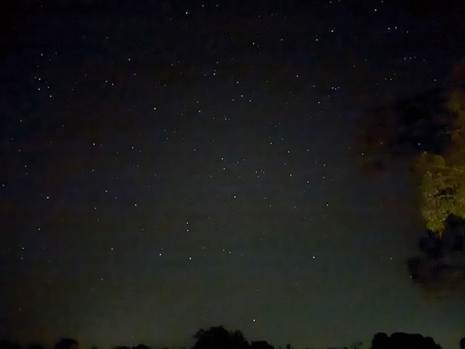
…… and the stars over the vineyard were exceptional (you have to look hard at this; the iPhone camera is excellent but this is stretching its abilities!
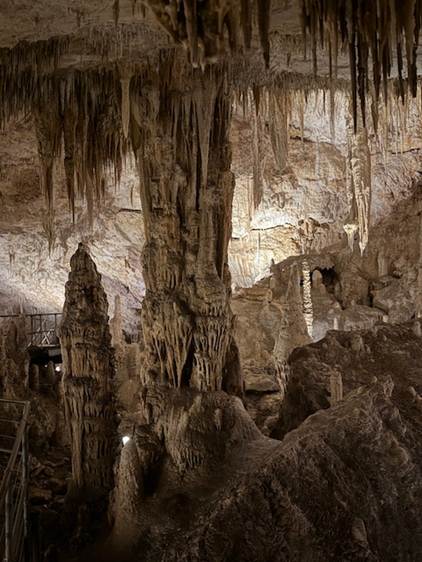
Geologically the area is mainly limestone on a lower stratum of granite. There are numerous caves; we drove south to the Mammoth Caves …..

….. and ooo’d and ah’d at the magnificent stalactites and stalagmites.
Lunch down on Prevelly Beach gave me the opportunity to paddle in the Indian Ocean for the first time in my life.

We drove up to the lighthouse on Cape Naturaliste, the cape named after the second ship in Frenchman Baudin’s mapping expedition of the coast.
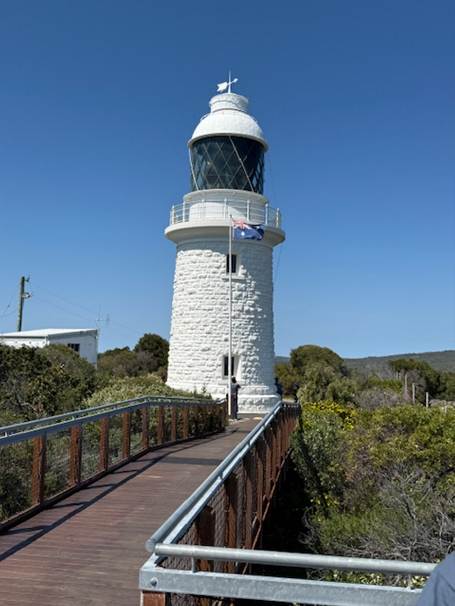
The recognition of the ancient Aboriginal people and their influence is very poignant here in Western Australia. The Magaret River area is the home of the Wadandi people. By the lighthouse is this welcome: “The traditional name for this location is Kwirreejeenungup, the place with the beautiful view. Look out to the horizon, where the sun sets. That’s where the spirits of our ancestors travel to rest, until the spirit totem return back to the boodja (country). We have a close connection to the ocean, land, plants and animals and will continue to care for this land and its waters. Our six-season calendar guides us as we live in harmony with boodja. We are encouraged by nature’s changes such as the flowering of different plants and animal behavioural cycles. If you look after the boodja, the boodja will look after you.”

To be continued ……….

Richard 10th October 2025

Hove
www.postcardscribbles.co.uk

PC 413 Hope in The Autumn (continues from PC 411)

“That was a long break, Richard!”

“Yes. Sorry! Got caught by Libby who wanted to give me an update on Susie.”

“How’s she doing?”

“Libby thinks she’s enjoying her course which should finish before Christmas. Obviously now looking where she can apply new-found her skills.” (Note 1)

“Unlikely we will see her back behind the counter! Sad but life moves on and so it should. We were talking about what The Times’ obituary writers had said about General Sir Mike Jackson. Always interesting to read the obituaries of others, not that I imagine for one second that mine will feature in a national newspaper.”

“Maybe, maybe not! The obituary writers must have a fun if not conflicting time deciding who to include. Did you see that one last month about possibly the last ‘ice harvester’?”

“No ….”

“In an age when a refrigerator and freezer are considered essential gadgets, we forget some of the ingenious ways our forebears used to keep food fresh. One such device was an ice box, made of wood or metal. Food was placed in the bottom and an ice block in the top compartment. Cold air falls so keeping the food fresh.”

“OK. I’ve seen some on visits to National Trust properties, but who was this ice harvester?”

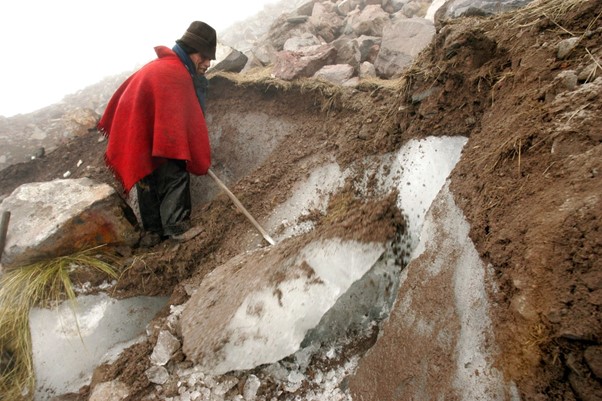
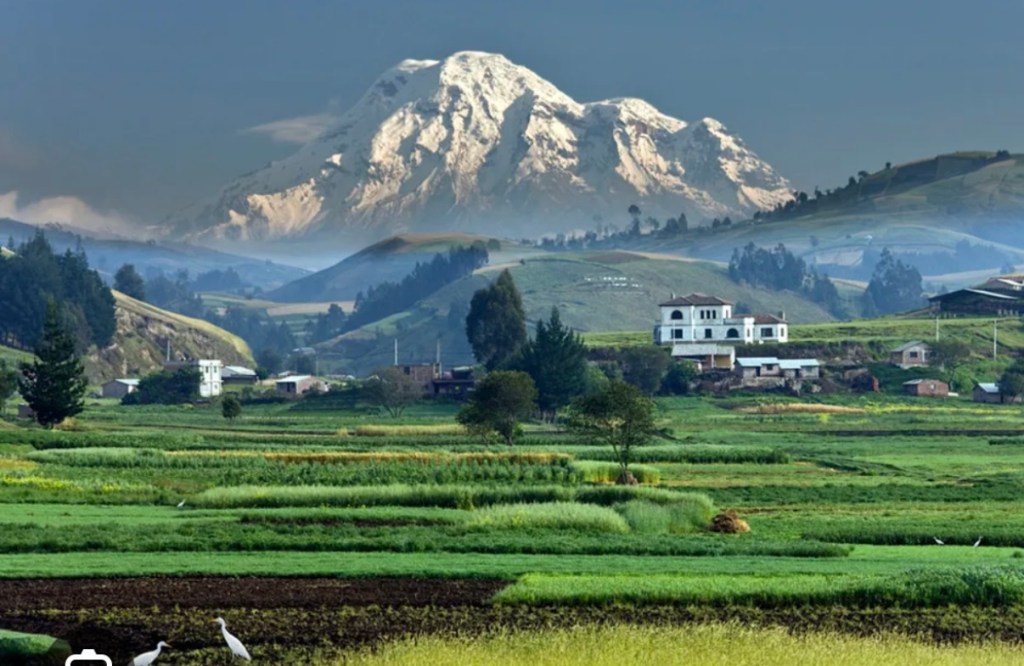
“Actually an Ecuadorian named Baltazar Ushca, who for more than 60 years climbed the slopes of Mount Chimborazo, the tallest mountain in Ecuador, to harvest the ice that covers the dormant volcano. “It’s the tastiest and the sweetest, full of vitamins for your bones,” he explained of the frozen water, which glistens in the sunlight like a huge diamond.”

“Now I know something about Mount Chimborazo. Its summit, over 6000m if I remember correctly (Note 2), is the point on earth closest to the sun, as it sits just one degree south of the Equator, where the Earth’s bulge is at its greatest. But why did The Times decide his life was worth remembering?”

Mount Chimborazo

“Probably to mark the end of a traditional way of life. At one time there were up to 40 ice harvesters, known as hieleros, including his brothers Gregorio and Juan. “We would go out in a group of friends, four or six groups, twice a week,” he explained in his native Quechua language. “I would go with my mother and father, with my brothers and sisters.” Gradually their number dwindled. Ushca, who was born in 1944 and started the five-hour trek to the top of the mountain aged 15, was believed to be the last one.”

Baltazar at work

“Ah! That’s both fascinating and sad. I haven’t been anywhere in South America, let alone Ecuador, although Rio and Machu Picchu are on my bucket list. And now, Richard, I need to get going as I promised my mother we’d meet in M&S in Brighton. She wants to buy some clothing staples and M&S’s very good for these. See you ……”

I sat back, relishing the agreeable atmosphere in the café, and was thinking of getting my iPad out to read the day’s news when I saw Sami coming through the left hand door.

“Hey Sami! A belated Happy Birthday for the 24th. Us Scorpios must stick together!”

“Afternoon Richard. How was your birthday?”

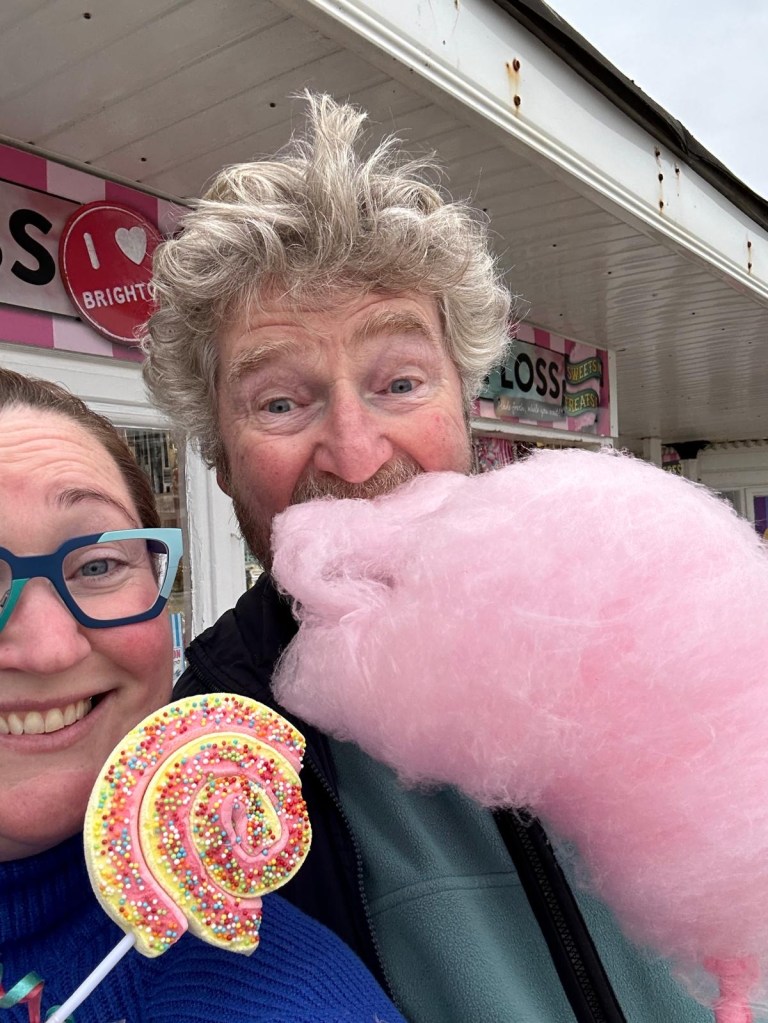
“Actually lovely and rather drawn out. The week after we went to Chichester for lunch with my brother and then had Jade and the boys down. They just LOVE Brighton; Lego shop, VR business, lunch down on the pebbles at Captain’s, then an hour on the pier. For some strange reason they had never been on it, so the excitement levels were sky high. And Candyfloss is a favourite – on a stick of course.”

“I bet they went for a swim before going home?”

“They did indeed …… and had a slice of cake. Actually it was a very drawn out birthday as my mother-in-law made me a cake when we were in Estoril last week!”

“And have they moved yet? I remember your daughter was buying a derelict house that her maternal grandmother had lived in. How’s that going?”

“Water under the bridge! A very stressful two months but they completed a week ago and have moved into a rented house until Christmas. They have replumbed and rewired, fitted a new bathroom and now have six weeks to fit the kitchen and windows. Certainly doable!”

“Thank you for the update. Good luck to them. You know Paul Simons, who writes a column in The Times about weather?”

“Yes. He digs up really interesting information. What’s piqued your interest this week?”

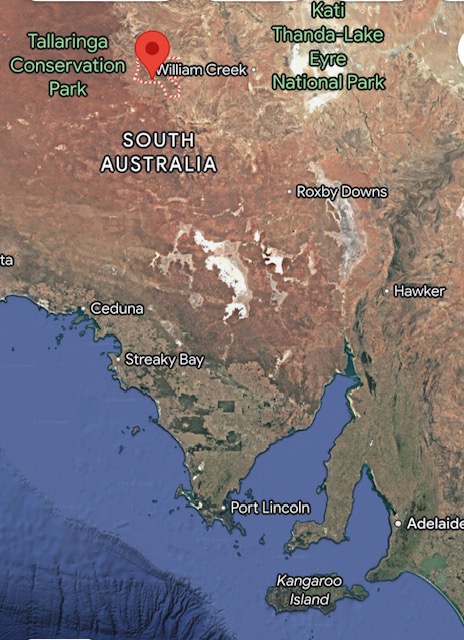
“A place in Australia called Coober Pedy. Australia is expected to face one of its hottest summers on record and, even though it’s spring in the southern hemisphere, a couple of weeks ago South Australia had its highest temperature for 29 years when the outback town of Coober Pedy recorded 43.7C.”

Red marks Coober Pedy

“Never heard of Coober Pedy. Tell me more?” (Note 3)

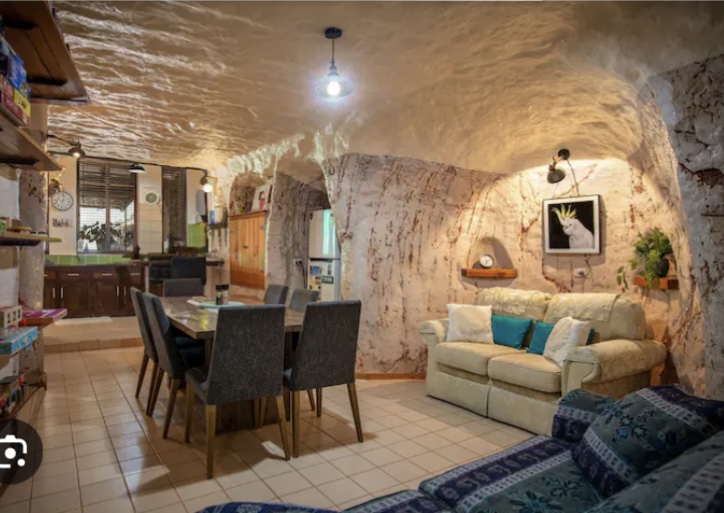
“Well, Coober Pedy is a remote mining town in the South Australian desert and has the largest opal mine in the world. When miners arrived in 1915 they soon found life was far more bearable underground, inside disused mine shafts, than above ground in the heat. So they began digging out their own subterranean homes and today it’s a grand subterranean town with restaurants, bars, art galleries, a bookshop, churches and even a four-star luxury hotel, all built to escape the desert heat. Temperatures below ground stay at a surprisingly pleasant 23C-25C throughout the year without any need for air conditioning. How about that!”

An underground Air BnB in Coober Pedy

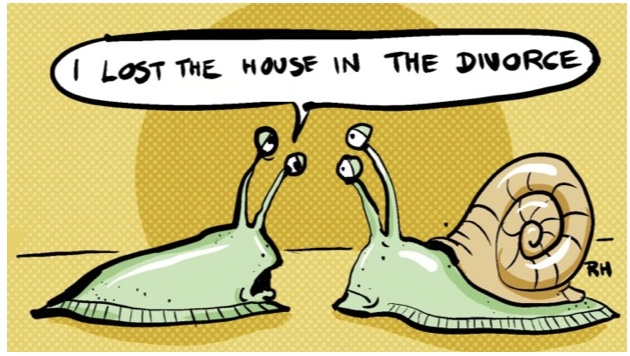
“Never been to South Australia; maybe I should put it on my list. Incidentally you read my postcard entitled ‘The Snail aka Brian’ (PC 406 Sep 2024)? Well, there was a lovely little cartoon on Facebook the other day which certainly made me smile.

And now we need to get going as I see Duncan wants to close. Love to Lisa and see you soon.”

“Great cartoon! Love to Celina. Good to see you. Take care.”

Richard 15th November 2024

Hove

www.postcardscribbles.co.uk

Note 1 After her late ‘Gap Year’, when Susie spent some time in New Zealand and Australia, she started a course on Logistics, with the intention of getting involved in the wholesale side of commerce.  

Note 2 Mount Everest, for comparison, is 8849m above sea level.

Note 3 Unbelievably Kay, our masseuse, had a one-year dance contract Australian tour that included a performance in Coober Pedy in 1988. ‘Very Red-neck!’