PC 111 Driving Around

The other evening I was driving back from a day with my daughter – actually a rather rare occurrence, not because I don’t love her to bits but because it’s over 70 miles away. The idea of dropping in for a cuppa isn’t a practical one – that’s not to say I don’t want to and wouldn’t if we lived closer just that we don’t! I have a choice of many different routes, as you would expect in a part of the country as crowded as the south east of England. The motorways M23/M25/A3 all have good dual (or more) carriageways and if the traffic flows it’s a doddle – if it doesn’t it’s just boring, and the M25 has a rather unfortunate reputation as the world’s largest car park!

Another option is going in a more direct way, along country roads. I used to drive on some of these roads when I was at university, as home was 18 miles north of here and university north of Swindon. In those days the traffic was lighter than today and being young and carefree I wanted to get from A to B as quickly as possible, wanting to be in ‘the right gear at the right time’, overtaking and sneaking into small spaces! But because I was a sort-of responsible adult, as responsible as I have ever been, it gradually became important to me that I drove well. I had passed the fairly rudimentary mandatory Driving Test in a Morris Minor 1000.

morris-minor-1000

But that was 1964 and I wanted to check I could drive well!! So in 1970 I took the Institute of Advanced Motorists (IAM) test in Swindon – a 90 minute exacting assessment of one’s driving – in my old Sunbeam Alpine; its registration number was SMO 420H if you are interested! Swindon, a Wiltshire city, had a mixture of residential streets, 1960’s brutal city centre architecture and the most roundabouts of any UK city at the time. At some point during the test, the assessor said: “Can you pull over here!” And when I had parked along the curb….” We have just past an alleyway. Would you reverse into it ….. centrally?” Well, the Sunbeam was 5 feet (1.52m) wide and the alleyway …… probably no more than 7ft (2.14m). Exacting huh!

Sunbeam Alpine convertible

I liked the freedom of owning a car, of being able to go somewhere whenever I wanted and still do. Driving was fun and exhilarating. Turn the clock forward to today and those same roads are more congested, and now there’s a local speed limit which varies between 40 and 50 miles per hour. Frankly, with the additional traffic it’s nay impossible to go faster than that and you can forget any idea of overtaking a slow moving car. If you actually succeed, all you do is end up behind the next slow moving car. Takes a great deal of will power to just relax and ‘go with the flow’.

In my Army days, I had always believed that I had to be able to do what I asked my soldiers to do. So in Germany I often jumped into the driving seat of the M109, a self-propelled medium artillery howitzer, at the end of some training and drove back to barracks.

M109

A M109

My ability to drive a vehicle steered by its tracks is still recognised on my UK Driving Licence – Group H. And although I occasionally I drove a lorry for fun, I was lazy and didn’t get my HGV licence, otherwise you might have seen me at the wheel of an articulated lorry on the M25!!

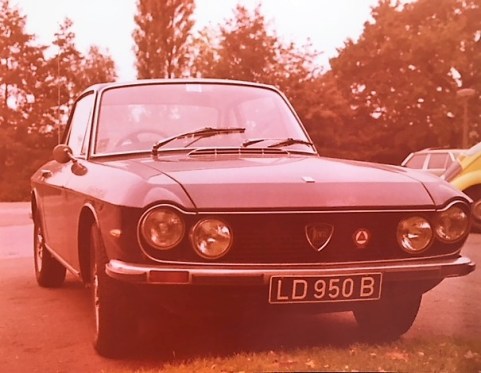
After university I was posted back to my regiment in Germany and was able to take advantage of the tax free allowances. I ordered a new MGB GT through the local garage that serviced my car. They were agents for Mercedes and Lancia …..  and I fell in love with a little red Lancia Fulvia with cream upholstery which was displayed in their showroom!! So I cancelled the MGB GT, which was going to cost £1258 and ordered a red Lancia for an extra £53. Months later I took the train from Paderborn in Germany to Turin in Italy to collect it from the factory.

Lancia Fulvia

This was my second Lancia, in blue. Note the Institute of Advanced Motorist badge!

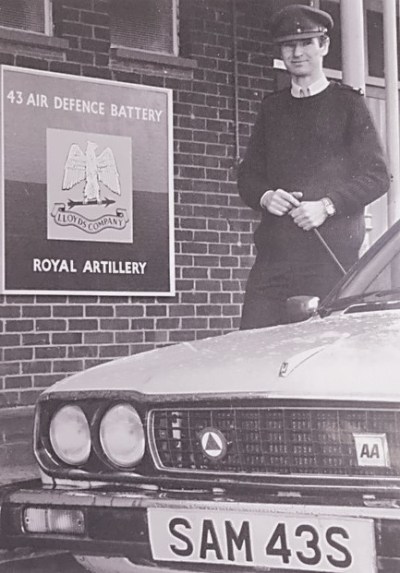
You will know I love coincidences! Well, in 1982 I took over command of an air defence battery just north of Salisbury in Wiltshire. The Royal Artillery history is preserved by the ‘battle honours’ of its batteries – a Battery being a sub-unit of some 120 soldiers. For instance I had served in 132 Medium Battery (The Bengal Rocket Troop) the latter reflecting the development of rudimentary rockets in India in the C19th. My Air Defence battery was known as Lloyd’s Company – after William Lloyd who had put together some guns to support Wellington in the Battle of Waterloo (1815). Its number, an arcane designation no one really understood as they were not sequential in terms of seniority, was 43. So its title was 43 Air Defence Battery (Lloyd’s Company) Royal Artillery and it was equipped with surface-to-air missiles (SAMs). My Honda Accord was bought in Swindon and its number plate, completely coincidentally, was SAM43S!


SAM 43 S

And come to think of it, I still smile when I remember Sergeant Cooke, my MT (Motor Transport) Sergeant and his driving test. The battery was down on Dartmoor for a fortnight’s training. Part of the training was all about driving, for instance testing the soldier’s ability to reverse a Landrover and trailer. He also wanted them to line up 50m away and drive the nearside wheels between two 4m long parallel planks, which he placed about 5cms more than a tyre width apart; a little light amusement! “Come on Sir! Have a go!” Well, never one to resist a challenge …… the result took the smile off his face!!

Coincidentally a neighbour five houses down here in Albany Villas Hove owns a Sunbeam Alpine (Tiger variant) and a Lancia Fulvia (Integrale) – now that’s weird.

A little nostalgia never hurt anyone and I hope you may reminisce on cars you’ve owned as a result of this PC.

Richard 3rd December 2017

PS Cars I have owned:

Volkswagen Variant (Left hand drive)

Sunbeam Alpine Convertible (SMO 420H)

Lancia Fulvia (Red)

Lancia Fulvia (Blue)

Honda Accord (SAM 43S)

Volkswagen Beetle (KBA 51K)

Vauxhall Astra

Volkswagen Golf GTI

Volkswagen Golf Cabriolet

Saab Vecta 93 Convertible

PC 110 That reminds me (2)

My introduction to classical music was gradual and subtle – staying with my grandmother in Bath and having to listen as she practised that ‘Arrival of the Queen of Sheba’ over and over again for instance! You might have thought I would have developed an aversion to it, such is the repetitive nature of someone practising, but I didn’t and came to love the sound. And it’s the sound I love; I read erudite critiques of pieces of music and wonder where the writer’s imagination has been. Not where mine has been.

And then along came Cliff Richard.

The first record I bought was his single called ‘Living Doll’ in 1959 and that was closely followed by Adam Faith’s ‘What do you want?’ I didn’t have a record player so had to borrow a school chum’s; and that wasn’t big enough to play a 12 inch ‘long playing’ record – ah! The impecunity of youth!

And then along came Elvis (Do I need to write ‘Presley’?).

My grandmother didn’t like this ‘crooner’ but boy did we. He shook the teenage world with his songs and brash antics and our memories are unsullied by subsequent binges ……. and drug abuse ……. and an early death. At boarding school we opened the windows in the winter months after evening ‘prep’ and played ‘O So Mio’ or ‘Love me tender’ at full volume ……. and wondered about life and love.

And then along came The Beatles ….. and the Rolling Stones.

In the holidays I went home, went to the odd party and heard The Beatles for the first time. I can still picture the cover of one of their first LPs ‘With The Beatles’.

The Beatles

In 1968 my UK-based regiment went to Cyprus for a month of ‘adventurous training’, a mixture of training in the mountains of this Mediterranean island and canoeing, hiking, sailing, shooting and rock climbing. Towards the end of our time, the Commanding Officer asked me, the most junior officer, to be in charge of the Rear Party. My only task, hardly onerous, was to manage the ‘Rear Party’ consisting of four soldiers and ensure the Regimental freight was dispatched by the RAF on time. Sadly it meant I had to spend an extra 14 days waiting for that flight; ‘ah!’ I hear you sigh. Why am I telling you this? Because ‘Hey Jude’ by The Beatles will be forever associated with Gail, the daughter of an officer permanently based in Dhekelia, the Sovereign Base Area on the island, whom I met at the Officers’ Club.  (Tea & toast?)

Then there was an American duo that created some lovely ballads – Don & Phil Everly. One of their famous hits was ‘Ebony Eyes’. Today I went on to YouTube ……. and there it was ……. and I put the cursor over ‘play’ ……. and I found myself singing along …… about Flight 1203 ……. my Ebony Eyes ……the words just came tumbling out of me as if it was yesterday. Ingrained somehow!

Another influence of my generation was another American called Buddy Holly – all clean cut and glasses. He sang about Peggy Sue, True Love Ways, Everyday and Crying, Waiting, Hoping …… and then he was killed in an aeroplane crash in 1959 at the age of 22 …… and became a legend in the process! Ritchie Valens was another rising music star on that plane, causing Don McLean to refer to it as ‘The Day the Music Died’ (American Pie).

The Day The Music Died

Here in Britain black & white television was becoming more common and a ‘Top of the Pops’ programme, with live acts performing their songs on television, established itself in the rhythm of our lives – it was mandatory viewing at The Royal Military Academy Sandhurst. In our Company ante-room we all crowded around a small TV, waiting with baited breath for Pans’ People, a dance group of 6 lithe women whose costumes were obviously deliberately designed to set our imaginations running.

The first musical I really loved was Evita, the story of Eva Peron and that song ‘Don’t cry for me Argentina’ still  runs around my head on occasions. As does ‘The Music of the Night’ from Phantom of the Opera, the Andrew Lloyd Webber musical. Michael Crawford, its first leading actor, recalled how some months before he was taking singing lessons on a Saturday morning when the tutor’s front doorbell rang. Telling Michael to practise his scales, he left him upstairs and went down to open the front door. It was Andrew Lloyd-Webber, who was working on bringing ‘Phantom of the Opera’ to the stage. He immediately asked whose voice he was hearing. On being told it was Michael Crawford he exclaimed ‘I think I have found my leading man for ‘Phantom’!

In Germany in the mid ‘70s I went to my first Rock concerto in Dortmund, in Germany, a group called Santana. I was just ‘going with the flow’ with chums and don’t remember finding the ground moved, but I did get completely hung up on the slow guitar introduction of Samba Pa Ti. Years later on my way to see my soon-to-be in-laws, driving down a laurel-banked road, the radio played it, taking my mentally back to Dortmund.

I developed no real passion for one particular type of singing or music over another, just loved some, and conversely didn’t get on with others. Singers whose voices and the songs they have sung I have loved, in no particular order, range from Francoise Hardy and her glorious “Tous les garçons et les filles de mon âge”, Carly Simon’s ‘I’m So Vane’, Jennifer Rush’s version of ‘The Power of Love’ and anything by Neil Diamond. I had all of his LPs up until the demise of my record player (!) and loved his ‘Jonathan Livingstone Seagull’ and ‘Stones’ LPs. I even saw him at the Wembley Arena one evening. And then, sadly, his voice was past its best and no one told him. I bought a recent CD and played it once; enough!

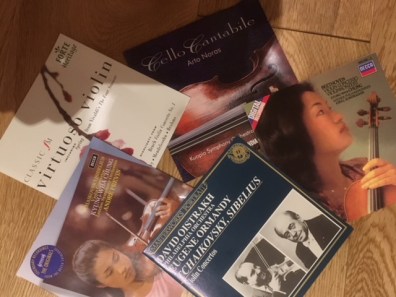
Another collection

Sometimes you need a good belter to lift your mood. In the immediate aftermath of my first divorce, in my lower ground flat on Cavendish Road in Clapham, London, nothing better to lift your spirits than ‘You’re the Best’ by Tina Turner.

All the LPs eventually went – cassettes didn’t really do it apart from in a cassette player travelling on business. Gradually my taste has evolved and the music of Ottmar Liebert (Thank you Jonathan H for the introduction!) and voices of individuals like Enya, Celine Dion, Adele and Enigma fill my rooms. Even more recently Angus & Julia Stone’s songs have tugged at the heart strings.

Occasionally I think “Why don’t I have any recordings of ……?” (Barry White and Demis Roussos for example) and it’s soon rectified by a cheap purchase through Amazon. Or you watch a drama on television and love the accompanying music and wait until the end of the credits to catch the artist …… and go on to Amazon …… for instance the Israeli singer Asad Avidan ….. but don’t ask me what the drama was!!

Mere scribbles, mere memories

Richard 18th November 2017


PC 109 That reminds me (1)


I hear the notes of the start of some music or song and almost immediately seem to be able to recall what it is called or remember when it meant something to me, such is the power of association. I doubt whether you are different and between us there will be hundreds and hundreds of pieces of music that we hold dear to our hearts, tunes that stir our soul. What follows are some of mine. Naturally some of you will identify with them and others will ask: “Really?”; such is life!

In my early teenage years I thought that the only ‘opera’ I liked was the accompanying overtures and none of the singing. This dislike was probably initiated at school as the teacher responsible for putting on the classical concerts and operas, Mr Oboussier, always seemed to choose Mozart. One year ‘Don Giovanni’ and the next ‘The Marriage of Figaro’; “One foot …. two feet ….. and that makes three….” sang Figaro and the squeaky strings of the school orchestra violins started these painful memories. However the school Tuck Shop was run by Mr Pickford, a delightful man with a clipped white moustache, short of stature but big in generosity; for some reason he always wore a white coat rather like a laboratory assistant. It was here we played cribbage, bought snacks and had our daily ⅓ pint of milk, invariably to the strains of Wager’s Tannhäuser Overture, obviously Mr Pickford’s favourite. I got to love it too and I get goose pimples whenever I hear those first stirring notes.

Years later my brother and I were making an infrequent visit to our father in Newcastle, driving north up the M1 in his Morris 1000 Traveller. At one point north of the Watford Gap Service Station the car radio played Rossini’s ‘Thieving Magpie’ overture …… and the link between this and travelling together on that wet grey day was cemented. I would search for record collections of ‘Overtures from the Operas’ whenever I could.

Then it all changed. You may recall my parents lived in the little village of Balcombe here in Sussex, and during my time at university (1969-1972) I would often drive down from north of Swindon for a weekend. On the Sunday evening, on the way back to a week of studying ‘Materials of Construction’ (good!) or ‘Mechanics of Fluids’ (not so good!), I would be passing through Camberley around 2100. At that time Alan Keith presented a BBC Radio 2 programme called ‘Your Hundred Best Tunes’; astonishingly he did so for 44 years – yes forty four years!! Quite often he would play the famous duet from Bizet’s opera The Pearl Fishers “Au fond du temple saint” (In The depths of the temple) – and in his wonderfully warm and cultured voice announce it would be the 1950 recording by Robert Merrill and Jussi Björling. I knew nothing about the opera but boy oh boy did this duet fill the car with a cacophony of passion, love and sheer magic. I was hooked. No more only orchestral pieces; duets and grand choruses became my love although I still dislike men or women ‘warbling’.

CDs 3

That dislike probably started in my teenage years if I think about it. My grandmother, a very accomplished pianist, would organise concerts to raise money for Bath charities. Occasionally some man or woman would get up and ‘warble’……. .not for me. But Granny practised …… and practised …… and practised Handel’s The Arrival of the Queen of Sheba, and then played it as a duet with a Rose Tobin in the concert. Hear this piece today and I am instantly transported back to the 1960s and Bath! Lovely huh!

On my journey of discovery of classical music I stopped learning the piano and took up the trumpet. The former had been taught at school in a small room by a teacher who, unbelievably, chain smoked! Clearly my strenuous but largely unsuccessful attempts to follow in my grandmother’s footsteps irritated him a great deal. I remember him trying to position my hands over the appropriate keys, leaning over me, all the time puffing on a cigarette that dangled precariously from the corner of his mouth. He gave up on me; it was mutual and everyone was happy.

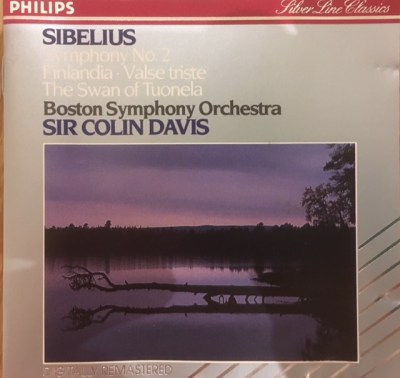
A Mr Weeks taught brass instruments so I asked him to teach me how to play the trumpet. Being virtually tone deaf this presented a problem for me, well for him too I guess, but if I heard the music first, I sort of was OK. Mr Philip Oboussier decided one year that the school orchestra should perform Sibelius’s Symphony Number 2. Initially I didn’t like what I heard, as we all sat around his Grundig Gramophone and listened to a recording. Then we dissected the piece and rehearsed each bit. We brought it all together, performed in in the School concert and now it’s possibly my favourite orchestral piece. Sibelius scored his compositions with a heavy accent on the brass section, so maybe I was slightly biased!

CDs 2

Music can often be associated with the untimely departure of a friend or loved one. During our unforgettable first term at The Royal Military Academy Sandhurst, one of our fellow Officer Cadets developed a particularly vicious form of Leukaemia. He went from being an energetic, charming chap to his death bed in about four weeks, or so my memory informs me. The Company Sergeant Major, a mature figure to us 18 year olds, loved Max Bruch’s Violin Concerto. Up until that point squeaky violins didn’t do it for me; maybe this was the right time to be educated. We cried our way together through this emotional music, laying the basis for a love of weeping violin and viola concertos that continues to this day.

CDs 1

In my second term at Sandhurst our intake were accommodated in some Nissen huts (see note) some distance from the main buildings. They were rudimentary, poorly insulated at best. I had been given an old record player, for which I was grateful, but there was something wrong with its ability to rotate the turntable at a constant speed – a fairly basic requirement you might think. Further investigation revealed that the drive was transferred from the central spindle to the turntable by a rubber belt attached to a plastic disc. This disc was not a true circle and despite endless attempts to shave it ‘round’ eventually I gave up ……. and put up with its idiosyncratic variable speeds! So why am I thinking of this now? Well, one of the records I had was a recording of Beethoven’s Piano Concerto No 5 – The Emperor ……. and I have always thought that the opening of the slow movement, the Adagio ‘un posso mosso’ was a dead ringer for the beginning of the song from West Side Story ‘There’s a Place.’ (aka Somewhere) written by Leonard Bernstein. Maybe he was a Beethoven fan? Let me know if you agree.

You might think that I only love classical music but that’s not true. As someone who spent some formative years during the Summers of Love in the 1960s, how could I have not been influenced by ‘pop’? More anon …….


Richard 4th November 2017

Note: Designed as cheap accommodation in the First World War by Major Peter Nissen, these prefabricated structures had a half cylindrical corrugated steel skin, with brick ends.


PC 108 I’m Long and Black

Oh! If I could only talk I could tell you a thing or two …….  but if it helps I’m almost 50 years old; not that it matters as I don’t measure my existence by years but by my capacity to deliver what I was made to do. OK So I’ve got your attention, that’s good as normally I am just left in a cupboard hung up, feeling abandoned ……. until the next time. Currently I’m in the cupboard with the hot water tank, a lazy maid and some Samsonite luggage as there’s no garage or attic where we live. It’s warm when the water’s hot and quite dry, so I can’t complain.

My first memory I think comes from 1969, when my owner needed something like me; it’s a good feeling to be wanted. He had a large room in the Officers’ Mess Annexe of the Artillery Barracks in the German town of Lippstadt, on the edge of the Paderborner Plain.

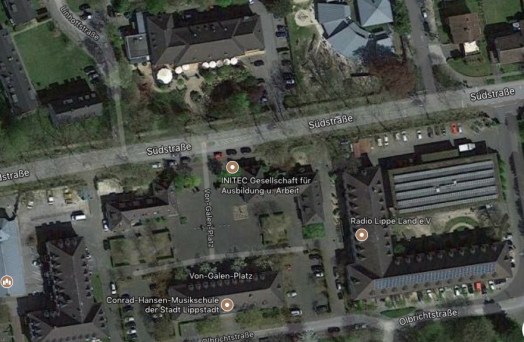
Sudstrasse Lippstadt

You can see the building that was the Officers’ Mess in the top of this satellite photo; looks like a hotel now with sun umbrellas in the garden. The block on the right now labelled Radio Lippe Land e.V was our officers’ accommodation. At the bottom was Regimental Headquarters, now the Conrad Hansen Musikschule der stadt Lippstadt. But I digress!!

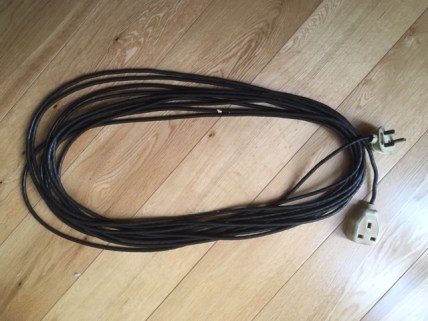
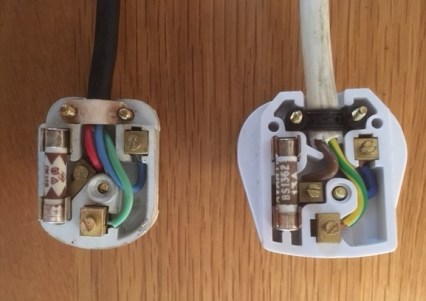
The barracks had housed a Luftwaffe battalion and the Mess itself was beautiful, but single officers’ accommodation was limited, hence the annexe within the main barracks. Sadly there were few electrical sockets and he saw a need for an extension cable of some sort. Ah! You’ve guessed it, I’m an electrical cable; three wires, green, red and blue (See Note) sheathed in a black outer casing. I used to be part of an enormous reel of cable that the army used for all sorts of things. Then one Saturday my owner soft-soaped the soldier in charge of the stores to cut some off; it was about 15 yards long (we didn’t ‘do’ metres in those days.) At one end he fitted a square pin extension block and at the other a German two pin plug. The smart record player, the radio and a couple of lights were all plugged in. Oh! And I am ¼ inch in diameter.

Cable

You might be surprised to read that I gave birth once! My owner needed about six feet of flex. He never told me why, just got a pair of pliers and cut it off! Didn’t hurt as I am inanimate but I healed up quite well, particular when the plug was refitted. By then we were back in England so my two end connections didn’t change. At one end I have a rubber coated square three pin plug, at the other a rubber coated socket. Both have become pretty grubby over the years but it’s been a long haul!

It’s hard to imagine today but outside lights at Christmas were a real novelty back in the 1980s …… and the best ones came from Germany ….. so a visit to a Christmas market in Hanover secured a large string that was rewired with a UK square plug  and that was plugged into me. In those days he didn’t have an outside socket and he relied on me, you see. But it was suffocating, being wrapped up in lots of plastic bags and duct tape to keep any rain out. Oh! The ignominy of it!

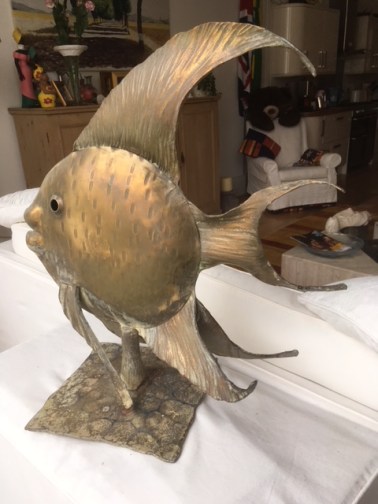
Wanda

Wanda the bronze angel fish doing her thing, provided with power by me! (circa 2001)

I was also used to provide power to the pump that fed water up into Wanda; it came out of her mouth!! But when the outside socket was fitted, my job was done, and I went back to hanging around, for some time at the top of some cellar steps.

Occasionally I would have a car vacuum cleaner plugged in but the suction was never strong enough and invariably the domestic vacuum cleaner was used. Don’t ever do this on a driveway which has been surfaced with gravel. I have always thought of myself as a sort of DIY (Do It Yourself) extension cable; no pretences, me. But I remember he once was in B&Q (a DIY Store) and saw an extension cable in a proper reel, red I think it was. I could sense he coveted it, looking all neat and new, but he is loyal to me and walked away, shaking his head and muttering.

I am grateful for his love of sailing, you know. If he hadn’t learned about how to handle ropes (on board a yacht a rope is actually called anything but a rope – for example warps, sheets, halyards, guys etc,) I would not be in as good a shape as I am now. On board a sailing yacht a tangled rope is a disaster waiting to happen, so there was constant vigilance to ensure all ropes were tidy and coiled It’s best to coil the rope/cable into the left hand, as that movement of the wrist takes out any twists in the rope. Wire cables such as me are no different.

In my twilight years I am generally used to connect to a jig saw, a sander or a garden strimmer, as his drill is now a Dewalt cordless one. You might think this is progress but he uses it so little the battery is invariably dead and needs a charge!! Maybe he rues the day he got rid of the one that needed me; who knows?  I won’t mention the fact that he uses the garden table as his workbench and that it occasionally gets nicked, sawn and drilled into (so don’t tell anyone). I cringe when it happens but what can I do?

Wanda 4

And my friend Wanda? Well, she’s come inside …… and seems content to look wistfully down the road to the sea …… some 150m away.

Sometimes one gets an idea and just needs to scribble …… inane really

Richard 21st October 2017


Note: these days it would be yellow/green, brown and blue

old & new

Old (ie me!) on the left, new on the right

PC 107 Lisbon

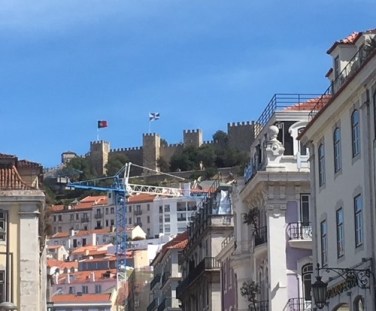
We had a drink in the Hotel Palacio in Estoril, Portugal, to celebrate an anniversary and learned that the bar had been a meeting place for British and German spies during the Second World War. Portugal had of course been neutral, as had neighbouring Spain, but that didn’t stop both Allies and Axis powers using these two countries for nefarious purposes!! The following day we caught the 30 minute train into Lisbon, and slowly climbed through the Alfama quarter to the site of Lisbon’s founding settlement, the Castel de São Jorge.

026

Castel de São Jorge

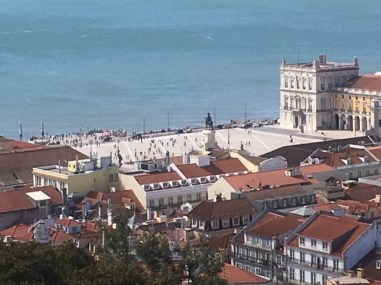
The placing of this Moorish castle was perfect and over a thousand years later you can look out over modern Lisbon. The Moors were ousted from Portugal in 1147 (compare with the last Muslim ruler sent into exile from Granada by the Spanish King Ferdinand in 1492). Down on the waterfront you can make out the Praça do Comérco and the statue of King Dom José on his horse. It was during his reign that Lisbon suffered its 1755 devastating earthquake which destroyed much of the city. What you see today is the result of 100 years of rebuilding.

022

Praça do Comérco

And it was during this lengthy rebuild that Napoleon’s troops rampaged through Spain and threatened Lisbon. The royal family, escorted by the English Royal Navy, fled to Brazil, leaving the British under the Duke of Wellington to resist the French invasion. History huh!! The monarch didn’t return for some 7 years, preferring to rule his empire (Angola, Mozambique, Goa and Brazil) from Rio de Janeiro. Modern Lisbon is littered with statues of kings and explorers – the most dramatic of which is the Monument to the Discoveries (1415 – 1543) overlooking the Tagus River.

monument to discoveries lisbon

Gradual exploration from Lisbon down the west coast of Africa, firstly by Diago Cao in 1483 and then by Bartolomeu Dias, paved the way for Vasco da Gama to cross the Indian Ocean in 1498 and land in India. The Portuguese had a monopoly of what became known as the Spice Trade, ensuring great riches for Lisbon. Ten years later they captured Goa and established a colony. Two years after that Pedro Alvares Cabral reached Brazil and established a Portuguese presence at Recife. (See PC 34).

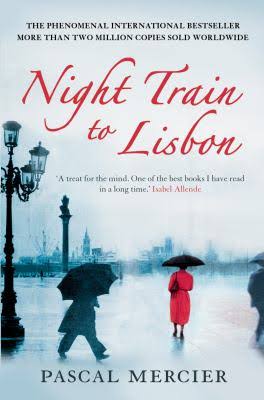
I saw a review of the book ‘Night Train to Lisbon’ by Pascal Mercier many years ago, liked what I read and bought a Kindle version. It’s the story of a Swiss Classics teacher, Raimund Gregorious, who, on his way to his stale academic job in Bern, prevents a Portuguese woman jumping to her death from a bridge. Nosing around in his favourite bookshop after work, he is drawn to a book by Amadeu de Prada, a Portuguese doctor who explores the philosophical issue of going back over one’s life and asking the ‘What If I had made a different choice?’ sort of question. (Compare with the film ‘Sliding Doors’ with Gwyneth Paltrow). The fact that Gregorious can’t read Portuguese doesn’t seem to put him off!!

Night Train to Lisbon

Very quickly Gregorious senses he may not be living his own life to the full and determines on a whim, or maybe with the image of the mysterious Portuguese woman in his mind (!), to go to Portugal to investigate the life of Amadeu de Prada, who had lived through the right-wing dictatorship of Salazar (1926 – 1968). He catches the overnight train to Lisbon that very evening. I got stuck with this book, restarted it several times, and eventually gave up. But then the story was made into a film in 2013, staring Jeremy Irons as Gregorious, and I loved it!!

Today you can take the night train from Bern but it’s more a ‘day & night’ train and takes 27 hours; it’s over 1600 kms! To get to Lisbon I flew TAP Portugal from Gatwick. I’d been to the city back in 1987 on business and to southern Portugal on a yoga retreat in 2016. My parents had enjoyed holidaying in the Algarve and on Madeira and my maternal grand-father not only loved Portugal but also loved imbibing the famous Mateus Rose, the height of sophistication in the 1960s!!

So the tale plays out in this city, going backwards and forwards from the modern day to those of the dictatorship. If one hasn’t lived under a totalitarian dictatorship as Salazar’s was, it’s hard to really understand what life was like. In the story, Gregorious looks at the difficulties faced by Prada, exploring themes such as loneliness, love, loyalty, friendship and mortality. I’m not quite sure if the classic’s teacher from Bern found what he was looking for, identifying what could have been alternative paths in his own life, but I am reminded of Robert Frost’s poemThe Road Not Taken’:

Two roads diverged in a yellow wood …….. And, sorry, I could not travel both

And be one traveller, long stood …….. And looked down one as far as I could

To where it bent in the undergrowth; 

……. and I  …….

I took the one less travelled by ……and that has made all the difference.

We all have choices in life, to take this path or that direction, but whatever choice you make …… that is in my view the right one.

Maybe in time we’ll wander around the back streets of Lisbon at our leisure, trying to understand its unspoken history simmering beneath the surface. And of course get to know some of the places from the story, like Rua Augusta that runs north from Praça do Comérco and is often called ‘the most beautiful street in the world’.

The Portuguese monarchy ended in 1908 with the assassination of the king and, after a serious of weak governments covering almost twenty years, Antonio Salazar created a dictatorship which ran from 1926-1968. During this period the country was virtually a recluse in the world community, industry and commerce dominated by a few very wealthy families. His successor carried on for another six years, but the political mood had changed and the Carnation revolution of 1974 ushered in modern democracy.

More scribbles from Lisbon in the future, no doubt.

Richard 8th October 2017

PS You can’t go to Portugal and not eat Pastel de Nata.

Pastel de Nata

These sweet custard tarts were originally created by the Catholic monks at the Jerónimos Monastery in Santa Maria de Belém, a western suburb of Lisbon, in the C18th. Starching the nuns’ habits required numerous egg whites and making custard tarts was a good way of using the surplus egg yolks. Boy – are they yummy!


PC 106 Sailing in The Baltic

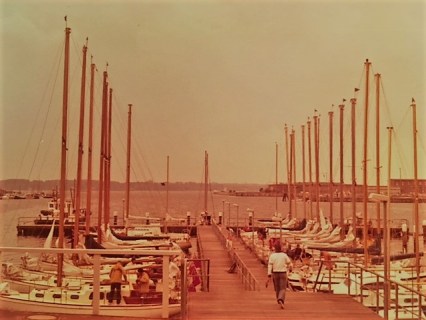
In the aftermath of the defeat of Nazi Germany in 1945 the spoils of war were, no doubt, extraordinary and various. One of them was a collection of yachts based in the Baltic city of Kiel, the centre for Hitler’s enormous U Boat fleet. The base itself had suffered extensive bombing and its huge concrete submarine pens lay crumpled and blasted, but the British Army established a sailing club on the western side of Kieler fjord, where these windfall yachts were moored.

BKYC 1969

The British Kiel Yacht Club (BKYC) 1969

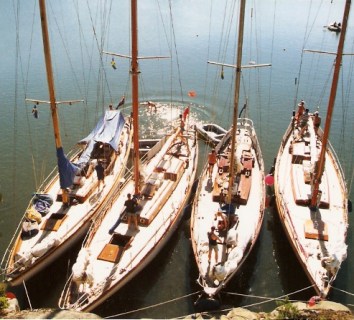
Wind the clock forward to 1969 and the British Kiel Yacht Club still had a small number of these ‘windfall yachts’ as they were known; some 30 sq ms, a couple of 50 sq ms and one 100 sq m classic wooden yacht called Kranich, built in 1936. (For explanation of sq m ‘square metre’ see note). In addition they had a fleet of modern GRP ones that were used to teach the rudiments of sailing to British Army personnel; these were without engines!

Windfall Yachts

Some ex-German ‘windfall’ yachts

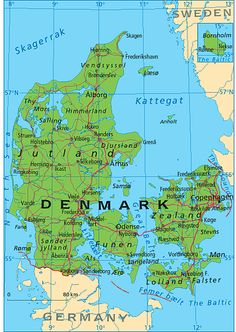
I hadn’t sailed much as a child, one simple sailing holiday with my father when I was 10, but in 1968 sailed around The Solent a bit in a little 19ft yacht called Barbican …… and on a very wet yacht in Cyprus …..  and rather liked it. You might say I took to sailing like a, er, duck to water? So when my Regiment was posted to northern Germany, the obvious place to indulge the interest was in The Baltic. To refresh your knowledge of geography, The Baltic is the name of the shallow sea that is almost enclosed by European countries – Sweden, Finland, The Baltic States, Poland and Germany, and flows out through the low lying islands of Denmark, through the Kattegat and into the North Sea. It’s got a low saline content due to its mix of salt water inflowing from the North Sea and outflowing fresh water draining from a land mass four times larger than the sea itself.

Denmark

Two shipping channels run between the large islands of Funen and Zealand and between Zealand and the western coast of Sweden. Otherwise the Danish waters are quite shallow, making for short sharp seas when it’s windy and always interesting navigation. Channels are marked by upturned broom sticks; some had one bundle of sticks lashed to the pole, others two and sometimes three. So typically Danish!!

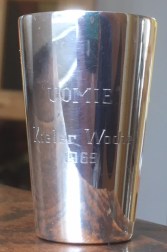
Before going off to university, I was in Germany for 9 months in 1969, and took part in Kieler Woche, the country’s equivalent of Cowes Week, the sailing festival on the Isle of Wight in UK. I sailed on a long keeled yacht called Uomie, named as it was taken in payment of a debt!! We did well during the week and particularly coming first in our class in the Fehmarn Light Race. The skipper gave each of the five crew members a little silver schnapps cup.

Uomie 1969

After university I rejoined my Germany-based regiment ….. and naturally went back to sailing in the Baltic. The first time was actually racing from Cowes on the Isle of Wight to Skagen, right on the tip of Denmark. (See note) We then passaged south to Malmö in Sweden for a regatta. Teaching soldiers the benefits of teamwork through using the forces of nature, ‘adventurous training’ as it was euphemistically called, was considered a good thing!! The attraction was obvious; hundreds of little islands, narrow channels threading their way between them, charming villages and towns with enchanting names like Aerøskøbing, Middlefart, Juelsminde, Kerteminde, Lohals and Faaborg.

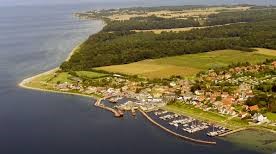
Lohals (2)

The Lohals marina was not there in 1973!

In my 5 years in Germany I must have developed a reputation for often being away from barracks sailing. Once, during a leadership course for junior NCOs, the Regimental second-in-command, Major John Harman, was explaining some aspects of the vital cooperation needed between the artillery and infantry. I won’t bore you with the details but at some point he asked, by way of confirmation that they had understood: “And where would you expect to find Golf 31 (my radio call sign) Captain Yates during this particular phase of the battle?” A wag at the back of the classroom shouted: ‘Sailing in the Baltic sir!’

In my room in the Officers’ Mess, I hung up on a wall four Danish maps sellotaped together so I could plot the course of each trip; after a couple of years it looked as though a drunken spider had walked into some red paint and then all over the map! Apart from trips up the Als Sund north from Sønderberg, drifting in and out of islands around Lohals on Langeland, and finding enough crabs for supper in a rotten rowing boat just alongside where we had tied up in Aerøskøbing, one major trip involved sailing St Barbara II, a 42ft Rebel, up to the Norwegian capital Oslo, when the engine had been taken out for its annual overhaul. This meant that we had to charge the battery, needed for navigational lights if nothing else, every time we went into a harbour. Going into a crowded marina without an engine was a tricky and anxious time and occasionally we gratefully took a proffered tow.

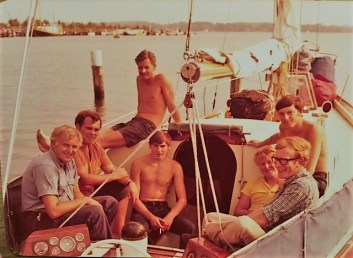
Oslo Crew

The Oslo crew on St Barbara II

On one trip sailing a ‘windfall’ yacht, we had just tied up alongside the village quay in Juelsminde and were getting down to the serious business of having a drink. People get attracted to yachts and boats in harbours as the poles of magnets to each other and we often had rubberneckers peering down on us. One particular old chap came wandering down the harbour wall and stopped; “Guten abend. Wie Gehts?” he greeted us. Then he proceeded to switch to Pidgin English. “Zis iz a lovely yacht, ja! Sehr schön. You took zem from us after ze war ja?” and with that, shaking his head as to what might have been, he shuffled off back into the village.

Generally the islands between the mainland of Denmark, Jutland, and the island of Zealand, on which Copenhagen is situated, provided ample enough cruising grounds, but one year I actually sailed into Langeline Harbour in Copenhagen, before continuing south through the Stege Bugt to Stubbekøbing. In Denmark’s capital city, down in the harbour, lies the delightful statue of ‘The Little Mermaid’, sitting on her rock since 1913. Her head is of the ballerina Ellen Price, but as she didn’t want to pose naked the sculptor persuaded his wife Eline Eriksen to pose for him.

Little Mermaid Copenhagen

The memories of sailing in these delightful waters will stay with me forever; although I have few still photographs, I have many hours of Super 8 Cinefilm, transposed to VHS Video and then to CDs as technology made one means obsolete! And so will the Danish sense of humour. Did you know that a ferry service runs between the Swedish city of Gothenburg and the Danish town of Frederikshavn on Jutland? Well, there is one and it’s rumoured that the skipper doesn’t need a chart, he simply follows the line of empty green Carlsberg bottles thrown over the side by Swedish passengers pleased to get away from the ruinously expensive alcohol of their home country!


Richard 24th September 2017

Note: The Skagen School of artists exists because the daylight at this particular place on Denmark is very special.

Note: For those technically minded, these ‘square metre’ yachts are measured by a difficult formula. R Metres = (L + 2d + √s – F) ÷ 2.37 where L is the waterline length, d the difference between skin and chain girth (?), s the sail area and F the freeboard

PC 105 Sirens

Some sounds are very evocative and some words engage the imagination. My regular readers will know that Celina’s brother and family are firmly established in Estoril in Portugal and when her sister moves there in October, the focus of the family will shift from Rio de Janeiro to Estoril. We were there in July to soak up some sun …….. and at exactly 12 noon, a siren sounded over the town of Cascais, some 3 kilometres from Estoril.

Firstly the sound is evocative, as it ties my memory to the old Air Raid siren sounded in England before an imminent air raid during the Second World War; there was a slightly different sound at the ‘All Clear’. And before you think I actually heard them, I was born after the end of the war, so the memory is from watching films set in and around that time!! But was Cascais about to be attacked? No, of course not, this was a signal to indicate the hour, a single note noise. It probably started back in the late 1800s or early 1900s, used throughout the industrialised world to signal the start of work; there was probably one for the lunch break and one at the end of the day – indeed if you look up siren in a dictionary, it says “Factory siren or hooter …… a siren or steam whistle used as a signal for work to begin …. or finish.” The sound was produced by revolving perforated metal discs over a jet of compressed air or steam.

And in this week, the start of the new Academic Year in the United Kingdom, it has similarities to the school bell that signalled the start and finish of lessons.

If you have been watching the world news recently you may have heard, during the report of North Korea’s missile test flight across mainland Japan, an Air Raid Siren. Here is a siren being used in anger, as it were. Such a strange and mournful sound, rising and falling, a wail, a warning to the civilian population that they should head for some form of shelter. The converse of course is equally true, a signal for Civil Defence Forces to head for their work stations to help in the aftermath of whatever unfolds.

Normally the only sirens one hears on the streets are those of ambulances, fire engines, of those of a police car on its way to stop criminal activity or indeed at the end of the shift, to get through the heavy traffic and back to base (sorry, a bit cynical huh?). In The USA the sound for a police car is a perfect 4th, for an ambulance a perfect 5th and for a fire engine it’s a perfect 2nd. However, being musically almost tone deaf none of this means much to me!

At school I was taught Latin, initially by a chap who was the Mayor of Wells as well as a teacher. Inattention or mispronouncing a word got a clip around the ear with a wooden ruler. Later we ploughed through some syllabus but it’s all forgotten, apart from remembering the Dog Latin:

‘Caesar adsum jam forte, Brutus aderat, Caesar sic in omnibus, Brutus sic in at.’

which, when read aloud, sounds like:

‘Caesar had some jam for tea, Brutus had a rat, Caesar (was) sick in omnibus, Brutus             (was) sick in hat.’

I was useless. We probably read bits of Homer and other Greek writers but the whole library of Greek Mythology, that body of teachings and myths concerning their gods and heroes, the nature of the world etc was, and remains to this day, a complete mystery. Ulysses? The Odyssey? Jason and the Argonauts? Nah! But for some reason the word ‘siren’ stirs my imagination.


Ulysses_and_the_Sirens_by_H.J._Draper

HJ Draper’s Ulysses and the Sirens

In Greek Mythology sirens were dangerous creatures who lured sailors with their enchanting music and voices towards the rocks of their island. They were incidentally all female, the daughters of the river god Achelous while their mother may have been Terpsichore, Melpomene, Steropre, or Chthon. These names may mean something to you but to me, it’s all Greek! In fact, how do you pronounce ‘Chthon’?

Ulysses escaped the danger of their songs by stopping his crew’s ears with wax so they were deaf to the sirens’ calls. Ulysses himself wanted to hear their song so had himself tied to the mast of his ship so he couldn’t steer his ship off its course. The classical painter Herbert James Draper was one who attempted to portray this struggle between good and evil, for the sirens were undoubtedly evil.

And who could not remember the 1994 film ‘Sirens’? Set in 1930’s Australia it tells the story of Tony, played by Hugh Grant, an Anglican priest newly arrived in Australia from the United Kingdom. He is asked to visit the notorious artist Norman Lindsay (Sam Neil), out of the church’s concern about a blasphemous painting of the crucifix that the artist plans to exhibit. Estella, (Tara Fitzgerald) the priest’s wife, accompanies him on the visit to the artist’s bucolic compound in the Blue Mountains, New South Wales, where incidentally the film was made. There they meet Lindsay’s wife, Rose, two models (one Elle Macpherson), and the maid, all of whom pose for Lindsay.

As the story unfolds, both Tony and Estella find themselves observing the young women bathing naked in a nearby pool and instead of turning instantly away, each pauses to watch, betraying an underlying sensual interest in the lifestyle they outwardly deplore.

 Sirens from the film

Portia de Rossi, Elle Macpherson and Kate Fisher as the sirens

If you never saw the film, maybe that’s enough to whet your appetite to watch it now? The film uses the word ‘Siren’ to describe Lindsay’s three models, and also the message they portrayed – a siren call of their lives and surroundings, enticing and tempting others.

Just some scribbles as always!

Richard 9th September 2017

PS     A hooter, in addition to being a siren-like device, is also the slang for someone’s nose, generally those of the larger variety!

PPS Those of you old enough may remember a garment called a siren suit, consisting of one piece, the ‘jacket’ part of the trousers, so easy to put on in an emergency, much trumpeted by Sir Winston Churchill. His of course was ‘pinstripe’!!

Churchill's Siren Suit - pinstripe of course


PC 104 Customer Service and Satisfaction

 It must be someone’s fault’; ‘I’ll make them pay’; ‘Take responsibility you fuckers’.

We live in a society where increasingly the hue and cry is ‘It’s their fault’ … ‘Sue them’, and all sorts of accusations in between. But how companies actually respond to their customers has always been fairly crucial; no more so than today. Get it wrong and you shoot yourself in the foot. Many of you will remember Jerry Ratner who had started out as a retailer in the jeweller business. In an after-dinner speech in 1991 he recalled being asked how he could sell his jewellery so cheaply; “Because it’s total crap.” he replied ….. wiping £500m from the company’s value. But at the very basic level, all we really want is someone to acknowledge our issue, take some responsibility, make a gesture.

The airlines come in for a lot of stick and some of it’s justified. Our very own British Airways never seems to handle a crisis well; they have yet to learn that customers want to be told something, even if it’s ‘we have no information’, because we assume they know!! Other airlines are no better. When we flew to Brazil via the Antipodes in January we found ourselves on a LATAM flight from Auckland to Santiago, with no vegetarian meal for Celina. The ‘special request’ wasn’t rectified when we flew on to Rio two days later. So on our return to the UK I asked via the travel agent for some explanation from the airline; eventually the travel agent said that LATAM are not obliged to provide options such as vegetarian food ….. so the travel agent sent us some chocolates …… and that made us feel good about them but not about LATAM who for the sake of a voucher or somesuch could have redeemed themselves.

We went with some chums to a local restaurant, The Ginger Pig, some months ago and had a very pleasant evening. It wasn’t crowded and we chatted to the duty manager Rob as we paid the bill and got our coats. I put mine on and was distracted by the conversation ….. until Celina yells anxiously: “You are on fire! Turn around!” Closer inspection suggested that I had backed up against a window sill on which there was a lit candle. The jacket came off, we stamped on it to put out the flames and went home with our ears ringing with apologies etc from the staff.

I expected an emailed apology but nothing happened, so I dropped them a note asking what they were going to do to get my jacket repaired. Without admitting any liability they offered a voucher for £25 – for a meal in the restaurant – so cost to them?£5? They didn’t get it, I thought; one telephone call to the local Trading Standards and they would get a visit, but I didn’t want to do that to a place which is local and where the food’s really good!! So I emailed: “A fortnight has gone by and I await your thoughts on offering to have my jacket repaired as opposed to a voucher towards a meal. I am normally quite patient but there is no more information so you just need to make a better decision!”

Jacket 1

The flames took out both outer and inner layers

I collected £25 from the Ginger Pig a few days later and my jacket is now patched. Result!

Moving away from London broke the regularity with which Stewart, who lives in Wimbledon, and I had lunch, to ‘chew the fat’ and catch up. Suffice to say we got together in July at Brew on Northcote Road, Battersea. We had a light lunch of fishcakes, poached egg, Hollandaise Sauce and spinach; Yum! You might think. And it was, but later that night, back in our respective homes, we both suffered the unmentionables.

I texted Stewart the following morning to say my night had been a bit troubled, and he admitted being quite ill; he recovered two days later. Brew went into the predictable: ‘It can’t have been us. We’ve checked batches of food and temperatures and ……. and …… etc etc’. When we pointed out that we hadn’t seen each for months until we met at Brew, that we live 60 miles apart, and so the obvious conclusion was that we picked up something at Brew, they still didn’t buy it and actually didn’t apologise. We eventually got our money back in the form of two vouchers, to be spent in …… Brew!! Er! Maybe not!

An altogether more satisfying exchange took place with Jessica Mason, founder of a bedding company called Piglet In Bed (www.pigletinbed.com). A feature in The Sunday Times a couple of months ago focused on bed linen, inter alia on her company and I thought I would order a duvet cover.

 “God, you have to be quick when you read something in the Sunday Times!” I emailed. “I was admiring your ‘blush’ duvet cover, thought over a cup of tea in the late afternoon I’ll order one ….. and find they have sold out. Congratulations on your success but when will you get some more in?

Six to eight weeks” came back a speedy response.

Six weeks passed and Jessica told me they were in. I ordered one and it duly arrived via Parcel Force.

Pigletinbed

Piglet in bed

 “My duvet cover and pillow cases came today. Great colour and we look forward to using them this evening. My only comment concerns the button holes. Lovely choice of buttons but actually the holes are not good. One or two are badly made and hardly wide enough to push a button through. I know I will not button and unbutton them every day but given the cost of the duvet cover they let it down badly.” I offered by way of feedback.

Quick to respond, Jessica emailed: “I am glad your bedding reached you safely. This is the first batch we have sold with this new button …… and I see your point about the holes being too small. Thanks for letting me know about this; we’re working to find a solution. Meanwhile I would like to offer a complimentary set in one of the other colours, with our previous buttons. Please get in touch ……..”

Well, I took her up on her generous offer, the second cover arrived and I reflected on how my impression of the company went through the roof. Everyone should buy something from Piglet In Bed – please!!

Satisfaction comes in all shapes and sizes!!

Richard 26th August 2017

PS I know some of you feel that we have a bit of a fetish for pigs. ‘Tis true! For me it started in 1989, buying two of the famous Oslo artist Mona Storkaas’ ceramic animals in that city; one a seagull and one a ……pig! Then I got a piggy money box …….. and the collection has grown! So we felt at home buying a duvet cover from Pigletinbed – but when I first read this, I sort-of read ‘Pigs Tin Bed’ which in the What3words locator would put you west of Cromer in Norfolk, UK at a Bed & Breakfast called …. The Pigs!!

Mona Storkaas Pig 1989

Mona Storkaas’ lovely pig mounted on driftwood

PC 103 Homework and in Class

My last scribbles described some of the highlights of my ten week ‘Creative Writing’ course and some of you emailed asking for the piece about Nelson, David and Freddie Starr. You were kindly appreciative, so I thought I shouldn’t hide another three little gems that came about either in class or as homework.

We were asked to write about shopping. Such a vast topic but for someone who hasn’t even been to Blue Water, one of those out-of-town shopping acreages, I decided to keep it simple. See if you agree?

For my fresh eggs I normally go to Dean & Perry’s market stall which is erected at the top end of pedestrianized George Street here in Central Hove. The eggs come from chickens in Peacehaven and are really lovely. Dean’s a tall chap and he has to stoop a little to fit under the canvas awning. Having picked up four egg cartons from the side of his stall, I come into view in front. It’s become such a regular occurrence that the whole shop goes somethings like:

“Hellllloooooo! How are you? Just your usual? ….. How many have we got?  …. Remind me, it’s the £1.09s, isn’t it?….. So that’ll be £4.36 ….

“Good morning Doris! How are you?……. Sorry! Be with you in a minute.

“…….So is that everything? These strawberries are the first of the season. No! We had the Spanish ones but these are from the Netherlands.

“Smell good an’ all” says Jim standing beside the stall from where he’s been talking to Dean about the football when there aren’t any customers….

“I don’t want to smell ‘em, Jim, I want to know how they taste .”

“Sorry Doris, two secs! ….. “

“So two dozen eggs and a punnet of strawberries £7.35 call it £7 Thanks for that …. three pounds change then ….. See you next week ……

“Now, Doris what did you want? Yes, the beetroot are cooked, real sweet, I can tell, had some for my tea yesterday.”

I wander back down the street, smiling. Such a pleasure!

In one of the first classes, we had ten minutes to write about a memory of school, for here for sure was something that everyone had experienced, some more recently than others. It did seem a very long time ago but eventually this flowed from somewhere:

Anywhere but here!

I sit at my usual desk. There are twenty of us, all boys, struggling to make sense of Mr Parrish’s mathematical calculations on the board. He has a large nose, a beak, and he’s not confident. It’s a two hour double maths period. On my left is Ray and on my right Ian. Chalk dust lingers on the hot room. The sun streams in through the large windows.

Anywhere but here!

In the distance I can hear the sound of Mr Gough mowing with his tractor, preparing the cricket pitch for this afternoon’s match. I loathe cricket so I’ll skive off somehow.

Anywhere but here!

Do I really want to know how to do differential calculus? Will any knowledge of it help in the future? I take my slide rule and apply myself; I have to!

Anywhere but here!

Mr Parrish’s voice interrupts. He sets homework, reminds us to hand in the answer to his problem and leaves in a flurry of black master’s cloak and chalk dust.

You may guess I wasn’t a fan of school!!

One week the homework was to write about a happy time in your childhood. Thought it strange that as soon as Heather had asked us to write about this, she mentioned that past students sometimes had had a real problem as their childhood had been unhappy! Made me wonder why she had chosen such a potentially volatile memory bank. Yet one has to assume that somewhere in this generalised memory of ‘childhood’ there might be the odd nugget of happiness, even if you’ve labelled the whole as ‘unhappy’. So here is one!

 I never used a Rolodex but understand how they operate. I look at my imaginary one, flip through it ‘A’ to ‘Z’ and realise that finding happy childhood eexperiences are as rare as finding pissholes in a large snow field! Surely somewhere …….

 So it is that I recall, aged maybe 6, walking down Marlborough Buildings in the Georgian city of Bath, the city of my birth, to Victoria Park at the bottom of the hill. It’s midsummer and the tall trees are in full leaf, reaching across the traffic-free road to touch gently in the middle. My heart lifts as I see the ice-cream van in its normal spot. On Sundays it comes in the morning, on weekdays only for the afternoon.

 I put my hand into the dirty pocket of my grey shorts and am reassured by the touch of my threepenny piece, along with a piece of string and my penknife; enough for my favourite ice-cream! There’s a small queue, some adults, some children – all wanting to taste something cool and sweet on a sunny morning; shouldn’t be long.

 My turn!  I get the coin out of my pocket, reach up on tiptoe as high as I can and put it on the aluminium shelf. It’s Giovanni, who I know from past conversations was interned during the war because he was an Italian living in England. He doesn’t know my name but I’m not bothered. “A vanilla block and wafer please?” He reaches into the ‘fridge, picks up a block, adds two wafers and hands it to me. “Thank you” I mutter hurriedly as I feel myself salivating.

 I turn away, carefully unwrap one side of the block, place a wafer on top of the ice-cream, turn it over and remove the remaining paper, replacing it with the other wafer. At last! Holding my ice-cream carefully between thumb and forefinger, I lift it to my open mouth. I smell it, inhale the dusty wafer crumbs, and take my first bite. Now I am happy.

As I said in PC 102, I loved the challenge of having to write something, then, there. Now I just need to get motivated to take it to the next level. Hey! Ho!

Richard 12th August 2017

PC 102 Writing Creatively

They were probably sitting up in bed, my daughter Jade and son-in-law Sam, their sons asleep, peace having descended and racking their brains as to what to buy me for my big decade birthday last year. “Why don’t we pay for your Dad to do a Creative Writing course?” Sam might have said. Funny how I get sensitive to being called ‘Dad’, preferring Pa or Papa! If I had been a fly on the wall I might have heard ‘he needs to improve’ or ‘it might help him’ or ‘he obviously enjoys writing his PCs so this might make them better’. Time moved on and they saw something they liked more; but it had been mentioned to me and the seed sown, so I investigated the course at the City College/MET in Brighton and signed up.

Not really much idea what to expect apart from the sales pitch, which mentioned ‘writing autobiography, poetry and fiction’, and ‘exploring techniques for sparking imagination and tapping into inner creativity’. It sounded interesting I thought. The course started towards the end of April and as instructed I had collected my security pass a couple of days earlier; strange to go and study and have to have a pass but times have changed.

Security Pass (2)

By the time we were ten minutes into the first class the last person had turned up. It’s in my DNA to be punctual, to be there at least 5 minutes before the start, but obviously my DNA is not shared by others!! We were a disparate bunch, genuinely reflecting the diversity of this City, three men, eleven women; I am not good at guessing ages but most 25-45 with one or two older than that. I wondered at some point during those first few minutes whether this class was for me and as the weeks progressed others must have thought the same.

Three dropped out: then there were 11

We filled out a form, indicating what we wanted from the course. Then we started, two hours with quite a lot of student participation, a little whiteboard guidance. We talked about characterisation, writing dialogue, believable plots and connecting people and events; we wrote a child’s simple bedtime story and we practised in class and with our homework. In the warm glow of the satisfaction at having completed each and every class, and having gained a great deal from them all, some things stand out:

One evening we were divided into groups of three and asked to tell the other two of a moment in your past you feared for your life. Then the group would choose one, and in class each member of that group would recount that experience as if it was their own, the others trying to guess whose actual tale it was. Got it? Well, I was grouped with Sophie and Steve; both had more tattoos than the owner of my local tattoo parlour, not to mention enough piercing for them both to leak if they stood on their heads and for Steve some green dye in his hair. We compared our experiences in the corridor, away from flapping ears. Steve told of his drunken stepfather throwing a supper plate at him as a child, shattering across his forehead; I told of being on a yacht in a race across the North Sea when we were hit by a 60 knot line squall which knocked the boat horizontal and the sea poured in: Sophie told of being at a Tattoo Convention in Kathmandu, Nepal at the time of the earthquake in 2015. We choose hers, but left out the bit about it being a Tattoo convention as it would have been visually obvious I have no interest in body art! Fun to recount someone else’s stories as if they are your own.

And then there were 8!

One topic was poetry, a form of expression I don’t enjoy either reading or listening to. The homework was to write a 40 line poem. “Forty lines!” the voice inside my head yelled at me as I reached for a clean sheet of paper and made my first half-hearted attempt; seemed like an impossible task. I eventually produced a basic effort on sailing; the fifth verse for example went like this:

Sail’s flapping, pull in the sheet,

Yank the winch, clear the cleat.”

Childish huh!

This challenge, of having to do something then, there, in class, in 10 minutes, in 100 words, that was fun! There was nowhere to hide; I wanted to produce something and not respond that I simply found this really too hard and “No, I don’t have anything!” which we occasionally heard.

For homework one week, I had to get someone to give me the names of two famous people and a newspaper headline; from these I was to concoct a story. Thanks Jon for suggesting David Beckham, Nelson Mandela and ‘Freddie Starr ate my hamster”

20245-e1403279892601

With a bit of research I produced something which worked; email me if you want to read it.

One of the tasks I found most enjoyable was to rewrite a fairy-tale “with a twist”! Such fun …….. and maybe, just maybe, I’ll work it up into a short story and send it off somewhere.

And then there were 5! Life interrupts; Claudia was unwell, James’ partner had a baby, Francesca was often seduced by an offer from chums of a picnic on the beach in the warmth of the evening, with a glass of bubbly. Difficult huh?

We were given a colour reproduction of an Impressionist painting. Mine was Édouard Manet’s ‘A Bar at the Folies-Bergère’. In class, for this was the last one, we had to write about the picture. Then write about the picture from the point to view of someone in the picture; then from artist’s point of view. And finally create a story connected somehow with the picture. An interesting and challenging exercise.

At the end there were 4; Rachel, who had a delightfully creative and imaginative mind but hated the sound of her own voice, her friend Lydia who contributed lots although was very self-conscious about her efforts, Melanie who was very focused and who clearly will publish sometime ….. and me.

And what of Heather, our teacher? I spent some time on the teaching staff of the Royal School of Artillery and know that preparation beats chaos, confidence wins hands down but then I was simply imparting facts. Encouraging people to write creatively requires a completely different set of skills, trying to tease out ideas, challenging people to think laterally. Although Heather always seemed to have lost her password so she couldn’t log on and register our presence, I actually warmed to her over the weeks – people who write or try to teach writing must have a certain Je ne sais quoi huh?

Richard 29th July 2017