PC 148 The Common Cold

Having had the ‘Flu Jab’ (ie influenza injection!) before Christmas I have missed contacting any real nasties, but a few weeks ago I had my first cold for 14 months. It starts innocently enough, doesn’t it? A slight tickle in the nasal passage that requires an itch with one’s finger. Later you feel a little dribble in one nostril and you pull out your handkerchief to wipe it away. It’s the repetition that’s boring, the familiar feeling you have felt so often before …. and despite what you may wish, you know what’s coming. A sense of something at the back of the throat? A slight blocking of the sinuses ….. been here, done that!

The common cold is a feature of our existence; you see it afflicting the young, the old and all those of us in between. I never quite understand how the body can manufacture all this revolting gunk in such a very short time, and continues to do so! You blow your nose, think you have emptied all the little nooks and crannies, put your damp handkerchief back in your pocket and within a minute you are full again, the pressure builds and you sneeze. They call being violently sick ‘projectile vomiting’ well I think ‘projectile sneezing’ should be part of our vocabulary. I am amazed just how many people don’t bother to use anything to block the outward spray. They sneeze into their hands, then wipe those same hands on their jeans/sweater; disgusting!

In the UK there have been some very graphic advertisements to try and educate us as to what happened when we sneeze – to the stuff, that gunk and liquid that exit both nostrils. It seems to get everywhere.

'Is that shredded carrots on the front of your jacket?'

The Government used to run cold trials where paid volunteers were infected with some form of the common cold virus and then various treatments applied. I don’t know if they happen anymore, if not it probably reflects are inability to understand these viruses. I’m often told that the infection ‘will run its course’ irrespective of what I do, so I simply try to relieve the debilitating effects of having a cold.

I look at my pile of used tissues and put them in the bin. Time to go and see the pharmacist; these days these purveyors of medicines are the recommended first port of call – rather than trying to see a doctor. The one we go to is run by a lovely chap called Andrew. Andrew is a real doomsayer, so every conversation I have ever had with him is a negative; the world’s going to end tomorrow, if not today, a real Eeyore, but he’s amusing if nothing else. He is also cross-eyed; this always presents a dilemma, just which eye do you look at? Or do you sort-of focus somewhere in the middle? Added to which Andrew is taller than most so is stooped, the result of talking to customers over the years shorter than himself, so his own gaze is downwards! “Lemsip’s best, Richard ….  time being the healer.”

You walk your aching body home and resist the Paracetamol or other headache relieving pills. Once upon a time, if I had a really bad cold, I used to heat up some milk, mix 50/50 with whisky, get into bed and drink a large tumbler-full. I thought it worked quite well.

Here in England the majority of us poo poo the use of herbal and Chinese medicine for curing physical conditions – part of me is curious but not curious enough to lie for instance in a warm bath infused with kelp, or ginseng, in the hope, for instance, the swelling on my arm will reduce. I was reminded of this, the way western medicine has become so science-based despite the fact that most of us probably benefit from taking supplements or a fad, for example Turmeric, when I watched a television programme.

Julia Bradbury, a UK TV presenter and lover of the outdoors, is currently doing a tour of Australia. Given that continent’s vastness her little 30 minute episodes are mere sound bites – but her’s on Western Australia caught my attention. Not for the brief overview of Perth, the world’s remotest Capital city, or for the footage of horse races at Broome, over 2200 kms north, but for the ten minutes with Neville Polemo an Aboriginal chap and his two children. Their weekend place was out in the sticks, on a river and surrounded, as he said, ‘by our medical needs.’ For instance, he showed Bradbury a particular vine on a tree. ‘Find one that’s young and juicy, scrape the bark off with your fingernail so that the juice starts to ooze out, and wrap the vine around your forehead. It’ll cure a migraine in 90 seconds” Later he suggested that if you weren’t sure whether a fruit in the outback or jungle was edible, put it under your armpit. If there is a reaction on the skin, don’t eat it! It makes for good television and you wonder whether there is really any truth in it. So much stuff I don’t know about, the treasures this earth contains; what we’ve lost and what we haven’t found.

You may recall a joke from many decades ago, about a hospital full of wounded soldiers. A general visits to raise morale and talks to one or two of the patients. Jake sits up as the general approaches.

“So what’s wrong with you?”

“Well I have an open wound around my groin.”

“And what’s the treatment?”

“Well, they have a pot of gentian violet solution which is applied by a brush, Sir!”

“And what’s your goal, lad?”

“To get out of here as soon as possible and get back to the fighting Sir.”

This scene is repeated beside another couple of beds further down the ward. Eventually the general stops at the bed of James.

“And what’s wrong with you, young man?”

“I got hit in the tonsils but it’s healing well.”

“And how do the nurses treat this?”

“It gets a brushing with gentian violet daily.”

“And so what’s your goal son, get back to the fighting huh?”

“No Sir. To get that brush before the chap who needs it on his groin.”

Richard 29th March 2019
Note: Gentian Violet has antibacterial, antifungal and anthelmintic properties and was formerly important as a tropical antiseptic.

PC 147 Ferries (Continued)


Having used the cross-channel services on numerous occasions, it was funny to find myself, years later, working with the executive team of Hoverspeed, who operated a large Mk3 SRN4 hovercraft and a SeaCat Rapide out of Dover, to Calais and Boulogne. Their owner, Sea Containers, also owned Wightlink who provide travel links across The Solent to the Isle of Wight with a small hovercraft and two ships. Some of my sessions with the individuals of the management teams were afloat. Sure as hell beat an office environment!

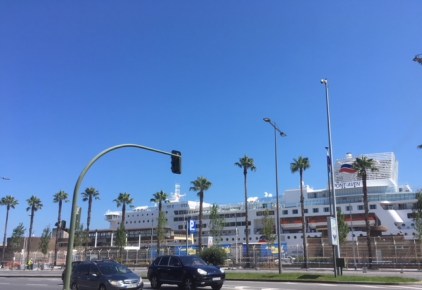
Then last year we took the Brittany Ferry from Portsmouth to Santander in northern Spain, and returned 5 weeks later. On our return the incoming ferry, the Pont Aven, was delayed by bad weather.

409 Pont Aven

The Pont Aven alongside in Santander (The name comes from a commune in the Finistère department of Brittany)

I started scribbling my observations and thoughts as we waited. The harbour area of Santander is typical of many port cities; business-like warehouses and customs sheds abound with their attendant lorries delivering and collecting, the lazy eyes of the port officials keep a wary lookout for anything suspicious, the sun harsh, its heat reflected off the acres of concrete. In town the shops shut at 2 o’clock for over two hours; northern Europeans, used to being able to shop from breakfast to suppertime, on every day of the week, think this a throwback to a different age, one less time driven, less focused, more relaxed; the Catholic versus the Protestant?

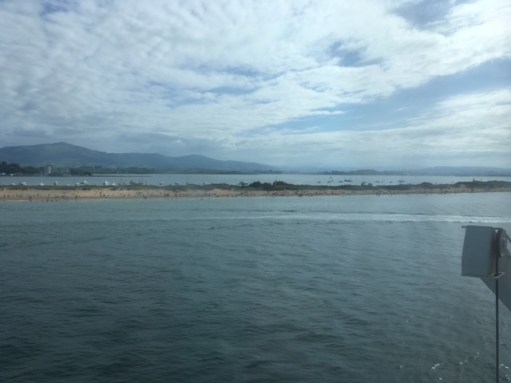
The dockside’s a sight: the old-and-bold with a rather gone-to-seed look but whose car is their pride and joy; the convertibles with their ‘look at me’ drivers mingle amongst the normal utilitarian ones that form the majority. There are caravans, some being towed by a car and others under their own steam (well petrol or diesel not steam). And there was obviously a rally somewhere for off-road quad bikes as a number, all muddy and tired, bit like their owners, sit on trailers behind …. the caravan. There is a large group of motorcyclists, probably all unknown to each other but joined by their love of their bikes. There are bikes of all sorts, bikers of all sorts- most look grubby, all leather and boots in the heat, the tattoos de rigeur and the hair making a statement too; worn long, worn short, a muppet look, wigs black and blonde and the atypical ponytail; and all podgey! We all sit aligned in our lanes on the tarmac in the hot sun. The cars get hot; blankets shield pets and humans as we wait ….. and wait. Some sit in their cars with the air conditioning on …… for an hour or so …. global warming??? We load eventually, hard on the heels of the poor cleaners who are trying to turn around the cabins for the new passengers. After the long hot wait on the quay everyone is anxious to occupy theirs, unpack and join the queue to pre-book a table for supper. This queue reflects both eating habits and the social importance of eating! The ferry shudders as the propellers work to turn the ship away from the dockside and into the narrow navigation channel. Slipping out, we leave the green starboard-hand buoys to port; the convention being port-hand markers are on the left coming in from the sea.

418

The bar is already busy – it seems part and parcel of the sea-going experience – beer in hand, queuing. Mind you these days as many stand with Kindle in hand, free thumb ready to ‘turn the page’. The average age seems 50 plus, with few children, as the schools only broke up a week ago. I realise this is rather like an airport terminal – busy every day, in this case three times a week, hundreds of people are in one place, at once, from all points of compass, from all walks of life.

The tannoy announces a demonstration of how to put a life jacket on – “andibetavmkgdu will be on B D…k at 1700″ – no one moves in its direction, imagining that disasters happen to other people. Mind you the loudspeaker volume is such that you only discern every second or third word and it could have been a demonstration of life drawing or some such. During the night we pass close to Ushant at the north western tip of France; it’s a calm and uneventful crossing. At breakfast I spy an oldish chap in a light blue polo shirt – it obviously has been sitting in his suitcase and is woefully creased, except where his large stomach presses against the material, producing a smooth area. Life huh!

You will know I love coincidences. You may not know that as part of my homework for my creative writing sessions I had to dream up a script for a Soap Opera, one that had individual stories and continuing themes and characters. I wrote mine after our outward trip on the Pont Aven in June. I had imagined the restaurant staff was run by Sabine: “The other main character is Sabine, tall, willowy and very French, whose responsibility is the waiting staff, of which there are 40. Some have been there for ever, some are taken on for the High Season, and some are apprentices seconded from the L’école de Cuisine de Belle France in Lyon.” And here was Sabine, exactly as I had imagined her, in real life. Tall, rather haughty, very short hair – and running her staff with enthusiasm and efficiency. So weird; so lovely!

420

We dock in Portsmouth, locate the correct staircase and lift to ensure we enter the right car deck, on the right side. We sit and wait; eventually, we disembark, drive through passport control and join the M27/A27 for the slow run home.

Memories huh!

Richard 16th March 2019


PC 146 Ferries

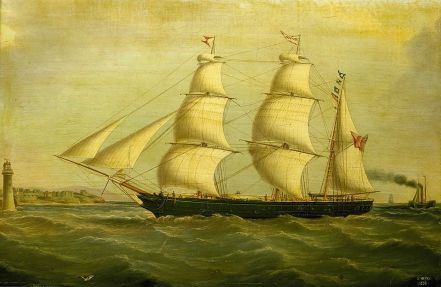
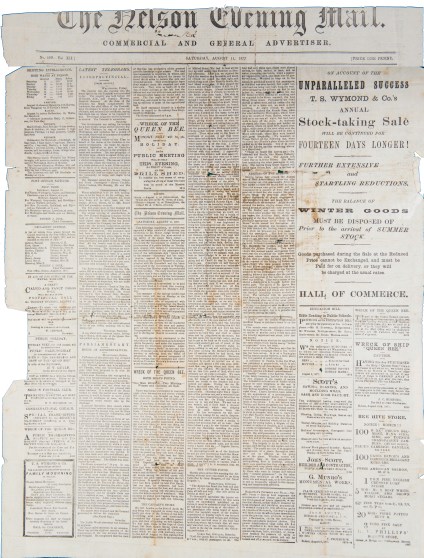
Living on an island, a ‘small island’ according to author Bill Bryson (see note 1), before the advent of flying one was reliant on boats and ships if you wanted to leave! My great great great grandfather Stephen Nation would have taken a ship to India in 1798 to join the East India Company, his grandson George’s wife-to-be sailed to New Zealand on the Queen Bee in 1877, and George himself crossed the Atlantic on ocean-going liners, twice using the US Mail Ship St Paul, on his journeys to Alaska at the very beginning of the C20th century.

Since then air travel has fortunately become commonplace but occasionally it is necessary to take a boat of some sort, for instance if you want to have your own car at the other end. I guess we’ve all experienced ferry travel at some point, whether across harbours, up rivers, down estuaries, or in larger ships across seas and oceans. Our June 2018 use of Brittany Ferries to travel from England to Spain, and back in July got me thinking of other times in my life when I’ve taken a ferry.

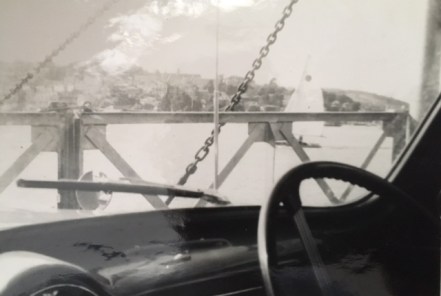
My first trip was to the Isle of Man for the Christmas of 1953; my father, divorced, took my brother and me to stay with a rich friend. I remember being sick, having had Tomato soup for lunch as we sailed across the Irish Sea, and little else of the week, except that I saw a hamper with fresh oranges and other strange fruits – extremely rare in mainland Britain still recovering from the cost of WWII! A year later our grandparents took us to visit their son and family in Mönchengladbach, in what was then West Germany. I don’t remember the ferry itself and sadly have mislaid a black & white photograph, taken at the dockside, of their car being craned onto the ferry’s deck at Harwich, but have this other one of passengers disembarking from the same ferry.

Harwich Docks

The abiding memory of that visit was persuading my grandmother to buy us some biscuits to eat under the bedclothes, as we were perpetually hungry!! Funny how these things matter to an eight year old!

By the mid-1970s roll-on/roll-off ferries were the norm, but on the ferry that sailed between Civitavecchia, on mainland Italy just west of Rome, to Olbia in Sardinia, they obligingly craned my car, a Lancia Fulvia, onto the open deck for the overnight crossing. It was 1975 and I was going to Sardinia for a couple of weeks to crew a yacht. It had been a long drive from northern West Germany and the first thing I did, once on board, was find the bar and  order a gin & tonic. The second thing? Order another gin & tonic! I can still smell and taste it; perfect! I slept the night in the car on the deck.

Aust Ferry 1958

Before Wales and England were connected by a modern bridge across the River Severn, there was a little car and passenger ferry that crossed the river at Aust, so saving a long detour north to the first bridge at the city of Gloucester. I remember taking this ferry as a teenager, in 1958, although the reason for the journey is in that brown mush of un-recallable memories!

I have crossed the harbour in the Dorset town of Weymouth in a little dingy rowed by ‘arry, “That’ll be a pound please.”, crossed the Medina River on the chain ferry from West to East Cowes on the Isle of Wight, experienced the Star Ferry from Kowloon to Hong Kong Island and have on many occasions been a passenger on the Sydney Harbour ferries; the last time was from Central Quay to Manley in January 2017. Another short ferry crossing that comes to mind is the one across the River Dart, between Dartmouth to Kingswear in Devon. My brother had started his Royal Navy career at the Naval College and this cross-river trip must have been associated with his commissioning parade in 1966 – the year England won the Football World Cup.

Dartmouth Ferry

Note the dingy sailing on the river away to starboard.

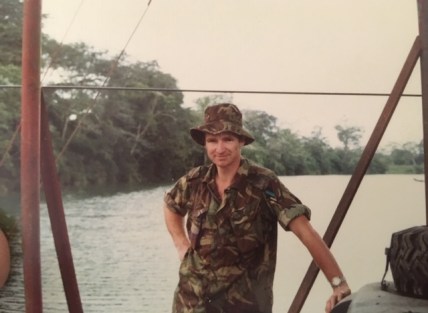
 During my Army service I had some troops stationed in Belize, in Central America, on a six month rotational tour. Naturally I had to visit them; this is me on some ferry in the middle of nowhere in Belize.

m169

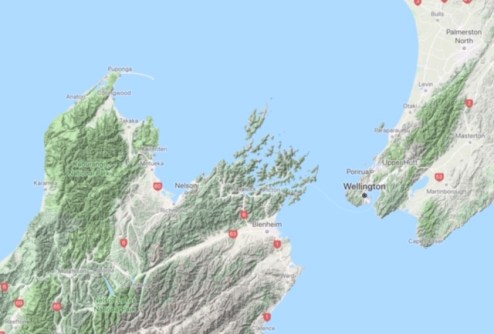
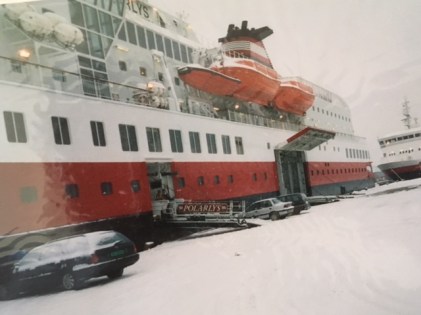
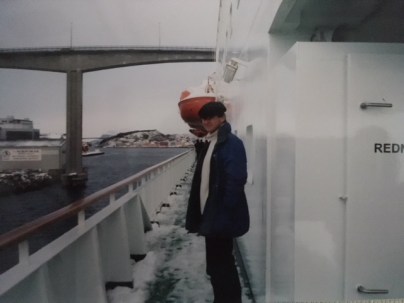
Then there are those that ply San Francisco Bay and the inter-island ferries of Seattle in Washington State. Larger boats have carried me between the Canadian city of Vancouver and Nanaimo on Vancouver Island, and between Picton, on New Zealand’s South Island, and Wellington on its North Island. For a greater adventure in February one year, looking for the Aurora Borealis (Northern Lights), I travelled on the MV Polarlys of the Hurtigruten Company from Tromsø near the northern tip of Norway down the coast to Bergen.

Hurtegreuten 5

Docked alongside at one of the numerous stops

Hurtegreuten 3

This before a storm; note the snow on the deck!

 The Norwegians treat this coastal service rather like a marine bus; there were numerous stops and people got off and people got on.

CIMG0002

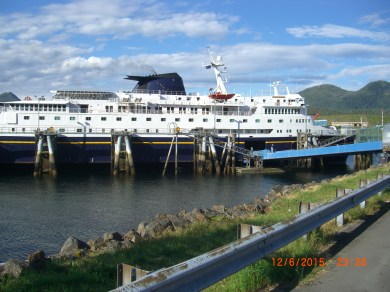
MV Columbia in Juneau

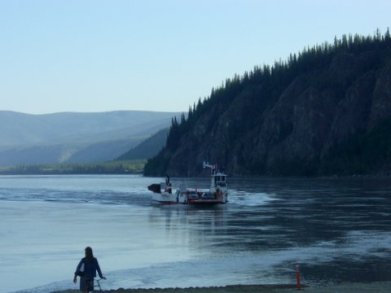
  If you read PCs 44 & 45 you will know that we took the MV Columbia north up the Alaskan Marine Highway from Seattle to Skagway in 2015, a journey of some 1600 miles. It took 36 hours to get to Ketchikan, the most southern of the Alaskan cities; the next port of call was the Alaskan capital Juneau, only accessible by air and sea, although there are 16 miles of roads for the petrolheads to enjoy!! Four days out of Seattle we arrived in Skagway. Later on that trip we took a ferry across the Yukon on our way from Dawson City to Eagle.

CIMG0313

The Yukon Ferry

This was a classic river ferry that used the strong current to its advantage; rudders kept the boat at 45º to the stream to produce a cross-river force. Ahead of us we had a 240 mile dirt road drive, the last 65 along the Taylor Highway during which we didn’t see another human being!

During my time in Germany 1972 -1976 we got very familiar with the cross channel ferries from Calais, Ostend, Dunkirk, or Zeebrugge to Dover – and if I am honest I always opted for a French-operated service as the coffee was better. Of course Zeebrugge, a Belgian port, became forever associated with the capsizing of the car ferry MS Herald of Free Enterprise, operated by Townsend Thoresen, in 1987.

Herald_of_Free_Enterprise_capsized

The vessel, a roll-on/roll-off ship, turned over just after leaving the harbour one cold March evening; the bow doors had not been properly closed, allowing the sea to surge in. One hundred and ninety three people died.

Richard 2nd March 2019 (to be continued)
Note. Bill Bryson – ‘Notes from a Small Island’ – a brilliant highly amusing book!!

PC 145 Extreme Weather Wednesday 6th February Rio de Janeiro

We’d been out to dinner, Celina, her mother, cousin Toni and me. Luckily Toni is a member of The Rio de Janeiro Country Club in Ipanema and had invited us there. The club was established in 1919 by English ex-pats and their Brazilian chums and still retains its early English influence.
During dinner it starts raining; for those of you familiar with a tropical deluge, multiple by three! Sheets of water drop vertically from the night sky; torrents run off the outside awnings, designed to keep the club members shaded from the hot sun. It is still pouring when we leave the table around 2130 but by now the wind has increased and, outside the solidity of the clubhouse, the night takes on a very different feeling. Lakes of brown dirty water are forming on the streets; trees bend to the wind.
We have two options to return to São Conrado. One via Niemeyer, a narrow twisty-windy road that hugs the sea, along the side of the Two Brothers mountain and the other via the tunnels slightly further inland. The trouble with the former is the run-off from the mountain can be like a waterfall, washing across the road and potentially causing a dangerous situation.
We choose the other route. Sloshing through the streets, the car wipers hardly keeping pace with the volumes of water, we arrive by the Rio Jockey Club. Chaos! Clearly Rio is suffering a catastrophic extreme tropical storm. It was later reported that wind speeds of over 110 kms per hour (70 mph) were recorded. Traffic backs up in all directions. We creep along, the vision forward blurred by others’ hazard warning lights.

m36

A tree has come down; we give the branches a wide berth. A traffic sign hangs drunkenly across the street. Over an hour we travel half a mile. Another green-and-white directional sign is propped up by the road: ‘Barra’ and ‘São Conrado’ suddenly are heavenwards! I think we all silently pray a tree or sign would not fall on us, but don’t voice our concerns. We press on, trying to get some news on the radio. At 2300 we learn that some parts of the Rocinha favela, home to some 80,000 people, are in danger of landslips and are being evacuated. Between the two tunnels the dual carriageway is severely restricted by deep puddles of water and collapsed sapling-like trees which have given up their struggle against the wind. Into the second tunnel; by this time everyone is silently beginning to think about a pee. Easy for us men, not so for the two women! I succumb and, mindful of the way motorcyclists weave in and out of the traffic lanes at will, relieve myself against the tunnel wall. I make the mistake of putting out my hand to steady myself …. and end up with the tips of my fingers black with diesel fume extract and brake lining powder!

People start walking towards the open end of the tunnel, maybe wanting to see what’s going on or maybe just going up into Rocinha which lies on the right at the end. We edge another few metres forward …. another 200 metres …….. and stop. We still can’t see the night sky and I feel like a rat trapped in a drainpipe.

We eventually emerge. The midnight news headlines reports that a tree has fallen onto a bus on that Niemeyer coastal road; one person has been killed. We shudder, sad for everyone concerned but glad we didn’t go that way. We reach the turn-off to Rua Joa and see it’s a river of mud, floating vehicles and stone blocks; we try a little slip road further on but a bus has skewed across the mud and it’s blocked. It’s stopped raining and Celina and I decide to make the rest of the journey on foot, leaving her mother and Toni to find a hotel in Barra.

We slip and slide, using the torch on my iPhone, wishing we had recharged it fully earlier (!), up over the grassy bank on to Rua Joa; this part is clear of the mud, just covered in fast flowing water. Three hundred metres uphill and we turn into Rua Iposeria; what happened in January last year has been repeated. Now, as then, so much water has come off the Pedra da Gavea mountain that its force has lifted hundreds of the 20cm granite blocks that form the road surface and thrown them aside. The 150 kg side stones are also unable to withstand the force of the water; once one has moved, its neighbour has also slipped.

m43

This hadn’t happened once since Celina’s parents bought the house in 1969 – confirmation that extreme weather is becoming more common as the planet warms.

We find the security guards; one offers to escort us, with his large torch, up to Celina’s mother’s house as there are power cables hanging loose! Thirty minutes later we have negotiated the mud and rock strewn road, missed the gaping drop into a destroyed sewer, slipped past a landslip almost blocking the road, ducked under and over cables hanging from a collapsed electricity pylon, and arrive.

m40

 In the cold light of day!

We shove hard against the pedestrian door and squeeze through; on the other side bricks, tree branches and mud have collected. Everywhere underfoot is covered with slippery mud. Carefully we climb the steps to the front door and unlock it. It’s obvious from our first steps that the floor is covered in water but without much light it’s difficult to establish how much damage has been done or indeed whether any sewerage or snakes have come in. We struggle to find some candles and some dry matches as there is no power; we wonder why the loo wouldn’t flush properly and go to bed; it was 0245.

m38

Four hours later we are beginning the clean up in the pale light of dawn. Aguinaldo the gardener and handyman arrives at 0700 and we survey the damage. One of the large water tanks has been destroyed when a large retaining wall collapsed; the house immediately above us has had a sewer pipe rupture; a water mark on the wall outside the glass rear door in the sitting room shows that a metre of water had built up then, nowhere to go, it had simply seeped under the door into the house. Outside a large electricity concrete pylon has buckled under the weight of a reinforced stone wall’s collapse and the cables snake down the street.

m37

Two days later, the access road is still unusable, there’s no power or water and no forecast of their return; we’ve emptied both fridges and freezers, decamped to a hotel, and left Aguinaldo to feed Ze the green parakeet.

On Friday we go to the Gavea Golf & Country Club to have a shower and lunch. The hundred acres of the golf course had not been spared from the mud and the army of the Gavea workforce were working to restore the pristine green conditions. Outside, the road, that two nights before had been under a metre of mud and sludge, was being cleaned by a municipal task force. The socialist in me wondered whether it had occurred to anyone in the club management that their equipment and manpower could have been used outside, for the betterment of the city, even for a day, than trying to restore the fairways so the members could play. Sitting by the pool I realise the irony of my thoughts!

Richard ……. written 9th February 2019               richardyates24@gmail.com

PS Ten days after the storm, the power and water are back on, but earth slips and dangerous looking walls dictate we will not return to the house for a while. (15th February 2019)


PC 144 From snow and ice to tropical warmth

Travel in the winter in the UK is always weather-dependent and no more so if you’re booked to fly to Rio de Janeiro, departing 1125 on the penultimate day of January. When it’s good and the traffic flows, this 65 mile trip normally takes 90 minutes from our apartment, minutes from the sea in Hove. Part of the journey is around the London Orbital Ring Road, known officially as the M25 and unofficially at times as a carpark. Add the peak traffic times of 0630-0900 into the mix, throw in a weather forecast of snow and sub-zero temperatures and suddenly you start to look for an alternative. Suffice to say, after many telephones calls, we secure a room for the night before our flight at the Thistle Hotel at the North West corner of the airport runway and Jon is happy to drive us. BA’s Terminal 5 actually has its own hotel, operated by Sofitel: just roll out of bed and roll across the concourse to check-in? Well, if you want to part with £325 and if you’re quick enough; it was fully booked!

The Thistle does what it says on the tin; clean, comfy bed and bathroom, good soundproofing and somewhere to eat. You could niggle about the fact that the bathroom door scrapes against the loo, or that the loo roll holder has been positioned so close to the receptacle that you have a choice, sit askew or accept the loo roll is wedged into your flank, but actually it is OK. Like all places where the majority of its occupants only stay one night, the ambience needs to be pumped in through the air conditioning. I see some of the minority, those in huddled groups enjoying, for example, an ‘off-site’ meeting to discuss managing ‘work from home’, or some-such. All the delightful male staff seem to be related and have a look of a Bradford-born Asian; the females, equally delightful, for some reason are no taller than 5 feet; so weird it’s noticeable!!

The Thistle Hotel has a POD (Passenger On Demand) service that runs to Terminal 5; sounds very space age! Leaving the hotel you make your way to the station, a driverless pod arrives at your beck and call and whisks you to the terminal in 5 minutes – for £5 per person. “Go through the door opposite Reception (marked Car Park A) and follow the green path and signs to T5 Pod. When you reach the steel gate enter your 4 digit code followed by the # key. Turn left and look for Station B.” Blah blah!

m17

Wonderful if you don’t have luggage for a year, or in this case simply going back to see Celina’s Ma …… and having responded to the ‘Can you bring some …… and some …..?’ and then of course gifts for cousin’s birthday or friend’s baby. With four big suitcases as well as ‘carry on’ and no trolley in sight, we rely on Imran, an ancient grey haired Pakistani who should have had his slippers on and feet up a long time ago, to take us in his taxi; job done.

Why do I always believe the ‘bargain’ labels on scent bottles? Seems hugely expensive, a small bottle of Gucci something or D&G …… but I do because it’s Duty Free (really?) Up to the BA lounge, where James and Daphne, manning the entry desk, are too busy chatting to each other to even look up. James senses us approach,  puts out a hand, imagines I am going to place my boarding pass in it, which I do (!), scans it and waves us through. A zero score for customer service!

The lounge offers every sort of snack, mainly of the breakfast variety, and drink. I suppose passengers using the lounge are from the four corners of our globe and maybe on a different body clock, but seeing people drink a glass of red wine at 0945 looks strange. The waitress staff shuffle silently between the little tables, clearing, wiping, asking ‘Is this finished Sir?’, succeeding wonderfully to be unobtrusive but extremely efficient. I wonder where all these people are going, or if in transit where they have come from and going on to, such is the nature of an international airport hub. Unless there’s a delay ….. “The 1100 flight to Manchester is delayed due to snow. Please listen for further announcements.” ……. flight departure notifications are no longer made (thank God) so there is no way of knowing  …. unless you overhear other’s conversations!

I go off to buy a book and come back to find 64 year Professor Marjorie Styles has unplugged her iPhone from the charging socket, switched off her iPad and left for the New York flight whilst David Winthrop, sitting two seats over from the professor, has also departed; actually he had looked as though he’d shuffled off his mortal coil some time ago, poor chap, so I was relieved to see there was life! Their replacements in the row of seats opposite, a ‘creative’ rather pleased with himself and a serious, bespectacled, earnest 40 something reading the Financial Times, are equally observable; I just didn’t get their names!!

m4
Outside brilliant winter sun blazes down on the Heathrow apron and there’s that constant movement of planes, some landing, some taxiing, some lifting off into the cold air. We go to our gate, board and join them, first moving to the de-icing area then taxiing to the end of the runway for take-off. In addition to the normal in-flight announcements in English about what to do should we land on water etc, I am surprised to hear it repeated ……. in Spanish! You probably know that all the Latin American countries speak Spanish apart from Brazil, which was originally a Portuguese colony. Even though the languages are vaguely similar, it seemed totally wrong; like flying to Stockholm and having the second announcement in Danish!

Twenty minutes later we’re over the Isle of Wight ……….

m5

Hours later the Mauritanian part of the Western Sahara looks like this ………

m7

After 11½ hours in the air, the gentle kiss of the wheels onto the apron of Rio’s Galeão Aeroporto Internacional Tom Jobim announces our arrival. We disembark into the tropical evening heat of 36 C at 2130. Quite a contrast to London’s Heathrow!

Richard 8th February 2019

PS Rio de Janeiro endured an extreme tropical storm on Wednesday (6th) night; six people died and landslips and flooding are widespread. No power and no water. You can guess the subject of the next postcard!

PC 143 Failure is simply a different perspective

Thomas Edison famously replied, when asked what it was like to fail for the 1000th time in his quest to develop an electric filament bulb, that he had simply found lots of ways that didn’t work (Interestingly the figure of 1,000 sometimes is quoted as 10,000; inflation? Then common sense kicks in – 10,000 times would be testing something three times a day for ten years!!!). For us mere mortals success and failure are part of life, the latter instrumental in bringing about change, I hope!

Rummaging in my three-drawer filing cabinet for some document, I saw a hanging file labelled “Certificates & Reports”. I don’t know about you but I am quite organised in filing important papers and such. This particular collection of papers spans decades of my life and some hadn’t seen the light of day for years; many deserve to be shredded!

m1

For some reason I have kept my ‘National Registration Identity Card’ dated 31 August 1950 (I was 4!). It allowed me to have a Ration Card so I could buy some sweets (those black jacks, a farthing each, were favourites).

In an academic sense I am very average. I didn’t particularly take to school work but was made aware how important it was to one’s success or failure in life. In amongst the pieces of paper there were those little slips recording my examination results. There seemed to be quite a lot as I made several attempts to pass enough …… but the one that bugged me the most seemed to be Chemistry. For some reason I needed this at ‘O’ Level to add to my science ‘A’ Levels for entry to university. I failed it at school, sat it twice at the officer training academy and finally got my pass.

m2

The Chemistry lecturer, whose name escapes me, had a passion for betting money on horses. If we hadn’t spent so much time discussing the tips, runners, form and betting odds for the 3:15pm at Cheltenham, for instance, I might have passed first time! He seemed to think the names of all the winners could be deduced from the racing pages of the Daily Telegraph and instructed us accordingly, when we should have been discussing whether common salt was Na Cl or why CH4 + 2O2 equates to CO2 + 2H2O; I never knew!! I judged his success at gambling on the horses by his fifteen year old car and the rather moth-eaten cardigan he wore.

I scribbled a little about university in PC 139 and can only assume that I was given my Civil Engineering degree for my reasonable attendance record. You will know the mnemonic POET’s Day relating to Friday – ‘Piss Off Early Tomorrow’s Saturday’. At Shrivenham some students left early, missing some pithy lecture on concrete for example. On a number of occasions the lecturer, who we had for the first period on a Monday, would declare that the Monday class would be ‘private study’. Those who weren’t there to hear this turned up as scheduled on Monday; ah!

Classical music and its part in my life was the topic for PC 109; how I had given up learning to play the piano and took up the trumpet. According to The Royal School of Music, on 7th December 1962 I took my ‘Wind Instruments Grade V (Higher)’. Although I scraped a pass, I didn’t impress the examiner during the Aural Test – “seemed to have no idea of pitch and timing” and my ‘Scales & Arpeggios’ had “only fair fluency”!! As I am almost tone deaf, I was surprised to be successful but thank my lucky stars I persevered as, although no Alison Balsom (see note) it gave me a life-long love of classical music, and particularly the music of Sibelius.

m3

Entry into Sandhurst was via the Regular Commissions Board at Westbury in Wiltshire where, aged 17, I spent three days undergoing assessments. I passed; the rather faded report says my ‘reserved personality may have something to do with the fact he comes from a broken home (!!)’ with a forecast ‘the boy might develop into a useful officer’. Ah! Such confidence! The term ‘broken home’ is rarely used these days, such is the acceptance that marriages don’t always survive. Of course the good thing is if you start somewhere at the bottom, the only way is up and I left Sandhurst and my officer training with a couple of prizes! Hey!

Officers were graded once a year in a ‘Confidential Report’ (CR). The ‘pen picture’ was always a challenge, either reading your own or writing one for one of your subordinates. I never met anyone who knew to whom they referred, but two anecdotal comments of officers always amuse: “I would not breed from this officer” and “His men follow him not out of duty but out of curiosity.” These CRs were delivered by your immediate boss, in the formal atmosphere of his office; your subsequent career depended on a good mark!! I have reread some of mine, copied unofficially by a friendly Chief Clerk and 18 years of my life goes by in a flash. Suffice to say my entry into Staff College confounded those early predictions of being average.

Life is such a lovely journey and we make choices all the way; if you don’t think you have a choice, think again. Being fairly casual of heart, I have faith and trust in others to do what they are meant to do. Sometimes I fall flat on my face! One such occasion was in Germany in 1974 when my unit had some super important inspection of our tactical expertise. The Artillery Firing Tables had not been amended (not my job!), a Command Post caught fire and we failed as spectacularly as possible! I had been selected to be a possible aide-de-camp to the most senior British military officer in Germany and I left the exercise early to travel 100 miles to have lunch with him and his wife (General Sir Harry & Lady Tuzo). My failures followed me, others had serious second thoughts and before I had even picked up a knife or fork I was recalled. What if I had succeeded? Different path, different journey; just the way it was, success or failure? Nah! Just life! We were retested, passed with flying colours and nothing more was said.

My military service is so long ago now that it’s overshadowed by my twenty five years of efforts to improve other’s lives and this period is littered, I judge, with much success. But all these events and experiences are in the past; I understand them for what they are and how my current behaviour is inevitably coloured by them.

Richard 25th January 2019

Note: Alison Balsom OBE is an English Trumpet soloist, arranger and ‘spokesperson for the importance of music education’.

PC 142 Rules is Rules

A sucker for the popular, on Monday we decided to go and watch the award-winning film ‘The Favourite’.  My knowledge of English history isn’t bad, but details of Queen Anne’s reign (1702-1714) have somehow escaped me. Now I know that she was bisexual, responsible for the union of England and Scotland, and looked like Olivia Colman. That’s right isn’t it? Having plenty of time before the film started, I left earlier than necessary so I could renew my International Driving Permit (IDP) at the Post Office.

m208

On the bus into Brighton it occurred to me I should organise lunch with my dear friend Jon. Reaching for my iPhone I texted him, asking when he was free in the next couple of weeks. With an affirmative answer for week one, we then focused on whether Monday or Thursday was better. I wrote ‘poss Monday 14’ and said I would confirm when I got home. Not wanting to forget, I then went to my iPhone diary to add this. It was extremely disconcerting to find that the person who lives in my phone had been reading the text exchange and had already put into my schedule ‘poss lunch Jon’. Now that is very scary! Maybe I should call it AI?

At Churchill Square I went down into the bowels of WH Smiths, the national newsagent chain established in 1792, to go to the in-store Post Office. (See note 1) It had had a make-over since I was last there. There is a self-service area where you could weigh, determine the correct postage, and then dispatch your packet or parcel, a ‘digital transactions’ booth, screened by a curtain, and a queue! Well, when isn’t there a queue in a post office?

m210

It was the reason these scribbles came into life, to avoid a queue in a Rio de Janeiro post office to buy some stamps. Brighton queues are of course fascinating for the diversity of their participants, but only to those who don’t live here; we get inured! Ten people in front; I look at my watch – time enough before the film starts I reckon.

The city’s diversity stretches to the staff. There are two counters; at one a chap in his 50s with well-cut greying hair and a goatee beard which is long enough to be plaited into a little rat-like tail, and next to him a man in his 30s who must have been to a local Turkish barber where, halfway through the haircut, he got up and left, leaving the left side of his head almost shaved and the hair on the other side long. I am not sure whether this look will catch on. The queue moves forward and I find myself in front of Mr Half-half. He looks at me as if I am a waste of time and glares questioningly; a ‘Good afternoon, how can I help you?’ was too much!

“I would like to like to renew my International Driving Licence please, to be effective from the end of this month.”

His body language suggests he’d rather be in Outer Mongolia and his sigh could have blown a house down. He gets up, rummages on some shelf a long way away, and comes back with a box of IDP forms.

“Where are you going and do you have your UK Driving Licence and a photograph?”

“Brazil” I answer, pushing a photo and my licence under the window. “And here’s my old licence if that helps?”

Why did I do that? I could have just given him what he asked for and would have been out of there within 10 minutes.

He starts filling out the form, then notices that the photo I have given him is the same as the one in my expiring IDP.

“It says ‘recent’ photo. This one is a year old.”

“My face hasn’t changed in 12 months” I say, pushing my visage against the glass.

“It says, recent and this is not recent. The rules is the rules.”

Purists of our language will know immediately that this should have been ‘the rules are the rules’ but I don’t feel I would gain any advantage if I point this out to him.

“Go and get a new photograph.”

I am about to get angry, realise that this will gain me nothing and that it’s better to just let it go. I turn and walk off to the nearby Photo-Me booth, conveniently located about 30 metres away. It’s occupied. I wait, looking at the advertising on the side of the cubicle and notice the variations of print form; beside me cartons of rolls of half-price Christmas wrapping paper almost become tempting! The dark blue leggings and little ankle boots visible under the booth’s drawn curtain suggest the occupier is female, but you never know in Brighton!

“This photograph does not comply. Please check your settings and try again.” The computer-generated voice tells them they have got it wrong. She tries again …… and again. In the older booths there used to be a little metal stool whose height you could adjust to ensure your eyes were in the correct place. Here there’s a large cerise rubber ball and the machine adjusts itself. The anodyne voice continues to say that the photograph is not compliant ….. and the woman is getting frustrated. Nothing compared to the chap, me (!), outside, who’s looking at his watch and wondering whether he will make the curtain up in the cinema. Obviously his expressions of exasperation become loud enough, the curtain is ripped back and the woman escapes, unsuccessful, and disappears, muttering to herself and throwing me a dirty look.

m209

 The old IDP photo (Jan 2018) compared with today

Five minutes later I am back at the end of the queue in the Post Office with five copies of a ‘recent’ photo. Fortunately Goatee Beard and Mr Half Half are busy and I present myself to the next free counter, manned by a young woman (Ed. That could be ‘womaned by a young woman’ in these ridiculously PC times, could it not?) with yellow-streaked purple hair and a few studs. She’s only worked for the post office for 9 months and has never done an IDP for Brazil (IDP1926 – see note 2) so she’s delightfully keen to get it right and, very quickly, we are done and dusted, without any fuss; I pay my £5.50 and head off to the cinema.

Simple observations about C21st life.

Richard 12th January 2019

Notes

  1. Despite this digital age, WH Smiths sells magazines, newspapers and books. There are some 2800 different magazine titles published annually in print form in the UK.
  2. It’s rumoured that UK citizens will need an IDP to drive in Europe after we leave the EU. I hope it’s from the same rumour factory that says post-Brexit flights will be unable to land in Europe.

PC 141 Saloio

m206

For those who find geography a black art – an orientation!

Lying some 30 minutes travelling to the west of Lisbon, Estoril has drawn people for over 150 years; some settle down to live in this Atlantic coastal resort, others visit briefly on holiday. The Hotel Palacio, the five star establishment whose de luxe rooms overlook the swimming pool and beyond to the gardens, in front of one of the largest casinos in Europe, opened its doors in 1930 and the ground floor corridors are lined with fading photographs of those who came to stay.

m200

European royalty, for example the Italian, French, Bulgarian and Romanian ex-royal families, mingled with actors and actresses, heads of government and Portuguese aristocrats. During the Second World War it was the home to both British and German spies and in 1969 featured in the James Bond film ‘On Her Majesty’s Secret Service.’ I personally don’t think it is the best 007 film (starred George Lazenby and the gorgeous Diana Rigg) but it was in the Hotel Palacio that Ian Fleming had conceived the idea for the series, and that’s a great coincidence!

m199

A sumptuously appointed corridor in the Palacio

My mobile rang when I was in Saloio, a very up-market grocer’s store on Avenida de Nice, a street in front of the hotel. It was my chum Stewart calling from Wimbledon in London to wish us a Happy Christmas. I could easily picture him as I know his house and whereas he might have some notion of the sort of place I was in, being a well-travelled chap, he would have been amused to actually witness it.

m202

I call it a grocer’s store as this is what it is, like Partridge’s on the King’s Road in London for instance; one central shelving unit snakes down the centre, each part crammed with particular foodstuffs. On the walls to one side are little bottles of condiments from every corner of the globe, jars of jams and marmalade (Marmalade is a very English description and coveted by the international clientele who shop here.) and then racks of vegetables, dairy produce and cheeses. If you want more specialist cheese the deli counter on the other side of the shop provides countless alternatives. Meats and poultry, raw or already prepared, lie on the next counter, under the watchful and attentive Paulo.

m201

A rather empty early morning on Boxing Day!

I told Stewart it was lovely and unexpected to hear his voice and that we were in the basement of the Saloio grocery store in Estoril. Down here, away from the shoving and pushing around the delicatessen counter, there is a moment to reflect in peace about which packet of loo paper to buy and to search for the dishwasher rinse aid.

On the narrow stairs back up to the frenzy of Christmas Eve shopping, towers of boxes of tea, of every make, type and taste, confuse and irritate one in equal measure. Those who linger here in indecision risk the wrath of the staff, moving in both directions, downwards empty handed, struggling up with replacement boxes to stack a small shelf, or clutching a single item asked for with an imperious tone and raised eyebrow in answer to the ‘they are downstairs madam’ response.
The old-moneyed Europeans mingle with the nouveau riche, both stretching past one for a packet of smoked salmon for instance without any consideration or acknowledgement of your existence. There’s a certain haughtiness, a sense of birth right, that gives them the confidence to act in this rude way, whether the disdain is obvious or not. Can you smell money? I think here there is a certain scent, whether it’s the classic Austrian Loden jacket that may not have seen the inside of a dry cleaners, ever, or the fur coat’s slight whiff of moth balls worn with a disregard for those who fight for animal rights. Maybe it’s the aftershave and perfume, or the cosmetics that cost a month’s wages. The younger generation, with their modern gilets and designer trainers, mix well, as they belong to this group where an excess of cash is the common currency.

The staff who stack the shelves, inquire whether it’s the smoked or unsmoked bacon of which you need 10 slices, ensure the baskets of warm fresh rolls are fully stocked, smile when you ask if they have any pickled ginger as you can’t find it, despite looking high and low, or simply take your euros at the checkout, unfazed by the bill for five items and a bottle of fizz that they wouldn’t consider value for money are, of course, lovely, polite, helpful people, with the patience of some saintly horde. Recognise them in some way, acknowledge them, and they ooze warmth and helpfulness, just like anyone in a similar position.

You can tell from the top-of-the-range cars hustling for parking space outside in the little narrow street that this is a very up-market shop. In amongst the Mercedes and BMWs I spot a beautiful deep-blue Bentley convertible with a Principality of Monaco licence plate. Just stunning, if of course you can afford a car that probably costs about £175k? Of course the Portuguese will park anywhere convenient to them. Pedestrian crossings? Why not? ‘I never walk anywhere so why should I recognise something for other people?’!!

m207

Hotel Palacio to the left, Saloio just right of centre

Down Avenida de Nice, towards the sea, you can see the end of the queue that stretches for over 100 metres to Pastelaria Garrett, a real cornucopia of all things bad for you, but just so yummy! Pre-ordering cakes, puddings and pastries is fine, but someone has to collect them! In Portugal the traditional Christmas cake is either the Bolo de Rei (King’s Cake) or a less showy Bolo de Rainha (Queen’s cake).

m203

Bolo de Rei

Just some seasonal observations gleaned from looking up and down one little street in Estoril, Portugal on Christmas Eve 2018. More scribbles in 2019 no doubt.

Richard 29th December 2018


PC 140 Extra! Extra! (2)

The frequency of my blog continues to be fortnightly, although last December I wrote an extra one (PC113) to reflect the modern tradition of having a little something extra at this time of year. Some companies pay their staff a 13th month’s pay, some give bonuses, and that’s all well and good; when I was working I was paid to carry out a role, for which I got a salary – end of! My PCs 86 (Boxing Day) and 27 (Christmas) covered something of this period but here’s a little extra scribble; have a great Christmas.

I have two pieces of homework to share, one because it’s seasonal and the other because I think it works (but then I would, as I wrote it!).

The first brief was to write the story behind a Christmas song or carol.

“It’s just before dawn in an old dusty room in an outbuilding beside a wooden clapperboard church. The church has only recently been connected to the new electricity supply and old gas lamp fittings from the main building are stacked in the corner. A single electric bulb hangs from the ceiling, giving light to a large table in the centre of the room. At the table a middle-aged man, wrapped in an old, rather worn, silk dressing gown, is bent over a pad of paper, writing something; his moving hand casts eerie shadows on the wall. There’s a knock on the door and, without waiting for an answer, a woman enters carrying a cup of tea.

“Here you are dear. I thought you’d like something to warm you up; there’s a favourite cookie on the saucer. How’s it going?”

“Bless you Matilda, bless you. How’s it going? Well, I am trying to write something we can sing on Sunday, something based on my trip last year to the Holy Land.”

“And ….?”

“It’s coming on, you know! I was very taken by the little place I stayed at, in Bethlehem, and I recall dreaming about that village’s importance in our Christian story. It was such a quiet place; unable to sleep I had looked up at the stars and the great sweep of the heavens, you know how one does, and I felt so humble and in awe.”

“Ah! Phillip. That’s lovely. Why don’t you put that in the lyrics, something about how the stars are so silent, something about the morning star, the wondrous heavens, angels and so on?”

“ …….. and now I’m on a roll, Matilda; how about ‘O morning stars together proclaim the holy birth’?”

“That ‘Holy Birth’ is good, although I never quite understand how we Christians could create an enduring religion based on a biological impossibility. Drink your tea, dear, or it’ll get cold. I’ll be back in half an hour or so.”

Matilda goes back to the main house and Phillip continues to scribble phrases that work, complete lines that flow; rubbing out some, inking in others, all recalled from his Bethlehem visit. Before 8 o’clock Phillip looks up as Matilda come back, bearing a bacon butty on a kitchen tin plate and places it on the rough table.

“Do you think Lewis could compose some music for this little carol? I’m calling it ‘O Little Town of Bethlehem’.”

“Don’t see why not. He’s a dreamer like you; he’ll be inspired by angels and other celestial beings” Matilda replied with a slight smirk.

As Phillip takes a bite into his butty, Matilda mutters:

“You know what, Philip! It’s snowing outside; could you work into your carol something about snow and how it’s deep and crisp and even?””


The second brief was to write something using an ‘unreliable narrator’.

I arrived home, the Victorian terrace I’d shared with George for 25 years, deep in the backstreets of Brighton. I could feel myself sigh as I put the key into the lock, a sigh of resignation mixed with excitement perhaps.

“I’m back, George!”

Silence! I took my coat off and walked down the corridor into the small kitchen. George predictably was sitting hunched over a book of crosswords on the pine table. Ever since he’d lost his job 8 months ago he’d become more and more introverted.

“Five down’s a problem, Fiona. 10 letters for ‘deceptive’; third letter’s R.” he muttered, without even looking up.

“Evening George” I said, although I couldn’t find any warmth in my greeting. “How about ‘Unreliable’”?

“OK! that works; thanks. By the way there’s a parcel for you from Victoria’s Secrets; you must have been ordering something online. You normally buy M&S’s ‘Three knickers for £10’, don’t you?”

He wasn’t expecting an answer, his head already back into the crossword, so I picked up the padded envelope and went upstairs to change. Sam had suggested I look at the Victoria Secrets website and the result? A trio of gorgeous sexy panties dropped out of the black tissue paper. Yes! Yes! And I could feel myself grow slightly moist.

The following morning George dragged himself down to the kitchen as I was finishing my breakfast of two boiled eggs; it was still dark outside.

“Eggs? You don’t like eggs; what happened to the muesli soaked in apple juice?”

“Oh! I was reading this magazine article in the dentist’s waiting room last week and it said how good eggs are, full of protein and stuff, so I thought I would try them for a bit. Is that OK?”

“Of course, Fiona, of course! Just that I do notice things you know, even after all these years.”

Slurping the last of my coffee, I suggested he could telephone Mark down at Temporary Solutions to see if they had any work for him, but I could tell from his face he was more likely to look for a solution to 11 across or try a Killer Sudoku. I headed out for my 15 minute walk to work.

“Sorry George, I’m going to have to pull an all-nighter. Paul’s got a deadline on the Mental Health campaign and he needs his team.” The message on WhatsApp sounded plausible and George wouldn’t question it. This wasn’t the first time that I had had to work late.

By 8.30 that evening Sam and I were tucking into some lovely food at Terre Terre and thinking of the room we had booked at The Old Ship Hotel. When you’re in those first weeks of new-found love, it’s full on; our legs touched under the table and, completely engrossed in each other, we fed each other little morsels as if our lives depended on it. So much so that it was a while before I noticed George, standing by the door. He’s probably found my paper diary with ‘S. Terre Terre 8pm’ pencilled in. What I will never be quite sure about is whether the shock on his face was because I was there, or that Sam was a beautiful redheaded young woman.

Enjoy!

Richard 21st December 2018


PC 139 University

Those who know of my early life will appreciate the service I gave to Her Majesty over twenty fun years. The devil is in the detail they say and it may not be common knowledge that I spent three years gaining a BSc in Civil Engineering. Some of you may wonder why two years at Sandhurst, the military academy, wasn’t enough? Well, the Armed Forces needed officers who were able to make a meaningful contribution to the development of future equipment and, to ensure that, those of a science bent went to the Royal Military College of Science (RMCS); those of an Arts bent were disregarded!! (See PS) I had joined the army with the intention of doing my bit for Queen and Country ….. and resisted the news I had a place to read an engineering degree; I didn’t want to! In characteristic institutional fashion the short answer was “Tough. Get on with it!” So 18 months after being commissioned, in September 1969, I started at the university, reading Civil Engineering as it had parallels with architecture, which had been an alternative career to wearing a uniform. My experience leads me to encourage those not really suited to an academic course to do something more vocational.

RMCS was based at Shrivenham, which should have been a sleepy village on the Wiltshire/Oxfordshire border. But it was on the main A420 road from Oxford to Swindon; in those pre-bypass days (see note) the road ran straight through the middle and traffic had to negotiate a tight S-bend in the village centre. Most of the larger lorries carried pressed-steel car bodies, made in Oxford, on their way to the automotive manufacturing and assembly plants in Swindon; ‘sleepy’ it was not! But the establishment nestled under an escarpment on which ran the ancient Ridgeway, a path in use for some 5000 years. It runs from just to the west of Marlborough to the north west of London, a distance of some 87 miles. From my bedroom window I could see the Uffington White Horse, a huge chalk figure cut into the hillside during the Bronze Age. This was very much a rural campus.

m195

The Uffington White horse

I was one of two non-Royal Engineer officers doing Civil and it was suggested I should gain some hands-on ‘engineering’ experience. At the end of the first year, our general year, I spent 6 weeks with Alexander Gibbs & Partners, the consulting architects for the construction of a section of the M4 Motorway between Newbury and Swindon. Apart from memories of checking levels and survey points, I can vouch for the fact that the tall transmitter mast at the Membury Service Station is within a few seconds (of degree, obviously) of vertical!

The Army didn’t accept that us military students should have the same length of vacations enjoyed by our civilian counterparts and ensured our holidays were busy. They had a point as we were being paid a salary!! In addition to my time on the embryonic M4, we went off to coastal South Wales on a geology field trip one Easter and went ‘wow!’ and ‘oh!’ and ‘that’s so ….’ about synclines and anticlines, conglomerate rock formations and Freshwater Beach.

Survey is an important part of a civil engineer’s skill set, so apart from doing a great deal of outdoor surveying and plotting, we spent two weeks at the School of Military Survey at Hermitage (awarded its Royal accolade in 1997 on its 250th birthday) during one summer vacation. Surveying is all about mathematics and during our examinations we had to use both slide rule and mechanical calculator. The latter are completely extinct but for dividing Log Sines by Log Cosines to six places of decimals (for whatever reason!) they were a godsend. Every time you got a decimal place the bell rang.

m196

 A state-of-the-art mechanical calculator

On the second summer vacation we had to attend a three week ‘Workshop Practice’, when we spent time in the foundry, in the turning shop and in some other workshop with an unremembered name. In the first we learned how to make a mould and fill it with some molten metal; if your first visualisation is of white hot metal rods and steam, we were of a slightly smaller scale! I copied a brass doorstop and my mother-in-law’s front door’s Georgian door knocker, which I still have – I have been looking for a door on which to hang it ever since!

m194

In the second we spent time turning metal rods, using a lathe to cut threads etc. I have kept a little bollard I made, with a movable collar. It still amuses me after 47 years!

m193

Our instructor in the workshop with the forgotten name had an accident while we were there and we had a day off; his tale of woe is hard to make up. In his kitchen, he was putting down some floor tiles with Evostick, a very effective glue. Halfway through, he thought he could clean the glue off his hands with a piece of newspaper. When finished, he threw the balled-up newspaper into an open coal fire. Sadly a part of the newspaper stuck to his hand; as it caught alight and flames began to burn his skin, he tried to pat it out ….. with his other hand – which also had some glue on it. Big mistake! Both hands needed hospital treatment!! Ouch!

Of the subjects we studied the only one that really brings a smile to my face was ‘Materials of Construction’. It stood apart from Squiggly Amps & Ohms (my name for the Mechanics of Electronics) and Mechanics of Fluids, where we studied, for instance, Water Hammer, by its practical aspects. Can you imagine getting excited about breaking a concrete beam? Well, for even greater pleasure was the ‘Concrete Slump Test’!

m197

Ah! Yes! University!

Richard 14th December 2018

PS. You know how it is at school; you begin to concentrate on subjects which you seem better at than others (note in my case not ‘good’ but ‘better’!) So I left school with very average scientific A Levels …….. and in my next life would like time for some of the more creative aspects of human existence.

PPS. Having graduated I thought, and hoped, I would never go back to ‘university’. However as part of our Staff training, I spent another year there seven years later completing a quasi MSc/MBA!

Note: Part of our Survey module was to design a bypass around the village. I wistfully hope that one of our designs was actually used but think it highly unlikely!