There are standards, there are passing fads and there are habits. But even the standards that you grew up with, understood them to be sacrosanct and embedded in your DNA, can and should be challenged sometimes. Take men’s shoes; I am using them as an example as to comment on women’s would be like me commenting on whether wedges are more comfortable than stilettos, and I am not qualified to do so!
I grew up in the days of leather, leather shoes and leather soles. I think I had a pair of suede shoes, not Hush puppies, but it was the leather polished ones which defined my upbringing. At Sandhurst we were taught how to polish one’s brown shoes, getting the wax into the welts, and one’s parade ground Drill Boots, with their steel quarters on the heels and the studs on the sole. We were even told that one should polish the instep of the shoes so that, when you were sitting down, if you crossed one leg over the other, exposing the instep, it looked cared for and polished. These habits became part of the collection of one’s standards. Like having a crease down the length of one’s trousers.
Then I got into suede boots and the number of shoes requiring polishing diminished. Back then trainers were what you wore if you were training, obviously; in the gym, on the running track, playing squash or going for a jog. They went with track suits, not an item of clothing for everyday wear, surely, Caruthers. Now I have more trainer-type footwear than leather shoes, the latter growing Mold at the back of the wardrobe. But if I do wear leather ones, they have to be polished beforehand.
Table manners are another ‘standards’ issue. In one of my PCs I mentioned I went to be interviewed by the C-in-C BAOR for a role. The first test would be over luncheon (Note 1), the unspoken ‘knife-and-fork test’; how did I hold my knife and fork, what did I do with them when I wasn’t eating, did I speak when I had food in my mouth and was still masticating etc. I was brought up to believe that these things mattered and still do. I try not to show how sad I am when others stab their food as if it will jump off the plate, hold their knife and fork vertically as if to indicate no one should try to take something off their plate or just speak with an open mouth showing the half-digested potato or sausage. Just so gross!
Writing about individuals eating with their mouth open reminded me that, many years ago, a new client sat down at my table in the Institute of Directors in Pall Mall, the start of some coaching sessions, expecting us to get straight into it. We did, after he had disappeared to the Men’s Room to remove his chewing gum. There are standards, Carruthers!
And if you are wondering, puddings should be eaten with a fork or a spoon and fork, not a spoon on its own!
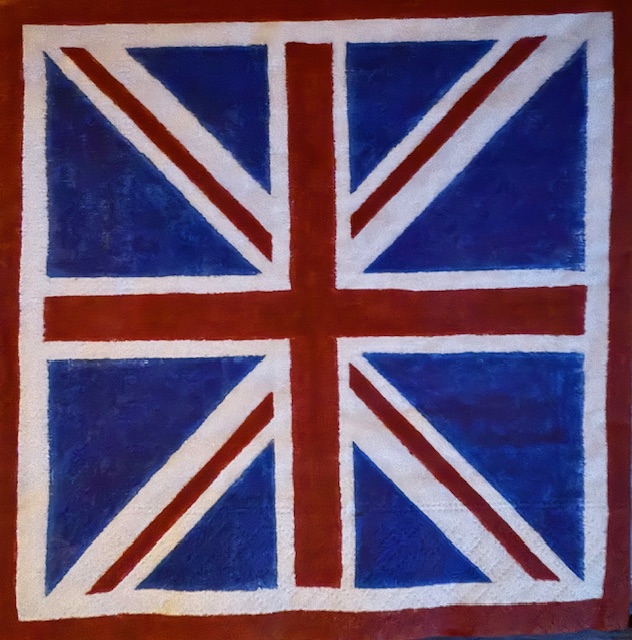
Napkins or serviettes, call them what you will, are another essential when eating. Because I like ironing, I am happy we use proper napkins, linen or cotton and not some paper replica, unless it’s for a party, like these:
And if you use a napkin, it’s good to have your own napkin ring in which to put it. There are standards after all.
I am not sure when it started but it has for me become one of the most annoying habits to witness and it’s mainly actioned by, I think, under-thirties women. Although in this age of equality I wouldn’t want to exclude some members of the opposite sex and anyone in between. For any multitude of reasons, the individual is feeling anxious and that anxious emotion brings a certain wetness to their eyes. Whether in disbelief that they’re going to cry or pleased that they’re showing their feelings, they move their hands towards their cheeks, fingers extended, nails prominent …. and shake their fingers, brow creased ….. mumbling ‘I don’t want to cry’ or somesuch. Someone could choreograph a little ballet with each finger having its own independent part to play. Any tears are carefully wiped away with the finger-print part of the finger; otherwise, their fashionable nails would stab them in the eye. (Note 2) I know we’re encouraging everyone to show their feelings more, especially young men, but this is absolutely ridiculous. And it goes on and on and no one says: “Oh! For God’s sake, Emma, get a f**king grip!” because that would breech their human rights.
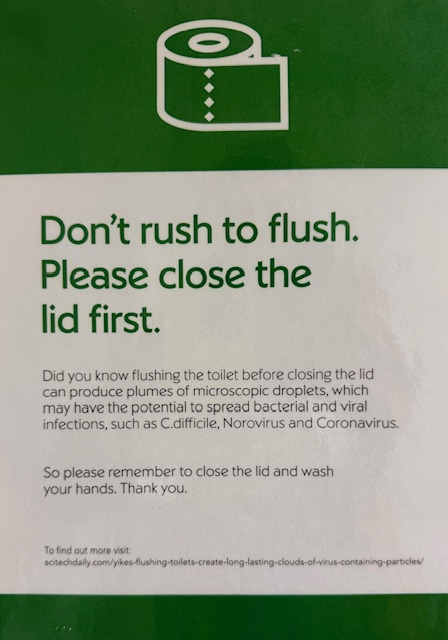
I have written before about ‘Loo Paper’ (PC 47 Aug 2015) and ‘The Loo’ (PC 54 November 2015). After using the loo, I think it’s important to close the lid, but I hadn’t factored in the latest advice. Close the lid then flush and not the other way around:
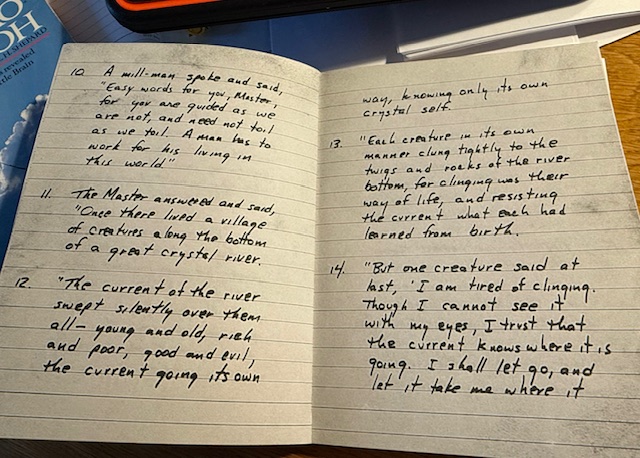
And finally, if you go to someone’s house and use a knife & fork, ie having something to eat, you should write a Thank You letter. With the cost of postage sky high, I write mine in cursive script with a fountain pen, take a photo then send it via WhatsApp. A rather modern take on old-fashioned standards; Carruthers would smile.
Richard 24th January 2025
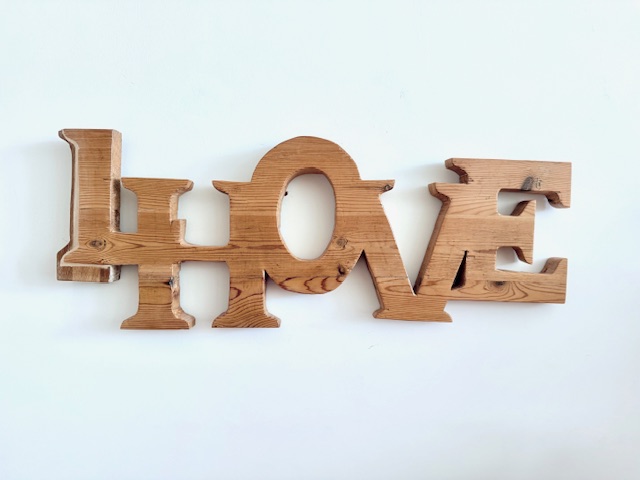
Hove
PS Carruthers is an old Scottish surname which reeks of upper-class aloofness. Inter alia, the main protagonist of Erskine Childers’ novel ‘The Riddle of The Sands’.
Note 1 Another word that defines a class and an age …. and an indefinable ‘meat’! Actually ‘fine-particle meat products enriched with pork fat and flavouring additives.’ Sounds very healthy.
Note 2 Nail extensions have become longer and longer, so much so that some should be registered as dangerous weapons and the owners of others will have problems in the future as in order to use a keyboard today, they have to hold their fingers in a convex manner.









 postcards