PC 421 Not the way to go

I hope most of my readers will be aware of the phrases ‘cancel culture’ and ‘ghosting’. The latter was the subject of a book entitled ‘Ghosts’ by British millennial author Dolly Alderton; an interesting if heartbreaking story. What concerns me is the long lasting, often traumatic, effect that either action has on its victims. Last year there was an article in The Times entitled “Cancel Culture on Campus; ‘Most of us are terrified’” by Alice Thomson. She was prompted to investigate what is going on by the death of Alexander Rogers, an Oxford undergraduate who committed suicide after being ‘cancelled’. Someone killed themselves because they were cancelled?

The coroner, Nicholas Graham, seemed to think that the punishment of ostracization exacted immediately before Roger’s suicide played an influential role. He cited an independent review commissioned by his college, Corpus Christi, describing an establishment and normalised culture in which students would rush to judgement without knowledge of all the facts and shun those accused. Finally, he urged those in positions of responsibility to take cancel culture, ‘the exclusion of students from social circles based on allegations of misconduct, often without due process or a fair hearing’, seriously. Thomson wrote that whilst at 20 one is old enough to take responsibility for one’s actions, nothing should be unforgiveable.

Blimey! Actually ‘blimey’ doesn’t do it! ‘What the f**k?’ would be a better expression of my reaction. What a very sad reflection on the realities of the social scene for our young adults, a time when they should be experiencing and learning about relationships in real life, not shunning them for fear of being cancelled; in real life and not on-line! A graduate of Cambridge, Ceci Browning, wrote: “This is the paradox of my generation. We are meant to be the most tolerant and liberal, yet when one of our friends slips up and falls out of step, they become the enemy. We cut friends and acquaintances from our lives on the basis of second-hand information about something deemed morally iffy that they may or may not have done. But we are also perpetually afraid that precisely the same thing could happen to us.”

We know that the difficulties of learning how to start, continue and stop relationships start in one’s teenage years. My own childhood, although privileged, was very mixed. Whilst I have fond memories of the second preparatory boarding school where I spent my pre-teenage years, I shudder at some of the early memories I had of my teenage ones. Bullied and ostracised, rather wet by nature, feeling abandoned by my parents, I took a long while to find my feet and my confidence. Then of course there was no instant messaging, no aggrieved soul venting their hurt on social media, for others to share with God knows who. So rumours rose and died, snuffed out by the smallness of the audience.  

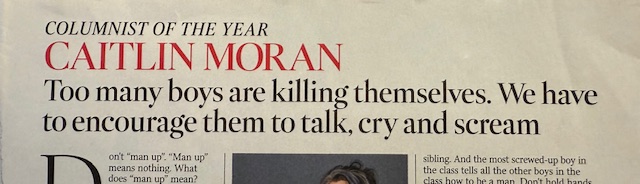
The suicide of Alexander Rogers is another statistic to some, but Caitlin Moran’s recent article ‘Too Many Boys are Killing Themselves.’ highlights a worrying trend. I read her book ‘About Men’ last year, an unusual topic for her, and subsequently wrote PCs 352 & 354 (About Men and More About Men) in September 2023. Moran writes that too many boys/young men are killing themselves. I have three grandsons so this subject is right there, on the front burner for me, trying to understand the modern pressures and how the three of them will be able to develop sensible values and self-discipline, able to filter out the crap peddled by influencers like Tait, who want to encourage boys to become incel – ‘unable to find a romantic or sexual partner’.

Socially relationships are key to our social fitness. The concept is not new; Aristotle, writing more than 2000 years ago, said that ‘man is by nature a social animal’. Moran described the difficulties of both sexes interacting in the digital world. For instance, what to one person might be an attempt to give an affectionate ‘touch of the neck’ could be construed by the object of their actions, someone who perhaps has watched too much internet porn, as a preliminary move towards a strangle hold and shock and revulsion is their response; a touch of the lower back easily extrapolated into an imagination of unwanted sexual advances. And this at a time when everyone is experimenting, trying what works for them, understanding what doesn’t.

It’s also important to remember that the ‘squishy part of the brain responsible for sensible decision-making’ isn’t completely developed until one’s mid to late 20s. ‘Students are still especially susceptible to making stupid mistakes and perhaps overreacting to perceived slights’. Rather than try and discuss and understand and accept an apology, they reach for their social media account. Stories are gobbled up in such an insatiable way there is no thought to pause, to think if it’s true or somewhat exaggerated; ‘share’ and ‘share’, part of the herd. So when someone is cancelled by those whom they believed to be in their ‘friends and acquaintances’ circle, it doesn’t take much to understand how their whole world comes crashing down.

I wonder whether those involved in the story of Alexander, either personally or by association, feel any lasting blame for their actions, any lasting shame. What has changed since the independent report commissioned by Corpus Christi? Has it really made it easier for students to talk about the inappropriate behaviour of other students, as part of a normal discourse about growing up and developing proper boundaries, or has the college decided that its reputation is more important than that of one individual?

In the final analysis we think and no one else can do that for us; we feel what we think, these feelings coloured by past experiences and expectations; then it’s our responsibility whether we act …. or not.

Richard 10th January 2025

Hove

www.postcardscribbles.co.uk

PS Read ‘The Happiest Man on Earth’ by Eddie Jaku if you’re a bit down; time to reflect.

PC 420 Contentious Issues in the UK for 2025

The complete resolution of contentious issues here in the UK seems impossible, taking forever, so much so that one suspects a certain degree of wilful obstruction and reluctance in the decision-making organisations. For example, I wrote about the scandal that engulfed sub postmasters and sub postmistresses back in June 2021, in PC 235 Generosity in Government, a piece which dealt with both the Post Office (PO) Scandal and the aftermath of the 2017 Grenfell Tower fire and its inflammable cladding. Then I met Sami in The Hope Café, listened to his own experience of working for the PO, which had ended up in his bankruptcy (See PC 271 Friday 25th February 2022). The last Tory government and the new Labour one both committed to ensuring every postmaster and mistress was exonerated and given compensation, no questions asked. And some still wait, PO lawyers arguing about levels of the latter. The Post Office Independent Inquiry finished on 18th December 2024 but don’t hold your breath for criminal charges to be brought. One estimate is two years! A good example of lack of action for fear of organisational reputation.

The Church of England is our ‘established’ church and in an ideal world should not only reflect the current mores of our society but also set some standards; if it can’t I think the link between church and state should be severed. The last Archbishop of Canterbury, Justin Welby, was a political appointee, famous for asking the population before the May 2023 Coronation to show obedience to and genuflect before the new king. Shades of ‘doffing one’s cap to the landowner’; fortunately, he was put right. What it showed was someone out of touch with society and his organisation’s role in it.

This aloofness was further demonstrated by his inability to get rid of a known paedophilic priest; he completely misunderstood the public mood, its belief that the church continues to protect its own. He was forced to resign and formally leaves the role on Monday. So far, so right and proper, you might think. A good example of lack of action for fear of organisational reputation. Sadly, he added insult to injury by making light of the whole saga in his House of Lords (Note 1) final speech, neither offering an apology nor mentioning the victims. His possible successor, the Archbishop of York, has also been linked to a sexual abuse case within the church and his inaction in ridding the church of the abusive priest. Another example of lack of action for fear of organisational reputation.

The threads remain. At two of Scotland’s prestigious schools, Edinburgh Academy and at Fettes College in the 1970s, ‘Edgar’ was notorious for his sexual abuse of dozens of boys. Rather than have him investigated by the police, he was given a glowing reference and allowed to take up a post in a school in South Africa, where he continued his evil behaviour. In this case, those who ran the schools are guilty of putting the reputation of the school before the victims. Edgar did not face his victims; he died whilst the UK and South Africa were agreeing his extradition back to the UK. The only good thing to come out of this is that more and more individuals are coming forward to tell their stories; those in charge in schools must be held to account.

Sami and I chatted about the Infected Blood Scandal in PC 392 Hope Continues (June 2024). After the inquiry concluded ‘the NHS and successive governments of all colours took part in a chilling cover-up and closed ranks to hide the truth’, the government announced a £11.8 billion payout. But the compensation scheme for some reason differentiates between those who contracted HIV from those who contracted hepatitis C. Somone with HIV gets over £2 million whereas someone with hepatitis C around £750,000; now the latter group are dying at a faster rate than those with HIV. Another example of a lack of urgency and fairness to settle the matter.

I can’t finish this postcard without wondering whether the fallout of the trial of Dominique Pelicot will have any lasting effect in France or indeed over here. It was his own actions, being caught ‘upskirting’, that led to the discovery of his cache of videos, but it was the courage of his wife, Gisèle, that led to an international furore and his subsequent very public trial. The media have made much of the remarks of the mayor of their village of Mazan, Louis Bonnet: “…. after all, no one died. It could have been far more serious. There were no kids involved. No women were killed.” He later apologised but there’s a feeling that the actions of Pelicot and those men who participated merely deserved a Gallic shrug. Sadly, society has a long way to go to accept that women and men should be given completely equal treatment. This not only applies to Christian societies but also to those who treat women in an unequal way.

There are many other contentious issues for the UK, but I’ll highlight another two to finish this postcard. I mentioned the Assisted Dying Bill in PC 418 Hope Christmas News. This is such a huge moral issue its unlikely to be far from the headlines. This month it’ll start its Committee Stage in the House of Commons.

The other is a change to Inheritance Tax rules. When I die my estate will attract a tax of 40% on my assets, after a tax-free threshold of £325,000. If I leave my home to Celina, there’s no tax. If I leave it to my daughter, I have a tax-free threshold of £500,000. I suspect she would have to sell it to pay the tax. The new Labour government have said that farmers, hitherto exempt, will have to pay inheritance tax at 20%. It’s a complicated scene, with tax allowances and the value of land, generational ownership etc but it brought the tractors into London …… and the furore is unlikely to go away.

Happy Contentious Issues 2025

Richard 3rd January 2025

Hove

www.postcardscribbles.co.uk

PS Today the news is that the urgent review of Social Care overhaul is delayed until 2028. Government urgency huh!

Note 1 The Archbishops of Canterbury and York, the Bishops of London, of Durham and of Winchester and the next 21 most senior diocesan bishops are all members of the House of Lords.

PC 419 Have you read …. (A continuation of PC 417)

Searching for ‘Zen Flesh Zen Bones’ on my bookshelf I spotted ‘Illusions: The Adventures of a Reluctant Messiah’. Written by the author of Jonathan Livingston Seagull, Richard Bach’s story concerns a barnstormer working the rural communities in the Midwest of the United States. Somewhere he describes how this reluctant messiah teaches the narrator to walk on water; it’s all in the mind, of course! But more importantly Bach starts his book with this little story which is worth repeating.

“Once there lived a colony of creatures (Note 1) along the bottom of a great crystal river. The current swept silently over them all, young and old, rich and poor, good and evil, the current knowing its own way. Each creature in their own way clung tightly to the rocks at the bottom of the river, for clinging was their way of life, what they had learned from birth. But one day a young creature said he was tired of clinging, was bored, that he would let go, trust the current and let it take him where it would. The other creatures said he would surely die, smashed against the rocks but, unpersuaded, he let go and the current lifted him up and took him downstream, free. Creatures downstream saw him and cried: ‘See, a miracle! He’s the messiah come to save us.’ ‘I am no more the messiah than you. The river delights to lift us free, if only we dare to let go ……’.

Ah! Yes! If only we dare to let go ……

Then I was reminded of something I wrote over ten years ago about letting go. I had come across a poem attached to the wall of a café in Tasmania, a remote and sparsely populated island state in Australia. It was a list of such lovely exhortations with a positive spin, found in such a bizarre place, it begged to be copied and studied. There are many examples of ‘letting go’ that come to mind and those who read this column may begin to reflect on their own circumstances, their own experiences.

In the jobs we do, roles we undertake, companies we work for, we all make many and varied attachments. Since the 1990s, redundancy has sadly become a normal feature of the working environment; “Sorry, Simon, we’re going to have to ‘let you go’.” After all the emotional turmoil these few words induce has eventually subsided, you understand that ‘letting go’ is not to deny, but to accept; accept that the decision’s been made, look forward and hopefully you begin to feel free – but the key to that freedom is realistically looking at the attachments you made to that role, that job, that company, and letting them go, permanently.

As humans we are naturally driven towards establishing relationships; relationships wax and wane as sure as the phases of the moon. Sometimes ending a relationship is really, really tough. And to ‘let go’ of the relationship requires one not to judge, but to allow the other to be a human being, to allow them to affect their destinies, to face reality. Easy to say, not easy to do; it hurts, letting go, but once you do, a great sense of relief floods the body and mind.

I wanted Tom my Labrador to live forever!! He was so lovely, so gorgeous, but as he grew older and older I had to face reality; that life is finite, and in his case I’d have to decide for him that his pain-free, carefree existence was over. Letting go of the negative memories of making that final decision and agonising over whether it was the right one (the “If only …..”!) have allowed me to be thankful for the life that he had and the love that he gave.

We so often dwell in the past, where are memories are stored, and forget to try and live in the present, like in the savasana position in yoga. And there’s a tendency to sometimes regret decisions we’ve made, paths we’ve taken, – “If only I had ….”. Free yourself by ‘letting go’ and not regretting the past, but to grow and live for the future.

In 2012 Celina and I moved to our current apartment, which has little storage space. I knew I had to ‘let go’ of things. In this case not take them to some half-way stage, a self-storage unit, a sort of ‘left luggage’, but to sell them, give them away, take them to the council tip. How hard was it? In reality, not too bad; if I hadn’t used something for 5 years, it went. Furniture that didn’t fit or was wrong for the apartment got sold, given away, painted. Books I had bought but never read, some I had read and were never going to read again, went to the Charity shop. Clothes went to same way. Gradually light and air began to circulate within the enlarged space.

There are few more important guiding principles to the way we approach our lives than taking on board the exhortations of ‘letting go’. As my daily yoga practice encourages me to ‘let go’ of those attachments I’ve made to a past posture and still the mind, outside of the studio those words found on the wall of the faraway café can bring a positive affect to anyone who cares to read them. Above all try to stop being fearful, be “fear less”, learn to truly relax “and love more.”

And if you want other recommendations to engage your brain, read ‘The Tao of Pooh’ by Benjamin Hoff or ‘Who Moved my Cheese’ by Dr Spencer Johnson. The latter story revolves around four characters searching for some cheese in a maze. As the cheese keeps moving, the characters are forced to confront their fears and adapt to change; happiness and success awaits.

Richard 27th December 2024

Hove

www.postcardscribbles.co.uk

Note 1 Bach doesn’t describe them in any way, just ‘little creatures’. Your imagination will create its own picture ……

PC 418 Hope Christmas News

Duncan has managed to create a wonderful warm, welcoming place for locals here in The Hope Café in Hove; actually not only for locals, as its reputation draws outsiders to push open the door. Next year he hopes to open a little boutique bookshop next door, so customers can drift between the two, reading, perusing the titles recommended, supported by coffees and delicious Brazilian tarts and pastries. He’d mentioned to his regulars that ‘minced pies and mulled wine’ would be available yesterday afternoon, the latter free as he has no licence to sell alcohol.  

Never one to miss an opportunity for a party, I stopped drafting some future postcard on my laptop, turned off the Christmas decoration lights and walked down to The Hope Café. As I pushed open the door I was met by the sounds of conversation and of clinking glasses, by the warmth of a cosy place and by the vibes of people enjoying themselves; felt good to be part of this community. I wasn’t sure whether all the regulars could be there but, knowing I had promised Mo my attention, had a quick scan of the room and spotted her; being tall has its advantages!

Before I got to Mo, I grabbed a couple of mince pies and asked Libby if she could provide me with a double espresso (Note 1).

“Wow! Mo! So good to see the place so busy. Sorry I had to dash when we last met (See PC 416 Catch Up in The Hope 6th December 2024) but Sami and I had chatted for too long! I needed to go.”

“That’s fine Richard. I wanted to ask you what you make of the recent debate on ‘Assisted Dying’? My mother’s been challenging me to talk about it.”

“There’s nothing wrong with her, nothing terminal?”

“No! No! But it’s become a major conversation piece in the residential village in Shoreham where she lives.”

“I’m with the majority of the population, that there needs to be a legal way for terminally ill adults to end their lives, subject to ‘safeguards and protections’ etc. Too often we read of individuals going to Dignitas in Switzerland to end their lives and that’s only available to those who can afford it. Thousands of others in the UK end their lives in pain and in a fog of medication. Fortunately Members of Parliament passed the first reading of the ‘Assisted Dying’ Bill by 330 to 275, but it’s got a long way to go, into committee, then the Report Stage which could bring amendments etc, before more votes and being sent to the House of Lords. It’s possible this could all take a couple of years.”  

“Let’s hope neither of us, nor my mother, have to contemplate such action! On a happier note, have you read Robert Harris’ latest book, Precipice?”

Suddenly there’s a lull in the conversation as a couple of chaps walk into the café, Luke followed by Josh. For those of you not familiar with the toings and froings of The Hope Café, last year Josh was a barista behind the counter. Then Hamas attacked Israel on 7th October 2023 and slaughtered 1,195 human beings. Josh, whose great grandparents were Ukrainian Jews, felt the call to arms. Despite suffering minor wounds in a drone attack on his Northern Israel post and his repatriation to the UK, he had gone back some months ago to continue to do what he thought he should. Now he’s back and looks very happy!

Luke clinks a glass with a teaspoon; there’s an immediate hush.

Josh is back, back for good! He wants me to say he’s happy to chat about his experiences in due course, but this afternoon just wants to savour the strange normality of being here.” Raising his glass he cries: “To Josh.” And everyone joins in ‘To Josh’ then everyone starts talking, the sound like water pouring off a waterfall.  

I look at Mo:

“That’s a relief; Luke’s obviously delighted! The situation in the Middle East has changed so much in the last two weeks that today it’s impossible to guess what may materialise. Israel seems to have neutered both Hamas and Hezbollah, and the fall of that shit Assad in Syria has given a headache, however temporary, to both Russia and Iran. So let’s pray that after so much killing, more level-headed, more pragmatic leaders will emerge.

“Some hope ……!! Look let’s talk about Harris’ book, brilliant by the way, next time. I want to go and catch up with Sami and Lisa who I see over there near the counter. But before I go, did I tell you I have been asked by Duncan whether I would help run the Hope Bookshop next door when it opens – he hopes by Easter.”

“That’s very exciting! By the way Happy Christmas …..”

I see Libby behind the counter, that she’s been joined by her niece Susie; Luke and Josh are sitting on stools chatting to them. Scanning the room I also see Robert with Lisa, and Anna. I go and sit next to her as it’s easier to talk to someone in a wheelchair if you’re both on the same level! Kate, who’s been a temporary barista, has joined us and …….

And so the afternoon slips into the evening, the Christmas lights brighter against the gloom outside, and no one is showing any indication of leaving. Ah! I think Duncan’s going to saying something ……..

Richard 20th December 2024

Hove

www.postcardscribbles.co.uk

PS Pope Francis’ autobiography, out next month, is called ‘Hope’.

PPS Other postcards relating to Christmas are PC 27 ‘Christmas’ from 2014, PC 210 Christmas Lights (2020), PC 262 Christmas Eve Post (2021), PC 314 ‘23rd December – A Story’ (2022) and PC 318 All I Want for Christmas is my Two Front Teeth (January 2023) (Ed. Grammatically it should surely have been ‘All I Want for Christmas are my two front teeth’. The lyrics were written in 1940)

Note 1 I used to love well-made mulled wine but today a coffee will be perfect.

PC 417 Have you read ….

The other morning, during the 10 o’clock Hot Yoga session, the teacher and co-owner BA recalled, between postures, the well-known quote from Marianne Williamson that was part of Nelson Mandela’s Presidential inauguration speech:

Our deepest fear is not that we are inadequate. Our deepest fear is that we are powerful beyond measure. It is our light, not our darkness, that most frightens us.”

You could, if you wanted to, read the remainder of that paragraph in PC 205 First Steps from November 2020. I had read her book, ‘A Return to Love: A Course of Miracles’, many years ago but now don’t remember much more about it, except that she’d recovered from a severe addiction to hard drugs to have a life with purpose and ambition. When I understood that it was not Mandela who had written those words, but Williamson, I had reached for the book on my bookshelf; somewhere in here I had thought, were those words, but where exactly? The amazingly serendipitous moment stays with me today. I closed my eyes, thought about this quotation, and opened the book at random, finding myself at page 165. The first paragraph started: “Our deepest fear is not that we are inadequate. …” I kid you not; there it was! SPOOKY or what? Possibly a miracle? You would first have to believe in them …….

Her suggestion is, of course, interesting. That we are more powerful than we imagine, able to achieve so much, able to be so much more; yet a little voice inside our heads stops us, the ‘no you can’t’.

Before I started my 1:1 coaching business, most of the books I read were thrillers in which I could lose myself. Then came a post-divorce period where I felt personal failure and asked myself the ‘Why?’, ‘What It’s For?’ sort of questions. I wasn’t depressed enough to medicate but found comfort in a book called ‘The Game of Life and How to Play It’ by Florence Scovell Shinn. It had been written in 1925 by an American artist and book illustrator who became a ‘New Thought’ spiritual teacher. It’s still in print and her advice and wisdom are timeless.

The huge number of titles in the ‘Self Help’ library is testament to the popularity of the topic, despite a tendency by some to sneer at what’s perceived as psychobabble! There are some real gems, often written by individuals who have experienced something special, something that worked for them. And if it worked for them, it might work for others. “Self-help books can reach people who may never think of engaging in therapy, for them to learn some of the great tools and techniques that are available to assist us to have a better quality of life.” Hear! Hear! And if you can’t afford therapy, just start writing down your thoughts …… for as long as it takes. Sure clears the knots!

Back in the early ‘90s, I spent a couple of years attending an evening philosophy course at the School of Philosophy and Economic Science; the main building is in Mandeville Place, London but this was in a house in South Kensington. I had seen the course advertised on an Underground poster, realised I knew very little about the subject and was intrigued enough to sign up. I soaked it up like a dry sponge does water and am still in touch with my favourite facilitator, Robin Mukherjee, a British screenwriter, author and teacher.

The course used many quotations, some religious, some modern, many from the Bhagavad Gita (Note 1), some oriental, some for example from Shakespeare, all used to illustrate a point or get a discussion started; many have stayed with me.

From ‘Zen Flesh Zen Bones’ (A Collection of Zen and pre-Zen writings brought together by Paul Reps) two particular stories illustrate how a good tale can reinforce a message. I must have lent my own copy of the book to someone, so what follows is from memory. The first is called the Muddy Road and concerns two Zen novices travelling from one town to another. They come to a particularly muddy patch on the road, where an extremely well-dressed and beautiful young woman hesitates, not wanting to get her dainty shoes dirty. One of the novices offers to carry her across the mud, whilst the other admonishes him, saying he should not concern himself with the problems of this woman, particularly this beautiful girl. The girl gets carried across and the Zen novices continue their journey. Later that evening the criticism is still evident. So the novice who carried the girl says: “Listen! I carried the girl across the muddy road and I put her down safety. Why are you still carrying her?”

We carry our experiences with us; they make us what we are and colour our lives. The danger lies in attaching emotions like guilt or anger or fear to them; then they become baggage to be dragged around and that takes energy you could use in a more useful way.

I was reminded of the second recently when I was doing some pro bono coaching with a yoga chum and concerns the issue many of us have, the reluctance to start something, something that may take one out of our comfort zone. An old Zen master has to travel from his cottage to the local town, but it’s a dark and stormy night and his friends urge him to wait until the morning. “But I have a light,” he exclaims, holding up a candle in a lantern. “You won’t see very far ahead with that small light.” “I don’t need to see very far ahead; I just need to see far enough to take the first step.” (See PC 205 First Steps)

Writing on the back cover of ‘The Element: How finding your passion changes everything’ by the late Ken Robinson, Stephen Covey, the well-known author of ‘The 7 Habits of Highly Effective People’, says ‘The Element offers life-altering insights about the discovery of your true best self’. I was so taken by this book that I gave it to a couple of friends for Christmas in 2020. If you don’t know what your passion is, making an effort to find out could easily change your life; read this book for inspiration. (See PC 195 Snippets September 2020)

I’ll continue this topic in a fortnight.

Richard 13th December 2024

Hove

http://www.postcardscribbles.co.uk

Note 1 For instance – “Man is made by his belief. As he believes so he is.”

PC 416 Catch up in The Hope

I use my Notes function in my iPhone to write down thoughts that occur to me, reminders to do this or that, or email myself if I need to take quicker action. The result is that some of these thoughts end up in my ‘More Thoughts for Postcards’ dump file. Always amused by coincidences, earlier this year I was reading Jo Nesbo’s latest novel, ‘Killing Moon’, some weeks after the removal of a haemorrhoid in January (see PC 373 Anally Focused February 2024). Nesbo wrote that ‘the Custody Officer at the local nick had a temper …. due to the presence of haemorrhoids.’, and this issue rarely makes it to the pages of a novel. Enough said!

I popped into The Hope Café on Tuesday and found Sami, head down in some new thriller, as is his wont. He looked up, smiled and suggested I join him. After getting a double espresso from Libby, I pulled up a chair and sat down. The chit-chat began soon enough.

“You remember Sami that, after reading Sweet Tooth by Ian McEwen and his reference to the awkward rhyme of Hove and Love, I had sat on the beach in Rio and sketched out an intertwining of the two words.”

Yes, and you created some wooden piece.”

“Well remembered! It’s up on a wall in our living room. The other Sunday there was a short interview in the newspaper with Peter James, our local author who’s made a name for himself with his Detective Roy Grace series, based in Brighton.”

“Probably, like you Richard, I think I have read every one of them, including the one about Grace’s wife, who had been declared dead. Was the interview interesting?”

“Actually it was, if not a little predictable. But it was the headline that caught my attention:

I thought, here we go again. Just add a little line between the ‘I’ and ‘Love’ and we have ‘Hove’!”

“Think you need to get out more, Richard; becoming too introverted! Seriously, what else have you got in those notes for future PCs?

“You will know from my last PC that I am an avid Times reader. The other day there was a caption for an Italian church in the town of Rimini: “Rimini’s Duomo cathedral.” Rather like saying “Nimes’ eglise church”; bit sloppy!”

“What’s that good descriptive word: – ‘pedant’? ‘A person who is excessively concerned with minor details and words.’”

“That’s me! And a fully paid-up member of the Apostrophe Protection Society. Like when I shouted at a past Masterchef Professionals episode when it stated that one of the finalists, an Australian called Kasae, was working in Gloucestershire. A minute earlier it said she was currently working in the Roman city of Bath, which is in the county of Somerset.” 

“Ah! MasterChef! Which brings us on to Greg Wallace and the allegations of sexual harassing behaviour. (Note 1) Sad to say, he’s a wonderful example of ‘give a man a spade and he’ll dig a deeper hole’.

Marcus Wareing, Monica Galetti and Greg Wallace, co-presenters of the MasterChef series in the UK

“You mean his retort that those making the allegations were mainly middle-class and women of a certain age? One of his accusers said he seemed to be claiming to be a victim of classism. Deborah Ross, writing a spoof story about him in The Times, suggested he would have said: “I’m an old-school geezer just having a laugh: what’s the harm in that?”

“I read that Ulrika Jonsson felt his response showed the arrogance of a man who has zero introspection or self-awareness.”

“I wrote to The Times …”

“Of course you did! What did you say?

“Let me have a look in my Sent box of emails; here it is:

‘Sir. I suspect the recent allegations about Greg Wallace and his sexist behaviour are the tip of an iceberg that’s based on traditional male banter, now outdated and unacceptable. I wonder, for example, how long The Great British Bake-Off will continue, given the sexual innuendo so often woven into its script.’

I feel there’s a wider issue here. Most of society has moved on from male banter although it’s still heard in the pub or in a sports’ hall locker room. But I cringe at some of the scripted or unscripted exchanges during each episode of The Great British Bake Off (Note 1).”

“Not a fan, Richard! The issue becomes one of judgement, whether a comment is amusing or risqué, endearing or crass; that fine line between what’s acceptable and what’s not. The trouble is that the line has moved for society as a whole but some, like Wallace, haven’t realised it. What happens on The Great British Bake Off?”

“There’s lots of sniggering when someone for example talks suggestively about ‘cream’ or the word ‘bun’ and one has to assume that everyone is either happy with it or won’t complain. Sometimes it’s so obvious it’s childish; maybe that’s the progamme maker’s intent and of course traditionally the public has liked ‘saucy’ stuff. Changing ways and what’s acceptable in society takes years.”

Suddenly we both realise we’d been chatting for over an hour and need to get on with the day. As Sami gets up, Mo puts her head around the door and I almost have a change of plan, as I like talking to her. Then the ‘To Do List’ interposes in my mind:

“Hi! Mo! Look, love to see you but I need to go. You coming to the pre-Christmas mulled wine and mince pies early evening do here on that Friday, 20th December? Can we catch up then?”

“Of course! Bye Sami, bye Richard.”

So until the Friday before Christmas …….   

Richard 6th December 2024

Hove

www.postcardscribbles.co.uk

Note 1. MasterChef, MasterChef Celebrity and MasterChef The Professionals have now been running for over twenty years and its format sold around the globe. The current series of MasterChef The Professionals is co-hosted by Monica Galetti, Marcus Wareing and Greg Wallace.    

Note 2 Another television series, this hosted by Channel Four, where twelve amateur bakers compete to be crowned Finalist of the Great British Bake Off.

PC 415 More thoughts for The Times’ Letters

I have been an avid reader of The Times ever since they offered a discount to schoolboys back in the 1960s. During my military career the mid-morning coffee break in the Officers Mess was an opportunity to skim other papers, for example The Telegraph or Guardian, or those known as the Red Tops, like The Sun and The Mirror, which did indeed have a red banner headline for more salacious gossip. But I have always enjoyed The Times for its balanced views and now read it digitally. ‘Letters to The Editor’ have featured in my postcards, firstly in July 2022 (PC 292 Dear Sir (1)) and secondly PC 317 Dear Sir (2) in January 2023.

Other attempts to get published have all met with disappointment, although the comments might amuse you and, in an uncharacteristic moment of not having many postcards in draft form, I hope that these will suffice.

Twenty years ago, in the month of May, I wrote:

I hope I am not alone in being flabbergasted by the clearance yesterday of the tube driver for playing squash whilst on sick leave. Even before his dismissal by London Underground, his appalling employment record, a day off every week for 5 years, suggests he will milk the ‘system’ as much as he can. Yesterday was a victory for the workshy, the uncommitted, the jokers – and sadly says a great deal about the culture of our Public Services.”

In 2013, I wrote about the NHS Health Check and its validity:

“Three months ago, in June, my local GP surgery suggested by text I had a free NHS Health Check Up and I duly booked an appointment. Although surprised that this health MOT didn’t inspect my eyes or my teeth, I was more than pleased to be told, after being checked for this and that, that I was fit and healthy with an 83% chance of not having a heart attack. Now, two months after a triple heart Bypass, I muse that someone must be in the 17%!”

In November 2014, an observation about business:

“Sir. One of the marks of a great leader is their ability to develop talent in both breadth and depth in their organisation, so much so that when they depart, there is no lasting ripple on the surface. Despite being awarded Veuve Clicquot Businesswoman of the Year, Harriet Green is clearly not in the category of a great leader, as the share price of Thomas Cook dropped 18% on the announcement of her departure.

Suranne Jones

In May 2016 I was prompted to put pen-to-paper, well not literally these days, but fingertips-to-keyboard doesn’t have the same ring:

“Sir. On the front page of Monday’s Times (9th May) you carried a photograph of Mark Rylance who had been given the BAFTA (Note 1) for the leading actor. Inside you showed a photograph of Suranne Jones, who was BAFTA’s leading actress. Did someone toss a coin to determine who went on the front page or was it yet another example of continuing sexism throughout our society?

28 April 2017

Appearance is everything. We have got used in recent years to seeing both terrorists and anti-terrorist forces hiding their faces with balaclavas or headdresses of some sort. A rather sinister frightening impression is given by this tendency, understandable for those perpetrating the terror but not for those acting to stop it. So it’s hugely refreshing to see those anti-terrorist police in Whitehall yesterday, bare headed and unmasked ……. proud of the role they undertake on our behalf.”

Couldn’t find the exact photograph but you take my point?

In the same year I wrote about ‘Modern Times’, prompted by a visit to a GP’s surgery.

“Sir, I secured an appointment with a doctor in a different surgery yesterday evening, my own being completely booked. In the waiting room I checked my mobile phone was switched to ‘silent’, popping it into my trouser pocket as I was called. The doctor stood, asking about my symptoms, then suddenly stopped talking. He looked at me intently, obviously expecting me to say something. I was not sure what, so I stared back! “Aren’t you going to answer your phone?” he asked in a rather irritated voice. I hadn’t recognised the sound and had assumed it was his!! Sure enough my phone was ringing. I hauled it out of my pocket, mightily embarrassed. I hadn’t locked the screen and inadvertent contact with my thigh had opened a coincidental sequence of ‘settings’, ‘sounds’, ‘ring tone’, and was offering me ‘ripples’ as an alternative to my normal ‘crickets’. I think the GP thought I was beginning to show signs of early dementia or some such and not seeking simple treatment for a chesty cough!”

April 2020

Sir. Am I the only person fed up with watching the BBC news spokesperson reporting from the outside platform near the Houses of Parliament, constantly trying the keep their hair away from their face? It distracts from their message and it can’t be beyond the resources of the BBC to find a wind-proof place.”

And finally a comment on society today:

“Sir. A recent television documentary concerned the Coventry forensic team’s work in trying to identify who stabbed a 15-year-old teenager. Their success was commendable. What was missing was any mention of parents, either of the innocent victim or of the three teenagers who committed the crime. As a society more needs to be done to ensure those who become parents understand the responsibilities that this entails.”

It’s fun to write to The Times, not only from the point of view of seeing one’s thoughts in print, but also to try to construct one’s letter in such a way as to appeal to the editors over the hundreds of others!

Richard 29th November 2024

Hove

www.postcardscribbles.co.uk

Note 1 BAFTA is an abbreviation for the British Academy of Film and Television Arts

PC 414 It’s all about the B

Some months ago, we had a couple of people who share our passion for hot yoga around for supper. Always a surprise to see other hot yoga enthusiasts with clothes on, as in the studio you need to wear as little as possible. One, Serena Wells, is a graduate of Brighton University where she studied Fashion Textiles and specialises in using colour to create bold, graphic works, often silk on silk. She currently has a design studio in Brighton. Her parents were from Guyana. (Note 1) The other, Armando Colucci, known to everyone as Armi, is an Italian from Naples who works as a head trainer for the hair products company Schwarzkopf. We sit down to a simple supper and the conversation starts. It wasn’t the first question but at some time Armi asked:

“Have you always lived in Brighton?”

That’s when the thought went ‘ping’!

“No. I was actually born in Bath ……”

Pulteney Bridge over the River Avon in Bath

…… and I realised that ‘B’ was a linking letter to a great number of places I have lived in! I could hear myself talking about being born in Bath (PCs 164 & 165), how I went to the first of three boarding schools there and how my parents had divorced.

Then my mother remarried and she and my stepfather moved away and my mind went into another subconscious loop about how they moved to Balcombe, too far away for more than one visit each term, the two-day half term.

Brighton’s where the blue spot is. Bath top left.

Balcombe is a little village some 18 miles north of Brighton. (See PC 58 Going Home December 2015). I remember a first Geography lesson at Daunsteys’, a public school in Wiltshire; ‘write an essay about where you live’ and Balcombe was by comparison to Bath very small, so I volunteered that it had a population of 300. These days I’d simply ask Google and get a reasonably accurate figure. The master, Mr Taylor, put a red ‘1’ before the 300; I guess the village had a large catchment area.

The Half Moon Inn in the centre of Balcombe circa 1961

It had a good steam train service to London Victoria and to Brighton, and a regular bus service to Haywards Heath, the local town where there were many shops and the Perrymount cinema, where the auditorium was divided into ‘smoking’ and ‘non-smoking’ sections. We went to the Theatre Royal, Brighton for pre-London productions or to the ice rink for a fun afternoon.

On the way to Haywards Heath the road passed over the River Ouse and to its west was the magnificent Ouse Viaduct, known locally as the Balcombe Viaduct.

My next ‘B’ would have been Bielefeld, a town in what was then West Germany, where the British Army had a large Headquarters and where I met my first wife. I was stationed in both Lippstadt and Sennelager, ten miles away. Returning to the UK for a staff role and Staff College, after a stint in the Ministry of Defence I took over an Air Defence battery in Wing Barracks in Bulford, a few miles north of Salisbury.

Wing Barracks, Bulford being demolished in the C21st!

Thoughts tumble through my subconscious like cereal into a bowl at breakfast. My mind leapt to London where I bought a rather dingy basement flat on the south side of Clapham Common, across the Common from Battersea. For those of us of a certain age, Battersea will for ever be associated with Peter Sellers and his ‘Balham – Gateway to the South’ radio skit. “We enter Balham through the verdant grasslands of Battersea Park, stretching for more than half an acre …..” or something like that! I toyed with the idea of buying a house just south of Basingstoke, southwest of London in Hampshire, but there were too many issues that couldn’t be resolved and I pulled out.

In 2000 I bought a terraced house in Bramfield Road, Battersea and nine years later attended my first session in Hot Yoga South, Balham, a ten-minute cycle ride away; the start of a continuing journey. Battersea is another London village that went from rather down at heel to being an attractive place to live, particularly for ‘Yummy Mummies’. So much so that the road at the bottom of Bramfield Road, Northcote Road, was known as Nappy Valley. 

Northcote Road, Battersea

My life moved on and through my regular hot yoga practice I met Celina.

Bournemouth Beach

Wanting to live on the south coast and needing to be able to practise Hot Yoga regularly, Celina and I identified where that was possible. We had a weekend in Bournemouth and went to two classes in the studio in Boscombe. For me, Bournemouth will always be associated with an uncle’s brother, a chap called Ken Bailey who was awarded the Freedom of the City for his work with the young. (There’s another B!). Boscombe is somewhat rundown, what might be called a ‘white trash’ area; sad, gaunt, pale faces, skinny bodies, dressed in black. We decided to look in Brighton. We knew the studio owners in Brighton and here were more options. We bought in Hove, practised in Portslade until 2018, then moved to practise in Yoga In The Lanes in Middle Street, Brighton.

Brighton of course is a city of contrasts, although in the early C20th its seedier side seemed to colour its reputation; in the 1930s – “Queen of Slaughtering Places”! Now it’s better known for its thriving arts scene and laissez faire attitude, for its Pride Parade in August and for its Palace Pier, and a beach of pebbles.  

The Peace Statue on the boundary between Brighton and Hove

It’s just a coincidence, these Bs; obviously could easily have been A or C.
These thoughts had drifted through my brain in a few seconds but suddenly I was aware that Serena was asking me a question about my paintings, and I needed to become fully conscious!

Never imagined I would return to Brighton & Hove!

Richard 22nd November 2024

Hove

http://www.postcardscribbles.co.uk

Note 1 The explorer Lucy Shepherd traversed the Guyana jungle from the east to the border with Brazil in the west, on foot in 50 days. Watch ‘Secret Amazon: Into the Wild’ on You Tube or Channel 4. Don’t if the idea of Bushmaster snakes terrifies you.

Note 2 My Podiatrist thinks Bath is ‘posh’.

PC 413 Hope in The Autumn (continues from PC 411)

“That was a long break, Richard!”

“Yes. Sorry! Got caught by Libby who wanted to give me an update on Susie.”

“How’s she doing?”

“Libby thinks she’s enjoying her course which should finish before Christmas. Obviously now looking where she can apply new-found her skills.” (Note 1)

“Unlikely we will see her back behind the counter! Sad but life moves on and so it should. We were talking about what The Times’ obituary writers had said about General Sir Mike Jackson. Always interesting to read the obituaries of others, not that I imagine for one second that mine will feature in a national newspaper.”

“Maybe, maybe not! The obituary writers must have a fun if not conflicting time deciding who to include. Did you see that one last month about possibly the last ‘ice harvester’?”

“No ….”

“In an age when a refrigerator and freezer are considered essential gadgets, we forget some of the ingenious ways our forebears used to keep food fresh. One such device was an ice box, made of wood or metal. Food was placed in the bottom and an ice block in the top compartment. Cold air falls so keeping the food fresh.”

“OK. I’ve seen some on visits to National Trust properties, but who was this ice harvester?”

“Actually an Ecuadorian named Baltazar Ushca, who for more than 60 years climbed the slopes of Mount Chimborazo, the tallest mountain in Ecuador, to harvest the ice that covers the dormant volcano. “It’s the tastiest and the sweetest, full of vitamins for your bones,” he explained of the frozen water, which glistens in the sunlight like a huge diamond.”

“Now I know something about Mount Chimborazo. Its summit, over 6000m if I remember correctly (Note 2), is the point on earth closest to the sun, as it sits just one degree south of the Equator, where the Earth’s bulge is at its greatest. But why did The Times decide his life was worth remembering?”

Mount Chimborazo

“Probably to mark the end of a traditional way of life. At one time there were up to 40 ice harvesters, known as hieleros, including his brothers Gregorio and Juan. “We would go out in a group of friends, four or six groups, twice a week,” he explained in his native Quechua language. “I would go with my mother and father, with my brothers and sisters.” Gradually their number dwindled. Ushca, who was born in 1944 and started the five-hour trek to the top of the mountain aged 15, was believed to be the last one.”

Baltazar at work

“Ah! That’s both fascinating and sad. I haven’t been anywhere in South America, let alone Ecuador, although Rio and Machu Picchu are on my bucket list. And now, Richard, I need to get going as I promised my mother we’d meet in M&S in Brighton. She wants to buy some clothing staples and M&S’s very good for these. See you ……”

I sat back, relishing the agreeable atmosphere in the café, and was thinking of getting my iPad out to read the day’s news when I saw Sami coming through the left hand door.

“Hey Sami! A belated Happy Birthday for the 24th. Us Scorpios must stick together!”

“Afternoon Richard. How was your birthday?”

“Actually lovely and rather drawn out. The week after we went to Chichester for lunch with my brother and then had Jade and the boys down. They just LOVE Brighton; Lego shop, VR business, lunch down on the pebbles at Captain’s, then an hour on the pier. For some strange reason they had never been on it, so the excitement levels were sky high. And Candyfloss is a favourite – on a stick of course.”

“I bet they went for a swim before going home?”

“They did indeed …… and had a slice of cake. Actually it was a very drawn out birthday as my mother-in-law made me a cake when we were in Estoril last week!”

“And have they moved yet? I remember your daughter was buying a derelict house that her maternal grandmother had lived in. How’s that going?”

“Water under the bridge! A very stressful two months but they completed a week ago and have moved into a rented house until Christmas. They have replumbed and rewired, fitted a new bathroom and now have six weeks to fit the kitchen and windows. Certainly doable!”

“Thank you for the update. Good luck to them. You know Paul Simons, who writes a column in The Times about weather?”

“Yes. He digs up really interesting information. What’s piqued your interest this week?”

“A place in Australia called Coober Pedy. Australia is expected to face one of its hottest summers on record and, even though it’s spring in the southern hemisphere, a couple of weeks ago South Australia had its highest temperature for 29 years when the outback town of Coober Pedy recorded 43.7C.”

Red marks Coober Pedy

“Never heard of Coober Pedy. Tell me more?” (Note 3)

“Well, Coober Pedy is a remote mining town in the South Australian desert and has the largest opal mine in the world. When miners arrived in 1915 they soon found life was far more bearable underground, inside disused mine shafts, than above ground in the heat. So they began digging out their own subterranean homes and today it’s a grand subterranean town with restaurants, bars, art galleries, a bookshop, churches and even a four-star luxury hotel, all built to escape the desert heat. Temperatures below ground stay at a surprisingly pleasant 23C-25C throughout the year without any need for air conditioning. How about that!”

An underground Air BnB in Coober Pedy

“Never been to South Australia; maybe I should put it on my list. Incidentally you read my postcard entitled ‘The Snail aka Brian’ (PC 406 Sep 2024)? Well, there was a lovely little cartoon on Facebook the other day which certainly made me smile.

And now we need to get going as I see Duncan wants to close. Love to Lisa and see you soon.”

“Great cartoon! Love to Celina. Good to see you. Take care.”

Richard 15th November 2024

Hove

www.postcardscribbles.co.uk

Note 1 After her late ‘Gap Year’, when Susie spent some time in New Zealand and Australia, she started a course on Logistics, with the intention of getting involved in the wholesale side of commerce.  

Note 2 Mount Everest, for comparison, is 8849m above sea level.

Note 3 Unbelievably Kay, our masseuse, had a one-year dance contract Australian tour that included a performance in Coober Pedy in 1988. ‘Very Red-neck!’

PC 412 Memories of Sandhurst (part 3)

The link between mental fitness and physical fitness is well researched. Thankfully we got physically fit, through sessions of PT, time in the swimming pool, ‘Battle PT’ runs, wearing kit and carrying one’s rifle, and undertaking long treks, particularly in the Brecon Beacons in South Wales. One evening towards the end of our first term, so probably early December, we got dropped off, at night, in the middle of nowhere! The first checkpoint was at the top of Pen y Fan, the highest mountain in this National Park, with a notoriously steep ascent to start; hard work, particularly carry full kit. Don’t forget this was light years before GPS and mobile phones; we had learned the basics of land navigation and worked with paper maps and old-fashioned compasses.

Pen y Fan

It was probably midnight when we got to the top and were given our next  checkpoint, some 16kms away. There we had to inflate a rubber boat and paddle some 10 kms to the next point. Oh! I think there was a stretcher race in there somewhere. Sometime the following evening we gathered in a pub carpark, without any permission to enter so psychological torture (!) and were given our next task, a four-point speed-march over the Sennybridge Impact Area. Sleep deprived and mentally and physically exhausted, I remember distinctly seeing a three-masted sailing ship slide across the face of the full moon, as we laboured from one water-filled hole to another.

Once I realised sleep deprivation was something one had to deal with, I learned how to catnap. The memory of hallucinating that wonderful sailing ship triggered another, sleeping standing up! It was before dawn on day three of an exercise on the local training area known as Barossa. My platoon was to be the assault unit for a company attack at daybreak.

John Thewlis and Martin Ward-Harrison – somewhere

After a night in trenches, with patrols and sentry duty, everyone was knackered but, fortified by breakfast cooked over ‘hexy’ burners and a hot coffee, we formed up in our sections and silently made our way to the FUP (forming up point), some 1000 metres away (actually it was probably 1093 yards as this was pre-metric UK!). We tried to move quietly through the darkness, every now and again stopping to ensure everyone was together. I fell asleep upright and only woke because John Webster, who was behind me and who had expected me to move, had shuffled into me!

As our understanding of military tactics, albeit at a low level, grew, so did the opportunities to show how much we had learned. The gathering of intelligence is often achieved by patrolling and the memory of one night patrol exercise has stayed with me. I am not sure who the platoon commander was, but I was his radio operator, equipped with an A41 radio set, about the size of a ream of A4 paper and weighed as much; its aerial was about 5 feet long. My task was to keep in touch with the controlling station, callsign Zero, and relay information as necessary. The problem was I had Laryngitis, so all my communications were barely audible, irrespective of how loud I wanted them to be! In the exercise debrief, the Directing Staff praised the quietness of the patrol; there are some benefits of being ill!

Sometimes we had to carry a lot of equipment. Preparing for an exercise in Belgium.

One aim of our training at Sandhurst was to teach us how to work as a team, both as a team member and as a team leader. Seems obvious, doesn’t it, but it is potentially one of the most difficult things confronting a leader. In each of the six Sandhurst terms, there was some Academy competition, be it the inter-company Drill Competition or the dreaded Assault Course, the winner the quickest team over a number of obstacles. The latter loomed at the start of the term in which it was placed as some mountain to climb. Actually that isn’t far from the truth as the ‘mountain’ was a ten foot wall. We were used to six-foot walls and one’s ability to climb up and over on one’s own. The 10ft wall required teamwork, technique and belief, particularly for the first and last person. To get the first person (A) on to the top of the wall, the tallest in the squad would stand with his back to the wall, with his hands cupped in front. Running from 10 metres or so, the second person (B – lightest and strong!) then placed his boot into the cupped hands of (A) and lifted himself up towards the top of the wall. His ascent was aided by (A) twisting his body and extending his arms upwards. Once on top, (B) could lean down and grab the next person (C), who was aided by (A). After the other five members of the section were over, this left (A) on his own at the bottom! (B) and (C) would both lean down, grab one of (A)’s arms, haul him up and over they all went. All this with the timekeeper’s stopwatch clicking away the minutes and seconds.

I am not sure the current training includes Bicycle Drill. Back in 1966 we were instructed how to stand next to a bicycle, how to mount, how to move off and how to stop. Saluting an officer whilst on a bicycle was not encouraged; we simply had to brace our arms, keeping looking forward! No helmets!

Sandhurst offered a full career to a pensionable age of 55. One loses contact with people, so I have little idea of how others’ careers developed. But I do know that my dear friend Martin Ward-Harrison was killed in Oman, that Sid Sonsomsouk retired as a general in his home country of Thailand and that Crichton Wakelin retired at 55, then took on a retired officer’s role for another ten years.  

The lighter side of Burma 39. I spent two years with these guys – apart from the chap on the far right, Martin Ward-Harrison’s groom.

There have been many television programmes following recruits, from the time they cross the threshold of various training establishments, to when they ‘pass out’, get their commission. Some have followed Marine recruits at their school in Lympstone, some Police Cadets at their Hendon training establishment, some recruits at the Army Foundation College at Harrogate and there was one for those going through RMAS – ‘Sandhurst’ (ITV 2011). All have shown that given the right fertiliser, anyone can grow from boy to man, from girl to woman.

Richard 8th November 2024

Estoril Portugal

www.postcardscribbles.co.uk

PS I did well at Sandhurst, becoming a Company Junior Under Officer and winning the Benson Award. This was awarded ‘to the cadet commissioned into the Royal Artillery who has shown himself most deserving on grounds of general efficiency and character at Sandhurst’. ‘From little acorns, mighty oak trees grow!