PC 29 Cards & Post Cards

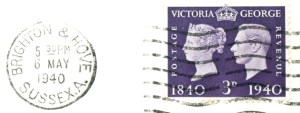
When Celina and I moved to Hove in 2012, it was very apparent from the outset that there was little storage space in our apartment – no garage, no cellar and no loft! A lot of ‘stuff’, an over-worked modern word for everything and anything, had to go. I hate throwing things out, never knowing when they might ‘come in useful’, but that’s the whole issue; when might they come in useful? Next week? Next month? Next year? In five years’ time? I admit to keeping some things for really no good reason, apart from being a bit of a romantic. For instance, I have a collection of cards/post cards which bring back some lovely memories. Of course the original Post Card had ‘Post Card’ printed on the front; then came ‘picture post cards’ with a photograph of something on the front and space on the back to write the address and ‘Wish you were here’, which probably was not wholly true! So here is a selection of some of my cards I simply cannot throw away!

I’ve been known for having a positive attitude towards life, something I tried to work into my coaching assignments. ‘Bestie’ is a card illustrator. One client sent me a Bestie card depicting a man lying in a distressed state in the gutter and a stranger walking by; both wear Biblical clothing. The walking man turns to the chap in the gutter and says: “Oh! Stop moaning about your problems and pull yourself together.” And the card is entitled: ‘The Bad Samaritan’!

The Art Gallery of New South Wales in Sydney has the most mesmeric installation I’ve ever seen. One hundred and three large stones from a river bed, suspended in a horizontal circle 11 metres in diameter by wire, no one stone touching another. Google it (Ken Unsworth) to see it! Just amazing; I treasure that memory ….. so I keep the card.

In the early 1980s I had to go and do a military reconnaissance of some type in Gibraltar and stayed in the Royal Air Force Officers’ Mess. My memory is a little vague, but somehow I’ve ended up with a 1930’s sepia photographic post card of a scantily-clad lady …. and on the back ‘The Thespians’ have written “Richard, Richard, Richard, where are you ….?!” and added ‘love’!. Maybe this should have been classified as much as the reconnaissance?!!

When I left Morgan & Banks to start up “The Yellow Palette”, my own coaching business, there was the obligatory farewell gift and the card signed by everyone in the office! Bestie again, showing a chap sitting at a table doing an exam. “While answering a question on surrealism his pen ran out”; and the pen has jumped off the table and is running out of the card!

I love the female body and admire those who have captured the essence of femininity. I have four cards: Modigliani’s female nude circa 1916, the photographer Annie Leibovitz’s depiction of Lauren Hutton lying in a sea of mud, Matisse’s Large Pink Reclining Nude 1935 and my favourite, Willy Ronis’s wife Marie-Anne. This famous black & white photograph shows her at their house in Gordes in Provence, naked, washing her face from a bowl; a pitcher of water stands on the rough stone floor.

There must be something about Bestie’s humour that gets to me, as another of his cards shows a grocer’s shop, run by a badger (not normal huh?). In the queue is a bear, a weasel and a rabbit. The bear is asking for: “Half a pound of tuppenny rice and half a pound of treacle please?” And the caption at the bottom? “Weasel didn’t like the sound of this.”*

I have a card of an aerial photograph of the Circus and The Royal Crescent in Bath. Together they look like a giant Question Mark, not something the Georgian architects would have been able to see from their earth-bound existence! I was born in Bath and Uncle Tommy and my grandmother lived in the Royal Crescent.

When I was running an Outplacement service, amongst other things I advised people how to be successful during the interview process. I am amused by a card showing an extremely large Hippopotamus, wearing a tie and a cross face, facing a small man with glasses. The man looks up to the Hippopotamus and says: “The bunny didn’t get the job because the bunny is cute. The bunny got the job because the bunny knows WordPerfect!” (WordPerfect? Gosh! That’s so last century!)

Winnie The Pooh featured in the early childhood of many here in England. A card shows Christopher Robin bringing Pooh downstairs: “Bump! Bump! Bump!” This was the only way Pooh came downstairs, on his head. And if you have never read “The Tao of Pooh.” (by Hoff), please, go and get a copy and read it …… now. It’ll improve your understanding of us humans and how we communicate, or not!

Just simple pleasures derived from a stack of treasured cards and post cards. Mere scribbles, you might say!

Richard Yates – richardyates24@gmail.com

*“Half a pound of tuppenny rice, half a pound of treacle, that’s the way the money goes, pop! goes the weasel!” an old nursery rhyme. Probable in Cockney rhyming slang that ‘weasel’ is coat and ‘pop’ is ‘pawn’….. ie pawn your coat to buy some food and drink. But ‘pop’could be ‘to explode’!

PC 28 Balloons, Bacteria and bloating!!!

I never wanted to be a roughie toughie Paratrooper but, during my officer training at the Royal Military Academy Sandhurst, there was an opportunity during an Easter holiday break to do some basic military parachute training. Edward Bear was a scruffy teddy bear, complete with beret and parachute wings, and the mascot of the club whose entry involved completing 7 daytime and 1 night-time parachute jumps. After our initial ground training, we arrived for our first jump, from a tethered balloon, its shape a little like those World War Two barrage balloons. Fitted up with my parachute, I climbed into the basket with a couple of others and the instructor. We left the ground behind and the cable was let out until the balloon was at 800 feet. It seemed a long way off the ground!! Adrenalin was pumping through my veins, the instructor went through the checks, I stood at the barrier, thought “What the f**k am I doing here?”, a tap on the shoulder and I jump ………. the ‘chute’ opens above me and my quick descent is suddenly jerked to a stop, becomes an ascent for a bit and then I float down! I look around: “Wow! This is such a feeling of elation, of satisfaction …. so weird.”  And suddenly the instructor on the ground is yelling through a megaphone; “Number 73! Assess your drift, prepare to land……” Land? Oh! Yes! I need to do that!

I remember doing two jumps from that balloon maybe three; then we jumped from aeroplanes, with kit, before we passed the course and became eligible to wear a small parachute badge on our uniform and the Edward Bear tie. But that balloon, standing there waiting to leap into space ……. I can picture it now! We did of course have a ninth jump, one summer’s evening about three months later, onto a nearby training area for the ‘Teddy Bear’s Picnic’. As you would!!

Balloons featured at my birthday party in October, ones filled with helium (He). And I was reminded that, at a wedding in August, two teenagers thought it such fun to let the helium out of the balloons and inhale it. Took a while before adults realised the effect the gas was having! Maybe the adults had already had too much of another gassy drink, Champagne!

Some years ago there was a craze amongst the cooking fraternity to rinse a raw chicken under some running cold water before preparing it for cooking. “Get all the blood off!” Now we’re told that this is so wrong. The reason is bacteria called Campylobacter, which seems to be present in a huge percentage of chickens, and it can cause severe food poisoning in us humans. A chart in a national paper suggested that no chicken supplier’s chickens are completely immune.  It’s destroyed by proper cooking but if you wash the bird then you potentially spread the Campylobacter around ….. your kitchen! Yuk!

The other morning, well actually around 0200, I thought about the chicken I’d had for supper. Normally I prepare our meals from scratch but I was lazy and it was a ‘ready-made’ one, Chicken Arrabiata if my memory serves me well! I went to our bathroom, contemplated my navel, went back to bed …..  and then I went to our bathroom, contemplated my navel, went back to bed … I was blowing up …. truly not sure what was really going on in my stomach but the Chemistry teacher from Breaking Bad must have had a hand in it!! Celina asked if I was OK? I said I felt like one of those large rubber bouncing balls, with two large hand holds, that children can ride on. “Bounce! Bounce.!” ….. except I had feet at the other end ….. just the middle that was so, so bloated. You know those Puffer fishes that, dare I say it, ‘puff’ themselves up when confronted with danger? That’s not how I looked, for sure, in the dim light of early morning, but it was exactly how I felt.

And what came to mind? Far from the Madding Crowd!! Some of you will have seen the cinematic adaptation of Thomas Hardy’s 1874 novel “Far from the Madding Crowd”, starring Terence Stamp and Julie Christie. It was in our cinemas the year Celina was born, 1967. OK! OK! What the hell brought this to mind? You remember the scene when a flock of sheep strayed into a field of young clover? Sheep love fresh juicy clover ….. and munch and munch and ……. and they can develop ‘pasture bloat’, caused by a build-up of methane (CH4) and Carbon Dioxide (CO2). (You’d think I was good at Chemistry but the truth is I can’t tell an oxide from a dioxide!). In the film they rush around the field performing rumenotomies, where they puncture the sheep’s stomach to let out the gas …. or the sheep dies!

Well, I wanted someone to come and perform a rumenotony ….. on me!!

You know that Celina and I practise Bikram Yoga most days? Well, what you probably don’t know is that there is a posture called “Wind Removing Pose” (Pavana mukt asana). You think I’m joking? No! Really, it’s true. After the one hour ‘standing series’ you have a half-an-hour floor series, and the first posture is ‘Wind Removing Pose’. You lie on your back, bend your right leg up to your chest, put your hands on it just below the knee and pull the knee down towards the right shoulder. You hold it for 10 seconds and then do the other side. It’s meant to ease the intestinal gases ….. out. So, at 0300, on the bedroom floor, I try it. My stomach is so extended I can hardly get my knee to bend, let alone touch my shoulder! I’m reminded of that ‘funny’ card of a women’s yoga class where it seems they are all in ‘wind removing pose’ ….. and it’s very effective (there is no delicate way to describe this, is there?).

Just some more mundane thoughts …..

Richard Yates – richardyates24@gmail.com

PC 27 Christmas!

In the latitudes in which England lies, December is often a cold month and so here we develop this huge association of Christmas and of cold, hopefully even of snow! Many a Christmas I walked or drove to the local church for the Midnight Mass service and if there was snow …… wow! Magical! We don’t really make the connection with Bethlehem and snow and frost, thinking the Middle East is always sunny and warm; we learn later in life that that is not the case. I’ve spent Christmas in Sydney in Australia, rather warm but wet that year, in New Zealand where it was warm and dry, and in Rio de Janerio, where it was amazingly hot … and humid. Wherever, “There must be turkey …. and sprouts ???” Really?? “It wouldn’t be the same without Brussel Sprouts.!” The most maligned vegetable in western cuisine, normally with any taste and colour boiled out ……. until Jamie Oliver came along and suggested roasting them with bacon. Brussel Sprouts are just another of those things in life associated with the most boring country, Belgium.

Christmas in Britain, commercial Christmas that is, starts sometimes in ……  October nowadays! I resist …. and resist …… until I think at least I should dig out the box of decorations. You go up into the attic, into the garage, into the cellar or in my case, in my modern no-storage apartment, into a spare bedroom and find the Christmas decorations box.

Uncle Tommy” shook his head. Well, he didn’t really, but as his head was attached to his body by a big spring, every time someone nudged the table, his head shook! This wonderful papier-mâchié Father Christmas, some 10 cms tall,  was bought in the 1960s, but still gives enormous pleasure as he sits on the dinner table at Christmas. He was christened ‘Uncle Tommy’ as his rather red cheeks, reflecting too much sherry drunk delivering Christmas presents, reminded us of our grandfather – who also loved his sherry, amongst other tipples!

Christmas is a family celebration …. a time when everyone gets caught up on the merry-go-round of eating and drinking, stuffing the turkey and stuffing their faces, nursing hangovers and wishing it hadn’t happened. Growing up as teenagers, we had to ‘make do’ with sandwiches and wine for lunch as we opened presents, before walking the dog and sitting down in the evening to roast turkey, roast potatoes, sausages with a bacon wrap, bread sauce, Cranberry sauce …. and the dreaded Brussel sprouts. This was followed of course by Christmas pudding, a wonderful sweet concoction of dried fruits, eggs, suet and spices, laced with Brandy during its manufacture to ensure it matured properly, accompanied by Brandy Butter. Before the pudding was brought into the dining room, hot brandy was poured over it and set alight. Uncle Tommy simply nodded his head – he’d seen it many, many times.

Of course, we all believed in Father Christmas and of his way of delivering presents by climbing down one’s chimney. So at the bottom we would put a plate – a couple of mince pies and a small glass of sherry for him, a couple of carrots for Rudolph. Dave Allen had a one-man evening comedy show on television in the 1980s and 1990s. In his wonderful glorious Irish brogue, he would talk irreverently about every single aspect of Christmas, religious or otherwise. He mused that if Santa drank all the sherry and ate all the mince pies he found at the bottom of every chimney, he would have exploded  ……. And that Rudolph certainly wouldn’t have got airborne with tons of carrots inside his tummy! He also had a few things to say about the party hats in crackers and about bringing a tree into one’s house!

One year he brought a rather modern look to the story of Bethlehem and that stable. He reckoned Joseph was a pretty disorganised husband. Mary: “What do mean, there’s no room in the inn?”Well,” says Joseph, “I thought it would be OK.” “What? OK? The whole nation is on the move, back to our home towns, and you didn’t think to book a room? And you see this”, says Mary, pointing to her huge pregnant belly, “that’s our baby, due any day now. And you didn’t book a room …….. and we have to make do……  in a stable?!!” You could imagine at this stage a modern woman would have sworn, possibly using a word beginning with ‘J’, but then you’d be getting ahead of the story

I spent a couple of Christmases in Northern Ireland when the IRA were fighting for some form of independence, firstly in Londonderry in 1973 and then in north Armagh in 1975. They were dangerous times but we still recognised Christmas; dinner was roast turkey, Brussel sprouts (!) and Christmas pudding served by the officers to the soldiers. The Miss World organisation, through Julia Morley, delivered 400 stockings to our regiment, with packets of cigarettes, sweets, playing cards and I think the latest copy of Penthouse, a Men-Only raunchy magazine. I’ll leave it to your imagination how the soldiers enjoyed the contents of the stockings! On Christmas Eve in 1973 I went up to the border, to visit some of my soldiers on patrol. A Baptist minister, let’s call him Desmond as my memory is too dim (!), attached to the regiment for the length of the tour, accompanied me. The sentry and I stood in a static observation post, looking out over the dark, frosty countryside, whilst Desmond talked softly about the meaning of Christmas; one of those memories that stays with you all your life!

The flaming Brandy on the pudding reminds me that one year in Kitzbuhel, in Austria, the real candles that decorated the Christmas tree flamed in the draught from a window … and the tree caught fire! You only do these sort of mad things once huh?

It’s been suggested I start a ‘blogg’, but I thought these were for the really really mundane …….. not just my simple mundane scribbles and thoughts. I wonder?

Richard Yates – richardyates24@gmail.com

PC 26 This Language of Mine

This is called ‘… of mine’ as a number of my readers do not have English as their ‘first language’; I’m not trying to be too possessive!

I was never very good at spelling and suffered the ignominy of having my brother, two years older than me, supervise spelling tests in the school holidays! We would sit in the study and he would dictate that day’s Times leading article. I hated it!! To this day I have to think about the difference between practise and practice for instance, but spell-check helps …… except when it wants to put an ‘s’ and I want to put a ‘z’ or vica versa. Luckily, I guess, I grew up in an environment where the spoken and written word was valued. My step father loved doing The Telegraph crossword puzzle. In those holidays, at a weekend he would bring the paper into the kitchen as mother was preparing supper and we’d wrestle with the final few clues: “Two Down, “No Sailor’s About To Desert.” 3.2 R blank blank. blank N.

It’s sad to reflect that some sections of our society never develop sufficient vocabulary, beyond a basic 500 words, to be able to use this rich English language. Sometimes I sense that the TV soaps have, over the years, dumbed down the use of language to its coarsest; or do they simply reflect what the writers hear. Bit “chicken & egg” possibly!  The other day in a local supermarket Mrs not-very-well-educated was having a ‘go’ at her husband. “You f*** git!” I told yer before, bring the f****g shopping list! Yer useless piece of s**t. I really don’t know why I bother.” …. and this in a loud, yelling, in-your-face voice. She didn’t seem to mind that the whole supermarket had almost stopped to listen ….. but why didn’t a member of the management take them aside and tactfully ask them to be quiet? Maybe they didn’t do ‘tactful’!

Some years ago a woman who didn’t know much about me, on the very first occasion we met, said: “So you’re trained to kill people!” or maybe it should have been “So you’re trained to kill people?”, referring to my time in the British Army, which at the time of this embryonic conversation had ended over fifteen years before. Funny how some people have a very warped perspective of some aspects of life. I think I responded that we actually tried very hard not to, but if push came to shove …..! My reply came to mind when thinking about this PC and I rather wish I had said: “No! Actually we were trained to write English in the most pedantic way.” Now that would have been true … but I was never very good at the quick witty retort!

Staff Duties (SD) were a major aspect of our training, seemingly on a par with tactics and strategy. If you couldn’t write an appreciation, whether tactical or strategic, you didn’t get on. If there were spelling or punctuation mistakes during staff courses, out came the red marker pen.

We had to grapple with the proper use of the apostrophe, know when to use a colon and not a semi-colon ….. and woe betide us if we dared to split an infinitive. Does it sound better to say “To go boldly” or “To boldly go”? Personally I think the latter is better and I wear my ‘pedant’ label with a small ‘p’! I don’t think I’m so precious about it now, as the SD taught us to be, and listen with interest how this language evolves, how it lives. Some 500 words join our dictionary every year and some fall by the wayside, no longer in vogue or just obsolete, or should that be obsolescent? See what I mean? A real mine-field!

I was awake enough the other day to read of a Zeugma, a ‘figure of speech by which a single word is made to refer to two or more words in a sentence, especially when properly only applying to one of them or to them in differing senses.’ The example given was that she could draw a cork, a nude and a conclusion. Wow! How clever is that? How did I manage to get through life without knowing that? The letters page of The Times was flooded with examples, all apt: for instance, “We had turkey for lunch and Granny for tea.” and John Lennon saying “I play the guitar and sometimes the fool.” But then people started asking how you could tell the difference between a Zeugma and a Syllepsis. Well, having not known of a Zeugma for the first 68 years of my life, I think I’ll leave the understanding of the second for later!

A book came out some years ago by Lynn Truss, called: “Eats, Shoots and Leaves.” It explores the correct and incorrect use of punctuation in English. The title came from a wildlife manual: “Panda. Large, black-and-white bear-like animal, native to China. Eats, shoots and leaves.” Of course it should have read ‘eats shoots and leaves’ but the image of a panda firing a gun into the air is rather endearing! Bless that comma!

Lynn also explored the use of the apostrophe. Did you know, by the way (sorry, btw!), that there is an Apostrophe Protection Society? I must find where to sign up, as I love this little mark. News the other day that the ‘autocorrect’ function in our iPhones and other Apple devices will insert an apostrophe, when it’s needed, is music to my ears! How can ‘its’ mean anything other than a possessive, as in “its colour” rather than “it is colour”?  I could go on …… and on …… and on.

There may of course be punctuation errors in the above – but that’s life, innit! Just some idle thoughts, mere scribbles.

Richard Yates – richardyates24@gmail.com

PC 25 A Voice

We humans have been trying to express what goes on inside our head ever since we stood upright and shrugged off the hairy mammoth’s coat. Sometimes we do well, using our vocal cords in speech or in song, using our imagination in painting pictures, writing a musical interpretation of our thoughts, or simply trying to express the thoughts in a written form. I hadn’t intended my electronic PCs to be more than scribbles or jumbles of thoughts ……. but getting ‘stuff’ down on paper is, for me, immensely satisfying.

Do you sense your brain, your mind, as I do? Is it simply something between your ears or is it something much bigger, stretching as far as our senses will allow? Have you tried to listen to the silence ……. beyond the furthest sounds? Sometimes when I’m listening to the idle ‘monkey’ chatter that is so difficult to still, it seems so loud that others must surely be able to hear it. And then there are those tunes or that song that go around and around …. inside ….. and you want to find the ‘off’ switch, but can’t . Even when you pop to the loo in the middle of the night, it’s there ……..!!

Of course, we only have to see something, a view of a river for example or a item like an IPad ….. and then the mind makes its own interpretation of what we see, depending on our own experiences of life. It was the Greek philosopher Epictetus who wrote: “Man is disturbed not by things but by the view he takes of them.” And that thinking can “make a heaven of hell and a hell of heaven.” as the poet John Milton wrote. So our thoughts influence our feelings which ultimately dictate our behaviour; scary if we get the wrong interpretation!!

I titled this PC ‘A Voice’, but it could easily have been “Expressing oneself”. Edward Munch painted a series of pictures in 1893 which became known as The Scream. He described sensing “a scream passing through nature.” and interpreted what he had sensed in a picture. This was his voice, although it’s interesting to read contradictory interpretations of The Scream by art critics, all seeking self-justification for their view! Did Munch want others to understand it, or was he simply trying to describe visually what was going on inside his head?

So if we get confused by our interpretation of visual art, often an expression or interpretation of what one can see, our interpretation of music, the voice of a composer, what we can hear, is much more difficult. I get all hairs-on-the-back-of-the-neck when I listen to that slow, second movement of Max Bruch’s violin concerto, feel my spirits lift when I hear Jean Sibelius’s interpretation of what’s going on in his mind by his Finlandia or his 4th Symphony. You and I, we both listen to the same piece of music …… and probably have a different interpretation of what we hear. Funny huh!

But our voice is so basic that memories of what we hear start from our entry into this world. One type of speech is expressed as a Command! “Sit!”, “Stop!” Often the louder the better! Those of you who haven’t experienced the collective spirit engendered by simple ‘drill’ have seriously missed out. No! I joke not!! Well, anything ‘collective’ has a whole different effect on one, singing in a choir or being part of a team for instance. When I was at the Royal Military Academy Sandhurst it was a busy place, with around 1000 cadets at various stages of their officer training. The culmination of the year was a large parade, for which we rehearsed ….. and rehearsed …. and rehearsed. As with everything in life, if you want perfection you have to practise, practise, and  …… practise. But being part of that parade lives on I think with all of us who took part. The ‘parade’ is drawn up in front of the Old College buildings, three lines of 330 cadets, all of us wearing our best uniform and sporting on our feet ‘drill’ boots on which we have sweated hours and hours to produce a shine to dazzle. Relaxed, feet 30 inches apart, we wait. At the appropriate moment, the Academy Sergeant Major brings the parade to ‘attention’. “Parade!” the booming command takes a single word, takes each syllable, extends the one word into a stretched sound that echoes around the ground and could probably have been heard three miles away. We brace, our muscles ready for the next order. Atten “SHUN”! (this is how it sounds, it is ‘attention’ in English!) A thousand boots lift the regulation height, move to the centre of the body, and crash into the gravel. The sound is glorious, perfection …. reverberating around the parade ground ….. like some explosion ……. we stand, rigid, like one body, proud of what we are.

Here in the developed world, we rely on the written word, but the Kogi, a tribe in the Sierra Nevada mountains of Colombia, have no experience of writing. Their history has been retained in the memory banks of their minds – which are so well developed that those of us who need to write everything down before we forget would be ashamed …. at our laziness? Well, maybe!

Combing words and music has produced a hugely rich collection of operas and Gregorian chants, simple jazz and pop, and the sacred. We all have favourite pieces but the one that often comes to mind as an example of exquisiteness is the prayer for those at sea, “Eternal Father Strong to Save.” Written in 1860 by William Whiting, it’s become a standard in military worship. At Sandhurst almost 50 years ago, those 1000 cadets who had been marching and parading, would fill the Academy Chapel. Towards the end of the service we got onto our knees, taking care of course not to scrape the toecaps of our highly-polished boots (!), prayed and sang that song, slowly, quietly ……. for me especially poignant as my brother was at sea in the Royal Navy.

Just some thoughts, as one might say!

Richard Yates – richardyates24@gmail.com

PC 24 A Short Story on Relationships

In his new novel “The Children Act”, Ian McEwan acknowledges various judges and their cases that are interwoven into his story, essentially of a teenager and a judge. He also writes that the characters, their views and personalities of his book bear no relation to any party in those cases. In part prompted by ‘The Children Act’, I’ve written a short story on a particular relationship:

“He stared at the document, a part of some personnel records from his youth. “He comes from a broken home, which may have something to do with his reserved personality. In due course he may develop ….. adequately ….”. The term ‘broken home’ was quite common, used to describe the background of children whose parents had divorced. It had social connotations too, back then, as though someone had marked your card, carrying some sort of stigma. It seemed so stark, so bleak, someone’s comment from decades before. He thought of its implications and wondered whether he had indeed fulfilled the writer’s expectation of his development.

Only last week a report, funded by the Department of Health and published by the Office for National Statistics, investigated “emotional and conduct disorders” in children caused by a breakdown of their parent’s marriage. On average the children were more than three times more likely to develop such disorders. Sixty years on, plus ça change plus c’est la même chose!

The thoughts whirled around inside his head, trying making sense of other people’s decisions that ultimately had affected him. Being sent off to schools where he boarded; had he felt ‘abandoned’, being left to the mercies of some educational establishment to mould him into something useful, to give him a rounded education? He remembered looking out of a closed school window on a dark Bonfire Night and seeing the fireworks over the city – untouchable and in another world. Abandoned yes, but such was the lot of so many young children here in Britain, where a culture existed, and for some still exists, that it was normal to send your children away ‘to be educated’. Confusingly, our ‘Public’ schools are actually private, and the free-for-all schools ‘State’! So parents actually pay to abandon their children? Sorry, that’s a tad cynical! He was sure they do it with the best intentions, but possible blind to the undercurrent of trauma and abuse. Only now one occasionally sees articles about “Boarding School Syndrome”, where survivors have dared to challenge the perceived wisdom of sending children away. “Stiff upper lip, what! Caruthers! Be a man and don’t talk about it.” So bottle it up and screw the lid on tight?

In amongst all the boarding school memories are the occasional flashbacks … of bedwetting, unexplained, parents called in and of hushed conversations, of sexual abuse, of being ridiculed and bullied, leading to a sense of abandonment …. the flashbacks like some lightning across a darkened sky …. illuminating events from the past for milliseconds …. not understood ….. and not forgotten. Traumatic! So this latest report brought it all back.

With little or no contact with his father, he accepted his step-father filling that role. As he grew older, he began to hear a rather one-sided version of why his parents had divorced, difficult to talk about, perhaps best left unsaid? Felt his father made little effort to stay in touch, such a gruff individual with whom it was difficult to communicate and who felt no need to explain his own actions. Did he, he wondered, even worry about it, just something that had happened? He had moved on, remarried, divorced again, and re-married. And that missed communication left an unfulfilled hole, certainly one that was not filled with love.

And then his father died, and was no longer able to respond. So he asked the widow:

“…… I have only my mother’s story of their marriage and why it broke up; Daddy never wanted to/felt it unnecessary to explain his side and I have always believed there was one. I had often thought of broaching the subject with him, felt I had a right to his explanation, as with the one-sided view of my mother I would maybe judge him unfairly; it never seemed the right time.  ………. 

 ……. Odd times, odd visits – but despite his remoteness, I always saw him as my father, needed to do that, was saddened when some time ago he suggested I call him by his Christian name. I like to think I did the right thing, but have often felt it was one-way. 

 Now he’s gone……… so this is a letter I realised I had to write.” 

And she wrote back, suggesting that the father had been ‘hurt’ by his mother’s action to divorce him. Surely an action which he had brought upon himself? And the sting in the tail ……. in her will she wrote that, “having mainly ignored his father for so many years, he should not benefit from any part of the estate.”

But he felt exactly the same,  ……ignored, …… abandoned. And now the widow has died, the door naturally closed, locked.”

We all know, I think, how difficult the ending of a relationship can be, especially when children are involved. Often the good intentions of fairness and communication get mired in recriminations and half-truths. Broken homes continue to cause angst among our children …… and I wish it were otherwise.

Slightly more than mere scribbles huh?!

Richard Yates – richardyates24@gmail.com


PC 23 Observations on shopping

Being a bit of a Metro Man, I went off with Celina to Waitrose the other afternoon to buy some bits and pieces for my birthday party – you know the sort of thing; wine offers, bubbly offers, cheese anyone, hummus (Oh! No! That will drop onto the carpet) still and sparkling water, cold meats and the makings of salads, as we have had some deliciously warm weather for late October. The cakes were already made.

Picked the wrong supermarket trolley, the one where one of its wheels does pirouettes completely independently of the other three, as if it is pleased to be used. The first decision to make is do you follow the store layout, fresh fruit and vegetables first and then at the far end, past the wines and spirits, the cleaning products or do it in reverse, as you want to get the heavy items, like a pack of 6 Evian water for the price of 5, into the trolley first. ….. and the salad bits on top? But then you reverse it when you unpack it at the check-out! I’m sure the supermarkets spend a fortune on researching just this sort of conundrum.

My dear mother sometimes comes to mind when I shop …… as in the days before our style of supermarkets, it was the local village shop that provided most basics. She would prepare a long list on the back of an old envelope, sit by the dial telephone, and ring Balcombe Stores – I think the number was Balcombe 258. She then dictated what she wanted, Mr Turner wrote it all down, and the next day his delivery van would arrive with a hamper or two full of the groceries. Once checked, and paid for, she then would take off all the price labels from the items, as she felt it was vulgar to show what you paid for things. But then the world’s turned full circle – I go online, no longer ‘dial-up’ but the parallel is there, find the Waitrose website, book a delivery slot, choose my items, pay ….. and the boxes arrive at my front door. And I can’t take the price stickers off because they are not there! Would I? Er! Funny life innit?

In Fleet in Hampshire, where I lived for a few years, there was the most delightful hardware store. It sold everything, its window full of boxes of fans, telephones, electric drills, security locks, fire alarms …. some so discoloured by the sun one wondered whether they had passed their sell-by date. Inside was an Aladdin’s cave of goodies for the house/home owner. But the most remarkable thing about the shop was the two white-haired old ladies who served behind the counter. Dressed in traditional brown coats, they had been there for many, many years, were probably a little dusty themselves ….. but consequently knew what the stock was and more importantly where it was. I watched with fascination; someone would come into the shop, hesitantly describe what they were looking for; some gadget, some tool, some fixture, some fitting, some screw or fastening – often they would draw a picture or produce a rusty broken piece from their pocket. “Ah! Yes!” Margaret would say, and shuffle off to the rear, put a wooden step-ladder up against the shelving, and climb to the top, showing to those of us watching out for her safety, her support stockings. Triumphant, she would reverse her journey, carrying a small cardboard box. Opening it in front of the expectant customer, unwrapping the oiled paper, she would display the item: “This is it, Sir!” ……. and sure enough it was!

Out on the waterways of England in a narrow boat some years ago, after a particularly rainy day I was drenched. Sam’s parents were joining for supper, and asked whether they could bring anything?  “A pair of dry trousers?” They arrived with a bag containing some new jeans. “How much do I owe you?” “Well, they were 25% off, so £3.00!” “£3?? It’s not possible!” Why pay £175 for a pair of designer jeans when you can get ones that do the job for £3 from Sainsburys Supermarket? They fitted! Perfect ….. and then actually I felt awful. How could a pair of trousers cost only £3. Child labour …. sweat shops ….. morally reprehensible ???? I still wear them 5 years on, and I still think we live in a crazy world.

I needed a large rug to go in our apartment …… and ‘large’ meant ‘enormous’ …. actually more than two and a half metres square. I looked locally … then looked online …….. found just what I wanted ….. ordered it, paid for it …… on a Thursday ……. and it arrived on the following Tuesday ….. air-freighted from …… Wisconsin!! Funny world, innit?

Many years ago I invested in a Gaggia coffee maker. I was reminded just how good an investment it was when our delightful neighbour admitted spending some £80 per month …. on her morning coffee at the café around the corner. Now I know that sitting in a café gives one the opportunity to people watch, and I love people watching ….. and that sitting in the comfort of one’s own home sipping a Latte or Americano isn’t the same but  ……

If I need something from John Lewis, a London-based department store, I can order it before 1600  ……… and collect it from its business partner, Waitrose’s local store, after 1400 the following day …. at no extra charge. Clever huh! My mother’s generation would have been flabbergasted

Stationed with the British Army in Germany in the 1970s, if we wanted to buy something British, we relied on an organisation called the NAAFI for our shopping. The NAAFI (Navy, Army & Air Force Institute) had large stores (hardly supermarkets!) where you would try and find it. I remember going to the Schloss Neuhaus one on a Saturday morning and, being unable to find what I wanted, ink cartridge refills for a fountain pen, went up to a member of ‘customer services’. Having described the ink cartridge and its make, the woman said “No! We don’t stock those; no demand!” And then, as she walked away, I overheard her mutter under her breath: “Funny, that’s the 5th time this week someone’s asked for that!” The irony was lost! Funny world, innit?

Space precludes sounding off about Lakeland, a shop where you buy things you never thought you needed, but I should mention a Sunday Times piece (28th October 2014) by Matt Rudd, who had been to Homebase, a ‘Do-It-Yourself’ store, to buy a lightbulb*, a pot of paint and a screw. Bamboozled by the huge variety and type of each …… he left with nothing! Funny World Innit?

Richard richardyates24@gmail.com

*“    “I wanted a screw-fit light bulb. Nothing more , nothing less. But there were 9367 screw-fit lightbulbs. Did I want 700 lumens or 1240? Did I want an eco-bulb, a very eco-bulb or a bulb that would light our bathroom? Did I want it to last 2 years, 5 years, 10 years or “up to 25 years”? The two year one cost £5, or £2.50 a year. The 25 year bulb cost £15, just 60 pence a year. Bargain. But what if we move house in seven years? Could we take the 18 year bulb with us? What if we decided to change the lighting in the bathroom in 2029? It might happen. I have no way of knowing – so I left the lightbulb section with nothing.”


PC 22 Life is uncertain, huh!

The English countryside is often defined by small villages and their Norman church, dating from the eleven or twelfth century. This particular Norman church is rather hidden behind thatched cottages in the tiny Hampshire village. Ancient carvings feature in the stonework of the arched doorway; ghosts of old paintings and fragments of the Ten Commandments are visible on the flaking plastered walls. The stone steps of the doorway have been worn away by the footfall of the faithful and they’re delightfully uneven; a beautiful alabaster monument to a long forgotten Tudor knight and his wife lies to the right of the altar. This church stands witness to both joy and sadness, to both hope and fear, to both faith and dedication, through its congregations over the centuries and, if you sit in a pew…… and pause ….. and imagine, you can hear some snippets of conversations, of sermons, of music from the little organ, of laughter and of silence. Some of those who have worshiped here lie at peace in amongst the rough grass around the solid building.

I sit on a hard wooden pew, close to where I had witnessed the marriage of her sister back in 1971. That was a joyous uplifting occasion, full of hope and happiness and the future. This is an extremely sad occasion, full of disbelief and finality; the falling rain and cold add their influence. Family and friends have come together in common grief, to acknowledge a life well lived but too short; no future. We’ve got rather used to an ever increasing life span in the Western developed world, so it’s hard to believe that at the beginning of the C20th life expectancy in the USA was a mere 49 ……  and in some parts of the world it probably still is! So now we expect to not only live longer but also live with better health. All the more shocking when someone close dies too soon; she was 60. Don’t be macho; listen to your body!

Working in a GPs’ practice must have given her huge understanding of the symptoms of heart disease; so she obviously didn’t have sense she had any, or maybe she just didn’t recognise them, didn’t think “It will happen to me.” The news reminded me of my own saga from last year! What if I hadn’t listened to my body and gone to the doctor to have the tightness in my chest checked out? I might not have had the Angiogram that found the blockage and might not have had the bypass. I might have joined the 60,000 people in the UK who have a heart attack every year, away from hospital – of whom 5% survive!! I could have been one of those 57,000 – I could have died, like my dear friend! Lucky, huh! (And do you remember, I had had a ‘Well Man Check Up’ a few weeks before and been told I had an 83% chance of not having a heart attack!)

But of course there are no guarantees in life! Educated, you keep fit, eat sensibly, drink in moderation, try to keep the weight off ……. and suddenly death comes and kicks you up the bum. A business chum, fit and healthy, died running the Humber Bridge half marathon four years ago, aged, er, 34! There are of course only two certainties in life – the event that starts it and the one that ends it. All the stuff in the middle depends on a multitude of circumstances.  One isn’t really aware of the beginning and maybe one won’t be aware of the end – so it’s all to play for in the middle!

With the certainty of life and death one can of course take a somewhat lighthearted view of this human experience.

“I think that the life cycle is all backwards.

You should die first, get it out of the way,

then you live 20 years in an old age home.

You get kicked out when you are too young,

you get a gold watch, you go to work.

You work 40 years until you are young enough

to enjoy your retirement.

You go to college, you do drugs, you do alcohol,

you party until you are ready for Public School.

You go to Public School, you go to Prep School,

you become a little kid, you play,

you have no responsibilities,

you become a little baby,

you go back into the womb,

you spend the last nine months floating,

and you finish off as a gleam in somebody’s eye.”

And then these words of Canon Henry Scott Holland rang out across the church, read by a nephew and my Godson:  “ ….. I have only slipped away into the next room. I am still what I am and you are still what you are. Whatever we were to each other that we still are. Call me by my old familiar name.  ….  All is well.”

The rain fell outside as the coffin was lowered, out of sight, into the cold ground. But our memories of her will remain, ‘gleaming in our eyes’, for many many years to come. Dwelling on the good and the happy, not the poor and sad.

Just some thoughts on this life of ours.

Richard Yates – richardyates24@gmail.com

PC21 What’s going on?

We walked along the line of the surf of the crowded beach on a Sunday in September in Barra da Tijuca, a suburb of Rio de Janeiro; the sun was warm on our backs. I looked at the carefree groups of families and friends, at children playing either in the surf or with a football (this is Brazil, after all!) and at other adults, just splashing in the shallows. It was totally divorced from the obscene photograph of a black figure brandishing a knife in front of a kneeling orange-suited human that had appeared on the front page of my digital Times that morning.

I had looked at the photo of the latest British hostage, a 44 year old man with a family, with friends, with loved ones. It was so surreal. I knew from the news report that, moments after the photo was taken, he would be murdered, in cold blood, in the most barbaric and inhuman way. The British Press seem to suggest that because the killer was a British citizen, that it was somehow worse than if he had been an Iraqi, Syrian, Pakistani. Murder is murder. The photos of Iraqi prisoners of war shot in ISIS-controlled territory, simply because they belonged to a different branch of Islam, produces the same sense the outrage that every like-minded human must feel, revulsion, disgust, huge sadness. However it seems that those who carried out these murders do not feel anything but pleasure, of satisfaction that the infidel is dead.

Interconnected thoughts run through my brain, with no sense of cohesion.

Isn’t this a rerun of the Crusades, white Christians battling the ‘infidels’ (that name again!) just updated by 700 years?

Is a man being shot, and I remember a horrific photograph of a South Vietnamese Army officer firing a pistol against the head of a suspected Viet Cong, any worse than a man being beheaded? Somehow I feel it is, but it’s hardly a rational thought, balancing one way of killing someone with another. In the Middle Ages people in England were ‘hung, drawn and quartered’; how barbaric! We’ve developed, I guess, more sophisticated ways of killing people – so that’s good, is it? But actually we are repulsed by what ISIS is doing now!

In an effort to define the ‘laws for conflict’, The 1899 Hague Convention specifies “the treatment of prisoners of war, includes the provisions of the Geneva Convention of 1864 for the treatment of the wounded, and forbids the use of poisons, the killing of enemy combatants who have surrendered, the looting of a town or place, and the attack or bombardment of undefended towns or habitations.” It was often ignored in World War Two and the countries in the present conflict in the Middle East, and in particular ISIS, clearly didn’t ratify it. I wonder whether they have read it!

During The Cold War the opposing power blocks of the USA and the USSR insured, through an unthinkable alternative of a nuclear exchange, peace; the tensions remained, but there was peace. And at the end of the Cold War everyone imagined that there would be a peace dividend, that the money spent on armaments could be channelled into education and health, two basic requirements of our societies. It hasn’t happened and it seems that the whole world has become unbalanced, fault lines opening up in every continent.

Jenni Russell, in a Times’ article about the Scottish Referendum, wrote:

“Afghanistan, al-Qaeda, Islamic State, Syria, Libya, Boko Haram, Ukraine. These are not just troubling diversions on the way to a better future. They remind us that there’s nothing inevitable about the victory of enlightened values, the spread of secularism or the appeal of democracy. Raw power and brutality are flourishing ……. and we need to work out how to deal with it.” She quotes the American Jonathan Haidt who argues that “institutions such as the UN and the EU have evolved to allow us to live together without turning on anyone who is not our kin. They are barriers against chaos and won’t work if we chose to follow the narcissism of small differences and become a group of fractured squabbling nations.”

Here in Brazil, despite a great deal of internal focus with a Presidential election this coming weekend, in our C21st interconnected world where for example Brazil sends millions of chickens to McDonalds in Russia every month, one can’t ignore what’s happening elsewhere. The Pope has called the current conflicts in the world a ‘piecemeal World War Three’. Certainly the liberal values by which we live are under threat, but we have a propensity to celebrate our differences in a tragic way and forget to rejoice in the potential for our common future.

……….. The sun continues to shine, the sea continues to break on the warm sand ……. and the world of conflict seems remote  …… but my feeling of helplessness remains. Is man destined to always be in conflict with himself?

As I said, just some scribbles about what seems to be going on inside my head!

Richard Yates – richardyates24@gmail.com

P.S. South America’s geographical position in relation to the other continents has, for some reason, meant it has stayed apart from global conflicts in the past, most governments maintaining a policy of non-interventionism. Pressure from the USA after 1942 meant Brazil leant towards the Allies cause, and after some of its merchant ships were sunk by German U boats, Brazil joined the Allies. In 1944 a Brazilian Division (some 25,000 men) was eventually established in Italy and saw action in the Allied forces’ drive north. Pilots of its Air Force flew combat missions in the Italian campaign whilst its navy also took action against German U boats.

And of course there was the Battle of the River Plate, off Argentina/Uruguay, when three Royal Navy cruisers cornered the German battleship Admiral Graf Spee in December 1939, three months into the war. After an hour of fighting, with damage being sustained on both sides, the Admiral Graf Spee retreated into the neutral port of Montevideo for essential repairs. The Hague Convention required the German ship to leave within 24 hours, but the British encouraged it to stay whilst they tried to gather more warships offshore. They fed disinformation about the size of this Royal Naval task force, so that the German captain, Captain Langsdorff, decided to scuttle his battleship in the shallow waters of the estuary of the River Plate, rather than face the imagined enemy offshore. Recovery of the wreck started in 2005 as it’s become a hazard to shipping!


PC 20 The Pantanal

The Pantanal is such an important area of our globe that experts from every aspect of our ecology have written about its peculiar flora and fauna, studied its vertebrates and invertebrates, researched and lectured on a particular animal such as the Giant Anteater and produced documentaries on its human and animal inhabitants. So what follows are my own simple amateur scribbles, reflecting a few days in this magical place.

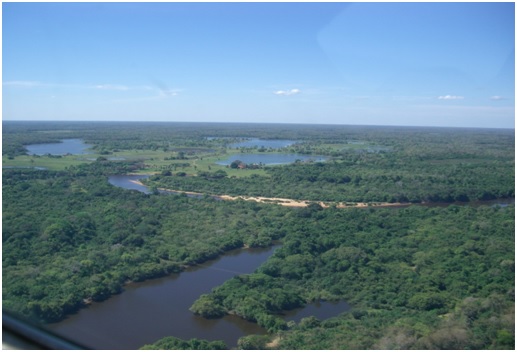
In PC 18 (and if you didn’t receive this, please ask!) I explained why we had decided we would go to the Pantanal, the world’s biggest wetland. The 100,000sq miles are like a giant saucer where water collects in the rainy season. It is so flat that the gradient on its 800 kilometres north to south run is a mere one cm per kilometre – ie 80 metres difference!

pc20 1

Looking North towards Rio Negro and Barranco Alto

And here we are! After many hours of travelling, firstly in a jet from Rio via Sāo Paulo to Campo Grande with the Brazilian airline Azul, then in a 4×4 Jeep, and finally in a Cessna Skylane (PT-1HF); we have arrived at the Fazenda Barranco Alto  …….. at that time of the day, ‘Bug Heaven’. Everything we touch seems to have a live creature on it, around it, in it. We wonder whether we have done the right thing in coming, but the bugs eventually vanish into the night, except for the permanent resident of our comfortable double bedroom, an enormous spider!

Fazenda Barranco Alto is essentially a large cattle station owned by Lucas Leuzinger, a charismatic rancher and biologist. He leaves the ecotourism side of the business to Hugo Guedes and Carolina Denzin, and they take an active part in ensuring we guests get what we want. We sit down to dinner and meet the other ten tourists, an eclectic mix of people; one large family group of parents, adult children and their partners and two other couples, one American from California who have arrived around the same time as us and with whom we would be paired for our visit. They turn out to be charming and good company.

The rhythm of the life on the fazenda is determined by the weather. Whilst the normal grazing Nelore cattle are raised for meat, there are a number of milk-producing cows that get rounded up on horseback at 0300 for milking. The  objective of most tourists who come to the Pantanal is to see animals and birds they would not normally see, and most of these shelter from the heat of the midday sun. So on our first morning we set the alarm for 0500, for breakfast at 0530. By 0615 we’re heading off upstream on the Rio Negro, in a small steel-hulled boat with the American couple and Fernando, who was our boat driver and knowledgeable guide. We look for, and have pointed out, the wide variety of birds that make the Pantanal so famous. We see many species, from small Black Skimmers to large Tuiuiui (Jabiru) storks standing some 2m tall.  On the warm, slowly flowing river, the water the colour of milky rust, anything that happens is observed by the ever watchful eye of Jacaré or Black Caimans, a 1.5m reptile.

pc20 2

A Jacaré or Caiman!

It is estimated that there are some 10 million in the Pantanal and, although they look ferocious, they are shy of humans. After about two and a half hours, having overdosed on birds, we make our way back to the fazenda before the sun gets too hot.

At about 1530, with a cooler sun and storms threatening on the horizon, the whole group climb aboard some 4x4s and head off with their respective guide to explore a part of farm. Our guide Lydia hails from Köln in Germany and is doing a doctorate on the habits of the Giant Anteater. The farm has about 25,000 acres, and Lydia has identified some 30, about one per thousand acres. Her knowledge of their habitat and of their habits pays off, and we find one of these large mammals, busily searching for termites on the corner of a wood. On another afternoon we spot a mother with a baby Anteater on its back.

We had arrived on a blisteringly hot afternoon but on our second day find the temperature has dropped and storms threaten. We are scheduled to ride horses across parts of the farm during the morning. Thunder and lightning are spooking the horses, so we wait for 45 minutes whilst a rain shower passes. It clears enough for us to go, so we get up into the saddle – only do have a torrential downpour which completely soaks us all, and cancels further riding. The Pantanal has the highest recorded lightning strikes in Brazil so this is sensible …….. and then the power goes off, and with only a 120v generator, it’s a rather disappointing morning.

There will often be an occasion during the sort of adventure that we are on, when you ‘see the light’, a moment when you sense how small one is in comparison to the natural world. After the rain of the morning, we have been on our second dusk excursion, looking for those animals for whom darkness is essential for their survival. As night descends, we have a fleeting glimpse of a Tapir, a strange looking animal to be sure, and a Burrowing Owl and we’re making our way back to the farm along the rutted tracks. The night sky is full of stars, their brightness heightened by the lack of light pollution; such is the remoteness of the Pantanal. Fireflies begin their busy evening and, as Lydia stops to open a gate in a cattle fence, we all become aware of what is around us! We turn off the jeep lights and sit, mesmerised, fascinated, not wanting to speak for fear of breaking the spell that the minute fireflies have induced …….. for everywhere we look, in amongst the grasses, in the small bushes and in the tall trees, there are fireflies, glowing incandescent, thousands of them. Above, with no visible divide, the stars map out the heavens and the constellations. Magic! Absolutely magic!

We weren’t lucky enough to see any Jaguar, Puma, otters or indeed anacondas – the yellow anaconda being one of the largest snakes in the world, about 6m long and 60cms in diameter – but we did see an Armadillo, wild boar and small herds of the largest rodent in the world, the Capybara, a very cute animal rather like a sheep in size.

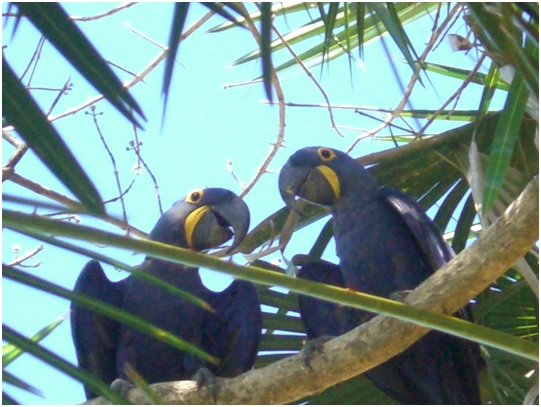
“If it’s clear of rain in the morning, are you up for a canoe trip?” asks Hugo. “Sure!” “OK! We’ll leave at 0500 for a 45 minute drive, get the canoes onto the river and stop for breakfast after 15 minutes or so.” So on Sunday morning we leave with Carol as our guide and make our way to the River Negro, some 10kms upstream of the fazenda. The sun is just cresting the trees as we slip the canoes into the water, and paddle off. It’s a cool morning and there’s mist on the river, although by contrast the water is warm bath temperature! We drift, we paddle, we stop on a sandbank for a breakfast of coffee, sandwiches and hard-boiled eggs, we paddle some more, we see Ringed Kingfishers, a few Roseate Spoonbills, Coicoi herons and Hyacinth Macaws, all our activities under the watchful eyes of a Caiman or three.

pc20 3

Blue Hyacinth Macaw

Three hours later we round the last bend in the river before the landing area and our trip is at an end. And our visit to the Pantanal is at an end too; after lunch we climb aboard the Cessna and lift off the grass strip, at the start of our long journey home.

Wow! What an amazing place! Time stood still a little during our stay and, although we were mere observers of the normal lives of various animals and birds that inhabit the Pantanal, it is enough to remind us we share this planet with some amazing creatures who all have a right to be here too.

Richard Yates – richardyates24@gmail.com

P.S. In PC 19 I scribbled about coincidences. On the first night in The Pantanal we sit down for dinner. Next to me is Simon, a British guy who lives in Paris. In conversation I find out that he worked for …….. Brighton & Hove City Council in their offices at the bottom of Grand Avenue in Hove – about 300m from where we live and thousands of miles from where we meet!