PC 134 The Largest Mediterranean Island

“We had arrived.” It was later than expected but Gianluca was there to greet us at La Rosa Sul Mare, our apartment hotel in the Plemmirio nature reserve, just south of Syracuse in Sicily. A tall, bald, lugubrious man who we gradually experienced wore a number of hats –  manager aka waiter aka guide aka coffee maker aka cook – Gianluca had that charming way of adding an ‘a’ to everything he said in English. ‘Welcome! Buena Sera! Ia hope youa hada a gooda flighta?

PC31

So it’s not surprising that the urge to scribble something of our week on Sicily is overwhelming. But why Sicily? Well, neither of us had been there and it’s almost in Africa so it must be drenched in the yellow stuff even in September. Think Sicily and I think Mafia, an insidious and dangerously important part of the Sicilian society, I think seafood and wine, I think active volcanoes (Mount Etna and Stromboli in the Aeolian Islands off the north coast), and I think Inspector Salvo Montalbano, a fictional detective created by Andrea Camilleri and the TV series of the same name, filmed around Ragusa.

The largest island in the Mediterranean, Sicily’s strategic location has ensured a colourful history; part of Greater Greece, a Roman Province, an Arab caliphate, a Norman kingdom and now part of a unified Italy. Scratch its poor soil and you’ll find remnants of its past everywhere, but broken columns and ancient theatres, Greek or Roman, don’t really interest me. It’s today’s inhabitants that make this island, them and the incessant flood of tourists. A fascinating article by Maria Luisa Romano in a magazine called ‘Best of Sicily’ gave me a rather negative view; here’s a synopsis: “Around 55% of the population is either unemployed or underemployed, the economy is still based on agriculture, and literacy rates are some of the lowest in Europe. There is a very small middle class and among the people themselves, envy and jealousy, not charity or empathy, have been the rule of the day for a long time. There is little sense of community outside the smallest towns. If history is any guide, there seems not to have been any real sense of civic awareness or community spirit in Palermo or Catania for centuries. And of course organised crime in the form of the Mafia, with its extortion and economic control, preclude any serious development of businesses.” (see note 1)

I took a photograph of the Temple of Apollo, built in 575BC in the Syracuse suburb of Ortygia, but didn’t spend hours looking at how its scattered stones might have looked.

PC32

Surprisingly there was little mention in the guide books of the importance of Sicily in the planning of the invasion of Southern Europe, by the Allied forces in 1943 during World War Two. There seemed to have been two main options, one to invade Greece and drive up through the eastern flank and one to invade Italy off the springboard of Sicily. In one of the most successful deceptions of the conflict, Operation Mincemeat, the body of a supposed Royal Marine Officer was allowed to float ashore in Spain. In his satchel were plans for the invasion of Greece; German intelligence accepted their authenticity and moved forces to reinforce that area. The subsequent invasion of Sicily was highly successful and completed in 60 days. Mussolini was toppled and Italy’s participation as an Axis power was over. (See note 2)

La Rosa Sul Mare had about ten small self-catering apartments and the other guests were couples who had come to relax, see the local sights, sleep, snooze, swim, sip, sunbathe, snorkel and chill. Peace and quiet writ large; sea birds cry, small waves break over the rocky shore, the wind gently rustles leaves in the vegetation, whispered conversations drift across the rocks and it’s heads down in one’s book. Until a large group of big Russians, or maybe a big group of large Russians (?) arrived half way through our week. Any ‘group’ is bound to dominate a small place but these people had no respect for others, demonstrating a lack of understating of acceptable behaviour; and because there were 8 of them they became a real nuisance. Their second morning they occupied more than 50% of the sun deck (tut! tut!) and plugged their USB into the loudspeaker; there was nothing quiet about this Russian playlist!! One of the men was a real comedian, or so he thought, as after everything he said he screamed with laughter and his chums joined in too; a nightmare if you’re trying to concentrate on a story!! After a couple of hours I asked the pneumatic blonde whether she could turn her loudspeaker off. She turned questioningly to this head of family. He rose up to his full 1.9m height, his belly extending way over his trunks: “Wot? You no like music?” ……..

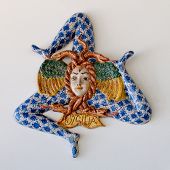
symbol-sicily-trinacria-long-time-ago-symbol-kingdom_cg1p01671565c_th2

The Sicilian symbol

The flag of the Isle of Man in the Irish Sea, a self-governing British Crown dependency, is red with a Triskelion, consisting of three legs conjoined at the thigh, at its centre. Its origin is thought to be from when the Norse ruled the island in 1260. I was surprised to find a similar emblem, a Trinacria, a three legged symbol with Medusa as the central face and three ears of wheat here in Sicily. The feet represent the three capes of this triangular island.

20

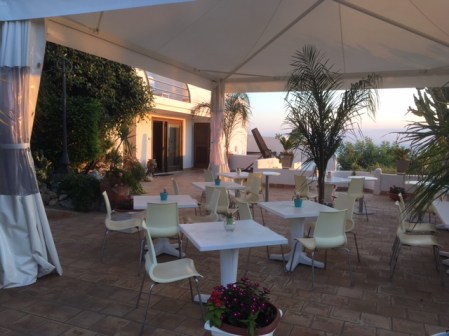
On the second night we decided to eat on the charming terrace overlooking the sea and we advised Gianluca at breakfast that morning accordingly. He asked us to select what we wanted as they didn’t have many people eating in and had to get the ingredients!! I chose as a starter Palma ham & melon (yum yum) and a favourite pasta dish, linguine da mare. Later that evening we sat expectantly under the awning and waited. Gianluca eventually appeared with a huge tray carrying everything we had ordered. As he set the dishes down, he muttered: ‘Maybe you ‘ad better eata pasta first as it hota, then starter. Eh?’

PC34

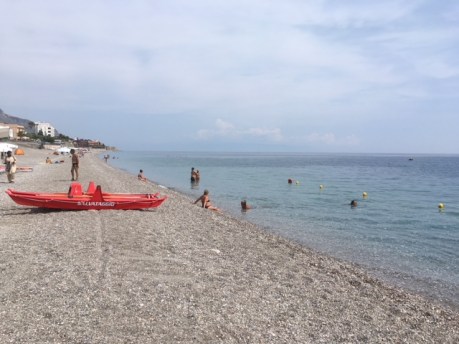
On our last day we drove north to Taormina; the place was crowded with tourist coaches wheezing their way up the steep roads and those on foot coming up from the car park. We hurriedly turned around and found a quiet beach. Here it was a little more tranquil; time for a swim and some lunch before returning the car to Avis in Catania airport.

pc36

Taormina’s pink beach with mainland Italy a smudge on the horizon

If you go to the trouble of putting up signs saying ‘return cars’ etc at least make them work. After two circuits and endless dead ends, dangerous U turns, reversing up a one-way lane etc eventually we worked out that the signs had been put up by a nincompoop. Ignoring them, we made our way towards the terminal building, where we recognised the Avis operation. I gave the keys back to Fabio – ‘You found us then?’ he asked, clearly embarrassed by the lack of sensible workable directions for his customers.

102

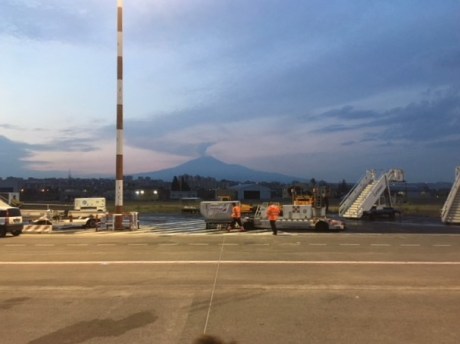
Mount Etna smoking quietly, seen across the airport apron

We left on time, climbing into the night sky, set our watches back an hour and read and chatted. It was good to get home; we even unpacked our damp beach towels before falling into bed around midnight!

Richard 4th October 2018

Note 1: http://www.bestofsicily.com

Note 2: Operation Mincemeat is the subject of a book of the same name by Ben Macintyre. Hugely interesting.

PC 133 A Travel Vignette

I imagine most of us get excited about the view of the earth from an aeroplane or hot air balloon, or even a parachute? I know I do, with my deep-rooted fascination with maps and all things cartographic. Many years ago, in 1970, I spent a couple of weeks at the School of Military Survey; a memorable fortnight in the summer, learning how to make maps from aerial photographs, amongst other things. And we finished early enough to enjoy tea and toast, with lime marmalade obviously, and a couple of games of croquet. Bliss!

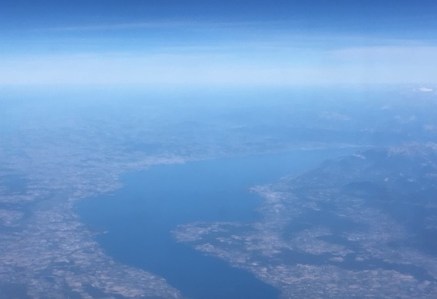
Eleven days ago, pausing in my read of the newspaper, I glance idly out of the port side of BA2594, on route to Catania in Sicily. It was a gloriously clear day for flying. ‘Wow, that must be Lac Léman,’ I thought; ‘there’s no other body of inland water quite so big in western Europe. So there’s Geneva ……’ and I became absorbed ….. the quest for news forgotten!!

1 Lac Leman

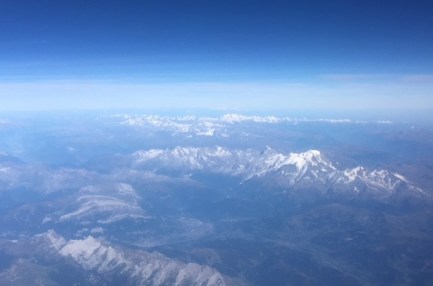
Within a few minutes the Alps are beneath us. Not sure whether they are the French Alps, the Swiss Alps, Italian Alps or Dolomites; from 33,000 feet they simply look majestic, small from this height but dwarfing the valleys and hilltop villages – the scale is Toy Town.

4 More Alps

Then we leave the land behind and slip down the west of Italy. The port of Genoa is below and the memory of the motorway bridge collapse invaded my brain space. Later I recall a ferry ride from Civitavecchia to Olbia in Sardinia in 1975 and a return from Olbia to Genoa and thence the UK.

“Good evening this is the captain. Currently North West of Palermo and starting our descent into Catania. Those of you on the port side of the plane have a good view of Mount Etna (see note). Unusually clear.”

7 Mount Etna 2

The brown parched land visible below is somewhat corrugated, as if some giant has raked his finger nails across the earth. Etna sits brooding on the horizon as the land gradually flattens out and we make our descent into Catania airport. Everywhere you look green regimented lines march across the fields; Sicily is famous for its wine!

The Captain puts on his ‘Aren’t I wonderful’ voice and announces we’ve arrived five minutes early. We troop down the aisle to the stairs and waiting coaches. Julia, the warm friendly stewardess in charge of the Cabin Crew, gives us a beaming smile and a ‘Thank you for flying British Airways’; she could have added something about how we treat your data sensitively!

The luggage safely on the trolley, we look for the familiar red sign of the Avis car hire company. Every company under the sun ……. except Budget and Avis! Frustratingly it seems they are located outside, after the end of the terminal building. Pushing the laden trolley we make our way in the gathering darkness towards the car hire office – us and twenty others. Inside, after the initial shock of what we see, we take a ticket – F78 – and gather our thoughts. There are just two desks open, and the number shown on the overhead display is an energy-sapping F69! So nine others in front of us and even if each transaction takes 20 minutes that’s over 90 minutes. Celina dives back to the main terminal in search of supper. ‘Baguette or baguette or pizza?’ She reappears to find I haven’t moved. Fortunately the German couple next to us realise they drew two tickets and when their number, F71, is called they give us their F72 ticket. I start getting excited; ‘simple things please little minds’ is so true in these sorts of situations. I sheepishly make my way to the desk as F72 is called, scrunching F78 into a small ball in my pocket. I say sheepishly as I am sure others in the queue will be thinking ‘I was here before him’ and other more unkind thoughts!
Nicola is just doing his job; I focus, my world shrinking to just him and me, and ignore the chaos behind me. I remark how busy it is, he mumbles something about the systems being slow, I would like to shout ‘you should have some more staff’ but want to be charming, want to be out of there into the night, although now not looking forward to a 70km drive in a car I don’t know, to a place I don’t know, driving on the wrong side of the road!! Nicola notices I live in Hove ……. and launches into how he had managed the Eat fast food restaurant in Brighton just by the Clock Tower for three years. He lived in Worthing (looks too young to have lived in Worthing!!) and has now come home to Sicily. A small world! I almost tell him he should have gone to Hertz or Europcar but that wouldn’t help my progress through the bureaucratic process involved in hiring an Avis car.

Avis logo

‘Insurance?’

‘Ah! Yes!’ I say, ‘you’re going to tell me I need to spend lots of money to ensure that if a Lambretta driven by a bella signorina scrapes the car or the windscreen shatters or ……’. My mind filters out the long list, knowing the only sensible thing is to say yes yes yes …… anything to get me out of the door. My watch says 2030 ….. we landed two and a half hours ago! OK! Tell me where to sign and for that enormous extra insurance cost please lend me a Satnav …… for free? The conditions and retail agreement are emailed to me and I sign on a screen he thrusts under my nose.

Out into the dimly lit car park …… ‘follow the blue painted lane’ …….. I think it was painted when the Greeks were in charge of Catania and has not been painted since, but after pushing and pulling the trolley up this lane and under that barrier, you know how it is, we find the little Fiat Panda – shiny black. Our ‘free’ Jezebel 3 is plugged into the socket – I was going to write cigarette lighter but who smokes in cars these days? Come to that, who smokes?? – and we input the details of our hotel near Syracusa. We couldn’t see anything of the beautiful scenery, road works disrupt our southerly progress and Jezebel keeps ‘recalculating’ but eventually, after an hour and a half, we find La Rosa Sul Mare in the Plemmirio nature and sea reserve. We had arrived.

Richard  22nd September 2018

Note: Mount Etna, Europe’s largest active volcano, rises to 3330m above sea level and is situated in the north east of the island of Sicily. The most recent eruption in 2002 destroyed the visitors’ centre and a cable car station. This year it’s been quiet, thankfully!

PC 132 September

I never really believed it was only me who wondered why the Academic Year started, at least in the Northern Hemisphere, at the beginning of this month and a quick google (that’s a verb now, isn’t it!) confirmed it. Lots of people scratch their heads and wondered why it doesn’t align with the Calendar Year, or actually vica versa, ie New Year’s Day could be the 1st September! Now that would be weird. But the reason is grounded in the rural development of societies, the importance of successful farming to life itself. In those cold and dark months of November, December, January and February, down on the farm nothing much happens; then comes spring and families got involved in planting seeds, tending the growing crops and harvesting the results.

m65 (2)

September Morning

As soon as I type in ‘harvest’ my mind goes back to those years of compulsory church attendance and the Harvest Festival Sunday. Here in Britain Christians give thanks on Harvest Sunday, a date defined by the full moon nearest to the Autumn Equinox, 22nd or 23rd September. In North America the fruits of the farmers’ labours are celebrated at Thanksgiving, sometime in October or November. Here, in church, amongst the baskets of fruit and vegetables decorating the aisles we sang, with great gusto, “We plough the fields and scatter the good seed on the land; but it is fed and watered ….” It was originally ‘Wir pflügen und wir streuen ….’, a German hymn from 1780, translated into English in 1861. In a nod to its obvious rural connection, we boys switched to what we perceived as a country dialect and ‘scatter’ became ‘scaaa….a…tuur’! Sorry; I digress, lost in my reverie. Education? Ah! Yes that could wait until after the summer was over. Of course, if you are part of the 12% of the world’s population living in the Southern Hemisphere, all this is irrelevant!

Education in the UK became compulsory for children up to the age of 10 in 1880; this upper limit gradually increased to where it stands now, 16, by 1972. Amazing it has taken so long for societies to recognise its importance? So the school year in the UK starts this first week in September, unless you live in Scotland where of course it started the last week in August; you following this? Dauntsey’s School in Wiltshire had started as an establishment rooted in the countryside. Although not an Agricultural College per se, when I started in its Junior School in 1960 lessons stopped in late September so we could go and pick the potatoes! My recollection is of very muddy fields, us boys dressed in the uniform of fawn shorts and long socks, bending over to pick the potatoes and throwing them into the trailer behind Mr Huff’s tractor. It doesn’t take a great deal of imagination to see that, as an alternative to an hour’s lesson of Latin, this was such fun; except if it was raining, or when Jones Minor’s thrown spud hit you on the head!! One chap Jack Bancroft even went home to his family farm to help with the combine harvester; two weeks off – we were green with envy!

This start of the term initiates a pattern in your life, one that follows you from your school years to attendance at college or university. For me after the summer holidays of 1965 I started my officer training at the Royal Military Academy Sandhurst ….. in September; the two year course mirroring the school months, so we got commissioned in July. (See note) Later in life when your own children start school, the same regimentation starts again, periods and breaks defined by the school year. Dolly Alderton, writing in her column in the Sunday Times, says it’s ‘a habit hard-wired into me since school; the calendar year will always begin in the first week of September.’

I asked my daughter, who is a teacher at a secondary school, if she was looking forward to the start of the term. Her thoughts, which I paraphrase, probably echo those of every teacher in the country.

“Er! Not really! I’ll miss the wonderful long summer and I have to get on the treadmill of teaching and marking and organising packed lunches for my boys and someone to walk the dog and ….”

“So no passion to teach?”

“Of course; in an ideal world, absolutely. But it’s all the other things that start in September that require one to be so organised or it’s chaos!”

So an oscillating mixture of anticipation and anxiety, of certainty and uncertainty. Those of you not involved in academic life are probably jealous of their long holidays! At the start of the Autumn Term at Dauntsey’s, those of us who played Rugby knew that on the first Thursday there would be a cross-country run. Mr Proctor would take us up onto the edge of Salisbury Plain, along for mile after mile and then back, muddy and exhausted, into the school grounds. I hated it, yes hated it; intellectually I understood why it was necessary but I still hated it! The roller coaster of life huh! Not a Ferris wheel, simply round and around, but something that goes slowly, goes quickly, goes up and goes down, goes around sharp corners and occasionally throws one off balance. The Times’ cartoonist summed it up with this ‘political’ cartoon on Monday (see note 2):

m63

Some of you will have moved house since the end of the last academic year, so your children may be/will be starting a new school. Some will have a new uniform. Some children will be starting school because they have reached that age (4 years old equates to Year 1; why does the year not match their age?), some a new school because they are moving from Primary to Secondary. Some of course are going to University, maybe leaving home for the first time in their lives. And some of you have no children and couldn’t care a stuff but acknowledge, I imagine, that society moves with this rhythm! Even the Leader of the Brighton & Hove City Council reflected on this in the local paper. “A good start to life, including a great education, brings benefits across the whole of our lives and for the whole community.” writes Daniel Yates (no relation!); “For each of you starting a new phase of your life within this city, I wish you great success.”

So a new year at the beginning of September. Perhaps Dolly has a point?

Richard 8th September 2018

Note 1 This pattern was thrown by attendance at a MSc-equivalent course at The Royal Military College of Science, which started in January 1978, to fit into the year-long Staff College course which started the following January; the establishments were some 60 miles apart! Played havoc with those families with children at school.

Note 2. The Prime Minister, Theresa May at the blackboard, trying to make a point about her ‘Chequers Agreement’ at the beginning of the Parliamentary Term to students David Davies (ex-Brexit Secretary), Boris Johnson (ex-Foreign Secretary), Iain Duncan Smith and Jacob Rees-Mogg (with the long nose).

PC 131 Sipping Ginger Tea

Sipping ginger tea and eating a large succulent red grape –  my body radiates warmth, at least that is what it feels like, in that afterglow of a massage. I’m on the third floor of the Banyan Tree Spa complex in Estoril, Portugal – a collection of pools, spas, saunas, a gym, treatment rooms and an indoor/outdoor café. The Spa Pool has water jets and a large circular section where the water rotates at about 2 mph. Swim against the current or simply let it lift you and take you – around and around!! Just the place for a wet Friday afternoon.

Massage has a funny reputation, a sort of nudge-nudge, wink-wink, amongst the male species and that reputation is not helped by some dubious massage parlours being used as a front for prostitution. You will have seen the different types of proper massages being advertised – Swedish, Aromatherapy, Hot Stone, Chair, Deep Tissue, Trigger Point, Shiatsu and Thai – and unless you regularly have them in conjunction with keeping fit or for some medical relief, it’s likely you only have one or two a year, on holiday maybe? I once heard a masseur saying that one a year is a complete waste of time – but hey that ‘afterglow’ is something, so why not have more?

Banyan 1

Celina gave me a gift of a 90 minutes Thai massage: “Apparently it’s really fantastic!” I love massages, so readily said: ‘Yes please’. I prefer being massaged by someone of the opposite sex as that introduces an imaginary world that excites and disappoints in equal measure. I once had a massage by a chap who was blind; with his enhanced sense of touch and space it was unique, but it missed that frisson that develops, in my mind if nowhere else, between a male and female.

One website says: “Thai massage is a unique blend of assisted yoga, passive stretching, and pressing massage movements. Thai massage is more energizing than other forms of massage: it’s a little bit like yoga without doing the work, as the therapist moves and stretches you in a sequence of postures, usually on a mat on the floor. Like shiatsu, Thai massage aligns the energies of the body. The massage therapist uses rhythmic compression along the body’s energy lines to reduce stress and improve flexibility and one’s range of motion. It is done fully clothed. This type of massage can reduce muscle spasticity and back pain, and has been shown to be useful in treating balance problems and migraine symptoms.”

So at 1720 I check in with Deborah at the Reception Desk, go and change into those obligatory white towelling bath robes, and report back. A Thai woman appears; it’s not until later I ask her name – Nicole – and there’s probably a Thai name by which she’s known at home, but here she’s trying to westernise herself. I think about asking but realise that pronouncing a Thai name might stretch my linguistic ability.

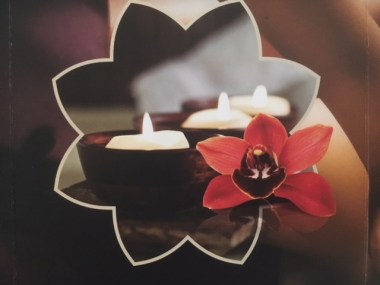
“OK. Go in there and take your clothes off. Here’s a sarong to wrap around yourself” – so much for the ‘fully clothed’! Obviously what follows is about my own experience, from my masculine perspectives. On my return she gestures towards a chair; I sit and have my feet washed – just so indulgent! Orchids and that piped music so typical of these places – ‘The Music of the Andean Pipes’ – Thai style! Then I am instructed to lie face down on the massage table, naked; she shields me from herself with a large green sheet, although there isn’t much to see! And once I’m prone I can’t see much either, as my head is face down in that little indentation in the table, tastefully covered with white gauze. After some initial kneading on my legs, I sense she climbs onto the table and starts on my hips and lower back, I can feel her thighs against my legs and that contact is ……… She presses her torso against my back and it feels good!

Banyan 2

Being completely naked there isn’t that pulling-down-the-hem-of-your-knickers normally associated with the masseuse working on your hips. Nicole simply moves the sheet and, besides, she’s seen it all before! I’m grateful she doesn’t chastise me for my sunburnt buttocks, the result of an hour in the sun earlier. At some point, in this warm haze of sensory overload, my arms are down the side of the table; she brushes her thigh against my hand and I smile to myself.

I ask how long she’s been in Portugal and she says she’s here for eighteen months. Her English is very limited (but better than my Thai!) so conversation doesn’t flow; she just gets on with her job, applying her skill and oil to my body. I wonder what she’s thinking as she adjusts the sheet to ensure my limited modesty as her hands massage my inner thigh; probably wondering which noodle bar she will go to when she finishes, with the other masseuses with whom she shares an apartment. My thoughts are not on supper! I learn later that a Thai company provides the masseuses for a two year stint.

There was certainly no sexual attraction between Nicole and me but the mere fact that some stranger’s hands are touching my skin, sometimes quite intimately, does cause feelings, strokes the imagination one might say. The fantasy suggests her asking: ‘You like something extra sir?’ but in reality that is exactly what it is, a male fantasy.  Add the fact that my masseur was a woman, so masseuse, and it’s most men’s pleasure. I say most men as some presumably are repulsed by such intimate contact, but if you are a tactile person like me, it’s heaven. I am instructed to turn over onto my back, the raised sheet much like a magician’s cloak, and the fantasies I had when ‘tummy down’ restart, as I suspect do Nicole’s about noodles.

Towards the end she lifts a leg to one side and pushes against the hip, opening that joint to its furthest extension. Wow! The Thai massage ‘Spinal Twist in Lying Position’. A few minutes massaging the hands and fingers, then my skull and I’m done. Off for a shower in a side room then, dressed, back for ginger tea and large succulent red grapes.

For Nicole this is just a professional job, what she does, and she relies on feedback from her clients. I mark her card accordingly – excellent. It cost Celina an arm and a leg, an appropriate expression here perhaps, and I hope Nicole gets at least 50%, but somehow doubt it.

On the way back from the Spa, Celina and I compare notes. She suggests a massage is a bit like a sexy dance between two strangers. Whilst there need be no sexual attraction, the act of following one’s natural rhythms and inclination can engender a feeling of sexiness. She’s hit the nail on the head; a great analogy. A true basic instinct, this sexual urge, encouraged by the sense of touch, of smell, of heat, of oil ….. and lots of imagination!

The Thai goodbye, hands together, fingers steepled, slight hardly-discernible bow and she’s gone – and leaves my empty outstretched hand, the normal British ‘goodbye’ gesture, untouched!!

Richard 23rd August 2018                                                                richardyates24@gmail.com

PC 130 Lisboa, Mafra & Sintra – July

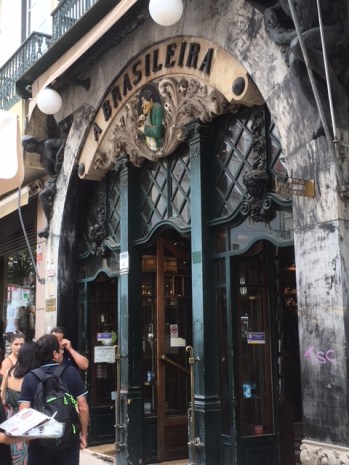
Sitting outside A Brasileira, the cafe on Rua Garrett in the Chiado quarter of downtown Lisbon (see PC 112), having a double espresso and a couple of naughty Pastel de Natas, I reach for my iPad and scribble. Around me sit tourists from across the world, although as this is the European holiday period the majority seem not to have travelled too far. It’s cloudy and muggy, not typical of normal Portuguese late July weather but this year is anything but normal, with global temperatures in the northern hemisphere significantly above average. The loss of life in a raging fire east of Athens is on everyone’s mind.

331

It is too airless inside the café so I try my luck at one of the outside tables, conscious that most are taken by smokers. Sure enough, just after I’ve sat down a five-people family group occupy a near-by empty table and packets of Gaulloise are placed on the table, together with the obligatory mobile phones ….. in case Mutti calls from München to check on the family, especially on Otto with his cold. Otto I should add looks 24! I watch the down-on-their-luck trying to cadge a cigarette, or just a light for their carefully cobbled-together roll-up made from picked-up fag ends. Further down the street cardboard from a shop’s merchandise’s boxes are used to insulate another from the little cobbled tiled pavement. The tourists step over the lying form, without so much as a look of sympathy, for this example of street life is in every city, a sad reflection on the world we live in.

327

The pace of life here is slow. The Portuguese are slow people, at least the modern ones, but you remember how its sailors and adventurers opened up the rest of the world to Europe? No slouch then huh?  Recently the singer Madonna, who’s made her home in Lisbon, was reported to be exasperated at the attitude of the Portuguese: “Lisbon is an ancient city and no one is in a hurry to do things.” Maybe she should sing ‘Like a Prayer’ more regularly?  The image of the typical Portuguese man or woman hasn’t changed much in decades – the black clothes, the rather bowed legs, the flat cap – and it still projects the country; somewhat rural and backward-looking. Of course sometimes this pace has its attractions, particular for those used to the rush rush rush some of us endure. It reminded me of that observation about how someone was so laid back they almost fell over. But when you come up against this personally, trying to get a builder to come and quote, for instance, it frustrates and irritates in equal measure. And when they do come, they turn up at 8pm and start hammering!!

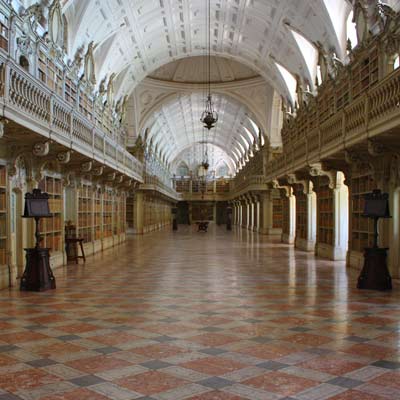
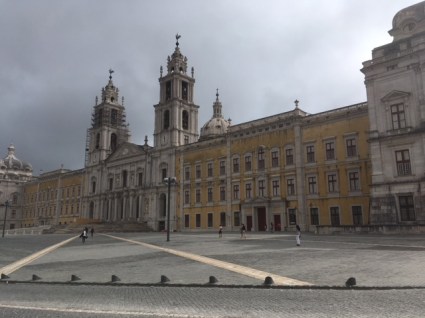
I had read about Mafra in a general book about Portuguese history, but didn’t inspect the DK entry carefully enough! “Open W-M except on 25 December.” …… ie closed on Tuesday. We visited ….. on a Tuesday; the Palácio de Mafra was closed …… for cleaning ….. but the basilica was open. A thirty minute drive wasted you might think, for Mafra lies about 35kms north of Estoril but actually, apart from the magnificent library with its beautifully crafted marbled inlaid mosaic floor …… (See note)

library-mafra-palace-400

…… I wondered how many of the 800 rooms one would see on the guided tour? Certainly I could give the room containing hundreds of animals stuffed by taxidermists a hundred years or so ago a miss …… so all we saw was the basilica, built between the king’s bedchamber tower and that of the queen’s. We peered inside; cavernous! Bigger than St. Peter’s in Rome? Maybe? And ‘dusty’ didn’t do it. (Maybe not part of the Tuesday cleaning programme?) Statues to those considered at the time worthy of sainthood or public commendation adorn the alcoves, the domed ceilings intricately laid with coloured marble and actually, for a Catholic Church, plain ….. but it sits in the biggest of buildings.

289

It was originally designed in 1717 to house 13 monks; I am not sure why thirteen, but it was obviously not an unlucky number then. The extravagance, the exuberance and sheer folly ran away with the Italian architect Ludwig and his client the king, João V. Portugal’s coffers were overflowing with gold from one of their newest colonies Brazil and, after 52,000, yes fifty two thousand builders laboured away for 13 years the result was a monastery for 300 Franciscan monks. For 104 years it was their home and a place for the hunting/shooting/ fishing set to spend their weekends. Actually I think ‘Le weekend’ is a modern concept and those who went stayed for as long as they wanted! Wasn’t it Maggie Smith as Downton Abbey’s Violet Crawley who asked “What’s a weekend?”

Eventually like all good things it came to an end. The monks got their marching orders in 1834 when all religious orders were dissolved …… and the king took all the furniture to Brazil in 1807 when his court fled the advancing French. The palace lay empty; the monarchy ended in 1910 and the then king left for Twickenham ….. so now it’s empty and a hideous example of how to waste money. But I read the Portuguese have been wasting money for decades!

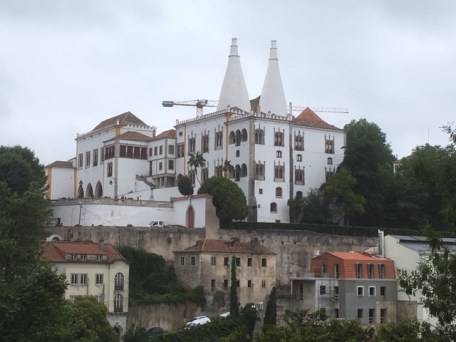
Sintra, which lies south of Mafra, is a little like Disneyland, although I have never been to either the original one or even the French one. A magnet for tourists all the year round, it’s the Portuguese equivalent of Petropolis in Brazil or Shimla in India, built by the monarch in the former case and the British Government in India in the latter case as somewhere to escape the summer heat. I should add that Sintra is normally surrounded by mist and low cloud; and so it was when we went! Lying north of the capital Lisbon it’s close enough for a trip for those taking a city-break weekend. Three palaces and their grounds cover some tens of square kilometres and we visited the Palácio National de Sintra, started in the C14th on the site of a Moorish palace. The best bit was the chimneys for the large palace kitchens and it’s these that give it, for me, a Disney feel; they are gorgeous!

216

There is also the Palácio da Pena and the Rococo Palacio de Queluz, a C18th development of a hunting lodge, to see but we left those for another time. I find after three hours of looking, peering, visualising and studying, my brain starts to fry and if anyone suggests a coffee, my hand is in the air quicker than you can say disconbobulation.

Richard August 2018

Note: “There is a colony of bats which live in the library and protect the ancient books from insect damage. These small bats are let out at night and can eat twice their weight in insects. This natural form of pest control has been in place for over 300 years.” Now that’s fascinating!!


PC 129 A new experience

The streets of any strange city are often confusing; normally one city block looks like any another; one way streets and directions to unfamiliar areas compound one’s sense of unease, tinged of course with the excitement of discovery. Walking around is at your own pace; driving one is in the flowing traffic and you need to know where you are going, or at least have a sense of that direction. These days you can have as much assistance as you like in the form of a satellite navigation/information system beamed to your smart phone or in-car dashboard display. They help quite a lot, although when they  start ‘recalculating’ because that side road she (also a female huh?) asked you to turn down was either a one way street the wrong way, blocked by a council refuse-collecting vehicle or just looked plain wrong, you want to shout at the sky: “aaggghhhh”!

Lisbon city map

So it was on a Sunday in early July we found ourselves heading to a school building (Escola Secundaria Maria Amalia Vaz de Carvalho) in the Portuguese capital Lisbon in search of a yoga class, taking place in an inflated tent. I think the principal is great. Take over some space, in this case a spare classroom, inflate your yoga studio inside (note: not inflating your ego!), pump in the heat and conduct an hour’s Vinyasa or something similar.

On Rua Sampaio e Pina we found the entrance to the waste ground that was obviously used as a car park and nodded to Santos, who was the weekend security chap. “Bom dia. Yoga?” he asked politely, peering through the car window. “Bom Dia. Sim!” He pointed to a rusted iron fence through which we should drive; down a ramp and park in the dust, among the weeds, alongside an enormous building. The sun was high in the sky and it was hot. We were early and were just discussing life and the universe when another car pulls up and out steps a young woman who says she’s Sophia and she’s our yoga teacher; she had made a ready assumption we were there for yoga! Why else would you be there on a Sunday morning? We walk towards a small white metal door at the rear of the building. Up a flight of stairs …. to the door of the studio.

“Is there a loo I can use?”

“Yes, down this corridor take the first right, another 50 metres, on the right.”

We knew there were showers we could use after the class and took advantage of someone coming out of the previous class to guide us. She asked whether we were Sophia’s parents – think I could have been her grandfather more like!!  It was a ten day Camel Ride, as they say; along this corridor, down some stairs, along that corridor, turn right, another 100 metres – it’s a large school building. Dusty indoor plants (Ficus Benjamina), looking as though they needed sunlight, water and a good feed, make a feeble attempt to brighten the entrance hall

On the way we pass the signs of school life at this time of year; notices on doors: ‘Exams: Silence!!’; School Sports’ Day’s photographs; timetables largely coloured out; photos of past Alumni; displays in English and Portuguese of subject matter – biological systems, the planets, geological strata etc; a noticeboard with personal messages and holiday advertisements etc. The half-tiled corridor walls bring back my own memories of decades ago, although these are that blue colour so loved of the Portuguese, not the mud brown on my Wiltshire school corridors! We eventually reach the showers, look, and retrace our steps, hoping we’ll find those showers when we need them!

“You can change in there” says Sophia, pointing to one closed door for me and to another door for Celina. In mine lies detritus from the IT Department. How quickly machines become obsolescent and then obsolete in the technology sector these days; dead desktops, keyboards by the dozen, cables everywhere, the odd printer and many screens all piled higgledy piggledy in the corner. Dusty and forlorn; depressing actually! I am reminded of that little green cursor winking at me …… fond memories of my first VDU.

Hot Pod

The pod glows purple and blue in the room next door and our fellow participants, some nine in all, are gathering and finding a floor space. The light level is low so Sophia, when she starts the class at the front, sort of appears in silhouette. Soon we are sweating in the 38ºC heat and going through the asanas; after almost two weeks of no yoga, this is good. All too soon it was over, we say our thanks and namastes, and head for the showers; we are the only ones going in that direction, suggesting that the others preferred to shower at home.

Down this corridor, these stairs, left by the potted plants and there we were five minutes later, the girls and boys shower rooms. The building was completely empty, the echoes of children and staff and bells and doors closing all too apparent on this quiet Sunday; I felt like I was trespassing in this empty school, devoid of pupils and staff  yet haunted and inhabited by its past. We decided to simply use one room and chose the boys’ – easier to explain if interrupted maybe? Rather worn and paint-splattered floor tiles, a shower area around by the windows and ….. no hot water! But we coped – washing the sweat off and a brisk dry with a towel.

Then out in to the hot sunshine, into the baking car, switch on Jezebel 2, and ask her to take us to Jardim des Amoreiras in the Rato district. “Turn  right out of the car park ……” Here we go again, except this time we’re relaxed and exercised, so in theory it should be a doddle.

Richard 27th July 2018                                          richardyates24@gmail.com

PC 128 Travelling

Our luggage was different this time. Normally we’ve established how many suitcases we can take with our airline allowance and packed accordingly, with a weather eye on the bathroom scales – those extra pots of Oxford Vintage Marmalade that we believe are coveted or that special Muesli that someone the other end identified as their favourite in the whole wide world and could you bring a bag or two (another 500 or 1000g eating into your weight allowance!!). And eventually it’s done and we leave for the airport, our minds running a mental check-list to ensure that it’s only at the top of the road that we shout stop and not think f**k when you get to the departure gate at the airport!!

One of my pet hates is the electrical socket difference. How did the world develop different plugs and sockets? Bit like PAL and VHS but some of you will be too young to remember those video formats? Surely this is something the UN should insist on, a change to one standard and it would have to be the UK system because that’s the best!! How many travel adaptors do I own? Too many – and often not the right one! (See note)

Cables and plugs

This time we were packing for an extended time away in Portugal and not Brazil, where some of the European descendants still hanker after certain English favourites. In Europe these are probably now available in the Saloio supermarket in Estoril, an upmarket delicatessen that serves a sizeable British ex-pat community. …. but going by sea ferry and car we were able to take as much as we wanted – weird! For example: “Should we take a picnic bag?” “Why not, it doesn’t take up much room.” “A kitchen sink?” “Nah!”

Do you have a box or a tin or a bag with all your loose foreign change, or are you good and drop it into the charity envelope proffered by the stewardess on the aircraft prior to landing or into that cardboard box close to arrivals? When I worked for Short Brothers in the second half of the 1980s my role was to go and meet potential customers; I was a salesman but I think I was called Sales Executive or Manager or some such as the word ‘salesman’ in the UK carries certain connotations, connections with second hand cars and the name Arthur Daley!! In those 5 years I covered just under 300,000 miles with Singapore Airlines alone and visited a large number of countries. Each time I came back with some loose change and generally put it into old Schimmelpenninck cigarillo tins I had for some reason kept (in case ?). Being quite organised I labelled each tin, according to the contents – Deutsche marks, Danish Krone, French Francs, Indian Rupees, Singaporean dollars, Malaysian Ringget, Australian Dollars etc. Now I only have some Euros or Brazilian Reals in coinage and don’t really need those tins.

Some of you will be aware that Celina and I took the ferry to Santander in northern Spain and then drove to Estoril in Portugal. Apart from the Dartford crossing of The Thames to the east of London where you have to pay a toll, no longer through a machine but only ‘online’, it’s rare for me to travel on a toll road. Here on the Iberian Peninsula motorways charging for their use are common.

toll-road-portugal

The locals will have one of those cards that are automatically read by sensors on an overhead gantry at the Toll Gate, and are charged monthly. Tourists have to pay at a personnel-manned or machined-manned gate. We thought we had got the hang of it, then found ourselves with a ticket that needed to be paid when we got off the motorway. An hour later, in the outside lane of three, the exit booths were upon us before we realised it and we drove through an open gate. Aagghhhh!!

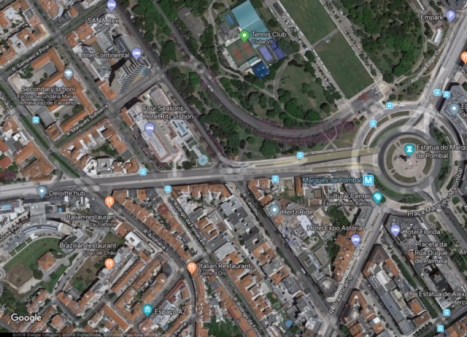
So, when we got into the hotel in Porto, we asked the reception staff how we could pay. “On the right of the Praça do Marquês de Pombal there’s a Post Office counter inside the CTT bank.” The man we found there laughed and almost accused us of trying to avoid paying. Then he told us he couldn’t take the payment but if we went down the street, turned left etc etc “You are in a car, no?” “No!” “OK, rather a long walk.” But this wasn’t the half of it, as they say. The attendant in the garage to which we had been directed said he couldn’t help but if we went …… five sets of traffic lights …… turn left …… can’t miss it. “You’re in a car, no?” “No!” “OK, rather a long walk …..” Eventually we did find the offices of the company Via Verde who operate the toll roads and paid what we should have paid three hours before. The dubious bonus was we saw parts of Porto that tourists rarely see ……. and I understand why!

167 A traditional port cask boat

Porto, on the Douro River, is the commercial capital and second largest Portuguese city: the inhabitants think it’s the best. It has of course given its name to the fortified wine beloved of after-dinner drinkers and the warehouses of the great trading families line the river – Taylors, Sandeman, Graham, Vasconcelos to name but a few. I have drunk enough port in my life to know it’s glorious, in the right place and at the right time. It was an essential part of the formal dining I enjoyed, and endured, in my military life. After the debris of the last course had been cleared away, the port decanters came out and were placed at each end of the dining table. As far as I remember, the ‘form’ was for the person at the end to offer it to the person on their right …… and then pass it clockwise. Once all the glasses were full, the appointed president asked the Vice-President to propose a toast to The Queen who, in the case of the Royal Regiment of Artillery, was also our Captain General. We got to our feet, toasted Her Majesty, and then got on with the more informal entertainment. Maybe some of that port had been in casks on one of these small boats on the Douro River, decades ago.

Richard 14th July 2018

Note: The eagled-eyed among you will notice a UK plugged extension cable. This trip I decided to take one and then replace its UK end plug with a Portuguese one – that’s on the assumption that I can find a plug as most electrical appliances these days have a molded non-replaceable one.


PC 127 I went looking for a family seat

I went looking for a family seat ….. and added a few more threads to my knowledge of the family’s tapestry. In our hall there is an oil painting of a rather gorgeous lady and only recently I found out that she was a great great grandmother, Sarah Fosbery. I know from the marriage certificate of one of her nine daughters that she lived in Adare, County Limerick, in Ireland. A few of you may stop reading now, the blinds coming down with the words ‘great great gra…’, having a phobia for uncovering our unique ancestry; personally I think it’s fascinating and important and helps me feel more grounded in this world.

Sarah Fosbery 2

Sarah Eleanor Fosbery 1822-1861

Andrew Black was my contact and I hoped through him to find the family seat, the house near the town of Adare. He was a rather amusing chap, typically Irish, self-educated and self-made; he called a spade a spade, or a shovel, depending on his mood. He continuously expounded his dislikes for food, especially those dishes from other countries, a dislike of sport in any form and a fervent dislike for any other race than the Irish or English – well the white ones at least. Each position was justified with a passion; I sensed that within a few months we could have had some form of discussion, but he just ‘switched to send’ and talked …. and talked ….. as those from his country have a reputation to so do. He assured me he could ‘show me Curraghbridge House’ so we booked a couple of nights in the Absolute Hotel in Limerick (Note 1).

Limerick 5

I couldn’t come to the City of Limerick without understanding something of its history, as that was crucial to my own. The city sits at the upper limit of the navigational part of the river Shannon and has played a hugely important part in the history of Ireland. The castle dates from 1200; rebellions by the largely Catholic population led to it being besieged a number of times. The last one was in 1690 when the defeated Catholic armies of King James retreated to Limerick after the Battle of the Boyne and were besieged by the armies of the Protestant King William lll. The Treaty of Limerick in 1691 created a peace that lasts until today, although I sense that those with long memories believe this a black moment in Irish history. This treaty allowed Patrick Sarsfield, 1st Earl of Lucan, to sail with his Irish Jacobite Army of some 19,000 to France, in what became known as the Flight of the Wild Geese (Note 2). With the Protestants victorious, land was distributed to a number of loyal English families who emigrated to Ireland. Burke’s ‘The Landed Gentry of Ireland’ (1910)  records that a Francis Fosbery was ‘said to have emigrated to Ireland 1690’ and settled in Clorane, on land south of the Shannon river, to the west of the town of Adare (pronounced Adooore if you have the Irish brogue!).

Limerick today is a place of “wonderful pubs, friendly people, scenic riverside views and an enormous castle”, but mention it to any Irishman, particularly those from Dublin, and they frequently mention the city’s nickname of ‘Stab City’. For sure there are areas of deprivation just like in many modern towns and cities, but we found the place safe and interesting, although I did find the height of the shower head in the Absolute Hotel had been fixed for Leprechauns, but that is a minor criticism!

Limerick 30

During our countryside search for Curraghbridge House we stopped at various little bungalows, built on tiny plots of land a direct result of land distribution, to inquire about the house owner and ask if someone had his contact number; no one did!

Limerick 32

Curraghbridge House, behind the locked gate, in the distance

I was by now growing frustrated that Andrew hadn’t made contact before our arrival, but the sun was out and this was Ireland, where there is little sense of hurry! At one such stop I did a double take, for the oldish chap was wearing what my somewhat distant father would have worn when gardening – a pair of dun coloured corduroy trousers sitting high on the waist with a piece of bailer twine to keep them up, and turn-ups A rather well-worn shirt of the same sort of grubby colour and muddy shoes completed the look, that of the care-worn Irish male. We saw a similar look the following day, passing through Kilrush. It was market day and, in addition to the food stalls laid out up and down the High Street, a group of men were hanging around outside the S. O’Ouibir Pub with a collection of dubious looking horses and ponies.

Limerick 12 Kilrush 2

We had driven along the north banks of the Shannon estuary and eventually had lunch at Kilkee on the Atlantic Ocean. We were blessed with gorgeous weather, completely contrary to the expected rain, and eventually paddled in the sea at Spanish Point.

Limerick 2

We never got onto the land or into the house of Curraghbridge but knowing it’s there, this family seat, and its importance in my history, made this trip very worthwhile. (Note 3)

Richard 29th June 2018

Note 1         The city rather downplays its obvious connection to the word limerick as a form of nonsense verse, made particularly popular by Edward Lear, which are rather rare today. The reason for the connection is lost in time!! It’s ‘ a jingle, now usually epigrammatic (short poem ending in a witty or ingenious turn of thought), and frequently indecent, consisting of five lines.’ Here’s an example from Anita V: “An infatuated man from Dover, was left by his imaginary lover. He pulled at his hair, in sheer despair, forgetting his wig was his cover.” And of course we know them as nursery rhymes. For example: “Hickory, dickory, dock, The mouse ran up the clock. The clock struck one, And down he run, Hickory, dickory, dock.”

Note 2         These troops continued to serve King James as he planned and then aborted an invasion of England. Lord Lucan was himself killed in the Battle of Landen in 1693; he was aged 33.

Note 3         Sarah had nine daughters and died shortly after the arrival of the last, aged just 39. Her husband Francis married again and, eventually, produced an heir. Unable to inherit anything from the family estate, well, apart from their mother’s portrait, all the girls emigrated to New Zealand apart from one who went to the USA.

Note 4         Limerick hit the headlines again in 1996 when Frank McCourt published his story ‘Angela’s Ashes’ about growing up in the poverty and deprivation that was Limerick in the 1930s. It’s been suggested that 60% of his account was fabricated and embellished but I know how difficult I find it to remember last year let alone sixty years ago so I would sympathise if it was the case!


PC 126 Brexit* and …… Racism

My personal view ……. picking and choosing the bits I understand ……. from an ever-changing scenario!!

After a number of false starts (note 1) the people of Britain joined the European Union in 1973; a 1975 referendum confirmed the nation’s wish to remain a member by 67%. Wind the clock forward 41 years to 2016, when the then Prime Minster, David Cameron, honoured his manifesto commitment to hold a referendum on Britain’s continuing membership. It seemed they walked into a disaster of their own making; confident of the result, the Government’s campaign to stay in was negative, rather than positive, and I reflected at the time the language of the postal campaign was of a sixth form debating society, not worthy of an organisation with the collective intellectual weight of the nation!! So on 23rd June we voted on whether to stay in or leave.

‘Take back control of our institutions; immigration and our future!’ was the message that screamed from the billboards across the country. The bogeyman was the potential, at some stage in the distant future, for Europe to develop into some socialist utopia, a Federal States of Europe, which I guess is a real anathema to most Brits; wave that flag and everyone will vote ‘out’. But today there are other issues. For those of you who live outside of Europe in other parts of the world, you may not know that EU citizens have freedom to work and live wherever they want to within its borders. For instance the Polish population in Britain, historically around 200,000 since the Second World War, has grown by just under a million since Poland joined the EU as its workers flooded in, armed with a great work ethic. Look for a plumber or builder, chances are they are Polish. More recently the Romanians, who joined the EU in 2007 but who had unrestricted access in 2014, have become the second-biggest non-British nationality living and working here. A section of society complains that these people ‘take our jobs’ – so voted ‘out’.

For those of us who believe it was better to stay in, ‘better the devil you know that the devil you don’t’, and for all its many faults (see note 2) believe it has been good for Britain, the result was like awakening in a nightmare – except this was real. I simply could not believe it – 52% voted to leave, although I was pleased Brighton & Hove was in the Remain camp. Sadly 69% of people over 65 voted to leave and whilst I fit into that category it’s only by age, not by either head or heart. Hoist with his own petard, Cameron resigned, ushering in the uncertain rule of Theresa May who had the unenviable task of implementing a policy she didn’t vote for. ‘Brexit is Brexit’. A headline oft repeated but never fully explained, because one senses that no one knows!!

‘Bring back control of our borders’. There was some very odd voting during the referendum. In Sunderland, in the North East of the country, they voted to leave despite the whole local economy being rescued from its past ship building days by Japanese car manufacturers, giving them an entry into other European countries tariff-free. Made in post-Brexit Britain cars will probably be subject to an import tax if sold into the EU. So it’s possible that manufacturing plants will move to mainland Europe. Cornwall, which as a deprived region was eligible for grants to improve its local economy, has been allocated £2.5bn between 2000 and 2020, yet voted to leave!! Talk about shooting yourself in the foot!

There is, in my view, another more odious aspect to those who voted ‘no’. They imagined that, in addition to the repatriation of millions of European citizens who live and work here, other ‘migrants’ would be forced out too. The other day someone said to me: ‘you know, lots of the Muslims will have to go too.’ I was too shocked to respond properly given the individual was educated and worldly. Britain has been subjected to immigration for ever. As a member of the Commonwealth we have accepted thousands of immigrants. For instance, when India and Pakistan were established in 1947, Anglo-Indians were expelled and settled here, just as Asian Indians did when expelled from Uganda by Idi Amin; the Commonwealth mother country opened its doors.

Recent newspaper reports have highlighted a common problem with immigrants. Despite living here for decades, thousands of immigrants don’t speak English, content to settle within their own established communities. Gradually that area becomes more like the country where the people came from, where they were born. ‘Good grief! They even allow Mosques to be built!’ But when we British expanded our empire, we built churches …… and if the ‘natives’ didn’t speak English we simply spoke louder. Ah! The circle of hypocrisy! Whilst every reasonable individual would, I suspect, like everyone to assimilate and learn English, the fact is we have large sections of some of our cities inhabited by those of Indian and Pakistani descent, and also little enclaves of Portuguese, areas of north London predominately Jewish, our French friends in ‘Petty France’. You can’t force people to be tolerant, but we do have a very multicultural society in Britain and you can’t put that particular genie back in the bottle, Brexit or no Brexit.

The comment about Muslims could equally have been made about Hindus or other religions but the visibility of head-scarfed or burka-clad female Muslims singles them out as being different. It’s not helped that Islam has been hijacked by extremists and the very wrong sort of PR specialists. Could it be that Islam is probably where Christianity was 600 years ago? But this issue has nothing to do with Brexit!!

Richard 15th June 2018

 *Brexit is horrible shorthand for ‘Britain exiting the EU’.

Note 1.        Our entry was opposed by France’s President Charles de Gaulle, but he resigned in 1969, making our application more likely to be accepted.

Note 2.        I have two real hates about the EU. One is the historic fact it has two geographic locations where its Parliament sits, one in Brussels and one in Strasbourg. Every six months or so the MEPs and their staff decamp from Brussels to Strasbourg. The reason for this doubling of the cost was France’s insistence that the ‘European’ Parliament be in French soil. So a costly fudge was made. The second one, which people seem to accept, is that the audit of the EU’s finances is never completed, giving reign to wastage, potential corruption, misappropriate use of funds …… and no one is accountable!

PC 125 Day


“It’s been a hard day’s night, and I been (sic) working like a dog …..” sang The Beatles in 1964 and having scribbled PC 124 about ‘night’ it was the most obvious thing to pull together something about ‘day’ for my next blog.

I guess we have all been here? Eyes open, looking at the blackness of the night around one and then, gradually, becoming aware that there is an infinitesimal lightening, the darkness is lifting, objects have shape and meaning, the sky is discernible …….. dawn is breaking. That hour before sunrise is magical for those of us lucky enough to be up and out; sort of allows you to own the day that’s coming. ‘Day’ – the time during which the sun is above the horizon; the time it takes for the earth to revolve once on its axis; but the ‘Solar Day’ is defined as from noon to noon – go figure that!

Often playing around inside my skull is the song ‘Let the sunshine in!’ from the musical Hair. I never saw the show on stage but I am sure we can all identify with those lyrics. Many years ago I visited Osborne House, the summer palace of Queen Victoria and Prince Albert situated on the Isle of Wight on our south coast. The mirrored shutters in one of the state rooms were a very clever idea and I replicated them here in our apartment in Amber House. Wooden shutters are good insulators and it’s a joy to open them on a sunny morning and ‘let the sun shine in!’ The large windows face due East so facing the direction of sunrise ……. well, not quite true and actually only twice in the year, on the equatorial equinoxes. As summer arrives, the sun rises further and further to the north, until at the summer equinox it’s rising almost due North East! Conversely on the winter equinox it’s well down into the South East; almost 90º difference.

You may have read PC 45 about our trip in 2015 up into Alaska. On the longest day we were in Dawson City, preparing to drive further north to Eagle.

Sunset The Longest Day 2015

This was sunset (!) at 0125 on 20th June

Did you see that 2002 film Insomnia with Al Pacino playing a detective sent to a small Alaskan town to investigate a teenager murder? He has trouble sleeping, due to the almost endless daylight in the summer at that latitude. We had no such trouble but it is a weird thing, living in constant daylight. It seems the body needs that rhythm of awake and asleep/day and night.

And these celestial moments define so much for us. Hands up who hasn’t taken endless photographs of magnificent sunrises and fabulous sunsets?

sunrise Portland

Sunrise over Portland Harbour, Dorset


sunset 25

Sunset in Hove

The worship of the sun has been a constant feature of man’s existence, for we would not be here without its light and warmth. In the UK we have the 4m high Sarsen stones forming Stonehenge in Wiltshire where, on the summer solstice, the rising sun lines up with particular stones; Druids celebrate. Did you read of the alternative idea, that actually it was used at sunset on the winter solstice, as that signified the beginning of longer days, warmer days, days for sowing crops? You’ve heard the term ‘the sun shot’ probably; the altitude of the sun relative to the horizon can be used in navigation to determine your latitude, providing you know the time accurately.

When you know something to be true, it’s sort of difficult to imagine it otherwise! In PC 120 Virgins I mentioned that in biblical times it was not understood that both man and woman were needed for procreation, something we could not comprehend now. Similarly, it wasn’t until the C16th that it was proved, by a Polish mathematician called Copernicus, that the sun is the centre of our universe, and not the earth! And you can see why – we sense the sun rises and sets and don’t sense that the earth spins on its axis.

We get used to the way it is and hardly question it. The time it takes for the earth to complete its orbit of the sun is 365 days. Yes! Of course! Well, actually it orbits a common centre of gravity, pulled and pushed a little by other planets, but ‘around the sun’ works better huh? And this takes 365.256 or 365.243 days ……. so every four years working, with the Gregorian calendar, we add on an extra day, February 29th . Folk lore in Britain says that’s the day a woman can ask a man to marry them, as it was a man’s right on every other day of the year; post-Harvey Weinstein that may change?

The sun defines our days but in Britain it can be a rare occurrence, this ‘sunshine’. Here our days are often cloudy, misty or sometimes foggy, the latter so disruptive if travelling but magical if just contemplating life. Without sunlight life would not exist, right? Crops wouldn’t grow; they use photosynthesis to convert the light energy into chemical energy which fuels the organism’s activities. Oxygen is produced as a by-product and this maintains sufficient levels in our atmosphere for life. But recently the Planet Earth series has shown life in a multitude of forms living in the complete darkness at the bottom of the oceans, at pressures that would crush a human.

We have hard days, good days, bad days, birth days, fun days, sad days, ‘Go ahead, make my day’ times (Clint Eastwood in Sudden Impact (1983), reinforced with his .44 Magnum), POETS’ Days (‘Piss Off Early Tomorrow’s Saturday’ – often used at work on a Friday), and the Sunday Times series ‘A Life in The Day’ where well-known individuals describe a typical day. The day, this 24 hour period when we work, rest and play, can also be an analogy for life itself, the span of our lives. This John Ellerton hymn is often sung at funerals; this is the first verse (read the rest please!)

‘The day Thou gavest Lord is ended,

The darkness falls at Thy behest;

To Thee our morning hymns ascended,

Thy praise shall sanctify our rest.’


Enjoy your day!

Richard 3rd June 2018