PC 233 Am I Obese or just overweight?

Am I obese or just overweight? I don’t feel ‘obese’, a bit wobbly maybe, and think that’s a label for the Billy Bunter character, or Noel Edmonds’ Mr Blobby; so no! But overweight? We probably have all had periods of being fatter or thinner than we would like, than we feel comfortable with, but overweight? What follows are my personal thoughts, reflecting that what’s right or wrong for me isn’t necessarily right or wrong for someone else. And I accept that advice changes – ‘butter is good for you’, ‘butter is bad for you’, ‘eggs are good for you’, ‘eggs give you salmonella’. Sedentary lifestyles during lockdown initially saw lots of people turning to exercise, but the novelty’s worn off and weight, well certainly mine, has been going up incrementally!

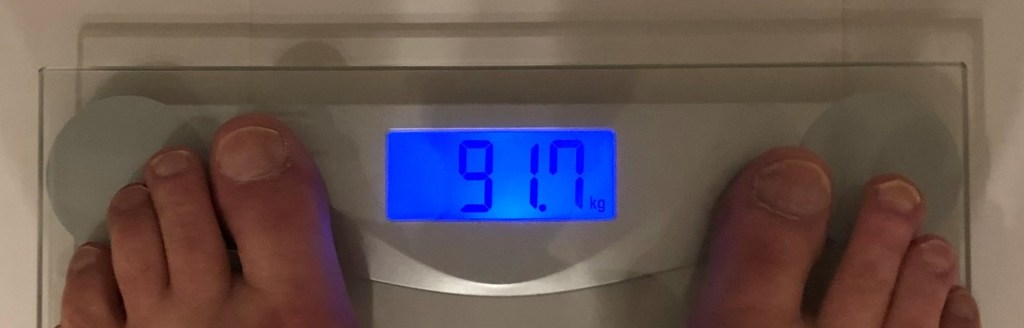
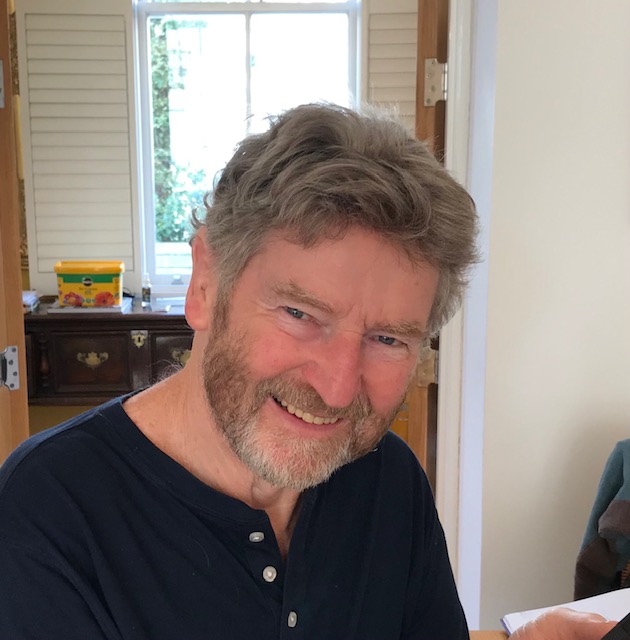
This was me just over two months ago – 100kg and a BMI score of 28 whichever way you look at it! (Overweight!)

Our headlines scream: ‘Britain has been the ‘Fattest Nation in Europe’ for a while’ and recent reports indicated the percentage of the population overweight or obese is increasing! So, does it matter?

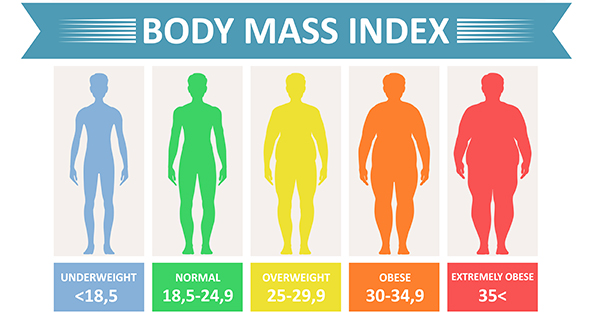
We have been measuring our childrens’ growth in schools for ever, establishing whether their health and growth were in line with the norms. The Body Mass Index (BMI) was introduced in the 1830s by a Belgian mathematician, Lambert Quetelet, as a way of estimating whether a person had a healthy weight, to measure the degree of obesity in the general population and therefore assist the government to allocate enough resources. I suspect we all know that BMI equals your weight in kilogrammes divided by your height in metres squared – kg h²

But this is simply measuring height and weight and doesn’t take into account other variables, for instance overall fat or lean tissue content. In 2013 Professor Nick Trefethen from Oxford University suggested that the height term ‘divides the weight by too much when a person is short and by too little when they are tall. This results in short people being told they are thinner than they really are, while tall people (that’s me!) are made to think that they are fatter than they are (‘tis true!!) Trefethen thinks a more accurate measurement would be multiplying the weight by 1.3 and the height by 2.5 and not squared. The same ranges would apply. (Ed. Doesn’t make that much difference to mine – still overweight!)

More recently it’s thought a waist-to-height ratio might be a better predictor of cardiometabolic health. Measure your waist mid-way between your bottom rib and hip; make sure it’s level and measure after you have breathed out. A healthy waist measurement should be less than 80 centimetres for a woman and less than 94 for a man. (Sorry? Not a circumference I recognise!) Your waist circumference should be less than half your height.

The urgency of tackling obesity here is the UK has been brought into focus by the evidence of the link between overweight and susceptibility to Covid; who knew? It’s estimated that 64 % of British adults, some 32 million people, are overweight (BMI over 25). This includes 28% who are obese and that’s double the figure for 30 years ago; of these almost a million people have a BMI of 35 or more. For those in this last category there is good news and bad news. The good news is that scientists have identified a gene, MC4R, that, if faulty, causes the brain to assume we have less fat than we do and signals we have to take in more calories. This might be the cause of an extra 16kgs. The bad news is it is likely to affect only 200,000 people in the UK; the other 800,000 obese are obese for other reasons!

Eating has become a continuous process – snacking or drinking coffee ‘on the go’. Mrs Fedup had a microphone stuck under her nose and the reporter asked her for her thoughts about the three hour delay from Magaluf to Manchester: “Shocking! No one tells us anything and no one provides us with any food. Haven’t eaten for 90 minutes. I’m starving!” We use words like hungry and starving too readily – it would be extremely difficult to find someone starving in the UK.

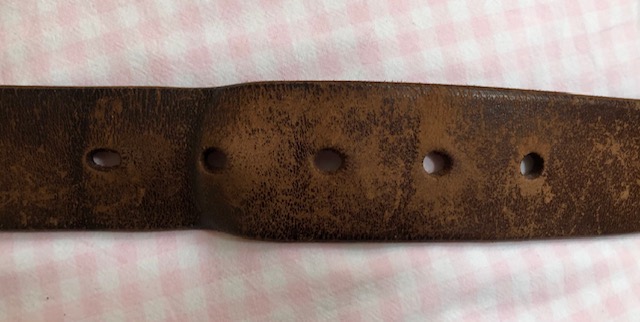
The leather belt by RM Williams shows the struggles, up and down!

Some people feel healthy even if they are overweight, particularly if they have been overweight most of their lives. Sadly being overweight often runs in families through bad eating and drinking habits; deaf to the warnings about the damage they are doing to their bodies and lacking the desire to self-educate about being healthier – but does that matter? We probably think that those who work in the health sector would understand and be role models of fit and healthy – but we are simply human and our doctors and nurses are just as likely to be overweight as the normal population. In Portugal last year the doctor we saw to get our Covid tests smoked and was overweight; I am sure he was happy, apart for the little monkey in his brain which every now and again said ‘Do something’. Some of us of course have a fatalistic approach to life.   

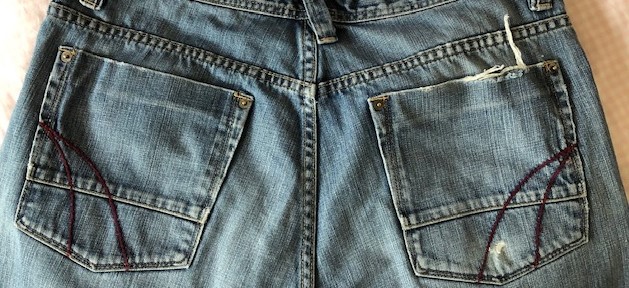
 Here we are making it easier to live with being overweight. Seats are being made wider, ambulances have stronger stretchers, you can find some clothes in XXXL (Well, maybe!). Instinctively this seems the wrong thing we should be doing; we should make it more uncomfortable as an incentive to lose weight. Part of my move away from 100kgs has been that, in order to get the jeans to do up, I have to breathe in; when I am zipped up, I breathe out and it’s uncomfortable. So I could go and buy some bigger jeans ……. or lose weight.

After decades of telling myself that breakfast is the most important meal in the day, I now skip it completely so actually fast from 2100 to 1230 the following day. Fasting changes the metabolism and from 100kgs I am on my way down ………

Some argue that the obese and overweight will actually save the NHS money as their life expectancy is lower than those of a healthy weight; bit morbid but probably true! However issues like heart disease and diabetes, brought on by being overweight, occur in middle age so there will be a bigger bill for the bigger nation. It matters and it matters big time!

Richard 4th June 2021

www.postcardscribbles.co.uk

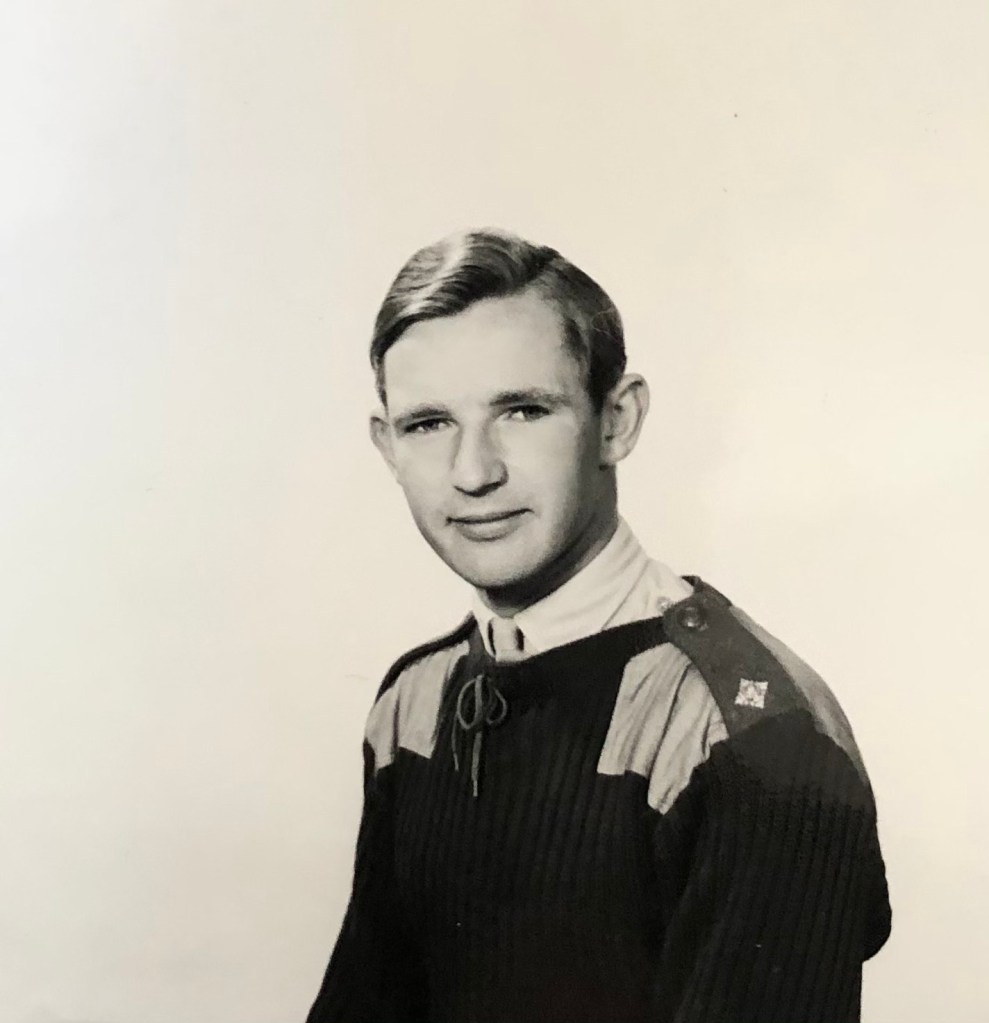
PS Suggestions one should get back to the weight you were at 20 are common. For me this would have been at The Royal Military Academy weighing 73kgs (11.5 stone) – with a BMI of 20. Ha! Ha!

PC 232 Pockets

This might be conceived as a very male–oriented postcard but in this unisex, gender-fluid world in which we live, I suspect we all wear trousers at some stage – real or metaphorical!

Originally in Britain the word pocket was used to describe a sack containing a measure of hops, some 168lbs, about 76kgs – or, if it was wool, a half sack. Feels like a lots of hops to me!

The other morning changing for our online yoga session, I decided to put the trousers I had been wearing into the washing machine, a process which requires diligence so not to wash a tissue or somesuch. As I emptied the contents of my pockets onto the bed, it struck me how habitual I am, and I suspect I am not alone? From my front right pocket I retrieved my house keys and my handkerchief, for I am sufficiently British to feel naked without one there in case of sniffles. It always amazes me when people who don’t have a handkerchief in their pocket sneeze – watching how they deal with any discharge, for sure there is always some, is intriguing – mostly they try and suggest nothing happened. Hopefully their disgusting personal habit will have changed post-Covid.

Normally my front left pocket is empty, a place for the wallet or mobile phone should I venture out.

In my back right hand pocket I always have a couple of monetary notes and a few coins. Despite losing two folded £20 notes many years ago from this rear pocket, I still take the risk! The advent of plastic notes has actually increased this risk, for they don’t fold as well as the old paper ones. In what used to be a virgin pocket, the left hand back one, I keep a reasonably clean face mask, ready when needed and hopefully not for much longer.

I remember a story from my childhood. A chap not too fond of flying boarded an aeroplane and found himself sitting next to an older man dressed in a three piece suit. As the plane taxied down the runway he observed the guy moving his hand, touching his forehead then following the line down to the waist, then from right to left across his chest. Imagining him rather religious, he asked whether it helped to pray.

“Pray? Oh! No! I was just checking: spectacles, testicles, wallet and watch!”

As a schoolboy one essential pocket item was a penknife – the older you got the bigger and more versatile was the penknife; the search for a horse to help with that stone in its shoe was never ending. Carrying a ‘knife’ these days seems problematic.

I grew up being told it was the correct thing to brush my hair, using a comb to create a parting, so a comb, however grubby, was another essential pocket item.

 That’s how it was, seemingly forever. Then I left the Army, grew my hair a little and decided it didn’t need a parting and a proper comb, just a comb through with my fingers. I am lucky, still retaining my hair and never carrying a comb.

And of course, as a smoker, a packet of Marlborough Reds and a cigarette lighter was always in a pocket; well, until 1994! No wonder the man-bag came into being – for a while!

The word accoutrements, as in an additional item of dress, is seldom used today  but off to a business meeting that’s exactly what I needed to check in my pockets. Business cards in a little silver case in a side jacket pocket and my half-hunter pocket watch in the outside breast pocket complete with silk handkerchief; if I failed to put one in I felt naked and hoped no one would notice – not about being naked, but about no silk pocket handkerchief!

In the army in our field ‘now you see me now you don’t’ disruptive pattern uniform, there were pockets everywhere. Especially useful was one on the outside of the sleeve for chinagraph waterproof crayons, to mark onto maps symbols that didn’t’ come off in the inevitable rain. Not to be confused with the look of the mad scientist with his pens in his jacket breast pocket.
Funny how phrases can be slightly contradictory; if you described someone as in-pocket after a deal, they had made some money, if they were out-of-pocket they had lost money. And if that had been the case it might have been because someone pocketed something dishonestly. Then of course we all remember pocket money?

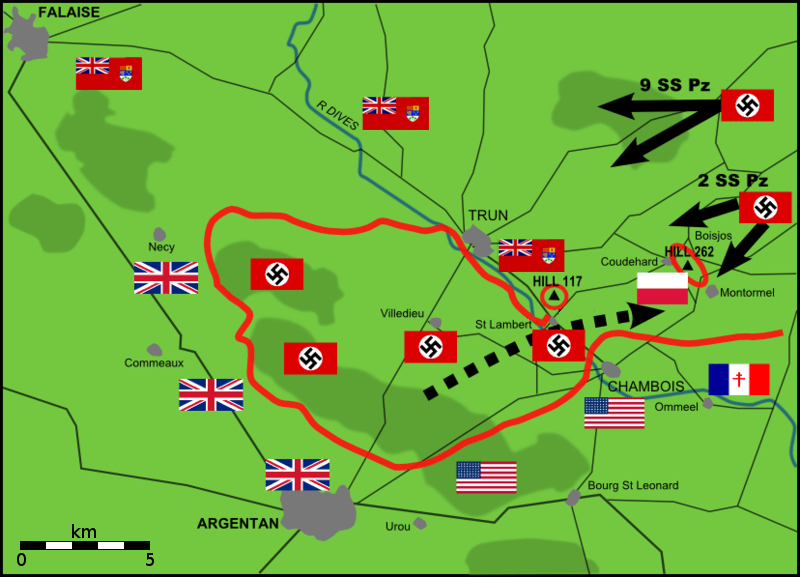
Military historians amongst you will think ‘pockets of resistance’ and remember the Falaise Pocket when, two months after the June 1944 Allied invasion of Normandy, 50,000 German troops were trapped in and around the Falaise/Chambois area of Northern France.

The original encirclement was penetrated a number of times by the Germans but eventually closed and they surrendered; their loss of men and equipment was enormous. A week later the Allies liberated Paris.

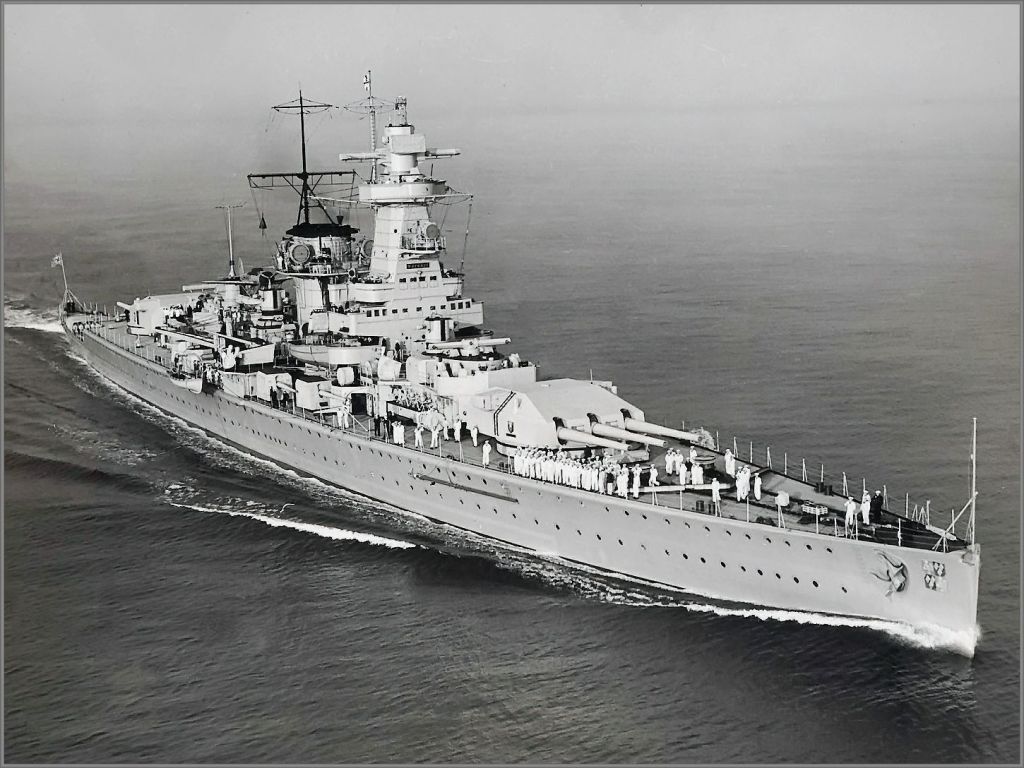
The original meaning of the phrase ‘pocket sized’ was that something was small enough to be carried in ones’ pocket, like a notebook. Not so the design of warship that was somewhere between a heavy cruiser and a battleship, the ‘pocket battleship’; the most famous of these perhaps the German Navy’s Admiral Graf Spee.

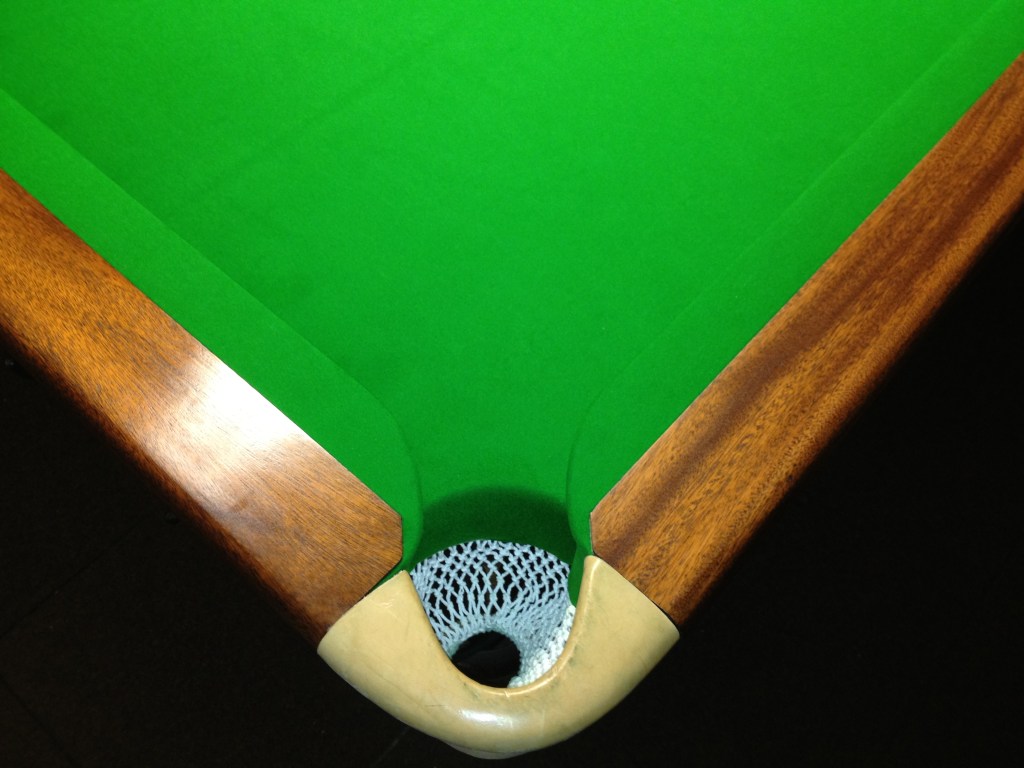
Over the years, starting at school I guess, I have played many games of both billiards and snooker, although not so obsessed as to watch the championships played here in the UK at The Crucible. Each billiard table has six pockets; the word can also be used as a verb, to pocket a ball, ie driving a ball into a pocket!

A corner pocket

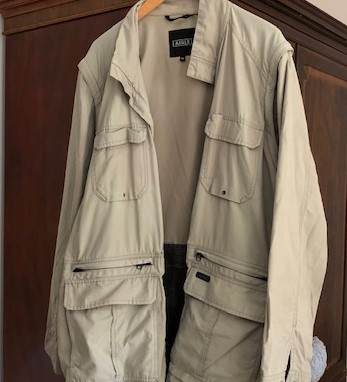
Needing an outside jacket with lots of pockets when out with my Labrador Tom, I dropped into Farlows on Pall Mall opposite the IOD in 2004. I am not a huntin’, shootin’, fishin’ chap but my Aigle angler’s jacket is perfect; pockets galore, even one at the back – possibly to bring back the stolen (poached?) trout – but used by me as somewhere to put the detachable sleeves.

And who hasn’t suffered air turbulence of some sort, some times worse than others? Those bloody air pockets into which the aeroplane seems to fall, your body straining against the seat belt.

Finishing these random thoughts about one’s pockets, I found this from Italy around 1850: ‘Shrouds have no pockets so money is for spending, not hoarding; you can’t take it with you!’

……. and no hands in pockets!!

Richard 28th May 2021

http://www.postcardscribbles.co.uk

PC 231 Ropes Warps and Sheets

Over the centuries those who sail have come to name every conceivable part of a boat, ship or yacht so that, in times of crisis, the exact name, particularly of a sail or rope, can be used. ‘Slacken off the main sheet’ cried the mate and a crewman jumped to do it. These scribbles are not designed to educate you to become an experienced sailor but simply to describe a couple of occasions when ropes, whether lifts or warps, made a difference.

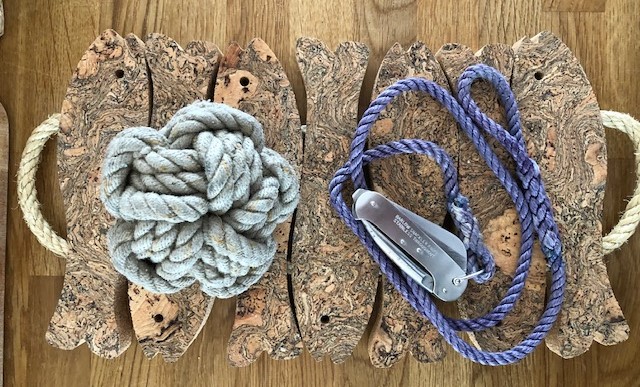
I should declare my love of ropes and warps and sheets and halyards and guys and hawsers ……. will whip any lose end and splice ropes to make lanyards etc. I even made a Star Knot but my five 60cm lengths soon disappeared and I never had a tail, the knot that is!  

Star Knot on the left and my sailing knife with spliced lanyard

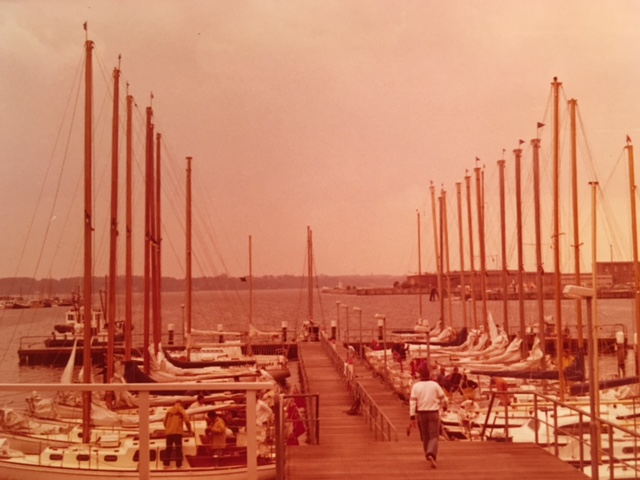
When I arrived at the British Kiel Yacht Club on the western shore of the  Kieler Fjord in northern Germany in 1969, all the club’s training yachts were ‘Danboats’; GRP, about 30ft long, sleeping 6 and without an engine, they were ideal for teaching the rudiments of sailing.

The BKYC Pontoon with Danboats on both sides

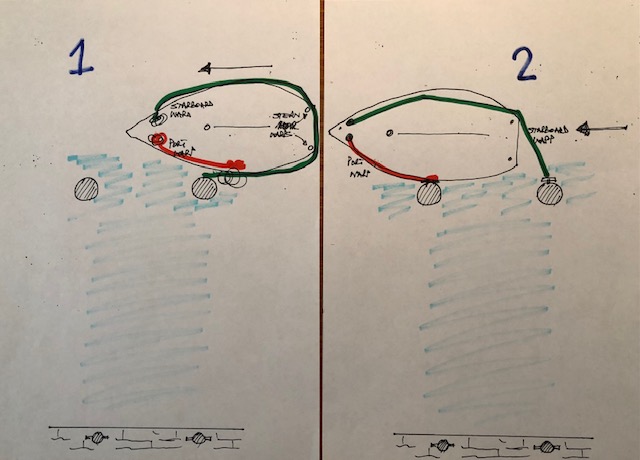
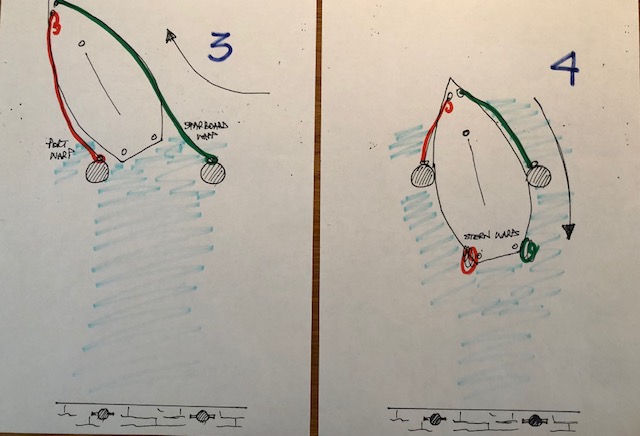
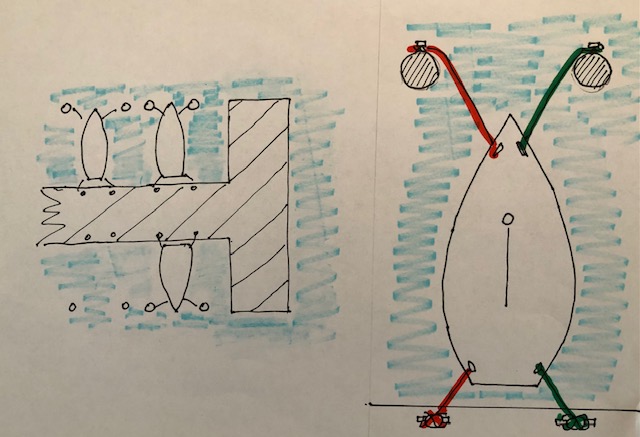
Rather like flying, taking off is easier than landing and when the yachts came back to the jetty they had to carry out a complicated manoeuvre to tie up.  Diagrams are the best way to illustrate this.

This is how the yachts are moored, bow to piles and stern to jetty

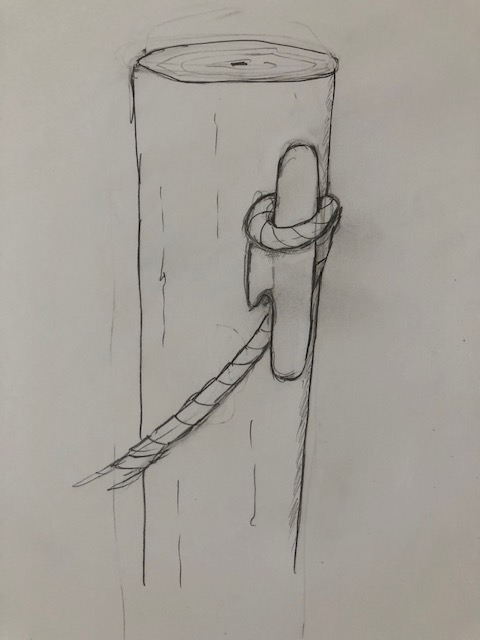
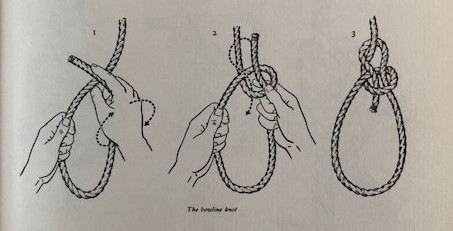
To get there you had to come alongside the piles, with both mooring lines having Bowlines (Note 1) made into their ends. You had no brakes so it was a real judgement about when to let the sails down. The starboard (green and right) warp was brought around the yacht’s stern to the port (red and left) side.

When you could you placed both bowlines over the cleats on the wooden piles and checked the forward motion a little.

When the stern was clear of the second pile, you turned the yacht through 90° by pulling on the starboard line first; squared up into the berth and pulled backwards, ensuring two crew were at the stern with mooring lines.  

The previous year my regiment spent three weeks in the Dhekelia Sovereign Base area in south eastern Cyprus, near Larnaca, undergoing ‘Adventurous Training’ and skills assessments. I was a second lieutenant and you don’t get lower on the officer ladder than that (Note 2). My troop commander, a Captain James Scarlett, loved sailing so he chartered a 44ft RAF yacht based at RAF Akrotiri, near Limassol, called Highlight.

On the first day of the charter we set sail for Dhekelia. Cyprus in August is hot and 1968 was no exception; generally the nights were calm with little breeze but by 1100 there was a strong onshore wind that got up from the south.

We arrived well after dawn off the sandy beach. We anchored and James Scarlett suggested we all went ashore for breakfast, Scarlett and me to the Officers’ Mess, two sergeants to the Sergeants’ Mess and the three soldiers to the mess hall – all very hierarchical!! In retrospect he was showing too much bravado and not much common sense as he left no one on board; sand is often a poor holding ground. By 1030, just finishing scrambled eggs and grilled bacon a mess orderly appeared and whispered in Captain Scarlett’s ear: “Sir! Thought you ought to know that your boat seems to be too close to the beach.”

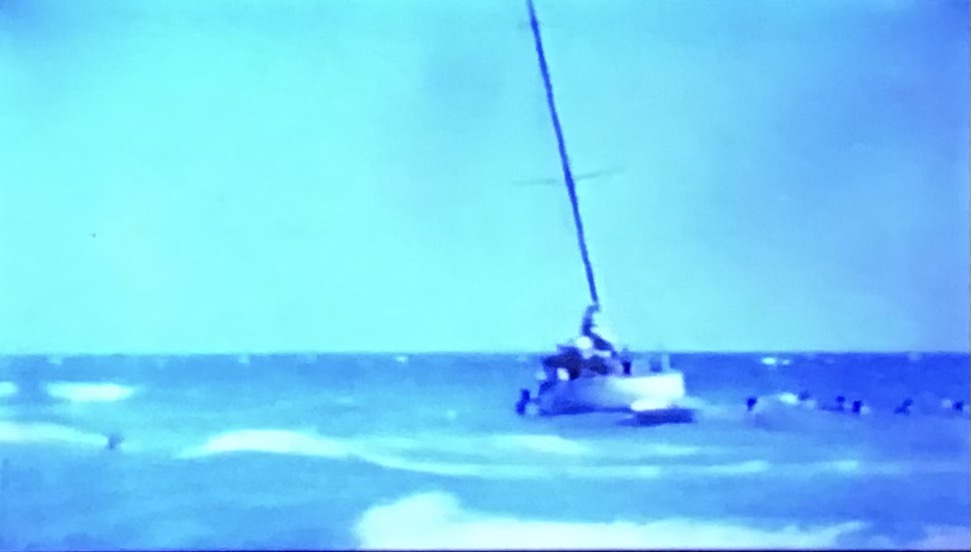
Never seen James blush so quickly and we legged it out the door and down to the beach to find Highlight bouncing up and down in the surf, her keel firmly on the sand. We managed to bring her around, head to wind, but by then she had created a little trench in the sand with the constant up and down action of her keel; I stood with water up to my thighs next to her and her draft was 6 feet!

A still from some cine film. The chap on the left of Highlight is standing!

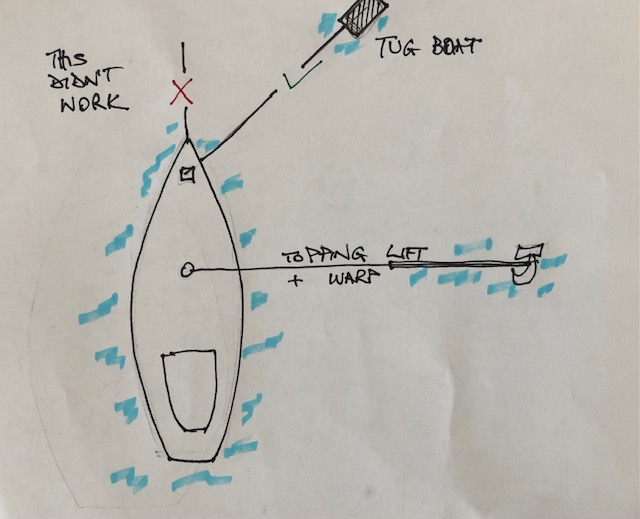
There was much scratching of heads and eventually a local Royal Engineer offered to bring over a tug – essentially a large metal assault boat filled with engines. A hawser was attached to the Samson Post up in Highlight’s bow and paid out to the tug. The first hawser, a rope, parted as soon as tension was increased; the second, a wire one, started to lift the Samson Post out of the rather rotten wooden deck. Back to square one!

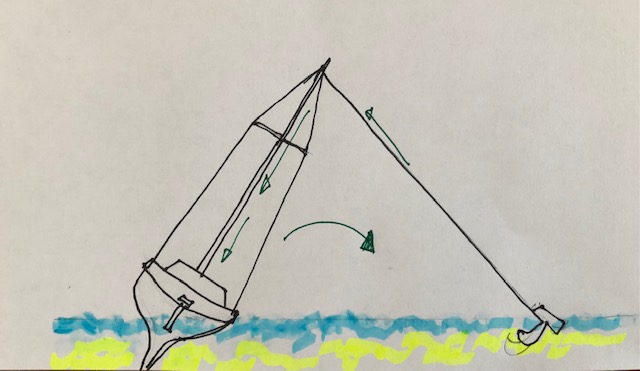
By now it was late afternoon and the wind had died down a little. To break the suction of the sand trench, we needed to be imaginative. Our solution was to take the topping lift and attach it to a large kedge anchor and put that in the sand some 25m off to the starboard side. We then winched in the topping lift; gradually the yacht heeled over and when it was about 40° the tug, sitting at an oblique angle, began to pull.

There was a great sucking sound and Highlight came free. We later tied up to a buoy in a nearby bay and inspected the keel. There was a slight dent in the keel plate but otherwise no damage. We were extremely lucky!

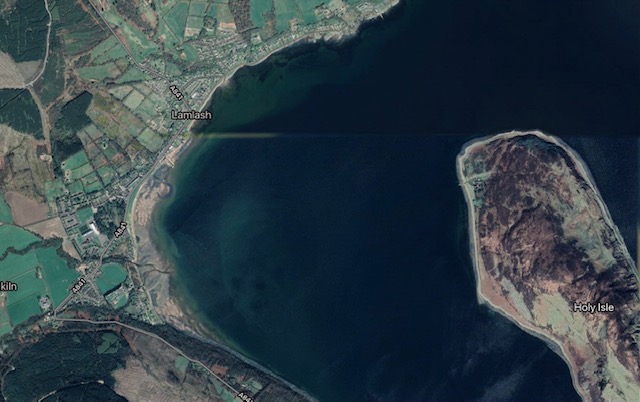
Lessons are always learned when sailing and I was reminded of Cyprus and near disaster when anchored off Lamlash on the Isle of Aran in Scotland, in the midst of sailing St Barbara IV from Liverpool to Oban.

The little village of Lamlash top left; Holy Island on the right

It was 1983 and the Royal Artillery Yacht Club was celebrating its 50th birthday by sailing St B IV around Great Britain.  I set an anchor watch as we turned in, for we were a bit exposed. At 0310 Chris woke me, worried about the rising wind and possibility of dragging the anchor. We started the engine, hauled the anchor in and motored three miles or so into the lee of Holy Isle. Anchor firm, engine off, back to my bunk. Job done!
Richard 21st May 2021

http://www.postcardscribbles.co.uk

Note 1The Bowline – an essential knot which can be undone very easily

Note 2 It had its advantages, being the lowest of the low, as towards the end of the three weeks the Commanding officer took me aside and asked me to be in charge of the 4 man Rear Party – another 10 days to make sure all the Regimental freight left as planned. An onerous task which took all of one day!

PC 230 Observations

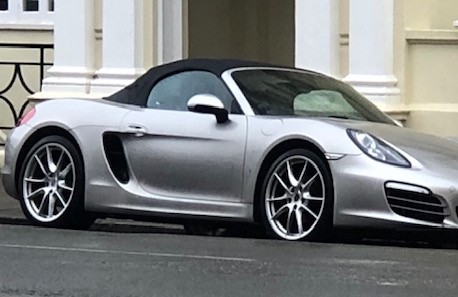
It’s fun to consciously observe one’s surroundings; too often it’s all in the mush of generalisations and we fail to see the detail, where the interest is. On my way back from collecting my newspaper the other morning, I observe a silver Porsche pull out from the kerb; we live in a posh area!

It wasn’t this one but same colour!

If I owned a Porsche I am sure I would do a little ‘look at me’ exaggerated movement or throttle revving – why not! But this individual had forgotten the basic lesson about never cross your hands on the wheel – and with a mixture of too much throttle and whirling crossing hands fighting to control the steering wheel, almost took the car across the street into another one. Writing ‘look at me’ brought back a memory of one of my first cars, a VW Variant, not the sexiest of automobiles. I bought some very nice Chrome wing mirrors and two seat belts, fitted both and drove around thinking ‘look at me’. Simpler age maybe?

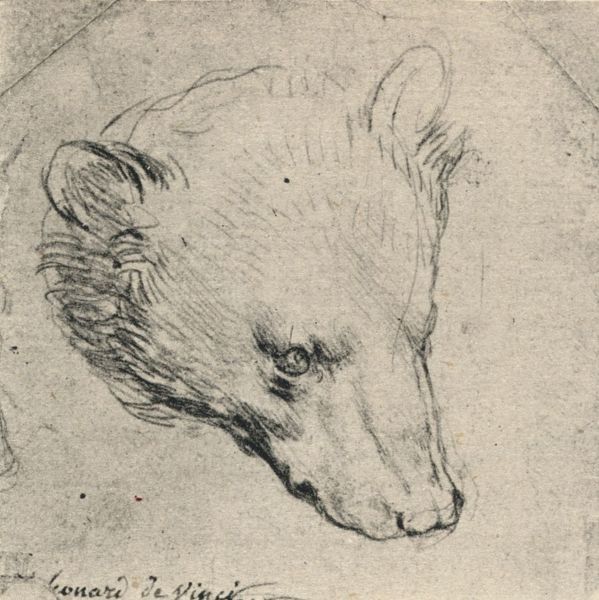
Did you see that lovely reproduction of Leonardo’s Head of a Bear in a newspaper last weekend? A ruler at the bottom showed it to be 7 cms long – and it was square. So it was 49 sq cms and not 7 sq cms as described! And I thought the editorial staff at The Sunday Times were numerate!

Leonardo da Vinci’s ‘Head of a Bear’ measuring 7cms by 7 cms

I sense everyone is trying to outdo everyone else with their ideas for saving the planet, doing their bit to slow the man-made element of climate change. Reducing the amount of plastic we use, improving recycling rates, moving from fossil-fuel powered transport to electrical, trying out new fuels ….. to our own efforts. We recycle but get frustrated that ‘stuff’ we think should be recyclable isn’t and we don’t understand why the industry isn’t publicising why we can’t do this or that or indeed why they can’t do this and that, and buying a Hotbin composter. In addition to the pile of loo paper from ‘Who Gives A Crap’ (minimum order 48 rolls) we now have a little plastic (sorry, couldn’t find a wooden one!) container in the kitchen for the food waste.

And I am reminded of my late step-mother and her habits. She and I didn’t have the greatest of relationships so I can indulge my memory in its entirety. She and my father lived in the middle of a damp wood in an old keeper’s cottage, in Wigtownshire. She kept chickens. One disgusting habit was to take the scraps of kitchen waste out in their little bucket to the chickens, scoop up the contents with her hand, come back into the kitchen and start preparing a meal – without washing her hands – well, to be fair, she might have wiped them down on her not-too-clean apron first.  

Unbelievably, the slippers sent to my mother-in-law in Portugal in November, and returned, and returned, have now been returned. They must be the most travelled slippers on the planet, having completed 4500 miles and still not worn! (PC 220 Soleful Tales and 221 Ephemera refer) We thought they had complied with the “Fill out the customs form and you might have to pay this or that but we are not sure so we can’t release them yet” request. Then silence …… until Royal Mail delivered them back to our front door.

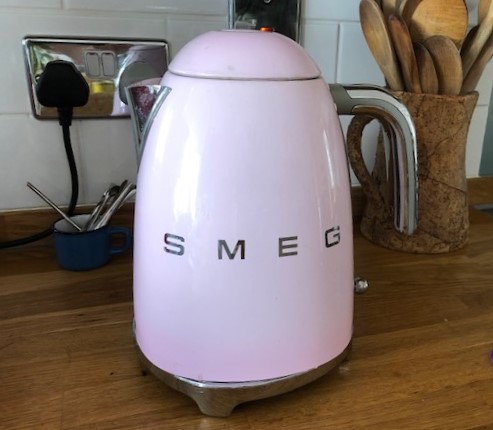
Monitoring the amount of energy you use is other way, so we are told, of helping the planet. Sadly the electrical meters for Amber House are in an outside cupboard more than 25m from my apartment and a Smart Meter wouldn’t work. Trumpeting the benefits of a Smart Meter, a recent advertisement stated it costs 63p per hour to boil your kettle. Who would want to boil their kettle for 60 minutes?

In the United Kingdom the Office for National Statistics conducted a census on Sunday 21st March. In the book ‘Britain: An Official Handbook’, published by the Central Office for Information, you can garner every conceivable fact about this country. Whenever I read the word census I am reminded of why Joseph and Mary travelled to Bethlehem, such are the Christian stories embedded in my psyche! Sorry! – Oh! Yes! The national census – these days completed online, done easily and without too much thinking. So it was a surprise to have a census chap ring the doorbell the other afternoon. “We need to verify some of the responses from a sample of the population and your address came up.” On Thursday a chap presses the door-entry phone and came into the inner hall but didn’t want to enter the apartment.
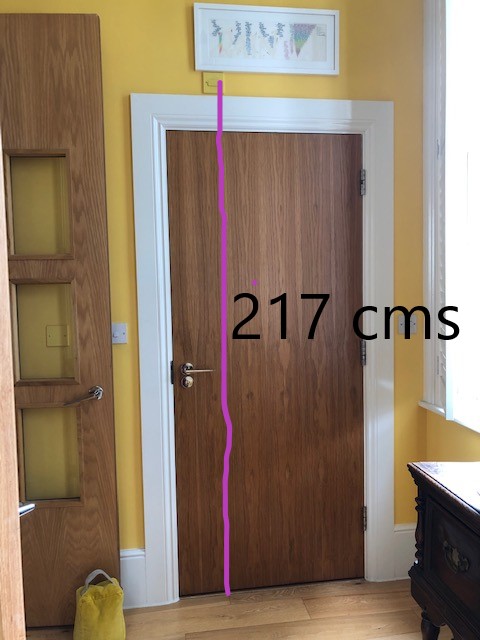
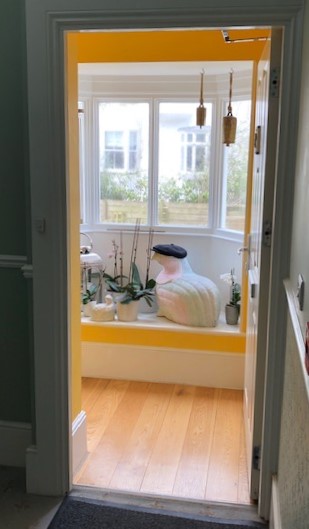
Our Apartment front door – and the view the census chap had!

I thought he was simply going to ask me a couple of questions and enter my answers digitally and that I would only going to prison if I my answers were not the same as those I gave on 21st March. But no, unable to get an internet connection, he withdrew a paper booklet from his satchel and proceeded to ask me every question on the census form. After ten minutes the question “What sex do you declare?” came up. I am not so much of a dinosaur that I am unaware that this is now a multiple choice question. “Really?” I asked. “Yes! Particularly as this is Brighton (& Hove).” “I am sorry I am not going to answer that!” I said, putting my hand in my trouser pocket, searching for something. (Note 1)

The founder of the Apostrophe Protection Society, a John Richards, died last month aged 97. Twenty years ago this retired journalist was so concerned for the apostrophe’s survival that he created a website (www.apostrophe.org.uk) aimed at preserving its correct use. “The apostrophe plays a vital part in written English. Just take this sign outside a block of flats: ‘Residents’ refuse to be placed in bins.’ Remove the apostrophe and you see a very different notice.” You may remember PC 195 illustrated with Lynne Truss’s ‘Eats, Shoots & Leaves’ and the misplaced comma? Apostrophes have, I think, an important part to play in modern written English; it’s true isn’t it or is it “its true isnt it?”

Richard 14th May 2021

http://www.postcardscribbles.co.uk

Note 1We are getting our knickers in a complete twist when it comes to gender and its variants. Here the LGBT charity Stonewall has a ‘Diversity Champions’ scheme urging employers to sign up to its goals, but not allowing individuals to argue against its diktats. Apparently ‘dozens of woman have faced disciplinary action at work for offences such as stating JK Rowling is not transphobic (interesting a word the online dictionary doesn’t recognise!), asking questions during equality training or requesting female-only loos’ – actually they used the word ‘lavatories’ but this is not a word I recognise!! I did, by the way, find what I was looking for.

PC 229 500 miles to Oslo

If you are a Netflix fan you may have watched ‘Occupied’, a very interesting drama set in the future about a partial occupation of Norway by Russia.  (Note 1) There was some good coverage of the beautiful city of Oslo and I was reminded of my many trips there, but one in particular, approaching from the sea.

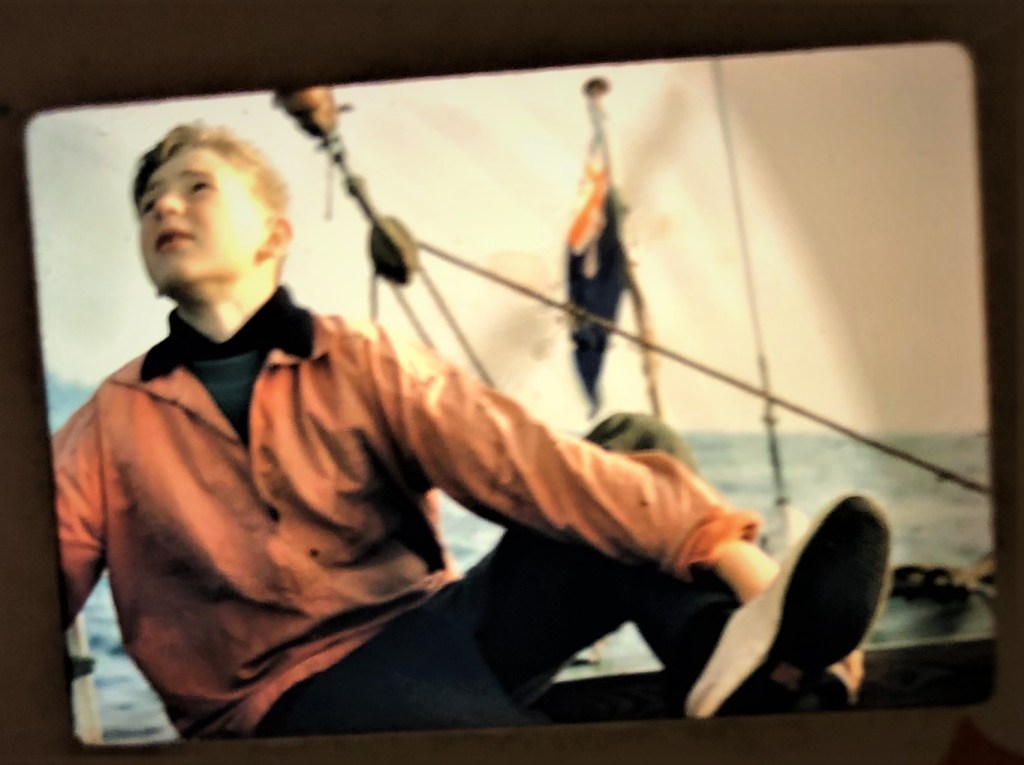
Sailing up in Scotland Aged 9

Regular readers will know that I have enjoyed many years of offshore sailing, clocking up some 15,000 miles since 1969. (See PC 106 (Sept 2017) Sailing in The Baltic and PC 161 (Sept 2019) The Atlantic) Some voyages are naturally more memorable than others and so it is with my 500 mile Oslo trip in August 1974. I was based in Sennelager near Paderborn in Germany and chartered the Royal Artillery Yacht Club’s yacht St Barbara II (St B II) for a fortnight. (Note 2)

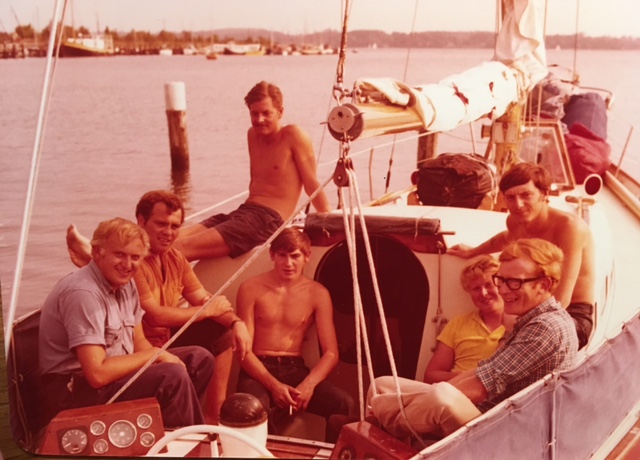
Crew Kiel to Oslo

Arriving at the British Kiel Yacht Club on the outskirts of Kiel, we were met by the bosun, a likeable and competent Bombardier on secondment to the club.  “You’ll have plenty of storage for your trip as the engine is out for maintenance and we are awaiting spares.”  St B II was a 42ft Rebel and I had sailed her a number of times, so wasn’t particularly fazed by this news, except in relation to the provision of electricity. A yacht’s engine was useful for charging batteries which, inter alia, powered the navigation lights essential for night passages. It was also useful for manoeuvring in tight marina berths, particularly in a 40ft plus yacht.

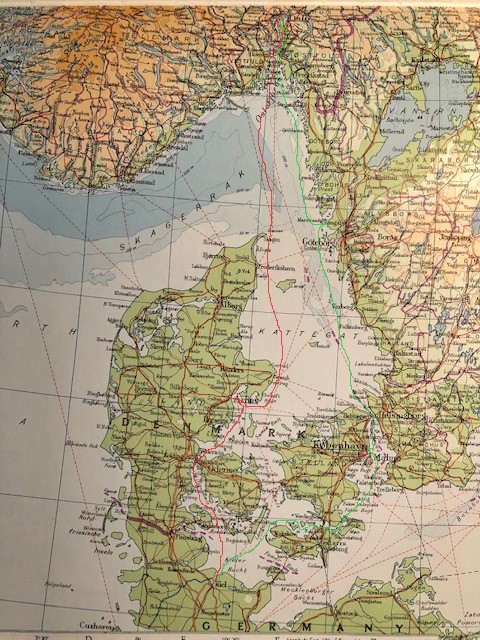
The outward trip in red, the return in green

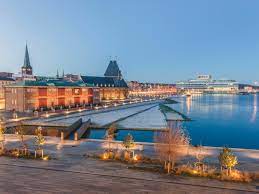
The crew numbered seven, 3of whom knew how to sail, so the trip was a mixture of training and sightseeing. Slipping the BKYC jetty on the Friday morning we sailed north up the Little Belt between the Danish mainland and the island of Fyn and into the harbour of Middlefart (Yes! Really!). From there a short hop to the university city of Aarhus (Note 3).

Aarhus

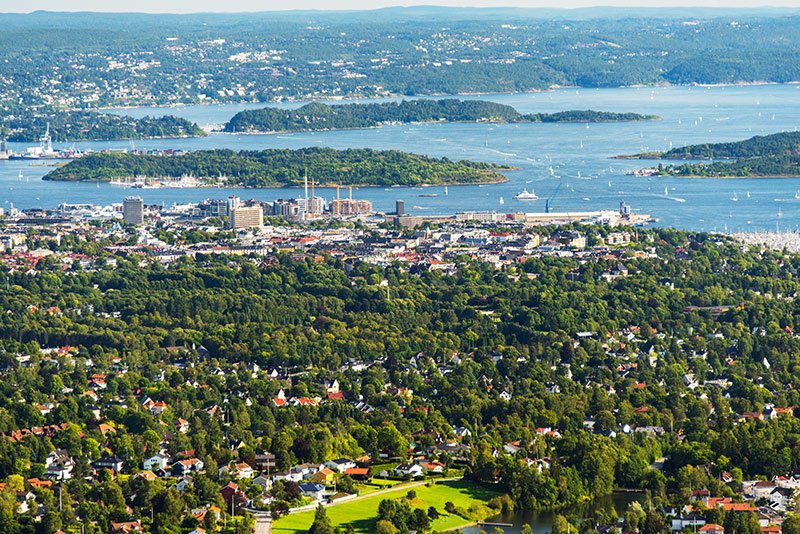
We did a little sightseeing while recharging the yacht’s batteries and then set sail, north up the coast, passing Skagen on the tip of Denmark, so loved by international artists for the purity of its light. The sea north of Denmark marks the exit of the fresh water of the Baltic, from the Kattegat into the Skagerrak and then into the North Sea. I didn’t want to sail the majestic Oslo Fjord at night as I had no means of getting out of trouble without an engine, so drifted into Hortens on the west coast of the fjord for an overnight stop and essential battery charging. The wind tends to funnel down the fjord so it was hard work beating northwards, but in daylight the following morning it was a wonderful experience, as sheer mountainsides close in from both sides, waterfalls tumble down, wind shifts are numerous and the water is extremely deep. Eventually we tied up alongside in the marina in Dronningen on the west of the city, did some sightseeing and welcomed a new crew from Germany.

Oslo

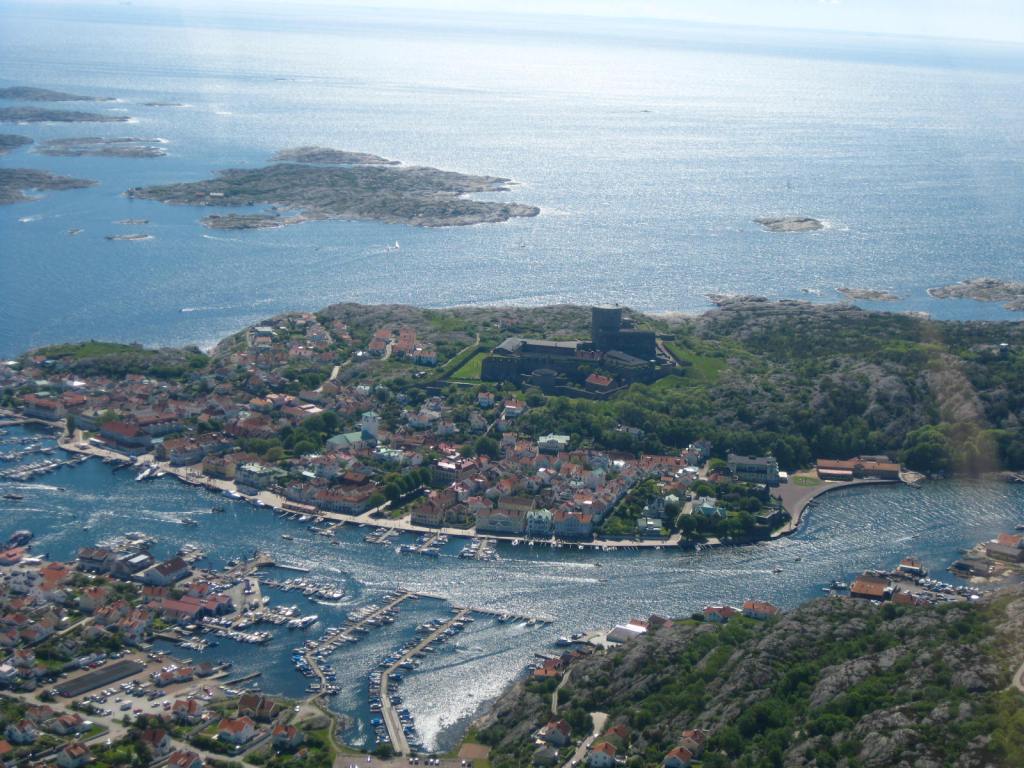
On Sunday 25th we sail south, this time goose-winged (Note 3), feeling very small as the mountains dwarf the yacht. Our initial destination is Marstrand, just north of Gottenburg on the Swedish west coast. The town is Sweden’s equivalent of Cowes on the Isle of Wight here in England and the focus of international racing festivals.

Marstrand, Sweden

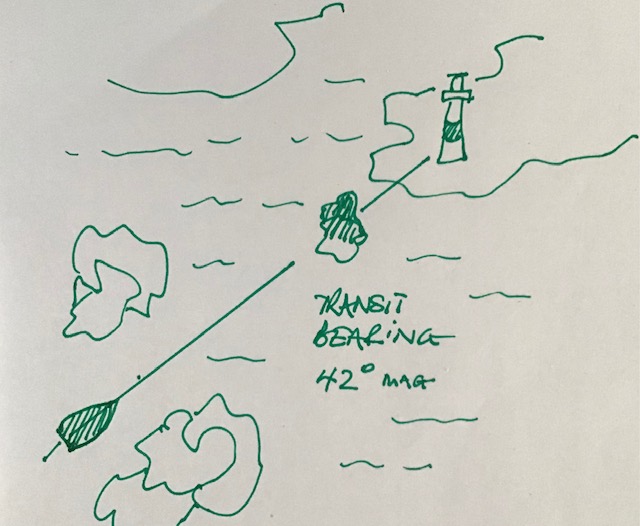
From the chart and from the various sailing guides I had interrogated there were two ways in ….. and the southerly one looked more interesting – I wished I had listened to the little voice in my head ‘play safe’. This approach required lining up a transit and sailing that exact bearing.

Lining up a transit of rocks and a lighthouse, sailing a course of 42°

Why? Well, the west coast is strewn with rocks and the transit took us between two large patches. It was blowing about Force 4-5 from the north, the wind was abeam and this made for fast sailing. Having lined up the transit we committed ourselves, knowing that we couldn’t deviate much from the line; the sea surged over some rocks visible on the bow to both port and to starboard but there was space between! The guides had described it as easy; my heart started beating faster than normal and I remember asking the mate what he thought, was this sensible … or not!

In Marstrand our arrival created some local interest and it wasn’t long before the jetty was crowded with onlookers. One particular chap and I struck up a good report and I invited him on board for a drink. Invariably we talked about the prohibitive cost of alcohol in Sweden and he told me that most Swedes brewed their own. “I use an old bath in a shed.” Olav said. “So how do you know when it’s ready to drink?” I asked. He held up his fingers; one was missing its tip. “I dip my fingers in; too strong and this is the result!”

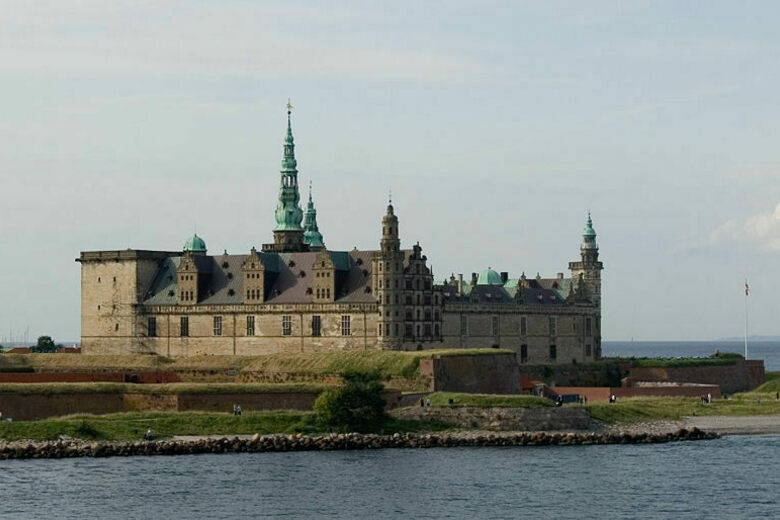
From Marstrand we sailed south into the channel between the Danish island of Zeeland and the Swedish mainland, passing the twin castles of Helsingør, used by Shakespeare as Hamlet’s Elsinore, and Helsingborg at the northern narrows.

Helsingør

As we approached the outskirts of Copenhagen what wind there had been vanished and we drifted. Fortunately we were spotted by Stan Townsend, a British retired engineer officer and well-known Baltic sailor. A tow was proffered and gladly accepted and we made it to a marina just north of the city. Judging when to let go the tow so that you have sufficient way to make a berth is tricky, for yachts without engines have no brakes!

After some sightseeing in the city we slipped the marina moorings and made our way south, down the west coast of Zealand and into Stubbekøbing.

Stubbekøbing’s marina is new!

Black Jack, the yacht’s mate, was responsible for taking St B II into this rather commercial harbour. Good practice for him I thought …….. until we found ourselves heading towards a fishing boat tied up alongside the quay too fast and emergency manoeuvres were required! 

The Army called this ‘Adventure Training’; for me an absolute delight!

Richard 7th May 2021

www.postcardscribbles.co.uk

Note 1 Norway is not part of the EU and this drama has been mirrored this week in a stand-off between French fishermen and the State of Jersey, part of The Channel Islands, over fishing licences. A French minister threatened to cut off the island’s electricity supplies, 98% of which come from EDF a French energy company!

Note 2 We covered 1050 miles and spent 45 hours sailing at night, between Thursday 15 August – 4th September 1974.

Note 3 The Danish TV series Dicte was based in this city

Note 4 With the mainsail set to one side and the foresail to the other, only possible with the wind well aft of the beam, the sailing term is goose-winging.

PC 228 Thinking Out Loud

Inspired to make a contribution towards more ecological living, you may recall my purchase of a Hotbin composter (PC 221) in the last few days of February and how I had had to use the landline telephone. Landline? Who has one of those these days? Well, here some 75% of the adult population but that’s probably a great deal lower in our 18 – 35 year age group. Living in Amber House the landline is essential as mobile signal coverage is very variable. Despite living in a city and despite my service provider O2 claiming I should have 5 bars, the reality is that it drops out, that the only way to get a good signal is to hang out of the window, with the tips of your toes wrapped around the radiator to prevent catastrophe. Texts?  ‘Didn’t send. Try again?’ ….. so you move a couple of metres and try again, lifting your arm up into the stratosphere as if that will help.

You may remember an office …… and you may have been lucky enough to have a desk …… which came with a landline telephone …… its cable coming up through a hole on the right hand side? I am sure you’ve watched a film where someone picks up the telephone with their right hand, dials a number and in the course of the conversation wants to make some notes. So they transfer the handset to their left ear, with the cable coming under their neck, half-throttling them, and use their right hand to write. Much easy to get used to using your left ear to listen, having the telephone on the left hand side of the table, with a free right hand to scribble. The reverse is true if you are left-handed (Note 1)

You might think if you have been reading these postcard scribbles for a while that I watch television quite a lot. ‘Tis true, particularly during these lockdown periods, but documentaries and dramas give me ideas about this and that.

Recently I watched some lightweight crime drama where the lead detective, and that’s lead as in most senior and not lead as in dead-boring and that probably would have been leaden…….. in the middle of a conversation with someone ……. when their mobile chirped and he said: “Sorry! Just need to take this!” without even looking at the screen to see whether it was someone on his Contacts List or someone unknown, without knowing who had called him and of course these days it could have been someone asking whether he had been involved in a no-fault car accident or someone whose first words were ‘I am not selling anything’ and one’s heart sinks because you know that’s exactly what they are going to lead into (lead again!) …… so interrupting whatever conversation he was having ….. just because your mobile rang or chirped or barked or whatever ringtone you have selected …… just because the caller has decided to call you as it’s convenient for them without knowing whether it’s convenient to you and we have become slaves to the ringtone, slaves to the ‘must answer this’ demands!

Sorry if I am a dinosaur about this but what happened to good manners when you are talking to someone aren’t you focused on them and what they are saying and how you might respond and yes sometimes you wish your mobile would ring and give you an excuse to pause the conversation because the person next to you is banging on and on and you wish they would listen and then you realise the only way to interject is to interrupt and that used to be rude but in some cases necessary. In the course of this particular drama the detective must have said ‘sorry I need to take this’ 8 times ……. not that I was counting!

I often call a chum, just for a catch-up, and I call when it’s convenient to me; possibly after lunch. “Sorry, just in the middle of lunch/afternoon tea/reading important stuff! Can I ring you back?” – so why answer in the first place when an answering machine will take a message? And don’t get me started on the modern habit of arriving in a restaurant (remember those?) and everyone puts their mobiles on the table; why go in the first place if you don’t want to engage with those you have come to be with?

Carol Midgley, writing in The Times on 17th April: “Oh! No! They’ve come back the phombies, more gormless than ever! People who walk and text simultaneously, oblivious to traffic or the old ladies they knock into. Almost knocked one over the other day texting, crossing the road, earbuds in; it’s important to be deaf as well as blind crossing.”

Of course our mobiles have become so much more than a way of speaking to someone. We communicate by voice, by text, by sending a photo or using one of the many social media apps. And more than a communication device, the mobile or iPad has become the internal spy for companies anxious to sell you stuff. For example, last year a bird dropped a seed and it landed in some compost in a terracotta pot. This I surmise as I didn’t actually see the bird but I saw the little shoots of growth.

So I encouraged it, watered it, re-potted it and watched it develop. The problem is I don’t know what type of plant it is, possibly a weed, possibly a shrub, possibly a tree. So I took a photo and sent it by WhatsApp to Sally whose a keen and knowledgeable gardener – if in doubt go to the Oracle or so I thought.

The Oracle responded in a negative way. Not so the internal spy! The morning after my Facebook offering is to invest in an App that will tell me what it is; I know there is one for plants but this is for trees.  

Just thinking out loud!

Richard 30th April 2021

http://www.postcardscribbles.co.uk

Note 1. Famous lefthanders include Angelina Jolie, Winston Churchill, US Presidents Barak Obama and Bill Clinton, Bart Simpson (as his creator Matt Groening is) and the future King of England Prince William.

PC 227 Departing ………

It comes to all of us, without exception, our departure from this world. Where we go, if anywhere, has been a constant in our philosophical merry-go-round discussions.

I appreciate it may be a factor of age, reading the published obituaries of individuals deemed worthy of comment, but three recently caught my eye. The first, George Reynolds, who heeded the advice of a priest after he emerged from his fourth prison sentence: “You’re clearly not very good at crime; why not try something legitimate?” Reynolds went on to make £260 million – a real mixture of businessman and rogue.

Then there was Doreen Lofthouse. Not sure whether it spans the generations but you may recognise the trade-name Fisherman’s Friend? Developed for fisherman from Fleetwood, Lancashire to sustain them and relieve their bronchial congestion in the cold North Atlantic, it was initially a liquid medicine, containing liquorice, menthol, eucalyptus oil and capsicum. From its origins in 1865 it was modified into a starch-enclosed lozenge and by 1971 into the aniseed one we recognise today. Believe it or not, some 5 billion lozenges are now produced annually and exported in various versions all over the world.

Doreen, who married into the family, changed the company from a small local operation to a global business; she died at the end of last month aged 91. Interestingly her obituary in The Times erroneously titled her as ‘OBE MBE’. When you are elevated from one rank in the ‘British Empire’ award, you drop the lower one; she should have been simply OBE! Just for accuracy you understand.

Then we have the celebration of the life of the Duke of Edinburgh, Prince Philip, who died aged 99. Anybody who has reached their 90s must be judged to have had a full and rewarding life; his was no exception. One of the lovely comments I read was from the Countess of Wessex, wife of Edward; “He passed away gently, as if someone took him by the hand.” Departed for sure!

Numerous stories have been published here in the newspapers about his unique and waspish sense of humour. One concerned some tabloid photographs of the Duchess of York having her toes sucked while she lay naked by some swimming pool in the south of France. “Beyond the pale!” the Duke commented, using a phrase popular amongst his generation. (Note 1) Reminded me of how this lovely phrase, meaning unacceptable behaviour, came into the English lexicon. The word ‘pale’ comes from the Latin ‘palus’ meaning a stake or fence. The historians of you will know that England ruled over much of the island of Ireland, although by the late C15th that area had been much reduced; what was left was contained by a ditch from Dalkey just south of Dublin to Dundalk to its north. The ditch had in theory a fence, and obviously anywhere beyond the fence was an area of lawlessness and danger – ‘beyond the pale’.

Gives colour to one’s language, to know the origins of these things. Nigel Rees’ ‘Phrases & Sayings’ is a great reference and what you can’t do if you simply Google it is read what phrases it’s sandwiched between. In this case ‘Beyond The Fringe’, a term first used at the Edinburgh Festival in 1960, and ‘BFN’. Jimmy Young had a hugely successful BBC Radio 1morning show and his sign-off was BFN – ‘bye for now’. Maybe it’s used in modern abbreviated text speak – but I know not!

Word associations and links can create fun challenges and often on the commercial radio station Classic FM the compere asks the listener to establish a link between pieces of music or composers. The other day I drove up to see my daughter, a rather unique event these days and the first since Christmas; I listened to the radio. The guest presenter was John Humphrys who hosted the television series Mastermind for 18 years and therefore anxious to measure his listeners’ knowledge. He played John Caponegro’s Shoe Symphony and was looking for associations. I immediately thought of Choux (pastry) and later research found a Baker’s Symphony by a Kuba Piecze.

Do you understand this: “to plus to is fore?” Or this: “Te kwality of merci is not stained. It drops as te gentle reign from heven on the place beneef. Its twice ……..” Not shore weather ither make cens? Maybe this is better:

“The quality of mercy is not strained; it droppeth as the gentle rain from heaven Upon the place beneath. It is twice blest; it blesseth him that gives and him that takes.”

Departure from a good standard of spelling and grammar has been on the lips of many pedants here, after the University of Hull announced that “they were committed to removing barriers to learning, increasing social mobility and providing opportunities to students from all backgrounds.” …. meaning if your work is badly spelt but understandable, that’ll do.

Writing in the Times, Giles Coran’s headline screamed: “Don’t stop at spelling, let’s refresh jography too”. (And this is not the science of slow running). Fortunately that newspaper’s leader of 12th April was written with clarity. “The claim that requiring good English could be seen as ‘homogenous north European, white, male, elite’ (as Hull had suggested!) is seen as a idiotic travesty of everything a university stands for …… and a massive disservice to those it misguidedly believes such piffle is meant to help.”

Such an appropriate if old-fashioned word, PIFFLE!

Richard St George’s Day 2021

http://www.postcardscribbles.co.uk

PS My last PC concerned the truth. One comment from Meryl, “Not only very interesting but highly philosophical! You have identified that the biggest threat to modern civilised society is the absence of absolute truth. Whereas for many this used to be God, it has now become a case of ‘what I believe is the truth for me.’ What do you think?” deserved a reply: “I think we see our perspective of our experience as the truth but acknowledge that others may see it differently and the reality may be something different again.” And Meryl again: “Truth is a concept that is increasingly stretched from reality.”

PPS Twitter exploded last Sunday with comments about a text read in a BBC Crime drama called ‘Line of Duty’. The word ‘indefinitely’ was spelt ‘indefinately’.

Note 1 There was another use of this phrase this week as we watched a Netflix series, Occupied. Another of those coincidences!

PC 226 The Truth, The Whole Truth ..

I am sure we have all seen it on television, in plays or in films, the moment of gravitas when the clerk of the court offers a bible to a witness and says: Take the bible in your left hand and say after me ………. “I do solemnly, sincerely and truly declare and affirm that the evidence I shall give shall be the truth, the whole truth and nothing but the truth.”

Some years ago I was called to serve on a jury in the local Hove Crown Court. Having been sworn in, we were asked to judge whether the accused was, beyond reasonable doubt, guilty or not. It was a great reminder of the way our justice system is the bedrock of civilised society, being judged by one’s peers. I had my share of making such judgements in the army, both as a Battery Commander delivering summary justice to miscreants under Military Law and also on a Courts Martial panel. Trying to establish the truth is quite subjective, for we all innocently filter what we hear and see through our own mesh of experiences.

Hove Crown Court

You may recall me quoting Caroline Jones from her book “the space in between” in PC 202; it’s worth repeating as she eloquently sums up the issues about memory: “…..  I don’t want to hurt anyone’s feelings – and who is to say that my version is true anyway? Who is entitled to say what is true in any family’s history? It is all shades of grey, interpretations and misinterpretations: something that passes one person by might be the thing that tips another onto a different journey; and all, in the end, coloured by imagination and weakened by unreliable memory.”

Last year, still in the age of the Trump Presidency, we read about the hearings on the nomination of Judge Brett Kavanaugh to the US Supreme Court. These are not things we in Britain understand. Here judges are appointed to our Supreme Court by the monarch; the name of a nominee is given by a Selection Commission to the Prime Minister who must pass the name without comment to the Queen, so in theory ensuring the Judiciary remains apolitical. You may of course think the American way has some merit, as it gives a congressional committee an opportunity to determine whether A or B could or should be selected.

This is by-the-by. What always amazes me is a person’s ability to recall conversations from their past, in the case of Christine Ford and Brett Kavanagh over thirty years ago. She had accused him of sexual assault at a party. Now I understand that when the experience is traumatic, the memory can be very vivid and long-lasting. But my mouth drops when I listen to someone recall a party 36 years ago …… one where alcohol was present ….. and go into the ‘he said’ ‘she said’ recall. It’s the same when people write their autobiography. Conversations with my mother when I was 7? Nah! Can I quote verbatim what I heard last week any better than last year or within the last decade? Nope! My mind generalises the experiences, compresses the data so it’s manageable.

I find myself shouting at the television more and more, mouthing ‘bollocks’ or somesuch; must be a feature of being over 60? Most recently it was during a screening of an ITV lightweight crime drama entitled MacDonald & Dobbs, set in the city of my birth, Bath. The second episode was centred around someone’s death on the railway tracks running through the Box Tunnel. This tunnel was designed by the prolific Victorian engineer Isambard Kingdom Brunnel (1806-1859) and its alignment catches the rays of the rising sun on his birthday, the 9th April.

Much was made of this fact in the drama and that it only happened once a year ‘on his birthday’. Well, anyone with even the scantest knowledge of our solar system and our earth’s tilting axis will know that the sunrises on the same azimuth some five months later, in this case on the 4th September. But if you didn’t know, as maybe the writers of the drama didn’t, then you would accept this as the truth – the whole truth being different, gospel.

I didn’t watch Harry & Megan’s interview with Oprah Winfrey, but saw enough of the clips and read much of the analysis to form a view. This is not about them or their situation but more about the trend to challenge what is true. Although advertised as an interview, it seemed more an opportunity for them to air ‘their truths’, to make statements that went virtually unchallenged. The rules for royal titles for instance were laid down in the Letters Patent, issued by King George V, so in my view it’s disingenuous for Meghan to make out otherwise. Similarly her statement that she had a ‘secret wedding’ before the official one was simply untrue; revelations such as these diminish the whole two hours and subsequent furore.   

Much has been made over the past 18 months by both Harry and his brother William of the modern challenges to our mental health. So in my mind it’s unbelievable that Meghan didn’t discuss her suicidal thoughts with him and he, in turn, couldn’t help or find the right person for her to talk to; shame on him. What is striking are these new ideas about what is true, what is your truth or my truth and what isn’t; to use a playing card analogy, that a ‘lived experience’ can trump ‘hard evidence and intellectual analysis’. One person’s version of past events can be rather different – summed up nicely by the statement from The Queen – “recollections may vary”.

The truth, the whole truth and nothing but the truth.

Richard 16th April 2021

www.postcardscribbles.co.uk

PS And slightly tongue in cheek, we always imagine that the BBC newsreader’s script is grammar-perfect and speaks the truth!! Not so the other evening when they described Prince Charles as the late Prince Philip’s elder son, when he is of course his eldest son

PC 225 The Fall Guy

Following on from my last postcard and continuing a little the theme of self-deprecating stories, I hope you will find this one is less intimate?

Do you ever dream of falling? Apparently it’s one of the most commonly reported dream subjects, this feeling of falling and it’s not falling in love or embracing any other emotion, it’s the physical action of falling through the air, one imagines from some height, with a degree of uncertainty about how it will end. Wow, that’s a long sentence, sorry. Oh! And I have never dreamt about falling, at least not in my conscious memory; who knows what goes on in that subconscious. I never quite understand how dreams can be so so vivid … and then you wake up, think ‘I’ve been dreaming’ and can’t recall anything.

These scribbles, despite what you might be thinking, are not about dreams, but about the act of falling, as I did the other morning. After we have learned to walk, it is one of the subconscious actions we carry out without thinking, like breathing. Like lifting your arm; you reach for something and unconsciously all the muscles do the bidding of the mind. Being physically fit, walking was just something you did, so it was a surprise when I enrolled in the British Army that one or two of my fellow officer cadets had two left feet and had to be taught how to use both independently; and how to swing the alternate arm – which seemed even more difficult!

So I cross the road and as I am reaching the pavement I trip and stumble, somehow (presumably to trip you have to have your toe too low?), sense myself heading for the rough asphalt that replaced some nice paving stones, put out my hand and in the last minute stop myself from being a complete prat! So not quite base over apex.

My hand stings and I look to see chips of gravel imbedded in my palm; blood starts to ooze. My pride’s taken a dent (Note 1). I get up; nothing obviously broken and no one has seen me – that’s a relief! Before all of you writers dust off any minimal notes you might for my obituary I am OK, shaken but not stirred. I collect my paper and gingerly make my way home. Realising my chinos have blood showing through on one knee, I am reminded how Jeremy Clarkson (Top Gear and gentleman farmer) never buys any other types of trousers but jeans, as jeans tend to hide the odd scuff, the little bit of dirt, whereas on my green Chinos it’s obvious. (Note 2)

So I became a guy who fell, a fall guy! Actually ‘The Fall Guy’ was a television action series in the 1980s, featuring Lee Majors as Colt Seavers who earned money from tracking and capturing bail-jumpers. The Fall Guy has another more well-known meaning, referring to a person to whom blame is deliberately and falsely attributed in order to deflect blame from another party. Obvious contenders here in the UK might be the scientists who appear flanking the politicians at the evening Covid briefings, not fully ‘independent’ and yet asked to support whatever policy is being outlined. If it all goes tits up, not difficult to know who takes the blame?

Well, it’s not the chap in the middle!

For those of you with longer memories, the stand-out American fall guy from the 1980s was Oliver North. The Iran-Contra affair was a political scandal that engulfed Ronald Regan’s presidency but it was North who was prosecuted. In a typical American twist, by 1991 all charges were dismissed; they know how to protect their own!

Now every morning, as I walk through the local streets to Rami, I pass the place where I tripped. I look at the pavement and kerb and give it a ‘you bugger’ sort of malevolent stare. It stares back. You might recall, as I am sure we’ve all done it (?), kicking the table that you bumped your knee on, as if it was its fault. Inanimate objects, no matter how much we hate or love them, have no emotions. Cleaning myself up, I feel lucky ….. and then am reminded of when I broke a bone in my arm, not sure whether the radius or the ulna, aged 11.

Glencot, a boys’ boarding school for 5-12 year olds, operated from an old manor house just down the road from Wookey Hole, near Wells in Somerset. The building is now a hotel!

Down at the basement level was a room with a table-tennis table and a black & white television. We used to gather around the latter to watch Saturday evening programmes as a treat. One music show featured Perry Como, who had a hit single “Oh! What did Dela ware boy?” whose lyrics ran through all the states of the USA and was clever. Like all catchy songs it still resonates “…… she wore a brand new jersey……” and “What did missi sip boy?” ….. “She sipped a mine sota”. Anyway, I digress. Two short flights of steps led up out of this room, the first step two feet away from the others.

I tripped on the first, put my hand out, caught my forearm on the next flight and broke a bone. My plaster cast was covered in others’ scribbles within a day.

The plaster-cast covered by the Cricket Scoring book!

A few weeks ago the US President Joe Biden tripped going up the steps of Air Force One and the press and everyone else made fun of him. Sadly it seems it’s a common trait.

I tripped on a paving slab on St John’s Road in Battersea many years ago, all suited and carrying my brief case after seeing a client in the IOD. I recovered my vertical position but not before someone starting laughing loudly.

Bearing has, I think, a great deal to do with our physical and mental well-being and with walking; demonstrable pride, neck in the back of the collar, head-up, shoulders back – that sort of thing. (Note 3) Maybe I should just look where I am going?

Richard 9th April 2021

http://www.postcardscribbles.co.uk

Note 1 ‘Pride Comes Before a Fall’ a C16th saying suggesting if you are too confident something bad will happen to remind you you are not as good as you think you are. Doesn’t apply here!! Moi? Surely not.

Note 2 Our new neighbour fell up his internal stairs before Christmas and cracked two ribs, so I was lucky!

Note 3 In yoga there’s a posture that requires you to keep your head level but drop your eyes to 4ft in front of you, bend your leg over the other and lower yourself to a swat. Try it!

PC 224 Trinity

Although we generally do our weekly supermarket shop online, I needed to go and pick up some Gordon’s Gin & Tonic 0.5% abv from the physical shop the other afternoon. As I reached for the hand-sanitiser inside the entrance, a chap was making his way into the supermarket, his left leg all encased in rods and strapping. To my eye he was making a bit of a meal of it and I ask whether he needs any assistance. He tells me he’s fine. Out of curiosity I ask whether it’s his ankle or knee and get the “Both knee and hip and don’t get me started!” line, with a light-hearted tone in his voice. I see him later struggling with some bags of Bok Choy and raspberries but leave him to it, his determination obvious to see. 

My local GP surgery moved from Sackville Road into the renovated, deconsecrated Holy Trinity Church in 2017, joining two other surgeries to become the 16-doctor Trinity Medical Centre; co-located in a new building is the Trinity Pharmacy.

After a recent prolonged period of bloatedness (see PC 28 Balloons, Bacteria & Bloating) and an email consultation with my doctor, she asks me to come in; yes, actually face-to-face …. or mask-to-mask! This led, inter alia, to the need for a microscopic examination of my faeces: “We will get to the bottom of this!” I left the old church clutching an envelope with all the instructions to follow and a warning from the receptionist ringing in my ears: “Follow the instructions carefully as 25% of the returned Faecal Immunochemical Test (FIT) samples are unusable.” This suggests to me the instructions need rewriting?

Having done what the instructions have asked of me, the following morning I walk up to the surgery clutching my enveloped-sample; not a lot, in fact only enough to fit through the eye of a needle! Normally the space that would have been the church nave is crowded with chairs, the majority occupied. Most will now be familiar with the Check-in Procedure on a wall-mounted computer screen; name and date of birth and then, ‘Take a seat’ or ‘Go to the first floor waiting room’. Another screen high on the wall indicates which of the waiting individuals should go to which doctor’s room. In between patient announcements are advertisements for treatments for this and that or, for instance, what to do if you think someone’s having a stroke – look for indications in FAST (Face, Arms, Speech and Time). We are reminded that every booked appointment that is a ‘no show’ costs the NHS £150. Bit like double booking a meal out and being too ignorant to cancel! Oh! To be able to think about eating out! Currently it’s like the Marie Celeste (note 1) but unlike the Marie Celeste a skeleton staff operates and greets individuals outside.

To the left of the main doors an intercom/entry device controls the large, glass double doors. I have timed my visit to miss the peak times, normally first thing in the morning when the night’s fears and niggles need addressing. Already there’s an elderly, slim, white headed lady standing by the door. One rarely chats to others in the waiting room, often lost in your own reasons for wanting to talk to your doctor and not wanting to invade others’ personal space. Generally we never talk about our health to strangers, unless you press the ‘on’ button of a health bore and then you get chapter & verse and if you are extremely unlucky Volume 2. Outside it’s somehow different:

Good morning. Have you dialled the number?” my head nodding in the direction of the intercom.

Ya! Ya!” she mutters with impatience “but no von comes!” I ask whether she’d been waiting long – she eyes me rather suspiciously: “Long time! But no von comes!” I often try to hear the origins of an accent and in this case think she’s either Jewish or Polish. She reminds me a little of Rose Tobin, who used to accompany my grandmother in piano duets in the Roman city of Bath.  

I walk over to the intercom and press the interrogation button. It rings out; I try again and again ….. eventually Anne-Marie the Irish receptionist on duty answers and promises to be out shortly.

She’s coming” I say to my companion who gives me an ‘about time’ sort of look. Anxious not to talk about the weather or politics or Covid or Brexit (is there anything else?) I say casually: “You wouldn’t want to know what’s in my envelope!” 

Can’t be as bad as mine!” she boasts, without smiling.

The electronically operated doors swing open and Anne-Marie appears, all smiles and apologies (well she’s masked so I don’t see the smile of her mouth but her eyes smile – best we can do these days). I let the old lady offer her envelope first ….. then give mine; they are both the same, both FITs, both of us leaving a deposit of our poo to be microscopically examined.

I smile as I leave – a connection!

Richard 2nd April 2021

(www.postcardscribbles.o.uk)

PS Completely coincidental that these scribbles about Trinity, those three GPs surgeries coming together to form Trinity Medical Centre, in the old Holy Trinity church and of course ‘the Father, Son & Holy Ghost’, are posted on Good Friday 2021.

PPS Doing our little bit for the planet, we ordered some 100% free-of-plastic loo paper made by a British company called ‘Who Gives A Crap’ – crap of course is slang for rubbish. Learn more about Loo Paper in PC 47 and about Thomas Crapper in PC 54.

PPPS An afterthought to PC 223 (Chips and Shoulders). My brother, who had a full career in the Royal Navy and in the Fleet Air Arm, writes: “Before taking over the Lynx squadron at Yeovilton in 1980, I had to learn to fly the beast (Ed. The Lynx helicopter). As the CO (designate), I was known on the training course as COD. Inevitably the (student) observer with whom I was often paired was dubbed “chips”.”

Note 1 I have mentioned the Marie Celeste before (PC 166) and was surprised when one of my readers expressed ignorance as to what or about whom I was referring! The Marie Celeste was a two-masted ship that was sailing from New York to Genoa in 1872. A month after leaving the US, it was found adrift, off the coast of Portugal, intact but with no soul on board. There has never been a satisfactory explanation as to what happened to the Captain, his family and crew; they were never found.